Custom laminated PP woven shopping bags are sewn bags made from drawn polypropylene tapes woven into fabric. Most are laminated with printed BOPP film for full-color graphics and water resistance. Before bulk production, buyers should write fabric GSM, handle construction, print route, a pre-production sample and named test methods into the purchase contract.
Who Orders Custom Laminated PP Woven Shopping Bags, and for Which Programs? ↑
The buyer is usually a procurement, packaging or promotions manager rather than an individual shopper. A PW Consulting market summary[1] updated in June 2026 values global PP woven reusable bags at about USD 1.65 billion in 2025. Retail and grocery account for roughly 59.72% of that figure, and promotion and advertising for roughly 23.98%. These shares estimate application revenue in a paid report; they are not the results of a buyer survey.
A 2026 wholesale buyer guide[2] describes three common order shapes:
Small businesses and event planners order about 500–3,000 bags with a one-color logo. Promotional distributors order about 3,000–25,000 bags per order. Regional chains order about 30,000–150,000 bags with multi-color print and durability documents.
That guide also covers non-woven, cotton and RPET bags, so use it to plan order structure rather than as a PP woven benchmark.
Typical programs include:
- Bag-for-life giveaways.
- Hardware and home-center carry bags for paint or cleaner jugs.
- Member-day merchandise.
- Trade-show bags meant to outlast a single event.
Why Do Branded Bag Programs Fail After the Sample Is Approved? ↑
The first sample is rarely the problem. The risk appears in bulk, where fabric weight drifts, stitching thins and inks change, so the bags that reach stores no longer match the bag that was approved. Anita Plastics[3] names inconsistent fabric GSM and weak stitching as the most common bulk defects.
The cost grows downstream:
PP Woven Bag Vietnam[4] cites a contract for 60 gsm fabric that arrived at 55–57 gsm. It argues that buyers should compare total operational risk, not FOB price alone.
Supplier Tiiocti[5] describes a factory that swapped gravure for flexo printing to cut costs. Color variance widened from ±2% to ±12%, and the buyer was left with USD 7,500 of unusable stock. This is a supplier's account, not an audited case.
End users notice the same weak points. A verified buyer of an oversized reusable bag wrote that it held a lot but doubted "the handles would hold up if the bags were full" (Amazon review[6]). When a branded bag fails at the handle, the complaint lands on your brand.
The fix is procedural:
- Write a measurable spec sheet.
- Approve a pre-production sample built on production tooling.
- Inspect bulk against that sample using named test methods.
The rest of this guide follows that order.
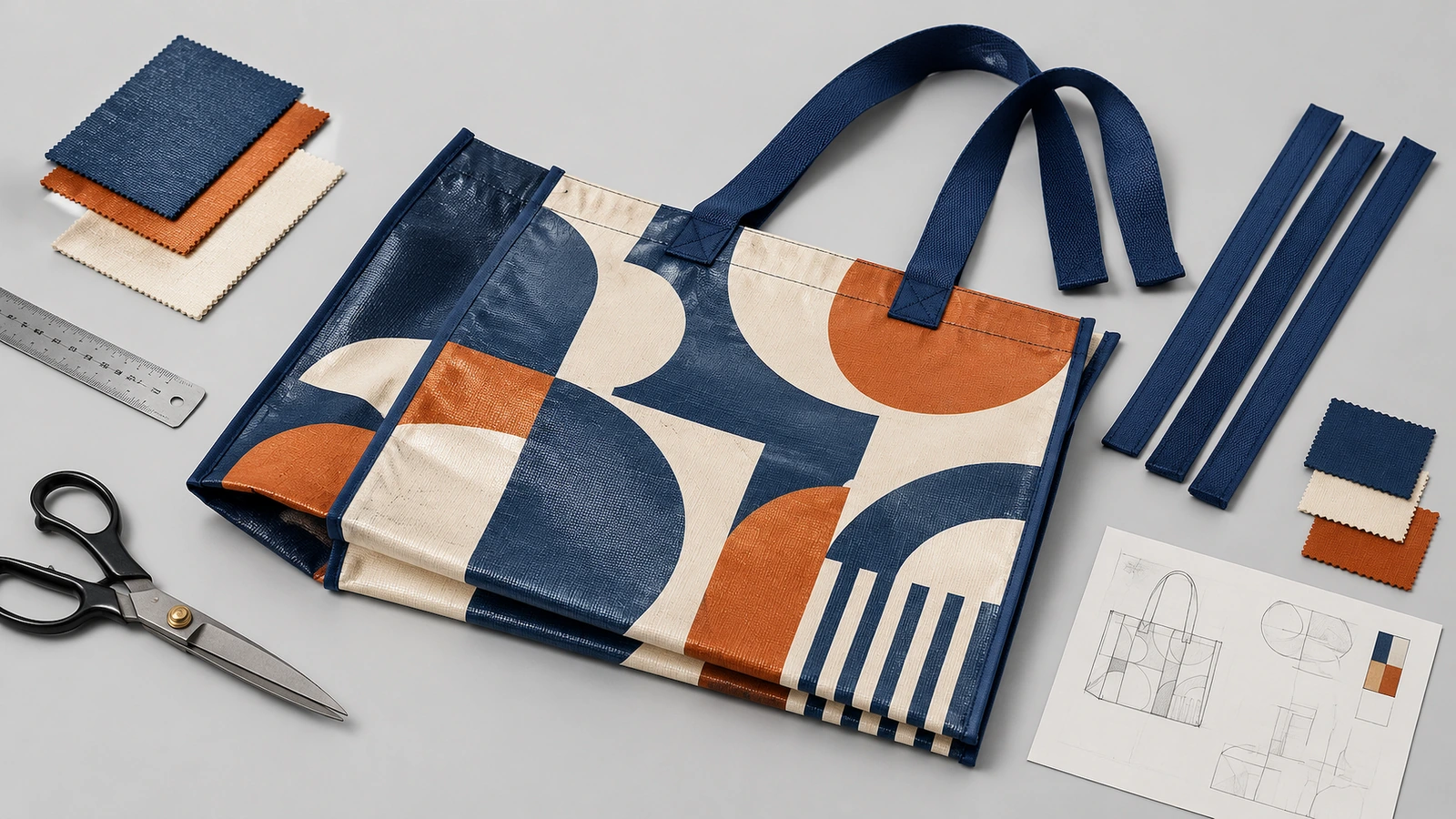
Table of Contents
What Exactly Is a Custom Laminated PP Woven Shopping Bag? ↑
Polypropylene is extruded into film, slit into tapes, stretched and woven into fabric. The fabric is usually laminated with a printed BOPP film, then cut, sewn and fitted with webbing or self-fabric handles. Two specification details catch many buyers out.
First, GSM covers only the woven fabric. The Anita Plastics glossary[7] states that GSM excludes coating or lamination, which must be specified separately. It gives this estimate: GSM ≈ (warp mesh + weft mesh) × denier / 228.6.
Second, water resistance comes from the lamination, not the weave. Uncoated woven fabric lets water through the gaps between tapes.
Lamination also determines print quality. Kete Group[8] notes that a bare woven surface is textured, so fine detail and thin fonts lose definition. A laminated surface is smooth and prints almost as well as film. The trade-off is that glossy film can look cheap under strong light, which is one reason to consider matte BOPP.
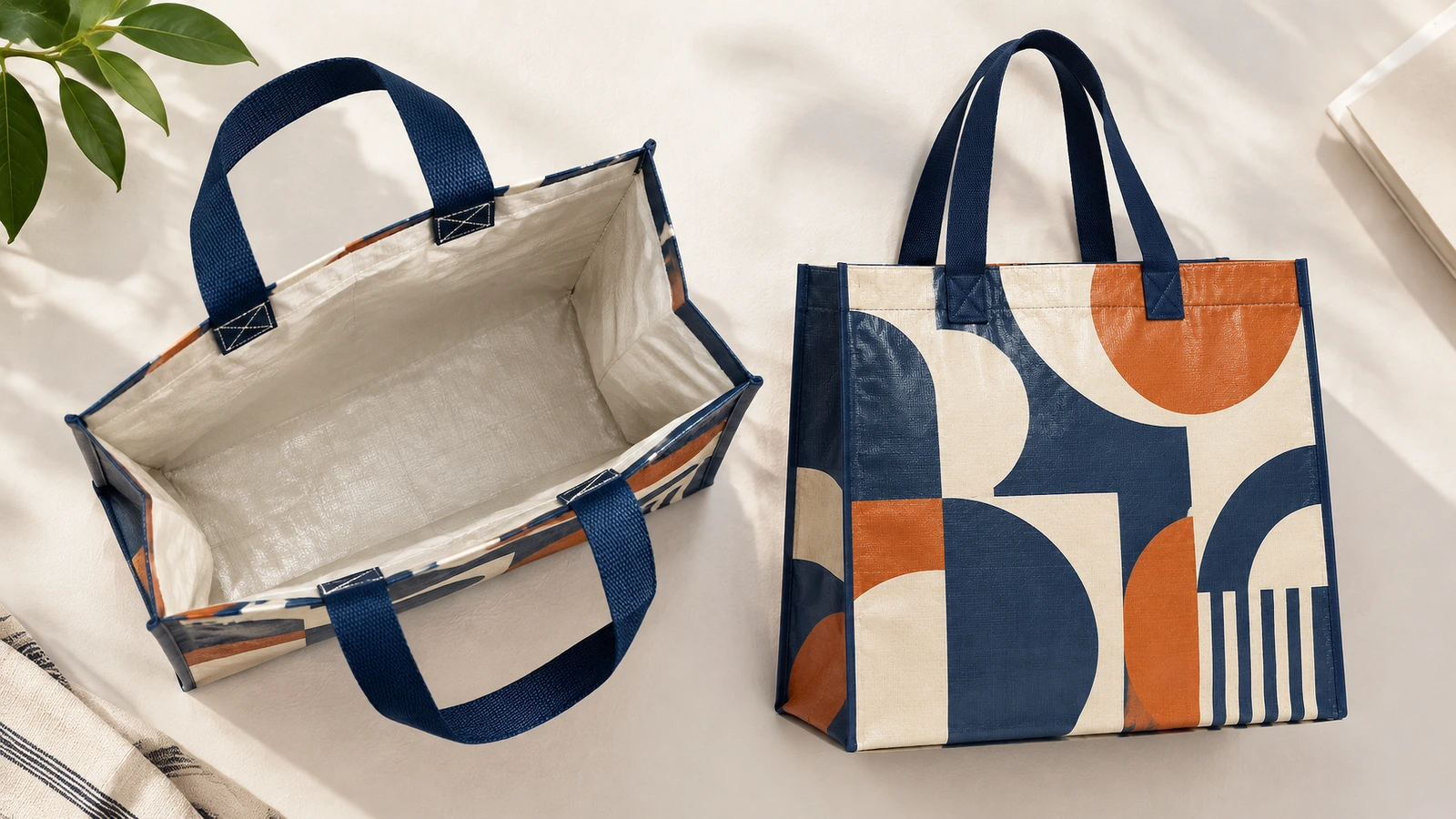
| Spec field | Published reference | Source |
|---|
| Fabric GSM | 80–100 light budget; 110–130 general retail; 140+ heavier duty | SmartBuy[9] |
| Laminated retail band | 120–160 gsm; supplier claims load capacity drops below 120 gsm | Tiiocti |
| NY procurement floor | Woven PP allowed; 80 GSM, 50% total recycled content, ≥15 L | GreenNY[10] |
| UV exposure | Unprotected PP degrades within months in direct sun | SmartBuy |
| Tensile method | ASTM D5034 or ISO 13934-1, warp and weft, with an acceptance value | SmartBuy |
| Lamination | Gloss or matte BOPP, listed separately from fabric GSM | Anita glossary |
These are published reference ranges from different sources, not test results for one product. Your bag's load capacity depends on its actual dimensions, handle construction, fill state and sample testing. State a target load and verify it on the pre-production sample instead of copying a 10 kg or 25 kg figure from a marketing page.
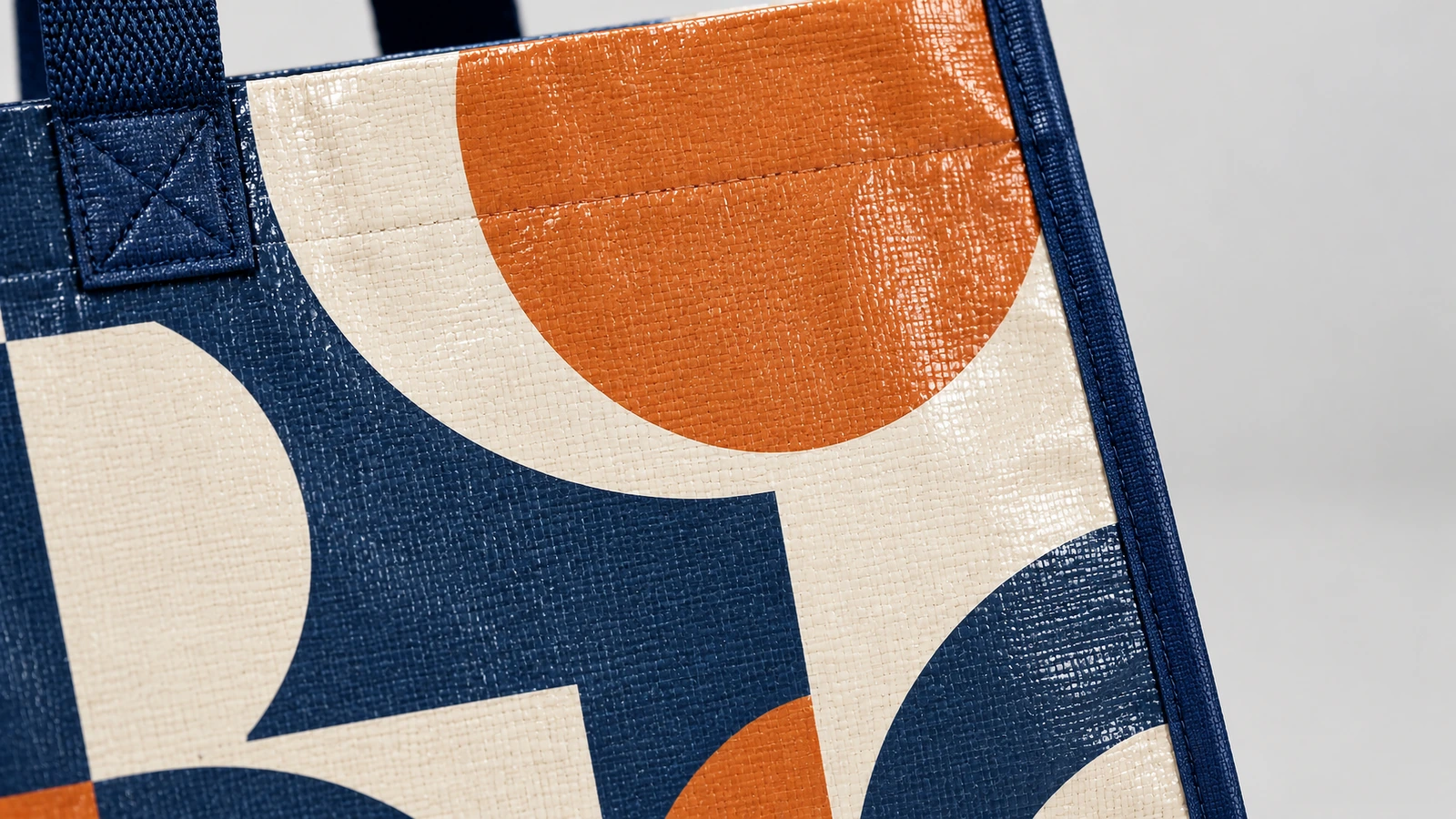
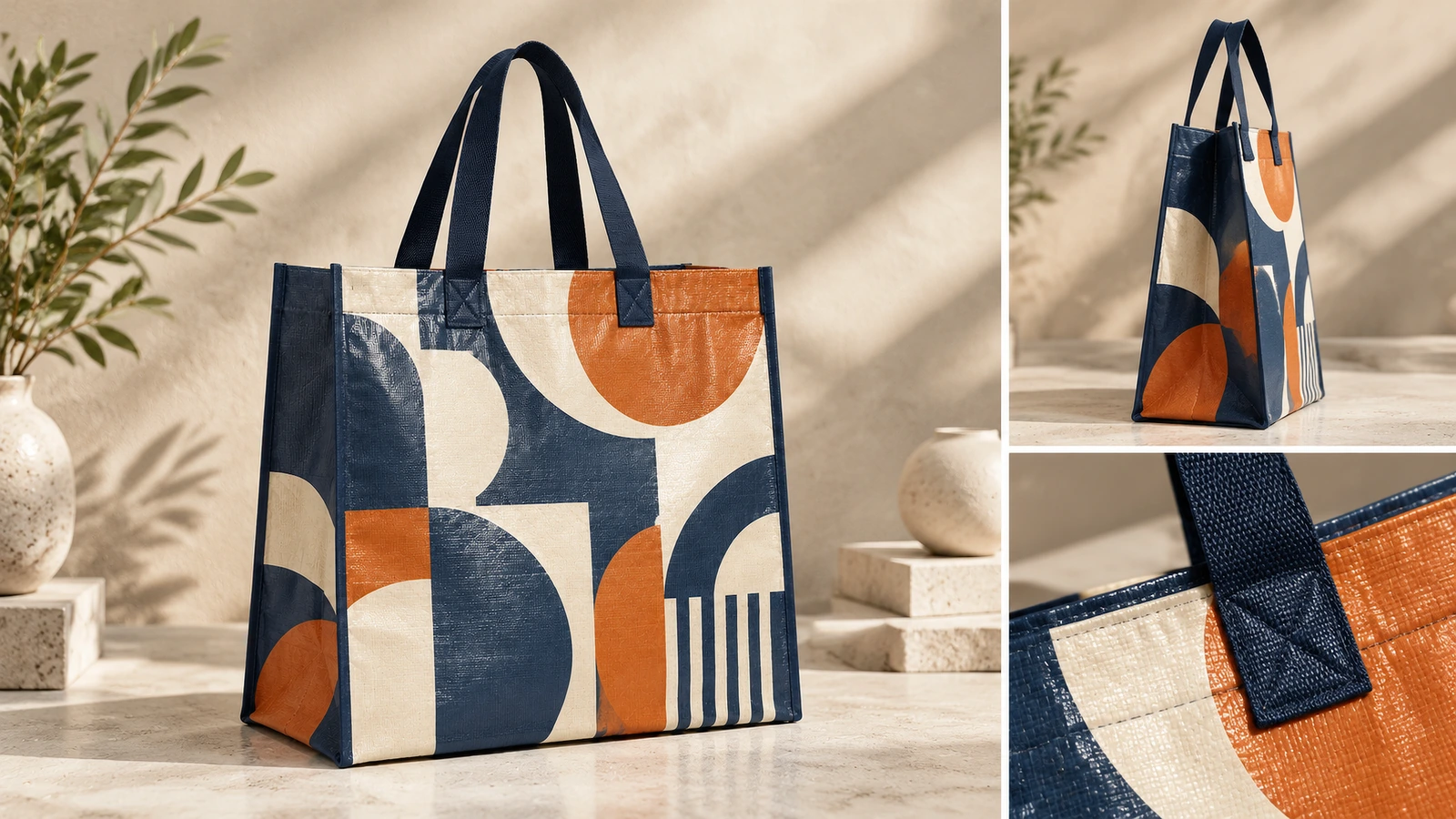
Handle and closure choices include cross-stitched webbing, self-fabric straps, rope, zippers and hook-and-loop tabs. Buyer feedback compiled by SmartBuy includes "Straps detached after three uses under normal load". For that reason, specify the attachment method, stitch density and reinforcement patch, not just "with handles".
How Do You Specify, Proof, and Order Custom PP Woven Bags Step by Step? ↑
The SmartBuy guide recommends deciding in this order: use case, size and load, fabric, handles, print method, supplier credentials, physical samples, then MOQ and lead time. It suggests allowing about 20% extra volume over the expected contents. The steps below apply that order:
- Write the use case, target load and dimensions into a tech pack before asking for prices.
- Choose fabric GSM, resin grade, lamination finish and UV treatment.
- Match the print route to artwork complexity and order quantity.
- Preflight the artwork files and color references.
- Approve a physical sample, then a pre-production sample.
- Set bulk timing, the inspection plan and Incoterms in the contract.
For step 2, virgin resin gives more consistent strength. Calcium carbonate filler lowers cost, but excess filler makes the tapes brittle, as PP Woven Bag Vietnam's import guide warns. Set a filler cap in the contract.
| Print route | Colors / detail | Typical starting quantity | Source |
|---|
| Direct flexo on woven | 2–6 colors (up to 8); logos, solid colors | About 10,000 bags | Anita[11] |
| Flexo on BOPP | 4–8 colors; cleaner brand panels | About 20,000–50,000 | Anita |
| Gravure on BOPP | 8–10 colors; photos, gradients | About 50,000–100,000 | Anita |
| Digital / trial run | Artwork validation; high unit cost | 500–2,000 | Jiuyuan[12] |
Thresholds vary by plant. Jiuyuan lists standard flexo at 5,000–10,000 bags and BOPP gravure at 10,000–50,000. Tiiocti places laminated shopping bags at 3,000–5,000 units. Use these figures as anchors when asking for quotes, not as commitments. Printing cylinders and plates are fixed costs, so every added color or artwork revision raises the unit price on small runs.
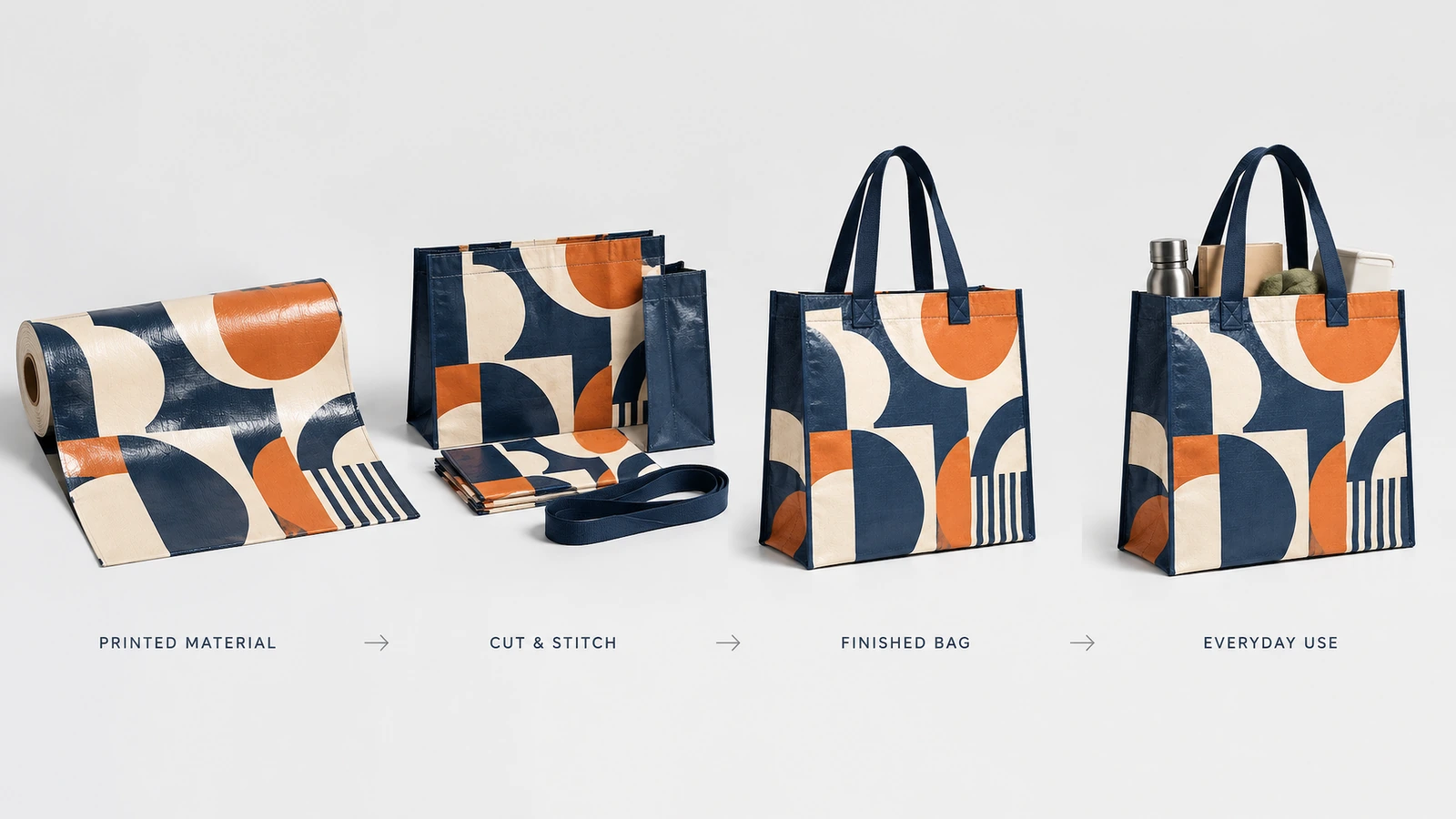
For step 4, the Anita print guide asks for vector artwork, photos at 300 DPI at final size, Pantone for flexo spot colors and CMYK for gravure. RGB files should never be supplied. Jiuyuan prefers 600 DPI images and PDF, EPS or AI files with outlined fonts. Gravure film is printed before it is laminated to the fabric, so changing one spot color usually means remaking a cylinder. Check mandatory text, such as origin, maker and recycled-content claims, before the cylinders are engraved.
For step 5, Gentle Packing[13] publishes about 5–7 days for samples and 15–30 days for bulk after sample approval. LantaoBags[14] stresses that a sales sample is not a production release; bulk should follow a pre-production sample made on production tooling.
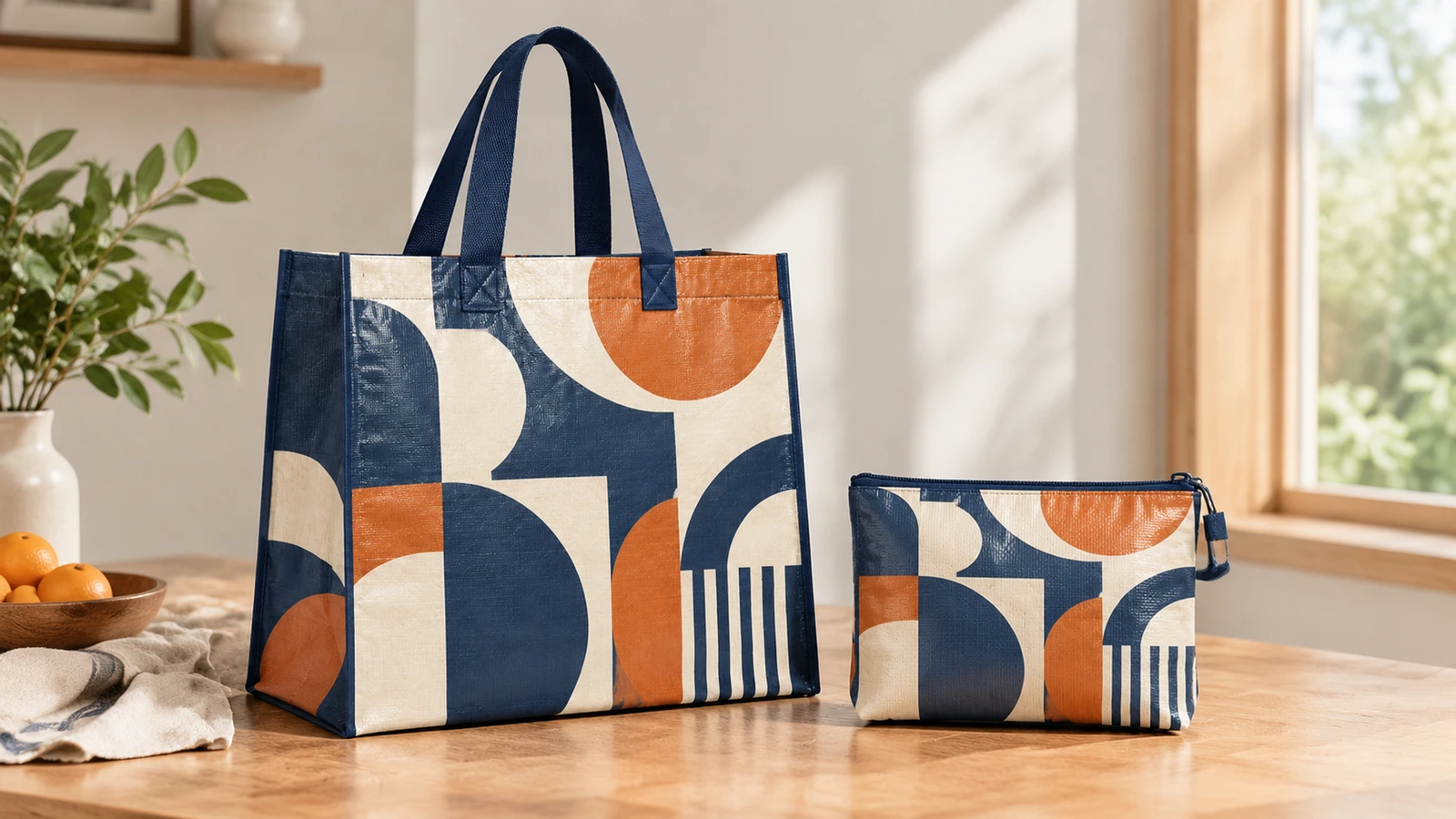
Production runs through extrusion and tape drawing, weaving, lamination, printing, cutting and sewing, then inspection. Jiuyuan quotes 15–25 days after artwork approval for standard orders and 30–40 days for multi-color laminated orders. Neither figure includes ocean freight. A US distributor, Bulletin Bag[15], quotes about 60–90 days from proof approval for a 145 g laminated woven bag, plus extra time around Chinese New Year. Your own MOQ and production time are confirmed in the quotation after sampling.
Laminated Woven, Light Woven, Non-Woven, or Industrial Sack: Which Fits Your Program? ↑
According to Anita Plastics[16], woven tape fabric at a comparable weight usually has higher tensile strength along the warp and weft. Spunbond non-woven fabric spreads strength more evenly, but load passes through its bond points.
| Option | Construction | Best fit | Main caveat |
|---|
| Laminated printed PP woven | Woven tapes + BOPP, flexo or gravure | Grocery chains, heavy retail, branded bag-for-life | Higher setup and MOQ; composite is harder to recycle |
| Light PP woven, 1–2 colors | Low-GSM woven, screen print | Budget giveaways that need more strength than non-woven | Weaker brand impact; puncture risk at low GSM |
| PP non-woven (spunbond) | Thermally bonded fibers | Events, apparel, cosmetics, short runs | Lower durability under sustained heavy loads |
| Industrial PP woven sack | Heavy fabric, liners, sewn or valve bottoms | Rice, feed, building materials | Not a shopping bag; different standards apply |
Haplast[17] recommends non-woven for fashion, beauty and trade shows, and woven for heavy supermarket loads.
On price, Tiiocti lists laminated woven bags at about USD 0.35–0.50 each for 3,000 units. Los Angeles supplier Blue Nile Bags[18] lists a large woven tote at USD 3.10 for 2,000 units, falling to USD 2.45 for 10,000. These prices cover different scopes, such as FOB versus a domestic service interface, so compare them only after landed cost is calculated.
Do not borrow industrial specifications either. ISO 23560:2015[19] covers only 25 kg and 50 kg woven sacks for foodstuffs.
What Should Your Compliance, Inspection, and Reorder Checklist Cover? ↑
| Topic | Requirement | Buyer action | Source |
|---|
| California checkout (from 2026-01-01) | Regulated stores may provide only recycled paper bags at checkout, minimum $0.10 | Position woven bags as giveaways or customer-owned bags | CalRecycle[20] |
| California PRC §42281 (pre-2026) | Sewn; 22 lb × 175 ft × 125 uses; ≥80 g/m² | Cite only as a historical benchmark | Justia[21] |
| New York GreenNY (approved 2025-12-11) | 80 GSM, 50% total recycled content, no PVC, no Prop 65 warning | Match these requirements for public tenders | GreenNY |
| Food contact | 21 CFR 177.1520 covers olefin resins; FDA does not approve finished bags | Request a declaration of compliance | Cornell LII[22] |
| Imports from China | AD/CVD orders on laminated woven sacks continued after the 2025-02-06 USITC vote | Check HTS classification and order scope before shipping | USITC[23] |
Two wording rules follow from these requirements. Do not describe bags as "CalRecycle certified", because the SB 270 program has ended. Do not claim an "FDA approved bag". ASTM D5034-21(2025)[24] is a fabric test method, not a certification mark. Name it in the contract with the test condition, direction and acceptance value. Whether a laminated bag counts as covered under the anti-dumping orders depends on the order scope, not on the "shopping bag" product name.
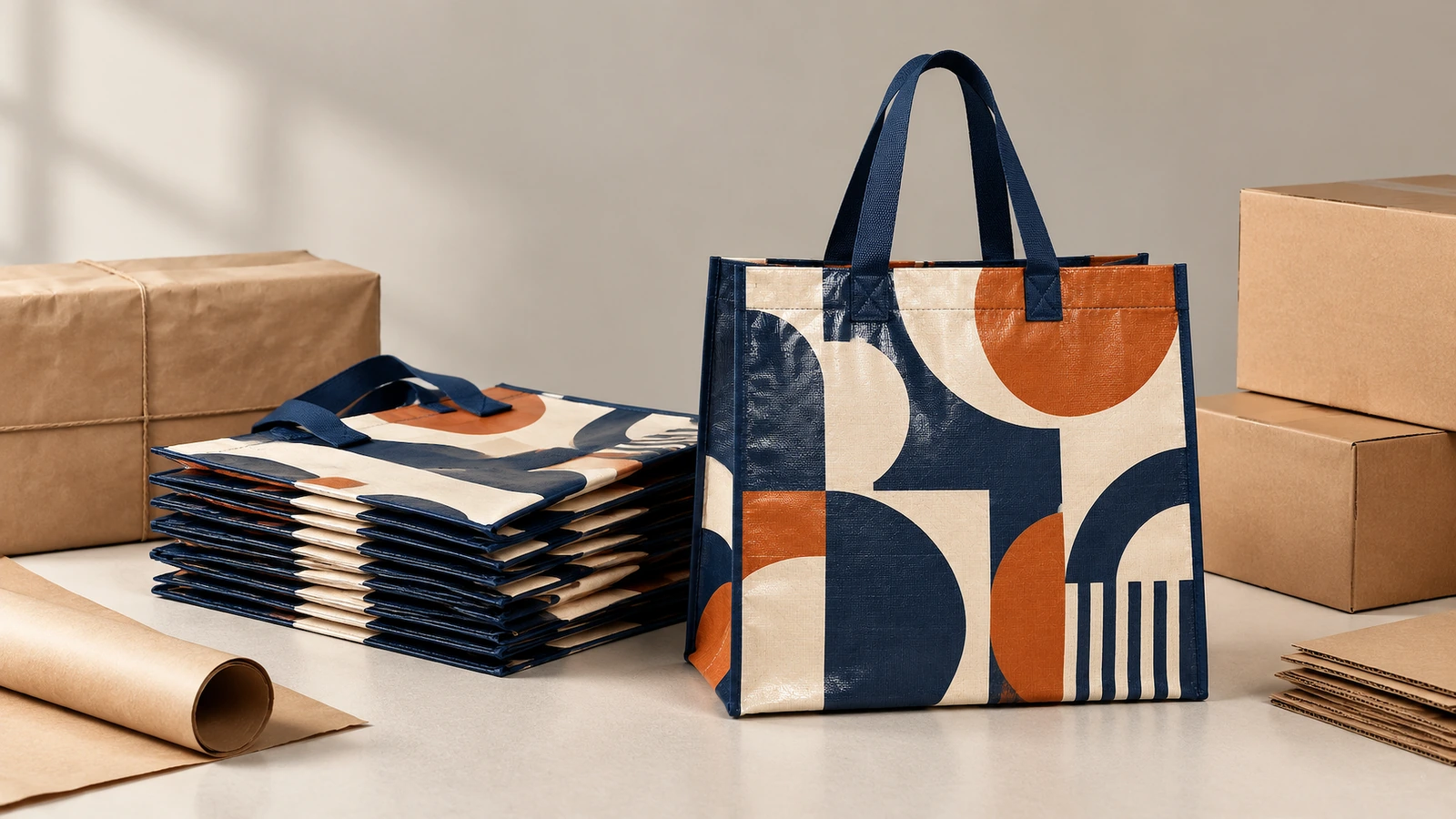
Build the bulk inspection around these checks:
- Weigh the fabric against the contracted GSM and tolerance.
- Pull-test seams; Kete suggests stitching trials at 1.5× the target load.
- Lift-test handles dynamically, not just static hanging.
- Rub and fold the laminate at folds and seams to check for peeling.
- Compare logo position and color against the signed swatch.
- Open cartons and check for odor.
On odor, Yuehaisaier[25] traces smells to low-grade resin and cheap laminating adhesive. The SmartBuy guide reports complaints of logos "off-center on nearly half the bags" and recommends AQL 2.5 or stricter for outgoing inspection.
Shipping disputes tend to involve quantities and moisture. BBB complaints[26] against a custom tote maker include receiving 108 bags against an order of 240, and moldy deliveries. That maker does not specialize in PP woven bags, but the contract lessons transfer. Set short-shipment, damage and mold claim windows, and protect cartons against moisture before ocean freight.
For reorders, keep the signed sample, color references, first-article records and inspection reports. Reuse the existing cylinders, and re-verify GSM on every repeat order, because cheaper material can be swapped in after the first order.
Key Takeaways ↑
- Retail and grocery drive most demand for PP woven reusable bags — about 59.72% of a USD 1.65 billion market in 2025 (Source)
- Photographic gravure print requires large runs — about 50,000–100,000 bags on BOPP; direct flexo starts at about 10,000 (Source)
- GSM shortfalls are a documented bulk risk — one import contract specified 60 gsm and received 55–57 gsm (Source)
- California checkouts no longer provide plastic carryout bags — since 2026-01-01, only recycled paper bags at a minimum of $0.10 (Source)
- New York public tenders accept woven PP above a minimum spec — 80 GSM and 50% total recycled content (Source)
- Published production times exclude freight — 15–30 days after sample approval in one supplier's public range (Source)
Ready to Turn Your Artwork Into a Tested Bag Specification? ↑
A reliable woven bag program depends on fixing GSM, handle construction, print route and inspection methods in writing before the cylinders are engraved. MOQ, production time, unit weight and load performance should be confirmed through quotation and sample testing, not assumed from marketing claims. Send your artwork, target load, dimensions and quantity to request a quotation and pre-production sample plan.




The information below is required for social login
Sign In
Create New Account