Custom ceramic mugs are stoneware or porcelain coffee mugs decorated with your logo or artwork. The common decoration methods are screen printing, sublimation, kiln-fired decals and glaze engraving. The decoration method decides dishwasher durability, microwave suitability, minimum order and lead time, and the word "ceramic" tells you none of that. Choose the method first and the mug shape second.
Most people searching for this product are buying for someone else. HR and people-ops teams need onboarding kits. Marketing managers need client-appreciation and trade-show gifts. Café, hotel and visitor-center buyers need mugs that survive daily service and still sell at the counter. The Promotion Choice buyer's guide[1] recommends standard ceramic mugs for office welcome kits. For executive or donor gifts, it recommends larger mugs with more restrained branding. That split is a practical first step when you scope an order.
The category is large enough to justify a real procurement process. PPAI estimated U.S. promotional distributor sales at $26.8 billion in 2024. Drinkware made up 10.2% of that, second only to apparel (PPAI sales estimate[2]). A 2026 PPAI study of more than 3,400 U.S. consumers found that nearly 90% keep branded merchandise, and 55% named everyday usefulness as the main reason (PPAI retention study[3]). A mug only earns that retention if both the logo and the body survive daily use.
The problem: many branded mugs are sold as "dishwasher safe," yet the decoration fails long before the ceramic does. One end client quoted by Promotional Mugs[4] reported logos chipping off after the first wash in a standard home dishwasher. Within about a year, their first batch had turned plain white. The same source explains why: ceramic inks fired at roughly 700°C or higher fuse into the glaze, while organic surface inks sit on top and wear off.
Why it hurts: buyers are also squeezed on time and risk. In October 2025 PPAI research, 68.8% of PPAI 100 distributors said end buyers prioritize faster turnaround, and 60.4% reported price pressure (PPAI distributor research[5]). Durable handmade stoneware does not move at that speed. Deneen Pottery[6] lists 8–9 weeks from order approval, plus 1–2 weeks for new art. Cheap and fast mugs can also fail in public. The CPSC recalled about 34,000 promotional mugs handed out as conference giveaways because they could crack when filled with hot liquids (CPSC recall[7]). In March 2025, a California Proposition 65 notice targeted ceramic mugs with exterior designs over lead exposure (Prop 65 notice[8]).
The solution: treat the order as a specification, not a catalog click. This page covers four steps: choosing a decoration method, planning the timeline backward from your event date, requesting the right test reports, and putting QC and packaging terms in writing. No factory test data is published here. Your project's MOQ, lead time and test results are confirmed at quotation and sampling, not assumed in advance.
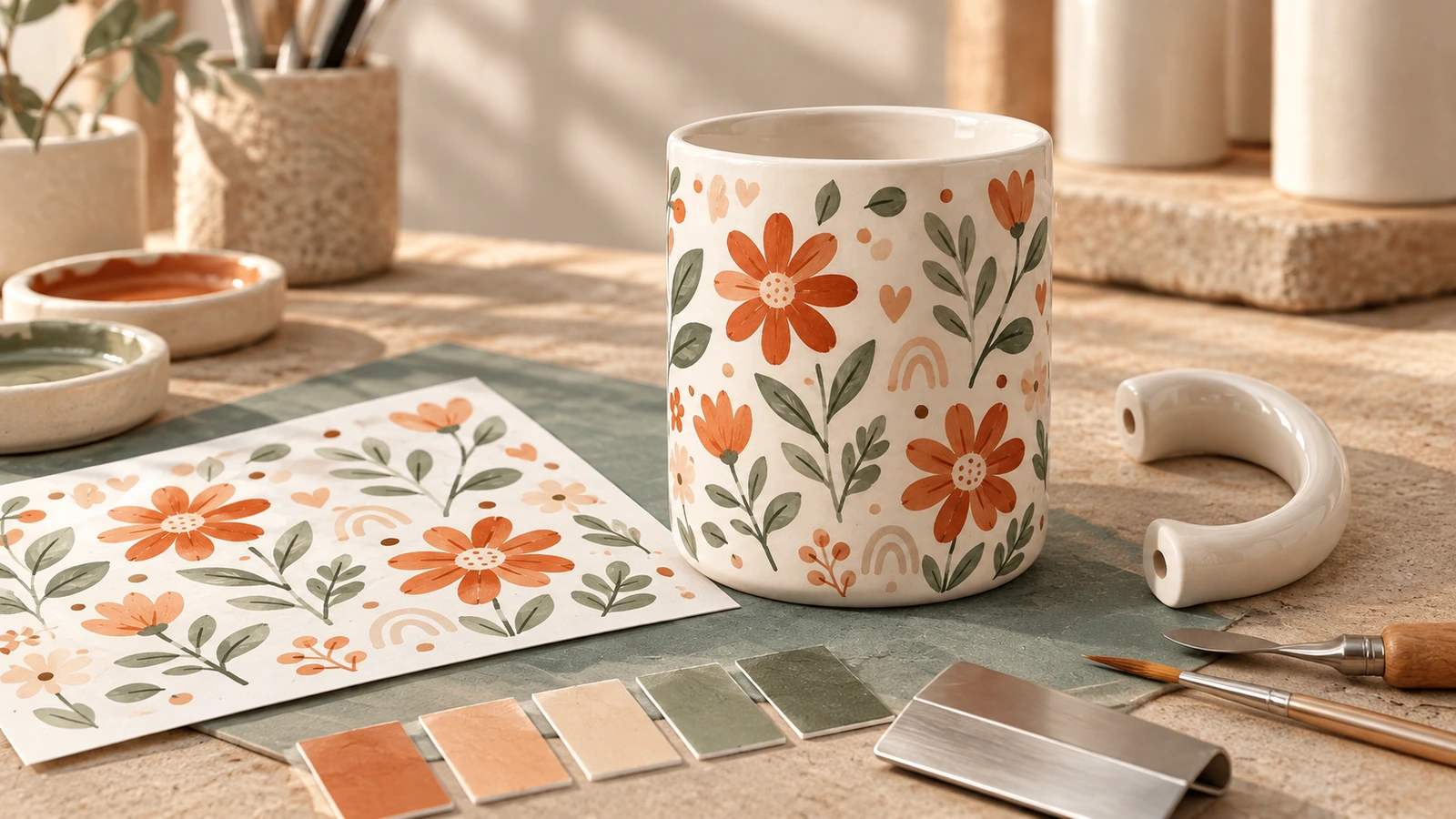
Table of Contents
What are custom ceramic mugs, and which decoration fits your program? ↑
The mug body is usually high-fired stoneware or porcelain. According to the Sunset Hill Stoneware FAQ[9], stoneware fired at 2,000–2,370°F can go in the microwave, dishwasher or oven without shattering. That claim covers the plain body only. The decoration layer is where products differ.
| Method | Best fit | Durability boundary | Watch-out |
|---|
| Kiln-fired decal | Corporate logos in 1–3 solid colors | Fused into the glaze at about 800°C (CURVD[10]) | Setup costs make very small runs uneconomic |
| Screen print | Budget-volume solid logos | Surface ink; some promo SKUs are listed as hand wash only (Bagmasters[11]) | Fine lines and gradients lose detail |
| Sublimation | Photos, gradients, single-unit runs | Dye bonds into a polymer coating; suppliers' durability claims vary | Get written dishwasher and microwave terms for that exact coating |
| Glaze engraving or medallion | Retail, hospitality, collectible programs | Design is formed in the clay or glaze, not printed on top | Lead times run to weeks; glaze color cannot be matched to Pantone |
Read this table as a map of trade-offs, not a ranking. Suppliers disagree about sublimation. Some call it fully dishwasher safe. Others say the coating can fade and was not designed for microwaving. The only reliable answer is the supplier's written statement for the exact blank and coating you are buying. For desk gifts meant to last for years, a kiln-fired decal or an engraved glaze is the safer default. For event photo mugs, sublimation is usually acceptable if each recipient gets a care card.
Size, handle, and imprint readability
The buyer's guide[1] pairs 10–12 oz mugs with onboarding kits and 14–16 oz mugs with executive gifts. Treat those sizes as starting points, not specifications. Three things must be verified on a pre-production sample: actual capacity, which depends on how full you consider "full"; the usable imprint area; and whether the mug fits a brewer or dishwasher rack. Amazon reviews of stock mugs repeat the same complaints, such as handles too small for large hands and bodies heavier than expected, so hold the sample before you approve. For artwork, Discount Mugs[12] advises keeping logos simple and bold, because fine details and thin lines blur at small imprint sizes.
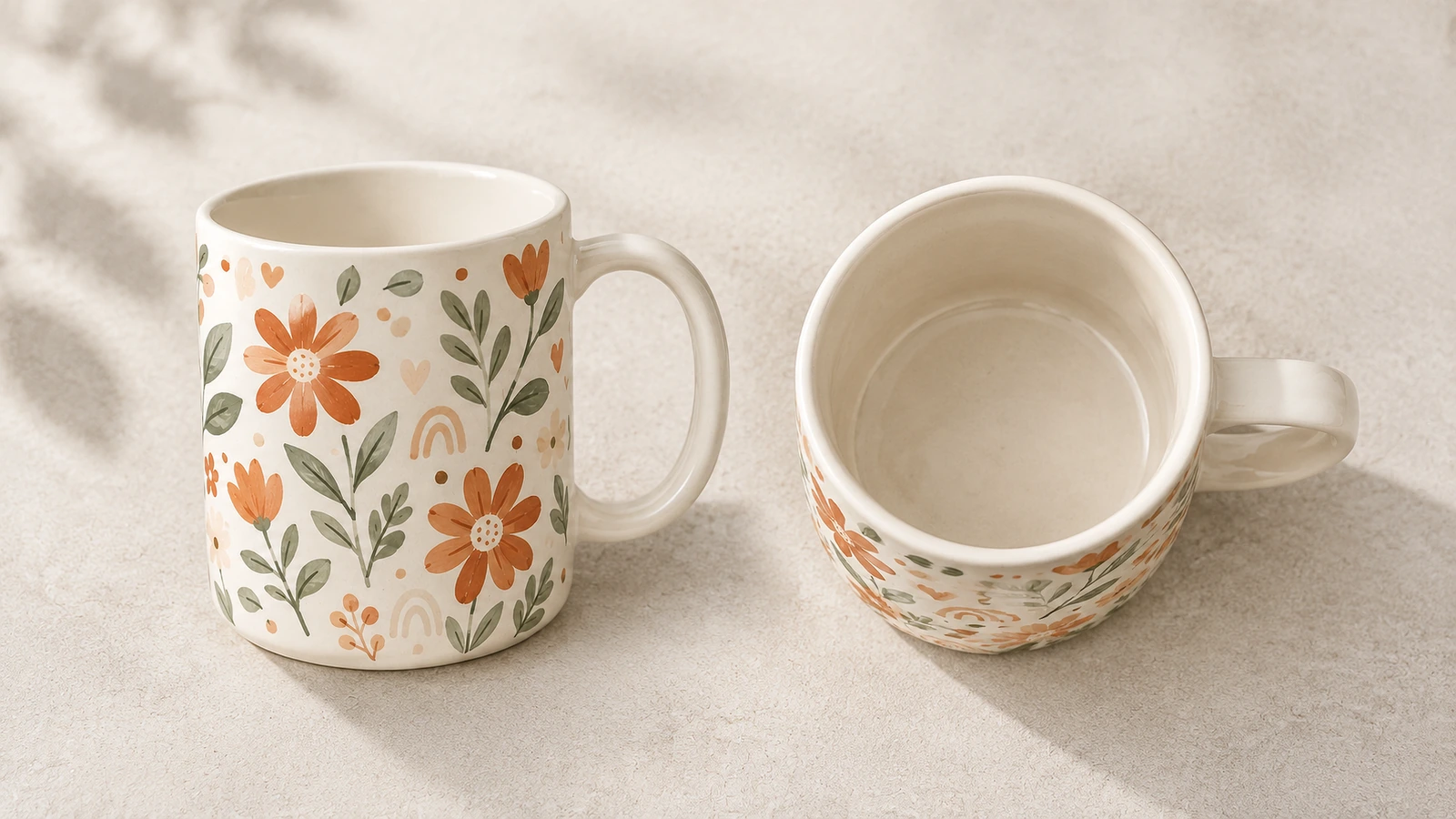
Glaze surface and back-stamp options
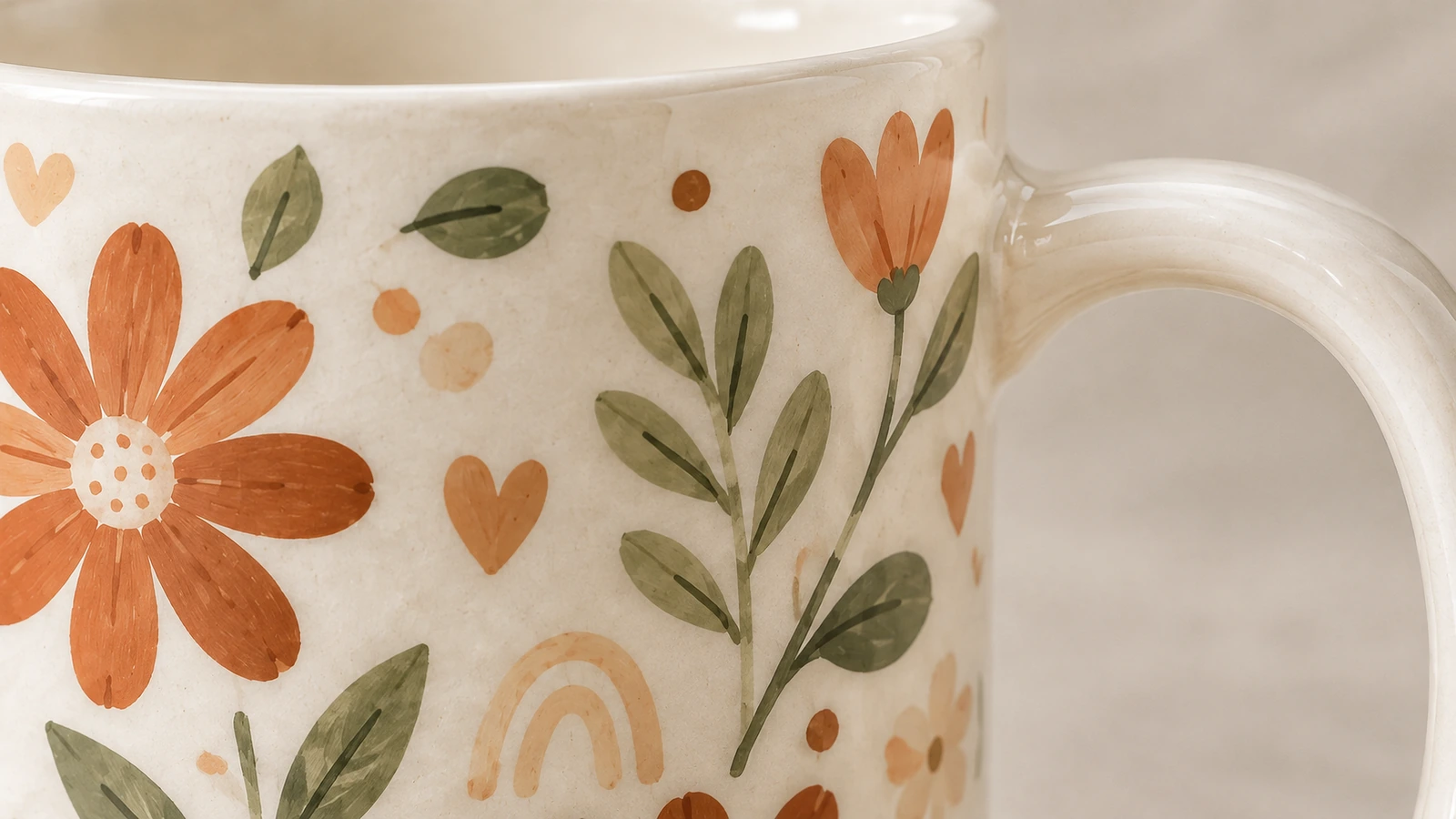
Glossy, matte, speckled and reactive glazes each change how a logo reads and how it photographs. Handmade glaze colors also shift from one firing to the next. Deneen explains[6] that glazes get their color from molecular changes in the kiln and can be unpredictable. Approve color against a fired sample, never against a screen. The base of the mug also carries compliance obligations. Under 21 CFR 109.16[13], decorative ceramics that look like they could hold food need two things: a conspicuous sticker with letters at least 3.2 mm tall, and a permanent statement on the base such as "Not for Food Use. May Poison Food." On food-use mugs, any "microwave safe" stamp must be accurate. The CPSC recalled[14] about 26,400 mugs whose base said "microwave safe" even though their metallic print could spark in a microwave.
How do you order without missing your in-hands date? ↑
Plan backward from the date the mugs must be in your hands. SourcingXpro[15] calculates the latest start date by subtracting each stage from the in-hands date: approval, sampling, production, QC and rework, consolidation, international freight and customs, and a local delivery buffer. It suggests allowing 8–12 weeks for standard promotional items and 12–20 weeks or more for custom colors, custom packaging or ocean freight.
- Qualify the order. State quantity, in-hands date, decoration method and destination market before asking for a quote. A 48-piece gift pilot and a 1,000-piece new-shape program follow different supply paths.
- Send vector artwork. Supply .ai, .eps or .pdf files with Pantone references and the imprint locations you want.
- Approve a written proof. Production should not start without written sign-off. CURVD, for example, includes a digital proof with every order[10].
- Approve a fired sample when color or test reports matter. Glaze color, decal density and handle fit can only be judged on a fired mug.
- Lock QC and shipping terms. Agree on over-run and under-run tolerance, breakage claims and carton protection before you pay.
- Plan the reorder. Keep approved art and specifications on file so repeat orders skip the new-art window.
Most proof delays come from artwork problems that a simple preflight check would catch. Convert fonts to outlines. Remove lines thinner than the decorator's minimum line weight. Supply photos at the resolution the decorator specifies. Check the full wrap view so that left-side and right-side images are not swapped, which is a recurring complaint in photo-mug reviews.
Production time depends on the decoration route. CURVD quotes 4–6 weeks for kiln-decal orders, depending on quantity, artwork complexity and number of colors[10]. Handmade stoneware takes longer because each mug must be thrown, dried and fired more than once. Each of these stages is a separate checkpoint where the order can slip.
Which supply path fits your quantity, budget, and timeline? ↑
Suppliers' published terms fall into three distinct groups: promotional printers, U.S. potteries and overseas OEM factories. The figures below come from each supplier's public page at the time of research and change with the season. They are benchmarks for comparison, not our quote.
| Path (example) | Published MOQ | Price / fees | Timing | Trade-off |
|---|
| Promo print, Crestline 11 oz[16] | 144 | From $1.78; about $63 setup | 8 working days, excluding art and shipping | Hand washing recommended to protect the imprint |
| Promo screen print, Bagmasters 14 oz[11] | 72 | $3.38 at 72 pieces; $50 setup | 10 days | Hand wash only |
| USA existing shapes, HF Coors[17] | 48 standard; 72 custom color; 144 custom shape | By quote | 4–6 weeks from design approval | Made in Tucson; claims lead- and cadmium-free |
| USA handmade, Sunset Hill timing[18] / pricing[19] | 24; orders under 24 add $150 | $30 down to $13.50 per mug by volume | 6–12 weeks recently | Handmade tolerance in size and appearance |
| USA handmade, Deneen[6] | 96 for new orders | Suggested retail $19.95–$29.95; rush +25% | 8–9 weeks, plus 1–2 for new art | Glaze color cannot be matched exactly |
| China new-mold OEM, GC Porcelain[20] | 1,000+ | Mold $300–$2,000 per shape | 60–120 days | Mold, glaze and packaging are developed in parallel |
The table shows why no single supplier can honestly promise "48 pieces in two weeks" and "fully handmade" at the same time. Promotional printers win on unit price and speed, but the imprint has a shorter life. Handmade workshops win on weight, feel and retail value, but they need weeks of lead time. New-mold OEM only pays off at four-figure volumes. Existing-shape U.S. production sits in the middle and suits buyers who need 48–144 pieces in a custom color.
Ask every supplier to itemize per-color setup fees, small-batch surcharges, sample freight, inner boxes, breakage allowance and freight mode. Rush service also costs extra. Deneen charges a 25% expedite fee[6]. Sunset Hill's FAQ[9] describes priority scheduling at about 35% of total cost, and even that can take eight weeks or more.
How should you verify food-contact safety before you pay? ↑
In the U.S., cups and mugs fall under FDA's strictest lead category for ceramics. Under FDA CPG Sec. 545.450[21], FDA can consider enforcement if any one of six sample mugs leaches more than 0.5 µg/mL of lead. For comparison, the limit for flatware is a 3.0 µg/mL average. Accepted test methods include ASTM C738.
| Requirement | Limit / scope | Source |
|---|
| FDA lead, cups and mugs | 0.5 µg/mL, any one of 6 units; ASTM C738 interior test | FDA CPG 545.450[21] |
| California Prop 65, cup interior | Lead 0.1 mg/L; cadmium 0.189 mg/L | NTH lab summary[22] |
| Lip and rim | Separate test under ASTM C927 | NTH lab summary[22] |
| FDA cadmium, cups and mugs | 0.5 mg/L (CPG 545.400) | NTH lab summary[22] |
| Netherlands, fillable articles (in force 2026-05-29) | Lead 30 µg/L; cadmium 20 µg/L | Intertek bulletin[23] |
These are regulatory thresholds, not test results for any product on this page. Ask for a third-party leaching report on the exact combination of body, glaze and decal used in your batch. The report should cover the interior, the rim and the exterior decoration colors. Pay particular attention to reds, oranges and yellows, which are the most common sources of cadmium.
Be skeptical of marketing language. FDA guidance[24] says that a "Lead Free" label on ceramicware that contains extractable lead may be considered false and misleading. A 2025 migration study[25] found that lead and cadmium migrated from mug exteriors at much higher levels than from interiors, especially from red rim decoration. A 2024 lab study[26] tested eight mugs marketed as lead-free and found lead and cadmium in every one. For these reasons, we do not use "lead-free" or "FDA certified" claims unless a report covers the specific decoration.
Dishwasher and microwave claims need the same discipline. CURVD's care guide[27] recommends normal home cycles of about 120–140°F for printed mugs and advises against sanitize cycles, which reach 155–170°F. Commercial dishwashers in cafés and hotels are harsher than home machines, so state "commercial dishwasher" in your specification if that is where the mugs will be washed. Any gold, platinum or other metallic decoration should be labeled not microwave safe. As the recall above showed, metallic print can spark in a microwave[14].
What quality checks and packaging terms protect the unboxing? ↑
Inspection should check for the failures that show up in public recalls and reviews. Run thermal-shock spot checks with boiling water before a whole lot is decorated, since the conference-giveaway recall involved mugs cracking under hot liquids[7]. Wash-test the actual decorated mug, not a blank, on the cycle recipients will use. Compare fired color with the approved sample in daylight, and check imprint position, wrap alignment, chips and glaze defects. The cycle count, sample size and pass criteria for your order are set in the test plan at quotation. None of them are pre-certified on this page.
Write the quantity tolerance into the contract. Deneen's FAQ[6] states that it will not remake mugs if the shortfall is under 10% of the order, because that falls within its under-run terms, and it invoices only for the mugs actually shipped. If you need exactly 200 mugs for 200 guests, order enough extra to cover the supplier's tolerance.
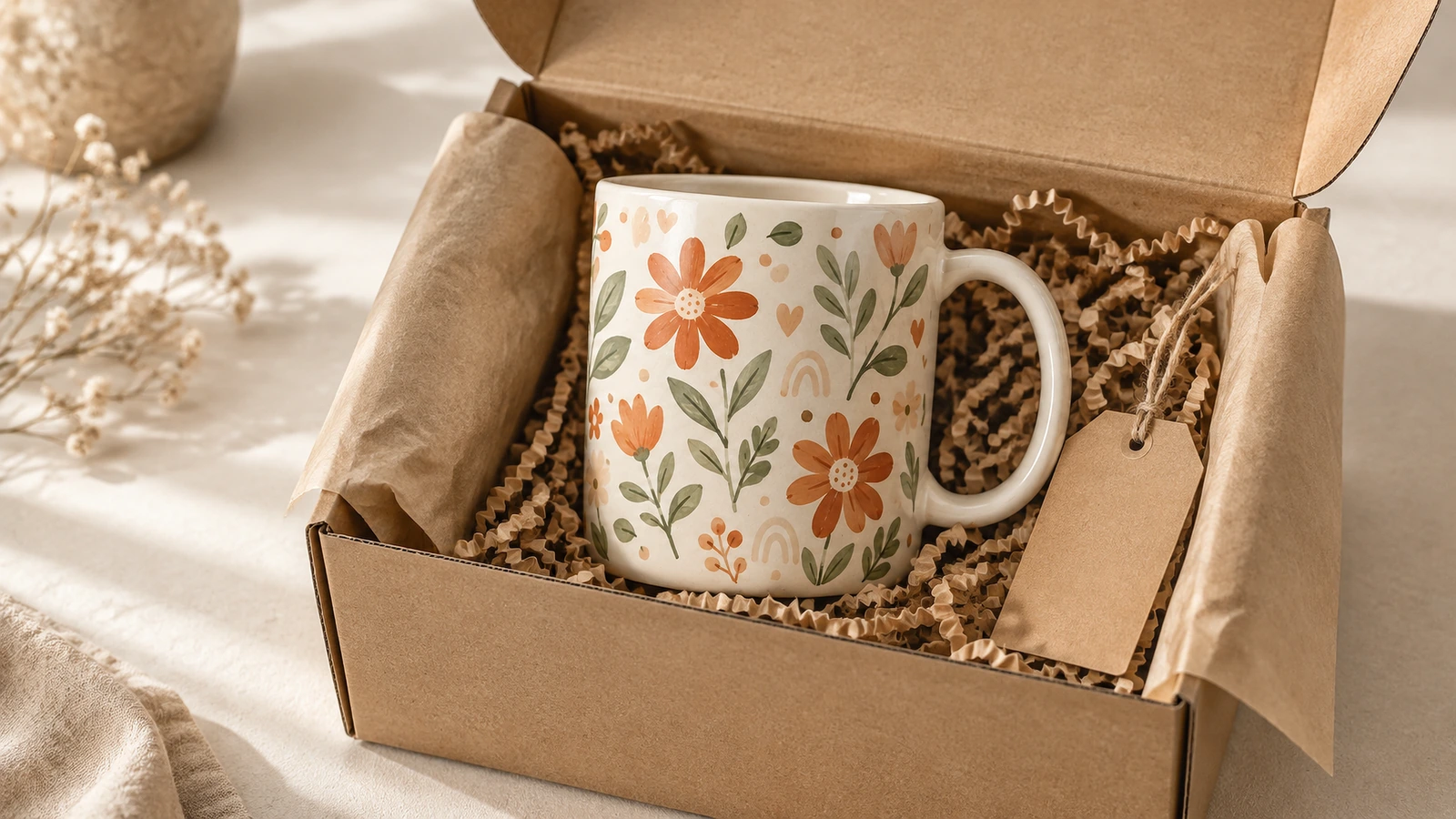
Packaging is where the gift experience most often falls apart. One buyer review[28] of a custom 11 oz mug described mugs shipped individually in foam cubes left open at one end, with dirt inside. Another reviewer's mug arrived chipped. Specify inner protection, carton strength and drop-test expectations, and agree on a breakage-claim process with photo requirements. Deneen notes that its gift boxes are for display only and need extra protection for shipping[6]. For reorders, keep the approved proof, glaze code and packaging specification together so the repeat order can go straight to production.
Key takeaways for procurement teams ↑
- Drinkware is a core promotional category. — 10.2% of $26.8 billion in 2024 U.S. distributor sales (Source)
- Usefulness drives retention. — Nearly 90% keep branded merchandise; 55% cite everyday usefulness (Source)
- Buyers are pushing for speed. — 68.8% of PPAI 100 distributors report end buyers prioritize faster turnaround (Source)
- Mugs face FDA's strictest ceramic lead limit. — 0.5 µg/mL for any one of six units (Source)
- California adds a stricter layer. — Cup interior: lead 0.1 mg/L, cadmium 0.189 mg/L (Source)
- Handmade kiln paths need more runway. — 8–9 weeks after approval, plus 1–2 weeks for new art (Source)
Ready to scope your mug program? ↑
The right custom ceramic mugs for your program come from three decisions made in order. First, choose a decoration method that matches how the mugs will be washed and used. Second, plan the timeline backward from your in-hands date. Third, require a leaching report that covers the actual decoration. Our quotes put the MOQ, sampling plan, test scope and packaging specification in writing, and each is confirmed at sampling rather than promised up front. Send your quantity, in-hands date, vector artwork and destination market to request a project quote.




The information below is required for social login
Sign In
Create New Account