Custom stainless steel tumblers are double-wall vacuum cups. The liner that touches the drink should be 304 (18/8) or 316 steel, and the brand mark goes on the outer wall by laser engraving, UV print, screen print or sublimation. To order safely, put four things in the purchase order: the steel grade, the lid type, the decoration method and the proof freeze point. Then leak-test and heat-test a physical sample before bulk production starts.
Who Orders Branded Vacuum Tumblers, and What Are They Really Buying? ↑
Three groups place most of these orders. Corporate buyers in HR, marketing and event planning want onboarding-kit items, client thank-you gifts, trade-show giveaways and anniversary awards that people will actually carry. Event hosts, such as couples ordering bridesmaid and groomsmen gifts, need small batches with individual names and a hard delivery date. Small resellers and market-stall engravers need blank cups, low or no minimums and sometimes drop shipping. Their budgets differ, but the purchase logic is the same: a cup used every day keeps a logo or a name in front of someone for years.
Industry data supports that logic. In the ASI 2026 Ad Impressions Study[1], more than 87% of end users said they keep branded drinkware because it is useful. More than three-quarters use it at least weekly and keep it for at least a year. ASI estimates about 1,300 lifetime brand impressions per item, and drinkware accounts for just over 10% of annual promotional product sales. At ASI Show Chicago 2026[2], 41% of end users named drinkware as the promotional item they would be most excited to receive. The flip side is that usefulness is the entire value. A tumbler that leaks into a laptop bag or sheds its logo turns those impressions negative.
Why Do Branded Tumblers Go Wrong After the Order Is Paid? ↑
Buyer complaints cluster in three places: the decoration, the lid and the timeline. On decoration, one buyer described in a Tervis review on SmartCustomer[3] how the printing peeled within three months even though the cup was only hand washed. Returning it cost $23 in postage, and the claim was rejected as improper care. Another reviewer on the same site received a layout email, asked to move a monogram, and was told the cup was already printing. A preview only works as a proof if production waits for your signature.
On timing, an organizer on r/Alibaba[4] ordered 80 custom tumblers on January 22 for an April 3 event. The supplier repeatedly said production was nearly finished, but the factory had not started. A sample video finally arrived on March 11, and the customization was wrong.
Some problems stay hidden until after delivery. A supplier review of low-price wholesale traps[5] describes several. 201 steel gets substituted for 304 or 316. Vacuum seals pass a quick factory check and then fail weeks later. Defect rates rise from a target below 1% to 5–10% when QC is skipped.
Lids are the everyday weak point. In a 40-review sample for a mass-market 30 oz tumbler on Amazon, loose gaskets and broken sip shutters drew more complaints than the steel body did. One reviewer found the ice melted after five hours in a 71°F room, despite the cup's 24-hour claim.
A better adjective on the product page will not fix any of this. What fixes it is four written decisions before payment:
1. The steel grade of every food-contact part.
2. The lid type and how it is labeled.
3. The decoration method, and whether dishwasher use is covered.
4. The exact point after which the artwork is frozen.
Then test a physical sample against those decisions before bulk production begins.
Table of Contents
What Exactly Is a Custom Stainless Steel Vacuum Tumbler? ↑
It is two steel shells, an inner liner and an outer wall. They are welded at the rim, the air between them is evacuated, and the base is sealed. Only the liner, lid, gasket and straw touch the drink. The logo sits on the outer wall or its powder coat.
For the liner, specify 304 (UNS S30400, sold as 18/8) as the default. Use 316, which adds molybdenum, for salty or highly acidic drinks. Upgrading to 316 does not improve insulation. Hongming[6] lists thermal conductivity of about 16.2 W/m·K for 304 and 16.3 for 316. Hold time therefore depends on vacuum quality and wall thickness, not on the grade.
The label "18/8" on its own is a weak specification. Laikoe[7] estimates that certified ASTM 304 sheet costs roughly 8–18% more than uncertified 18-8 material, and a low bid can exploit exactly that gap. Ask for the mill test report (MTR) for the heat of steel used, and compare it with the ASTM A240 Type 304 range.
Also check how the cup is built. A catalog "stainless" cup can be a hybrid: the 15 oz Terra[8], for example, pairs a steel interior with a plastic exterior.
| Grade | Composition note | Food-contact role | When to specify |
|---|
| 201 | Less nickel, partly replaced by manganese | Rusts more readily with acidic drinks; not for liners | Outer shell only, if disclosed in writing |
| 304 (18/8) | About 18–20% chromium, 8–10.5% nickel | Everyday drinkware default | Coffee, water and soft drinks for most gift programs |
| 316 | Adds about 2–3% molybdenum | Better pitting resistance with salt and acids | Sports drinks, juices or coastal use; check whether the extra cost is worth it |
The table separates materials by what touches the drink. If a supplier uses 201 for the outer shell, the order and the MTR should say so plainly. The cost gap for upgrading the liner is smaller than raw-material prices suggest: Hongming[6] puts steel at about 40–50% of finished cost and estimates the 316 premium on a 20 oz cup at roughly $0.60–$0.70. These are that supplier's figures, so confirm them in your own quote.
No regulation produces an "FDA-approved tumbler." What applies instead are the general food-contact rules:
• Under 21 CFR 117.40[9], food-contact surfaces must be corrosion-resistant and made of nontoxic materials.
• 21 CFR 174.5[10] requires components to be of a purity suitable for their intended use.
• Plastic lids, gaskets and straws are assessed separately under 21 CFR Part 177, so a steel MTR cannot cover them.
Lead deserves its own written question. FDA[11] states that no regulation authorizes lead as a component of foodware. Even so, some vacuum processes seal the base with a lead-bearing pellet that is then covered by steel. In April 2026, a federal judge dismissed claims against Stanley's maker because the plaintiffs did not show a specific and plausible risk of harm (Reuters[12]). That was a ruling on the pleadings, not a safety certificate. Ask your supplier in writing how the vacuum is sealed.
For shipments into California, Proposition 65 sets a safe-harbor lead exposure of 0.5 µg/day for reproductive toxicity and an oral cancer NSRL of 15 µg/day (OEHHA[13]). These are daily exposure levels, not content limits for the cup. Sourcing guidance from Chill Titan[14] notes that Prop 65 risk in drinkware usually sits in coatings, inks and plastic lids rather than in the steel. Test reports should therefore name those parts specifically.
How Do You Order Without Missing Your Event Date? ↑
Step 1: Pick the size and a readable engraving area
Buyers most often ask for 20, 30 and 40 oz. Trade commentary from Award Maven[15] calls the 40 oz handled tumbler with a straw and leakproof lid the 2026 baseline. Treat nominal capacity, cupholder fit and engraving window as values to confirm on the physical sample, measured with the lid on.
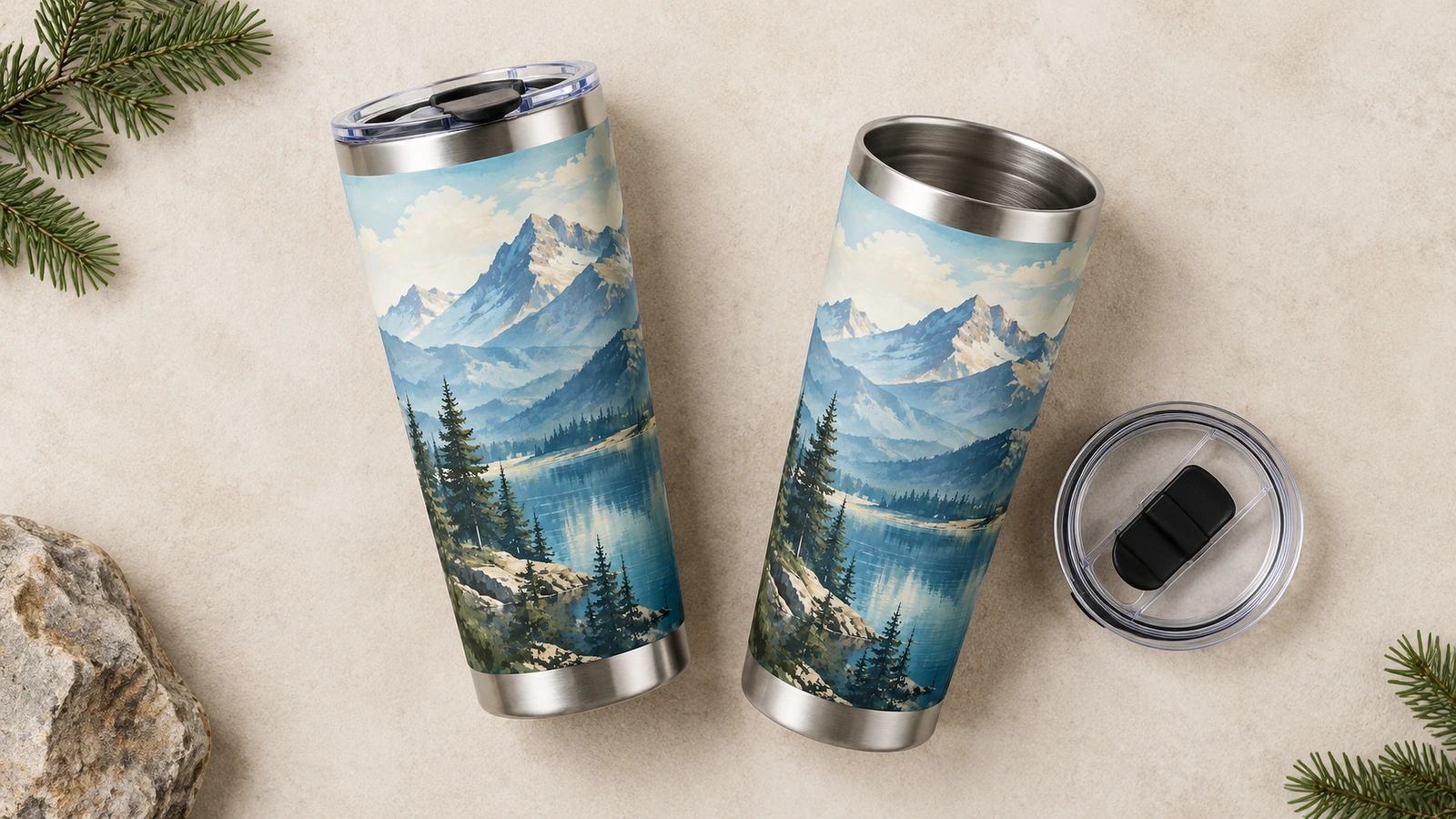
Readability is a design constraint. As a laser engraving FAQ[16] explains, engraving reveals the metal beneath the coating rather than adding color, so it cannot match a Pantone brand color. Victory Laser Co.[17] notes that white cups give the least contrast of all. Avoid hairline strokes on small cups, and do not assume a full 360° wrap is possible on a handled or tapered body.
Step 2: Match the surface finish and the lid to the use
Powder coat engraves cleanly. Practitioners on r/Laserengraving[18] warn about three problems with other finishes. Heat-shrink vinyl coatings and rubber sleeves are not bonded to the cup and can come off in sheets. Tinted clear coats chip at fine detail. White and pink engrave less cleanly than black, and blue and purple are harder to remove than red or yellow.
For lids, separate threaded sealing lids from slide lids and straw lids. A leakage test guide[19] recommends labeling slide and open-straw designs as spill-resistant rather than 100% leak-proof. Also ask whether replacement gaskets are sold, because the gasket usually wears out before the steel does.
Step 3: Preflight the artwork and freeze the proof
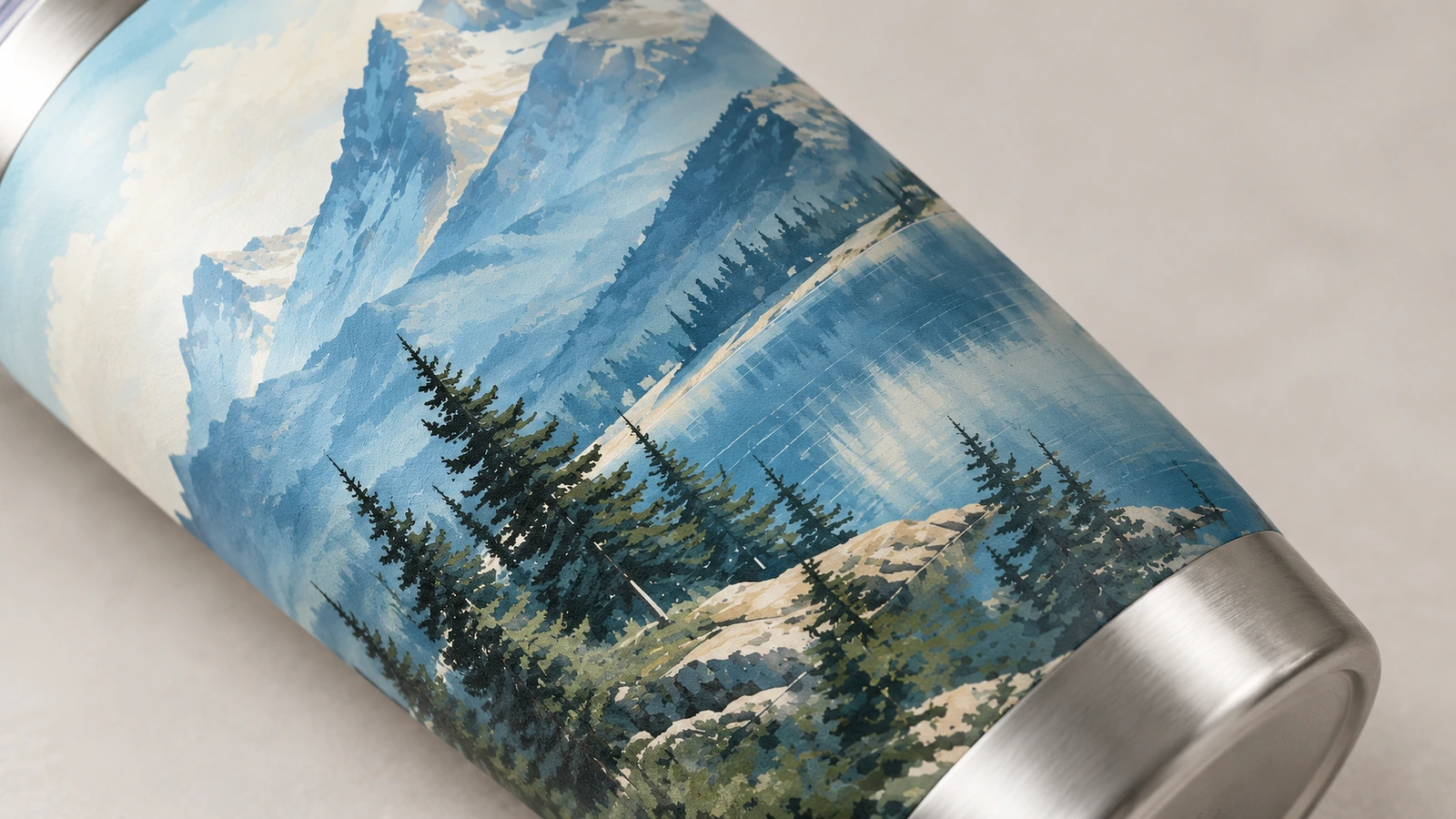
Send vector files (AI, EPS, SVG or PDF) with text converted to outlines, and state the print face: front, back or wrap. The proof should show the real engraving window on the actual cup shape, not a flat logo stretched across a rectangle. Kodiak Wholesale[20], for example, sends a free digital proof within 24 hours and does not begin production until the customer approves it. Whichever supplier you use, write the freeze rule into the order: edits are accepted until a named time, and nothing prints before a signed approval.
Step 4: Test a pre-production sample under written conditions
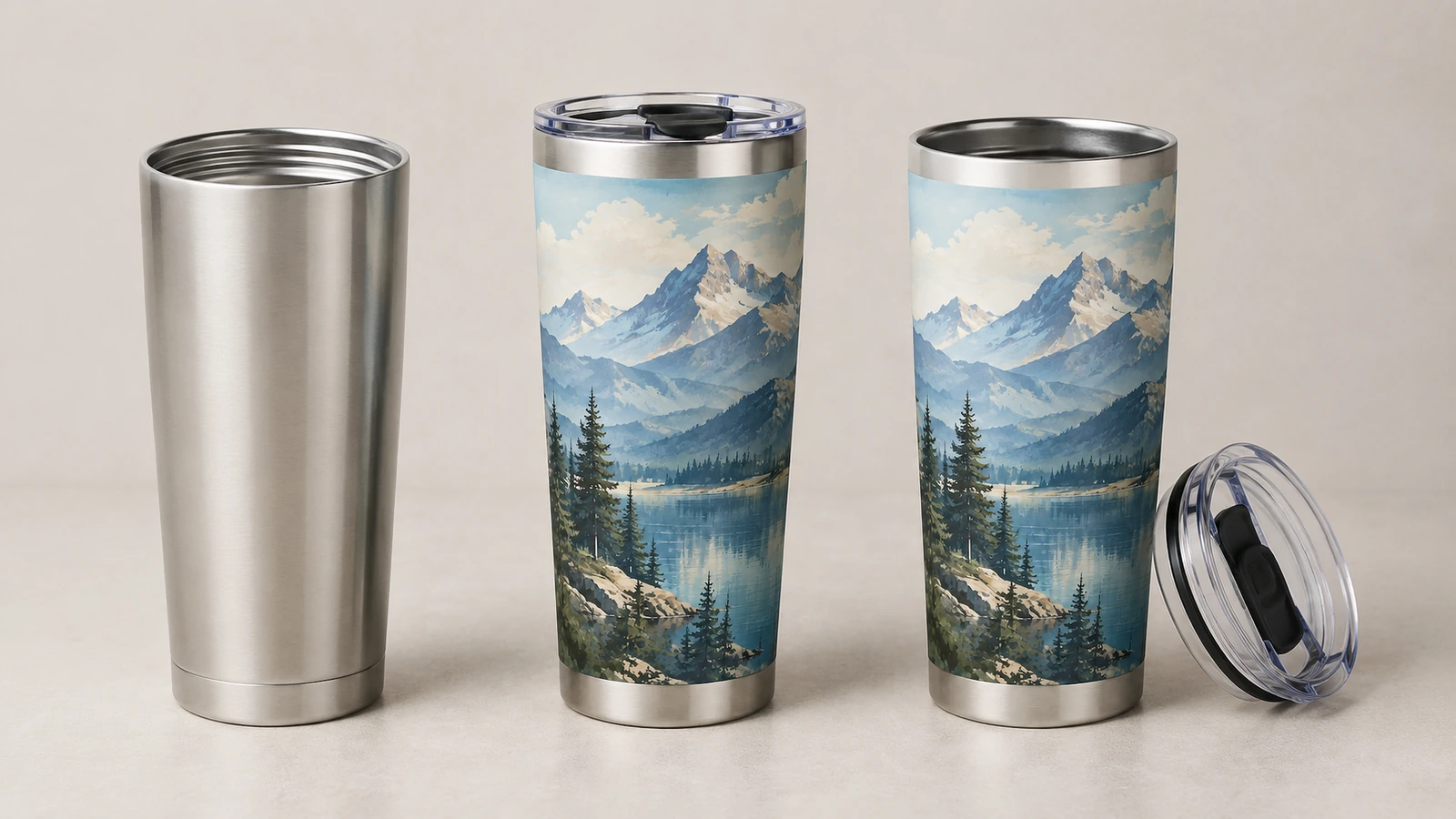
Replace "keeps drinks cold all day" with a test that can be repeated. The Haers inspection checklist[21] provides a usable model:
• Hot leak test: water at ≥95°C, cup half full, lid closed at the specified torque, shaken, then laid flat for 30 minutes. Zero leakage allowed.
• Cold leak test: water at 4±1°C, cup full, laid flat for 30 minutes. Zero leakage allowed.
• Coating adhesion: at least 92 of 100 crosshatch squares retained, zero tape pull-off on the print area, and the coating survives 30 rubs with 75% ethanol.
Insulation hours for any tumbler discussed here are pending a sample test. That test must record four conditions: starting temperature, ambient temperature, fill level and whether the lid was on. Treat any hold-time figure without those four conditions as marketing.
Step 5: Schedule production backward from the event
Count from proof approval, not from the day you first inquire. For in-stock powder-coated cups, published post-approval engraving times are 1–3 business days at Kodiak[20] and 3–5 business days at Victory Laser[17].
A new cup body or lid is a different project. Chill Titan[22] puts the first sample from a new mold at roughly 5–7 weeks, and samples of existing models at 2–7 days. Build in time for at least one re-proof before the event, and agree in writing that wrong artwork does not ship.
Step 6: Inspect before shipment
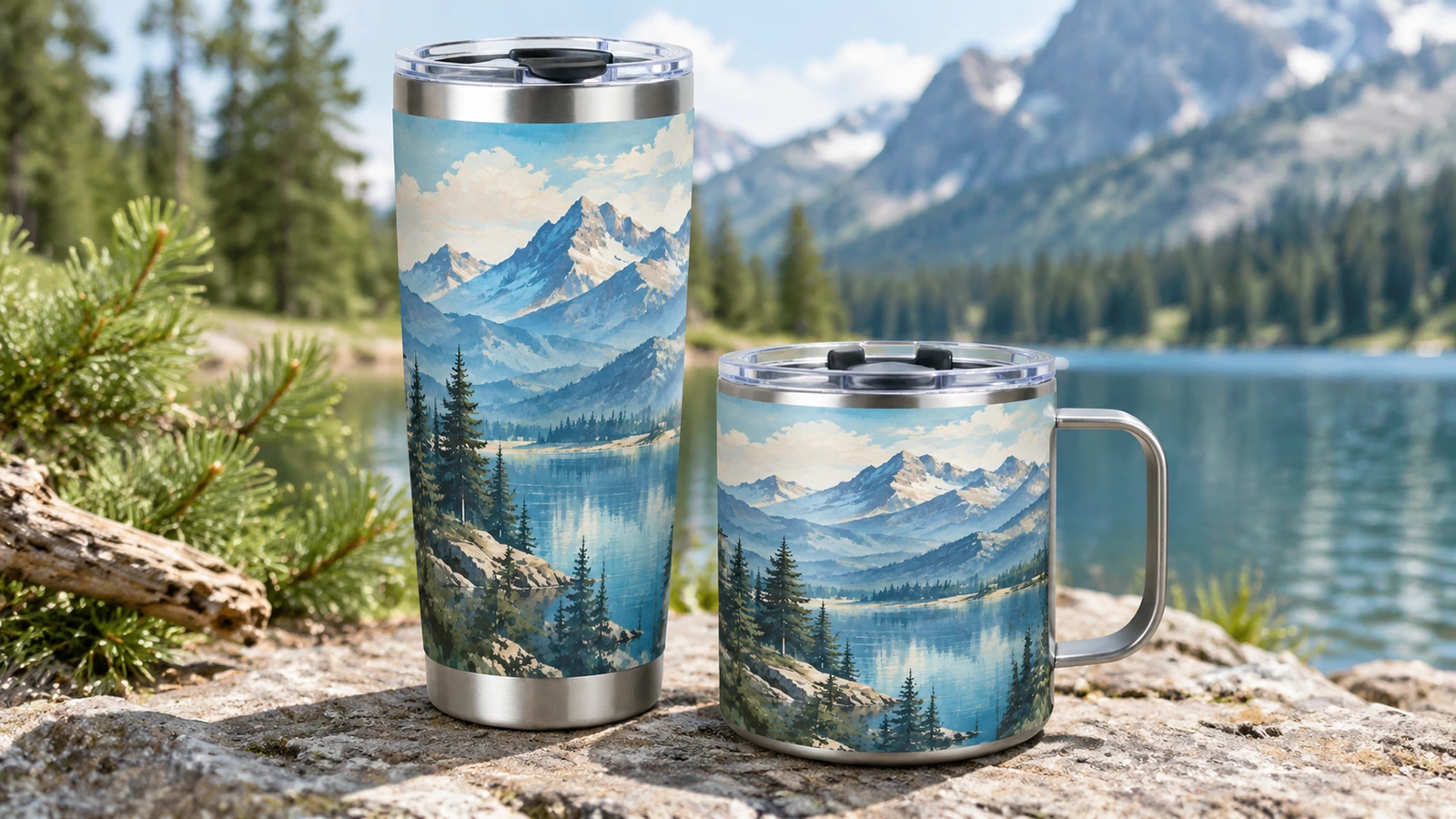
Check the liner grade against the MTR or with a spectrometer. A magnet test on its own is unreliable, because cold-worked 304 can be slightly magnetic. Repeat the inverted leak test on random units, check logo position, size and adhesion, and confirm that every unit ships with its lid, gasket and straw.
Interior cleanliness matters too. In 2024, about 33,000 promotional tumblers distributed in Canada were linked to chemical residue in the insulation layer, and 43 people were reported ill (ASI Central[23]). For any giveaway run, include a residue check on rinse water in incoming inspection.
Which Sourcing Route and Decoration Method Fits Your Order? ↑
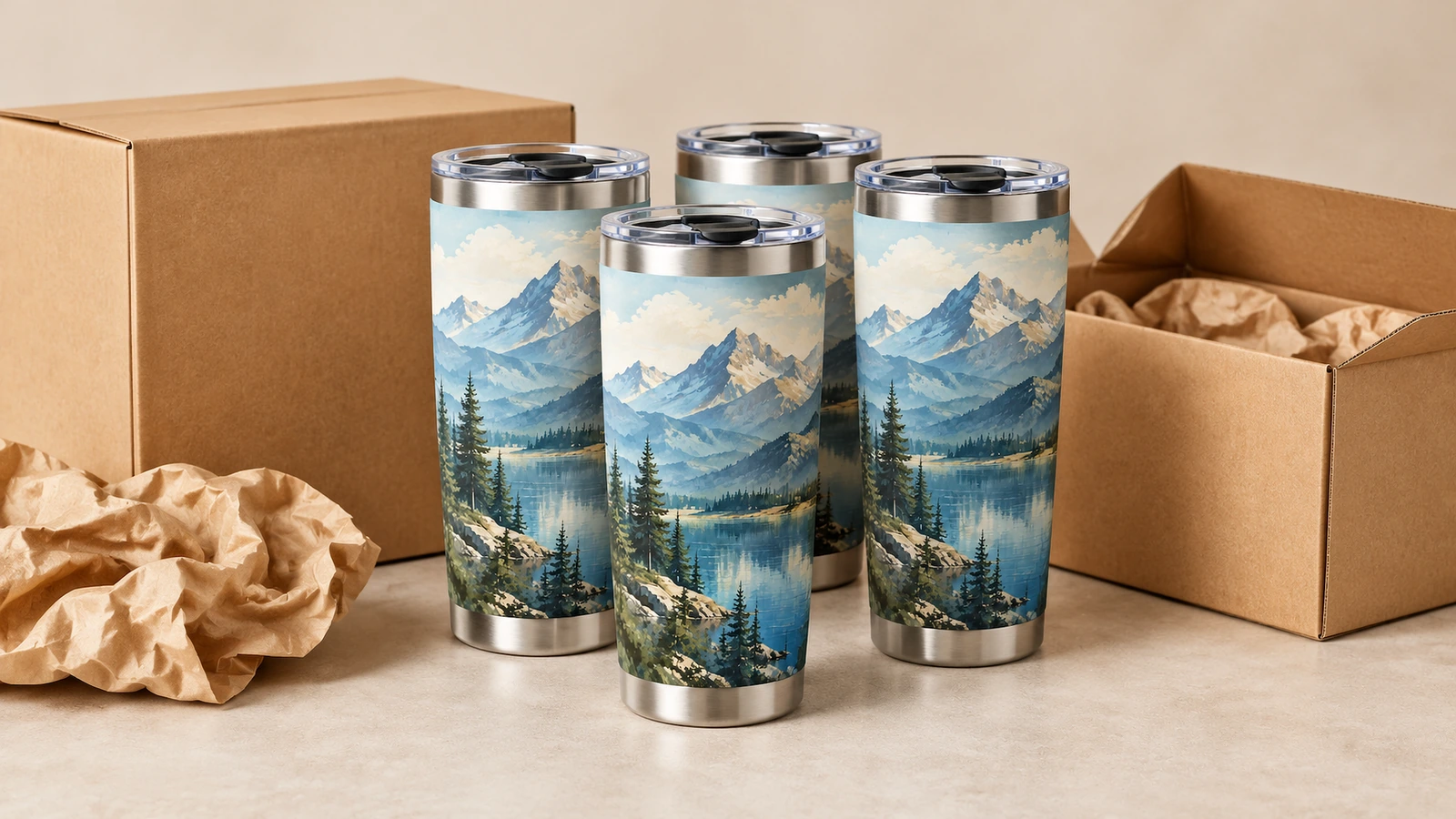
Price per cup falls as quantity and lead time rise, so your deadline should drive the choice of route more than your logo does. The figures below are prices published on the cited sellers' pages in 2025–2026. They are not industry list prices or quotes.
| Route | Published price signal | Lead-time signal | Best fit |
|---|
| US decorator | Bulk Tumblers[24]: 72 pieces from $13.50 each; no-minimum laser option. Victory[17]: $30 for one, $16 each at 50+ | 3–5 business days after proof (Victory) | Events, names, short runs |
| Promo catalog | Custom Earth Promos[25]: decorated 20 oz about $5.21–$6.42, tiers from 50 | 4 days in-stock; about 30 days overseas production | Trade shows, channel promotions |
| Factory OEM | Ohway[26]: about US$3–$8 per unit for 500+, before freight and import costs | New-mold first sample about 5–7 weeks[22], plus ocean freight | Private label, annual volume |
| Online designer | Retail-level pricing per piece | About 10 business days order-to-ship, in-stock (Custom Branding[27]) | Single gifts, photo or name designs |
Two trade-offs sit behind these rows. A US decorator charges more per cup in exchange for speed, low minimums and domestic accountability. A factory OEM order cuts unit cost, but supplier audits, color matching, test reports and import liability then become the buyer's responsibility. Promotional catalogs sit in between, with fixed print areas and limited colors.
| Method | How it marks | Strength | Watch for |
|---|
| Laser engraving | Removes coating to expose steel | No ink to peel; reads as premium | Single tone only; weak contrast on white |
| UV print | Cured ink on the outer surface | Full color, including gradients | Needs adhesion and abrasion testing |
| Screen print | One or two ink colors | Cost-effective for simple logos | Each color adds cost; wears over time |
| Sublimation | Dye absorbed into a special coating | Photo-quality full wrap | Requires a sublimation-coated blank |
Amazon reviews show both sides of the laser trade-off. One gift buyer praised engraved text that "looks like it was engraved and not colored letters plastered on it." A client-gift buyer was satisfied overall but had expected a lime-green letter in the logo to stay in color. State on the order that laser output is single-tone exposed steel.
What Belongs on Your Spec Sheet Before You Request a Quote? ↑
A one-page specification turns the steps above into terms a supplier can quote and you can inspect against. Each field below pairs the requirement with the evidence to request.
| Field | What to write | Evidence to request |
|---|
| Liner and shell grade | 304 or 316; whether shell and base match | MTR against ASTM A240 heat analysis |
| Lid, gasket, straw | Lid type, plastic material, spill-resistant or leak-proof wording | 21 CFR Part 177 declaration and BPA test |
| Decoration | Method, position, colors, dishwasher scope | Signed sample and adhesion result |
| Insulation claim | Hours plus all four test conditions | Sample test record (pending) |
| Leak performance | Hot and cold protocols | Inspection record per batch |
| Lead and California | Coating, ink and base-seal method | Prop 65 test or warning decision |
| Schedule | Proof freeze, production days, ship date | Written timeline with dates |
| Packing and warranty | Dividers, rim protection, lid coverage | Packaging spec and warranty text |
Fill in every row before you request a quote. Two suppliers can then be compared on identical terms, and a lower price that quietly drops a test or a document becomes visible. Any field the supplier cannot document should stay marked as pending until a sample or report closes it.
Packaging and after-sale terms finish the job. Ship each cup in its own divider with rim protection, and define transit scratches as the supplier's responsibility, not normal wear. Warranty wording matters, because some warranties cover only the steel body and exclude lids, seals or decoration. For reorders, keep the signed sample and a retained powder-color chip so the second batch matches the first.
Key Takeaways for Tumbler Buyers ↑
- Branded tumblers stay in daily use for years — more than 87% kept for usefulness; about 1,300 lifetime impressions (Source)
- Steel grade does not change insulation — about 16.2 W/m·K for 304 vs 16.3 for 316 (Source)
- California's lead safe harbor is a daily exposure level, not a content limit — 0.5 µg/day reproductive MADL (Source)
- Leak tests need both hot and cold conditions — ≥95°C half full and 4±1°C full, each laid flat for 30 minutes (Source)
- Skipping QC multiplies defects — target below 1% vs 5–10% without QC (Source)
Ready to Turn Your Logo Into a Tumbler People Keep? ↑
A tumbler earns its place on a desk when the steel is documented, the lid matches its label, the logo survives washing and the box arrives before the event. Pricing, minimums, lead time and insulation results for your project are confirmed through the quote and the pre-production sample, not assumed. Send your vector logo, target quantity, preferred size and event date to request a quote and a pre-production proof.




The information below is required for social login
Sign In
Create New Account