Custom die struck pins use a precision steel die to press raised and recessed details into metal—no enamel, no color fill, just dimensional contrast shaped by light. That stripped-back finish makes them the preferred choice for employee recognition, military insignia, school honors, membership programs, anniversaries, and other formal applications where metal texture speaks louder than full-color artwork.
Who Benefits Most From Custom Die Struck Pins? ↑
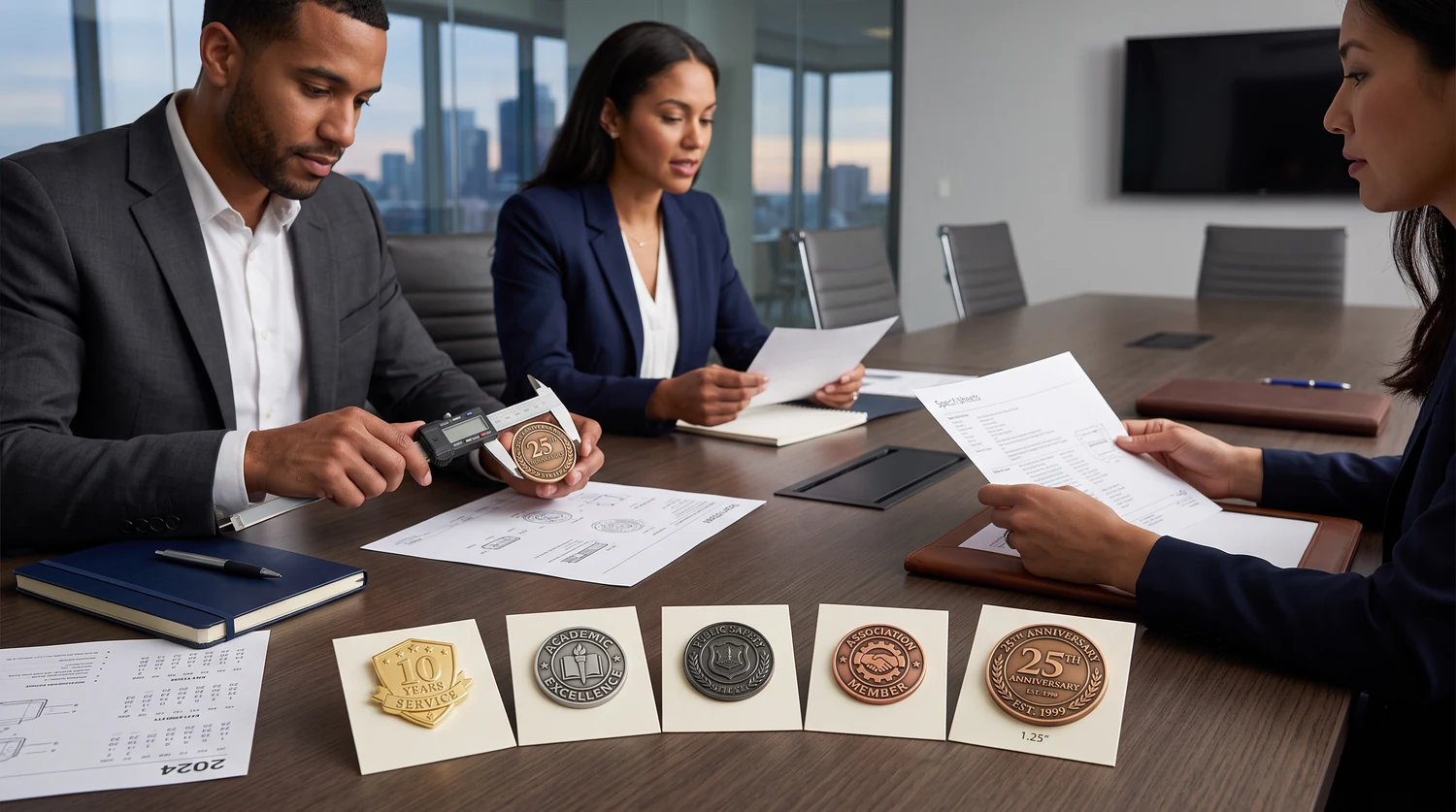
Purchasing managers, HR teams, government departments, educational institutions, associations, event planners, and branded-merchandise distributors all specify die struck pins when they need a formal object that communicates achievement, membership, authority, or institutional history without relying on bright enamel colors.
Typical programs include employee service awards, safety milestones, graduation honors, alumni recognition, military or public-service insignia, executive gifts, membership identifiers, and limited commemorative releases. The wider U.S. promotional-products market recorded $26.78 billion in distributor sales for 2024, up 2.63% year over year, according to PPAI distributor sales data[1]. This is an upstream industry figure—not a die-struck-pin market-size estimate—but it confirms the scale of the purchasing environment in which recognition pins are sold.
Why Do Otherwise Promising Pin Orders Become Expensive Problems? ↑
A digital logo may look precise on a screen, yet lose legibility the moment it is converted into raised and recessed metal. Thin strokes close up. Small counters disappear. Polished surfaces reflect nearby details into illegibility. A large pin rotates on its post because the attachment layout was never stress-tested against the final weight.
These errors do not stay contained—they multiply across the entire production run. A misunderstood plating instruction can require a full remake; a defective die repeats the same mark on every unit; and a single-post attachment makes a heavy pin lean or spin on every lapel it touches. Small orders feel the pressure most acutely because tooling, proofing, setup, samples, and brokerage are all fixed costs. One public factory-facing price schedule lists a 1-inch die-struck pin at $2.62 for 100 units versus $1.10 for 1,000 units, illustrating how volume reshapes unit economics even before order-specific extras are added.
The antidote is straightforward: treat the project as a controlled manufacturing specification, not a logo-upload transaction. Define the intended use, dimensions, metal, relief, plating, texture, attachments, packaging, delivery term, tooling rights, testing requirements, and inspection criteria before production begins. Approve a physical pre-production sample when design or deadline risk justifies it. The rest of this guide shows how.
Contents
What Exactly Is a Die Struck Pin? ↑
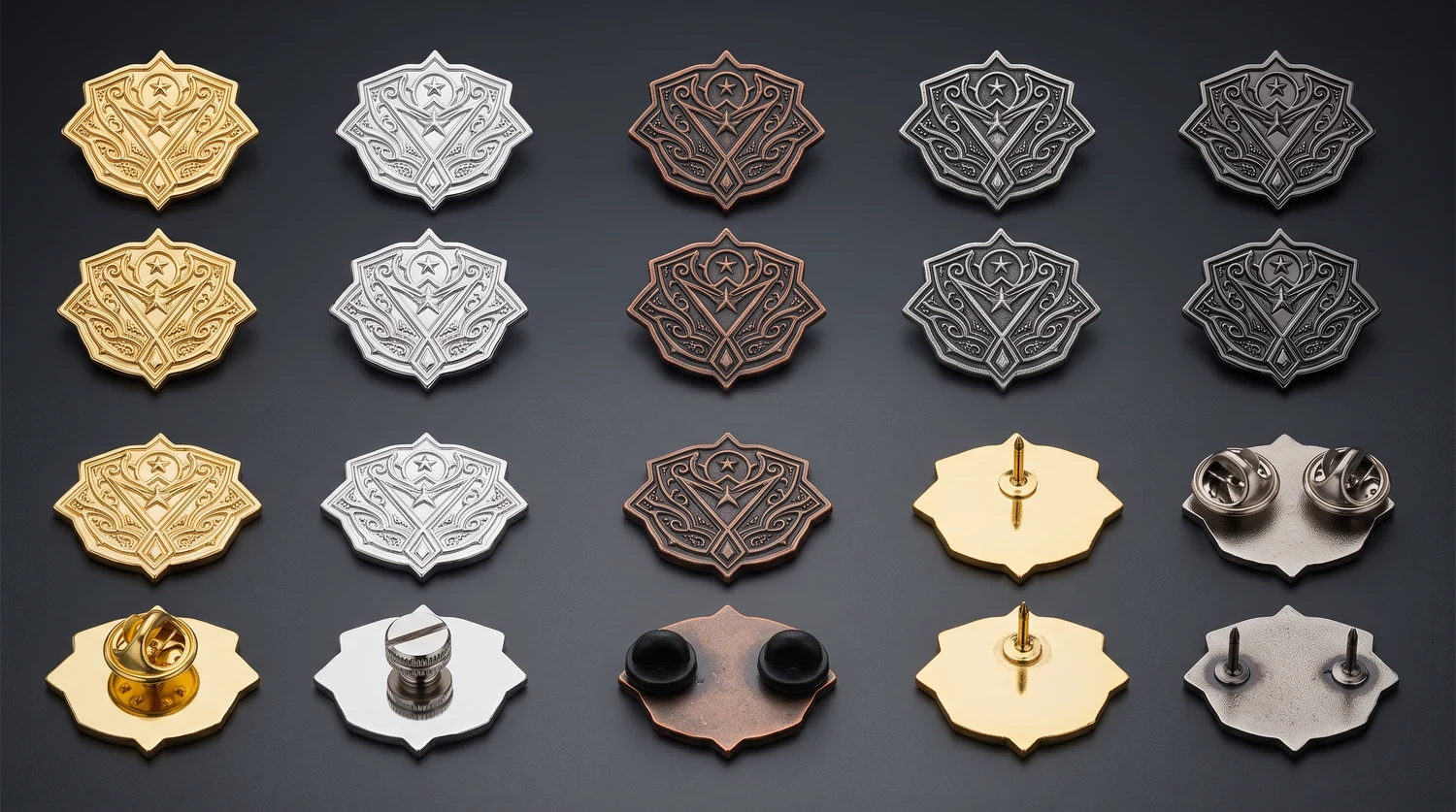
A die struck pin begins with a custom steel die carrying a reversed version of the approved design. Pressure transfers that design into a metal blank, producing raised and recessed areas. The part is then trimmed, polished, textured, plated, fitted with posts, inspected, and packed. Commercial descriptions commonly identify brass, copper, bronze, and iron as possible base metals and gold, silver, antique, copper-toned, or black-nickel appearances as finish options; see this die struck manufacturing overview[2].
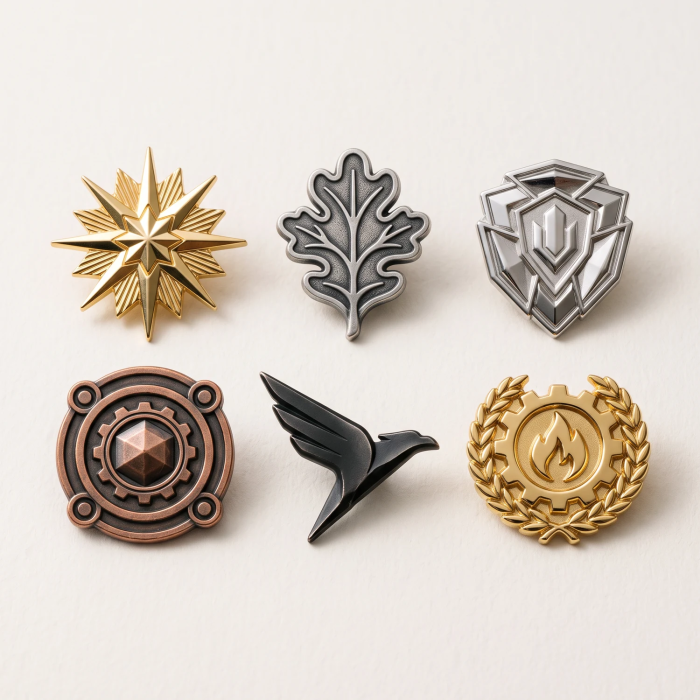
In its classic form the product contains no enamel. Contrast comes entirely from relief and surface treatment: raised areas may be bright-polished while recessed areas are sandblasted, matte, or darkened with an antique wash. The result shifts with viewing angle and light—making this construction especially effective for seals, lettering, line art, dates, borders, and heraldic elements that reward a second glance.
"Die struck" describes the forming method, however, not an absolute prohibition on color. Enamel can be added after striking, but the result should be specified as a die-struck enamel or mixed-process pin. That distinction matters because enamel introduces additional color-matching, filling, curing, polishing, and inspection requirements that change the cost structure and timeline.
Size, relief, and readable detail
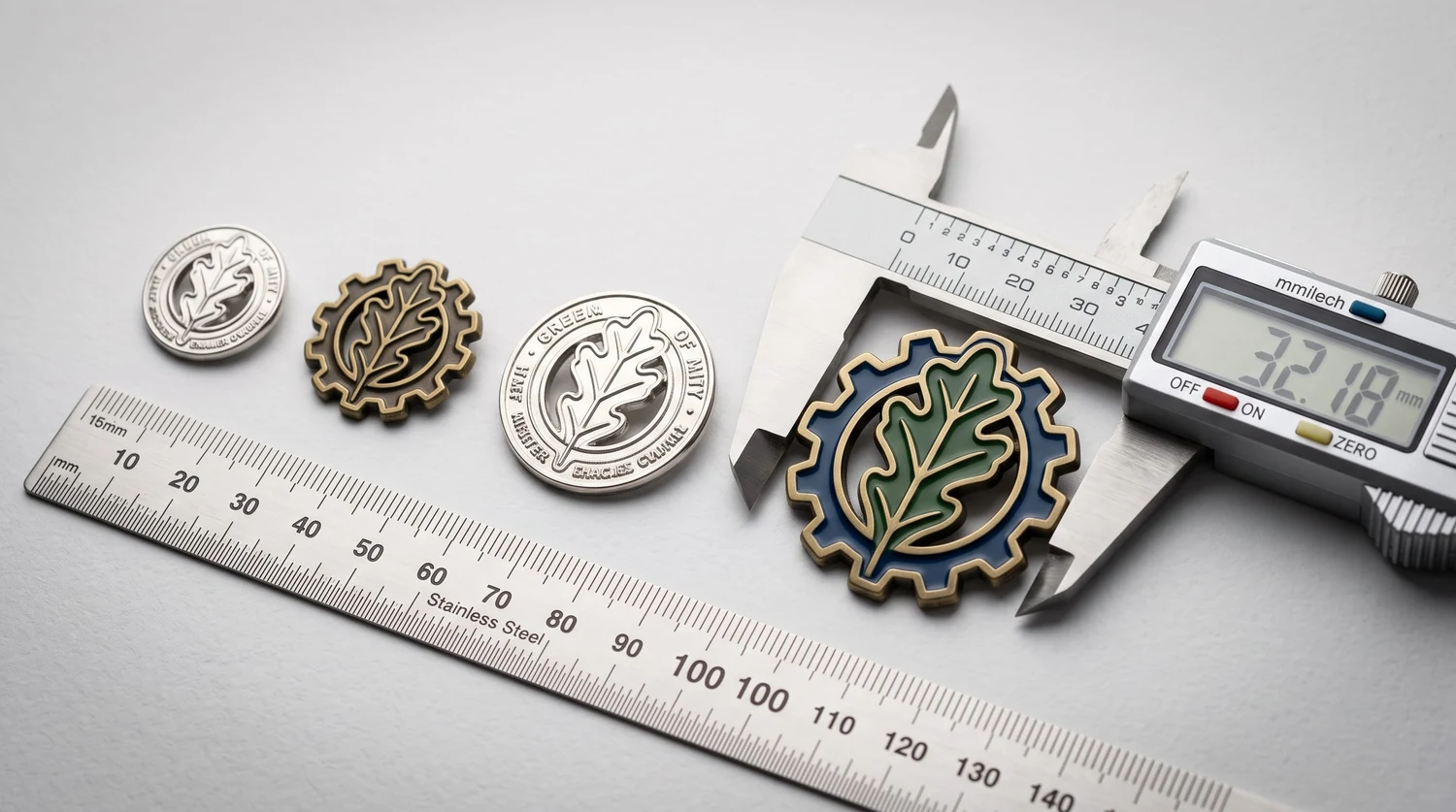
There is no universal minimum line width that applies to every metal, die, press, finish, and supplier. A reliable quotation therefore converts the design into measurable manufacturing fields: overall width and height in inches or millimeters, nominal thickness, minimum raised line, minimum recessed gap, smallest letter height, relief levels, edge profile, and permitted tolerance.
A practical artwork review should test the design at its actual physical size rather than at browser zoom. For compact pins, preserve open negative space around letters and avoid stacking multiple textures behind fine type. Large pins can accept more detail, but their added weight may require two posts to prevent rotation.
Surface and attachment choices
| Specification |
Best use |
Control point |
| Polished gold or silver appearance |
Simple logos, executive awards, formal presentation |
Approve a physical finish sample; reflections can reduce fine-detail contrast |
| Antique gold, silver, or copper appearance |
Dense lettering, heritage marks, commemorative artwork |
Define the desired darkness and variation with a signed reference sample |
| Black nickel appearance |
Modern, low-key branding |
Check whether dark recesses merge with thin raised lines |
| Butterfly clutch |
General programs and cost-sensitive distribution |
Confirm post fit and include spare clutches where loss risk matters |
| Locking clutch |
Higher-value pins or repeated wear |
Test removal force and compatibility with the post |
| Two posts |
Wide, tall, asymmetrical, or heavier pins |
Verify spacing against lapels, uniforms, hats, and presentation cards |
The finish and attachment should be selected as one system. A visually successful front does not compensate for a weak post, incompatible clutch, sharp edge, or attachment position that makes the product tilt in use.
How Do You Specify and Order a Reliable Production Run? ↑
Nine steps separate a concept from an accepted shipment. Each one is a decision gate—skip it, and the risk simply moves downstream where it costs more to fix.
1. Define use, audience, quantity, and deadline
Start with the business event rather than the artwork. State who will wear or receive the pin, where it will be used, the required in-hand date, and whether the program is a one-time release or a recurring award. Separate the requested delivery date from the production-complete date and reserve time for proof revisions, sampling, customs clearance, inspection, and corrective action.
If the item is designed or intended primarily for children aged 12 or younger, safety obligations may change substantially. The U.S. Consumer Product Safety Commission states that accessible components of children's products must not exceed 100 ppm total lead, while paint and similar surface coatings are subject to a 90 ppm limit; review the current CPSC lead requirements[3]. Children's jewelry may also fall within ASTM F2923-20[4], depending on intended user and product classification.
2. Build a standardized quotation sheet
Every supplier should quote the same fields: finished dimensions, base metal, thickness, relief type, plating appearance, front texture, edge treatment, post count, clutch type, packaging, quantity, overs or unders policy, sample method, tooling charge, unit production price, shipping term, tariff treatment, delivery window, and defect remedy.
Use one landed-cost equation across bids:
Landed order cost = tooling + quantity × production price + attachments and packaging + samples or rush fees + international freight and insurance + customs duties + brokerage and domestic delivery.
Divide that result by accepted—not merely shipped—units. A low factory price loses meaning if the bid excludes tooling, air freight, duties, inspection, or an elevated defect allowance.
3. Confirm tooling and intellectual-property terms
Paying a tooling charge does not automatically transfer physical ownership of the die. Put the owner, storage location, retention period, reorder conditions, modification policy, destruction process, and transfer rights in writing. Identify the final artwork version and prohibit unauthorized production, display, or resale.
Before supplying a logo, character, seal, or licensed property, verify authorization through the rights holder and, where relevant, search official trademark and patent records through the USPTO[5]. A factory's ability to reproduce an image is not evidence that the buyer has permission to commercialize it.
4. Preflight the artwork before proof approval
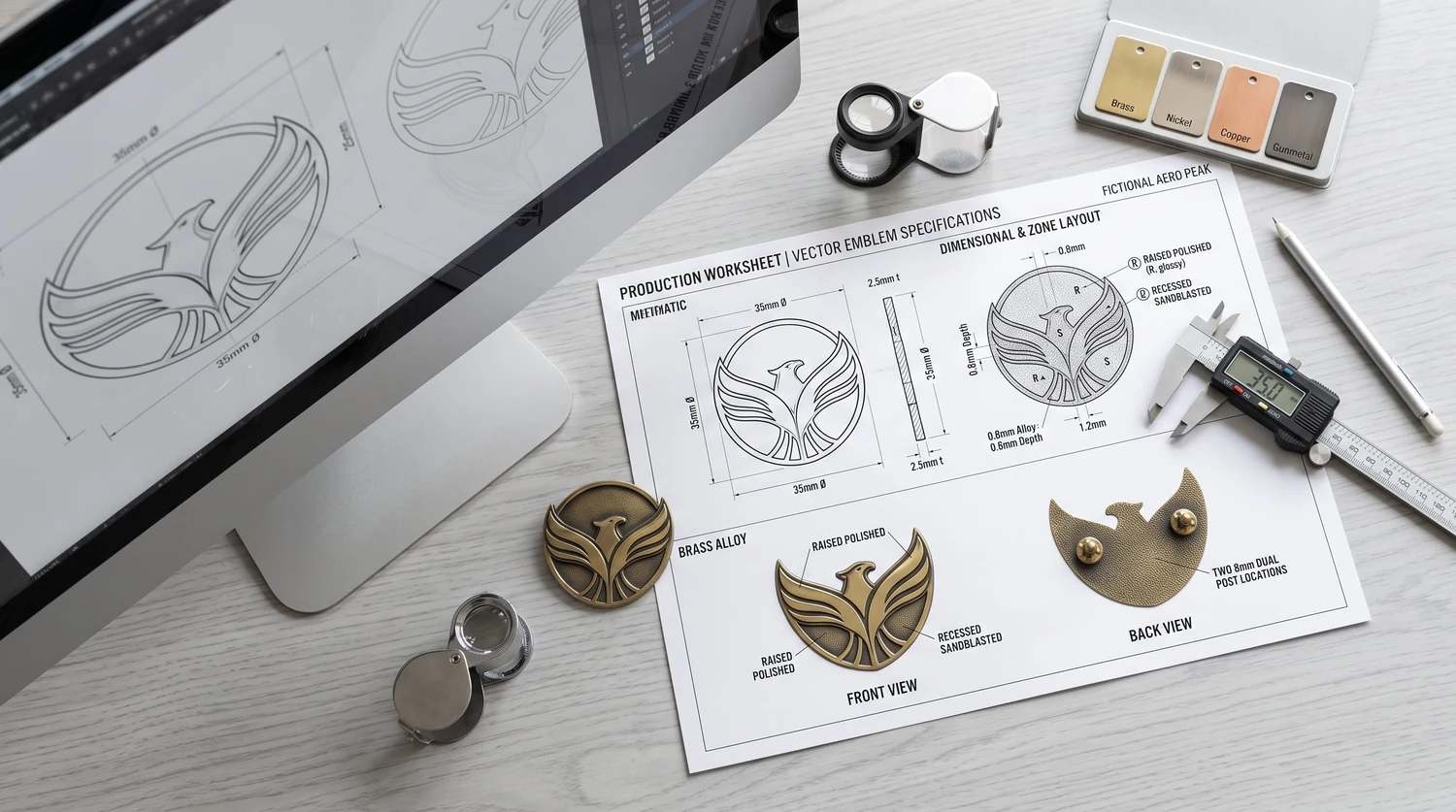
Preferred files are AI, EPS, SVG, or vector PDF with fonts converted to outlines. The production proof should show dimensions, relief direction, polished and textured zones, plating, metal, thickness, post positions, clutch, front and back views, packaging, and revision number. Do not rely on a chat message such as "antique silver" without a marked visual reference.
5. Approve a physical pre-production sample when risk is material
A digital proof verifies layout and annotations; it cannot fully prove plating tone, relief depth, edge feel, reflectivity, post strength, weight, or clutch performance. A physical pre-production sample is particularly valuable for a new supplier, high-value recognition program, complex emblem, special finish, children's application, or deadline where a bulk remake would be unacceptable.
Sign and date the accepted sample. Record its mass in grams, dimensions in millimeters, approved finish, die number, attachment configuration, and any intentionally accepted variation. That sample becomes the visual and functional reference for mass-production inspection.
6. Control the manufacturing sequence
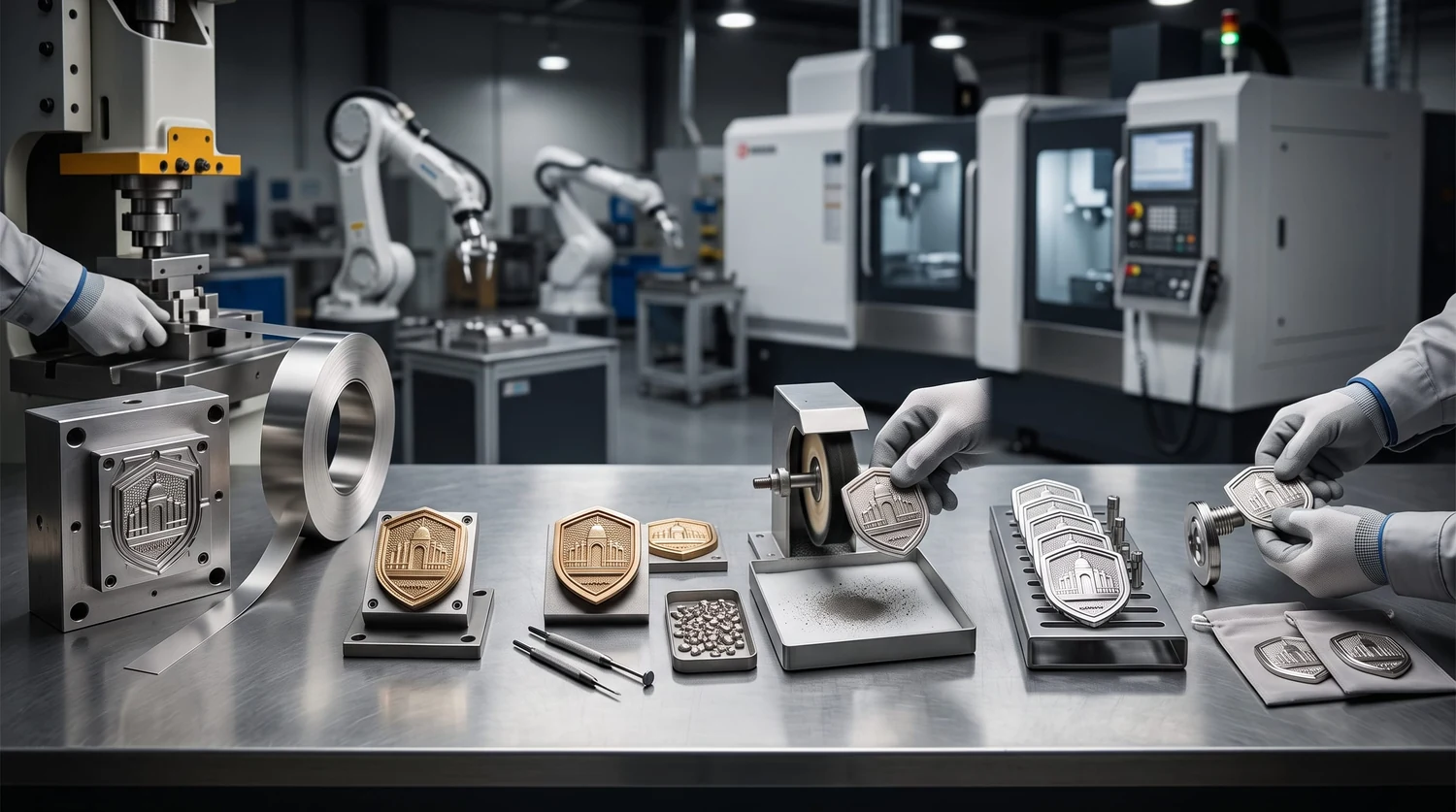
The normal sequence is artwork approval, die preparation, metal striking, profile cutting, deburring, polishing or texturing, plating or antiquing, post attachment, cleaning, inspection, and packing. A more complex relief, cutout, dual finish, or mixed enamel treatment adds operations and additional failure points.
7. Inspect measurable characteristics, not adjectives
| Inspection field |
Evidence to record |
Typical defect signal |
| Dimensions and profile |
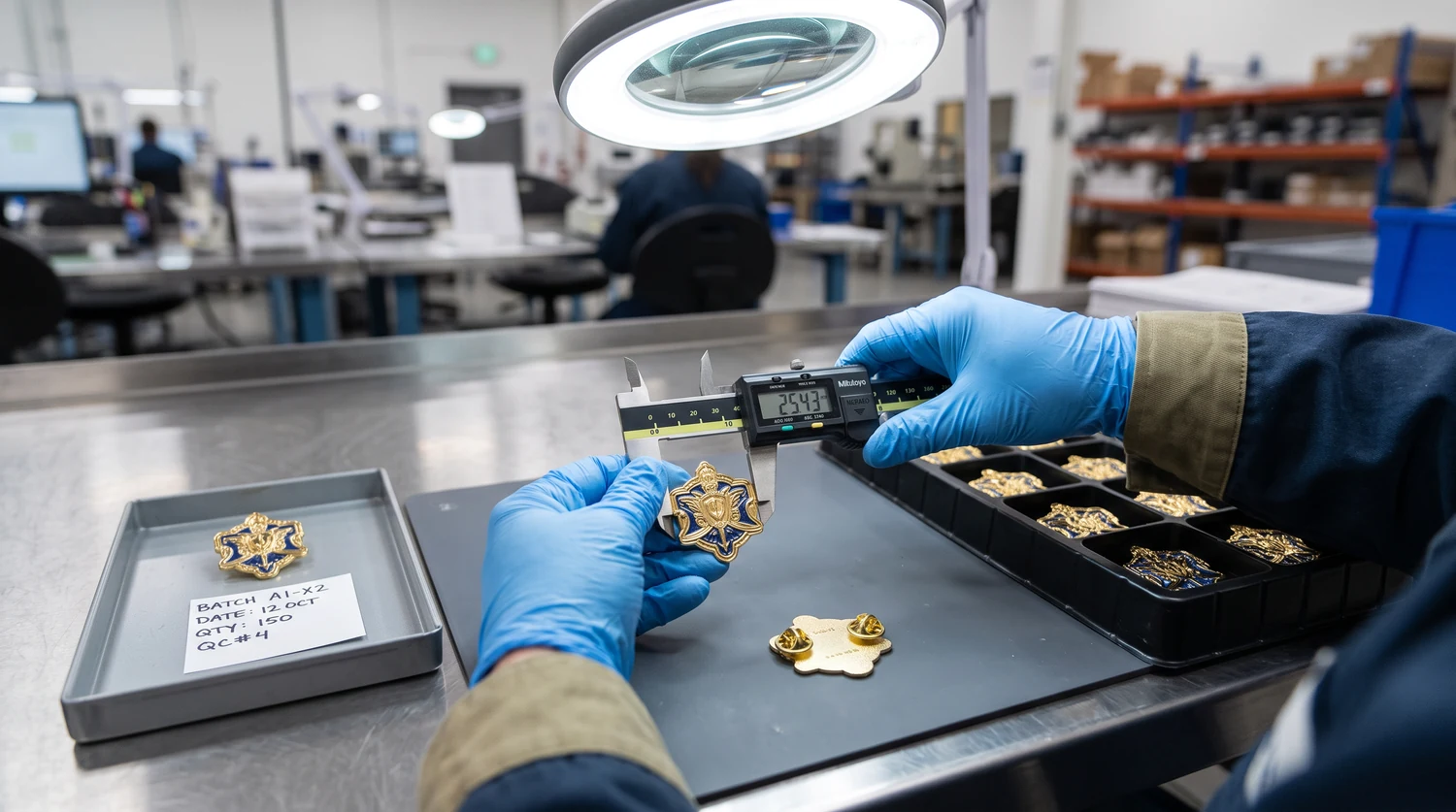
Caliper measurements against the signed specification |
Incorrect scale, distorted outline, or inconsistent trimming |
| Relief and lettering |
Comparison with the approved sample under consistent lighting |
Filled counters, softened edges, reversed relief, or die marks |
| Plating and surface |
Reference sample, batch photos, and any agreed test report |
Blisters, peeling, stains, pits, visible base metal, or unacceptable color drift |
| Post and clutch |
Position, orientation, fit, and agreed mechanical test method |
Loose post, spinning product, mismatched clutch, or poor solder joint |
| Edges and cleanliness |
Visual and handling inspection |
Burrs, sharp points, polishing residue, fingerprints, or scratches |
| Quantity and packing |
Accepted units, rejects, spares, carton count, and batch label |
Short shipment, mixed versions, or transit abrasion |
The purchase order should define the sampling plan, tolerances, defect categories, acceptance threshold, and remedy. "Premium quality" is not an inspection criterion; a signed sample plus measurable requirements is.
Historical evidence shows why material verification cannot be replaced by appearance alone. The CPSC previously announced a recall of metal Nintendo lapel pins due to lead exposure risk; the official lapel-pin recall notice[6] remains a useful procurement reminder: request product-appropriate, batch-linked evidence instead of accepting an unsupported "lead-free" statement.
8. Resolve import, tariff, and environmental claims before shipment
Do not assign an HTS classification solely from the phrase "lapel pin." Potential headings may vary with material, construction, principal use, and whether the item is treated as imitation jewelry, an ornamental article, or another product type. Confirm the current code and base duty through the USITC Harmonized Tariff Schedule[7] and obtain advice from a licensed customs broker.
For China-origin goods, determine whether the confirmed subheading appears in a Section 301 action and whether any current exclusion applies. USTR records show that List 3 duties were increased from 10% to 25%, but applicability is tariff-line specific; consult the official Section 301 List 3 records[8]. Require a DDP quote to identify what duties, brokerage, and destination charges are actually included.
Likewise, claims such as "eco-friendly plating," "recycled metal," or "zero impact" require substantiation. The FTC Green Guides summary[9] advises against broad, unqualified environmental-benefit claims and calls for specific, supportable qualifications. Ask for the percentage by weight, pre-consumer or post-consumer basis, batch traceability, and certification scope rather than accepting a generic green label.
9. Protect the pins in transit and preserve reorder data
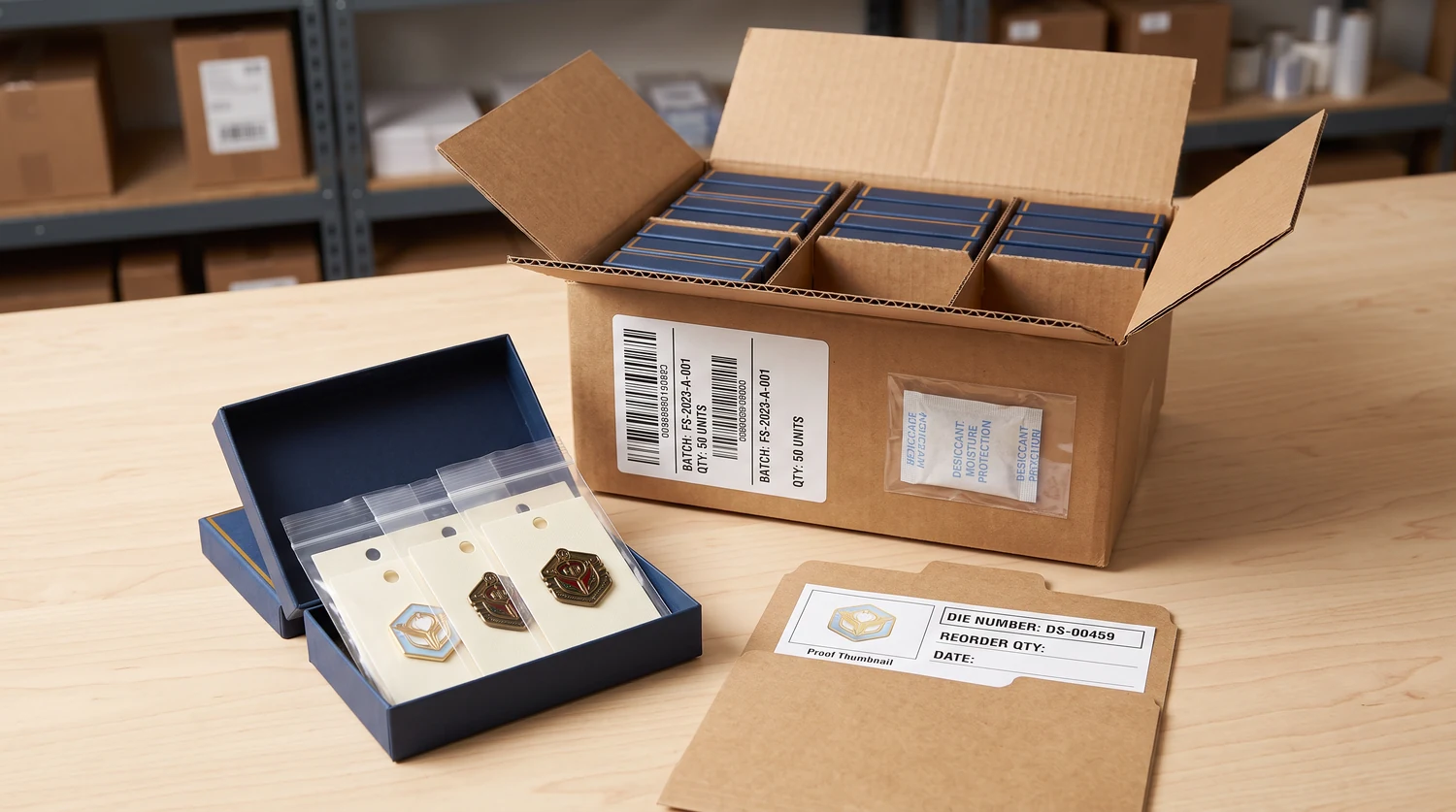
Individual poly bags reduce abrasion; presentation cards organize distribution; and fitted boxes support premium recognition programs. Packing must also control movement inside the master carton, keep incompatible finishes from rubbing together, and match the weight and moisture risk of the shipping route.
At receipt, inspect within the contractual claim period and retain the carton labels, batch number, accepted sample, defect photos, and quantity reconciliation. The reorder record should preserve the vector file, proof revision, die number, metal, dimensions, finish, texture, attachment, packaging, actual lead time, accepted defect history, and tooling-retention date.
Which Pin-Making Process Fits Your Design and Budget? ↑
Die striking is one of several established pin-making methods. Choosing the right process depends on what your artwork needs to communicate and how the product will be used.
| Process |
Visual strength |
Primary limitation |
Best-fit application |
| Die struck |
Raised and recessed all-metal detail; polished, matte, or antique contrast |
Classic version does not reproduce photographs, gradients, or color-dependent branding |
Service awards, official emblems, anniversaries, formal membership |
| Soft enamel |
Bright recessed color with tactile raised metal lines |
Exposed relief and recessed color create a deliberately textured surface |
Events, fan merchandise, colorful promotional releases |
| Hard enamel |
Smooth, polished, jewelry-like color surface |
Color boundaries and process requirements can constrain artwork |
Premium branded gifts and collectible color designs |
| Die cast |
Complex curves, thicker forms, deep 3D relief, and structural cutouts |
Different tooling and alloy behavior; not interchangeable with sheet-metal striking |
Mascots, sculptural forms, heavy relief, intricate open areas |
| Printed |
Photographs, gradients, shadows, and very complex color art |
Appearance depends on the printed layer and protective coating |
Photo reproduction, prototypes, short campaigns, intricate illustrations |
Select the process from the artwork's dominant information. Choose die struck when shape, line, typography, relief, and metal finish carry the message. Choose enamel when color identity is essential, die cast when the form is sculptural, and printing when photographic detail or gradients cannot be simplified.
Public pricing should only be compared at the same size, quantity, finish, attachment, packaging, freight, and tooling terms. One current schedule lists a 1-inch hard-enamel estimate of $2.75 at 100 units and discloses that extra charges may apply for certain colors, attachments, prints, and 3D tooling; review the underlying lapel pin pricing schedule[10]. This is a useful screening reference, not proof that one process is always cheaper.
What Should a Buyer Remember Before Approving Production? ↑
- Budget the accepted landed unit cost, not an isolated factory price. — One public 1-inch die-struck schedule decreases from $2.62 at 100 units to $1.10 at 1,000 units, demonstrating the effect of quantity before order-specific adjustments (Source)
- Separate production time from the complete delivery schedule. — Public supplier guidance commonly places total custom-pin lead time around 2–4 weeks once design, production, and delivery stages are considered (Source)
- Apply children's-product requirements only after defining the intended age group and use. — CPSC limits accessible lead in applicable children's-product components to 100 ppm and lead in paint or similar coatings to 90 ppm (Source)
- Model China-origin tariff exposure by confirmed HTS subheading. — USTR's List 3 modification increased applicable additional duties from 10% to 25%, but coverage remains tariff-line specific (Source)
- Qualify recycled-content claims with measurable evidence. — FTC guidance uses percentage-based examples such as "made from 30% recycled material" rather than unsupported general environmental claims (Source)
Ready to Turn Your Artwork Into a Production-Ready Specification? ↑
A successful custom die struck pin is not a commodity—it is the product of controlled decisions: readable relief, a signed metal finish, stable attachments, documented tooling rights, measurable inspection criteria, and a landed-cost calculation that accounts for logistics and import exposure. For a factory-direct evaluation built around your quantity, artwork, delivery date, and compliance needs, request one itemized production quote.




The information below is required for social login
Sign In
Create New Account