We use cookies to enable our websites to remember information, to help some website functionalities to work properly, to understand how you interact with and use our websites and to display you content and ads that are relevant and engaging for you.
By clicking Accept All you consent to the use of these cookie.
The store will not work correctly when cookies are disabled.
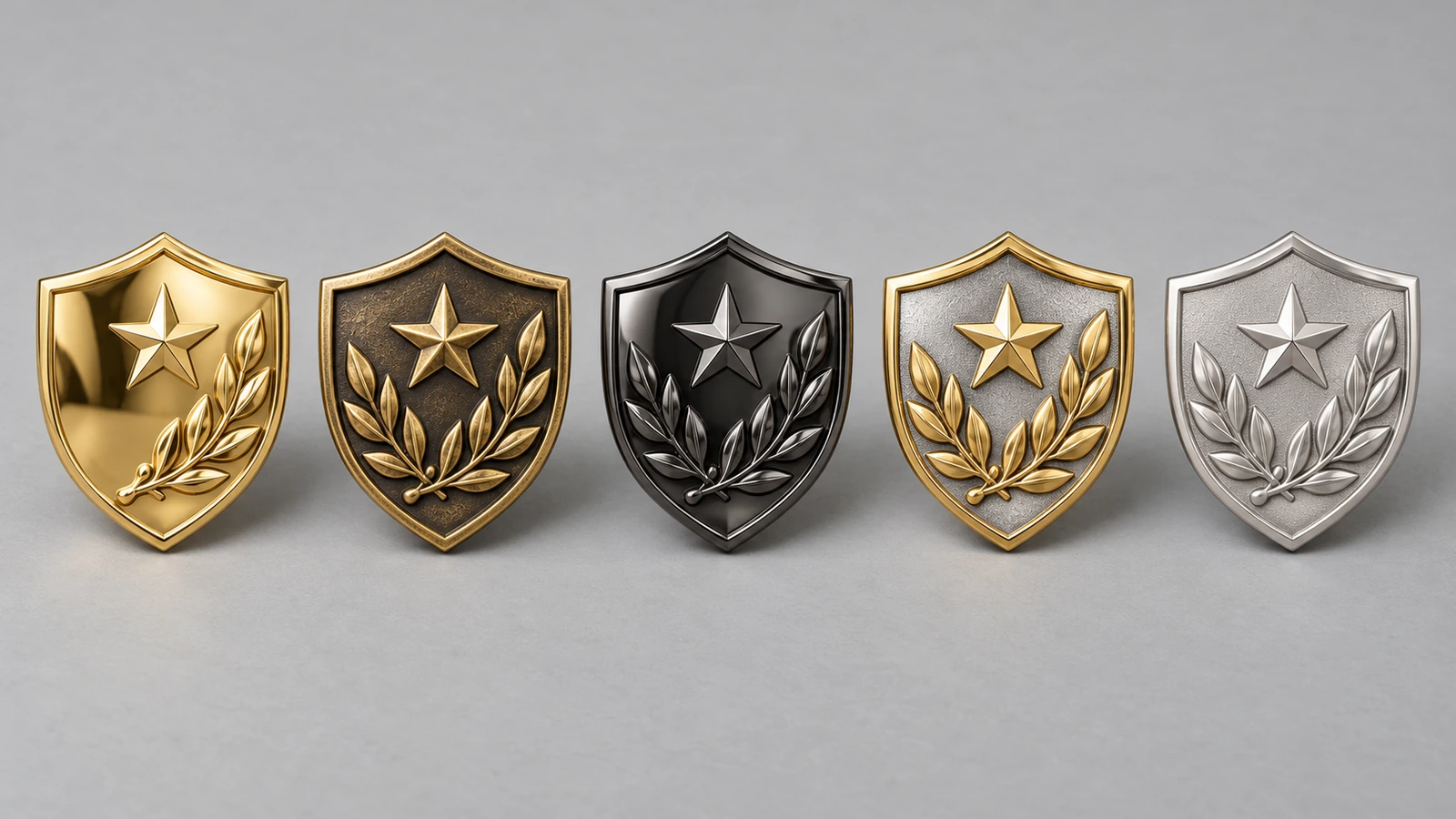
Quick answer: The main lapel pin plating options for die struck metal are polished, antique, black nickel, dual-tone and sandblasted. Antique hides wear and sharpens small text. Polished shines but shows scratches first. Dual plating adds the most cost and schedule risk.
Most buyers choose between lapel pin plating options by looking at a flat color swatch or a glossy digital render. The trouble starts when the pins arrive. A single relief design can look crisp and ceremonial in antique gold, but in polished gold the same design can turn into a mirror that loses its lettering under office lighting. In black nickel it can sink into a dark blur that nobody can read from across a table.
Mistakes like this are expensive because plating is applied to the whole batch at once. In one public post, an independent creator explained that she had given her factory the wrong plating option for a die struck run. The whole order had to be remade, and she then had to contact every preorder customer and ask whether they would wait for the corrected pins or keep the first version. Another creator reported that fewer than half of a batch was sellable because small dents and scratches showed through a bright finish. Neither problem started with the metal. Both started with a finish decision that was never checked against how the pin would actually be seen and worn.
This guide is for HR teams, award program managers, associations and brand buyers. It covers how each finish behaves on raised and recessed metal, what changes first in daily wear, and how each choice affects unit cost and production time, so the decision is made before the die is cut.
What Is Plating, and How Is It Different From a Finish?
Plating is a thin layer of metal deposited onto the base metal by electroplating, which gives the pin its color: gold, silver, nickel, copper or black nickel. A finish is the full surface recipe. It combines the plating color with one or more mechanical or chemical treatments: mirror polishing, sandblasting (texturing with abrasive media), or oxidation (chemically darkening the metal and then buffing the high points back to bright). Two pins can share the same "gold plating" and still look completely different, because one is polished and the other is antiqued.
The difference matters most on die struck pins. A die struck pin carries no enamel color, so contrast between the raised and recessed areas has to come entirely from the finish. If you need a refresher on how the stamping itself works, our guide to custom die struck pins covers the process and materials. This article stays on the surface.
Finish choice is also a large-volume decision, not a niche one. U.S. promotional products distributors reported $26.78 billion in 2024 sales according to PPAI's 2024 Sales Volume Report[1], and its category scheme places lapel pins alongside awards. IBISWorld[2] sizes the industry at about $22.4 billion for 2026 on a revenue basis. The two figures use different methods and should not be compared directly. At the product level, Dataintelo[3] estimates the global pin buttons market at about $2.8 billion in 2025, with metal pins accounting for 54.3%. No public data isolates die struck pins, but every metal pin in that share leaves the factory with a plating decision attached.
How Does Each Finish Look on Raised and Recessed Metal?
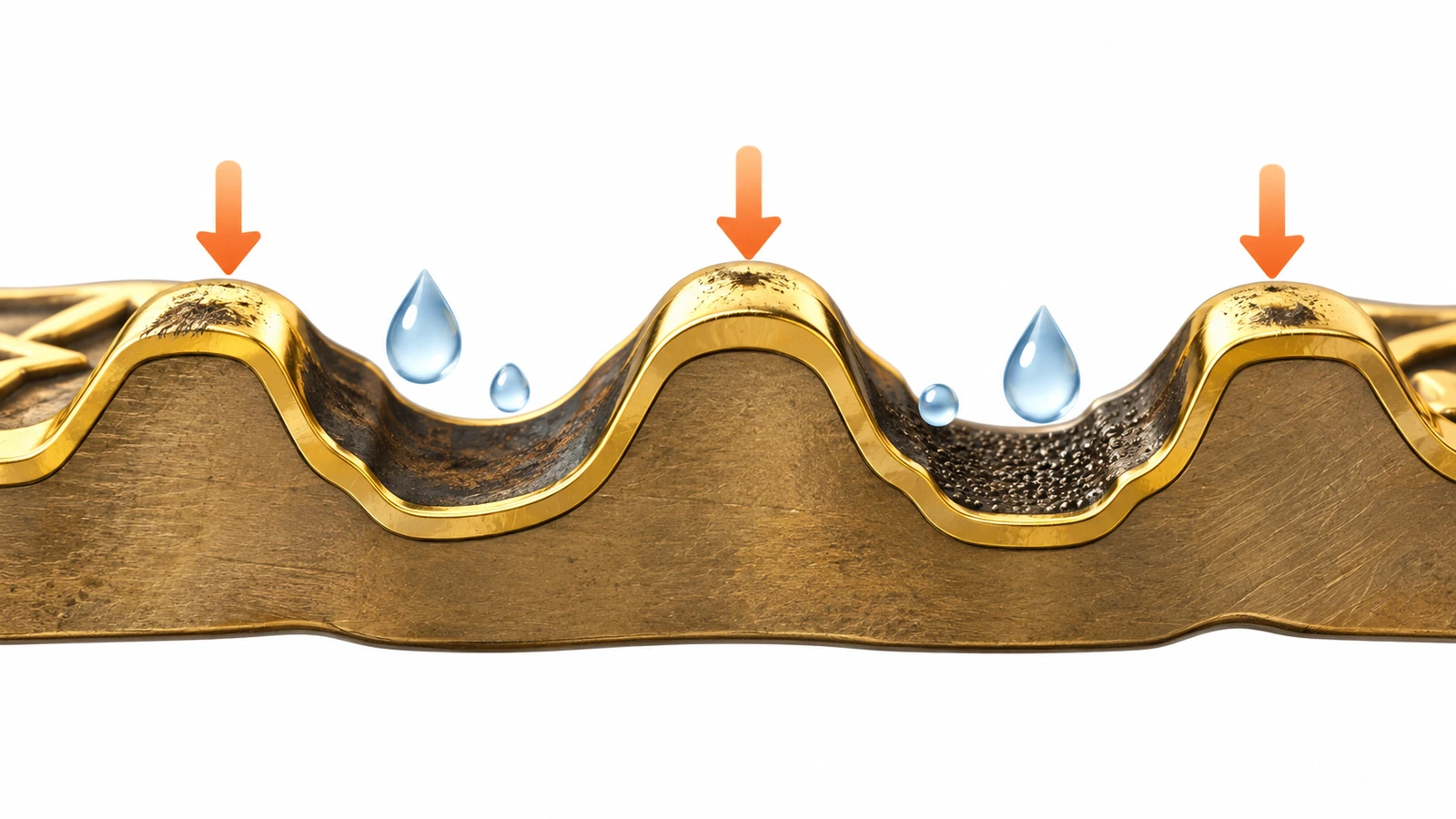
On a die struck pin, the raised areas are the high points the die leaves standing: outlines, lettering and borders. The recessed areas are the lower field around them. Each finish treats these two zones differently, and that treatment controls legibility, how wear shows and how much work the factory has to do.
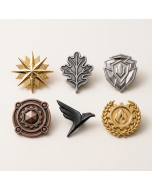
Polished (bright) plating
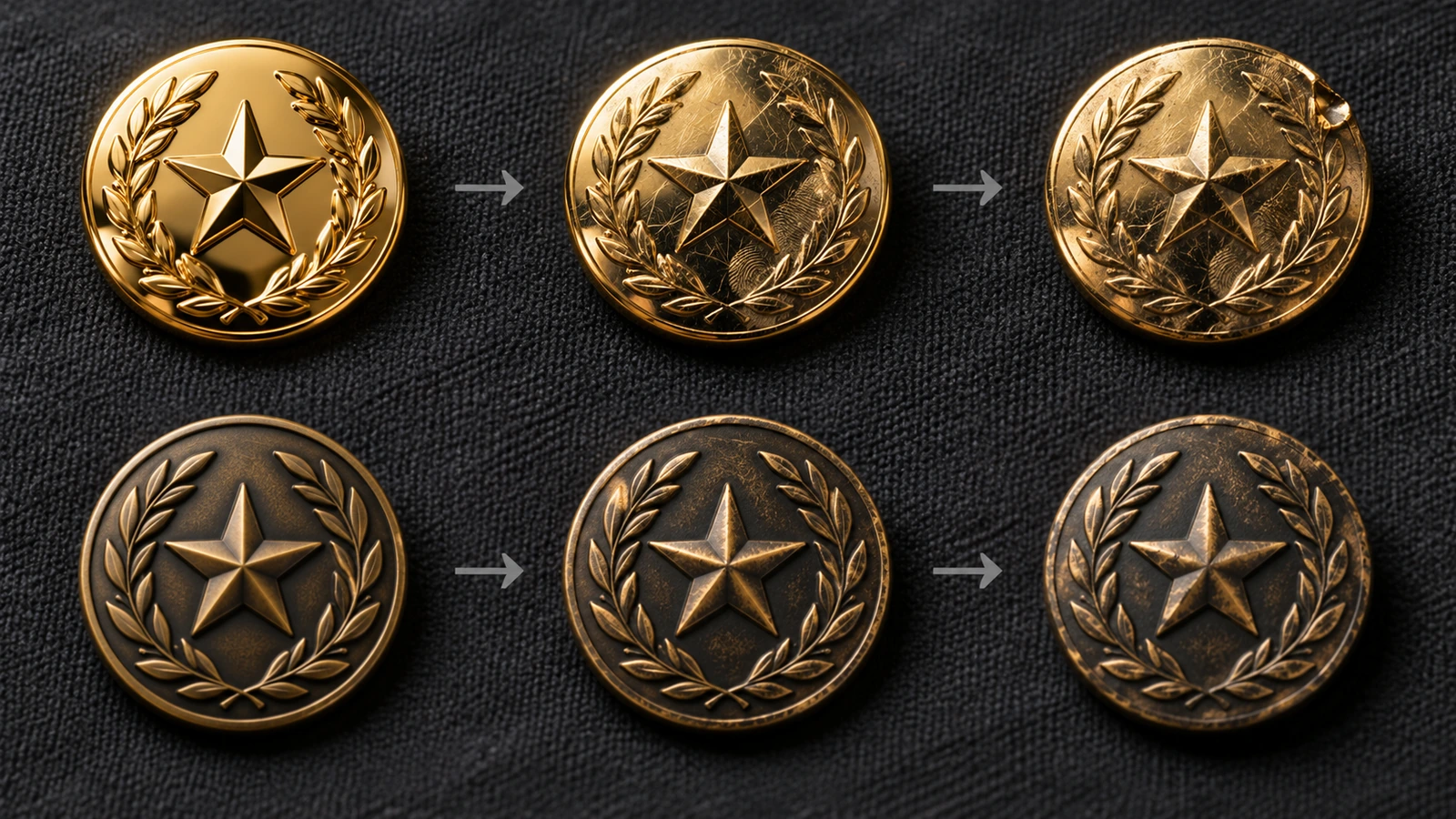
Look: Both raised and recessed areas are plated in one bright color. Raised areas are mirror-polished, and the recessed field is usually textured so the design still separates. Polished gold or silver reads as formal and high-value. Daily wear: Mirror surfaces show fingerprints within one handling and fine hairline scratches within weeks of regular wear. Dents from transit or bulk packing are most visible on this finish. Cost and time: This is usually the baseline finish, with no extra oxidation or masking steps. Best for: Simple, bold designs with large lettering, such as executive gifts and milestone awards that live in a presentation box more than on a lapel.
Antique plating (gold, silver, copper, brass)
Look: The pin is plated, chemically darkened, and then relief-polished so only the raised high points return to bright metal. Recessed areas stay dark, which gives an engraved, heirloom contrast. Daily wear: Antique is the most forgiving finish. Abrasion polishes the high points, which antiquing already does on purpose, so wear tends to look like character rather than damage. The weak point is the recessed dark layer: harsh metal-polish dips or abrasive cleaners can strip it. Cost and time: It adds an oxidation bath and a hand or tumble relief-polishing step, so expect a modest premium and more batch-to-batch variation in darkness unless a reference sample is agreed. Best for: Dense lettering, seals, crests, service-year pins, and anything worn daily on uniforms. Antique gold plating is the default recommendation for designs with small text.
Black nickel plating
Look: A dark, smoky gunmetal tone across the whole pin. It feels modern and understated. Because raised and recessed areas share one dark color, contrast comes only from polish versus texture. Daily wear: A black nickel finish hides fingerprints well. Deep scratches can expose a brighter underlayer, though, and that shows clearly against the dark surface. Cost and time: This is a specialty bath at many factories, so it may carry a surcharge or depend on the schedule for that bath. Confirm both when you quote. Best for: Tech brands, minimalist marks and pins worn on dark garments. Avoid it for fine lettering unless you pair it with sandblasting or a second plating color.
Dual plating (two-tone)
Look: Two plating colors on one pin, usually gold raised areas over a silver or nickel field, or the reverse. This gives the strongest color separation possible without enamel. Daily wear: The finish wears the same way as its two component platings. The specific risk is the boundary line, where a slightly misaligned mask leaves one color bleeding into the other. Cost and time: This is usually the most expensive and slowest finish. It needs masking, a second plating bath and extra inspection, and every added step is another point where a batch can be rejected and redone. Best for: Premium recognition tiers, anniversary editions and logos where two metal colors carry meaning, such as a gold emblem on a silver shield.
Sandblasted finish
Look: Recessed areas, and sometimes the whole face, are blasted with fine abrasive before plating, which leaves a frosted matte texture. Paired with polished raised areas, it gives clean contrast in a single color. Daily wear: Matte texture hides fingerprints and light scuffs far better than mirror polish. Its weakness is that skin oil and dirt can settle into the texture over time and dull it, and it needs a soft brush rather than a cloth. Cost and time: It adds a blasting step, but this is often bundled into standard die struck production. Confirm whether your quote includes it. Best for: Clean modern logos, and as a contrast partner for polished, black nickel or dual plating. A sandblasted pin finish rarely stands alone on designs with fine text.
How Do You Choose and Specify a Finish? Six Steps
The steps below cover only the finish decision. Quoting, proofing and production approval are covered in the die struck pin buying guide.
Audit the artwork for contrast needs. Count the elements that must be readable: names, dates, Latin mottos, fine borders. If the design depends on small text, start with antique plating or a polished-and-sandblasted pairing. If it is one bold shape, polished or black nickel works.
Match the finish to how the pin is worn. A pin worn every day on a uniform or lanyard needs a wear-forgiving finish such as antique or sandblasted. A pin presented once and displayed in a case can use mirror polish safely.
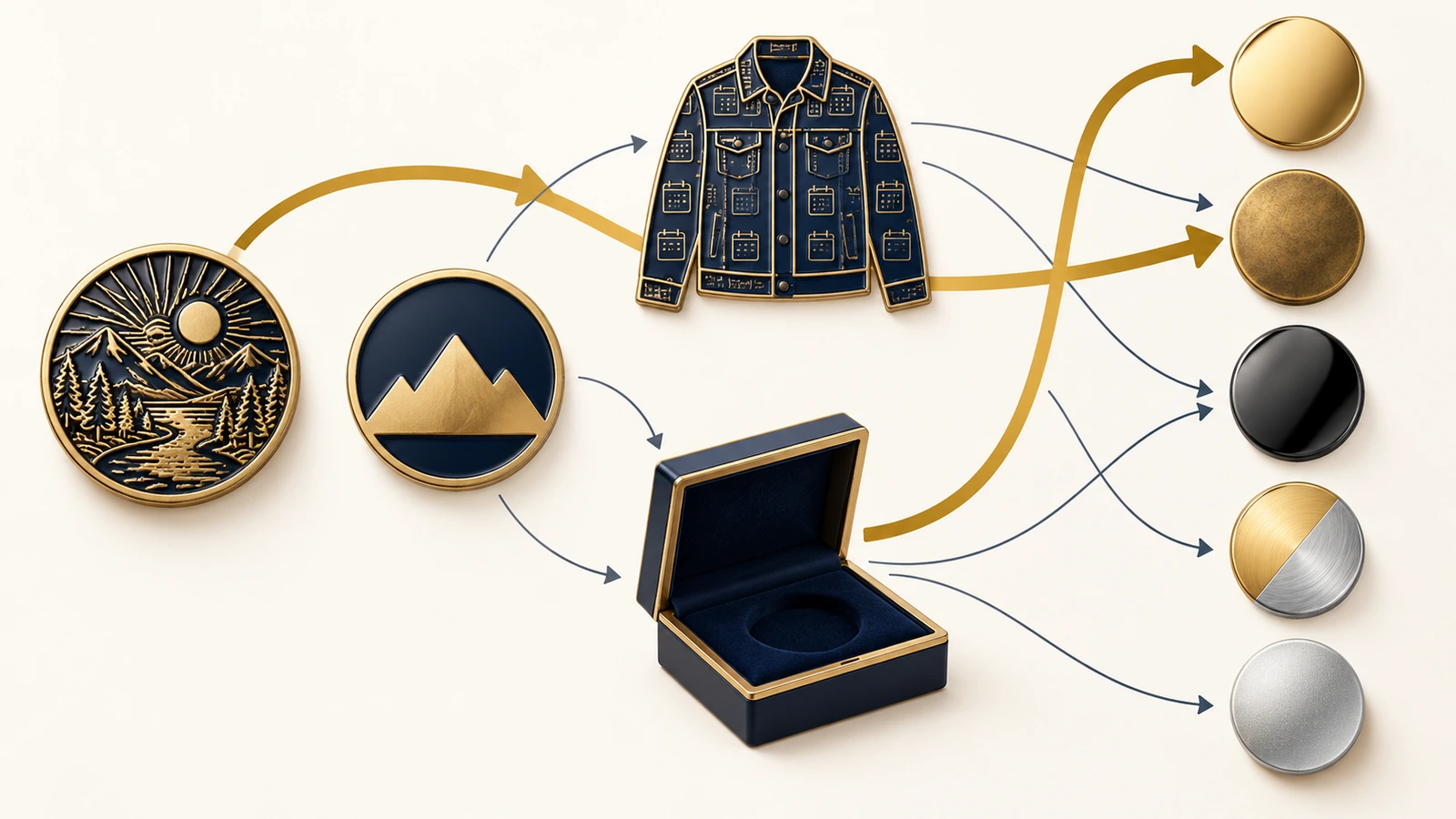
Check the finish against the garment. Black nickel nearly disappears on charcoal suits. Polished silver can wash out against light-gray fabric. Gold and antique gold read clearly on navy and black.
Write a finish map, not a color name. For each zone (raised, recessed, edge), state the plating color and treatment, for example "raised: polished gold; recessed: sandblasted gold." Ask the factory to state plating thickness in microns and whether a clear protective lacquer is applied.
Request test evidence for high-wear programs. For uniform or daily-wear pins, ask which methods the factory uses to check plating. Common references are ASTM B571 for plating adhesion and ASTM B117 or ISO 9227 for salt spray corrosion resistance. Agree the target result in writing instead of accepting "won't fade" language.
Approve a physical sample under real light. Look at the sample at arm's length under office fluorescent light and in daylight. Digital renders cannot show oxidation depth or how glare behaves on mirror polish. Record the approved finish code and keep the sample as the reference for reorders.
How Do Lapel Pin Plating Options Compare on Look, Wear, Cost and Lead Time?
The table ranks each finish on relative terms only. Exact unit price and production time depend on size, quantity, plating bath scheduling and packaging, so request a quote with your finish map attached to get firm numbers.
Finish
Raised areas
Recessed areas
First visible wear
Relative cost
Schedule impact
Strongest use
Polished
Mirror bright
Same color, usually textured
Fingerprints, hairline scratches, dents
Baseline
None added
Bold, simple award pins
Antique
Bright high points
Darkened
Recess darkness fading if over-cleaned
Low premium
Oxidation and relief-polish step
Small text, crests, daily uniform wear
Black nickel
Dark, polished sheen
Dark, matte or textured
Deep scratches showing brighter underlayer
Low to medium premium
May depend on specialty bath schedule
Minimalist and tech brands
Dual plating
Color A
Color B
Edge bleed at the color boundary (a production defect)
Highest
Masking plus second bath plus extra inspection
Premium tiers, two-metal emblems
Sandblasted
Polished or matte
Frosted texture
Dirt settling in texture
Often included
Blasting step, often standard
Clean logos, contrast partner
What actually shortens a finish's life?
Under every finish, the base metal stays sound much longer than the surface does. What wears out is the appearance, and four factors control that. The first is plating thickness and pretreatment: thin or poorly bonded layers peel at the edges first. The second is contact with sweat and humidity: chlorides in perspiration attack thin plating, which is why pins worn on gym bags or outdoor uniforms age faster. The third is abrasion against fabric and other pins, which affects high points first. The fourth is storage: pins kept loose in a drawer scratch each other, while individually bagged pins stay closer to factory condition.
For care instructions to send with the pins: wipe with a dry microfiber cloth, use a soft brush on sandblasted surfaces, and never dip antique finishes in silver or brass polish, because it removes the darkening that makes the design readable.
Do Plating Choices Affect Safety Compliance?
For adult corporate pins worn on clothing, finish choice is mainly an aesthetic and durability decision. It becomes a compliance decision in two situations.
Nickel exposure. Nickel and black nickel platings contain nickel. In the EU and UK, REACH limits nickel release from items that stay in direct and prolonged contact with skin, as summarized in this EU/UK pin compliance checklist[4]. If pins will be sold in Europe as jewelry, or worn against skin, confirm whether the rule applies and ask about nickel-free alternatives.
Children's products. If a pin is designed or marketed mainly for children aged 12 and under, U.S. law limits total lead in accessible substrate to 100 ppm and lead in surface coatings to 90 ppm, according to the U.S. Consumer Product Safety Commission[5]. Third-party testing and a Children's Product Certificate are required. ASTM F2923-20[6] explicitly includes pins in its children's jewelry scope. California adds its own lead and cadmium rules under the Metal-Containing Jewelry Law[7]. These risks are real: in 2008 the CPSC announced a recall of licensed lapel pins[8] because of high lead levels. If a factory advertises "recycled metal" or "eco plating," ask for batch documentation before you repeat the claim in your own marketing.
FAQ
FAQ: Is gold-plated die struck metal real gold?
Gold plating is a thin electroplated layer of gold over a base metal such as brass, copper or iron. Some economical finishes use a gold-tone color instead of gold. Ask the factory to state on the quote whether the plating contains gold, and give its thickness in microns, so that competing quotes describe the same finish.
FAQ: Which plating is best for pins with very small text?
Antique gold or antique silver. The darkened recesses frame each raised letter, so the text stays readable at arm's length. Polished-only finishes reflect light across the letters, and black nickel removes color contrast, so both lose fine text faster.
FAQ: Will an antique finish wear off?
The bright high points wear in gradually, which suits the antique look. The darkened recesses are protected by their depth and usually last unless they are scrubbed with abrasive cleaners or metal-polish dips. Dry-cloth cleaning keeps the contrast in place.
FAQ: Is black nickel suitable for people with nickel allergies?
Black nickel contains nickel. Lapel pins usually rest on fabric rather than skin, but for jewelry-style use or skin-contact designs, choose a different plating or ask the factory for a nickel-free underlayer and supporting documentation.
FAQ: Can I combine a plating finish with color?
Yes. Enamel can be added to the recessed areas of a stamped base, but at that point the pin is an enamel-filled die struck pin rather than a classic all-metal piece. The plating then mainly shows on the raised outlines. A comparison of processes is in our die struck pin manufacturing guide.
FAQ: Can I match the finish of an existing emblem or seal?
Send the factory a physical example, not a photo, so they can match plating color and oxidation depth. If the design itself is a registered mark that belongs to another organization, confirm your rights first. The USPTO[9] trademark search is a good starting point.
Key Takeaways
Finish selection affects a large share of pin orders, not a niche one. Metal pins hold 54.3% of a roughly $2.8 billion global pin buttons market (Source)
Pins sit inside an awards-heavy promotional channel where perceived quality drives reorders. U.S. distributor sales reached $26.78 billion in 2024, up 2.63% (Source)
Industry size estimates depend on method, so use them for context only. A revenue-based view puts U.S. promotional products at about $22.4 billion for 2026 (Source)
Children's pins need tested platings and coatings, whatever finish you choose. The limits are 100 ppm lead in substrate and 90 ppm in surface coatings (Source)
Plating compliance failures have already caused pin recalls. The CPSC recalled lead-tainted licensed lapel pins in 2008 (Source)
Pins fall within children's jewelry safety scope when marketed to kids. ASTM F2923-20 explicitly lists pins (Source)
Conclusion
The right finish is the one that keeps your design readable after a year of real wear, not the one that looks best in a render. Choose antique when legibility and daily wear matter. Choose polished for bold pins that are presented more than worn. Use black nickel for understated branding with simple shapes. Reserve dual plating for programs where two metal colors carry meaning and the budget allows the extra steps. Pair sandblasting with any of these when you need contrast without color. Write the choice down as a zone-by-zone finish map, approve a physical sample, and keep that sample for reorders.
When your finish map is ready, take it into a full specification with our guide to factory-direct custom die struck pins, and request a quote to get exact pricing and production time for your design.
Sources
Promotional Products Association International (PPAI), "2024 Sales Volume Report." ppai.org. Accessed 2026-10-21. ↩
IBISWorld, "Promotional Products in the US" (NAICS 54189). ibisworld.com. Accessed 2026-10-21. ↩
Hi there! I'm Bruce, proud dad to my amazing son. I'm the founder of Zigpac, a printing and packaging company empowering small and medium-sized businesses with custom solutions. Let's create something great together!



 Blog PDF for offline reading












The information below is required for social login
Sign In
Create New Account