Custom soft enamel pins use raised metal lines around recessed color areas to create a tactile, dimensional finish. SKU ZPCP0001 has a verified minimum order quantity of 50 pieces, a verified production time of 3–10 days, and a verified unit weight of 0.012 kg. Final pricing, materials, dimensions, plating, packaging, shipping time, import charges, and special effects depend on the approved design and quotation.
Who Are Custom Soft Enamel Pins Designed For?↑
Custom soft enamel pins serve three distinct purchasing scenarios. Companies and organizations use them for employee recognition, event giveaways, club identity, fundraising, commemorative programs, and branded merchandise. Independent artists and small labels use them to test original designs, create limited releases, or add a compact product to an existing collection. Collectors choose them for visual identity, tactile interest, and personal expression on jackets, hats, bags, display boards, or other suitable surfaces.
The product is especially relevant when a design benefits from visible metal outlines and recessed color. Some collectors actively prefer this texture rather than treating it as a lower-grade substitute for a smooth pin. One community discussion describes the tactile surface as a defining attraction of soft enamel texture[1].
Before ordering, identify the real objective: free distribution, employee recognition, retail resale, a limited collector release, or demand testing. That decision affects quantity, packaging, backing hardware, durability expectations, inspection criteria, and how much inventory risk is acceptable.
Why Do Promising Pin Designs Still Become Expensive Mistakes?↑
The problem is rarely a lack of customization choices. It is the gap between an attractive digital concept and a controlled production specification. A buyer may approve the general artwork while overlooking actual size, post position, back marking, Pantone references, plating, packaging, or acceptable manufacturing variation. Once the production proof is approved, an omitted detail can become an entire batch of unusable merchandise.
The pain becomes more severe in bulk orders. Reported failures include uneven fill, missing enamel, rust, rough edges, incorrect posts, unwanted back logos, plating defects, and inconsistent pieces within the same batch. One creator reported serious quality problems across a 400-piece order, illustrating how a single uncontrolled run can turn anticipated inventory into a difficult refund negotiation. This is a reported case, not an industry-wide defect rate, but it identifies a credible bulk quality-control risk[2].
The solution is a proof-first purchasing process: define the application, preflight the artwork, approve every visible and functional detail, obtain a complete quotation, choose proportionate sampling, and document inspection and remedy terms. Low unit cost cannot compensate for illegible artwork, weak attachment hardware, missed event dates, unauthorized intellectual property, or inventory that customers perceive as poorly made.
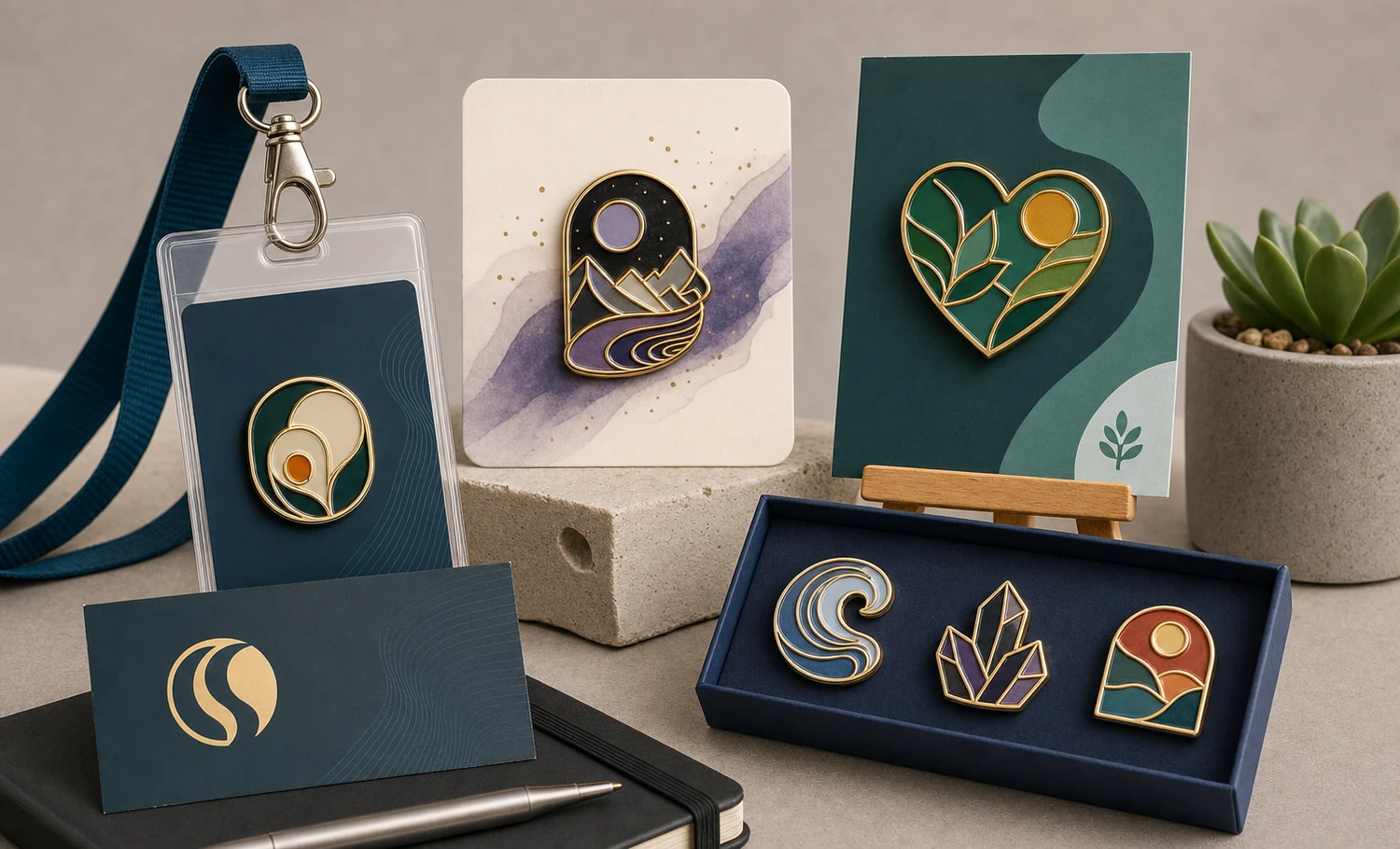
Table of Contents
What Defines a Custom Soft Enamel Pin?↑
A soft enamel pin has raised metal boundaries with color deposited into lower recessed areas. The height difference creates the characteristic texture. The metal lines separate individual color regions, reinforce outlines, and become part of the artwork rather than merely supporting it.
This construction is well suited to solid color blocks, expressive outlines, lettering that remains readable at the selected size, and designs that deliberately use exposed metal. An independent product review reported vibrant color and strong reproduction of small decorative details, while also noting that proof approval affected the final result. It is useful as an experience-based illustration of both the visual opportunity and the buyer’s responsibility during artwork reproduction, not as a guarantee for every order.
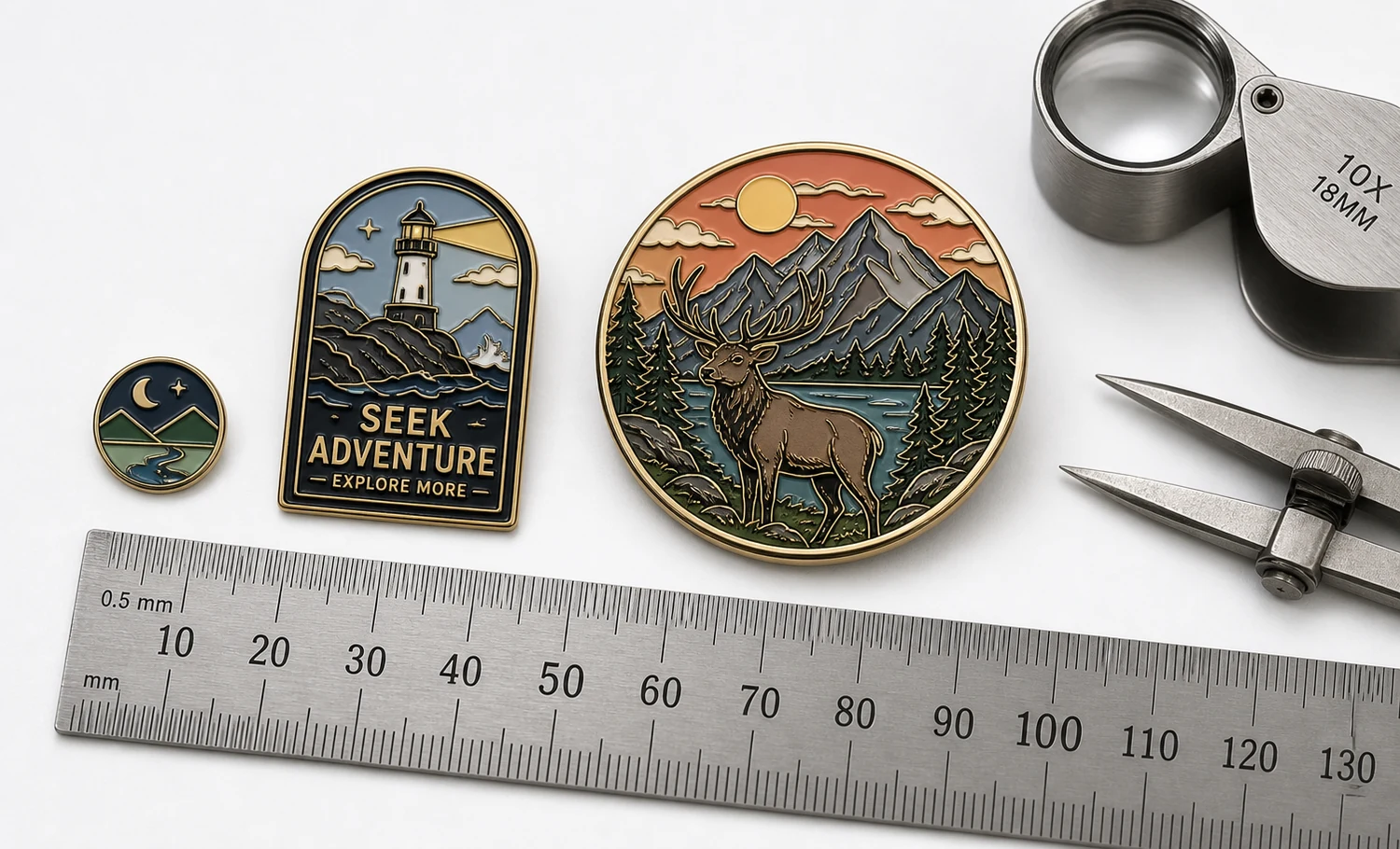
Dimensions must be judged at physical scale
A design that looks clear on a large monitor may become crowded when reduced to pin size. Review an actual-size printout rather than relying only on a zoomed screen. Check the smallest text, enclosed color areas, gaps between lines, edge clearance, and whether the silhouette is recognizable from normal viewing distance.
Supplier guidance in the research materials uses approximately 0.2–0.3 mm for metal lines, approximately 0.3 mm for fillable color areas, and at least 6 pt as a reference for soft enamel text. These are supplier-side process references, not universal production guarantees. The applicable minimums must be confirmed against the chosen dimensions, metal-forming method, plating, and approved artwork.
Surface and attachment choices affect the user experience
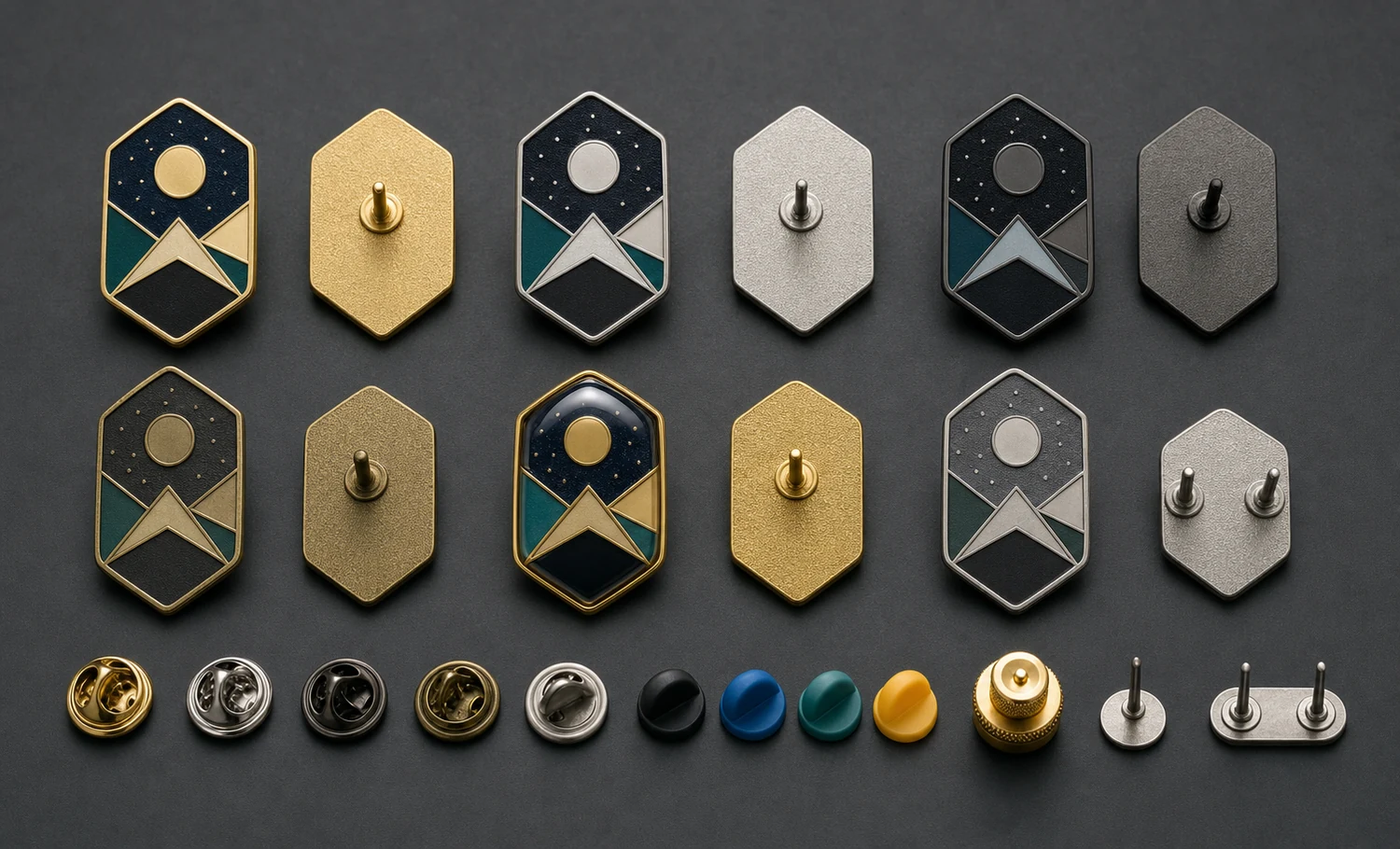
Commonly discussed metal finishes include gold, silver or nickel, black nickel, antique gold, antique silver, and copper tones. Availability and appearance remain quotation and proof items. Special finishes, glitter, glow effects, printing, movable structures, or other treatments must not be assumed from a generic product name.
Attachment choices may include butterfly clutches, rubber clutches, locking clutches, one or two posts, magnets, or safety-pin-style fittings. The correct choice depends on physical dimensions, weight distribution, wearing orientation, substrate, and expected use. A larger or unbalanced design may need two posts to resist rotation, but this must be determined from the actual dimensions, loading condition, and sample validation.
A transparent epoxy layer is optional; it is not the soft enamel itself. It can cover recessed areas, modify the tactile surface, and provide additional surface protection, but it can also create a domed appearance and introduce aging concerns. Community reports mention possible yellowing, cracking, or coating deterioration after extended use under varying material and environmental conditions. These reports identify a risk rather than a uniform service-life prediction for epoxy-coated soft enamel pins[4].
How Should You Prepare and Approve a Custom Pin Order?↑
1. Define the commercial and functional brief
Record the intended use, quantity, physical dimensions, target arrival date, distribution method, packaging requirement, budget basis, and rights ownership. Separate the production deadline from the delivery deadline. For event work, the schedule should account for proof revisions, production, inspection, international or domestic transportation, customs clearance where applicable, and contingency time.
SKU ZPCP0001 has a verified MOQ of 50 pieces, verified production time of 3–10 days, and verified unit weight of 0.012 kg. Production time must not be interpreted as total door-to-door delivery time. Freight method, destination, customs processing, holidays, proof revisions, and special packaging can affect the final arrival date.
2. Preflight the artwork before requesting production
AI, EPS, or vector PDF files are preferred when available. A bitmap must be sufficiently clear for conversion, but conversion does not automatically make every element manufacturable. Review whether each color area is closed, whether colors are separated by metal, and whether gradients, photographic content, tiny gaps, or very fine lettering should instead use a printed construction.
Check intellectual-property rights before submitting artwork. Unauthorized use of entertainment characters, games, films, music identities, trademarks, logos, illustrations, or fonts can lead to order refusal, marketplace removal, unsellable inventory, or legal claims. A manufacturer’s willingness to produce an image does not grant the buyer permission to sell it.
3. Approve a complete production proof
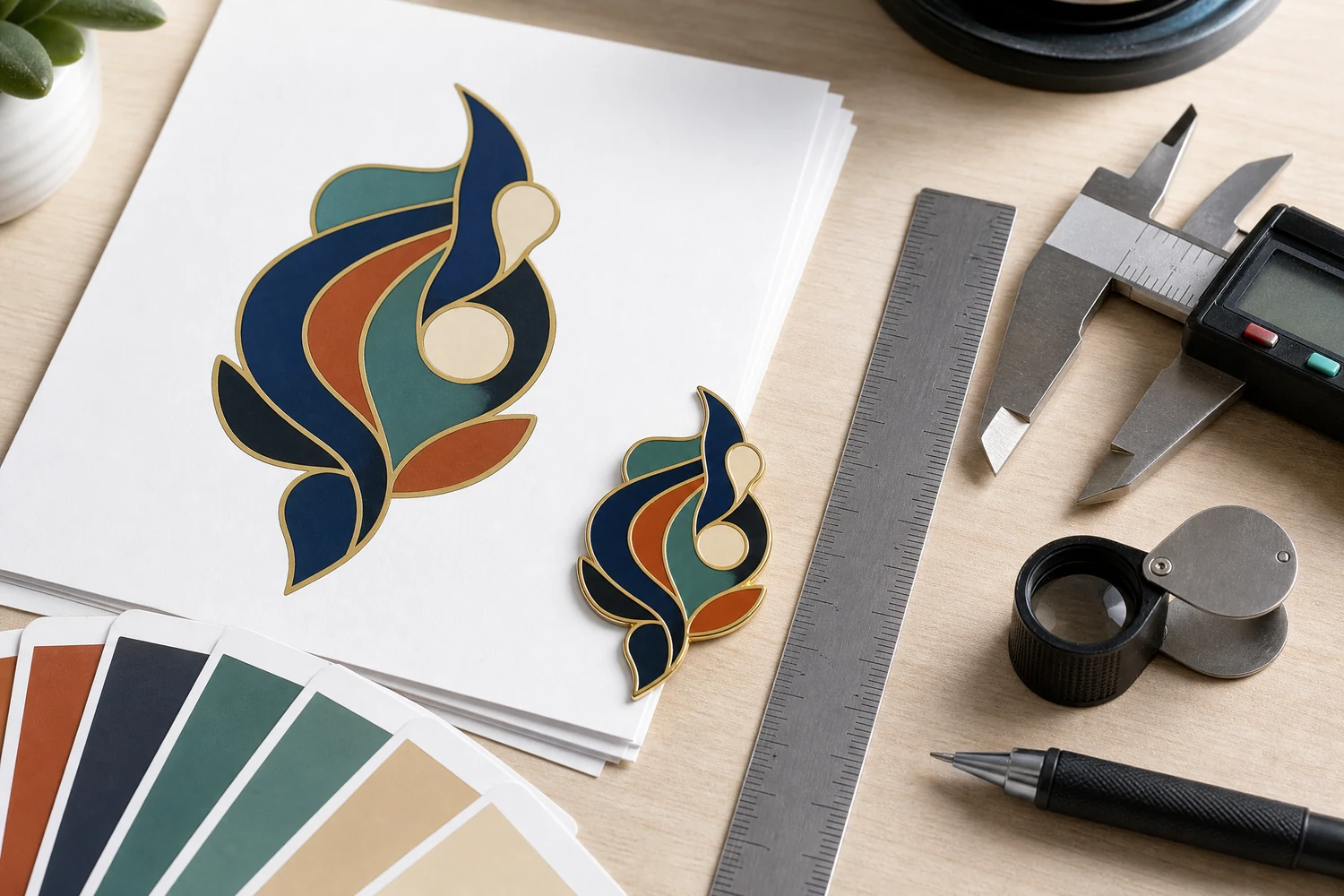
The proof should identify finished dimensions, Pantone or PMS references, plating, raised and recessed regions, post quantity and position, back logo or copyright text, clutch type, packaging, optional effects, and agreed production tolerances. Screen color is not a substitute for a physical color reference. If brand color is critical, consider a physical sample, video review, or trial run as a quotation item.
Print the proof at actual size and ask a second reviewer to check it. Inspect the spelling, margins, edge clearance, color labels, front orientation, post placement, back markings, and accessories. Freeze the design after approval. Any later change to dimensions, color, plating, back, post, or packaging should trigger a revised proof.
4. Understand the manufacturing sequence
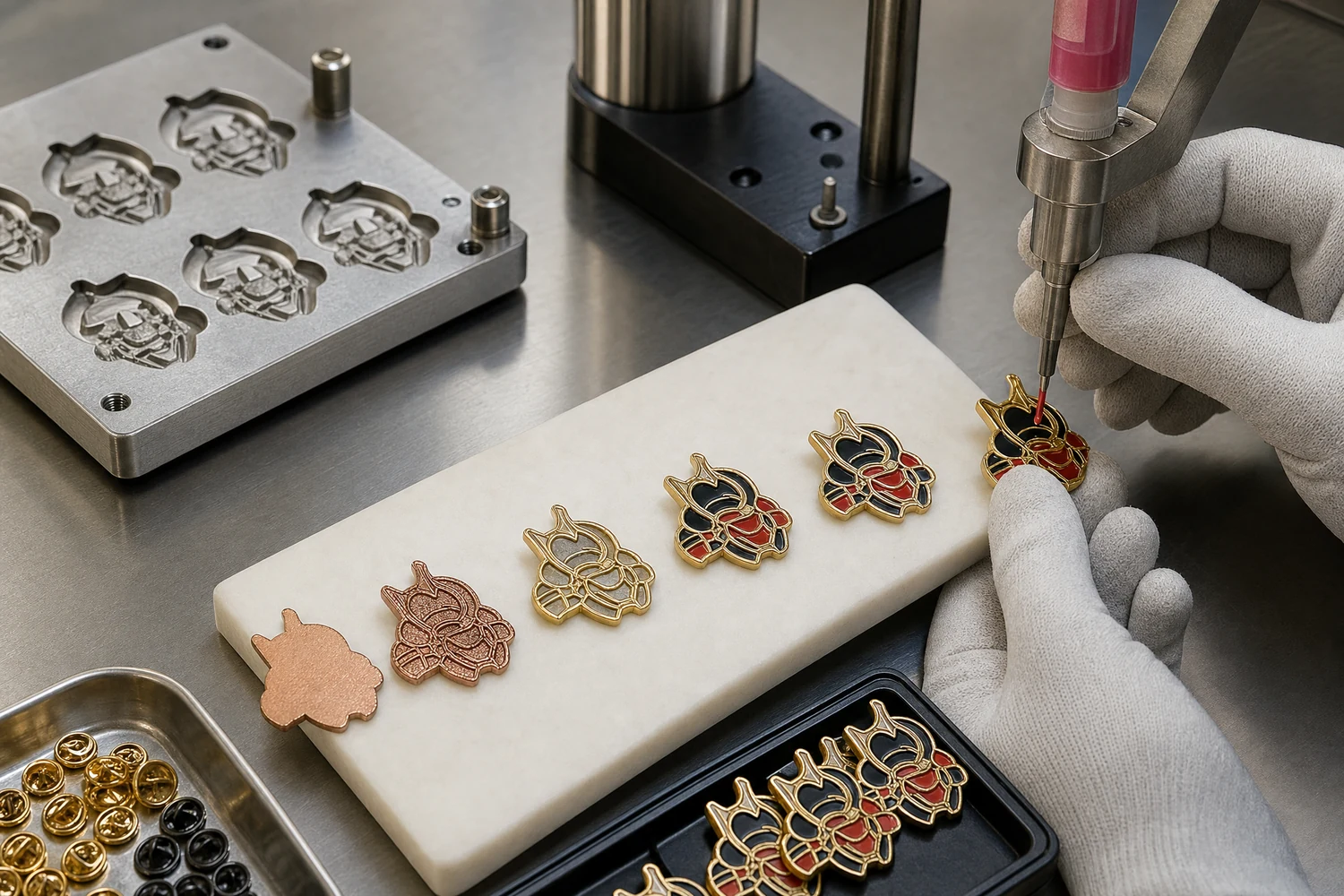
A typical sequence can include mold preparation, metal forming, outline cutting, post installation, deburring, plating, color filling, curing, inspection, attachment fitting, and packaging. Iron and zinc alloy appear as common base-material options in the supplied research, with zinc alloy often considered for complex outlines, cutouts, or cast structures. The final material and process remain design-dependent quotation items.
5. Establish inspection and remedy criteria
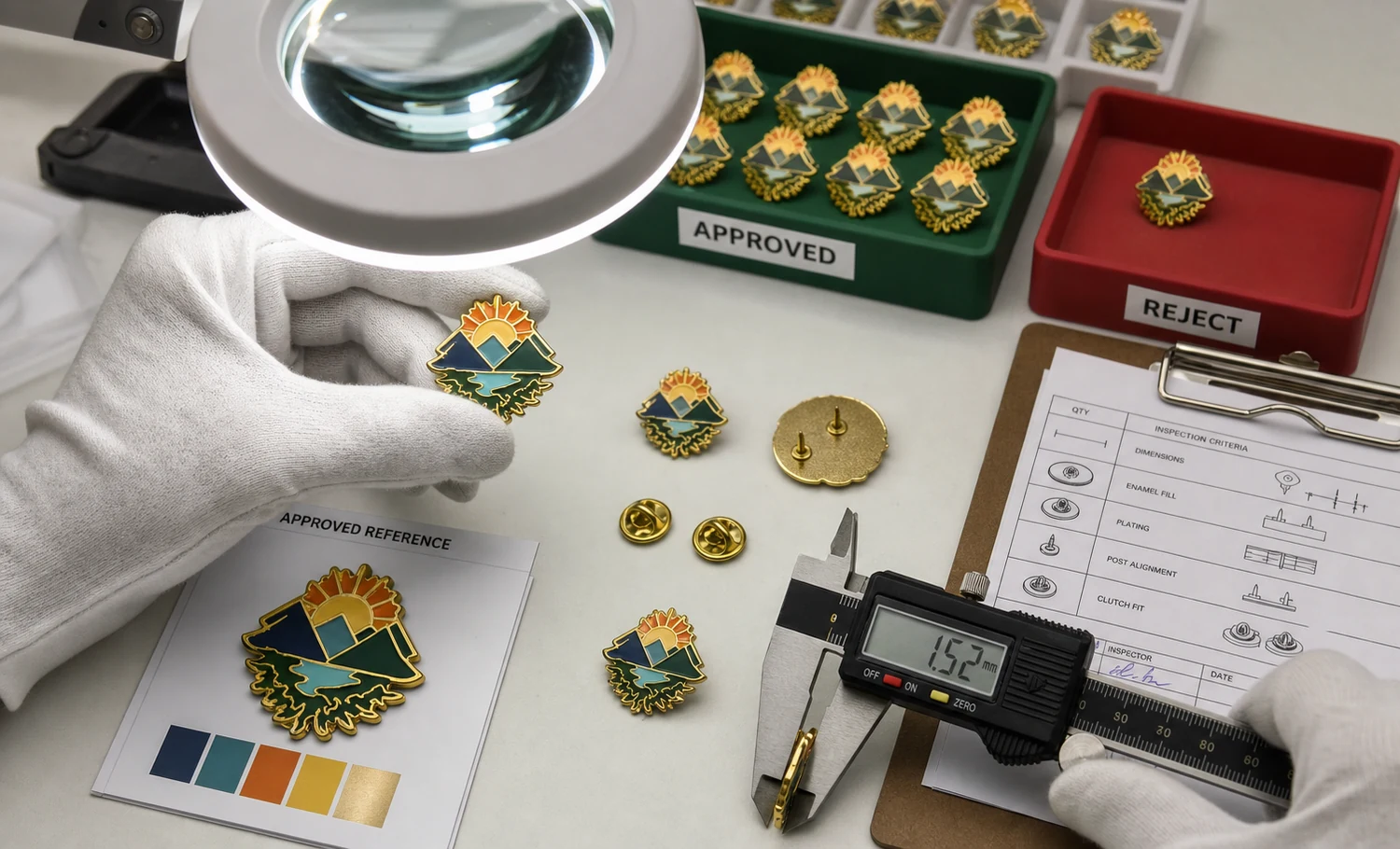
Inspection should cover color placement, fill height, exposed metal, bubbles, missing enamel, stains, scratches, burrs, plating coverage, post position, post security, clutch engagement, back markings, quantity, packaging, and consistency within the shipment. Classify defects as major or minor before production rather than debating definitions after delivery.
A major defect might be defined contractually as a condition that prevents intended use, materially changes approved artwork, creates an attachment failure, or makes the item commercially unacceptable. Exact definitions, tolerances, sample size, acceptance criteria, evidence requirements, and remedies are not provided as verified factory data and must therefore be agreed through quotation, sampling, and written order terms.
Which Pin Construction Best Matches Your Design and Use?↑
| Construction |
Visual and tactile result |
Best-fit use |
Decision boundary |
| Soft enamel |
Raised metal with recessed solid-color areas |
Art merchandise, promotion, events, clubs, and texture-led designs |
Choose when tactile relief and visible metal outlines support the artwork |
| Hard enamel |
Color filled close to the metal height and polished smooth |
Formal recognition, premium presentation, and frequent wear |
Choose when a smooth, flatter surface and greater scratch resistance matter more |
| Die-struck |
Metal relief with little or no color |
Awards, heritage designs, formal emblems, and metallic styling |
Choose when the design can communicate through metal texture alone |
| Printed pin |
Printed imagery capable of gradients and photographic detail |
Artwork that cannot be divided into enclosed enamel regions |
Choose when visual complexity matters more than traditional enamel relief |
| PVC or rubber |
Lightweight, flexible, and potentially dimensional |
Cartoon-led merchandise and soft promotional items |
Choose when flexibility or molded depth is preferred over metal character |
The comparison is not a universal quality ranking. Soft enamel’s recessed texture attracts some buyers and repels others. A community discussion contains both preferences: some participants value its tactile detail, while others associate hard enamel with a smoother and more consistent appearance. That divided collector preference[5] makes product positioning and sample evaluation more useful than declaring one construction universally superior.
Soft enamel may have a relative cost advantage, but it is not automatically the cheapest choice for every specification. Small quantities, complex outlines, numerous colors, special plating, packaging, expedited work, sampling, and shipping can narrow or reverse an advertised price difference. Compare constructions using the same dimensions, quantity, color count, finish, backing, packaging, destination, and remedy terms.
How Should You Evaluate Quotations, Suppliers, and Landed Risk?↑
Request an itemized quotation covering mold or setup, unit production, colors, special effects, backing hardware, back cards, individual packaging, samples, freight, insurance, import variables, rush fees, and defect remedies. “From” pricing is not a landed-cost comparison unless every supplier is quoting the same specification.
| Evaluation area |
Suggested weight |
Evidence to request |
| Quality consistency |
25% |
Approved sample, defect definitions, inspection method, and remake terms |
| Landed cost |
20% |
Itemized production, packaging, freight, and identified import variables |
| Schedule reliability |
15% |
Separate proof, production, inspection, shipping, and clearance stages |
| Design support |
10% |
Proof coverage for color, posts, back markings, accessories, and packaging |
| After-sales handling |
10% |
Claim window, required evidence, response time, and available remedies |
| Applicable compliance |
10% |
Documents matched to product age grading, material, and destination |
| IP controls |
5% |
Rights declaration and procedure for high-risk artwork |
| Review quality |
5% |
Recent, detailed, product-specific feedback from varied sources |
The weights are a purchasing framework, not an audited industry standard. Adjust them for the project: an event order may place more emphasis on the schedule, while a retail release may prioritize consistency, packaging, and repeatability. Positive community reports about affordable pricing, communication, and turnaround demonstrate that a favorable bulk outcome is possible, but a single supplier experience[6] cannot replace project-specific proof and terms.
Budget for inventory and import uncertainty
Low MOQ can reduce initial inventory exposure even when the unit price is higher. Larger orders may distribute setup costs across more pieces, but they also increase the loss if the design underperforms, infringes intellectual property, or arrives with unacceptable variation. Compare several quantity tiers against expected distribution or validated demand instead of optimizing only for the lowest unit price.
For US imports, do not rely on a historical per-piece customs estimate. Charges can depend on declared value, classification, origin, current tariff measures, de minimis treatment, electronic filing, and carrier or broker service fees. The supplied evidence does not provide a reliable current tariff rate. HTSUS classification, MFN treatment, Section 301 exposure, and clearance requirements should be checked at the time of transaction.
Match compliance evidence to the intended audience
Pins marketed to children can raise lead, coating, sharp-point, mechanical, and children’s-jewelry considerations that do not automatically apply in the same way to adult collectibles. The CPSC materials cited in the research state a 100 ppm total lead limit for accessible component parts of children’s products and a 90 ppm limit for lead in paint and similar surface coatings. Applicability still depends on age grading, materials, exemptions, and testing rules; review the official CPSC lead requirements[7] for the actual product.
The research also references ASTM F2923-20 for children’s jewelry. Because the supplied material does not establish that this remains the latest applicable edition, confirm the current standard, product scope, and testing obligations before making compliance claims. The cited ASTM F2923-20 standard[8] should not be presented as a blanket requirement for every adult collector pin.
Record the first batch before reordering
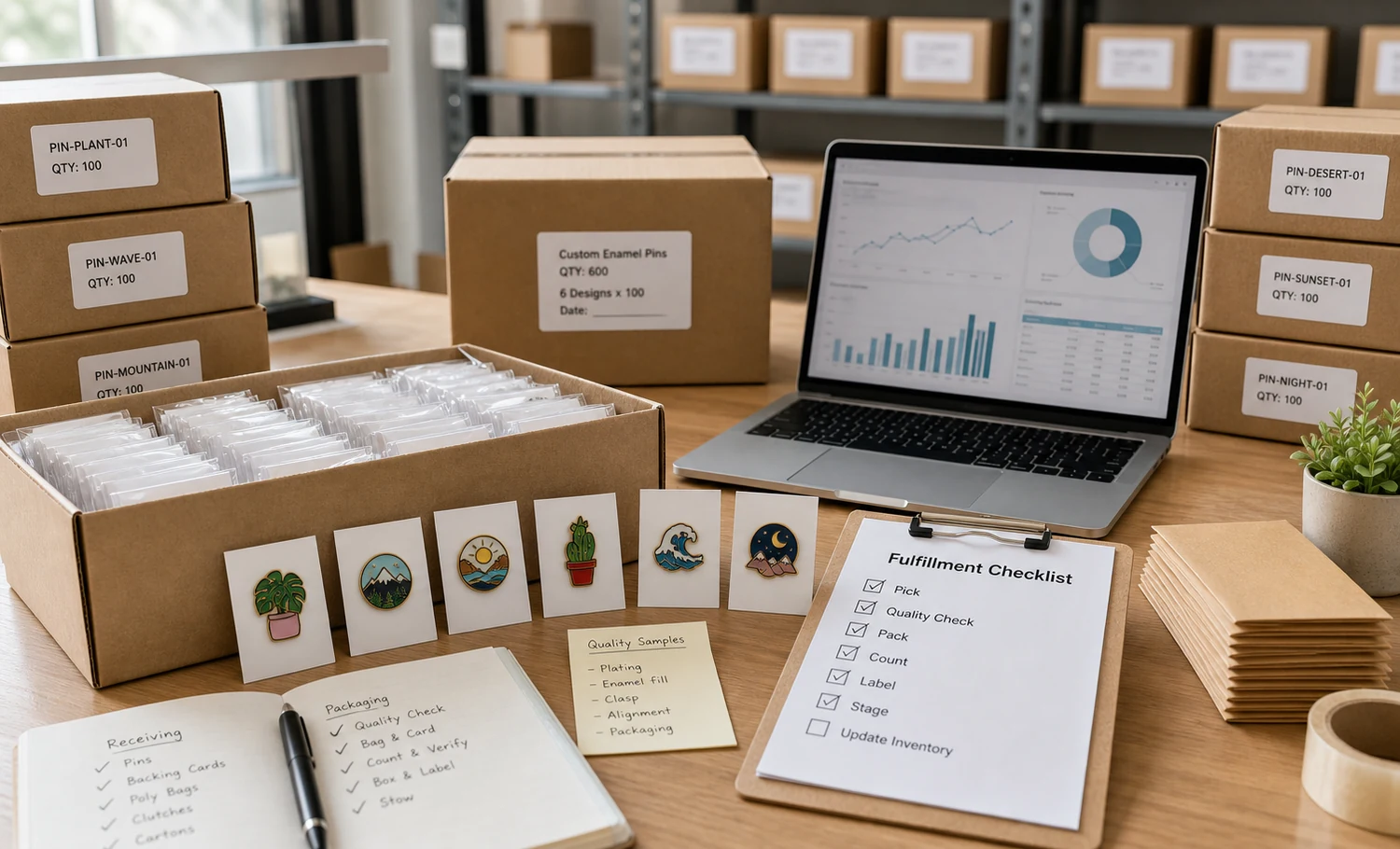
After receipt, document actual production and delivery timing, major and minor defect counts, color variation, customer reactions, distribution or sales velocity, packaging performance, and after-sales response. Confirm whether the mold is retained, for how long, under what ownership terms, and whether reuse creates a later charge. A repeat order should incorporate the first batch’s issues into a revised specification rather than relying on memory.
What Are the Key Takeaways for a Safer Purchase?↑
- SKU ZPCP0001 starts at a verified minimum order quantity. — 50 pieces.
- The verified production window must be separated from shipping and customs time. — 3–10 days.
- The verified unit weight should be used as the current procurement value. — 0.012 kg per piece.
- The broader US promotional-products market provides context, not a soft-enamel market size. — $26.78 billion in 2024 sales, up 2.63% (Source[9]). The report’s Buttons & Badges category excludes lapel pins used as awards, so it cannot be converted into product-level demand.
- The widely cited pin-buttons forecast uses a broader category than enamel pins. — $2.8 billion globally in 2025 and $4.6 billion projected for 2034 (Source[10]). These are third-party estimates that were not independently cross-verified in the supplied research.
- Marketplace supply confirms an active selling environment but not sales volume. — Etsy displays custom enamel pin listings (Source), while listing counts and third-party search estimates should not be treated as verified demand.
The external market figures above describe context, visibility, and purchasing intent; they do not prove Zigpac sales, capacity, defect rates, profitability, or market share. The procurement facts for MOQ, production time, and unit weight are listed separately because they are verified product facts rather than conclusions from market research.
What Should You Confirm Before Production Begins?↑
A successful custom soft enamel pin order begins with a manufacturable design and ends with a measurable acceptance standard. Confirm actual size, Pantone references, metal finish, raised and recessed areas, post layout, backing, reverse markings, packaging, schedule boundaries, intellectual-property rights, inspection criteria, and remedies before approving production.
Use samples or trial production when color, detail, attachment stability, or retail presentation is critical. Any capacity, load, attachment suitability, or compatible quantity must be determined by physical dimensions, loading condition, and sample validation. Do not substitute marketing claims, average review scores, or a low advertised unit price for a complete proof and itemized quotation.
Submit your artwork, required quantity, dimensions, finish, backing, packaging, destination, and target date to request one project-specific quotation and proof review.




The information below is required for social login
Sign In
Create New Account