Custom tri-fold brochures organize a brand story, product offer, event message, or service explanation across six printable faces in a compact folded format. Paper, finish, panel geometry, artwork, color expectations, inspection criteria, quantity, production time, unit weight, packaging, and delivery must be confirmed through quotation, proofing, sampling, or testing because no factory-specific procurement specifications were supplied.
Who Benefits Most from a Custom Tri-Fold Brochure? ↑
A tri-fold format is useful when a buyer needs more narrative space than a flyer but less bulk than a bound catalog. Common users include marketing agencies, small and midsize businesses, retailers, restaurants, manufacturers, nonprofit organizations, educational teams, freelancers, and independent creators. Typical applications include trade shows, product introductions, fundraising campaigns, local service promotion, sales follow-up, direct-mail programs, menus, portfolios, and branded information packs.
The format is particularly practical in face-to-face settings. A visitor can scan the cover, open the brochure to follow a structured message, and retain it for later reference. The supplied research describes trade shows and local services as recurring use cases, while the keyword snapshot recorded 10 monthly US searches and 20 worldwide searches for “custom tri fold brochures” on August 4, 2026. These figures describe the narrow search phrase, not the size of the broader brochure market. See the dated SEMrush keyword snapshot.
For B2B campaigns, the brochure can bridge physical and digital contact points: one panel establishes relevance, the interior explains the offer, and the final panel presents contact details or a QR destination. For consumer-facing campaigns, imagery and rapid scanning may matter more than detailed technical copy. In either case, the layout should be designed around one audience, one distribution setting, and one primary next action.
How Do You Avoid Wasted Spend, Weak Folds, and Unusable Artwork? ↑
The problem is rarely “just printing.” A brochure can fail because its message is crowded, a fold crosses important text, the paper feels different from the expected sample, the two sides do not align, or a color-sensitive brand element shifts during output. A low initial price may also exclude proofing, special finishes, packaging, freight, or revisions.
The pain becomes visible only after distribution begins. The supplied social research includes an overseas-order anecdote alleging weak paper quality and ink smearing after two weeks. That account is not a controlled test and should not be generalized to a country or production method, but it illustrates why a buyer should approve a representative physical sample rather than rely on price alone. The original account is available in the referenced small-business discussion[2].
The solution is a controlled specification and approval path: define the unfolded and folded dimensions, map the panel sequence, choose a candidate paper and finish, preflight the artwork, approve a digital proof, evaluate a physical sample where risk justifies it, document measurable acceptance criteria, and confirm packaging before the full order proceeds. Claims, testimonials, prices, guarantees, and comparisons should also be checked before permanent reproduction. The FTC business guidance reinforces the need for truthful, supportable advertising statements.
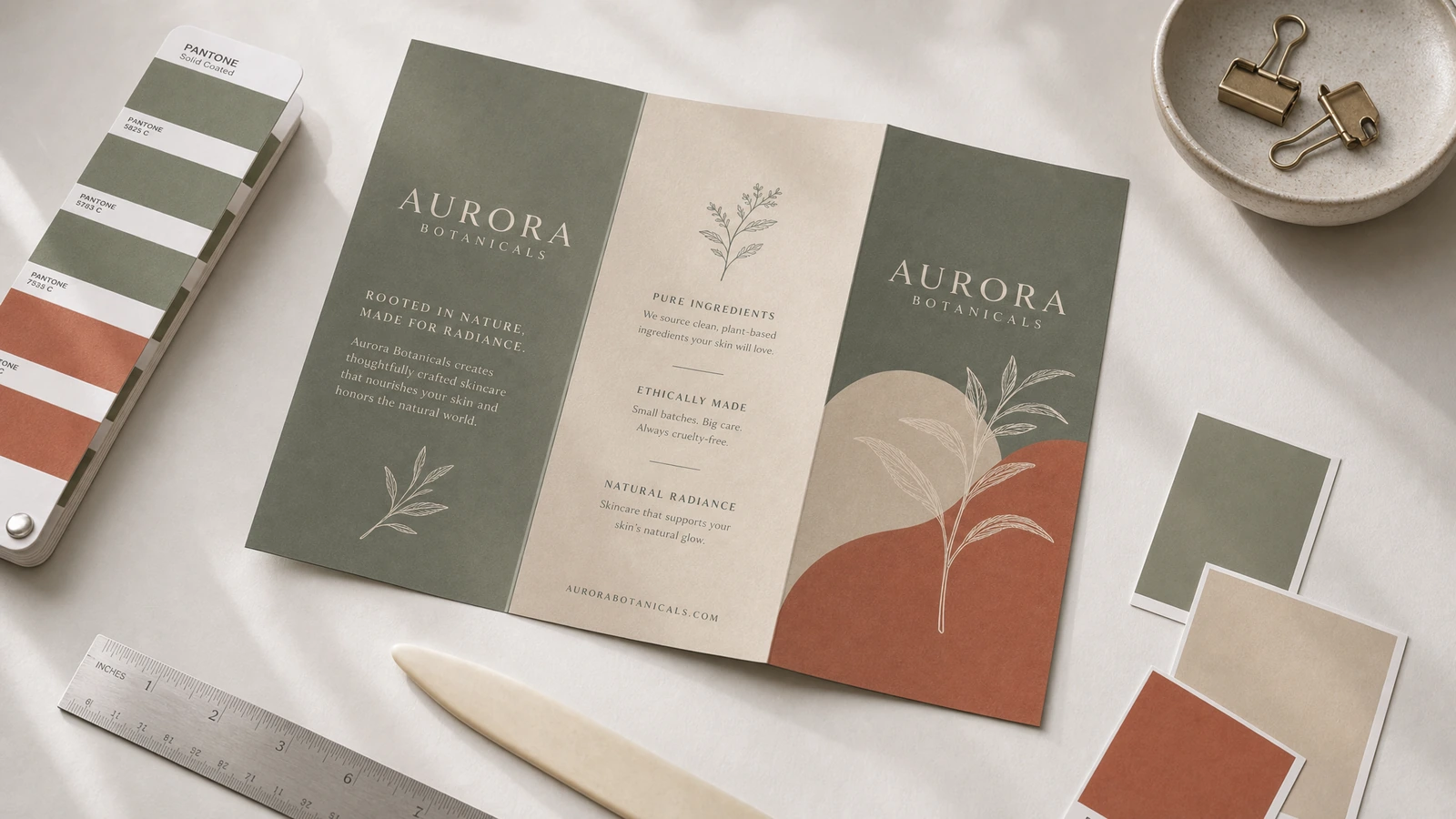
Table of Contents
What Exactly Should a Custom Tri-Fold Brochure Specification Define? ↑
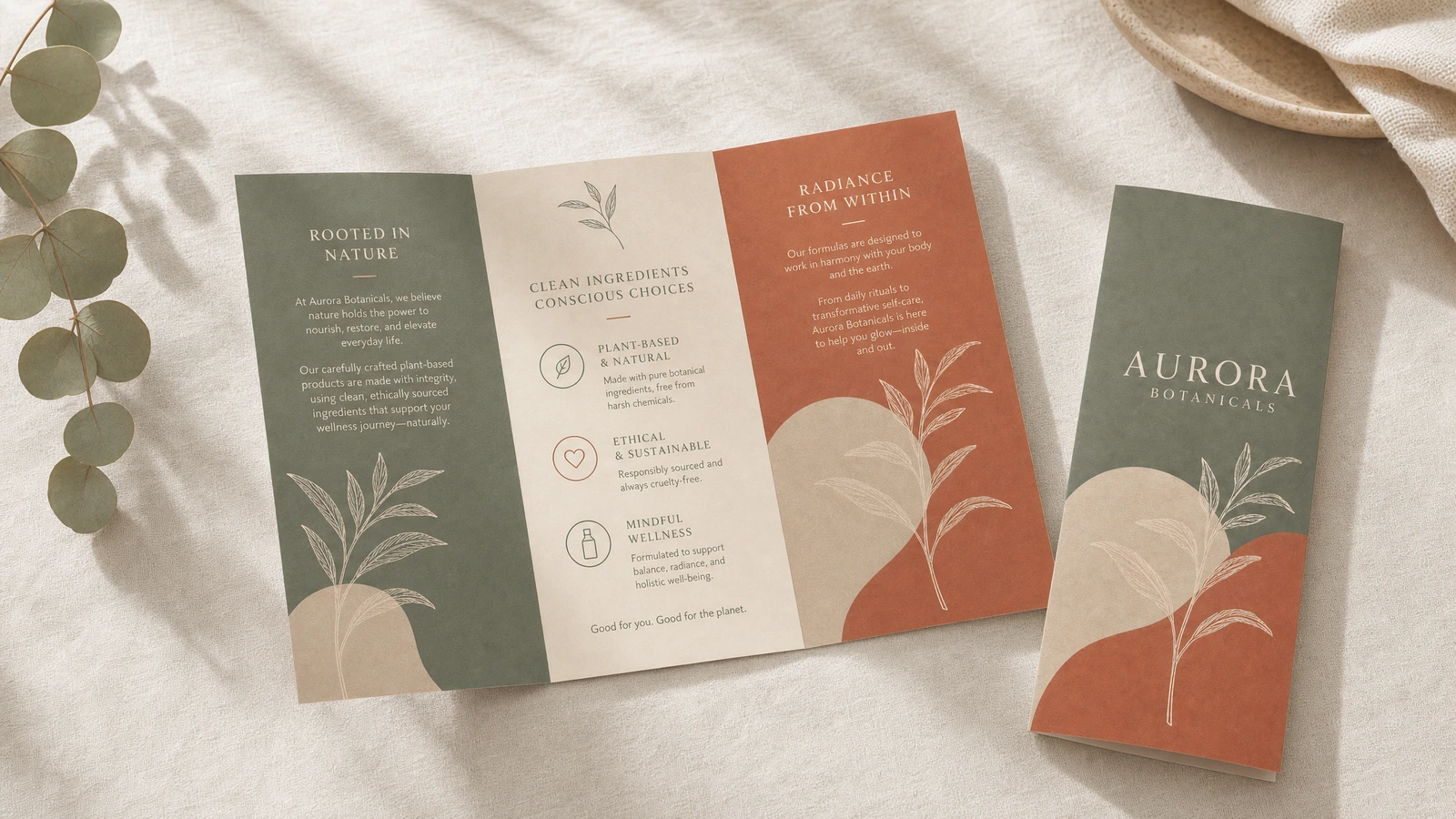
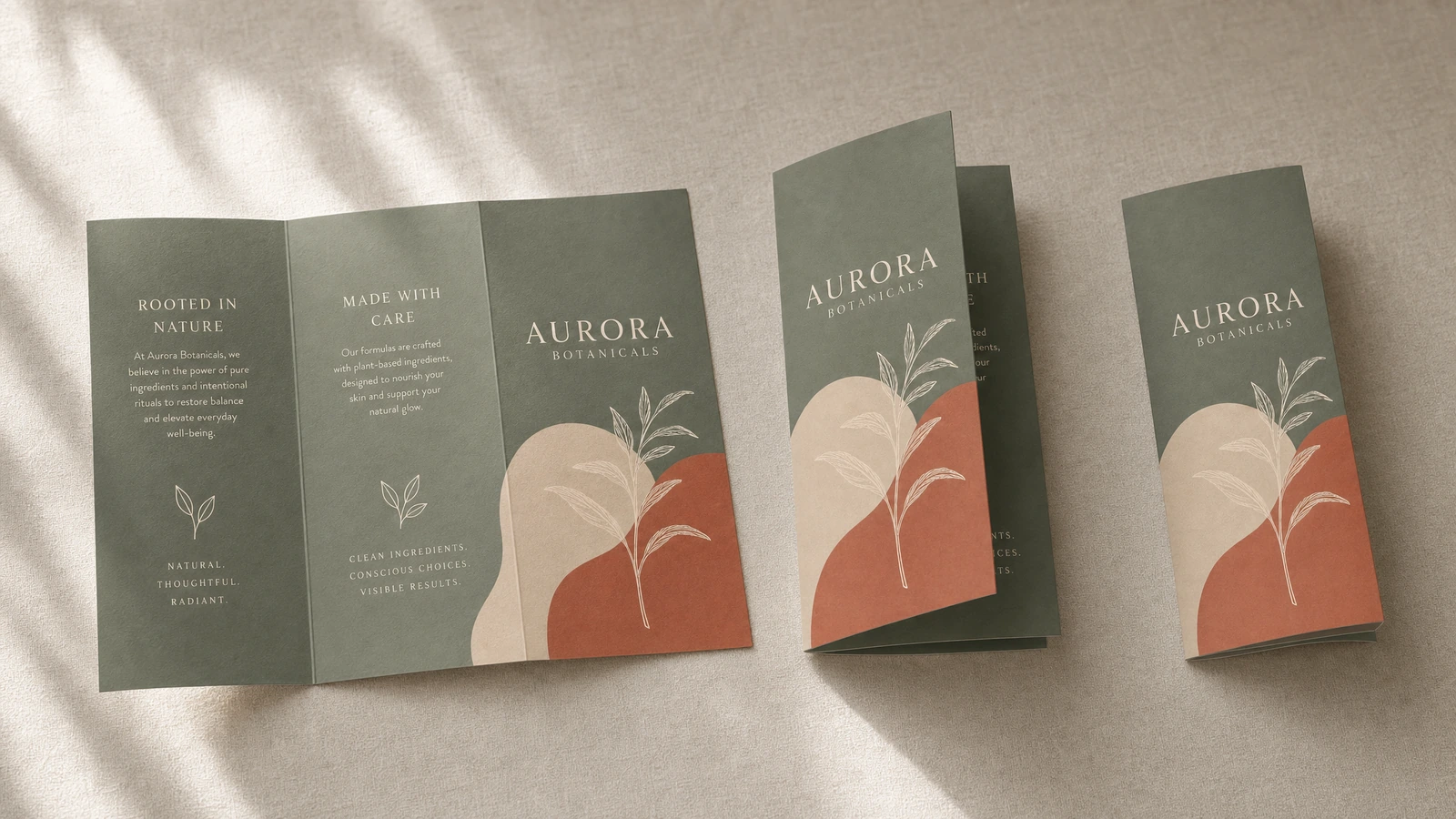
A tri-fold brochure starts as one sheet printed on both sides and divided into three vertical panels. Once folded, those panels create six reading faces: a front cover, a back panel, a fold-in panel, and three interior faces. A commonly referenced US format is 8.5 × 11 inches unfolded, producing panels of approximately 8.5 × 3.67 inches when described as equal thirds. In production, however, a roll-fold panel may require a small width adjustment so the inside panel nests cleanly. Final panel widths therefore belong in the approved dieline or layout guide.
Readability depends on more than sheet size. Establish a safe area around folds and trimmed edges; keep logos, prices, QR codes, contact information, and small text away from those boundaries. Panel order must be checked in both flat and folded views. A technically correct flat layout can still produce a confusing reading sequence if the designer misidentifies the cover or fold-in panel.
The specification should separate buyer requirements from supplier-dependent options. The following fields create a practical quotation and proofing brief:
| Decision field |
What the buyer should define |
How it should be verified |
| Format |
Unfolded size, folded size, orientation, and fold direction |
Dimensioned layout and folded mockup |
| Panel geometry |
Panel sequence, fold-in panel, safe areas, and bleed requirements |
Supplier template plus artwork preflight |
| Paper |
Target feel, basis-weight system, opacity, stiffness, brightness, and recycled-content preference |
Physical swatch, material data, or sample |
| Surface |
Uncoated, matte, semi-gloss, gloss, or other requested treatment |
Representative finished sample |
| Color |
Brand references, critical colors, image expectations, and acceptable variation |
Approved proof and agreed inspection method |
| Construction |
Standard tri-fold or a custom back-tab, closure, buckle, pocket, or fastening concept |
Structural drawing and physical prototype |
| Commercial terms |
Quantity, destination, packing method, proof type, and required date |
Itemized quotation and written schedule |
This table is a specification framework, not a list of verified production capabilities. No factory-specific paper range, finish menu, closure system, MOQ, production time, unit weight, certification, capacity, or test result was provided. Each selected option must remain subject to quotation and approval.
Surface appearance changes both perception and practical handling. Gloss can emphasize imagery but may show reflections or fingerprints; matte and semi-gloss treatments are often evaluated when buyers want a quieter visual surface. Uncoated paper may suit a natural or writable presentation. These are selection considerations rather than guaranteed performance claims.
A “back buckle” is not inherent to a standard tri-fold brochure. If the project requires a tab, interlocking cut, adhesive closure, band, pocket, or mechanical fastening on the reverse, treat it as a custom structural feature. Its dimensions, opening behavior, added thickness, mailing compatibility, durability, and assembly method must be validated with a physical prototype. Capacity, holding strength, and fit are determined by the real dimensions, loaded condition, and sample testing.

Standards should be cited precisely. The supplied research references ISO 12647-7 proofing guidance[4]. A standard reference does not prove that a particular brochure, paper, facility, or order is compliant. Any required certification, report, calibration condition, or conformance statement must be named in the purchase specification and supported by current documentation.
How Should You Prepare, Proof, Produce, and Inspect the Order? ↑
1. Define the distribution moment. Specify where recipients will encounter the brochure, how long they are likely to hold it, and what they should do next. A trade-show handout may need a fast visual hierarchy; a service guide may need clearer explanatory copy; a direct-mail piece must also account for mailing format and closure requirements.
2. Build a six-face content map. Assign one job to each face. A practical sequence is cover promise, audience problem, solution overview, supporting details, proof or next steps, and contact information. This prevents every panel from competing for attention. Keep the primary keyword natural; repeating it across every face weakens readability.
3. Confirm size and paper before final layout. Do not design around an assumed fold template. Obtain the production layout for the chosen sheet and fold method. The market material mentions several paper references—from 100–130 gsm in one commentary source to 160–200 g/m² recommendations elsewhere, as well as 100–110 lb cover-stock guidance. These systems and recommendations are not interchangeable product guarantees. The appropriate choice must be quoted, sampled, and tested for the intended fold and handling conditions.
6. Lock the commercial scope. Request an itemized quotation covering artwork support, proofing, paper, output, finishing, special construction, packing, freight, duties or taxes where relevant, and revision assumptions. No verified MOQ, production time, or unit weight appears in the supplied procurement facts. Those values must be confirmed for the final dimensions, material, finish, quantity, destination, and packing plan.
7. Release production through a controlled record. The working sequence normally includes material confirmation, artwork approval, proof approval, output, curing or drying where applicable, creasing, folding, trimming, inspection, counting, packing, and dispatch. Actual sequencing and duration depend on the approved specification. A public industry commentary reports that local sourcing may provide stronger brand consistency in some circumstances, but that statement is a market opinion rather than proof of any supplier’s performance; see the referenced brochure sourcing commentary[5].

8. Inspect measurable risks. Review text sharpness, image clarity, front-to-back registration, color consistency, ink coverage, trim position, fold alignment, cracking, scuffing, contamination, count, and packaging condition. The supplied risk report suggests requesting a Delta E report with a target of no more than 1.5 when color is contractually critical. That number should not be inserted casually: the parties must also agree on device, illuminant, substrate, measurement location, comparison standard, and sampling plan.
The same discipline applies to durability. The research proposes a repeat-fold target of at least 50 cycles and mentions ASTM D1974, while its paper-verification notes mention ASTM D644. These are proposed purchasing controls from the supplied material, not verified test results for this product. Confirm whether the cited method is relevant to the selected construction, identify the pass/fail criterion, and require a traceable report if the requirement is material.
A user report in the supplied research described slightly uneven finishing on a budget order. It remains a single anecdote, but it supports inspecting fold alignment and edge condition on received cartons rather than judging quality from an online preview alone. See the original finishing discussion[6].
9. Preserve a reorder baseline. Retain the approved artwork, version history, physical reference sample, material description, color requirements, packing configuration, inspection record, and issue log. A reorder should reference this package while still reconfirming material availability, commercial terms, production time, unit weight, and freight conditions.
Which Sourcing Route Fits the Quantity, Quality, and Schedule? ↑
| Route |
Supplied market benchmark |
Potential advantage |
Primary buying risk |
| Online custom service |
$0.25–$1.50 each; commonly 100–500 starting quantities; 3–7 working days |
Convenient ordering and short-run access |
Limited physical consultation and variable option depth |
| Local professional service |
$0.60–$2.50 each; commonly 500–2,000 starting quantities; 7–14 working days |
Hands-on sampling and finish discussion |
Higher minimums or longer schedules may apply |
| High-volume offset route |
$0.45–$1.80 each; commonly 2,000+ starting quantities; 10–21 working days |
Scale economics and batch consistency |
Setup cost, inventory exposure, and longer lead time |
These figures are historical market comparisons contained in the supplied 2023–2024 research, not an offer for Custom Tri-Fold Brochures and not verified factory procurement facts. They may exclude design, proofs, premium paper, finishes, custom closures, tax, packing, freight, duties, and rush handling. Current pricing, MOQ, production time, and unit weight require a specification-based quotation.
Choose the route by total campaign risk rather than unit price alone. A small event order may value speed and low inventory exposure. A color-critical launch may justify closer proofing and inspection. A high-volume campaign may reduce unit cost while increasing the financial impact of an artwork error. Before scaling, compare landed cost, sample fidelity, revision handling, quality documentation, replacement terms, schedule resilience, and storage needs.
Sustainability also involves trade-offs. One supplied industry article reports a 15–25% price premium for FSC-certified options and higher perceived value in customer surveys; this should be treated as a market signal, not a quotation or guaranteed response. Review the original sustainable brochure discussion[7]. Environmental commentary also warns that unnecessary printed volume can become landfill waste, supporting smaller validation runs and realistic demand planning; see Earth911’s marketing-material overview[8].
A hybrid campaign can make performance easier to observe. A QR code or short URL may connect the physical piece to a landing page, video, appointment form, or downloadable document. The destination must be tested before approval and maintained throughout distribution. One supplied B2B discussion recommends pairing a brochure with a QR code or landing page; it is community commentary rather than controlled conversion evidence, but it identifies a practical tracking method. See the brochure effectiveness discussion[9].

What Should Procurement Teams Remember Before Ordering? ↑
- The narrow keyword has limited recorded search demand. — 10 US searches per month, 20 worldwide, and a competition score of 0.52 in the August 4, 2026 supplied snapshot (Source)
- No factory procurement limits are verified. — MOQ, production time, unit weight, paper range, finishes, capacity, certifications, and test performance remain subject to quotation, sampling, or testing.
- Physical validation is essential when feel or construction affects acceptance. — Paper stiffness, surface appearance, fold behavior, back-tab or closure function, loaded fit, and packaging protection cannot be approved reliably from a screen alone (Source)
- Sustainable material choices may carry a reported market premium. — 15–25% for FSC-certified options in the supplied 2024 industry commentary (Source)
- A physical-to-digital path is a recurring market direction. — The supplied trend commentary describes thick stock, matte lamination, and a QR-linked landing page as a “smart brochure” combination (Source[10])
The numerical market findings above provide context rather than a performance guarantee. Campaign response still depends on audience selection, offer quality, distribution, message clarity, tracking, and follow-up. Procurement success depends on a separate chain of evidence: an unambiguous specification, approved proof, representative sample where needed, measurable acceptance terms, and traceable packing and delivery records.
Ready to Define a Brochure That Can Be Quoted Accurately? ↑
Custom Tri-Fold Brochures can turn a compact sheet into a guided six-face brand narrative, but reliable results begin before production. Fix the format, panel sequence, artwork, paper objective, surface expectation, proofing method, inspection criteria, quantity, destination, and packing requirements first. Treat specialized closures, durability targets, color tolerances, MOQ, production time, and unit weight as items requiring explicit confirmation. Submit the completed specification and artwork for a tailored quotation and proofing plan.





The information below is required for social login
Sign In
Create New Account