Custom leather key fobs combine a personalized leather attachment with key-holding hardware. For a successful branded gift or retail accessory, specify the material, finished dimensions, logo treatment, attachment construction, and packaging together. Approve a physical sample before committing to bulk production; appearance alone cannot establish durability or suitability.
A key fob can make a welcome gift feel personal without turning it into a display piece. For corporate gifting, dealership handovers, hotel projects, and retail collections, the useful starting point is the recipient’s routine: where the keys go, how the attachment feels, and whether the branding remains readable at its actual size.
Corporate buyers may prioritize consistent presentation and an event deadline. Retail brands may need a distinctive shape that complements their other accessories. Personalized gift projects put more emphasis on correct names, initials, and presentation. Each brief needs a different balance of appearance, construction, and cost.
The problem begins when an attractive mockup becomes the entire specification. A dark logo can disappear against dark leather, an oversized attachment can feel cumbersome, and an unclear material description can create expectations the delivered product does not meet. Discovering these issues after distribution means more than replacing an accessory: the recipient has already associated the experience with your brand.
The practical solution is to approve the complete combination—not just the logo. This guide separates design possibilities from confirmed specifications and sets out what to check before ordering. Material availability, customization methods, minimum order quantity, production time, unit weight, and performance for this product remain subject to quotation, sampling, or testing.
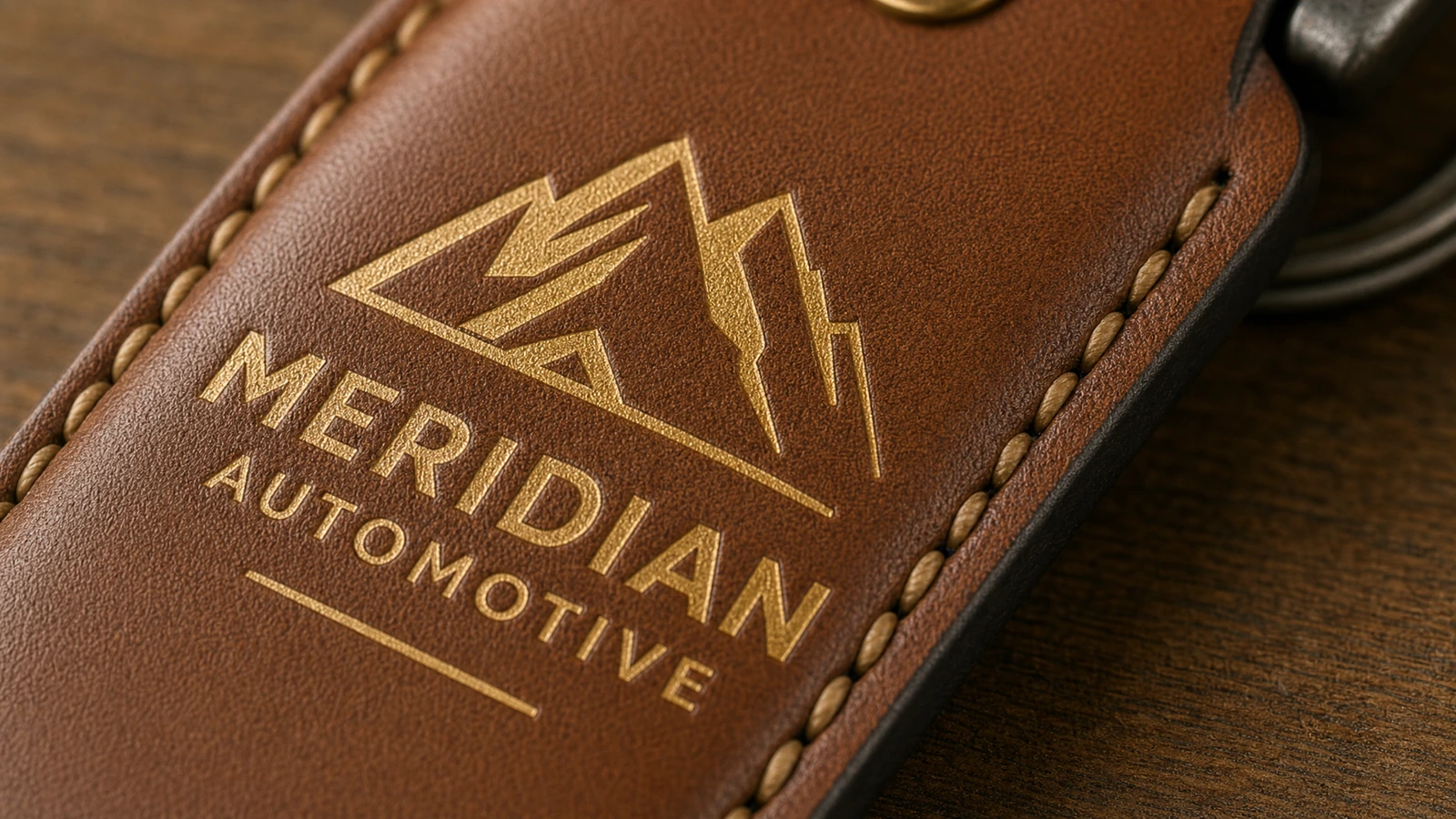
Images illustrate design and purchasing considerations; they are not photographs of approved production samples or evidence of tested performance.
Explore this buying guide
What does a leather key fob actually include? ↑
Here, a leather key fob means a customizable leather tag, tab, or loop attached to key-holding hardware. It is not an electronic remote, a replacement vehicle key, or automatically a fitted protective cover. Those distinctions matter when reviewing reference photographs or comparing supplier quotations.
A fitted car-key cover is a separate design problem. It needs checks for the exact remote shape, button access, emergency-key removal, and battery access. A decorative attachment should not be described as preventing accidental button presses, protecting the remote housing, or providing tested signal compatibility.
Likewise, a loop-shaped design is not automatically a wristlet. Wearability, carrying capacity, and compatibility depend on physical dimensions, the loaded configuration, and sample validation. Do not infer a key count or load rating from a photograph.
Material descriptions also need precision. “Genuine leather” alone does not specify the hide layer, surface finish, thickness, or construction. The FTC leather guides[1] address misleading composition and product-property claims. For purchasing purposes, use an explicit material description rather than treating a broad label as a quality grade.
How do you specify size, branding, and attachments? ↑
Start with the finished object
Record the finished leather-body dimensions separately from the overall dimensions including hardware. For a folded loop, distinguish the unfolded cutting shape from the assembled size. Specify leather thickness and finished assembly thickness separately where multiple layers are involved. Use millimeters throughout the drawing so quotations refer to the same geometry.
Balance the branding area against the space the recipient will carry. A larger surface can accommodate more artwork, but it also changes the pocket profile. Check the sample with the intended keys or remote attached; capacity and comfortable use depend on physical dimensions, the loaded configuration, and sample validation.
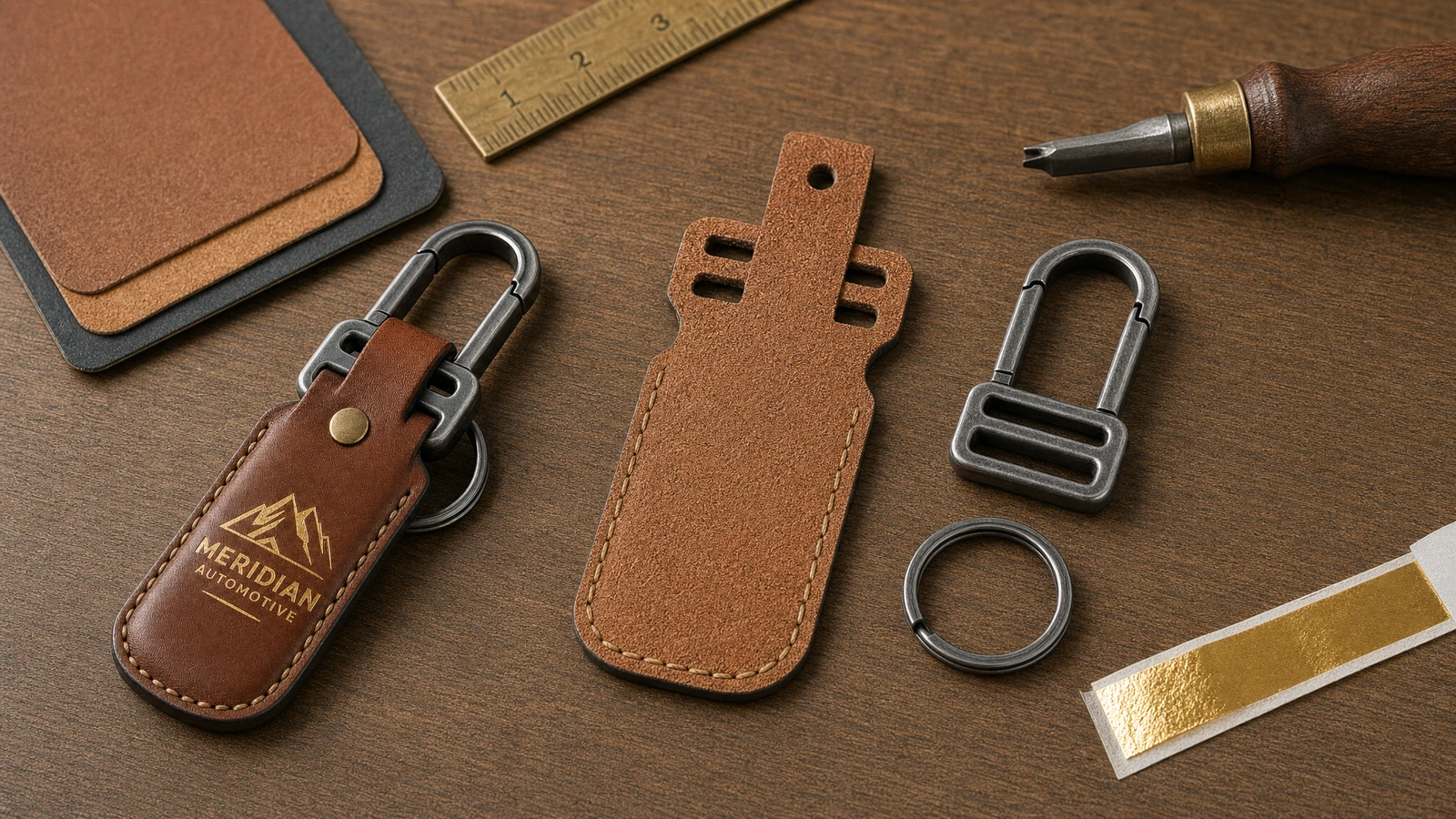
Evaluate the surface and fastening together
Blind debossing creates a recessed mark without a colored surface print. Embossing produces a raised effect, while foil introduces a contrasting decorative finish. Laser engraving and printed treatments are additional routes to evaluate where the selected material is suitable. These are candidate processes, not confirmed options for every leather or finish.
For the reverse side and attachment, compare the proposed rivet, stitching, ring, or clip arrangement. Specify the hardware material separately from its color or plating: a brass-colored finish is not a declaration of solid brass. Review the contact points where hardware meets leather, rather than assessing the front face alone.
| Specification field | What the brief should record | Approval basis |
|---|
| Material | Leather type, tanning description, finish, and any backing | Material declaration and physical swatch |
| Dimensions | Body and overall dimensions in mm; thickness in mm | Dimensioned drawing and assembled sample |
| Branding | Process, artwork size in mm, position, and orientation | Actual-size proof and decorated sample |
| Hardware | Base material, surface finish, ring or clip, and fixing method | Component specification and assembly check |
| Order terms | Quantity in pieces, price in USD, and agreed delivery milestones | Written quotation |
| Unit weight | Finished product weight in g, with packaging distinguished | Measurement of the approved configuration |
These fields define what needs agreement; they are not published specifications for an existing configuration. No numerical dimensions, unit weight, MOQ, or production schedule have been confirmed for this product.
How should artwork be prepared for approval? ↑
Prepare the logo as vector artwork where possible, with the intended front and reverse designs clearly identified. Include the desired finished mark size and its location on the leather body. For names or other variable text, keep the approved spelling list separate from visual reference images so personalization can be checked systematically.
A useful preflight checks fine lines, small lettering, spacing, and the distance between artwork and nearby edges, stitches, folds, or rivets. Minimum reproducible detail must be established for the chosen process and material. Enlarging a screen preview does not show whether a small mark will remain legible on a textured surface.
The digital proof should show shape, orientation, artwork placement, hardware position, and color intent. The physical sample should resolve what the screen cannot: texture, marking contrast, impression depth, edge appearance, and handling. Where exact color matters, approve a physical reference rather than relying on a monitor image.
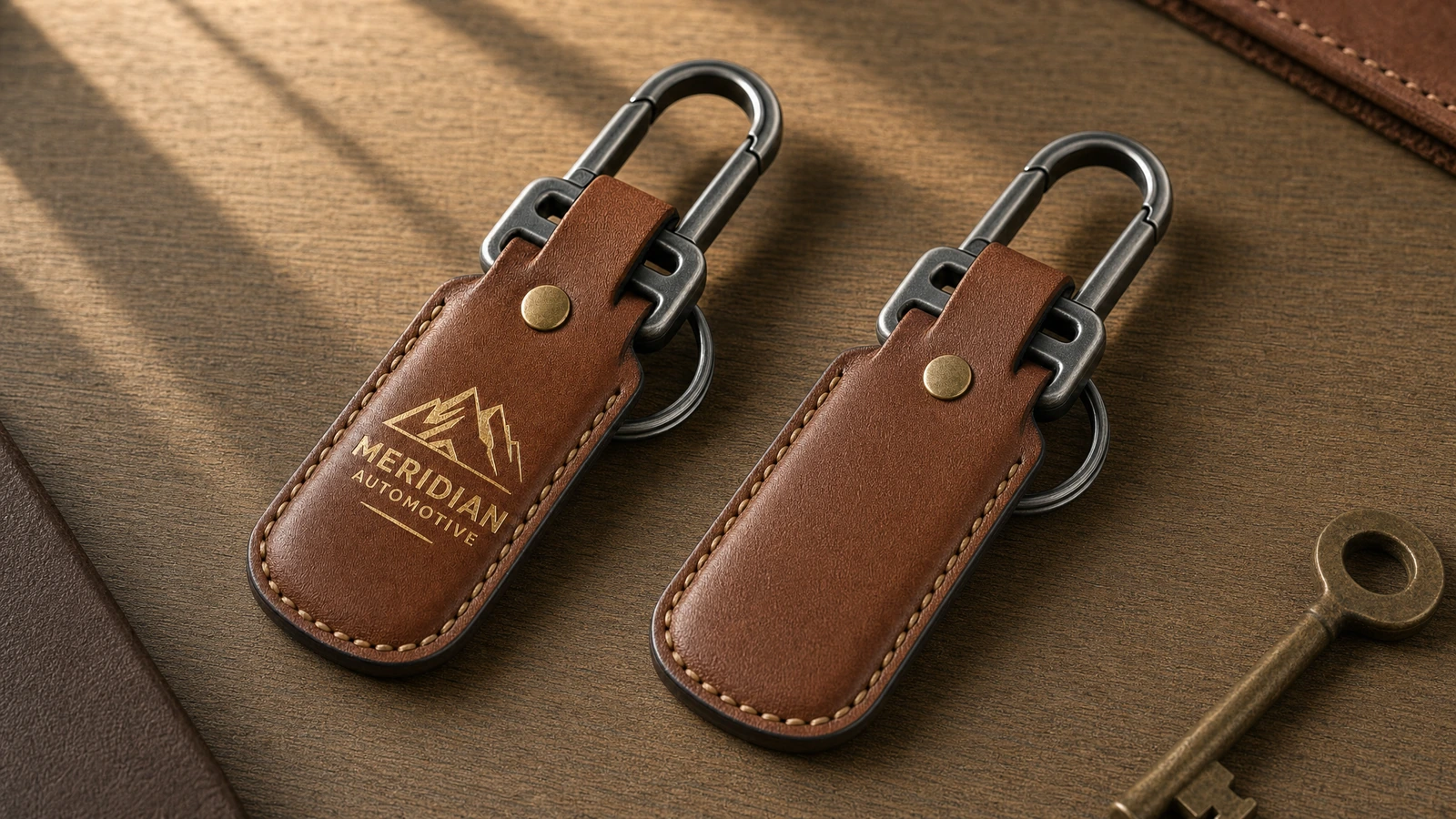
Keep the approved artwork version linked to the sample approval. Changes to the logo, material, marking method, or placement should be reviewed before production. For personalized batches, confirm the complete text list rather than assuming that approval of a representative name approves every entry.
What should happen between sampling and production? ↑
Use a documented approval sequence to connect the quote, the sample, and the production order. The following is a proposed purchasing workflow, not a statement of a verified factory’s equipment, capacity, or turnaround.
- Define the commercial brief. Record the application, quantity, destination, packaging needs, and required arrival date.
- Resolve materials and construction. Confirm the leather description, color reference, body shape, edge treatment, and hardware arrangement.
- Approve the artwork proof. Check dimensions, personalization, orientation, and placement before sample production.
- Review the physical sample. Examine the decorated leather and assembled hardware together, using the intended carrying setup.
- Freeze the approved specification. Attach the accepted sample reference, drawing, artwork, and inspection requirements to the order.
- Release production and inspection. Agree how substitutions, defects, and deviations will be handled before dispatch.
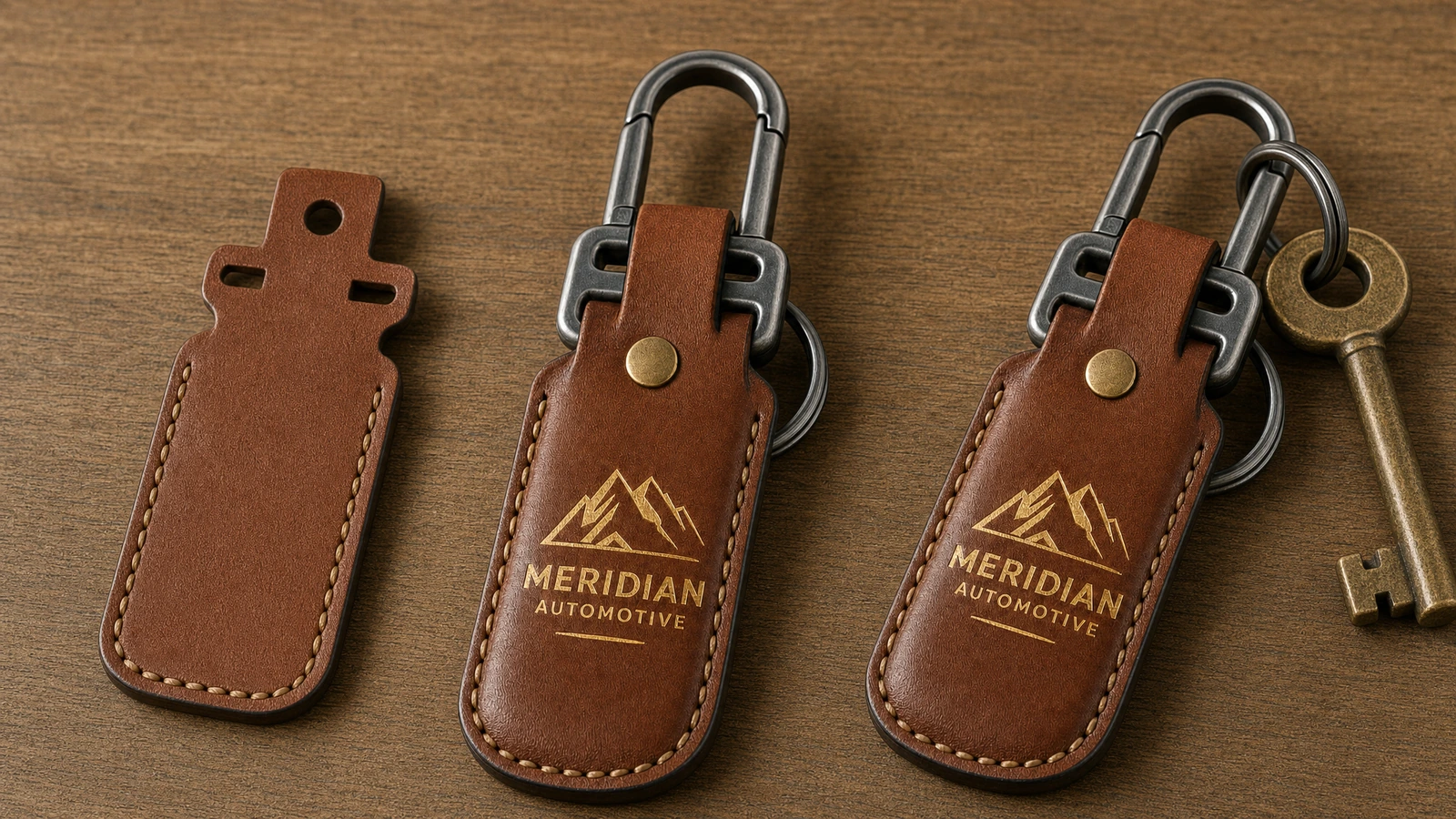
Keep sample preparation, revision, bulk production, inspection, and transport as separate schedule items. A production estimate is not an arrival guarantee. Material availability, custom colors, decoration, packaging, and approval changes can affect the sequence, so the order should identify which event starts each agreed lead time.
For event-based orders, work backward from the required arrival date and resolve the sample before making distribution commitments. Sample charges, tooling, revision costs, and any proposed rush arrangement belong in the quotation. Do not substitute another supplier’s advertised minimum order or turnaround for project-specific terms.
Which quality checks belong in the purchase agreement? ↑
Translate broad expectations such as “durable” or “premium” into observable acceptance criteria. Separate appearance checks from functional testing: a visually attractive sample does not establish attachment strength, colorfastness, or resistance to repeated flexing.
| Concern | Proposed check | What needs agreement |
|---|
| Wrong design or personalization | Compare the finished item with the approved artwork and text list | Correct content, orientation, placement, and legibility |
| Edge or layer separation | Inspect edges and evaluate flexing and rubbing | Method, exposure, and acceptable appearance afterward |
| Weak attachment | Evaluate the assembled leather-to-hardware connection under pull | Force in N, loading direction, hold time, and failure criteria |
| Surface transfer or fading | Assess the selected leather and decoration under agreed rubbing conditions | Conditioning, contact material, and acceptable transfer |
| Hardware problems | Check fixing security, ring closure, and clip operation where applicable | Functional acceptance and any corrosion-testing requirement |
| Batch inconsistency | Compare production samples with the approved physical reference | Sampling approach and acceptable color or texture variation |
No pull force, cycle count, defect rate, or service life is claimed here. Test conditions and acceptance limits need agreement before testing, followed by results tied to the actual material and assembly.
Where finish adhesion is relevant, ISO 11644:2022[2] provides a leather finish-adhesion test reference. Naming a method does not demonstrate that this product has been tested, passed a threshold, or received certification.
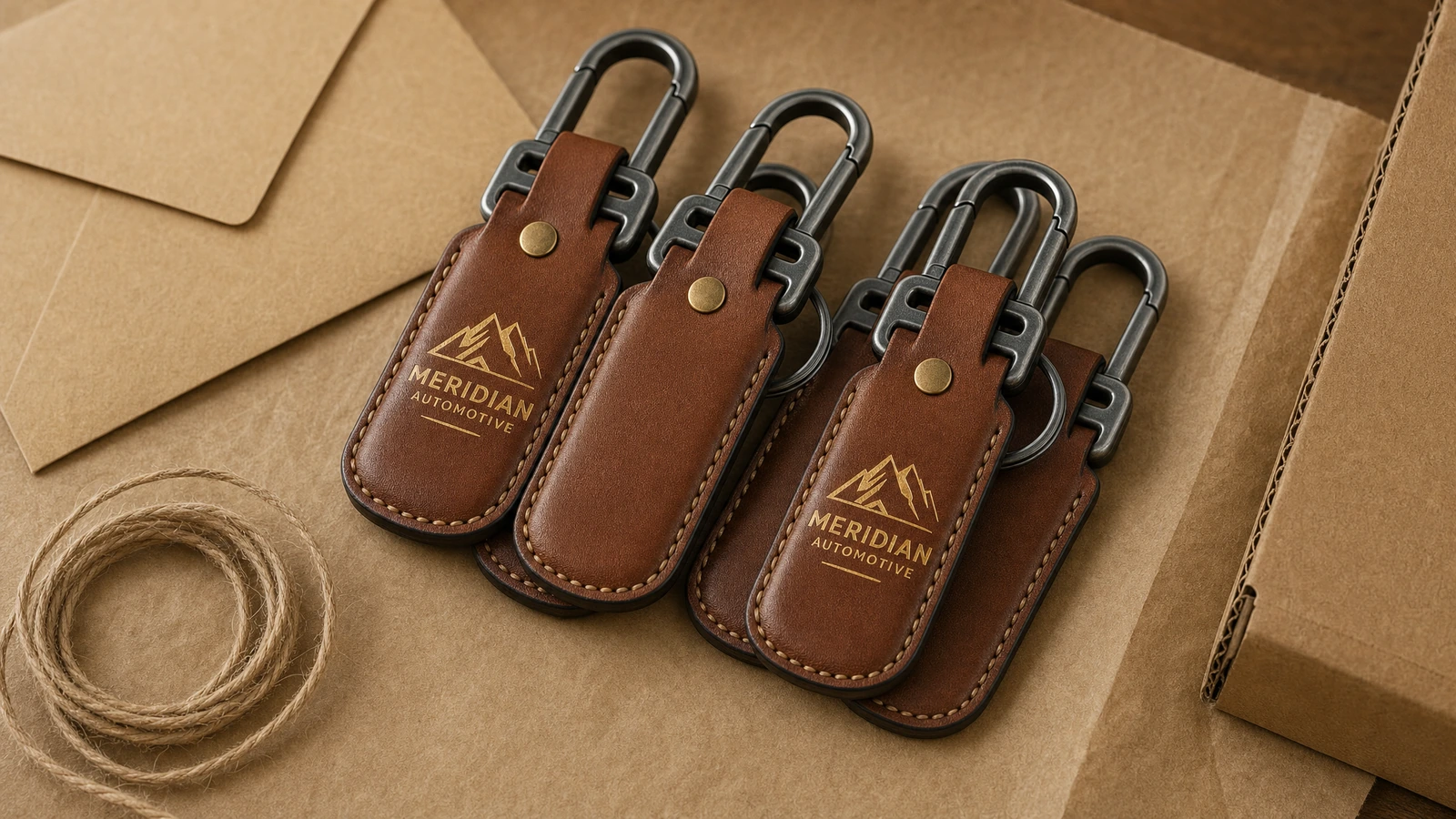
Destination requirements also belong in the specification. The cited REACH restriction text prohibits placing skin-contact leather articles on the market at chromium VI concentrations equal to or greater than 3 mg/kg of total dry leather weight; equality is not a passing result. See the published chromium VI restriction[3]. Applicable requirements and supporting reports still need review for the destination and order.
For California-bound projects, include Proposition 65 assessment in the compliance brief rather than treating “tested” as a universal compliance certificate. Identify the relevant materials, chemicals, exposure considerations, and any warning requirements with the responsible compliance reviewer. Leather, coatings, adhesives, and hardware should not be treated as interchangeable evidence sources.
How do packaging and reorder records protect the project? ↑
Choose packaging around distribution, not appearance alone. An individually presented corporate gift has different needs from a retail accessory or a bulk event handout. Evaluate whether the proposed bag, card, or box keeps the item in position and limits damaging contact between the hardware and decorated leather during transport.
Include packaging in the sample review. Check the packed presentation, personalization visibility, and any material or care information. For individually named gifts, agree how the outer identification will be matched to the item inside; otherwise, correct products can still reach the wrong recipients.
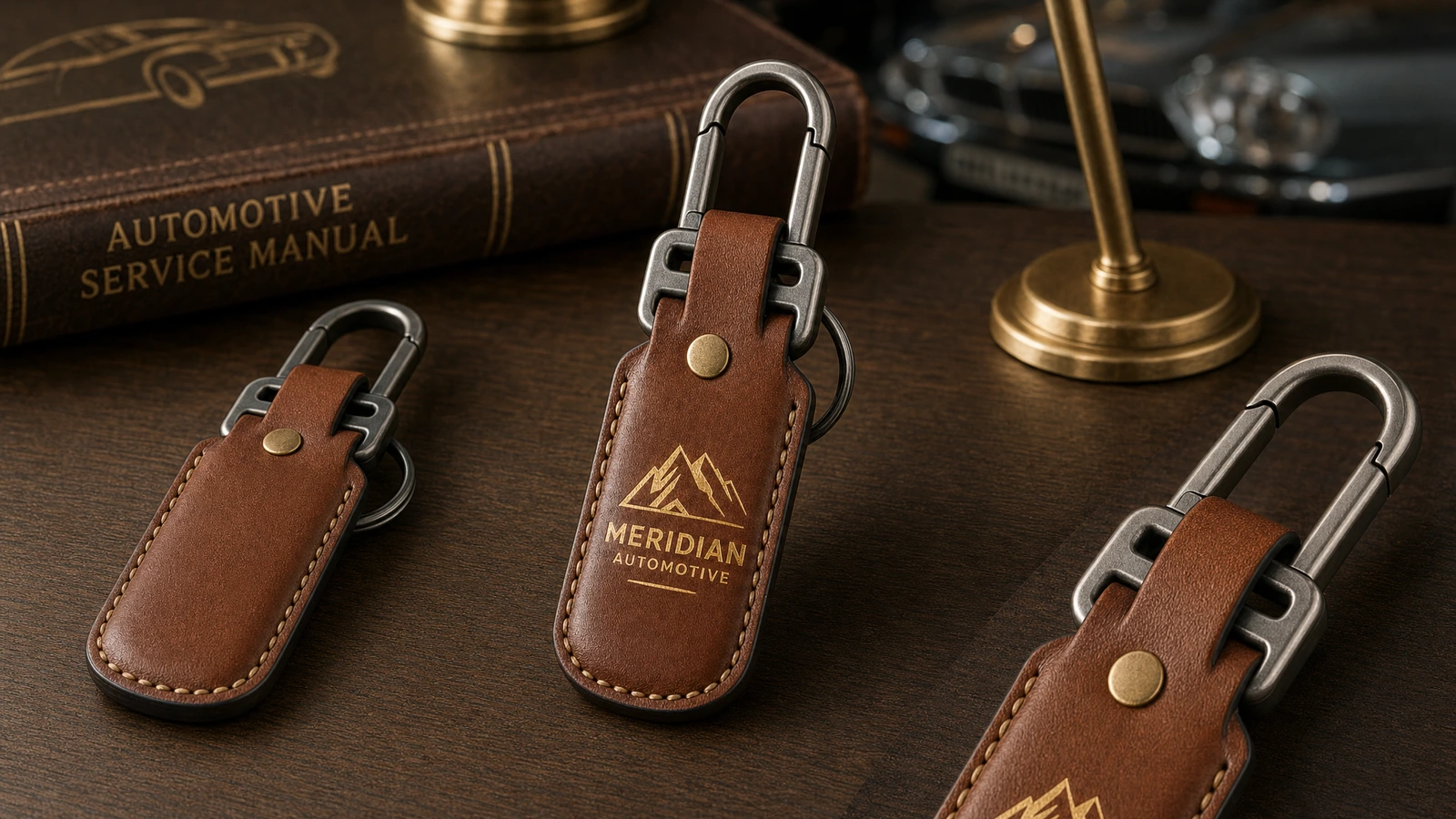
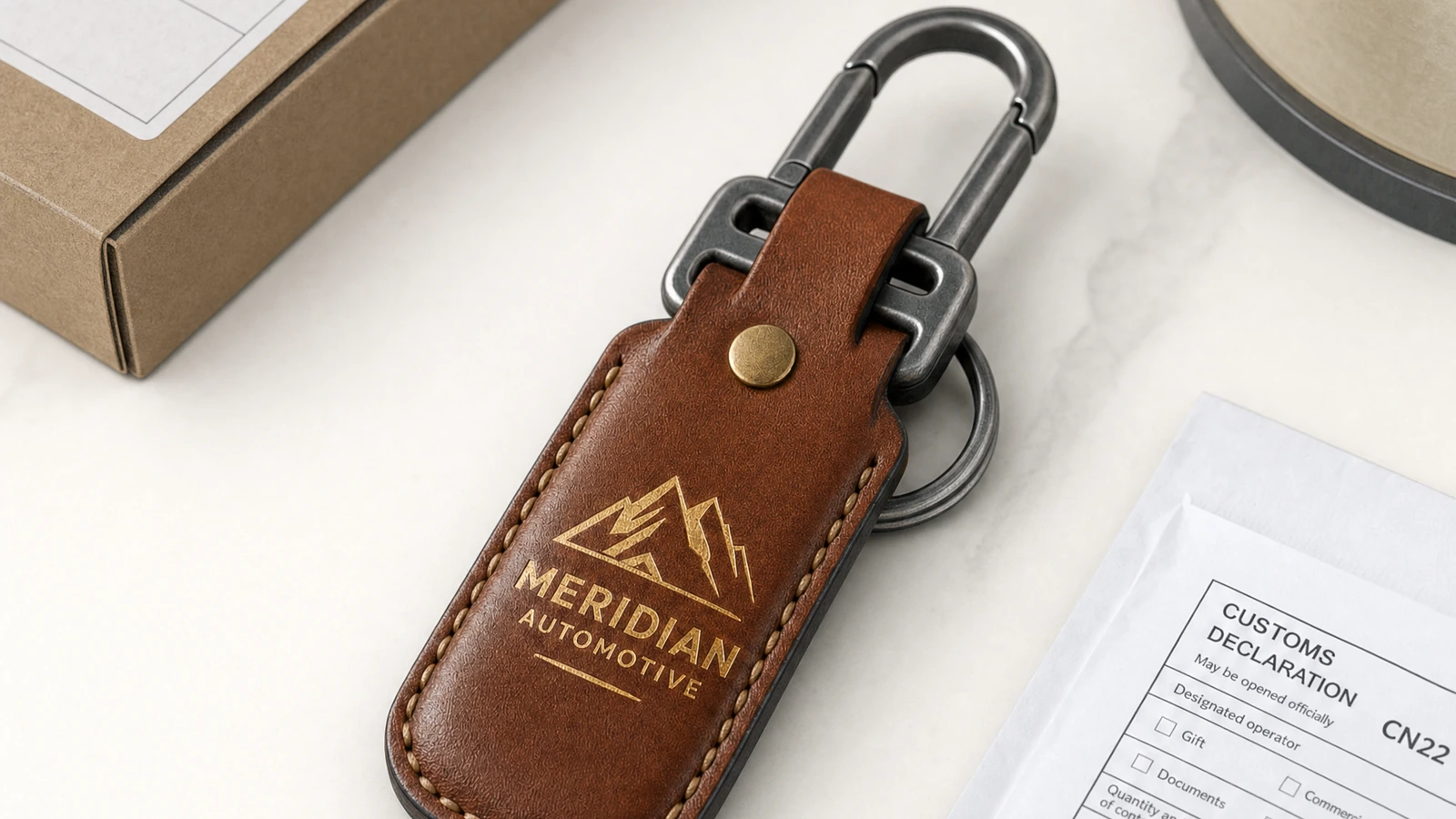
Keep shipping charges, delivery terms, tracking arrangements, and the response to transit damage explicit. International transport and border processing should remain distinct from manufacturing time. Agree how visible damage, shortages, and incorrect customization will be documented and resolved instead of assuming a generic return policy covers personalized goods.
For repeat orders, retain the approved sample, artwork version, material description, hardware specification, packaging reference, and inspection record. Reorders should be compared with this record, particularly when a material batch or component changes. Care guidance should match the selected finish: avoid universal conditioner recommendations and do not promise that routine care guarantees a particular lifespan.
Which material and branding approach fits your brief? ↑
Compare materials by the appearance you want and the evidence you need—not by a fixed lifetime ranking. The supplied research discusses several construction routes, but none establishes the material currently supplied for this product. The options below are candidates for quotation and sample evaluation.
| Material route | Reason to evaluate it | Main purchasing caveat |
|---|
| Full-grain leather | Natural grain and a character-led presentation | Approve acceptable surface variation and aging expectations; do not assume a service life. |
| Finished top-grain leather | A controlled surface appearance for coordinated branding | Check the actual finish, color match, flexibility, and marking response. |
| Split leather | An alternative construction for a cost-sensitive brief | Clarify the coating and backing, then evaluate edges and hardware attachment points. |
| Bonded material | A composition-based alternative requiring explicit disclosure | Obtain the composition declaration; do not describe it as equivalent to an intact hide layer. |
| PU or other synthetic material | An alternative when a non-leather construction is requested | Identify the composition and evaluate the complete assembly; do not assume environmental superiority. |
Vegetable tanning describes a tanning approach, not a separate grain grade. Specify tanning and grain description independently. A synthetic alternative should also be labeled distinctly rather than quietly replacing a quoted leather construction.
For understated branding, compare a blind-debossed sample with the selected leather color and texture. For stronger visual contrast, evaluate foil or a suitable printed treatment. Engraving may suit detailed personalization, but processing suitability must be confirmed for the exact material and finish before use. No decoration method should be sold as permanently wear-proof without supporting evidence.
For sustainability-led purchasing, move from adjectives to documentation. Leather Working Group[4] provides auditing and certification frameworks within the leather supply chain. If a sourcing claim matters to the order, verify the named supplier, relevant certification scope, and traceability documentation. This page does not claim LWG certification for the product.
“Vegetable-tanned,” “vegan,” “recycled,” and “biodegradable” are not interchangeable claims. Assess the complete construction, including coatings, adhesives, hardware, and packaging. Vehicle recycling targets do not establish the recyclability of a separate key accessory, and a material preference alone does not substantiate a finished-product environmental claim.
Compare the complete quote, not just the unit price
Use the same approved specification when comparing offers. Separate the unit price from sampling, tooling, decoration, packaging, inspection, testing, and freight. A lower figure may cover a different leather construction, simpler attachment, smaller branding area, or less protective packaging.
Ask for quantity breaks against your actual purchasing scenarios rather than relying on broad market price ranges. MOQ and production time remain quotation items for this product. Evaluate the total order commitment alongside revision costs and delivery risk; an inexpensive unit is not necessarily the least costly project.
Key takeaways for a better purchasing decision ↑
- Define the product correctly. A leather attachment is not automatically a fitted remote cover, wristlet, or protective device.
- Approve the complete configuration. Material, dimensions, branding, hardware, and packaging need to work together in the physical sample.
- Make quality measurable. Agree test methods and acceptance criteria before treating durability as an established benefit.
- Keep claims proportional to evidence. Supplier documentation, test results, and certification scope must support the specific claim being made.
- Compare equivalent quotations. Include setup, sampling, packaging, testing, and transport instead of judging unit price alone.
Turn your design brief into a sample-ready inquiry ↑
The right custom leather key fobs begin with a clear brief: who will use them, how they will carry them, what the branding must communicate, and which details must be verified before production. A documented sample approval turns those expectations into a purchasing reference and gives future reorders a consistent starting point.
Request a project-specific quote with your logo, intended quantity, preferred style, delivery destination, and required arrival date.




The information below is required for social login
Sign In
Create New Account