Custom acrylic photo frame magnets bring photographs and branded keepsakes onto compatible refrigerator surfaces. Start with the actual photo dimensions, display surface and preferred frame design, then approve a physical sample for fit, appearance and magnetic retention before placing a bulk order.
For gift retailers, photographers, event planners and promotional buyers: build your project around what the recipient will display. A school photograph, wedding portrait, pet picture or branded insert needs a suitable viewing area—not simply an attractive outer shape. Decide whether recipients should replace their photographs or receive a permanent printed keepsake.
A frame that looks appealing in a product image can disappoint when the photograph is cropped, the cover is difficult to open or the assembled item slides on the intended surface. For bulk buyers, these problems create more than an unhappy unboxing: they can mean repacking, replacement shipments and inconsistent customer experiences.
The practical solution is to specify the photo, frame and mounting arrangement together. Use an approved sample to establish the appearance and acceptance criteria. This page covers Custom Acrylic Photo Frame Fridge Magnets within Custom Magnets → Custom Acrylic Fridge Magnets, using provisional reference NSKU-744-02. Dimensions, construction, pricing and performance remain subject to quotation, sampling and testing.

Explore the buying guide
What makes a photo frame magnet different? ↑
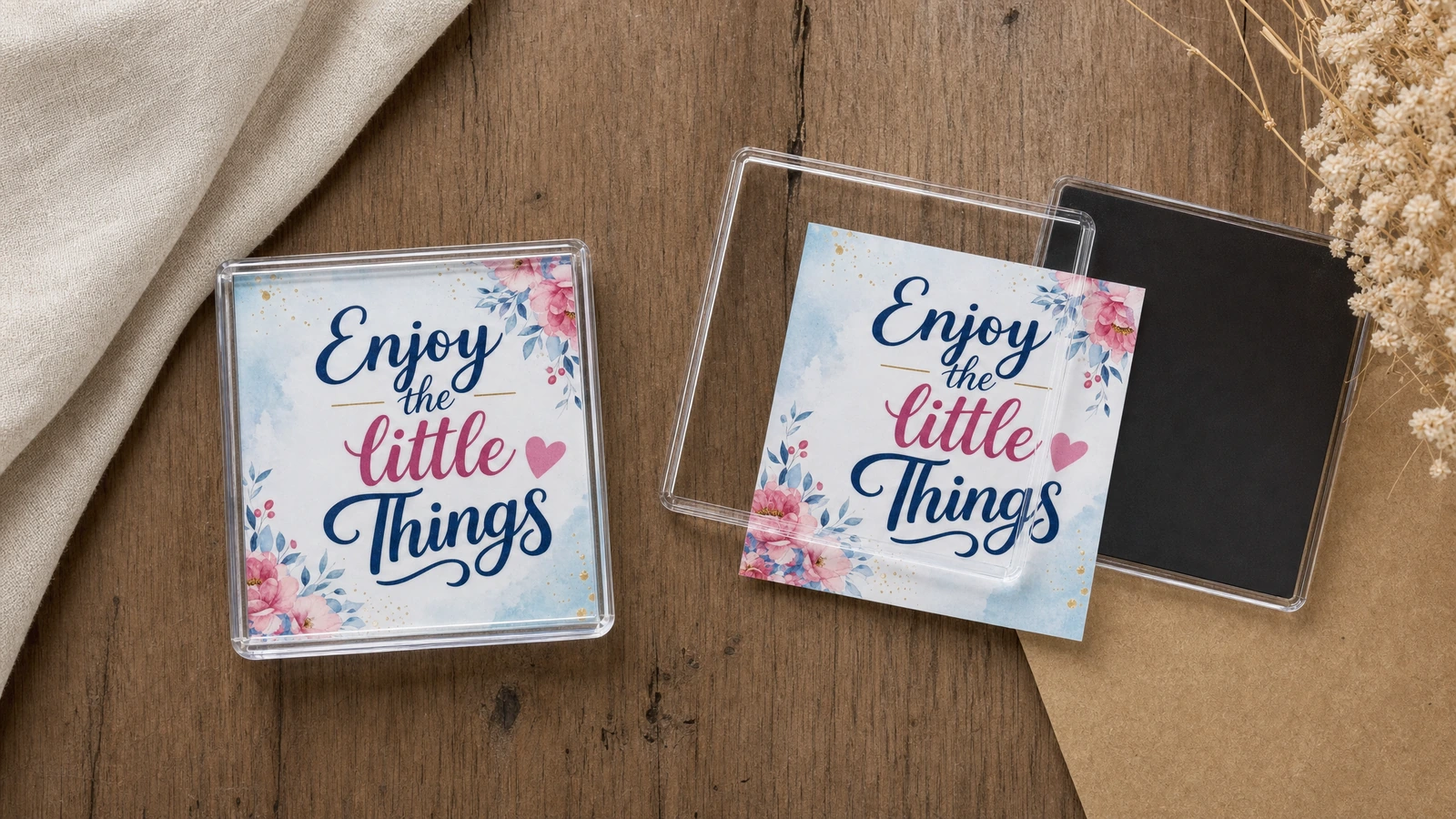
A photo frame magnet combines a photographic display with magnetic mounting. A replaceable-photo version holds a separate insert; a directly printed acrylic magnet carries a fixed image. Both may serve as personalized gifts, but only a confirmed insert-style construction should be described as allowing photograph changes.
Magnetic closure and refrigerator attachment are separate functions. Magnets that keep acrylic panels together do not automatically establish that the complete frame will remain attached to a refrigerator. Likewise, a thick tabletop magnetic frame should not be treated as a fridge magnet without a mounting specification and a successful sample test.
For this product, request confirmation of the opening method, backing arrangement and insert access. Treat double-sided visibility, freestanding use and interchangeable photographs as design requirements to evaluate—not established features. A rear mounting component may also affect what can be seen through the back.
The visual brief should identify the intended result: a clear border around the photograph, a printed decorative surround or a branded presentation. These choices affect the visible image area and the position of structural components. Reference images illustrate a direction; the approved drawing and sample define the order.
How do you prepare and use a sample? ↑
- Check the intended location. Establish whether the actual refrigerator door or display panel accepts a magnet before evaluating the frame.
- Inspect the unopened sample. Note damaged packaging, displaced components and visible corner damage before removing protective materials.
- Remove the specified protective film. Follow the sample instructions rather than assuming a particular number of layers. Inspect the exposed surface separately from the film.
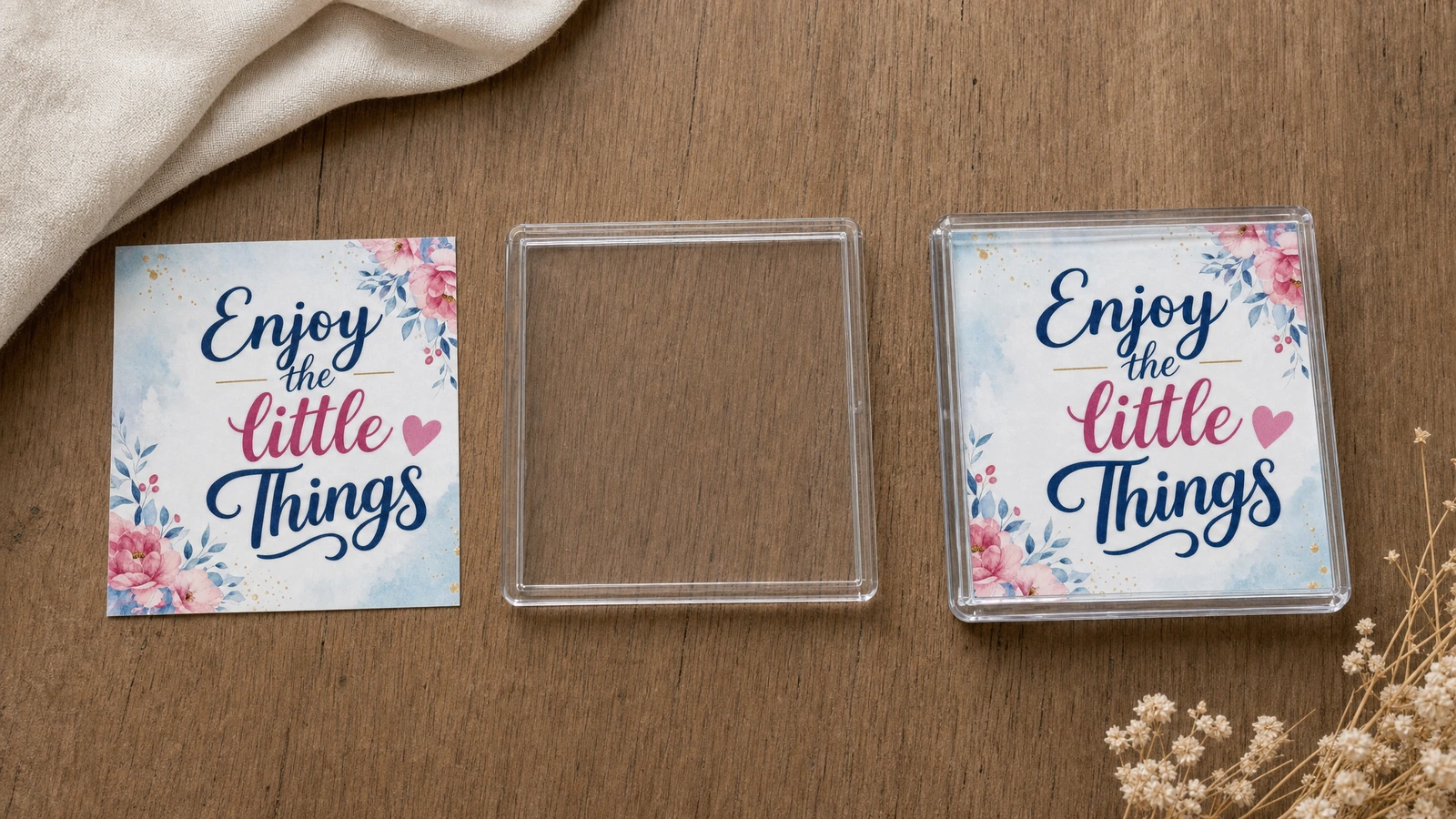
- Load the intended photograph. If the construction is replaceable, use its confirmed opening method. Do not force thick inserts into a closing gap.
- Evaluate the complete assembly. Check alignment, closure and retention with the actual insert on the intended surface, including representative door movement.
- Record the result. Keep photographs and observations with the sample reference so revisions can be compared consistently.
For routine acrylic care, use a soft, damp, lint-free cloth and mild detergent where appropriate. Avoid dry rubbing and abrasive cleaning. This approach follows the material manufacturer's acrylic cleaning guidance[1]. Confirm cleaning compatibility separately for any print, coating or adhesive used in the finished frame.
Get photo fit and readability right ↑
Specify the complete physical print, including any white border, rather than relying on a camera brand or a loosely described photo format. Instax, Polaroid and wallet-size references are not interchangeable dimensions. The outer frame size, insert space and visible image opening must be distinguished on the drawing.
| Specification field | How to record it | What to confirm |
|---|
| Physical photograph | Width × height × thickness in mm | Include borders and any intended sleeve |
| Outer frame | Width × height in mm | Approved outline and corner treatment |
| Visible image area | Width × height in mm | No unintended cropping or component overlap |
| Acrylic construction | Individual thicknesses and assembled depth in mm | Drawing and physical sample agree |
| Finished unit weight | Measured weight in g | Specify whether the insert and packaging are included |
| Insert capacity | Actual insert type and loading arrangement | Determined by physical dimensions, loaded condition and sample validation |
These are quotation and acceptance fields, not published specifications for this provisional product. No measured unit weight, dimensional tolerance or supported insert quantity has been established.
Review readability at the intended viewing distance. Faces, names and small logos should remain clear through the proposed front surface. If a floating border is desired, approve its relationship to the photograph on the sample rather than enlarging the frame without checking magnetic placement.
Choose the surface and magnetic backing together ↑
Not every metallic-looking appliance front accepts magnets. Some stainless-steel finishes are non-magnetic, while ordinary wood, glass and drywall do not provide direct magnetic attachment. The distinction is explained in this mounting-surface guide[2]. A basic magnet check establishes surface compatibility, not the holding performance of the finished frame.
Discuss localized rear magnets, a broader magnetic backing or a panel-closing arrangement as separate construction options. Their availability for this product needs confirmation. Ask where the mounting elements sit, whether they remain visible and how they are secured. A backing described only as “strong magnetic” leaves important purchasing questions unanswered.
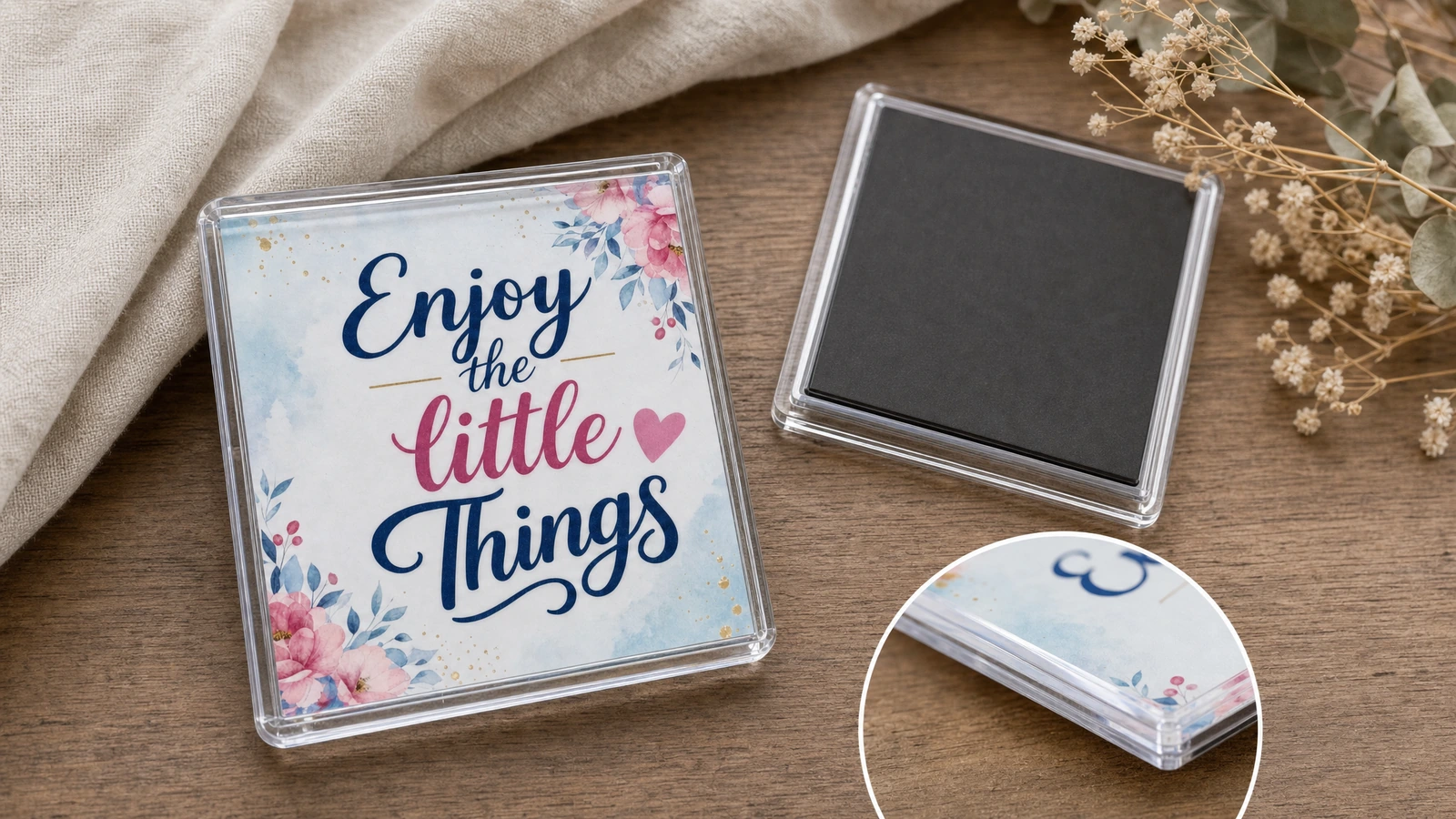
Evaluate the contact face as carefully as the front. A proposed protective pad or backing layer should be assessed for both surface protection and assembled retention. Texture, gaps and added layers belong in the sample test rather than being excluded from the test setup.
Clear, printed or specially coated surfaces also require separate approval. Transparency alone does not establish scratch resistance or protection against photograph fading. Any UV-filtering claim needs evidence for the specified material and finished construction.

Prepare artwork before approving the design ↑
First identify what will be customized: the removable photograph, a printed frame border, a permanently printed image or the packaging. Keep these elements separate in the brief. A frame intended for changing photographs needs a different approval process from a fixed-image souvenir.
- Provide the original image. Review its usable resolution at the final output size rather than judging only a screen preview.
- Mark the crop. Show which faces, text and details must remain visible inside the viewing area.
- Separate structure from graphics. Distinguish the outside outline, photo opening and magnetic component locations.
- Identify transparent areas. Make clear which regions should remain unprinted and which require a printed background.
- Check the assembled color result. Evaluate the image through the proposed acrylic, including any visible tint or reflected glare.
- Approve the correct orientation. Confirm portrait or landscape presentation and the direction of any reverse-side artwork.
File resolution cannot compensate for an unsuitable crop or unreadable text. Use the digital proof to check layout, then use a physical sample to judge the assembled appearance. Printing method, engraving availability and detailed file requirements remain items for quotation and feasibility review.
Turn the design into a controlled production brief ↑
A useful production brief connects each visible requirement to something that can be checked. Specify the acrylic appearance, edge finish, insert arrangement, magnetic attachment and packaging before approving bulk manufacture. Do not let an attractive rendering substitute for a construction drawing.
The proposed workflow is: review requirements, confirm construction feasibility, approve artwork, make a sample, evaluate the assembled product, agree acceptance criteria and release the approved version for production. Cutting, printing and assembly methods should be confirmed by the supplier rather than inferred from other manufacturers' listings.
Record changes made during sampling. A revised backing, thicker panel or different insert may require another retention check even if the front appearance seems unchanged. The final approval should identify the exact configuration being purchased.
No factory capacity, certification, minimum order quantity or production schedule is established for this product. Request these commercially relevant details in the quotation. Separate sample preparation, production after approval and transportation so an estimated dispatch date is not mistaken for an arrival commitment.

Define quality checks before ordering ↑
Translate concerns about slipping, scratches and difficult opening into an agreed inspection plan. The checks below are proposed acceptance methods, not completed factory tests. Define the test conditions and rejection criteria before using a sample as the production reference.
| Check | Proposed method | Acceptance evidence |
|---|
| Photo fit | Load the actual intended insert and inspect closure and image position | Documented fit without unintended cropping or movement |
| Surface and edges | Remove protective film and inspect under agreed lighting | Appearance compared with the approved sample and agreed defect limits |
| Mounted retention | Test the loaded assembly on the intended surface, including representative door operation | Recorded conditions and observed sliding or detachment |
| Magnet security | Inspect attachment and perform an agreed retention test | No loose components under the specified test conditions |
| Opening and reuse | Repeat the intended photo-changing operation under an agreed protocol | Observed closure, alignment and component condition |
| Packed condition | Inspect representative packed samples after agreed handling or transit evaluation | Documented condition of corners, surfaces and components |
A test record should identify the sample, insert, mounting surface, orientation and evaluation conditions. Holding capacity and supported loading must be determined by physical dimensions, loaded condition and sample validation; a magnet grade or standalone pull-force figure is not a finished-product guarantee.
Also check the opening experience. Film should be identifiable, instructions should match the construction and users should not need improvised sharp tools. If a frame remains cloudy after the specified film is removed, assess the material and finish rather than assuming the appearance is normal.

Keep safety and environmental claims specific ↑
Loose high-powered magnets present an ingestion hazard, particularly for children. Stop using a damaged frame with a loose magnetic component and keep that component inaccessible to children. The hazard is documented by the CPSC magnet safety guidance[3]. Acrylic construction does not make the complete assembly child-safe.
Product classification should reflect the final design, intended users and marketing. Do not treat a decorative frame as automatically certified, assume that a warning replaces testing or transfer compliance documentation from a different magnetic product. Request evidence that identifies the purchased configuration.
For California distribution, review potential chemical exposure rather than assuming that all acrylic items require—or never require—a warning. OEHHA's Proposition 65 guidance[4] concerns exposure to listed chemicals; no warning determination or chemical assessment has been supplied for this product.
Recycled content, recyclability and reusability are different claims. No recycled-content percentage or recycling route is confirmed here. If these matter to the purchase, request evidence identifying the relevant component and clarify handling of the combined acrylic, print, adhesive and magnet assembly. Do not transfer another supplier's environmental claims to this SKU.
Plan packaging, delivery and repeat orders ↑
Packaging should address surface abrasion, corner impact and movement between packed items. Discuss individual protection, separators and suitable outer packaging as part of the quotation. A retail gift presentation and a bulk shipment may need different arrangements; neither should be assumed included.
Approve removal instructions alongside the pack design. Recipients should be able to identify protective film, understand the opening method and recognize unsuitable mounting surfaces. For personalized orders, also define how each image variant will be matched to its packaging.
Compare the total delivered project cost rather than the unit price alone. Sampling, customization, packaging and freight should be identifiable, with the delivery basis stated clearly. Confirm whether the promised date refers to production completion, dispatch or arrival.
For repeat orders, retain the approved sample, artwork version, dimensional drawing, backing specification and pack arrangement. Check whether anything has changed before reusing the previous approval. A visually similar replacement material or magnetic component should not inherit an earlier test result without review.
Which photo display format fits your project? ↑
| Format | Reason to consider it | Purchasing boundary |
|---|
| Replaceable acrylic fridge frame | Separate photographs can be part of the intended design | Confirm insert access, usable space and loaded mounting performance |
| Direct-printed acrylic magnet | Fixed artwork suits a branded keepsake | Do not describe it as a replaceable-photo frame |
| Flexible magnetic photo pocket | Pocket construction suits insert-based refrigerator display | Do not present a flexible pocket as a rigid acrylic frame |
| Freestanding magnetic acrylic block | Tabletop presentation without refrigerator placement | Magnetic panel closure does not establish fridge compatibility |
| Conventional glass frame | Traditional framed presentation | Compare handling, packing and mounting requirements separately |
Choose the format around the recipient's task, not a shared use of the word “magnetic.” These categories explain construction differences; they are not a claim that every option is available under this provisional product reference.
At the material level, acrylic offers a lighter, more impact-resistant alternative to ordinary glass, but it should not be called unbreakable. The general distinction is discussed by A&C Plastics[5]. Finished-frame durability still requires evaluation of its actual construction and packaging.
Comparable quotations should cover equivalent dimensions, customization, mounting components and packing. A low price for a thin photo pocket is not a direct benchmark for a rigid acrylic assembly. Likewise, competitor delivery promises and review scores do not establish this product's commercial terms or performance.
Key takeaways for a clearer purchasing decision ↑
- Define the display before choosing the construction. Specify whether the image is replaceable, directly printed or part of a branded surround.
- Approve the loaded assembly. Fit, supported loading and retention depend on physical dimensions, loaded condition and sample validation.
- Keep unverified specifications out of the purchase assumptions. MOQ, production time, unit weight, dimensions and testing remain to be established for this product.
- Magnet safety thresholds apply within a defined regulatory scope, not automatically to every frame. — For subject products, loose or separable magnets fitting the small-parts cylinder must have a flux index below 50 kG² mm² (Source[6]). CPSC defines the covered uses and exclusions; toys covered by the toy standard follow that separate framework. Guidance reviewed September 20, 2026; applicability to this product requires assessment.
- Preserve the approved configuration for reorders. Keep artwork, materials, magnetic backing and packaging aligned with the accepted sample.
Start with a sample-ready brief ↑
A successful custom photo gift starts with a clear image, a suitable display location and a construction that works as intended. A complete brief lets the quotation address those requirements without substituting generic material claims or competitor specifications for product evidence.
Request a quotation for NSKU-744-02 with your photograph dimensions, artwork, intended mounting surface, order quantity, destination and required delivery date.





The information below is required for social login
Sign In
Create New Account