


 Blog PDF for offline reading
Quick answer: Magnet picture frames are clear acrylic or magnetic-backed holders that keep a photo on a fridge or other steel surface. Event photographers, schools, real estate agents, clinics and promotional marketers use them as branded keepsakes. The recipient's own photo earns the fridge spot, and a discreet brand mark stays in view every time someone opens the door.
Most branded giveaways are built around the logo, which is why so many end up in a drawer. Magnet picture frames work the other way. The content is the recipient's wedding portrait, their child's school photo or their family in front of a new house, and your brand sits on the frame or on the reverse side. People keep the photo, so they keep the frame.
The stakes are bigger than they look. U.S. promotional products distributors sold $26.8 billion of merchandise in 2024, up 2.63% year over year, according to the Promotional Products Association International[1]. A large share of that spend competes for the same few square feet of attention in a home. Cheap fridge frames also carry a specific risk. Marketplace reviews of budget frames describe magnets too weak to hold on a fridge door, and one widely shared test reported that three of five frames slid or fell within 48 hours. A keepsake that ends up on the kitchen floor with your name on it does more harm than no keepsake at all.
This guide covers how each type of business uses photo frames on the fridge, how to plan them into events and gifting cycles, and how to compare programs by industry. It deliberately skips manufacturing detail, which belongs in a production brief rather than a campaign plan.
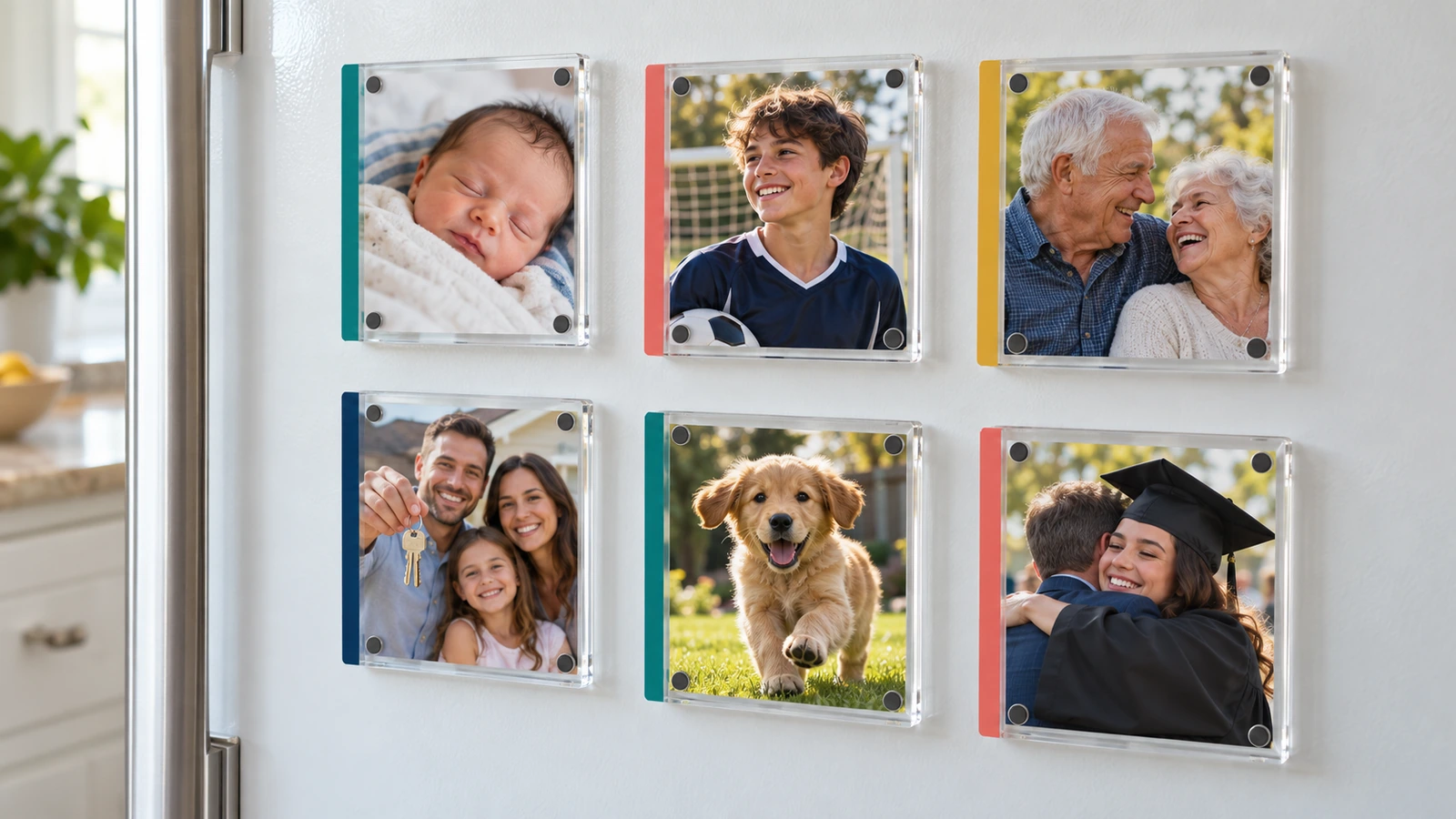
What are magnet picture frames, and why do they hold attention?
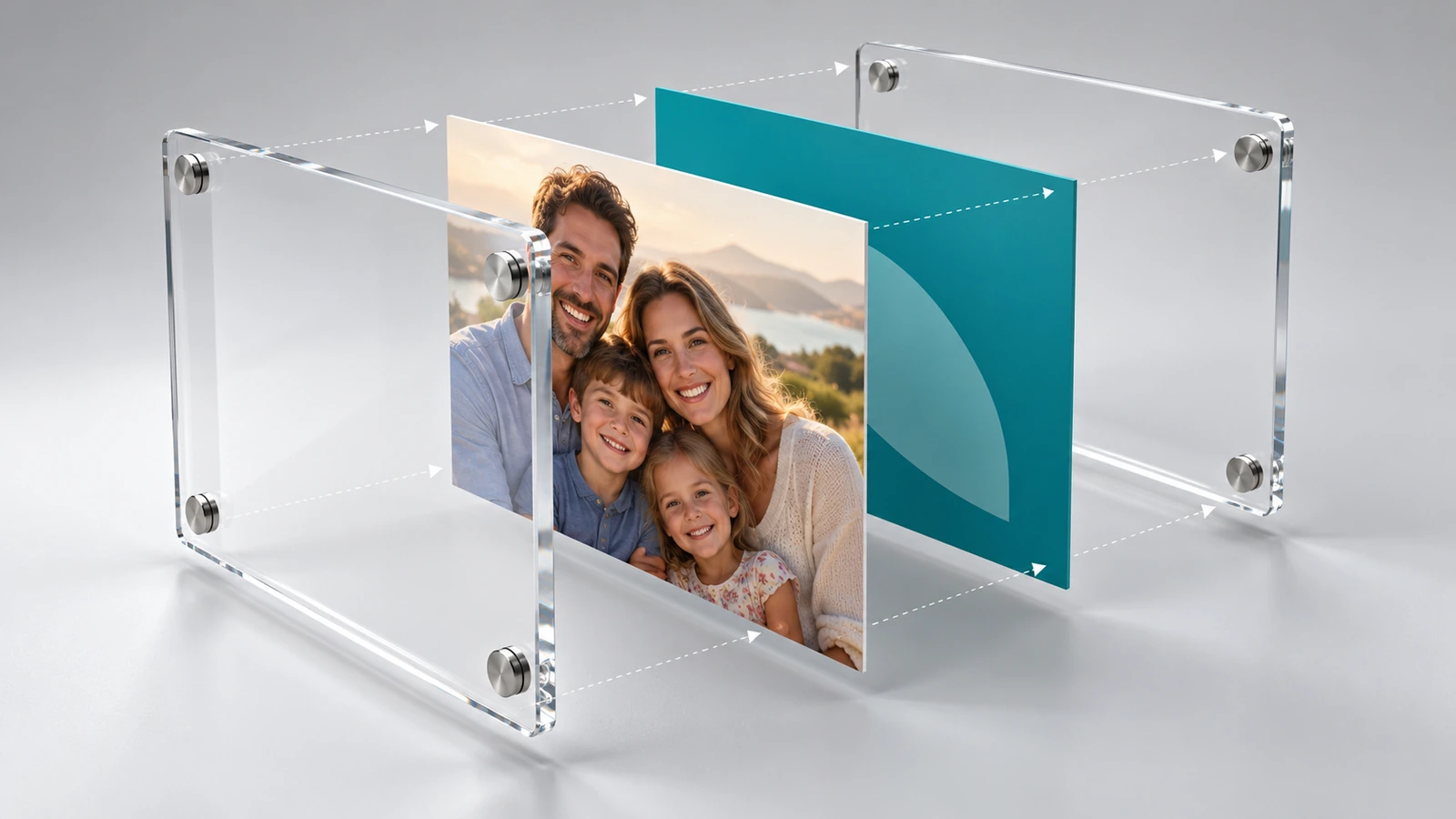
A magnet picture frame is a photo holder that attaches to, or stands near, a ferrous metal surface. Two constructions dominate. The first is the acrylic "sandwich": two clear panels clamp a print between them, held together by small magnets embedded near the corners, with a magnetic back or a freestanding base. The second is the pocket frame: a clear sleeve laminated to a flexible magnetic sheet. The idea is not new. U.S. Patent 5,050,834, granted in September 1991, already described a magnetically supported frame using clear acrylic panels[2] to hold picture cards on metal surfaces.
The format has also earned independent credibility. A two-panel acrylic magnet frame appears among the picks in the New York Times Wirecutter picture-frame guide[3], which matters for business buyers. A recipient who already recognizes the style as a "nice frame" reads your gift as a considered object, not a trade-show freebie.
Clarity is what lets the photo carry the gift. Acrylic sheet manufacturers typically report luminous transmittance of about 92%, measured under the ASTM D1003 haze and transmittance method. The material itself is standardized: ASTM D788[4] classifies PMMA compounds whose polymer is at least 70% methyl methacrylate and notes their frequent use where extreme clarity is required, while acrylic sheet is specified under ASTM D4802[5] and, internationally, cast sheet under ISO 7823-1. In practice, a well-made frame looks like the photo is floating, so the recipient sees their memory first and your brand second. That order is what makes the format work.
Three properties turn a frame into a recall tool rather than a one-time gift:
- Personal content. The image belongs to the recipient, so removing the frame feels like throwing away the memory.
- Swappable inserts. When the photo can be replaced, the frame stays relevant through next year's school portrait or next season's team photo. Each swap is another moment of handling your branded object.
- A second face. Double-sided sandwich frames hold a card behind the photo. That reverse side can carry contact details, a referral offer or an anniversary date without putting text on top of the picture.
If you need the technical side, such as material choice, magnetic backing and print readiness, the product page for our custom acrylic photo frame magnets covers it in detail. The rest of this article is about strategy.
Five businesses that use magnet picture frames to drive brand recall
Event photographers: deliver the first print on the spot
At weddings, galas, graduations and corporate parties, an on-site print slipped into a clear frame becomes the first physical keepsake guests take home. The photographer's mark sits on a slim edge band or on the reverse card, with a gallery link and a booking prompt for future events. Consumer reviews show that families already buy these frames themselves. One marketplace reviewer said loading school photos into store-bought fridge frames was "way more affordable than ordering magnets through the photographer." That is revenue photographers leave on the table when they don't offer a framed print.
Schools and PTAs: picture day, teams and graduation
Schools have a built-in refill cycle: picture day every year, seasonal team photos and graduation. A frame carrying the school crest and colors, given at enrollment or as a fundraising add-on, can be refilled each year with the new portrait. Grandparents are a natural second audience, and the same reviewer above bought frames specifically to send school photos to them. For younger students, hand frames to parents rather than to children directly, for the safety reasons covered below.
Real estate agents: the closing-day photo
A photo of the buyers holding their keys in front of the new house is one of the few images clients actively want to display. Framed and handed over at closing, it stays on the fridge in the very home the agent sold, where neighbors and visiting friends, who are future sellers and buyers, see it. The reverse card can carry the agent's contact details and a home-anniversary note, and a fresh photo sent each anniversary gives the agent a reason to stay in touch.
Clinics: celebrating milestones, not appointments
Pediatric dental offices, orthodontists, veterinary clinics and fertility or maternity practices all produce emotional moments: a braces-off smile, a puppy's first visit, a newborn photo. A framed milestone photo builds a positive association with the practice, which an appointment-reminder magnet cannot. Keep medical details off the frame entirely. The photo and a small practice mark are enough, and patient privacy stays intact.
Promotional marketers: photo booths and trade shows
Brand activations with photo booths solve the biggest weakness of event marketing, which is that attendees forget who ran the booth. Printing the booth photo into a branded frame gives visitors something they want to take away, and the brand travels home with them. Seasonal programs work well too, such as holiday gifts to clients, team photos for corporate gifting and sponsor keepsakes at sports events.

How to plan frame magnets into campaigns, events and client gifting
The difference between a keepsake program and a box of leftover merchandise is planning. These seven steps apply whether you run a single event or a year-round gifting calendar.
- Define the moment of recall you want. Decide what the frame should prompt: a rebooking, a referral, a re-enrollment, a home-anniversary call. Everything else follows from that. A photographer wants the frame to come to mind when a friend gets engaged. An agent wants it remembered when a neighbor lists their house.
- Make the photo the hero. Use images recipients would frame on their own: real people, real milestones, good light. Stock imagery and product shots defeat the purpose. In a 2026 discussion among instant-film photographers about magnetic frames, one participant summed up the standard well: the frame "should not visually compete with the photo, but enhance your ability to enjoy it."
- Place the brand where it won't compete. Choose one of three positions: a thin color band or small mark on the frame edge, a printed reverse card in a double-sided frame, or a branded insert behind a smaller "floating" photo. Avoid logos across the image area, which is the fastest way to get a frame taken down.
- Time the handoff to the emotion. Give the frame at the peak moment: the end of the reception, closing day, the braces-off appointment, the booth photo still warm from the printer. A frame mailed three weeks later becomes just another package.
- Build a refill loop. A swappable frame only drives repeat contact if you supply the next photo. Schedule it: next year's portrait, an anniversary print, a holiday family photo session. Each refill is a branded touchpoint that costs little more than a print and an envelope.
- Plan for safety and compliance. Small, strong magnets are a real ingestion hazard. The U.S. Consumer Product Safety Commission warns that swallowed magnets can attract each other through intestinal walls[6], causing perforations, blockages or death. For products within its scope, the federal magnet rule at 16 CFR Part 1262[7] requires any magnet that fits entirely in the small-parts cylinder to have a flux index below 50 kG² mm². CPSC's business guidance on magnets[8] explains scope and testing, and items intended for children fall under the separate toy safety requirements[9]. In practice, specify fully embedded magnets, give frames to adults at schools and pediatric clinics, and ask your supplier which rules they test against. If you distribute in California, also confirm whether the finished item needs a warning under Proposition 65, the state's chemical-disclosure law in force since 1986. Some acrylic sheet products already ship with Prop 65 notices.
- Measure what you can. Put a short URL or code unique to each program on the reverse card or the gift envelope, not on the photo. Track bookings, referrals or re-enrollments against that code, and ask new clients "Where did you hear about us?" with the frame as a listed option.

Planning mistakes that turn a keepsake into clutter
Four mistakes come up again and again. The first is ordering frames without a photo plan: a frame with a placeholder card has none of the format's advantages. The second is assuming every fridge is magnetic: many stainless appliance fronts hold magnets weakly or not at all, so freestanding or dual-use frames are a safer choice for mixed audiences. The third is choosing on unit price alone: review data on budget frames points to weak magnets, magnets popping out of corners, and protective film that is hard to peel and leaves scratches. Every one of those failures reflects on the brand printed on the frame. The fourth is ignoring sunlight: buyers of low-cost frames report photos fading within weeks near windows or stoves, and clear acrylic alone does not guarantee UV protection. Before you order, turn these decisions into a written brief. The acrylic photo frame magnets page walks through sampling, quality checks and repeat-order planning.
Comparing magnet picture frames for fridge programs by industry
The format is the same across industries, but the program design is not. Use this table to adapt the content, brand placement, handoff and refill cycle to your business.
| Business | What goes in the frame | Best handoff moment | Brand placement | Refill trigger | Recall goal |
|---|---|---|---|---|---|
| Event photographer | On-site print of the couple, guest or team | End of the event, before guests leave | Reverse card with gallery link | Anniversary print, next family session | Referrals and repeat bookings |
| School / PTA | Class portrait, team or graduation photo | Picture-day delivery, given to parents | Crest and school colors on frame edge | Each new school year | Community pride, fundraising, re-enrollment |
| Real estate agent | Buyers with keys at the new home | Closing day | Small mark on edge plus contact card on back | Home anniversary | Neighbor referrals, future listing |
| Clinic | Milestone photo (braces off, new pet, newborn) | End of the milestone visit | Discreet practice mark only, no medical details | Next milestone or annual check-up | Positive association, family referrals |
| Promotional marketer | Photo-booth or sponsor-event picture | Immediately after the photo is taken | Campaign color band or reverse offer card | Seasonal campaign or next event | Brand recall after the event ends |
Two patterns stand out. Programs with a natural refill cycle (schools, real estate anniversaries, clinic milestones) get repeat exposure from a single frame. One-off event programs (photo booths, galas) depend on the strength of the first moment, so print quality and fast on-site delivery matter more than reverse-card copy.
FAQ
FAQ: Do magnet picture frames stick to stainless steel fridges?
Not always. Many stainless appliance fronts use grades that are only weakly magnetic or not magnetic at all, so a frame that holds firmly on a painted steel door may slide on a stainless one. For audiences with mixed kitchens, choose frames that can also stand freely on a shelf or desk, and test a sample on the surfaces your recipients are most likely to have.
FAQ: Are frame magnets safe to give out at schools and pediatric clinics?
They can be distributed responsibly, but treat small magnets as a hazard. CPSC warns that swallowed magnets can cause serious internal injury. Specify fully embedded magnets, give frames to parents rather than to young children, and ask your supplier which federal magnet or toy safety rules the product has been assessed against.
FAQ: Should our logo go on the frame or on an insert card?
If you want the frame to stay up, keep the logo off the photo area. A thin edge mark keeps the brand visible from across the kitchen. A reverse card in a double-sided frame holds more information, such as contact details, an offer or a referral code, without competing with the picture. Many programs use both: a small edge mark plus a reverse card.
FAQ: Will the photos fade on the fridge?
They can. Buyers of low-cost frames report noticeable fading within weeks when frames sit near windows or stoves, and clear acrylic does not automatically block UV light. Use quality prints, suggest a spot away from direct sun, and plan refills, so a faded photo becomes a reason for the next touchpoint rather than a reason to remove the frame.
FAQ: How far ahead should we plan frames for an event or gifting season?
Plan backwards from the handoff date, leaving time for sampling, artwork approval and production. Timelines depend on quantity, customization and destination, so request a schedule with your quote rather than relying on generic estimates. Peak gifting seasons fill up quickly.
FAQ: How do we know if a frame program is working?
Use a code or short URL unique to the program on the reverse card or packaging, and track bookings, referrals or sign-ups against it. Add the frame as an answer option in your "how did you hear about us" question, and compare refill response rates year over year.
Key takeaways
- Branded keepsakes compete in a crowded promotional market, so the recipient's own photo has to earn the fridge spot. — $26.8 billion in U.S. promotional distributor sales in 2024, up 2.63% (Source)
- Clear magnetic frames for picture cards on metal surfaces are a long-established format, not a fad. — U.S. Patent 5,050,834, granted in 1991 (Source)
- The clear acrylic behind the floating-photo look is a standardized material, not a generic plastic. — at least 70% of the polymer from methyl methacrylate under ASTM D788 (Source)
- Small magnets that can come loose are regulated for good reason, so specify embedded magnets and give frames to adults. — flux index below 50 kG² mm² for in-scope small magnets (Source)
- Magnet ingestion injuries are severe enough that federal regulators run a dedicated safety center for them. — multiple swallowed magnets can cause perforation, blockage or death (Source)
Conclusion
Magnet picture frames work for businesses because they reverse the usual promotional logic: the recipient's memory is the content, and your brand stays in view as part of the frame. Event photographers capture value on the spot, schools and clinics gain a reason to reconnect every year, agents keep a presence in the homes they sold, and marketers turn a fleeting booth visit into something people take home. The format succeeds or fails on a few decisions: the right photo, discreet brand placement, a well-timed handoff, a planned refill, and frames that are safe and hold firmly.
If you are planning a campaign, event or client-gifting program, start with the use case and recall goal outlined above, then request a quote and sample for custom acrylic photo frame magnets. We will help you match the frame to your audience, quantities and timeline.
Sources
- Promotional Products Association International (PPAI), "PPAI Sales Volume Estimate: Modest Growth in 2024 but Reasons for Optimism Remain." ppai.org ↩
- U.S. Patent 5,050,834, "Magnetically Supported Frame for Photographic Picture Cards," granted September 24, 1991. Patent PDF ↩
- The New York Times Wirecutter, "The Best Picture Frames." nytimes.com/wirecutter ↩
- ASTM International, ASTM D788-24, Standard Classification System for and Basis of Specification for Poly(Methyl Methacrylate) (PMMA) Molding and Extrusion Materials. webstore.ansi.org ↩
- ASTM International, ASTM D4802-16, Standard Specification for Poly(Methyl Methacrylate) Acrylic Plastic Sheet. standards.iteh.ai ↩
- U.S. Consumer Product Safety Commission, Magnets Information Center. cpsc.gov ↩
- Electronic Code of Federal Regulations, 16 CFR Part 1262, Safety Standard for Magnets. ecfr.gov ↩
- U.S. Consumer Product Safety Commission, Business Guidance: Magnets. cpsc.gov ↩
- U.S. Consumer Product Safety Commission, Business Education: Toy Safety. cpsc.gov ↩












The information below is required for social login
Sign In
Create New Account