SEO Title: Custom Printed Wooden Fridge Magnets | Full-Color MDF
Meta Description: Plan custom printed wooden fridge magnets in full-color MDF. Compare artwork, backing, sample checks and packaging before requesting a project quote.
Custom printed wooden fridge magnets turn photographs, illustrations and brand artwork into personalized MDF keepsakes. This product uses medium-density fiberboard, not solid wood. Size, thickness, printing method, magnetic backing and packaging need project-specific confirmation; holding performance and durability must be verified on a physical sample.
Product: Custom Full-Color Printed MDF Fridge Magnets
Category: Custom Magnets / Custom Wood Fridge Magnets
Provisional reference: NSKU-739-02
Product information review: September 28, 2026
For souvenir buyers, event planners and branded merchandise teams
A destination illustration, wedding date or original artwork gives this format a clear purpose. Gift shops can plan coordinated souvenir collections; event organizers can develop personalized keepsakes; illustrators can translate their designs into physical merchandise. Each project needs a different balance of image detail, finished size, presentation and budget.
Start with the recipient’s intended use. A decorative souvenir needs to remain attached under its own weight. A magnet advertised for holding notices needs additional load testing. A wedding design needs readable names and dates, while a retail collection needs packaging that makes the material and magnetic function immediately understandable.
A convincing mockup is only the beginning
The costly mismatch happens when attractive artwork becomes an unreadable small print, an unexpected material or a backing that does not suit the intended surface. For a retailer, these issues can become returns. For an event planner, correcting them after delivery may leave no time before the occasion.
The practical solution is to approve the complete object: printed face, MDF edge, magnetic attachment and packaging. Use the specification and sampling sequence below to turn a visual idea into a purchasing brief, without treating a rendering or another supplier’s performance claim as evidence for your order.
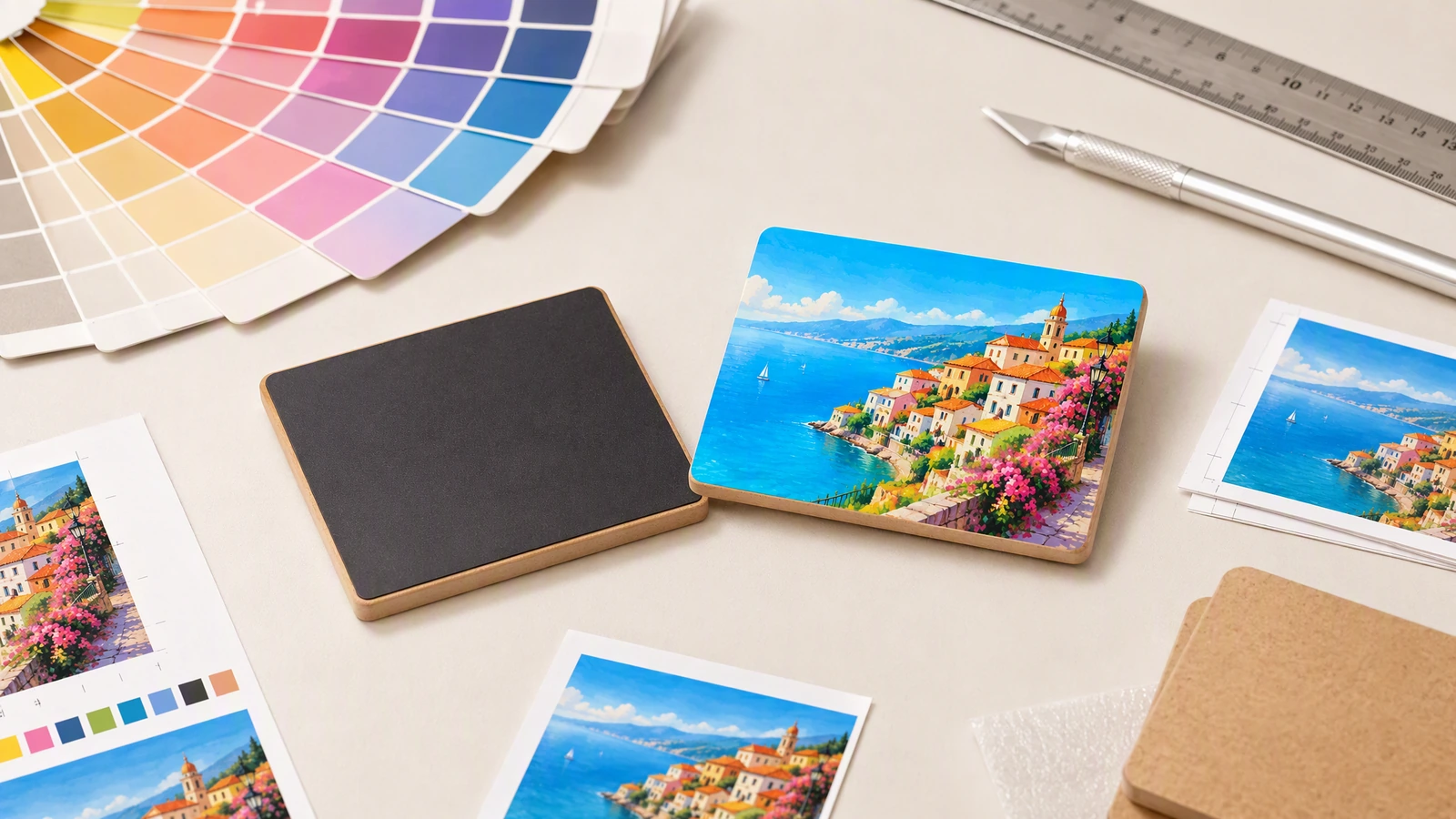
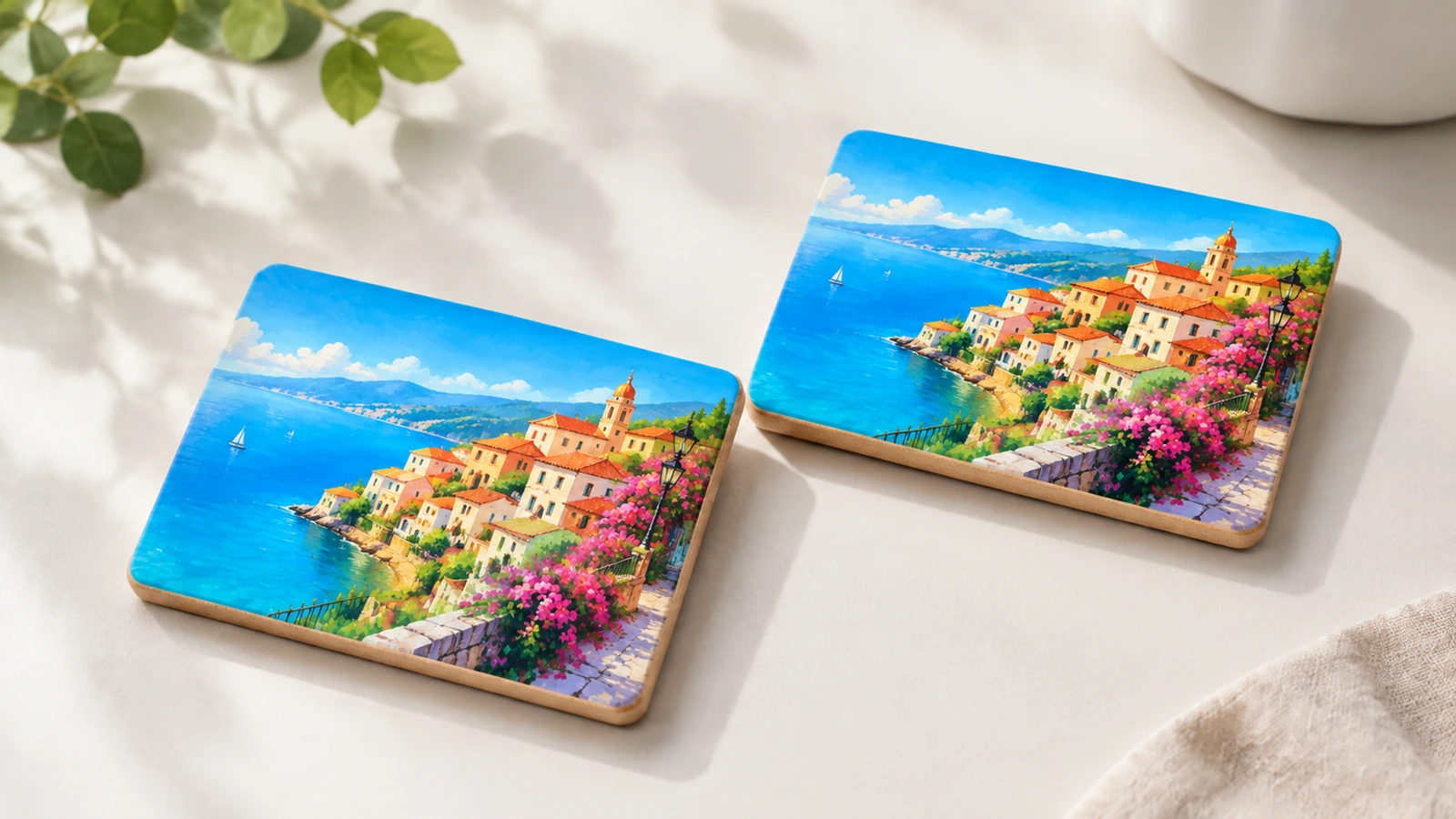
Concept illustration: the designs and presentation shown are not approved production samples.
On this page
What are you ordering when you choose printed MDF magnets? ↑
The verified product identity is a custom full-color printed MDF fridge magnet. MDF is an engineered wood-fiber board, rather than solid timber or layered plywood. Calling it “wooden” describes the broader product category; specifying MDF tells your purchasing team and customers what the actual substrate is.
Do not expect the knots or continuous grain associated with natural timber. If visible wood grain is central to the design, that is a different material requirement to discuss separately. A printed wood-grain graphic should not be presented as natural grain in the board.
The decorative face and magnetic attachment perform separate jobs. The face carries the artwork; the backing attaches the finished piece to a suitable surface. Full-color printing is confirmed at the product-identity level, but UV direct printing, white underprinting, protective coatings and particular magnet types are not established specifications for this reference.
| Specification field | Current status | What the purchasing brief should establish |
|---|
| Base material | MDF confirmed | Board specification and required material documentation |
| Decoration | Custom full-color printing confirmed | Printing route, surface preparation and color reference |
| Finished dimensions | Pending quotation and sampling | Width, height and thickness in mm |
| Magnetic attachment | Pending specification | Type, dimensions, placement and fixing method |
| Unit weight | Not provided | Measured finished weight in g |
| MOQ and pricing | Pending quotation | Quantity per design, setup charges and price inclusions |
| Sample and production timing | Pending quotation | Separate schedules and approval milestones |
| Packaging | Pending agreement | Presentation, protection, labeling and pack quantities |
This table separates confirmed identity from purchasing decisions. Dimensions and commercial terms published by other manufacturers are market examples, not selectable specifications or delivery promises for NSKU-739-02.
Size should follow readability, not the enlarged screen preview
Review artwork at its intended physical size. Check whether the destination name, wedding date or logo remains legible without zooming. Detailed photographs may need a different crop, while a long message may need simplification. Confirm the outline before approving small text near the edge.
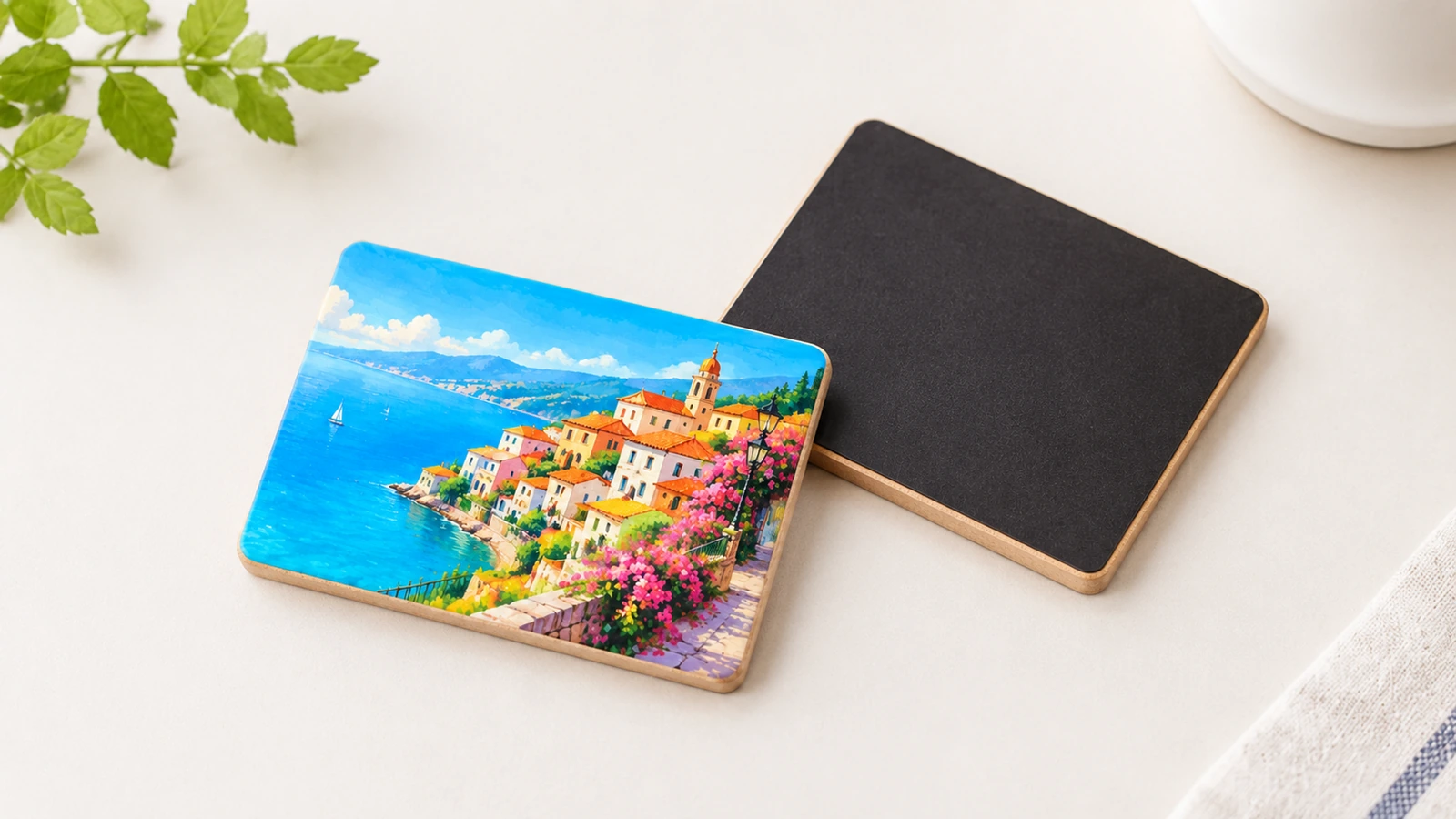
Illustrative size comparison: no dimensions or thicknesses are established by this image.
The appliance surface matters as much as the magnet
Stainless steel is not a universal compatibility guarantee. Some finishes hold magnets and others do not; GE also advises against magnets on its Black Stainless and Fingerprint Resistant Stainless doors because the finish can be damaged. Check the appliance instructions before testing the intended location, following GE appliance-finish guidance[1].
How do you turn artwork into a sample-ready specification? ↑
Step 1: Define the job before choosing the backing
Write down the intended display surface, whether paper holding is required, and how the recipient will remove or reposition the magnet. Describe the actual paper or photograph rather than requesting “strong magnets.” Holding capacity depends on physical dimensions, loading conditions and sample verification; no paper count or load rating is confirmed for this product.
For a decorative design, test attachment under its own weight. For a functional design, test the complete assembly with the intended load on a representative vertical surface. Coatings and inserted paper create gaps, while friction and placement affect resistance to sliding, as explained in K&J Magnetics’ fridge-magnet guidance[2].
Step 2: Discuss the printed surface and attachment together
Ask whether the proposed print sits directly on the prepared MDF or uses another construction. Confirm whether white underprinting or a protective finish is proposed, and inspect its effect on pale colors, dark areas and fine lines. These are specification questions, not confirmed options included in the current product.
Potential backing approaches in the wider category include flexible magnetic strips and recessed disc magnets. Compare them through samples rather than material names alone. Record their contact area, position and fixing method. A recessed component still needs retention checks; a flexible backing still needs adhesion and flatness checks.
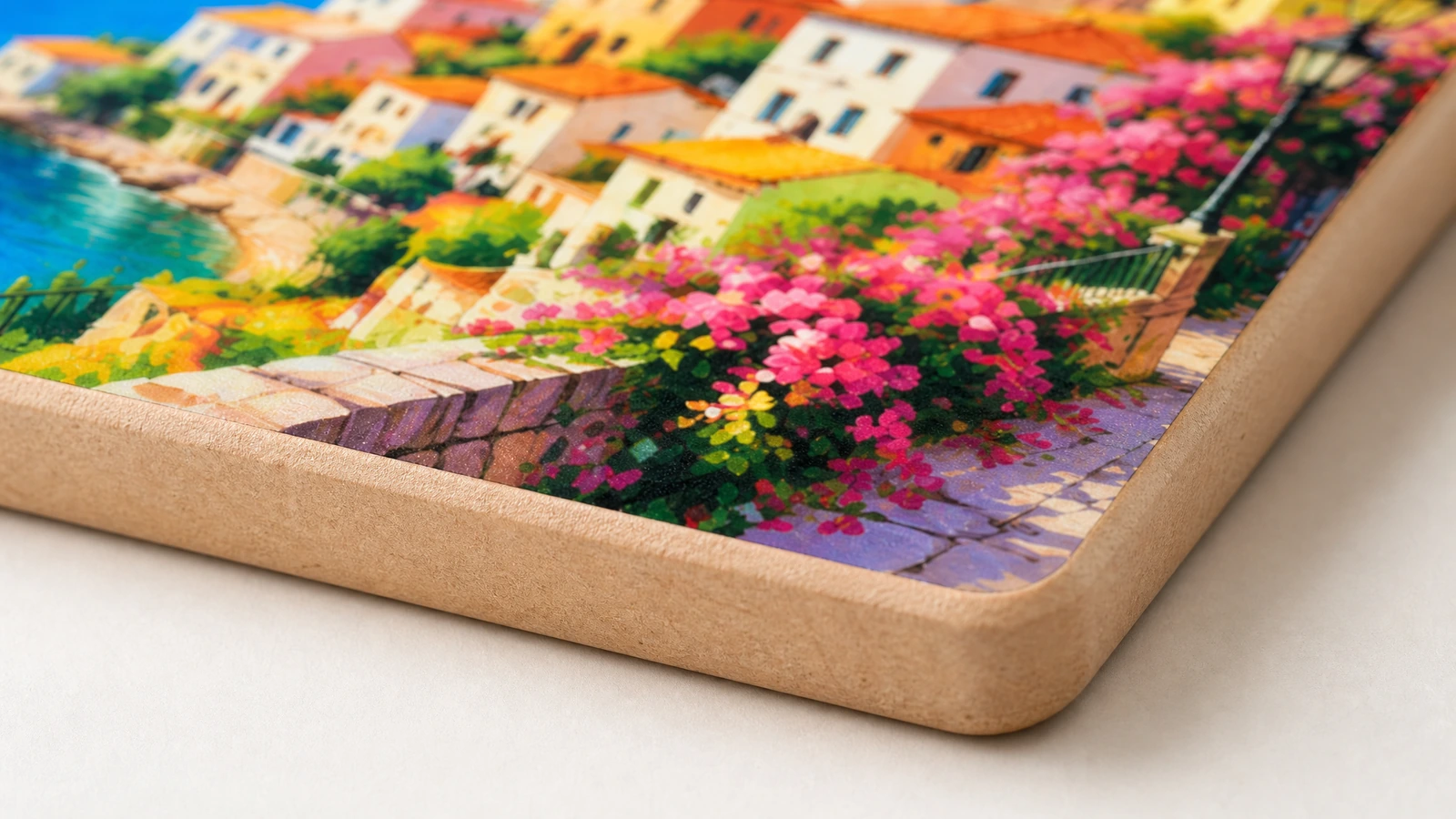
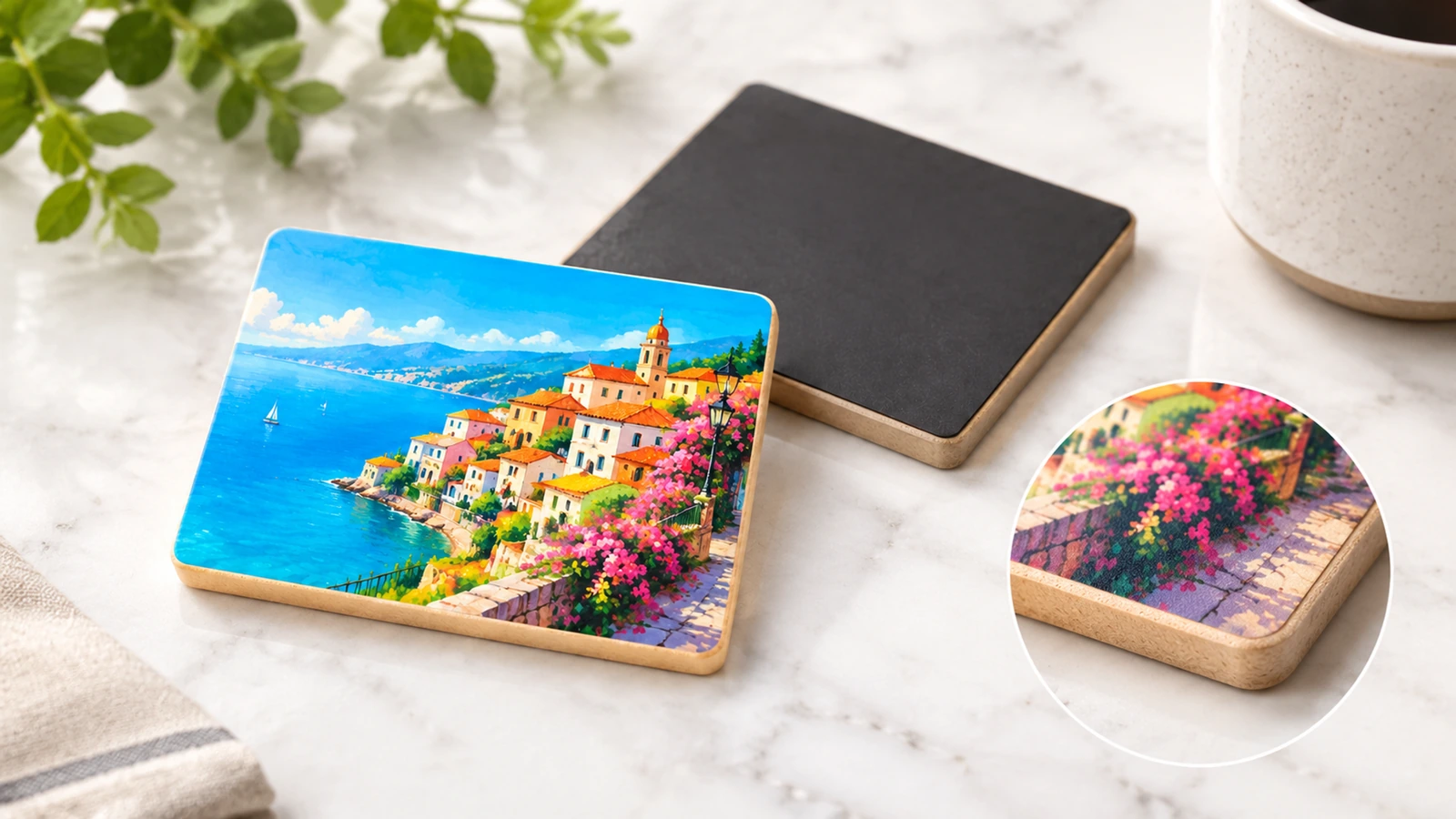
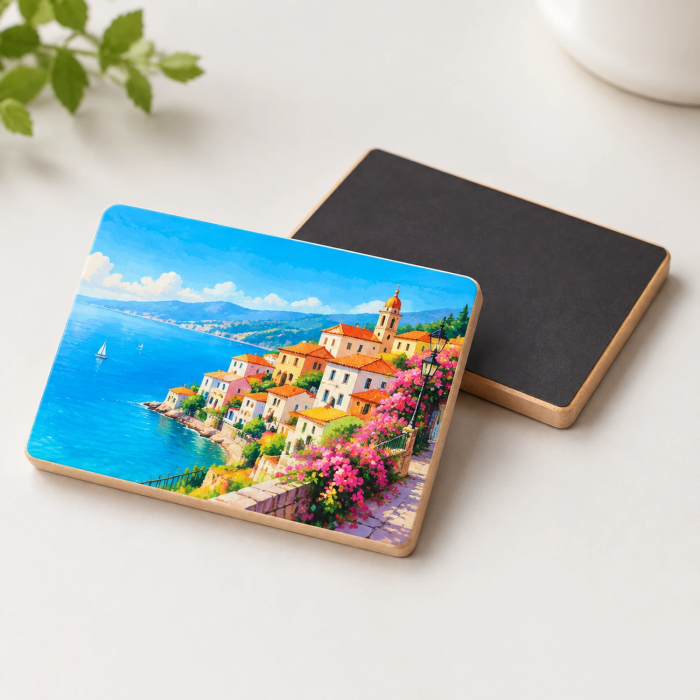
Construction concepts only: illustrated finishes and backing types require separate feasibility and sample approval.
Examine the contact side for protruding components, rough edges and trapped debris. If a protective layer is proposed, include it in the holding test because it changes the finished contact arrangement. Avoid approving the print and magnetic backing as unrelated parts.
Step 3: Preflight the artwork before making the physical sample
Supply vector artwork for logos and outlines where available, together with the original high-resolution photograph or illustration. Check raster detail at the final print size; changing a resolution setting cannot restore missing image information. Confirm the selected production route’s file requirements before preparing the final export.
- Outline: Separate the cutting path from the visible artwork and identify delicate projections.
- Crop: Keep faces, names and essential design features clear of the finished edge.
- Color: Identify important brand colors and the physical reference used for approval.
- Print layers: Confirm any white layer, coating or other special treatment separately.
- Text: Check spelling, dates and fine details at actual size, not only on a zoomed screen.
- Rights: Confirm permission to reproduce photographs, illustrations and brand marks.
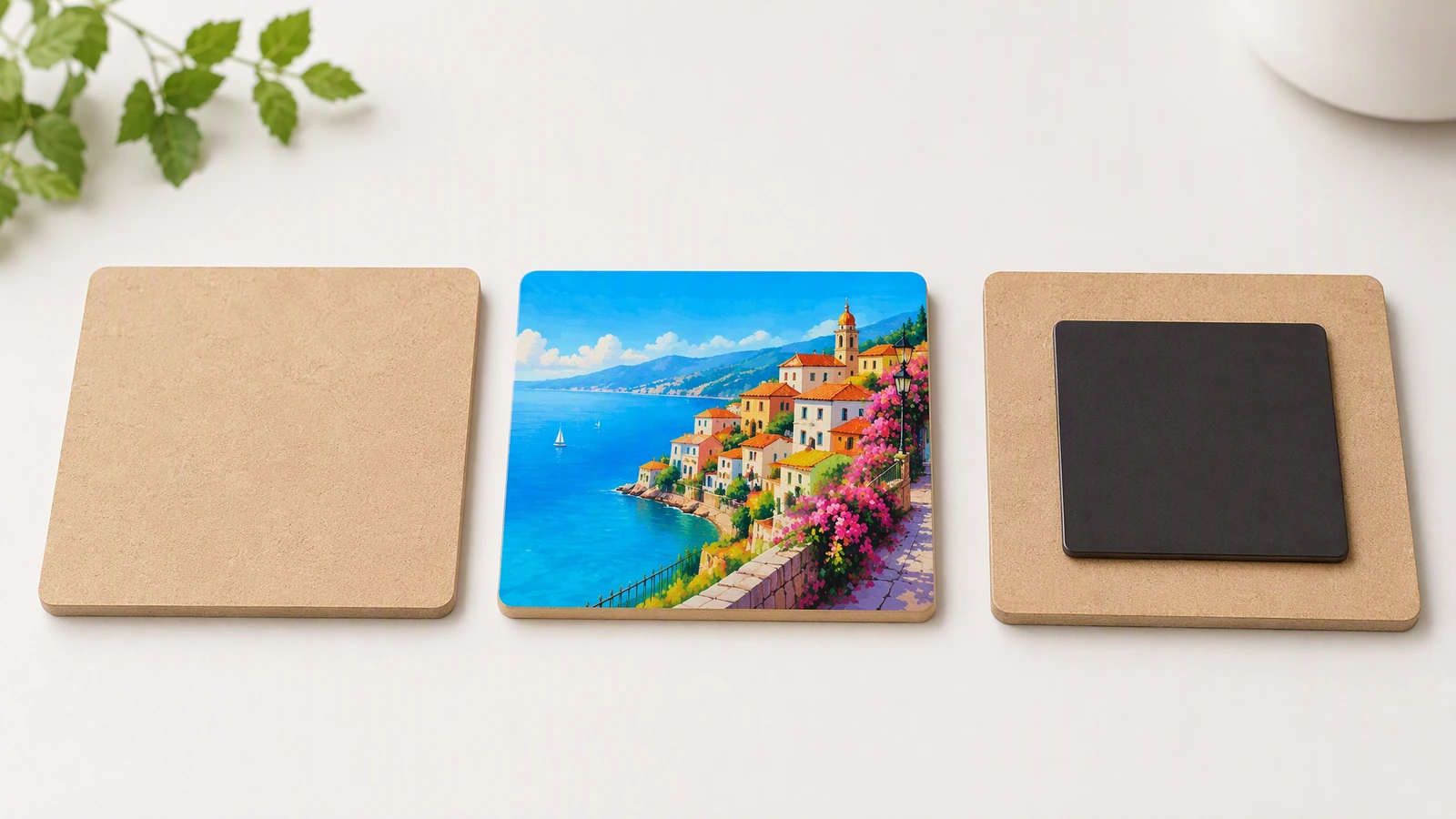
Illustrative preflight arrangement, not a completed artwork check for a customer order.
A digital proof settles layout, spelling and positioning. It does not establish surface feel, exact color on MDF, attachment strength or resistance to rubbing. Keep those decisions for the physical sample, with the same intended construction as the production order.
Step 4: Approve the complete sample before releasing production
A proposed purchasing sequence is specification agreement, artwork review, physical sampling, written approval, production and inspection. Actual manufacturing operations depend on the confirmed printing and cutting methods. This sequence is an approval framework, not a claim about installed equipment or an existing production commitment.
Review the front, reverse and edge under consistent viewing conditions. Where consistency matters, inspect several pieces rather than relying on one flattering photograph. Include the intended backing card or individual protection so the approval covers how the product will actually arrive and be presented.
Illustrative process stages: this image is not evidence of a particular factory, printing method or production capacity.
Retain the approved sample and record the artwork version, material, finish, backing and packaging. Agree that changes to these items require review before production proceeds. A sample made with one printing route should not silently become a bulk order made with another.
Separate sample timing, production timing and shipping in the quotation. Establish which approval starts the production schedule and how revisions affect it. Neither the supplied product facts nor factory data establish an MOQ, sample turnaround or production lead time for this reference.
Step 5: Make quality acceptance observable
Describe defects before inspection begins. Examples include unreadable text, an incorrect design, chipped edges, visible print damage, backing movement and incorrect packing. Agree the inspection standard, lot size, sample size and acceptance rules in writing. This approach follows PPAI product-inspection guidance[3], which identifies ANSI/ASQ Z1.4 normal single sampling and General Level II as an example framework.
| Check | Proposed verification method | Record before acceptance |
|---|
| Print and color | Compare finished pieces with the approved physical reference | Viewing conditions and acceptable differences |
| Size and edges | Measure finished dimensions and inspect cut edges | Dimensions in mm, tolerances and defect examples |
| Magnetic performance | Test the complete magnet on the agreed surface and load | Surface, load, duration and observed sliding or release |
| Backing retention | Inspect attachment before and after agreed handling tests | Movement, lifting or separation criteria |
| Surface durability | Conduct agreed rubbing or moisture-exposure checks | Method, exposure and acceptance criteria |
| Packaging | Inspect packed samples after agreed transport simulation | Print scuffing, edge damage, labeling and quantities |
These are proposed acceptance checks, not reported test results. Test duration, loads and permissible changes remain to be agreed. No validated holding strength, abrasion rating, moisture resistance or service-life figure has been supplied.
Inspection illustration only: no pass result, measurement or certification is represented.
If acceptance sampling is required, the supplied research proposes zero acceptance for identified critical defects, with major AQL 2.5 and minor AQL 4.0 as negotiation starting points. These are not established terms for this product. Select the applicable sampling plan before using them; AQL is not permission to ship a stated percentage of defective pieces.
Which construction and purchasing choices fit your project? ↑
Compare the intended result, not just the word “wooden”
| Approach | Reason to consider it | Trade-off to evaluate | Status for this product |
|---|
| Full-color printed MDF | Photographs, illustrations and brand artwork | Verify print clarity, edges, finish and backing as one assembly | Confirmed product identity; detailed specification pending |
| Printed plywood or solid wood | Visible natural grain is part of the design | Material appearance can influence the printed result | Separate material alternative, not this confirmed MDF product |
| Laser-engraved wood | Text and linework with a carved or burned appearance | Engraving alone does not reproduce a full-color photograph | Separate decoration approach |
| Printed wood with a clear resin dome | A glossy, raised presentation | Review added construction, weight, packing and cost | Separate construction requiring feasibility confirmation |
| Layered wooden construction | Physical depth for a landmark or illustrated scene | More joining surfaces and projecting details to inspect | Separate construction requiring quotation |
| Sublimation-coated MDF | A coated substrate designed for heat-transfer decoration | Depends on the coating and transfer process | Do not assume equivalence with another printing route |
This comparison distinguishes category alternatives; it is not an available-options list. Keep the MDF specification unless a different substrate or construction is explicitly approved. Likewise, another manufacturer’s finish claims cannot establish this product’s durability.
Compare complete quotations on the same basis
Ask each quotation to identify the design quantity, finished dimensions, substrate, printing route, attachment and packaging. Separate artwork or setup charges, samples, special finishes, inspection, freight and taxes where applicable. A low unit price is not comparable when one offer includes individual presentation and another covers loose pieces only.
For multiple artworks, clarify whether quantities and charges apply per design or across the order. For repeats, confirm whether the approved specification and artwork remain unchanged and whether setup charges recur. A previous order’s price or schedule should not silently become the basis for a new quotation.
Check material documentation without adding unsupported labels
MDF deserves a material-document review, not a generic “natural wood” claim. EPA identifies MDF among the composite wood products covered by its formaldehyde framework. For U.S. purchasing, assess the applicable requirements for the proposed board and finished article using EPA composite-wood guidance[4]; this page does not establish compliance for the product.
No FSC certification is confirmed. If certified sourcing is required, request documentation for the actual supply chain and proposed product claim. Applying labels, manufacturing or relabeling certified products, and selling with invoice claims involve different requirements from promotional use, as explained by FSC licensing guidance[5]. Neither an MDF substrate nor paper packaging establishes an environmental certification or recyclability claim.
Keep decorative merchandise distinct from children’s toys
Do not infer child suitability from colorful artwork or a wooden appearance. Review the intended user, marketing and possibility of magnetic-component separation. Under 16 CFR Part 1262, covered subject magnet products have requirements for loose or separable magnets that fit the small-parts cylinder, including a flux index below 50 kG² mm². Toys subject to 16 CFR Part 1250 follow their applicable toy requirements instead. These scope distinctions are explained in CPSC magnet business guidance[6].
No toy testing or child-safety certification is established for NSKU-739-02. A “not a toy” statement does not replace classification based on the actual design and marketing. Keep detachable magnetic components away from children and stop using an item if its backing becomes loose.
Packaging should protect the print and explain the product
Choose packaging around the sales channel. Retail presentation may need a backing card and barcode; event distribution may prioritize individual protection and clear recipient instructions. Where the magnet is attached to a card, show how it separates so the recipient recognizes the intended use.
Review protection against face-to-face rubbing, chipped edges and moisture during transport. Pack quantities and carton arrangement must follow the actual product dimensions, packed condition and sample verification. No carton capacity, shipment weight or damage-rate claim is established here.
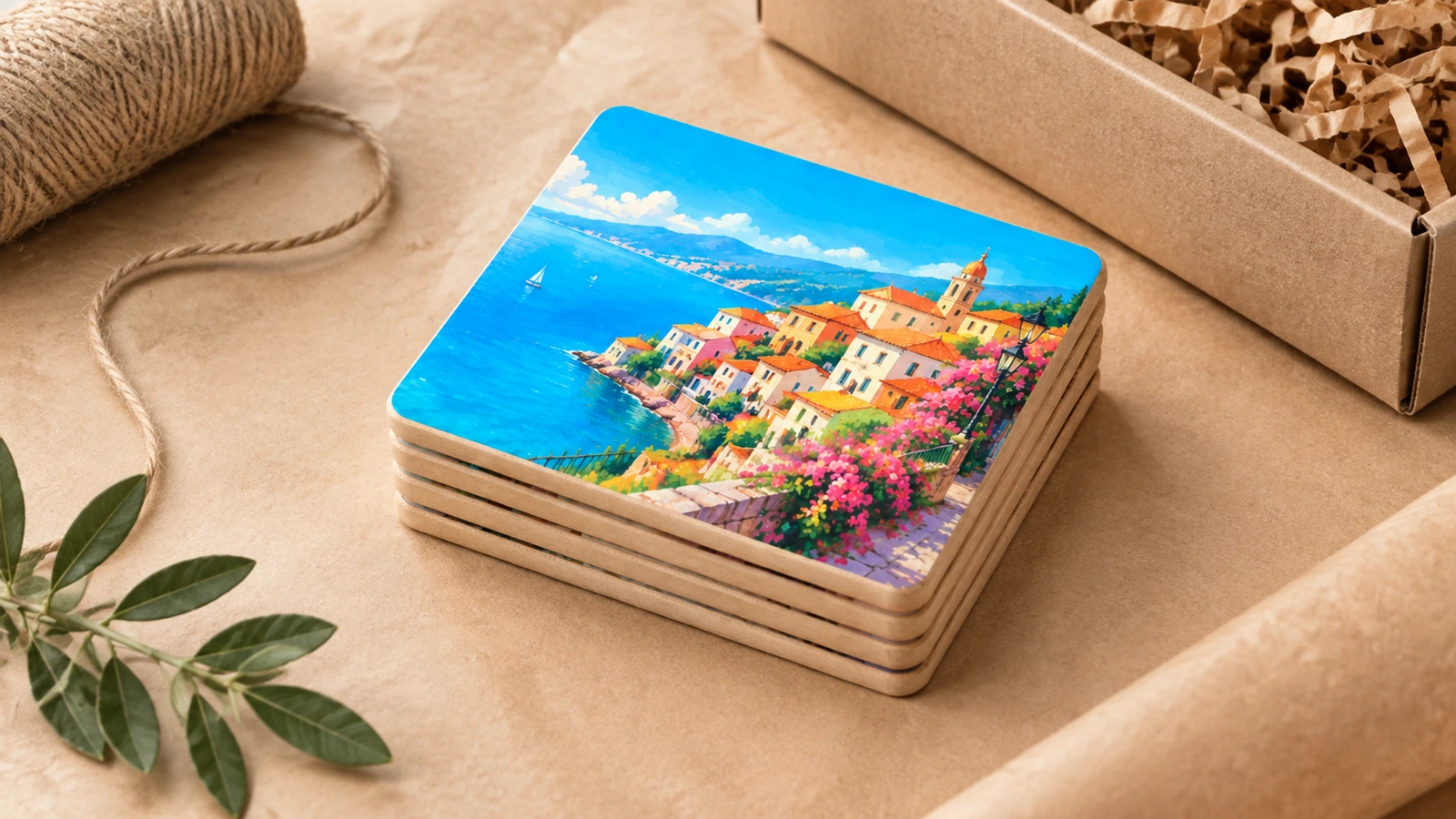
Packaging concepts are illustrative; materials, pack quantities and transport performance require agreement.
Until a finish-specific care method is validated, plan for dry indoor display, gentle cleaning with a soft dry cloth, and avoidance of soaking, steam and direct heat. A supplier’s claim about an ink layer does not establish waterproof performance for the entire MDF, adhesive and magnetic assembly.
Keep the approved sample, artwork file, packaging specification and inspection record together for reorders. Record any material or process change before comparing the new batch. This gives the next purchase a physical reference rather than relying on an old screen image.
What should you settle before placing an order? ↑
- Specify the actual material. This product is full-color printed MDF, not solid wood or plywood.
- Approve a complete object. Layout approval does not establish color, edge quality, magnetic retention or packaging performance.
- Define the intended load. Holding capacity depends on physical dimensions, loading conditions and sample verification.
- Separate identity from unconfirmed specifications. Size, thickness, backing, unit weight, MOQ and production timing remain pending.
- Make quotations comparable. Match the design quantity, construction, packaging, inspection scope and delivery basis.
- Require evidence for added claims. Certification, child suitability and durability need relevant documentation or testing, not category-level assumptions.
Make the next decision with a complete project brief ↑
A useful brief combines the artwork with the business requirement: intended audience, quantity per design, desired dimensions in mm, display surface, decorative or paper-holding use, packaging, destination and required arrival date. It lets the quotation address the actual project instead of borrowing assumptions from an unrelated magnet.
Request a project quote for NSKU-739-02 with your artwork and purchasing brief.




The information below is required for social login
Sign In
Create New Account