


 Blog PDF for offline reading
Quick answer: No, not in any way you could notice. Wood and MDF are neither attracted nor visibly repelled by magnets. Both are very weakly diamagnetic, and that repulsion only becomes visible in laboratory fields of roughly 16 tesla, thousands of times stronger than a fridge magnet. A wooden fridge magnet holds because a separate magnet is bonded to its back and grips the steel door. The wood is the printed face; the magnet, the adhesive and the door do all of the holding.
Do magnets repel wood? The question usually comes up at an awkward moment. You press a printed wooden magnet against the fridge and it slides to the floor. A save-the-date arrives and the backing pops off. A souvenir that looked solid in the shop won't hold a single postcard at home. Wood seems like the obvious suspect because it is the part you can see. It is almost never the cause.
Buyer reviews of wooden fridge magnets keep returning to the same few complaints. One says a set "will do the trick when holding up a few pieces of paper but they can struggle a bit with thicker post cards." Another says a magnet that "falls on the floor" loses its backing. A third says the magnets don't stick to the reviewer's stainless steel refrigerator at all. Each of these has a physical cause, and none of them involves wood pushing a magnet away. Below you'll find the physics in plain terms, the parts that actually decide grip, and a ten-minute test that shows how much a wooden magnet will really hold.
Do magnets repel wood? What the physics actually says
Materials respond to a magnetic field in three broad ways. Ferromagnetic materials such as iron, most carbon steel, nickel and cobalt are strongly attracted, and that attraction is what every fridge magnet relies on. Paramagnetic materials such as aluminum are attracted very weakly. Diamagnetic materials are repelled very weakly. Water, cellulose, lignin and most plastics and resins fall into this last group.
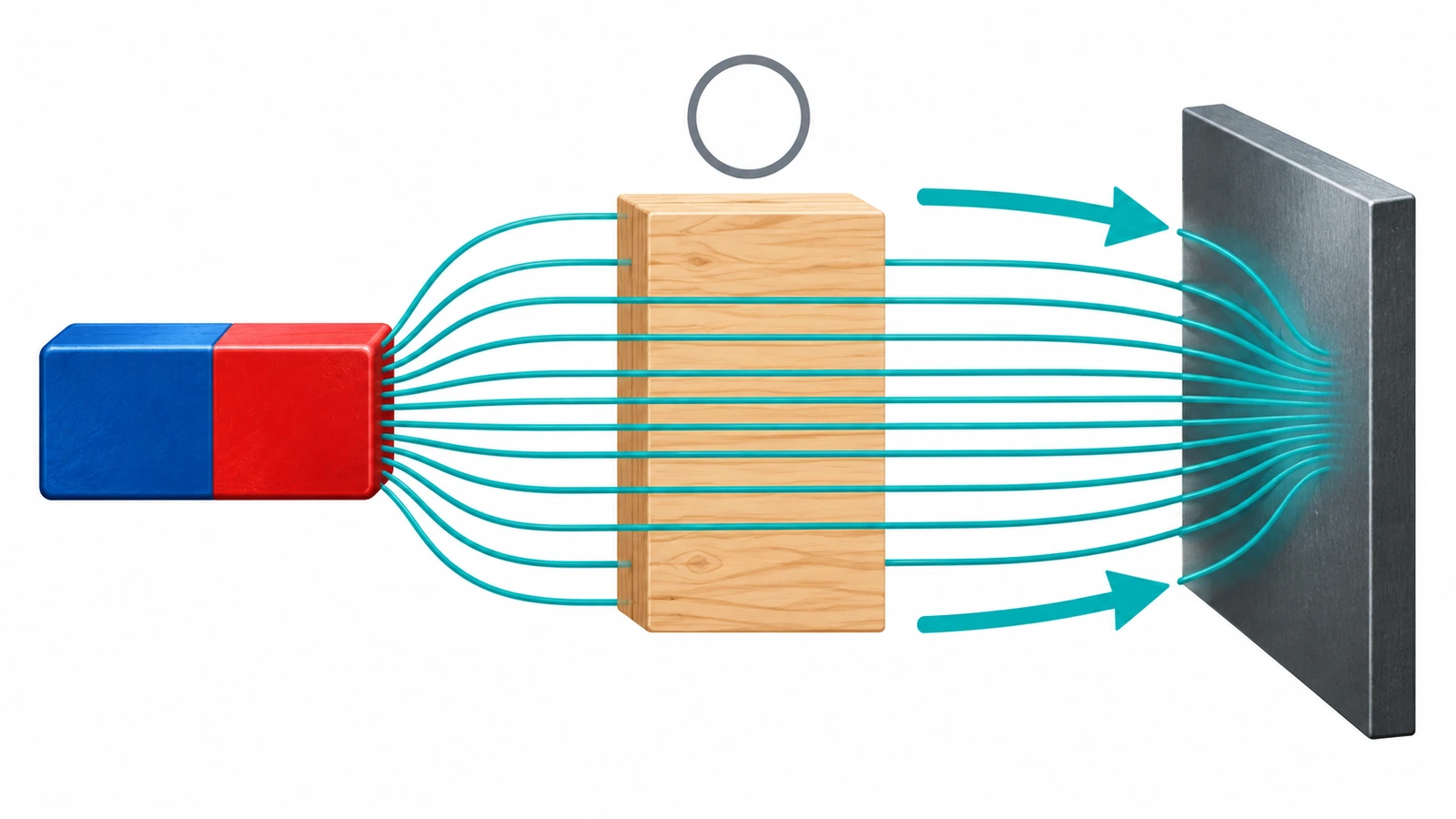
Wood consists of cellulose, hemicellulose, lignin and some water, so strictly speaking it is diamagnetic. The size of the effect is the important part. Water has a volume magnetic susceptibility of about −9 × 10⁻⁶ (SI). Soft iron has a relative permeability in the thousands. The gap is roughly a billion-fold. To make diamagnetic repulsion visible, researchers at Nijmegen in 1997 levitated a living frog inside a magnet producing about 16 tesla. For comparison, a flexible fridge magnet produces a surface field in the low tens of millitesla, and a small neodymium disc produces a few tenths of a tesla. At household scale, the force between a magnet and a piece of wood is effectively zero.
MDF behaves the same way. It is made of wood fibers pressed together with a resin binder, and neither the fibers nor the resin respond to a magnet in any useful sense. Because MDF is a composite wood product, U.S. rules on it are about formaldehyde emissions from the binder, not magnetism (see the EPA's composite wood FAQ[1]). Wood also does not conduct electricity. That matters because a magnet moved quickly past copper or aluminum gets slowed by eddy currents (Lenz's law), and people sometimes mistake that drag for "repulsion." Wood produces no eddy-current drag. If a wooden object does seem to react to a magnet, look for a hidden staple, nail, screw, or steel insert.
Customs authorities read the product the same way physics does. In ruling N359907, dated April 6, 2026, U.S. Customs and Border Protection described a decorative magnet made of an image on a square wooden base, backed by a rubber magnet of strontium ferrite and chlorinated polyethylene. CBP classified it under HTSUS 8505.19.2000 as a composite good containing flexible magnets (CBP ruling N359907[2]). EU explanatory notes, summarized in a UK tariff notice, put it more directly: in a refrigerator magnet with a decorative article attached, the magnet gives the product its essential character and the decoration is secondary (GOV.UK Tariff Notice 15[3]). In short, the wood carries the picture and the magnet carries the load.
How a wooden fridge magnet actually holds
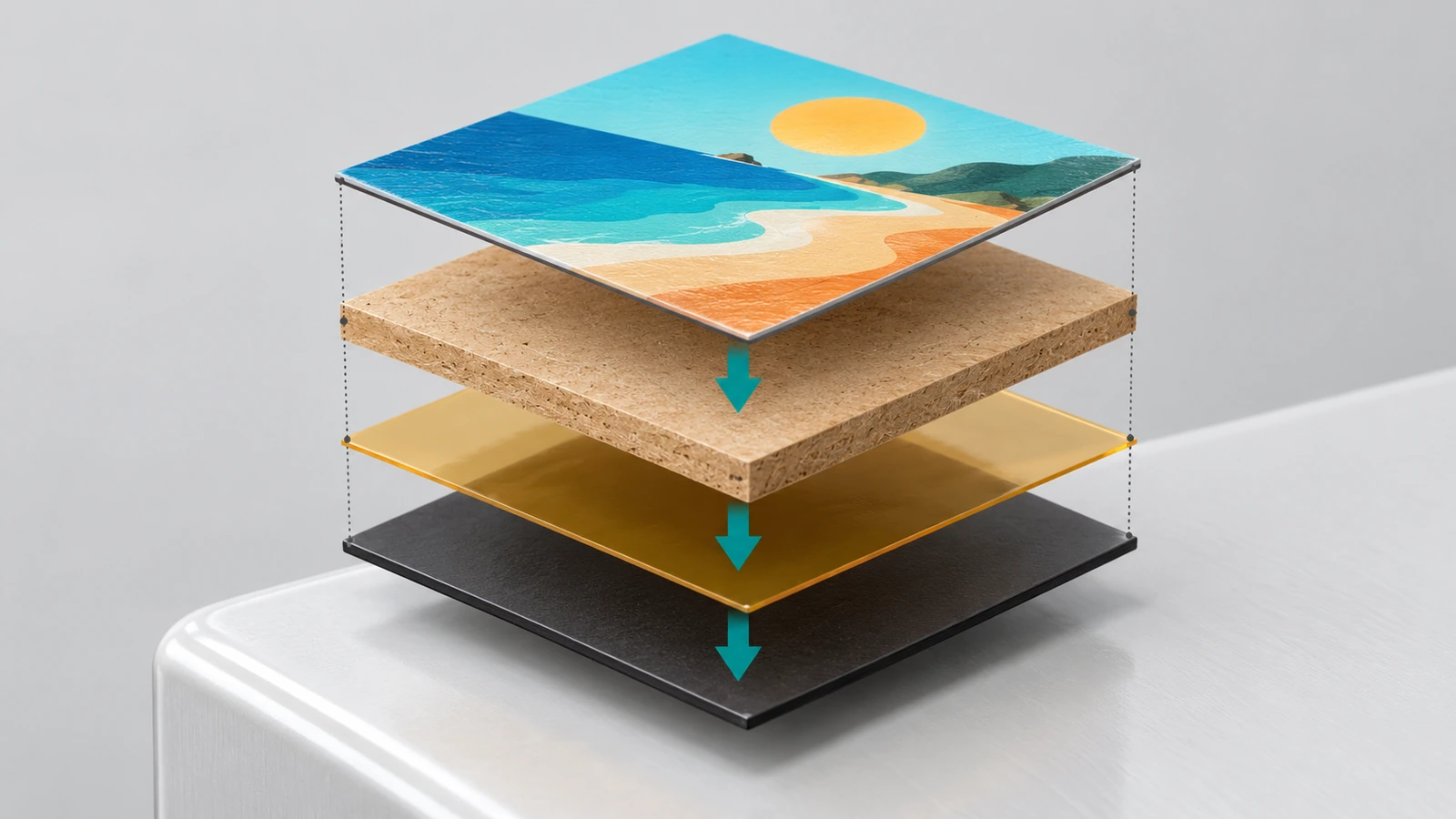
Think of a wooden fridge magnet as a chain of five links: the steel door, the gap, the magnet, the adhesive and the printed wood. Grip fails at whichever link is weakest, and in most complaints that link is not the wood.
Link 1: The door has to be ferromagnetic
Many "stainless" refrigerator fronts use austenitic grades such as 304 or 316, which are essentially non-magnetic. Ferritic grades such as 430 and 434 are magnetic. Some doors also have a thick coating that adds gap. The side panels of many refrigerators are painted carbon steel and hold magnets well even when the front does not. Before blaming a magnet, test the door with one you already know works. If that one fails too, no wooden magnet backing will fix it. Note also that magnets have no effect on how well a fridge cools or how much energy it uses, but hard backs and sharp edges can leave fine scratches on the finish (Tom's Guide[4]).
Link 2: The gap is the silent strength killer
Magnetic attraction drops steeply with distance. A sheet of copy paper is about 0.1 mm thick, a felt pad 1 to 2 mm, and the wood itself usually 3 mm or more. A magnet placed behind 3 mm of wood, facing the door through the wood, loses most of its grip. That is why the magnet is always mounted on the back face, flush with the surface. There is a trade-off here. Woodworkers sometimes recess a neodymium disc slightly below the surface, or add a thin pad, so it doesn't scratch the door. Every fraction of a millimeter of setback reduces hold, so this choice should be deliberate and should be tested.
Link 3: Vertical doors turn pull into friction
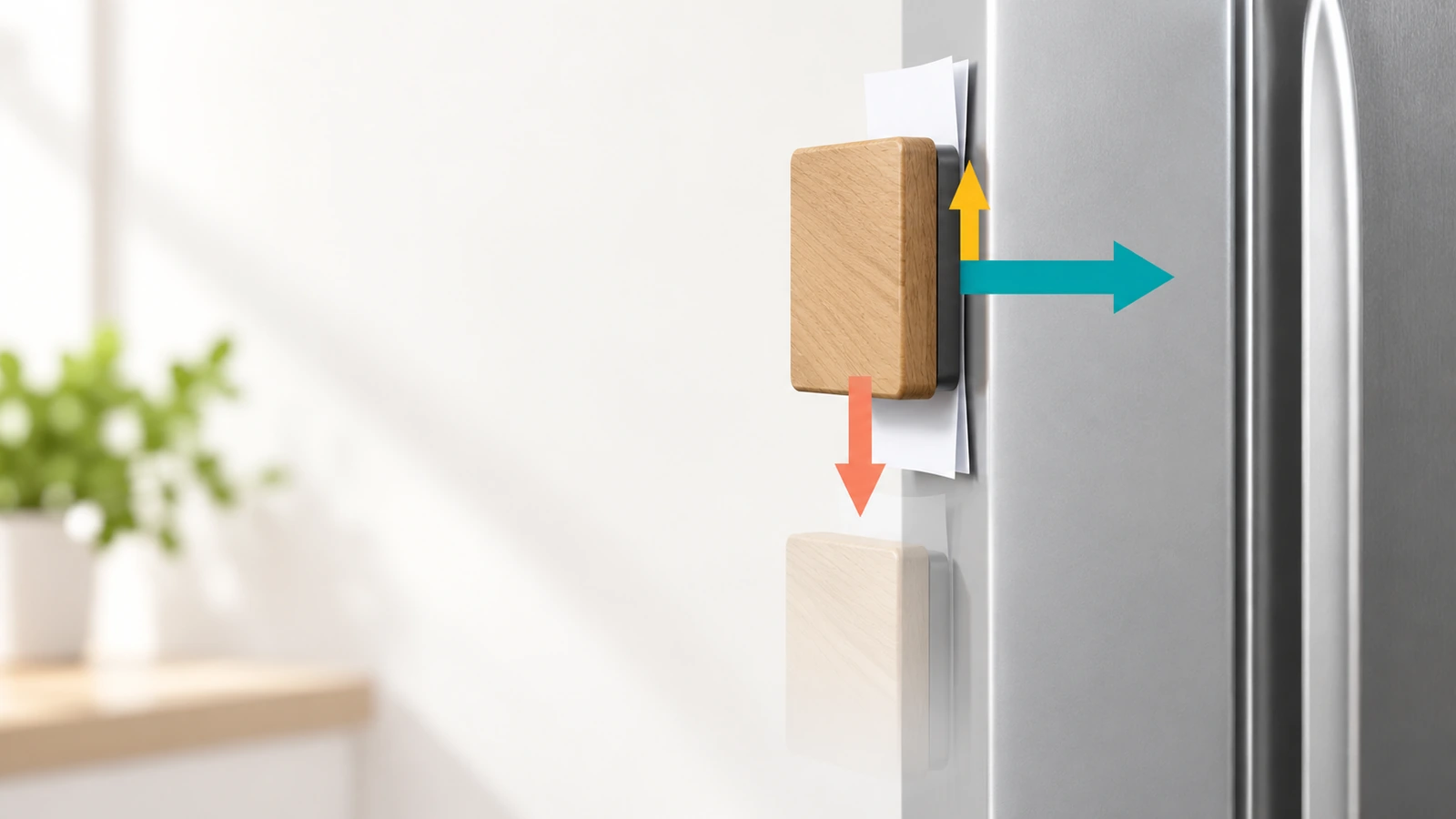
Advertised pull ratings are usually measured by pulling a magnet straight off a thick, flat steel plate. A fridge door is vertical, so the magnet isn't being pulled off; it is sliding down. What keeps it in place is friction, roughly the clamping force multiplied by the coefficient of friction between backing and paint, which is often around 0.2 to 0.4. On a vertical door, a magnet may therefore hold only a fifth to two-fifths of its rated pull. Door skins are thin sheet steel, usually under 1 mm, and they can saturate under a strong neodymium disc, which lowers the real-world number further.
Here is a worked example. A 51 × 51 mm piece of 3 mm MDF at about 0.75 g/cm³ weighs roughly 6 g. One U.S. letter sheet of 20 lb copy paper weighs about 4.5 g. The wooden face alone can weigh more than the paper the magnet is supposed to hold. This is why a magnet backing that works for a thin printed paper magnet can fail on a wooden one.
Link 4: The adhesive decides whether it survives a drop
Flexible magnet strips are typically attached with a pressure-sensitive acrylic adhesive. Small neodymium or ceramic discs go into a drilled pocket or onto the surface with two-part epoxy or cyanoacrylate. The failure modes are predictable. Low-grade adhesive softens with stove heat. Raw MDF edges absorb moisture. A hard fall to the floor shears a small disc off a thin glue line. If the backing separates after a single drop, the bond was the weak link, not the magnet or the wood.
Link 5: The printed wood is decoration, but processing matters
UV-curing inks set under ultraviolet light at relatively low temperatures. Evaporative drying processes run at about 130–230°F, which can make magnetic substrates brittle or warp them (Digital Output[5]). Neodymium magnets also lose strength if overheated; standard N-grades are typically rated to about 80°C (176°F). For printed MDF, this is one reason the face is usually printed before the magnet goes on, or with a low-heat process.
Safety: when a loose magnet becomes a regulatory issue
A magnet glued firmly to a decorative wooden piece is not the same thing as a set of loose magnetic balls. That changes if a small, strong disc can come off. U.S. federal rule 16 CFR Part 1262 covers consumer products marketed for entertainment, jewelry, mental stimulation or stress relief that contain loose or separable magnets. Any such magnet small enough to fit in the small-parts cylinder must have a flux index below 50 kG²mm² (16 CFR Part 1262[6]). The CPSC's guidance explains the scope and notes that toys subject to 16 CFR Part 1250 are exempt from Part 1262 (CPSC magnets guidance[7]). Those toys follow the toy standard instead: ASTM F963-23 for toys manufactured after April 20, 2024, including its magnet requirements (CPSC toy safety guidance[8]). For a household, the practical rule is simple. A wooden magnet whose disc has come loose should be removed from reach of young children right away. This section is general information, not legal advice.
How to check real pull strength in ten minutes
Ratings and adjectives like "strong" won't tell you whether a magnet holds your photos. This test will. It works for a single gift magnet and for a sample from a larger run.
- Confirm the surface. Place a magnet you trust on the exact spot you plan to use: front, side or freezer door. If it slides, the door is the problem.
- Self-hold test. Place the wooden magnet with nothing under it and leave it for 24 hours. Mark its top edge with painter's tape. Any creep downward means it barely carries its own weight.
- Paper ladder. Add standard copy paper one sheet at a time: 1, 2, 4, then 6 sheets. Write down the last count that stays put for 10 minutes. Then try a postcard or a printed photo, since card stock adds both weight and gap.
- Slide test. Push the magnet sideways with a fingertip. It should resist and stay where you leave it. A magnet that skates easily will drift every time the door slams.
- Bond check. Press firmly along the edge of the backing with a fingernail. Lifting corners on a strip, or any wobble in a disc, signals a weak adhesive line.
- Drop check (samples only). Drop it once from counter height, about 36 in (0.9 m), onto a hard floor. The backing should stay attached and the edges should not chip.
- Scratch check. Slide it across a hidden area of the door. Bare neodymium faces and sharp laser-cut corners are the usual culprits.
Record the results as numbers, for example "holds 4 sheets, fails at 6, survived drop." Those are far more useful than "strong" when you compare options or brief a supplier.
Magnet backings compared: strip, ceramic disc and neodymium
The backing determines grip far more than the type of wood. The table compares the three common backings using standard published material values. Remanence (Br) roughly indicates how strong the magnetized material is; energy product (BHmax) indicates how much magnetic energy it can store per unit volume.
| Backing | Typical material and grade | Approx. Br / BHmax | How it is attached | Hold behavior on a vertical door | Common failure |
|---|---|---|---|---|---|
| Flexible magnet strip or sheet | Strontium or barium ferrite in rubber binder; anisotropic is stronger than isotropic | ~0.2–0.25 T / ~1–1.6 MGOe | Pressure-sensitive adhesive across part or all of the back | Gentle, even grip over a large area; good for light faces and a few sheets; the larger the coverage, the better | Corner lift from heat or humidity; weak if only a narrow strip covers a heavy face |
| Ceramic (hard ferrite) disc | Sintered ferrite, grades such as C5 or C8 | ~0.38–0.39 T / ~3.4–3.5 MGOe (C8) | Epoxy or hot-melt onto the surface or into a shallow pocket | Stronger point grip than a strip of the same size; brittle, but tolerant of kitchen temperatures | Glue line shears off on a drop; chipping if it is struck |
| Neodymium (NdFeB) disc | Nickel-plated, grades N35 to N52 | ~1.2–1.45 T / 35–52 MGOe | Two-part epoxy in a drilled pocket, set flush | Highest hold from a small area; can carry thick card stock; thin door skins may saturate | Scratches if proud of the surface; a separated small disc is a swallowing hazard |
Three conclusions follow. For a light printed face that holds a note or two, a well-bonded flexible backing with full coverage is usually enough and is the gentlest on the door. For a heavier face, or for holding photos and card stock, a flush, epoxy-set neodymium disc gives the most hold per square millimeter, but bond quality then becomes a safety matter as well as a performance one. In every case, the wood itself does not change the outcome. If you are specifying a run of custom printed wooden fridge magnets, the product page explains the construction options; this guide is meant to help you judge whatever sample arrives.

FAQ
FAQ: Will a magnet work through wood?
Yes. Magnetic fields pass through wood as if it were air, which is how hidden cabinet catches and magnetic knife strips work. The limit is distance, not the material. Each additional millimeter of wood between the magnet and the steel reduces holding force sharply, so a magnet meant to work through wood needs to be much stronger than one mounted on the surface.
FAQ: Why does my wooden magnet stick to the side of the fridge but not the front?
The front is probably austenitic stainless steel, such as grade 304, which is essentially non-magnetic, or it has a thick coating. The side panel is often painted carbon steel, which is strongly magnetic. Wood has nothing to do with it; a plain magnet will show the same pattern.
FAQ: Does MDF block or weaken magnets differently from solid wood?
No. MDF, plywood, birch and bamboo are all magnetically transparent. What differs is density and thickness. Denser, thicker pieces weigh more, so the same magnet has more dead weight to carry before it holds any paper.
FAQ: Can wood or printing ink demagnetize a magnet over time?
Wood and cured ink have no effect on magnetization. Real threats are heat, such as a magnet stored above the stove or a neodymium disc exposed to temperatures above its grade's limit, and physical damage like a cracked ceramic disc. A "weaker" wooden magnet usually has a lifting backing or a coated door, not a demagnetized magnet.
FAQ: Can I call a wooden magnet FSC certified because it's made of wood?
Only if the supply chain holds a valid FSC chain-of-custody certificate and the claim follows FSC trademark rules. FSC labels such as FSC 100%, FSC Mix and FSC Recycled can be verified through FSC's claims check[9]. "Wooden" alone is not a sustainability claim.
FAQ: Do people actually keep wooden magnets?
Material does seem to matter for keeping. In research summarized by the promotional products association PPAI, 76% of consumers said sustainability influences whether they keep or use a product (PPAI Research, January 2026[10]). A wooden magnet still only stays on the fridge if its backing holds.
Key takeaways
- Magnets do not noticeably attract or repel wood; the grip comes from a bonded magnet meeting steel. — U.S. customs classifies a printed wooden-base magnet under HTSUS 8505.19.2000 at 4.9% general duty (Source)
- In a decorative fridge magnet, the magnet defines the product and the decoration is secondary. — EU subheadings 8505 11 00 to 8505 19 90 (Source)
- A small magnet that can come loose is a safety issue, not just a quality issue. — flux index must be below 50 kG²mm² for covered loose magnets (Source)
- Magnets sold as toys follow the toy standard instead. — ASTM F963-23 for toys manufactured after April 20, 2024 (Source)
- Low-heat UV curing protects magnetic materials during printing. — evaporative drying runs at about 130–230°F (Source)
- Material choice affects whether a magnet gets kept. — 76% of consumers say sustainability influences whether they keep a product (Source)
Conclusion
Wood is not working against your magnet. It is magnetically almost invisible, with a diamagnetic effect billions of times too weak to matter on a kitchen door. When a printed wooden magnet fails, look in this order: a non-magnetic or heavily coated door, too much gap, a backing too small for the weight of the face, or an adhesive that gave way. Run the ten-minute test, record the number of sheets it holds, and judge any magnet by that figure rather than by the word "strong." When you are ready to put your own artwork on wood, start with our printed MDF fridge magnets and request a sample you can put through the same test.
Sources
- U.S. Environmental Protection Agency, "Frequent Questions for Consumers about the Formaldehyde Standards for Composite Wood Products Act." epa.gov ↩
- U.S. Customs and Border Protection, CROSS Ruling N359907 (April 6, 2026), HTSUS 8505.19.2000. rulings.cbp.gov ↩
- GOV.UK / HMRC, "Magnets (Tariff Notice 15)," citing Explanatory Notes to the Combined Nomenclature 2021/C 333 I/01. gov.uk ↩
- Tom's Guide, "Do fridge magnets drive up energy bills? An expert reveals whether you should take down your souvenirs." tomsguide.com ↩
- Digital Output, "Rules of Attraction" (July 2, 2026). digitaloutput.net ↩
- Electronic Code of Federal Regulations, 16 CFR Part 1262, Safety Standard for Magnets (87 FR 57756, September 21, 2022). ecfr.gov ↩
- U.S. Consumer Product Safety Commission, "Magnets Business Guidance." cpsc.gov ↩
- U.S. Consumer Product Safety Commission, "Toy Safety Business Guidance" (ASTM F963 via 16 CFR Part 1250). cpsc.gov ↩
- Forest Stewardship Council, "Claims check." fsc.org ↩
- PPAI, "PPAI Research: New Year, New-ish Trends" (January 7, 2026). ppai.org ↩












The information below is required for social login
Sign In
Create New Account