Custom acrylic fridge magnets combine a rigid acrylic face, UV-printed artwork, a laser-cut outline, and magnetic backing. Specify the finished size, artwork layout, backing construction, and packaging together, then approve a physical sample for appearance and intended use before committing to production.
For artwork, souvenirs, and personal occasions. Turn an original illustration into artist merchandise, a landmark into a destination keepsake, or a wedding design into a personalized favor. Brand buyers can develop logo-led gifts, while retailers can plan coordinated collections. Each application needs a different balance of readable detail, recognizable shape, and presentation.
A design that looks impressive on screen can disappoint when reduced to a small physical object. Names become difficult to read, narrow details look fragile, or the magnetic backing does not suit the finished piece. For an event, these problems affect the entire giveaway; for a retailer, they can become customer complaints after sale.
The practical solution is to approve the complete product rather than the artwork alone. Start with actual dimensions, review the print and cut layout, and evaluate an assembled sample on the intended surface. Product reference NSKU-744-01 identifies the UV-printed, laser-cut acrylic construction; thickness, magnetic specification, order minimum, price, and delivery schedule remain subject to quotation and sample confirmation.
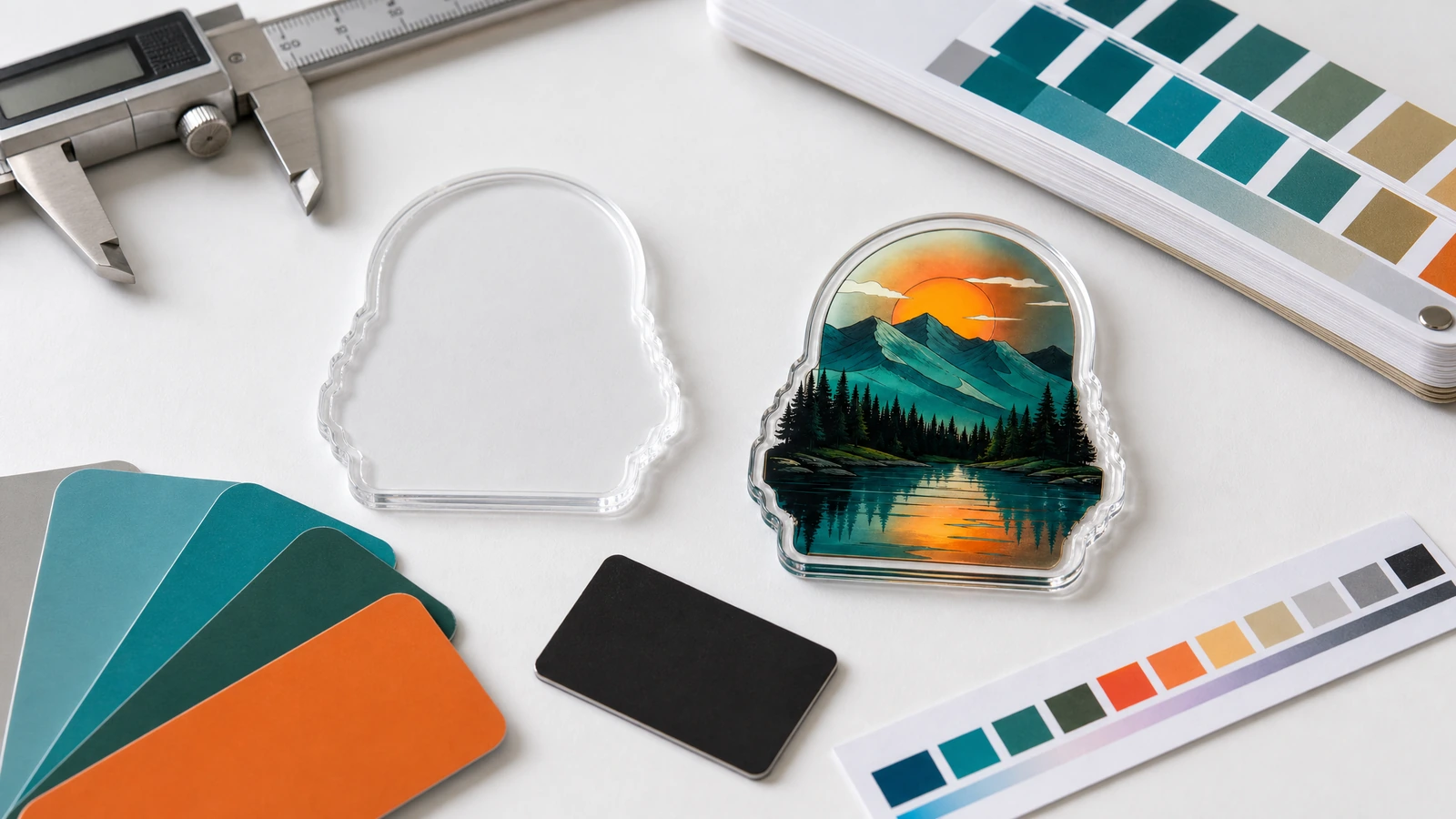
Images illustrate design and purchasing considerations, not verified production samples, available options, or test results.
Explore this product
What defines this acrylic magnet construction? ↑
This product combines custom UV printing with a laser-cut acrylic face and magnetic backing. The printed image supplies the visual detail; the cut outline determines the silhouette. These are separate design decisions: a photograph can sit inside a simple outline, while an illustrated character or landmark may benefit from a contour that follows the subject.
Acrylic magnets should not be confused with flexible printed magnetic sheets or glass decorative magnets. Their construction changes how the product feels, how its edges appear, and how the backing must be specified. A review of another material may reveal useful buyer concerns, but it cannot establish this product’s holding strength, scratch resistance, or service life.
The procurement specification should identify the acrylic material, print placement, finished outline, magnetic component, and attachment method. Do not assume that a transparent appearance means the image is enclosed between acrylic layers. Surface printing, reverse printing, and layered constructions need different sample checks and should be described explicitly in the quotation.
Choose dimensions that make your artwork readable ↑
Begin with the smallest detail that must remain recognizable. For wedding favors, that may be a name and date; for a souvenir, the landmark silhouette; for brand merchandise, the logo. Establish that priority before choosing the outer size. Adding more content to a small face is not a substitute for selecting appropriate dimensions.
Record maximum width and height in millimeters, with inch equivalents if your purchasing team needs them. For irregular shapes, also inspect the usable printed area: a long, narrow contour and a compact rounded shape can share the same outer dimensions while offering very different space for text.
Print the proposed artwork at actual size and view it without magnification. Check whether lettering remains distinct, faces retain recognizable features, and important details sit comfortably inside the cut boundary. If a QR code is required, test the printed sample rather than relying on its appearance in the digital proof.
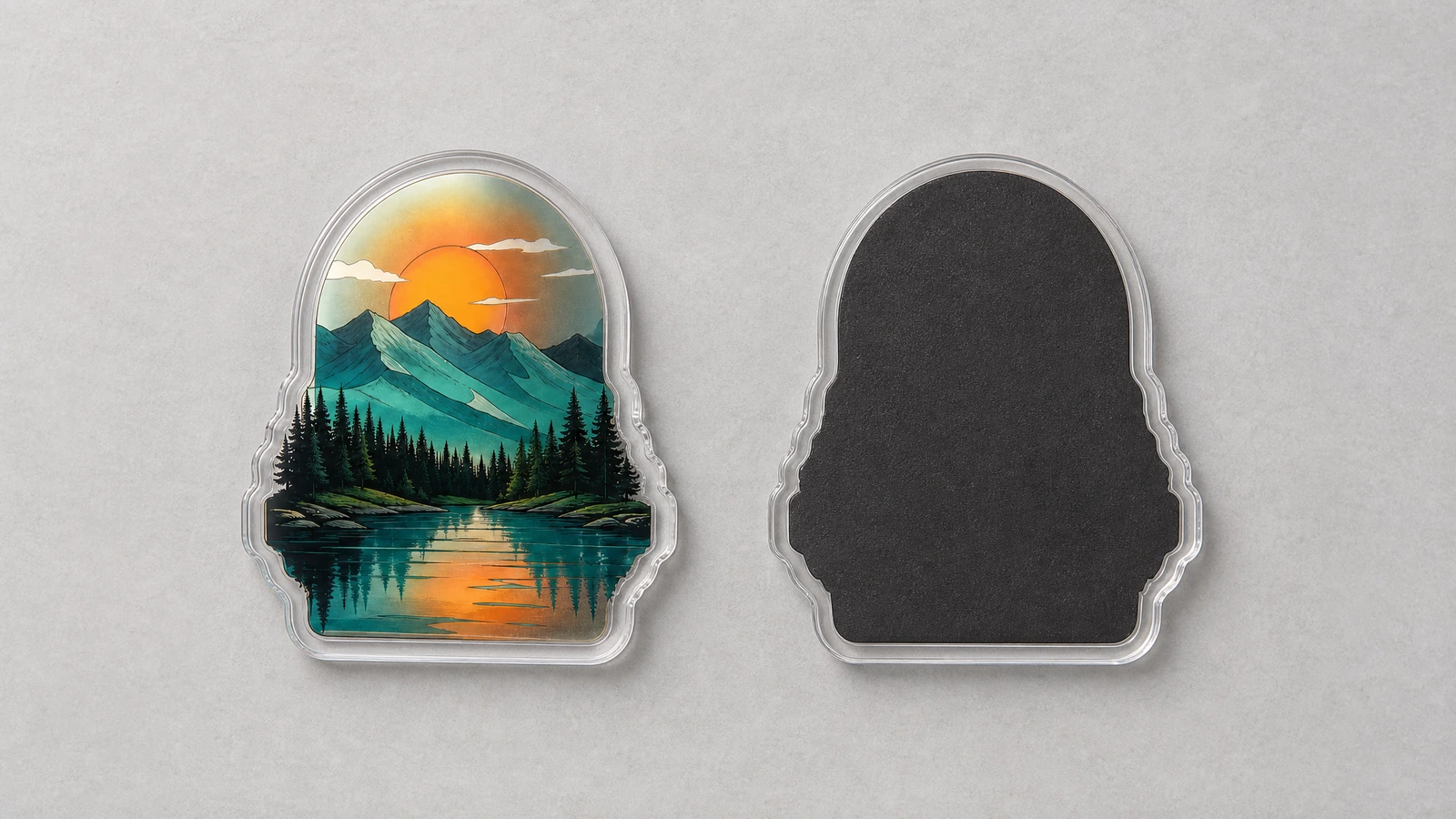
Do not treat additional thickness as an automatic quality upgrade. It changes the assembled construction and must be considered alongside weight, backing, and packaging. Exact thickness, dimensional tolerances, and unit weight need confirmation for the selected design; none is established for this product reference.
Which surface and backing options deserve a sample? ↑
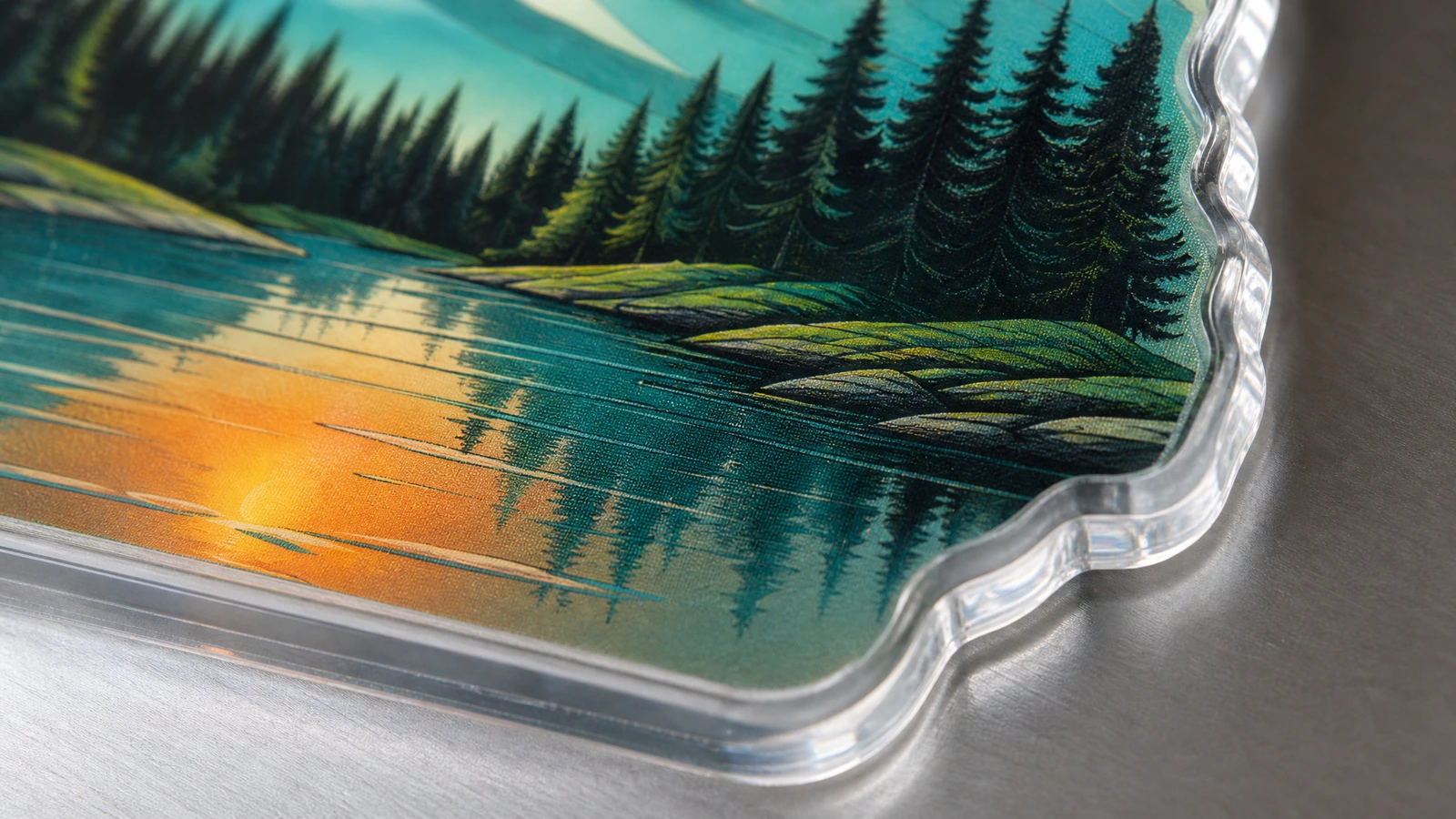
Decide whether the design should look predominantly opaque or intentionally transparent. A white underprint can support opaque color areas, while selected clear areas can become part of the design. The proof should distinguish these areas instead of leaving the printer to interpret a flattened image.
Ask where the ink will sit and what protects it. If requesting reverse artwork, show the magnetic backing position on that view. A backing component may conceal part of a rear image, so a repeating pattern or deliberately positioned mark may be more suitable than important text.
| Construction choice | What to specify | What the sample must establish |
|---|
| Acrylic face | Material, thickness, outline, and intended clear areas | Appearance, edge finish, dimensions, and readability |
| Printed surface | Print side, white underprint, and any protective layer | Color appearance, registration, and exposed print areas |
| Disc-style backing | Material, dimensions, position, and attachment | Stability, attachment integrity, and rear artwork obstruction |
| Sheet-style backing | Coverage, thickness, contour, and attachment | Flat contact, edge adhesion, and assembled performance |
| Additional finish | Any requested dome, second layer, or special surface | Feasibility, changed dimensions, packaging needs, and cost |
These are quotation questions, not a confirmed option list. Disc and sheet backings should be compared as complete assemblies; neither a magnetic grade nor a backing thickness alone establishes usable holding performance.
Recycled acrylic is available in the wider market: Zap! Creatives describes recycled acrylic magnets[1]. That supplier’s declaration does not establish recycled content for this product. If recycled material matters to your project, request documentation covering the actual material supplied. Recycled content and local acceptance of the finished acrylic-and-magnet assembly for recycling are separate questions.
How should you prepare artwork for approval? ↑
Provide editable vector artwork for logos and cut outlines where possible. For photographs, supply the original high-resolution image rather than a screenshot or repeatedly compressed copy. Include the requested finished dimensions so resolution can be assessed at the intended output size.
As an external preparation reference, Magnets.com’s artwork guidelines[2] recommend raster artwork at a minimum of 300 DPI at the requested size. Treat this as preparation guidance, not a guaranteed printing result or this product’s final template. Enlarging a low-resolution image does not restore missing detail.
Keep the print image, cut contour, and proposed white-ink areas clearly distinguishable. Identify intentional transparency, outline fonts where appropriate, and supply the original color references. Confirm the production color workflow before converting files; a screen preview is not physical evidence of the finished color.
- Check content: spelling, dates, logo version, image crop, and orientation.
- Check geometry: outer dimensions, narrow projections, internal openings, and edge clearance.
- Check print layout: opaque areas, transparent areas, and white-ink coverage.
- Check assembly: backing position and any overlap with reverse artwork.
- Check approval scope: identify what the digital proof confirms and what requires a physical sample.
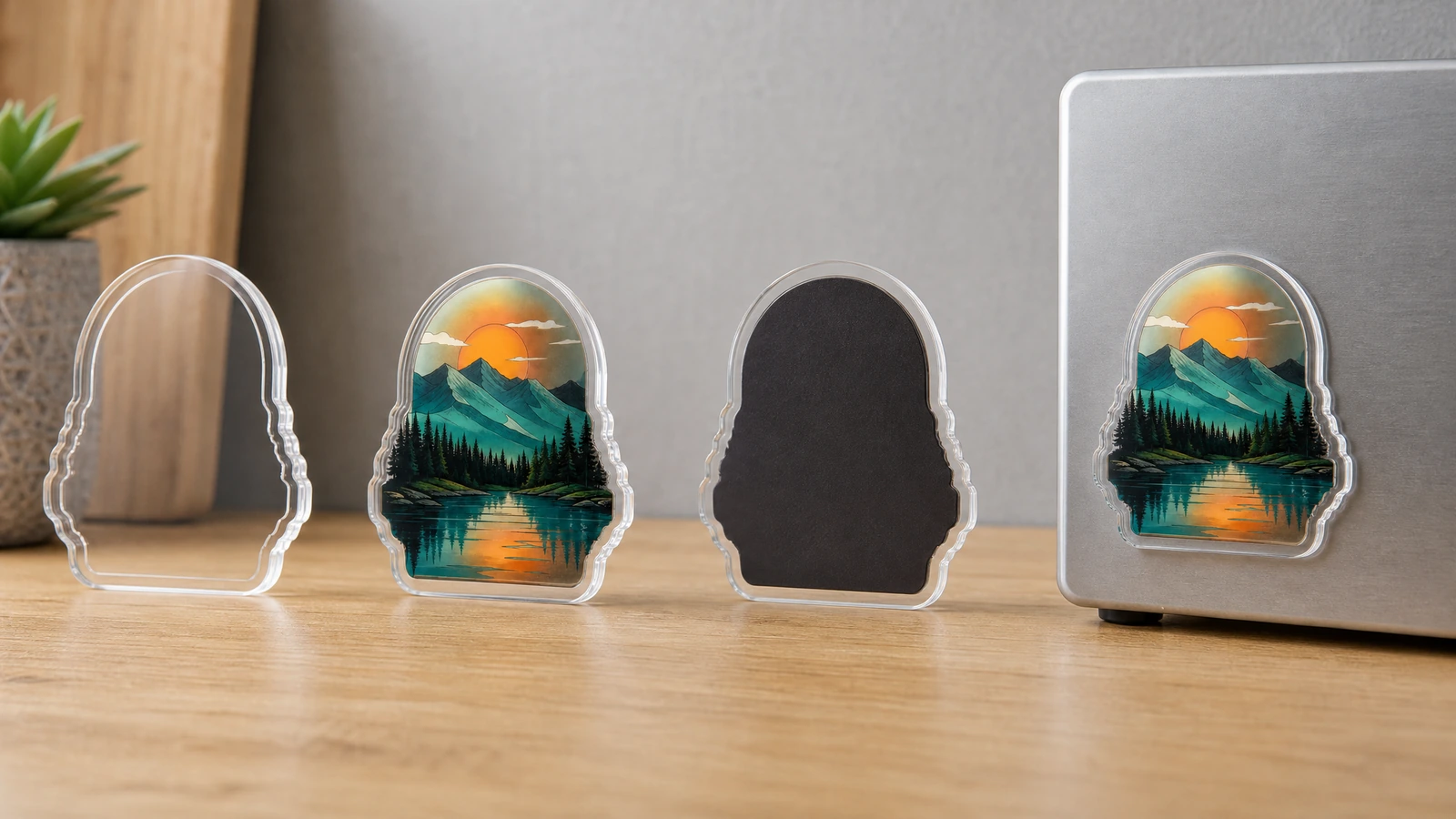
Use the approved template for bleed and safe areas rather than applying a generic margin to every design. A thin projection or tight internal corner may need simplification. Preserve essential content first; a slightly revised silhouette is preferable to a detail that cannot be produced or handled reliably.
How does the design move into production? ↑
The intended route is artwork preparation, acrylic selection, UV printing, laser cutting, magnetic assembly, inspection, and packing. The exact sequence and equipment settings belong in the production specification. The process below is an approval framework, not a claim about an audited factory line, installed equipment, or production capacity.
- Freeze the design brief. Record intended use, dimensions, design quantities, destination, packaging, and required arrival date.
- Approve the construction proposal. Confirm the acrylic face, print arrangement, magnetic backing, and attachment method.
- Review the digital proof. Resolve text, crop, contour, transparency, and backing-position questions before sampling.
- Evaluate an assembled sample. Review the actual print, edges, magnetic function, and packaging rather than an unassembled face alone.
- Set acceptance conditions. Agree how appearance, dimensions, attachment, and intended-use performance will be assessed.
- Confirm the order schedule. Separate sample approval, production, dispatch, and transport milestones.
For a process example, Thunder Laser’s acrylic magnet tutorial[3] demonstrates material positioning, design preparation, cutting, and subsequent assembly. It illustrates manufacturing stages; its project construction and machine settings are not specifications for this UV-printed product.
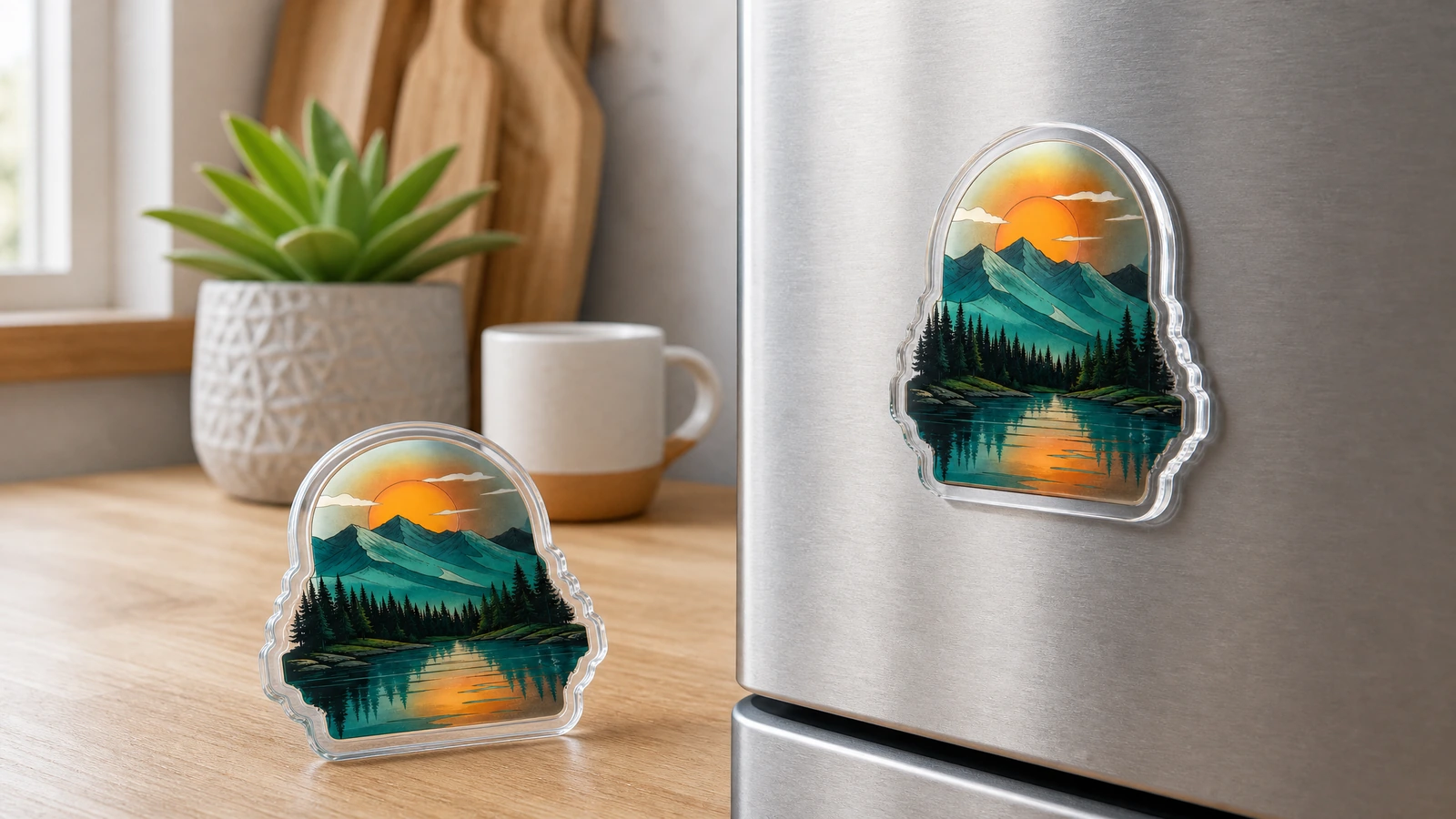
Any additional layer or coating needs a revised assessment of cost and timing. Ask whether setup, sampling, artwork changes, and special packaging are included. Custom laser-cut shapes should not be interpreted as automatically carrying no setup charge, and a production estimate should not be mistaken for a delivered-by commitment.
What should a physical sample prove? ↑
A sample should answer specific acceptance questions. Review it at normal viewing distance and under angled light, then compare it with the approved artwork. Check for image blur, unwanted white areas, visible scratches, cracked edges, and inconsistencies between the printed image and cut contour.
| Inspection area | Practical method | Record before approval |
|---|
| Dimensions | Measure the finished outline and assembled thickness | Actual measurements and agreed tolerances |
| Readability and color | Compare physical output with the approved design and color reference | Accepted sample and any agreed deviations |
| Surface and edges | Inspect under direct and angled light; distinguish film marks from underlying defects | Defect examples and acceptable finish |
| Magnetic function | Test the assembled piece on the intended surface and in its intended orientation | Surface, load condition, observation period, and result |
| Attachment | Evaluate the backing joint using an agreed test method | Method, conditions, and acceptance criteria |
| Packaging | Inspect a packed sample for product-to-product contact and movement | Approved packing arrangement |
This is a proposed inspection checklist, not a completed test report. No verified holding-force, attachment-strength, durability, or transport-test result has been supplied for this product.
For paper-holding applications, usable capacity depends on physical dimensions, load condition, and sample verification. Specify the actual paper or photograph, the receiving surface, and how the magnet will be positioned. A competitor’s paper-count claim cannot be transferred to a different acrylic shape or backing assembly.
Check the intended appliance surface before ordering. Do not assume that a stainless-steel appearance establishes magnetic compatibility. Also inspect the rear contact area for roughness or trapped debris; surface protection should be evaluated alongside magnetic function rather than treated as an automatic property.
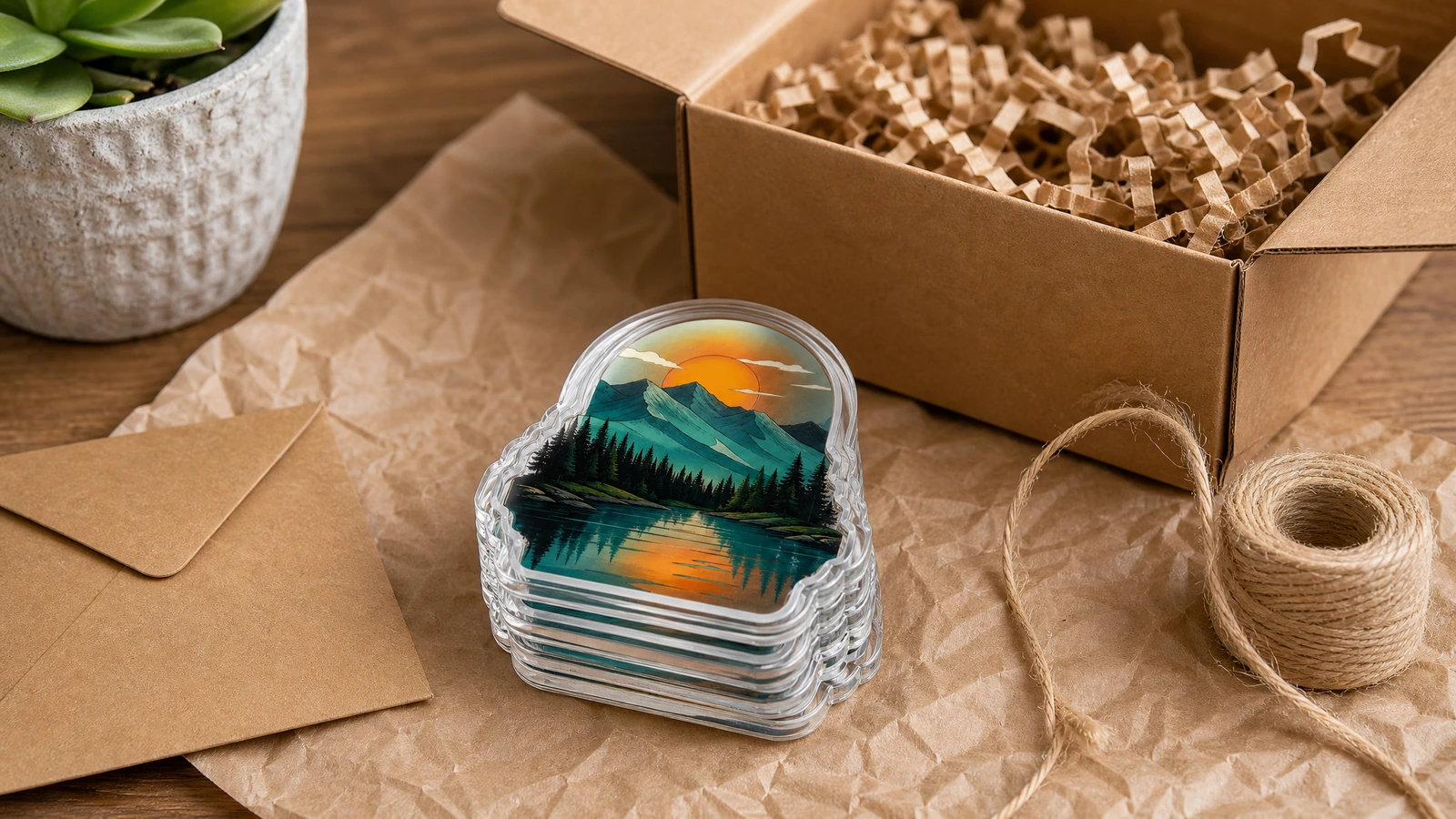
Agree the intended environment. Water resistance, scratch resistance, outdoor suitability, and fade resistance require evidence for the complete construction. Until established, do not market the product as waterproof, dishwasher-safe, vehicle-ready, or guaranteed for a stated lifespan. Cleaning instructions and restrictions should accompany the approved construction.
Which magnet format fits your purchasing priorities? ↑
Choose the format around the result you need, not an assumed ranking of materials. Acrylic is the focus when a rigid printed face and shaped outline matter. Other constructions deserve consideration when flexibility, molded relief, natural texture, or a different visual treatment is the primary requirement.
| Format | Design direction | Purchasing tradeoff to evaluate |
|---|
| UV-printed acrylic | Printed artwork with a rigid custom silhouette | Edge finish, transparency, scratch protection, and backing balance |
| Flexible magnetic sheet | A thin, bendable printed format | Thickness, edge behavior, print protection, and contact area |
| Molded soft PVC | Raised shapes and tactile character designs | Tooling, artwork translation, sampling, and production schedule |
| Resin or domed construction | A rounded surface or dimensional decorative effect | Added weight, curing requirements, and edge condition |
| Metal, wood, or glass | A material-led appearance distinct from acrylic | Finish, moisture or breakage concerns, packing, and attachment |
These are qualitative selection prompts, not equivalent performance ratings. Compare actual quotations at the same finished size, quantity, packaging level, and delivery basis. Material choice alone does not establish magnetic strength, environmental benefit, or safety.
For wholesale purchasing, request the total order cost rather than comparing headline unit prices. Separate sampling, artwork preparation, production, backing, individual packaging, freight, and any applicable import charges. If several designs share an order, confirm how quantities are counted and whether each design affects the minimum or setup cost.
For a deadline-led event, compare approval milestones as carefully as pricing. A lower quotation offers little clarity if it omits sampling or transport. No order minimum or production duration is verified here; both need a written quotation tied to the selected construction and quantity.
Protect the finish and simplify repeat orders ↑
Choose packaging according to how the magnets will be handled after arrival. Artist merchandise may need an individually presented unit, event favors may need simple distribution, and retail stock may need a coordinated backing card. Request these formats as options rather than assuming they are included.
Specify how adjacent faces will be separated and how the packed items will be restrained. If protective film is supplied, include clear removal instructions and distinguish film damage from damage to the acrylic beneath it. Review both the individual pack and the outer shipping arrangement.
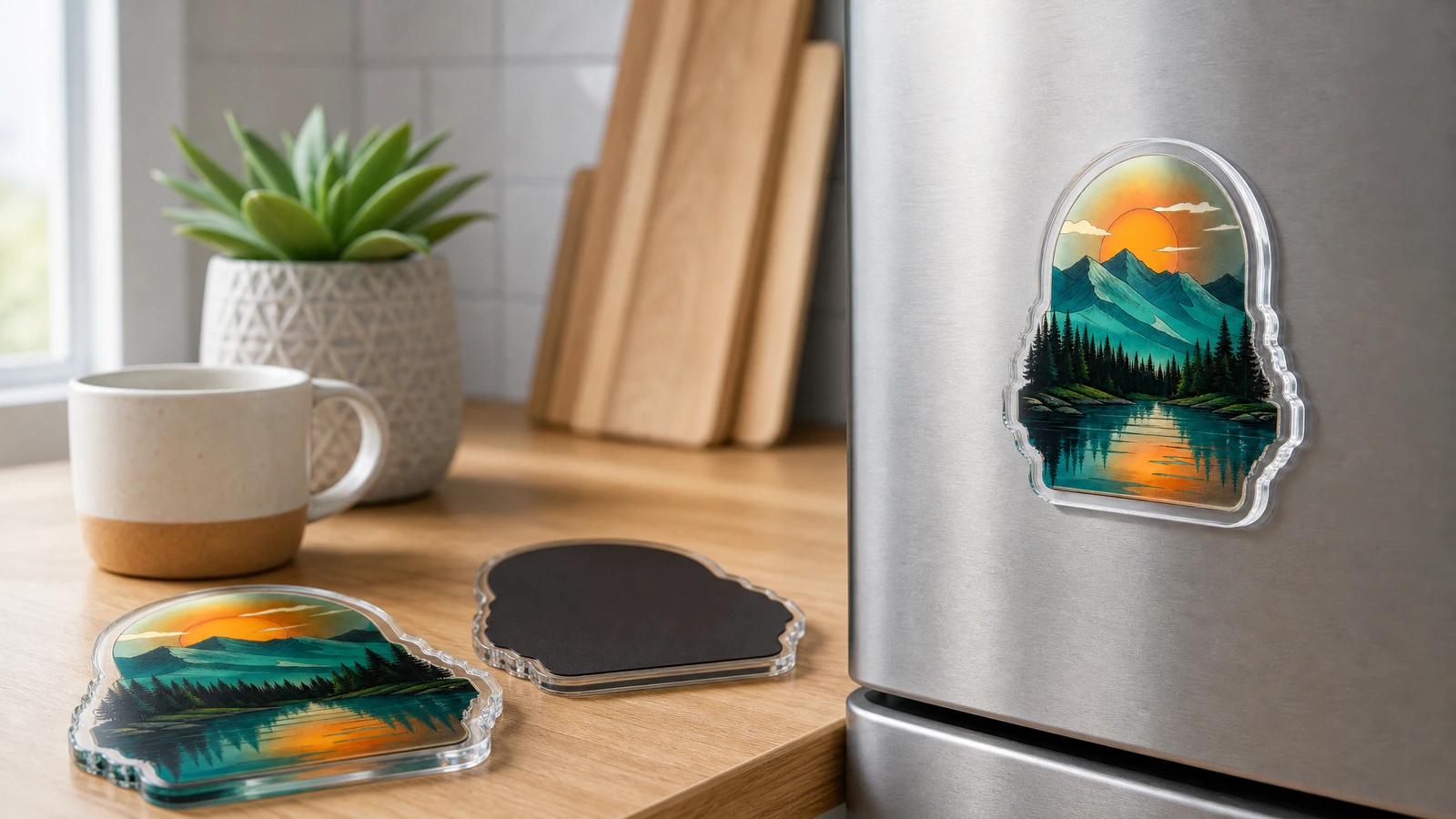
Confirm how delivery damage and manufacturing defects will be reported, what evidence is needed, and what remedy is agreed. A photograph of the outer carton, internal packaging, and affected pieces can help distinguish transport damage from an underlying production issue. Do not assume automatic refunds or free replacements without written terms.
For repeat orders, retain the approved artwork version, construction details, packaging specification, and reference sample. Confirm whether materials or processes have changed before reordering. Reusing the same artwork alone does not establish that a new batch will match the previous assembly.
Key takeaways for a better buying decision ↑
- Buy the complete construction. Evaluate the acrylic face, printing, cut outline, backing, and packaging together.
- Approve readability at finished size. A large digital preview is not evidence that small text or detailed artwork will remain clear.
- Keep holding claims sample-specific. Capacity depends on physical dimensions, load condition, and sample verification.
- Check the scope of U.S. magnet safety requirements. — For covered products, loose or separable magnets that fit the small-parts cylinder must have a flux index below 50 kG² mm² (Source[4]).
- Separate material declarations from product claims. Request evidence for recycled content, durability, and any certification associated with the actual order.
Regulatory applicability depends on the product’s design, marketing, intended use, and classification—not simply the presence of a magnet. The CPSC guidance cited above distinguishes covered magnet products from toys governed by separate requirements and explains certification obligations for regulated products. No compliance certification is established for this product reference.
Build your quotation around the finished product ↑
A successful acrylic magnet order begins with a clear design purpose and ends with an approved physical assembly. Define what must be visible, where the product will be used, how it will be packaged, and what evidence is needed for acceptance. That gives the quotation a meaningful basis without relying on borrowed specifications or untested promises.
Request a quotation for NSKU-744-01 with your artwork, finished dimensions, quantity per design, intended use, packaging preference, delivery destination, and required arrival date.




The information below is required for social login
Sign In
Create New Account