Custom plastic coil bound notebooks use a continuous plastic spiral rather than twin-loop metal wire. Specify the finished size, paper, sheet count, cover, artwork and packaging together, then validate writing comfort and page turning on a physical sample before approving your order.
For training teams, schools, promotional buyers and stationery brands, a notebook needs to do more than display a logo. It needs enough usable writing space, an appropriate page layout and a binding that works with the finished book’s thickness. This product belongs to Custom Notebooks / Custom Spiral Bound Notebooks, with provisional reference NSKU-760-02.
A workshop workbook needs room for exercises. An employee notebook may need meeting templates. A retail journal needs a clearly described writing surface and cover construction. Start with what recipients will do, rather than choosing a decorative finish first.
A polished cover cannot compensate for text punched through at the binding edge, ink showing through the paper or a cover too flexible for writing away from a desk. Those mismatches can turn a useful giveaway into unused stock—and make a replacement order more complicated when an event date is approaching.
The practical solution is a specification-led purchase: define the intended use, separate confirmed requirements from optional features, and agree on sample acceptance before production. Materials and configurations below are discussion points, not a verified stock menu. Product-specific MOQ, production time, unit weight and test results remain unconfirmed. Images illustrate planning concepts, not documented factory samples or test evidence.

Explore specifications, samples and ordering decisions
What makes plastic coil binding different? ↑
Plastic coil binding threads a continuous spiral through holes along the notebook’s binding edge. It is not Wire-O, which uses paired metal loops. That distinction matters when approving photographs, comparing quotations and specifying replacement components: a plastic cover does not mean the notebook also has a plastic coil.
Hole spacing is described as pitch. Plastic spiral commonly uses 4:1 pitch, meaning four holes per inch; Wire-O commonly uses 3:1 or 2:1. These are binding-system conventions, not confirmed specifications for this product. The distinction is explained in Binding101’s pitch guide[1].
The format supports flat opening and fold-back use, but the finished sample must demonstrate unobstructed turning. Neither an attractive mockup nor the word “spiral” establishes acceptable clearance, secure ends or comfortable writing near the binding.
Choose coil diameter from the actual loose stack, including covers and inserts. MyBinding recommends measuring that stack without compressing it and allowing additional turning clearance; its sheet-count charts depend on a specified paper stock. See its coil sizing guidance[2]. Actual capacity depends on physical dimensions, the complete assembled configuration and sample validation—not page count alone.
Which size, paper and cover fit your users? ↑
Record finished width and height in both millimeters and inches. Do not accept “A4 / Letter” as an interchangeable description: the dimensions differ. Also identify whether quoted measurements describe the inner sheets, the cover or the overall notebook including the projecting coil.
| Reference format | Finished sheet dimensions | Use to evaluate |
|---|
| A5 | 148 × 210 mm / approximately 5.83 × 8.27 in | Portable meeting notes and journals |
| A4 | 210 × 297 mm / approximately 8.27 × 11.69 in | Exercises, diagrams and international-format workbooks |
| US Letter | 215.9 × 279.4 mm / 8.5 × 11 in | Workbooks coordinated with US Letter documents |
These are reference dimensions, not confirmed available sizes. Check the usable page area after allowing for punching, inner margins and any perforation. Print a representative page at finished size to assess reading comfort before choosing the format.
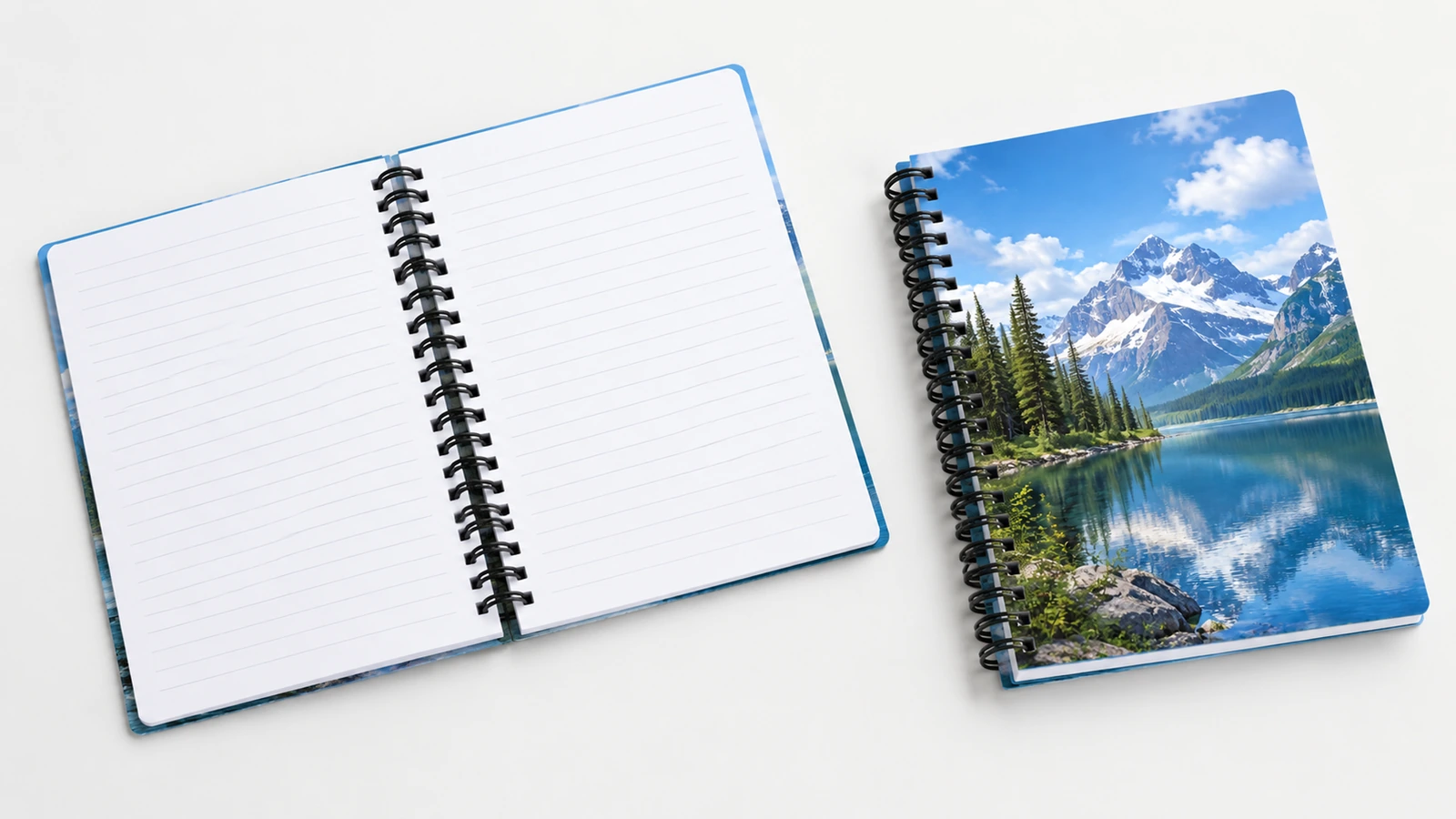
Specify the writing experience, not just the paper weight
Paper weight is expressed in grams per square meter, or gsm. It does not independently guarantee resistance to ink penetration. Coating, surface treatment, ink and pen choice also matter. Pure Pens discusses these differences in its fountain pen paper guide[3].
Ask for candidate paper samples appropriate to the intended pens. Evaluate bleed-through, where ink penetrates the sheet; ghosting, where reverse-side writing remains visible; and feathering, where ink spreads along fibers. Record the pen, ink and paper reference with the result. “Fountain-pen friendly” remains a test requirement until supported by the selected sample.
Specify sheets and writing sides separately. For example, 60 sheets provide 120 sides; that arithmetic is not a confirmed configuration or capacity for this product. State whether covers, dividers and introductory pages are included in the count. For ruled, dotted, grid or planner pages, approve spacing and print darkness at actual size.
Separate cover appearance from support and accessories
Printed card, laminated card, plastic covers and wrapped-board constructions appear in the supplied market references. Ask which constructions can be quoted for this notebook. Describe material and thickness rather than relying on “hardcover”: a flexible plastic cover and a rigid board cover do not provide the same writing support.
Matte or gloss finishes, foil decoration, a rear pocket, pen loop or elastic closure should each be treated as an optional quotation item. For back-mounted closure details, confirm attachment position, movement and interference with page turning. Do not assume these features are included because they appear on another notebook or in an illustration.

How should artwork be prepared for punching and printing? ↑
Use the template approved for the selected construction. It should distinguish the finished trim, bleed, punching area and text-safe area. Bleed protects artwork at the cut edge; it does not protect text from the binding holes. Avoid borrowing a template from a notebook with a different binding system.
- Separate the files: identify front cover, back cover, inside covers and inner pages, including intentionally blank areas.
- Check typography: embed fonts or convert them to outlines as required, and inspect small text at final size.
- Prepare print color: follow the agreed CMYK workflow and supply a physical or specified color reference for important brand colors.
- Confirm image quality: assess resolution at final output size rather than relying on the file’s pixel count alone.
- Protect content: keep logos, page numbers, exercise instructions and QR codes outside the punching and trimming risk areas.
Review the actual front and back artwork rather than approving a cover thumbnail. Check whether supplier branding must be excluded, whether personalization changes between copies and whether all inner-page versions are present. A repeated error in a template can become a repeated error throughout the order.
Approve color on the proposed paper and finish when color accuracy matters. A screen proof can establish layout, but it cannot establish the final appearance of ink under a laminate. Agree on the color reference and acceptance method instead of promising a universal color-difference tolerance.

How do you move from specification to production? ↑
Use the following sequence as a purchasing workflow to agree with the supplier. It is not a statement of an existing factory procedure or a promised turnaround.
- Define the brief. Provide quantity, size, intended users, writing tools, layout, destination and required arrival date.
- Resolve the construction. Confirm plastic coil material, paper, cover, inserts and packaging. Identify substitutions that require approval.
- Obtain an itemized quotation. Separate development, sampling, production and delivery charges.
- Approve the digital proof. Confirm text, page order, print coverage and punching clearance.
- Evaluate the physical sample. Check the proposed materials, assembled thickness, writing behavior and binding operation.
- Release the agreed version. Record written approval, acceptance criteria and the production schedule before authorizing the bulk order.
- Inspect and dispatch. Compare production samples with the approved reference and verify packing before shipment.
Ask whether the sample uses the intended production printing method and materials. If it does not, record what it can and cannot establish. A construction dummy may help assess thickness but cannot prove final print color; a printed sheet cannot prove assembled page turning.
Keep sampling, revision, production, transport and customs time separate. The required arrival date is not the factory dispatch date. Changes after approval should trigger a documented review of price and timing, not an assumption that the original schedule still applies.

When is plastic coil the right binding choice? ↑
Compare binding structures using the intended task, not the assumption that one is universally more durable. The alternatives below are buying references; this product’s verified identity remains Custom Plastic Coil Bound Notebooks.
| Binding | Reason to consider it | Decision boundary |
|---|
| Continuous plastic coil | Fold-back writing and a visible colored binding element | Validate ends, clearance, material and handling performance on the complete sample |
| Metal single spiral | A continuous spiral with a metal appearance | Assess deformation and exposed ends; do not treat it as plastic coil |
| Wire-O twin-loop wire | A different visual finish and potentially useful facing-page alignment | Requires its own matching hole pattern and closing setup |
| Perfect binding | A conventional spine for identification and shelf presentation | Do not assume the same flat-opening or fold-back behavior |
A binding change can affect punching, artwork margins, packaging and cost. If evaluating alternatives, compare samples with equivalent paper, page count and cover construction; otherwise, the apparent difference may come from those components rather than the binding.
For left-handed users, evaluate an actual writing task near the binding edge. Top-bound or right-bound layouts may be worth requesting, subject to feasibility. Fold-back operation alone does not establish comfort for every writing position.
For maps, diagrams or artwork crossing a spread, inspect alignment on the assembled notebook. If users need to add or reorder pages regularly, clarify that requirement before choosing a permanently assembled coil format.
What should the sample and delivery inspection check? ↑
Translate general words such as “premium” and “durable” into observable checks. Agree on inspection quantities, methods and acceptance limits before production; no product-specific test result or defect threshold is established here.
| Inspection area | Suggested check | Record to retain |
|---|
| Binding and holes | Turn pages throughout the book; inspect alignment, torn holes and both coil ends | Close-up photographs and a page-turning video |
| Paper | Write with the intended pens and examine both sides after drying | Paper reference, pen and ink details, sample photographs |
| Print | Compare layout, color, page order and ruling with the approved reference | Artwork version and approval record |
| Cover and accessories | Assess support, finish appearance, closure operation and attachment security | Construction details and observed results |
| Packing | Inspect notebooks from different positions within the packed carton | Carton photographs and damage observations |
These checks define what to examine; they do not claim that a batch has passed. Any durability, abrasion or transit test needs an agreed method and recorded outcome before its result becomes a sales statement.
If tear-off pages are requested, distinguish the tear perforation from the binding holes. Test removal using the proposed production paper and check whether tearing damages neighboring sheets. A notebook that opens smoothly does not necessarily tear cleanly.
Inspect more than the outside cover on arrival. Inner sheets may show pressure marks even when the exterior looks acceptable. Photograph damage before repacking, retain affected samples and follow the agreed claim procedure. Odor complaints should prompt investigation; smell alone does not identify a chemical or establish compliance.

Which safety and environmental claims need evidence? ↑
For the US market, intended age and product classification matter. Products primarily intended for children 12 years or younger that are subject to applicable children’s product safety rules require the relevant testing and certification, subject to applicable exceptions and determinations. Follow CPSC’s Children’s Product Certificate guidance[4]. Do not assume a paper-related exemption covers the complete coil-bound construction.
Toy requirements are a separate classification question, not an automatic requirement for every school notebook. CPSC’s toy safety guidance[5] provides the relevant scope. Confirm which requirements apply to the finished product rather than requesting unrelated certificates.
For an FSC claim, verify the applicable certified supply chain, product scope and sales documentation. A paper supplier’s certificate does not by itself establish the claim for the notebook being sold. The relevant framework is FSC’s chain-of-custody standard[6].
No certification is established for this product. Request documents matched to the actual materials and intended market. Likewise, avoid calling the entire notebook recyclable without checking local collection requirements, component separation and the treatment of coatings or laminates. Recycled content and end-of-life recyclability are different claims.
How should packaging protect the order and support reorders? ↑
The projecting coil deserves attention when choosing packing orientation. Review how notebooks sit against neighboring covers, carton walls and protective separators. A decorative sleeve or plastic bag does not, by itself, demonstrate protection against compression.
Agree on individual wrapping, protective boards or dividers where needed, then evaluate the proposed packed configuration. Carton capacity and packing quantity must be determined by actual notebook dimensions, loaded arrangement and sample validation. Do not infer them from another order with a similar page count.
Record packed dimensions and weight for the freight quotation rather than estimating shipping from paper gsm. Confirm carton markings, destination requirements, transport terms and the process for reporting damage. Customs classification and duties require shipment-specific review; no fixed total import tax is promised here.
For repeat orders, retain the signed sample, artwork revision, paper and cover references, coil specification and packing arrangement. Require approval for substitutions. “Same as last time” is less reliable than a versioned specification, especially when paper, finishes or accessories have changed.

What belongs in a comparable quotation? ↑
A low unit price is only meaningful when the included construction and services are clear. Ask competing suppliers to quote the same brief rather than comparing a cover-only stock notebook with a fully customized interior.
- Development: artwork preparation, proofing, special tooling and sample charges, where applicable.
- Notebook construction: finished size, sheets, paper, printing, plastic coil, cover and individually listed accessories.
- Order conditions: quantity tiers, MOQ for the selected configuration, payment terms and quotation validity.
- Delivery: packaging, freight, trade terms and clearly identified exclusions.
- Acceptance: sample approval, inspection arrangements and the agreed remedy for nonconforming goods.
Special finishes, custom colors, extra inserts and larger quantities may change both cost and scheduling. Request a simpler alternative if the preferred version exceeds the budget, but keep the intended writing experience visible in the comparison.
No verified SKU-specific MOQ, sample duration, production duration or unit weight has been supplied. These require a written quotation or physical measurement. Public category slogans and another supplier’s price table should not be substituted for this notebook’s order terms.
Key takeaways for a better purchasing decision ↑
- Keep the product identity precise. Continuous plastic coil is different from metal single spiral and Wire-O.
- Approve the complete notebook. Paper, cover, inserts and binding must work together in the assembled sample.
- Test the intended writing tools. Paper weight alone does not establish ink performance.
- Use environmental labels accurately. — FSC Recycled identifies 100% recycled fiber, not an automatic claim for this product (Source[7]).
- Compare the full purchase. Include sampling, packing, delivery and acceptance terms alongside the unit price.
Turn your notebook brief into a clear quotation request ↑
The right notebook starts with a clear use case and ends with an approved physical reference. For custom spiral coil notebooks, the strongest purchasing decision connects the writing surface, usable page area, plastic binding and delivery requirements—without relying on unsupported performance promises.
Request a specification-based quote for NSKU-760-02 with your quantity, finished size, intended use, artwork, destination and required arrival date.





The information below is required for social login
Sign In
Create New Account