


 Blog PDF for offline reading
Quick answer: Measure the full book block, meaning every sheet plus both covers and any inserts. Add about 2–3 mm of turning room and round up to the next standard plastic coil diameter. Then punch at 4:1 pitch (four holes per inch, 6.35 mm centre to centre), the standard pitch for plastic coil from 6 mm to 50 mm. Paper weight and cover stock change the result as much as page count does.
If you are working out how to choose coil binding size for a branded notebook order, the risk is simple to state. A coil that is one size too small makes pages drag, tear at the holes, and refuse to fold back. A coil that is two sizes too big makes the book block wobble and catch on bags. Neither problem shows up on a screen proof. It shows up when thousands of finished notebooks are in boxes and the binding cannot be redone without destroying the punched sheets.
The stakes are real. U.S. promotional products distributor sales reached $26.8 billion in 2024, according to PPAI's 2024 sales volume estimate[1]. Notebooks compete for that budget because people use them every day. When the binding fails, that daily use becomes daily irritation with your logo on the cover.
Users describe the failure plainly. One notebook user wrote that single coils "sometimes they start to uncoil themselves from the notebook with use, either from the bottom or the top" (r/notebooks discussion[2]). Overstuffed coils put constant tension on the crimped ends, and that tension is a common cause of unwinding. This guide shows how to size the coil from measurable inputs so the notebook turns freely, lies flat and keeps its pages.
What "coil size" actually means
A plastic coil is specified by two numbers, and buyers often only mention one of them.
Diameter is the coil's inside diameter (ID), stated in millimetres. Common plastic coil sizes run from 6 mm to 50 mm. Typical notebook sizes sit between 8 mm and 25 mm. The ID has to be larger than the book block, not equal to it, because each sheet has to travel around the inside of the coil when you turn it.
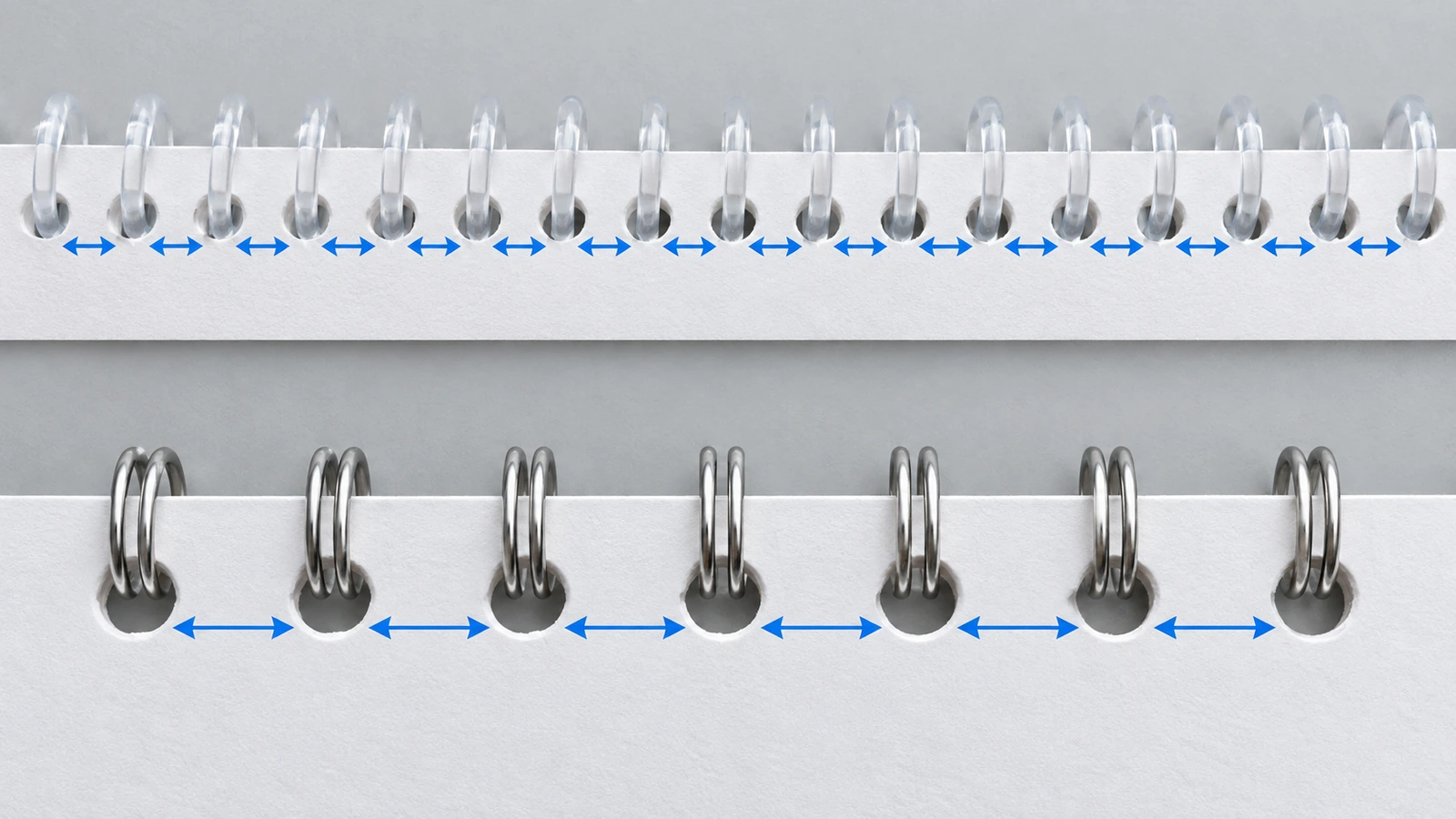
Pitch is the hole spacing along the bound edge, written as holes per inch. Plastic coil is normally punched at 4:1. Some binders also offer 5:1 for thin books. The coil's wire spacing must match the punch exactly.
The third input is the count unit. Coil charts count sheets, not pages. One sheet is two pages, so a "120-page" notebook has 60 sheets. Mixing up the two units is the quickest way to order a coil twice as large as you need, or half the size.
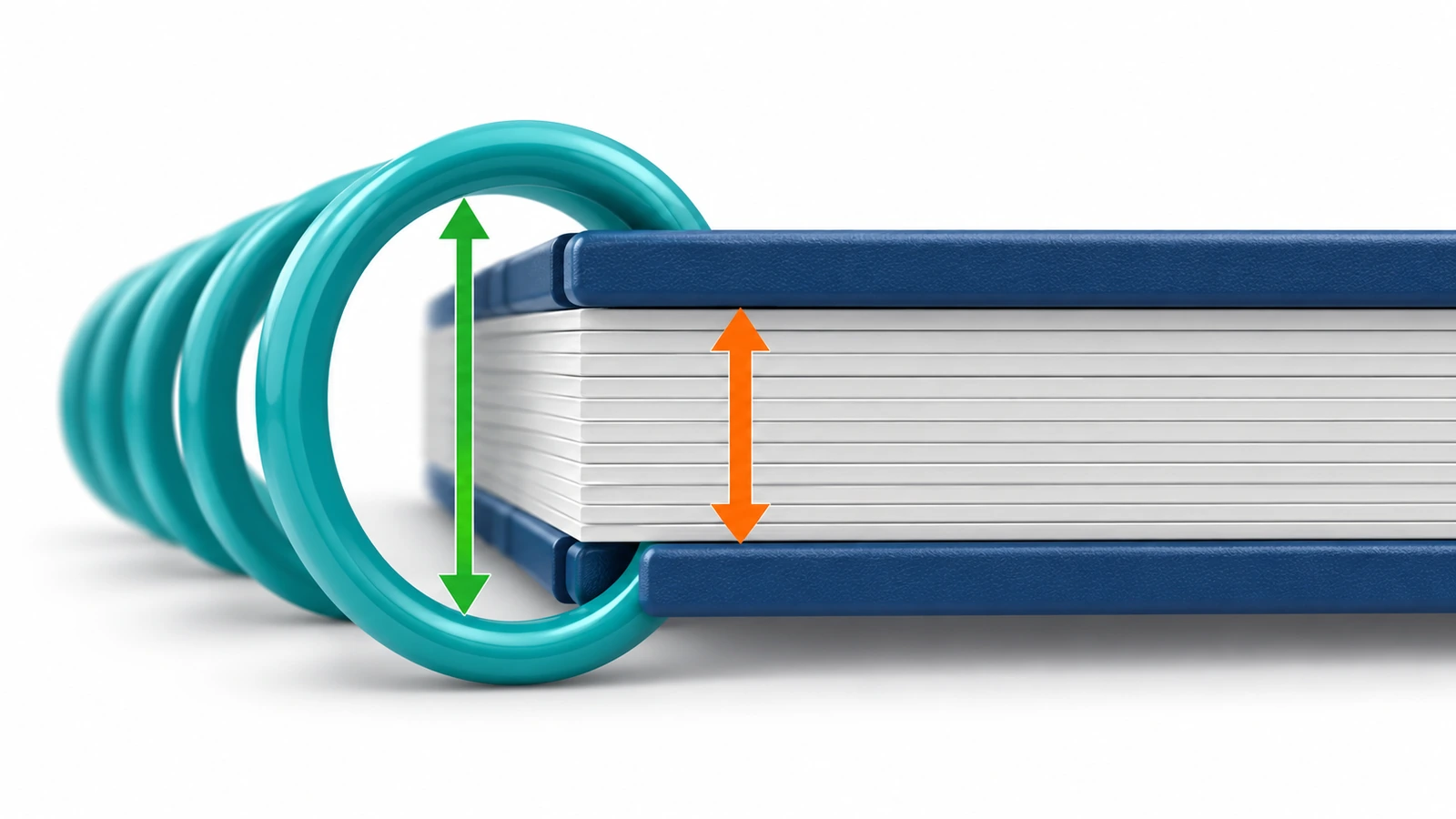
How to choose coil binding size in five measurements
The most reliable method uses a measured stack rather than a page count copied from a chart. Use a pre-production dummy if you have one. If you don't, calculate from the paper specification and then confirm on the sample.
- Count sheets. Convert pages to sheets, then add any printed inserts, dividers or tab sheets.
- Convert paper weight to thickness. Paper weight is stated as grammage in g/m², the method defined by ISO 536[3]. Grammage alone does not give you thickness. Ask the mill or printer for the caliper (thickness per sheet), or use the typical values in the next section.
- Add both covers and any pockets. Hardcover boards can add more thickness than 40 sheets of paper.
- Add turning room. Add about 2–3 mm (roughly 1/8 in) to the total. Use the upper end for notebooks that will be written in heavily, folded back 360°, or carried in bags.
- Round up, never down. If the result falls between two standard diameters, take the larger one.
Worked example A: A5 meeting notebook
A5 is 148 × 210 mm under ISO 216 (University of Cambridge ISO paper size reference[4]). This example uses 60 sheets of 80 gsm paper and two laminated 300 gsm covers.
- Paper: 60 sheets × about 0.10 mm = 6.0 mm
- Covers: 2 × about 0.35 mm = 0.7 mm
- Book block: 6.7 mm. With 2–3 mm of turning room, the target is 8.7–9.7 mm.
Result: a 10 mm coil.
Worked example B: Letter-size training workbook
This example uses an 8.5 × 11 in book with 100 sheets of 100 gsm paper and two plastic covers of about 0.5 mm each.
- Paper: 100 × about 0.125 mm = 12.5 mm
- Covers: 1.0 mm
- Book block: 13.5 mm. With turning room, the target is 15.5–16.5 mm.
Result: a 16 mm coil. Move up to 18 mm if the book has a back pocket or tab dividers.
Worked example C: B5 hardcover planner
This example uses 120 sheets of 100 gsm paper, two 2 mm board covers and a 0.5 mm back pocket.
- Paper: 15 mm
- Boards: 4 mm
- Pocket: 0.5 mm
- Book block: 19.5 mm. With turning room, the target is 21.5–22.5 mm.
Result: a 22 mm coil will bind it. Specify 25 mm if the boards must rotate fully behind the book, because rigid boards need more clearance than flexible card to swing around the coil.
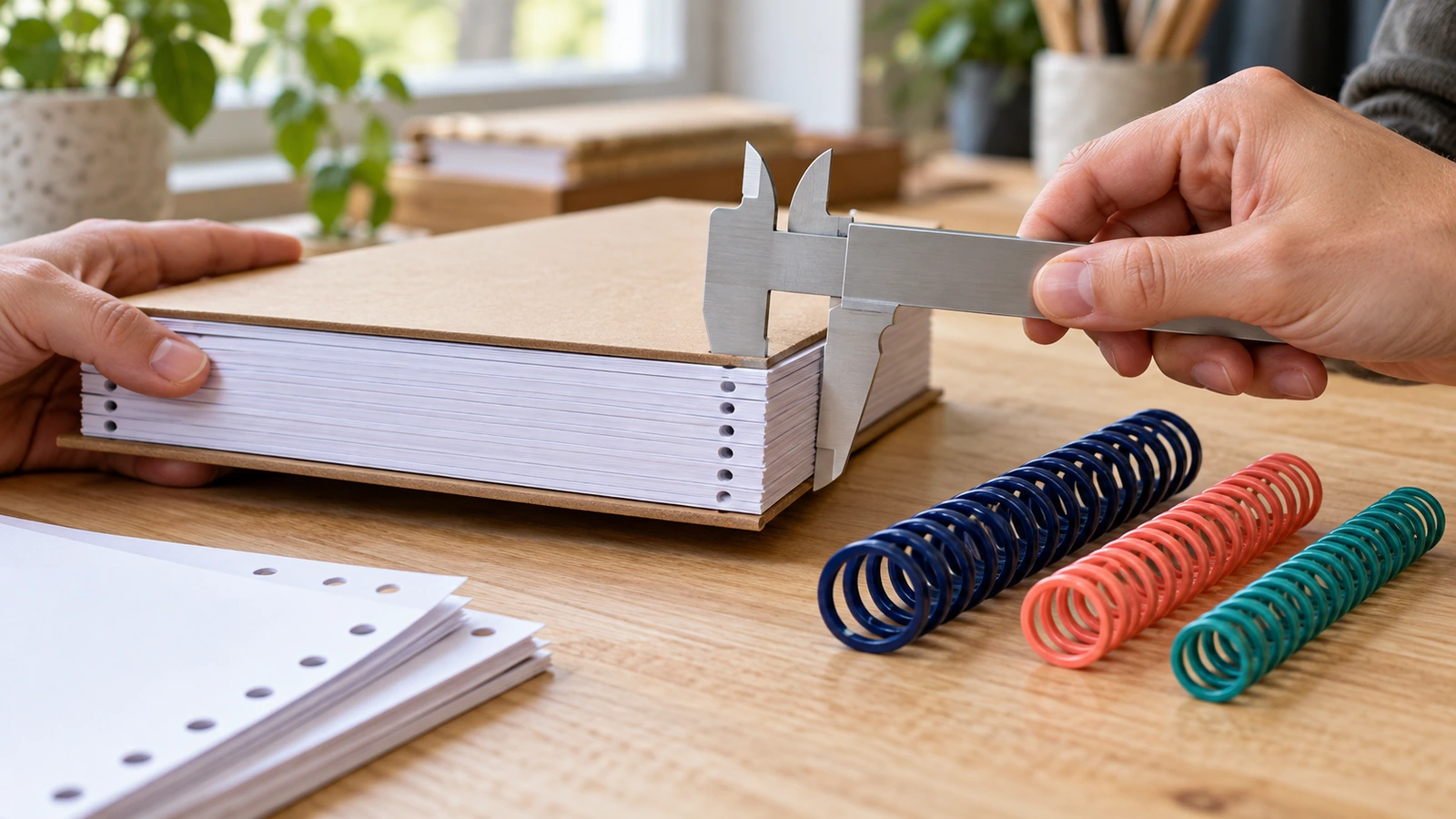
How paper weight changes coil binding thickness capacity
Buyers often upgrade paper to stop ink bleed-through and forget that heavier paper is thicker. The table below shows typical calipers for uncoated writing paper. Bulk varies by 10–20% between mills, and recycled and textured sheets tend to run thicker, so treat these as planning values and confirm against the supplier's caliper figure.
| Paper weight | Typical caliper per sheet | Sheets per 10 mm of stack | Typical use |
|---|---|---|---|
| 60 gsm | ~0.08 mm | ~125 | Budget school notebooks |
| 75–80 gsm (≈20 lb bond) | ~0.10 mm | ~100 | The baseline most coil charts assume |
| 90 gsm | ~0.11 mm | ~90 | Gel pens, light markers |
| 100 gsm | ~0.12–0.13 mm | ~80 | Branded gift notebooks, fountain pens |
| 120 gsm | ~0.15 mm | ~65 | Dot-grid journals, sketching |
The practical effect is large. A 100-sheet notebook grows by about 5 mm when you move from 75 gsm to 120 gsm. That is roughly two coil sizes. If a supplier quotes a heavier paper but keeps the coil diameter from the original quote, ask why.
Archival or "permanent" paper is a separate specification from paper weight. It is defined by ISO 9706[5] and does not tell you anything about thickness. Size the coil from caliper, not from paper marketing terms.
Cover stock and inserts: the overlooked millimetres
Coil charts usually leave covers out of their sheet counts, but the coil has to hold the covers too. Rigid covers also need room to rotate around the coil.
| Cover or insert | Typical thickness (each) | Effect on coil choice |
|---|---|---|
| 250–350 gsm laminated card | ~0.3–0.4 mm | Small; usually covered by the turning allowance |
| 14–16 pt coated cover | ~0.36–0.41 mm | Similar to card; the 16 pt option feels stiffer on wider formats |
| Polypropylene plastic cover | ~0.4–0.8 mm | Check the actual spec, because PP thickness varies widely |
| Grey board hardcover | 2–3 mm | Adds 4–6 mm per book; often one size up for a full 360° fold |
| Back pocket, tab dividers, ruler insert | 0.3–1 mm each | Add them all to the count; bundled extras are easy to overlook |
Paper certification can change caliper as well. A switch to recycled or FSC-labelled paper is a different sheet with a different thickness, so re-measure. Remember too that the label category (FSC 100%, Mix or Recycled) has its own rules (FSC label definitions[6]). Environmental claims themselves are covered on the product page.
Plastic coil diameter by sheet count: reference chart
The figures below combine published size charts from binding-supply companies. All of them assume 20 lb bond (about 75 gsm) and exclude covers. The charts disagree on some sizes, which is why the table gives ranges. For example, one chart rates 8 mm at about 40 sheets and another at about 60.
| Coil ID | Max book block (approx.) | 20 lb sheets (chart maximum) | Comfortable notebook load | Typical spiral coil size for notebooks |
|---|---|---|---|---|
| 6 mm | ~4–5 mm | up to ~35 | ~25 | Pocket jotters |
| 8 mm | ~6 mm | ~40–60 | ~40 | Slim A6/A5 notebooks |
| 10 mm | ~8 mm | ~70–80 | ~60 | Standard A5 meeting notebooks |
| 12 mm | ~10–11 mm | ~75–100 | ~75 | 100-page school notebooks |
| 14 mm | ~12.7 mm | ~120 | ~95 | Thicker subject notebooks |
| 16 mm | ~14 mm | ~130–140 | ~110 | Letter workbooks |
| 20 mm | ~16–17 mm | ~160–180 | ~140 | Multi-section planners |
| 25 mm | ~21–22 mm | ~210–230 | ~180 | Hardcover or high-page planners |
| 50 mm | ~44 mm | ~390–440 | Not typical | Manuals, not notebooks |
The "comfortable notebook load" column reflects a gap between the charts and actual use. Chart maximums are written for reports that are read and closed. A notebook gets written on, which makes the paper cockle slightly. It also gets folded back on itself and carried around. Leaving about 20% headroom below the chart maximum is what lets the pages turn freely after months of use. The column assumes about 75 gsm paper and card covers, so scale it down using the paper-weight table if your sheets are heavier.
Coil binding pitch explained
Pitch is decided when the sheets are punched, so you cannot fix it after binding.
- 4:1 pitch means four holes per inch, or 6.35 mm centre to centre. It is the industry default for plastic coil and the same punch works across all diameters from 6 mm to 50 mm. That compatibility is useful: standard-pitch notebooks accept off-the-shelf tab dividers and inserts. One verified buyer complained that a non-standard spiral made it "extremely difficult to make your own tabs".
- 5:1 pitch means about 5.08 mm spacing. It is sometimes used on thin books for a finer look. It only accepts 5:1 coil, so confirm the binder stocks it in your colour before you approve.
- Twin-loop Wire-O uses 3:1 (about 8.47 mm, up to roughly 9/16 in) or 2:1 (12.7 mm, for 5/8–1¼ in). If you are considering wire instead of plastic, the pitch you choose also caps the diameter you can use. A 3:1 punch rules out thick books.
Hole count follows from the binding edge. On A5 bound along the 210 mm long edge, 4:1 gives roughly 33 holes. Bound along the 148 mm short edge (top-bound), it gives about 23. Top binding is the usual answer for left-handed users. One widely upvoted post described writing on a side coil's left page as "arm wrestling a cheese grater" (r/lefthanded[7]). Moving the binding edge does not change the diameter, but it does change the punch die and the artwork safe zone.
Keep text and logos at least 0.5 in (12.7 mm) from the bound edge, or 0.625 in for notebooks that get heavy use. For coils above about 20 mm, ask the binder to confirm the hole margin, because larger coils sit further from the edge. Full file setup is covered on the custom spiral coil notebooks product page.
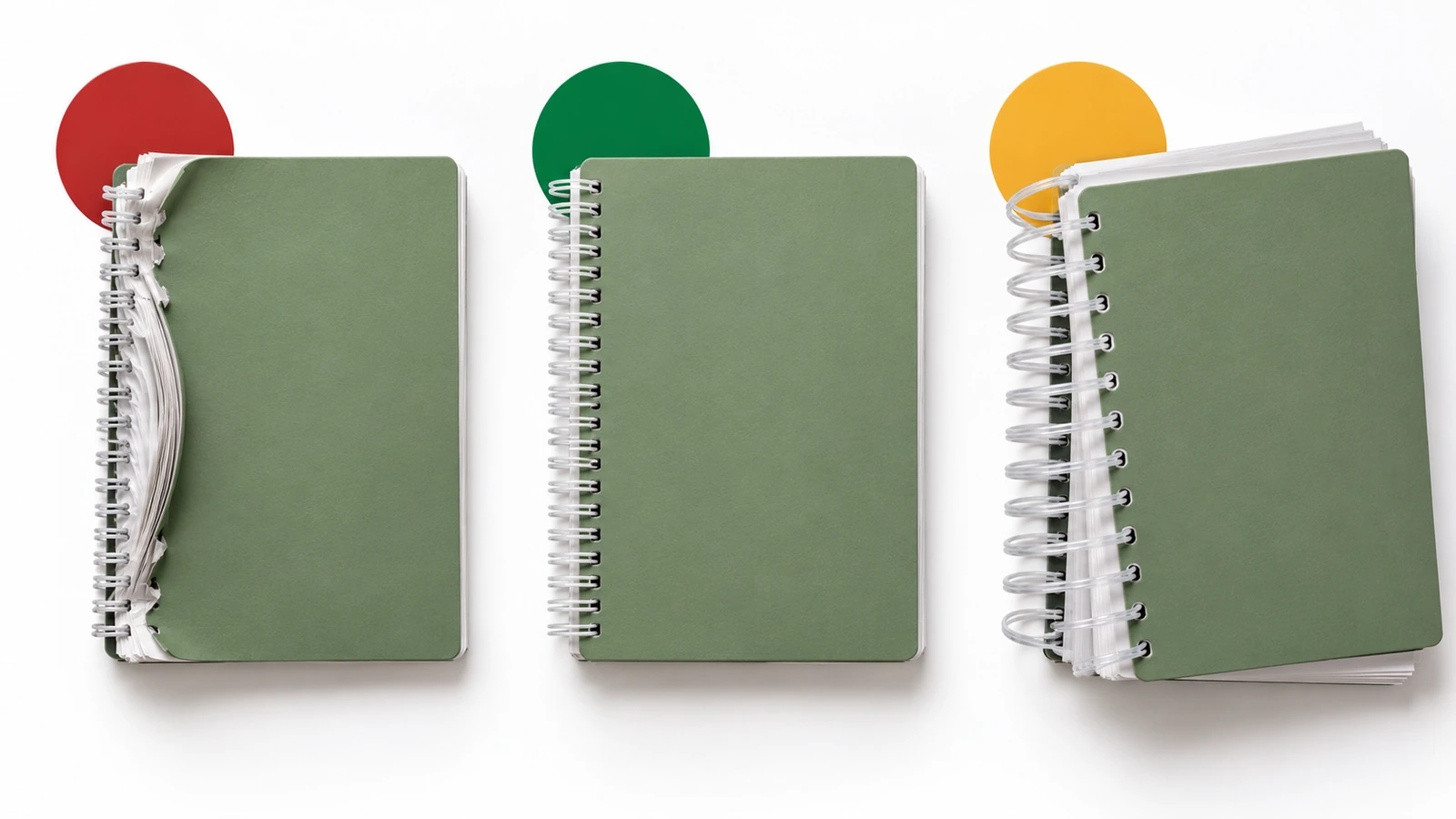
Too tight, right, too loose: how fit problems show up
| Symptom | Coil too small | Coil correctly sized | Coil too large |
|---|---|---|---|
| Page turning | Pages drag and bunch near the spine | Each sheet rotates without catching | Pages shift sideways as they turn |
| 360° fold-back | Covers will not fold flat behind the book | Folds fully and lies flat | Folds, but the book block wobbles |
| Holes | Tear-outs, starting with the back pages | Holes stay intact | Holes elongate from movement |
| Coil ends | Tension pushes the crimps open and the coil unwinds | Crimps stay tucked | Extra coil length snags on bags and zips |
| Bulk and shipping | Spine bulges, covers warp | Even stack in the carton | Wasted carton space and more crush risk |
Coil ends deserve extra attention on notebooks meant for children. In 1999 the U.S. CPSC announced the recall of about 3.8 million toy notebooks because the coil ends could break off into small parts (CPSC recall notice[8]). In 2008, about 90,000 Wire-O journals and calendars were recalled because the paint on the coloured metal coils exceeded lead limits (CPSC recall notice[9]). Correct sizing reduces stress on the crimps. Material testing is a separate requirement, outlined on the product page.
FAQ
FAQ: Why not just order the biggest coil to be safe?
An oversized coil lets the book block slide, so pages turn unevenly and hole edges wear faster. It also adds weight and spine depth to every carton. Going one size above the calculated target is reasonable for hardcovers or books with pockets. Going three sizes up mostly creates new problems.
FAQ: Does a notebook that must fold back 360° need a larger coil than one that only lies flat?
For card covers, usually not, because the 2–3 mm allowance covers it. For rigid boards of 2 mm and more, yes. The board has to swing around the outside of the coil, so plan one size up and check it on the physical sample by folding every cover fully back.
FAQ: I'm upgrading paper to stop bleed-through. What else changes?
Expect the book block to grow by roughly 20–25% when moving from 80 gsm to 100 gsm, or by about 50% from 80 gsm to 120 gsm. You can keep the original coil by reducing the sheet count, or keep the sheet count and raise the coil size. Choose one of these before artwork approval, because the decision changes the punch margin.
FAQ: Do coil charts count pages or sheets?
Sheets. A chart rating 10 mm at "80 sheets" means 160 printed pages of 20 lb bond with no covers. Always give the supplier the sheet count, the paper gsm or caliper, and the cover spec, not just "160 pages".
FAQ: If the notebooks are for children, does coil choice affect compliance?
It can. For products designed primarily for children aged 12 or under, U.S. importers and manufacturers must issue a Children's Product Certificate[10] based on third-party testing. Plastic and coated metal coils are components that may need to be tested in their own right, so specify the coil material and colour early.
Key takeaways
- Size the coil from the measured book block plus 2–3 mm, not from a page count. — Paper weight is defined in g/m² under ISO 536, so convert it to caliper before calculating (Source)
- Confirm the trim size before calculating hole count and safe zones. — A5 is 148 × 210 mm, which gives roughly 33 holes at 4:1 on the long edge (Source)
- Overstuffed coils stress the crimped ends, and coil ends are a known safety point. — About 3.8 million toy notebooks were recalled in 1999 over coil ends breaking off (Source)
- Coloured metal coils carry their own material risk, separate from sizing. — About 90,000 Wire-O journals and calendars were recalled in 2008 for lead in the coil paint (Source)
- Children's notebooks need certification that covers the coil, not just the paper. — Products intended for users aged 12 and under require a CPC (Source)
- Binding failures cost more than they appear to, because notebooks are bought for repeated daily exposure. — U.S. promotional distributor sales reached $26.8 billion in 2024 (Source)
Conclusion
Coil sizing comes down to a few inputs that can be measured: sheet count, paper caliper, cover thickness and inserts, a 2–3 mm turning allowance, and a pitch that matches the punch. Get those right on paper, confirm them on a physical sample, and the finished notebooks will turn freely, fold flat and keep their pages for the life of the book. When you are ready to price an order, send your sheet count, paper gsm, cover material, binding edge and target coil size through the custom spiral coil notebooks with plastic coil binding page. The quotation can then be checked against a specification you have already worked out.
Sources
- Promotional Products Association International (PPAI), "PPAI Sales Volume Estimate: Modest Growth in 2024," published 2025-02-20. ppai.org ↩
- Reddit r/notebooks, "Why do so many wirebound notebooks use this type…," 2024-08-25. reddit.com ↩
- PaperSizes.org, "Paper Weights," explaining grammage under ISO 536. papersizes.org ↩
- Markus Kuhn, University of Cambridge Computer Laboratory, "International standard paper sizes (ISO 216)." cl.cam.ac.uk ↩
- International Organization for Standardization, ISO 9706:2025, "Information and documentation — Paper for documents — Requirements for permanence." iso.org ↩
- FSC US, "What do the FSC labels mean?" us.fsc.org ↩
- Reddit r/lefthanded, "Spiral notebooks were clearly designed by someone…," 2025-05-10. reddit.com ↩
- U.S. Consumer Product Safety Commission, "CPSC, Colorbök Announce Recall of Blue's Clues Toy Notebooks," 1999-03-25. cpsc.gov ↩
- U.S. Consumer Product Safety Commission, Release #08-226, "Galison/Mudpuppy Recalls Wire-Bound Journals and Calendars Due to Violation of Lead Paint Standard," 2008-03-18. cpsc.gov ↩
- U.S. Consumer Product Safety Commission, "Children's Product Certificate (CPC)," 16 CFR part 1110. cpsc.gov ↩













The information below is required for social login
Sign In
Create New Account