SEO title: Custom Wire-O Notebooks for Brands & Teams | Zigpac
Meta description: Plan custom Wire-O notebooks with clear paper, cover, binding and artwork requirements. Compare options, define sample checks and request a project quote.
Custom Wire-O notebooks use paired metal loops rather than a continuous spiral. Their appeal is a neat binding edge and lay-flat writing format. For a successful order, specify the paper, cover, finished dimensions and interior layout together, then approve a physical sample for page movement, writing performance and packaging protection.
Category: Custom Notebooks > Custom Spiral Bound Notebooks. Product: Custom Wire-O Bound Notebooks. Provisional reference: NSKU-760-01. Guide date: October 1, 2026.
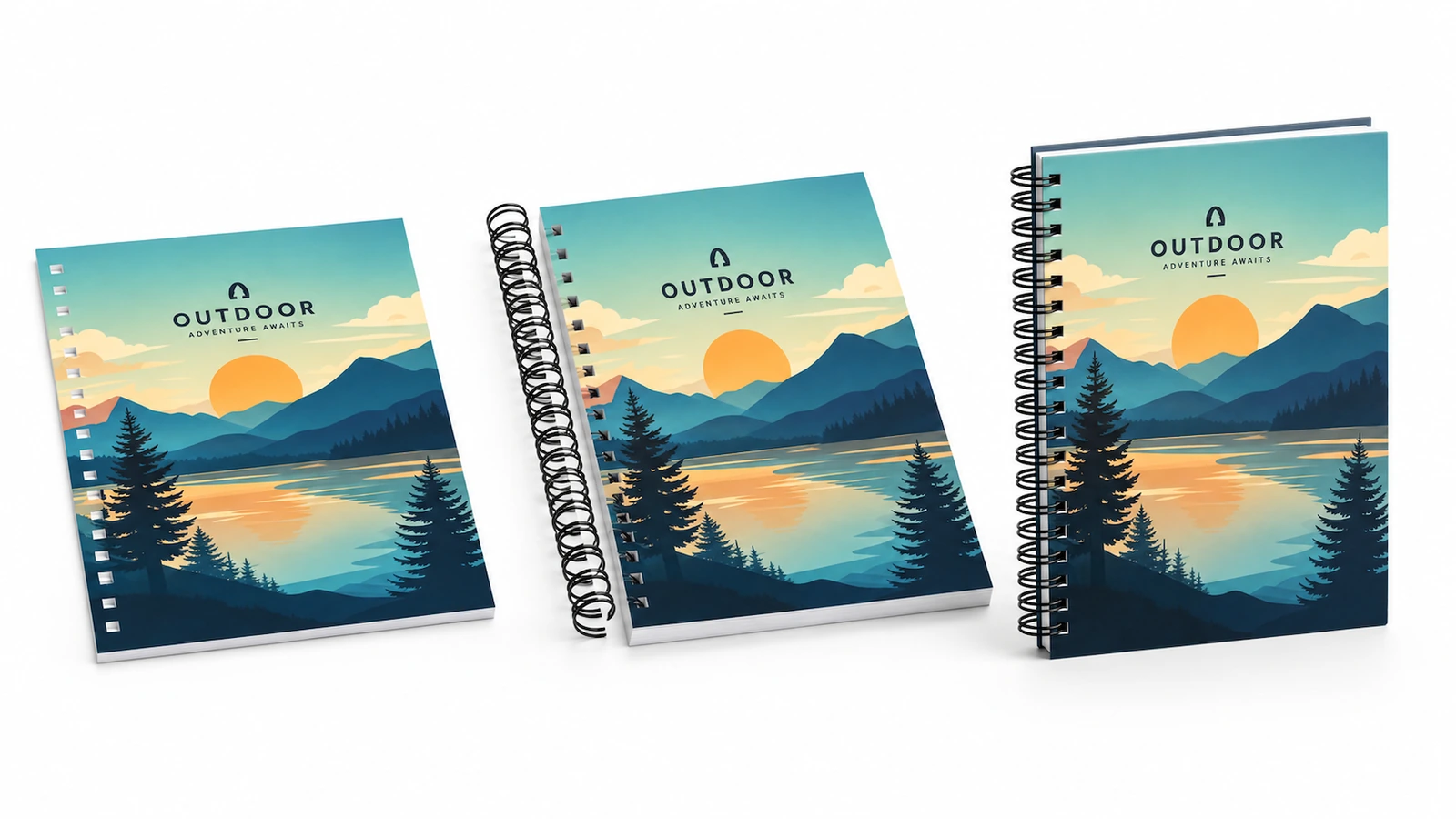
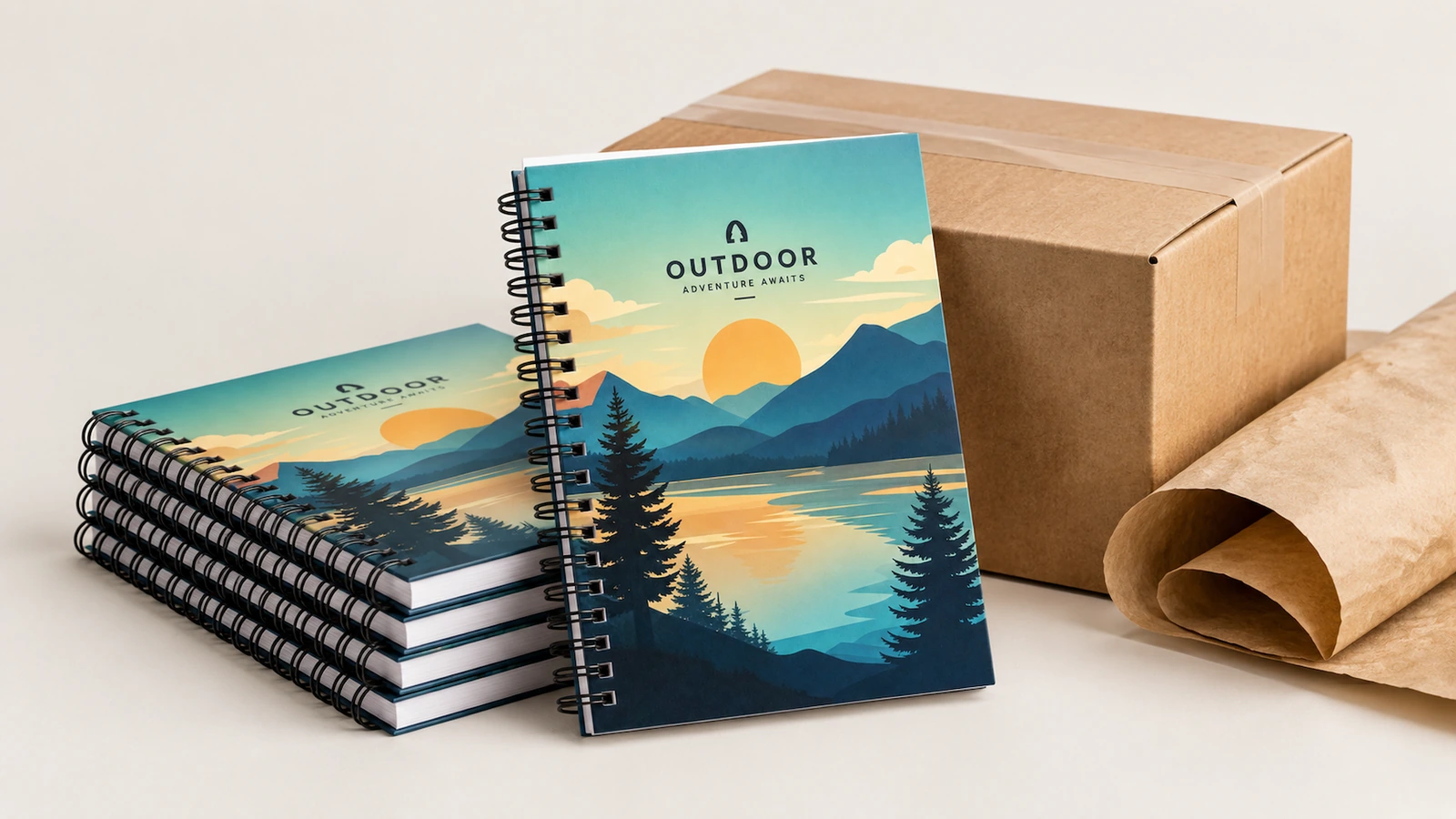
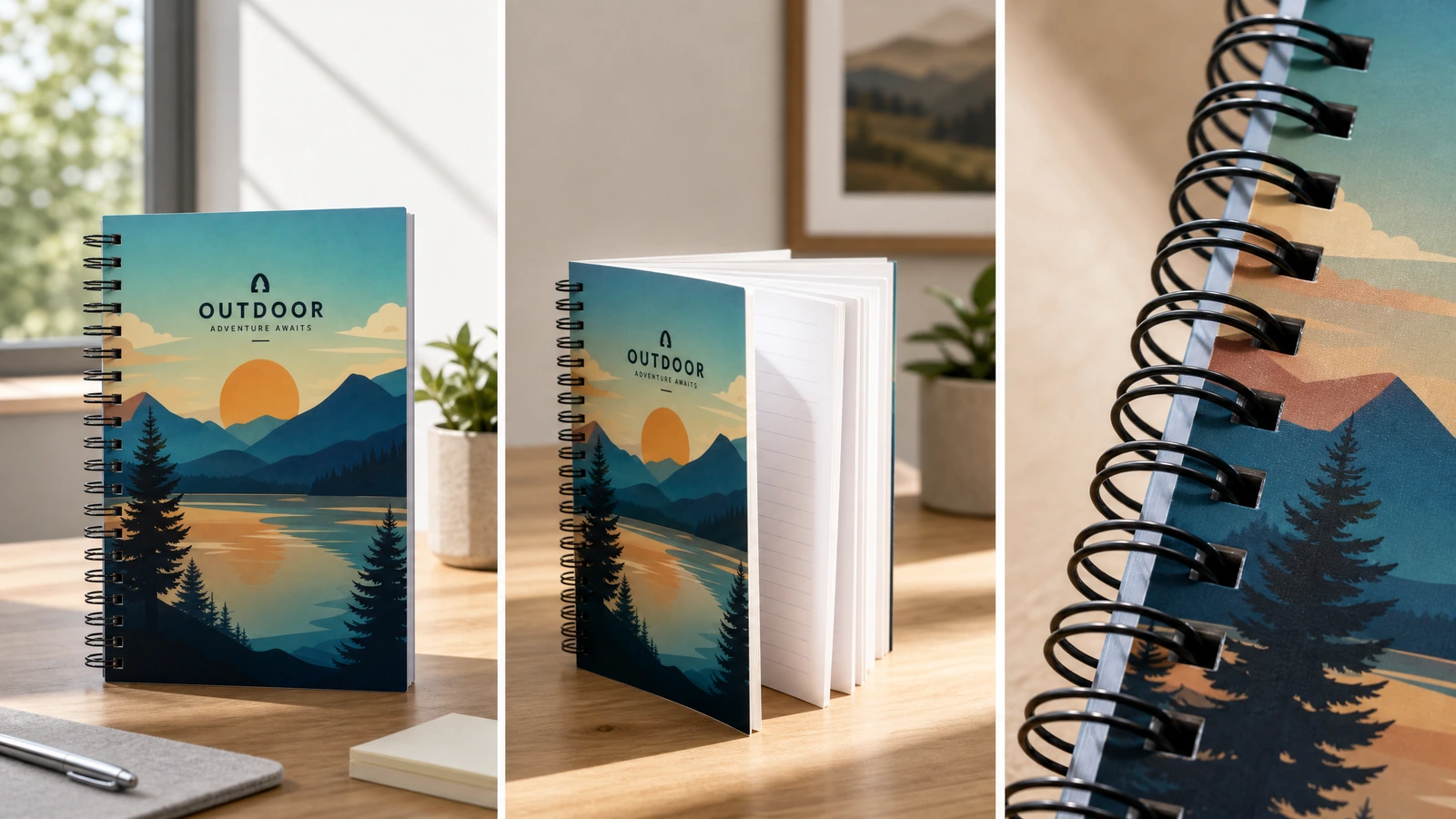
The configurations below are options to discuss during quotation, not confirmed specifications for this product. Minimum order quantity, pricing, sample availability, production time and unit weight require a project-specific quotation. Concept images illustrate purchasing decisions; they are not photographs of approved samples or evidence of tested performance.
Choose a notebook around the way people will use it ↑
A conference notebook, an employee welcome gift and a retail planner can share the same binding but need different interiors. Begin with the writing task rather than the cover decoration. That decision determines how much page space, structure and material testing the project needs.
- Events and training: prioritize readable notes, useful writing space and a format that fits the distribution kit. Include the event date in the enquiry.
- Onboarding and client gifts: consider whether branded introductory pages or meeting templates would be more useful than a logo alone.
- Independent stationery brands: define the interior content, cover collection and packaging before comparing production quantities.
- Desk planners and working notebooks: check binding position, page-turning comfort and access to writing space near the punched edge.
Avoid a good-looking notebook that disappoints in use ↑
A polished cover cannot compensate for pages that catch, writing that shows through excessively or important text placed inside the punching area. These problems are especially frustrating when the notebook carries your brand: the recipient experiences the complete object, not the separate specifications on a purchase order.
The commercial consequences extend beyond replacing a damaged copy. A missed event date can remove the purpose of the order, while a printing error discovered after binding can require substantial rework. Comparing only the unit price leaves these risks outside the purchasing decision.
The practical solution is to approve a complete construction: printed interior, finished cover, selected wire and proposed packaging. Keep the approved sample and written acceptance criteria together so production and delivery can be assessed against the same reference.

Contents: plan your notebook specification
What makes double-loop binding different? ↑
Double-loop binding holds punched sheets with paired metal loops that are mechanically closed. A single spiral instead follows one continuous corkscrew path through the holes. Specify the intended construction explicitly: “spiral notebook” alone does not distinguish these structures.
The original Wire-O® binding system belongs to the James Burn product family[1]. The product name on this page does not establish that any particular branded wire has been selected. If original branded consumables are required, include that requirement in the quotation and material approval.
Lay-flat opening and full fold-back movement are different checks. Publishing Xpress describes full 360-degree page turning[2], whereas DocuCopies describes rotation limits and bending risks[3]. Neither description proves this product’s performance. If folding fully behind the cover is essential, make that an explicit sample acceptance requirement.
How should you specify size, paper and readable interiors? ↑
Choose the finished writing area first, then evaluate portability. A5 and US Letter are different formats, not interchangeable labels. State dimensions in millimetres, paper weight in gsm and whether the binding sits on the left or top edge. Record cover construction separately from interior paper.
| Specification | Starting point for discussion | Required confirmation |
|---|
| Finished format | A5: 148 × 210 mm; A4: 210 × 297 mm; US Letter: 215.9 × 279.4 mm | Requested size, orientation and production feasibility |
| Interior paper | Uncoated writing paper; compare proposed 80, 100 or 120 gsm samples | Actual stock, writing response and availability |
| Interior layout | Lined, dotted, blank or custom working pages | Artwork, contrast and space beside the binding |
| Page count | State sheets and page sides separately; identify covers and inserts | Finished block thickness and bound sample |
| Binding specification | Double-loop wire; proposed pitch, loop diameter and color | Matching holes, closure and comfortable page movement |
These are planning references, not an available-size list or performance promise. Binding capacity depends on physical dimensions, the assembled loading state—including covers and inserts—and sample validation. Paper weight alone does not establish thickness or a reliable maximum page count.
For paper approval, use the pens recipients are likely to carry. Compare reverse-side visibility, ink penetration, feathering and smearing rather than asking only whether the stock is “premium.” A heavier candidate should still be tested; a gsm value is not a guarantee of fountain-pen or marker compatibility.
For planners, inspect the smallest dates, labels and ruled sections at actual size. For meeting notes, test writing near the punched edge with both left- and right-handed users. A larger sheet does not automatically solve an interior layout that leaves too little usable space.

Which cover finishes and closure details deserve a sample? ↑
Use the cover to express the brand, but approve it as part of the binding construction. Printed card, laminated surfaces, textured coverings, foil and debossing are possible enquiry directions drawn from market examples—not confirmed options for this provisional product.
Compare surface appearance and handling separately. A digital image can communicate artwork placement, but it cannot establish tactile feel, foil appearance or how a finished cover moves around the loops. Review the actual proposed material and finishing process before approving a premium presentation.
Back-cover details also need definition. If an elastic closure is requested, assess its attachment, pressure on the cover and interference with opening. No back clasp or fastening system is confirmed here. Treat a closure as a separate quotation and sample item rather than an assumed accessory.
For a concealed-wire design, ask for a construction sample before completing the artwork. Covering the binding changes the spine structure and available movement; a photograph of an exposed-wire notebook cannot validate the concealed version.

How can artwork avoid the punching and trimming zones? ↑
Design around the finished trim line and the separate binding exclusion area. Background artwork may extend into bleed, but logos, page numbers and working text must remain clear of both trimming and punching. Do not make a table depend on uninterrupted alignment through the metal binding.
As a supplier-specific example, Walsworth’s mechanical-binding guide[4] recommends single-page files, at least 0.125 inch bleed and a 0.5 inch inside margin. These are reference values, not this product’s approved template. Other suppliers specify different clearances; use the template confirmed for the actual punch and construction.
- Page sequence: check front and back covers, blank sides, inserts and interior order.
- File integrity: confirm the requested PDF format, embedded fonts and image resolution before export.
- Finishing artwork: supply suitable vector artwork for proposed foil or debossing and confirm separation requirements.
- Variable content: proof names, dates and QR codes individually where used.
- Physical readability: review an actual-size print, not only a zoomed screen view.
Keep color approval distinct from layout approval. A screen proof can identify missing text or misplaced artwork, but the proposed paper and printing process must be considered when agreeing the final color reference.
How do you move from an enquiry to production approval? ↑
The following is a proposed purchasing workflow, not a claim about an established factory process. Each stage should produce a clear approval record rather than relying on informal descriptions such as “same as the picture.”
- Prepare the brief. Provide intended use, quantity, finished size, interior content, cover direction, destination and required arrival date. Mark undecided fields so alternatives can be quoted separately.
- Compare complete quotations. Request material descriptions, binding construction, minimum quantity, sample charges, finishing costs, packaging and freight inclusions.
- Approve the digital proof. Freeze artwork version, page order, spelling, print placement and finishing separations.
- Approve the physical construction. Check the proposed paper, covers and wire together, including any requested closure or inserts.
- Agree production controls. Record the selected pitch, loop diameter, paper and cover specifications alongside the approved sample. Define inspection criteria and substitution approval.
- Release production and delivery. Confirm the schedule’s starting point, inspection arrangements, packing specification and shipping method in writing.
Pitch describes hole spacing: 3:1 and 2:1 refer to different holes-per-inch patterns. The punch pattern and selected wire must match. Do not choose solely from a generic sheet-capacity chart; use the measured assembled thickness and a bound sample.
No minimum order quantity or production duration has been verified for NSKU-760-01. Separate quotation time, proof revisions, physical sampling, production, inspection and transportation when planning an event. A competitor’s advertised turnaround is not a delivery commitment for this order.

Which binding best matches your purchasing priorities? ↑
Compare bindings using the same size, interior, cover and order quantity. Supplier price rankings differ, so a claim that one method is always cheaper or more durable is not a reliable purchasing rule.
| Binding direction | Reason to consider it | Trade-off to assess |
|---|
| Exposed double-loop wire | Orderly metal binding and a desk-oriented, lay-flat format | Compression damage, closure quality and actual fold-back movement |
| Concealed double-loop wire | A covered spine for a more enclosed presentation | Additional cover construction and its effect on opening |
| Plastic single coil | Flexible binding for frequent handling and fold-back use | Different appearance, end finishing and page alignment |
| Perfect binding | A printable spine and conventional softcover presentation | Ordinary constructions do not provide the same lay-flat writing experience |
| Sewn hardcover | A structured gift format with substantial cover protection | Weight, production complexity and different opening behavior |
| Reopenable comb | Potential page replacement for changing internal documents | Less suitable when a polished retail or gift appearance is the priority |
This comparison identifies sample questions rather than guaranteed rankings. A thicker planner, coated cover or concealed spine can change the result. Page capacity for any candidate remains dependent on physical dimensions, assembled contents and sample validation.
Evaluate total delivered cost: notebooks, setup, proofs, finishing, packaging and transportation, plus any import-related charges stated outside the quotation. Record what is included rather than comparing unrelated factory, retail and delivered prices as if they represented the same purchase.
What should the sample and acceptance checks cover? ↑
The sample should expose likely failures, not simply provide an attractive cover photograph. The supplied Binding101 guidance on wire-binding limitations[5] describes under-closed loops that release pages, over-closed loops that distort and the need to replace the binding when changing pages. These are potential failure modes, not measured defects in this product.
- Binding: turn through the complete notebook, inspect loop closure and check for snagging, sharp ends or loose sheets.
- Punched edges: examine alignment, torn holes and rough edges; test the intended writing position beside the binding.
- Paper: use agreed pens and compare feathering, reverse-side visibility, ink penetration and smearing.
- Print and finishing: inspect trim, skew, page order, logo placement and color against the approved reference.
- Cover: test opening with the actual finish, board and any proposed closure fitted.
- Packed condition: assess the proposed shipment configuration for corner damage and deformation of the wire.
Agree the inspection sample size, defect definitions and acceptance limits before production. If an AQL-based plan is requested, specify the plan and defect categories; a bare AQL number does not mean every notebook has been inspected or that a fixed defect percentage is acceptable.
No cycle-life, pull-strength, ink-resistance or shipping-test results are provided for this product. Required testing remains to be agreed and performed. Keep photographs, sample identification and the result of each agreed check with the approval record.
Which sourcing and safety claims need supporting documents? ↑
Separate material sourcing from finished-product performance. FSC chain-of-custody certification[6] concerns the traceability of forest-based materials. If an FSC claim is required, request the relevant certificate details and order-specific claim before approving labeling. No FSC certification is established for this provisional product.
A quality-management certificate is not a test report for loop strength, paper permanence or writing performance. Likewise, a paper report does not automatically cover the cover board, inks, coatings or metal components. Match every requested document to the material or process it actually addresses.
For US children’s applications, establish product classification before deciding the testing and certification route. CPSC’s total-lead guidance[7] is relevant to accessible components of children’s products; an adult corporate notebook should not automatically be assigned the same certification route.
Surface coatings require a separate assessment. CPSC’s lead-in-paint guidance[8] distinguishes covered coatings from treatments such as electroplating and inks absorbed into the substrate. Do not use a generic supplier certificate as proof that every colored wire or printed component is covered. For other destinations, identify applicable requirements rather than treating a collection of certification logos as universal approval.
How should packaging, delivery and reorders be specified? ↑
Plan protection around the exposed binding, not just the printed cover. Discuss a protective box, spine protection or another suitable packing arrangement, then assess it using the intended shipping configuration. Carton capacity must be determined from actual notebook dimensions, packing materials, loading arrangement and sample validation—not an assumed number of books per box.
Record packed dimensions and weights when available. Separate dispatch from arrival, and clarify the treatment of customs delays, import charges and destination delivery. For date-sensitive orders, the written schedule should identify which approvals must occur before production can begin.
Confirm the treatment of approved artwork errors, manufacturing defects and transit damage before ordering. Specify the evidence needed for a claim and the agreed remedy process. Do not assume a change-of-mind return policy applies to personalized printed goods.
End-of-life instructions are location-specific. San Jose Recycles advises removing metal or plastic bindings[9] before recycling notebook paper. That is local guidance, not a universal rule or proof that every cover and finish is recyclable. Recipients should follow their local collection instructions.
For repeat orders, retain the artwork version, paper specification, cover finish, wire details, approved sample and packing record. Confirm proposed substitutions before production and reassess writing or opening performance when materials change. “Same design” alone does not define the same finished notebook.
Keep the essential purchasing decisions visible ↑
- Specify the construction, not just the category. Record double-loop wire, binding edge, paper, cover and interior layout in the same brief.
- Approve performance on the assembled sample. Fold-back movement, writing response and page retention remain sample checks rather than assumed benefits.
- Keep commercial terms product-specific. MOQ, sample cost, production time, unit weight and delivery inclusions require a quotation for the requested configuration.
- Match evidence to the claim. Material sourcing documents, component testing and finished-notebook inspection answer different questions.
- Protect the repeat order. Preserve the approved construction and identify material changes before authorizing another run.
Build a quote around the notebook your users need ↑
The strongest specification connects appearance with everyday use: readable interiors, suitable paper, a binding that behaves as required and packaging appropriate to the journey. It also gives both parties an objective reference when assessing the finished order.
Request a project quote from Zigpac for NSKU-760-01 with your quantity, preferred dimensions, page count, artwork, destination and required arrival date.




The information below is required for social login
Sign In
Create New Account