Custom brown kraft paper takeaway bags with flat handles bring your branding into the pickup and delivery experience. Start with your actual containers, packed weight, and artwork—not an assumed bag capacity. Dimensions, paper weight, printing, protective treatments, pricing, and delivery terms require a confirmed quotation and sample approval.
Who should consider these flat-handle takeaway bags? ↑
This format is relevant to restaurants, cafés, bakeries, food trucks, and growing foodservice brands reviewing an outer carry bag for packaged orders. An independent café may prioritize a recognizable logo and manageable inventory. A multi-location operator may need consistent dimensions, repeatable print approval, and documented material specifications across reorders.
Begin with the handoff: counter pickup, customer carryout, or third-party delivery. Each involves different handling and exposure. A bag approved around a dry bakery carton should not automatically be accepted for hot meal containers or chilled drinks. Container fit, carrying capacity, and the number of items accommodated depend on physical dimensions, loading conditions, and sample validation.
Solve the packing problem before printing the logo ↑
A container that catches on the opening slows packing. A strained handle or weak bottom can turn a completed order into a replacement meal. If staff routinely double-bag orders, the apparent saving on each bag may be offset by extra materials, handling time, and wasted stock.
The answer is not simply thicker paper or more prominent branding. Treat container fit, handle attachment, moisture exposure, and print readability as separate purchasing decisions. Approve a sample with your real order configuration, then use that approved construction as the reference for the quotation and repeat purchases.
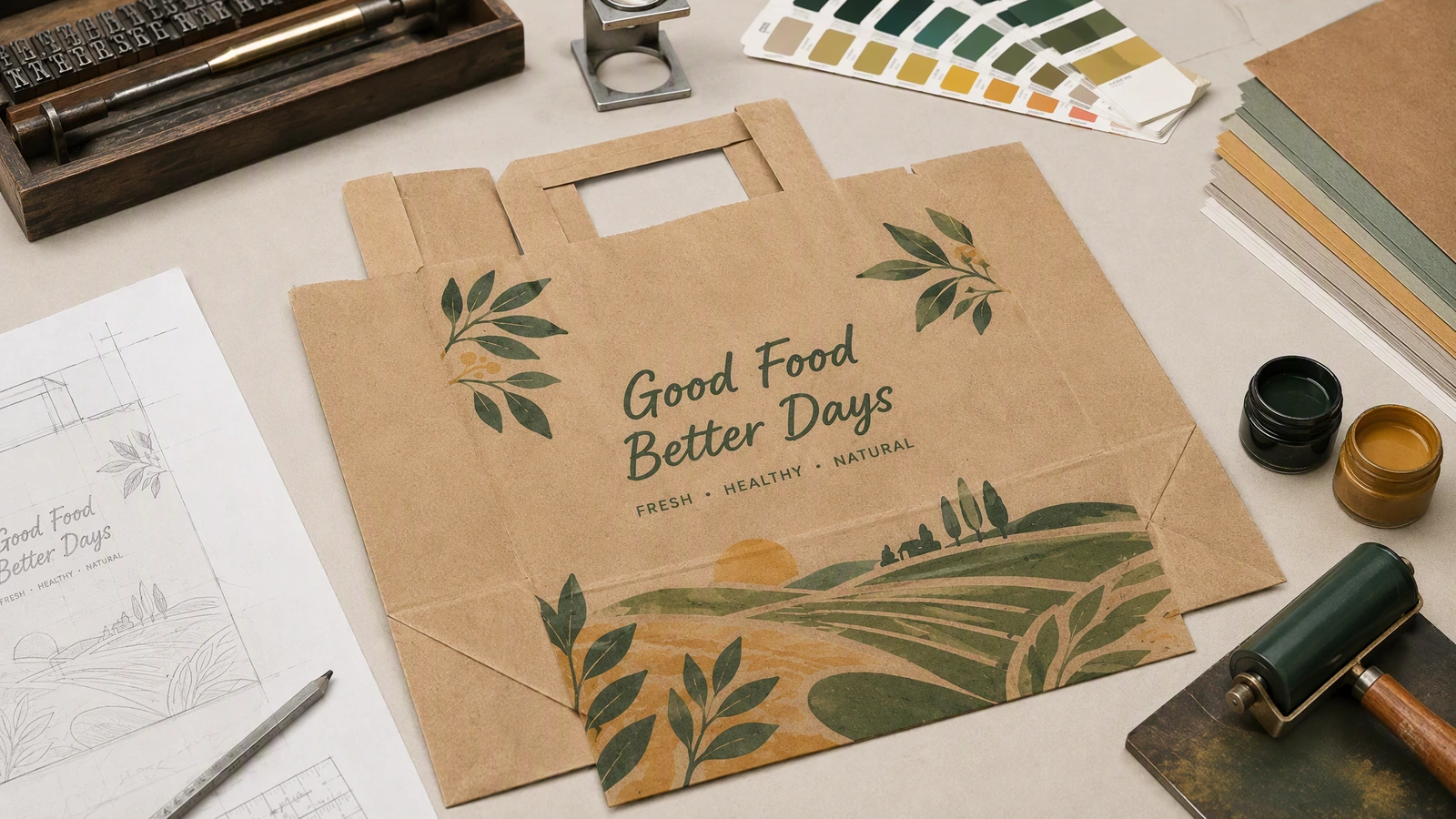
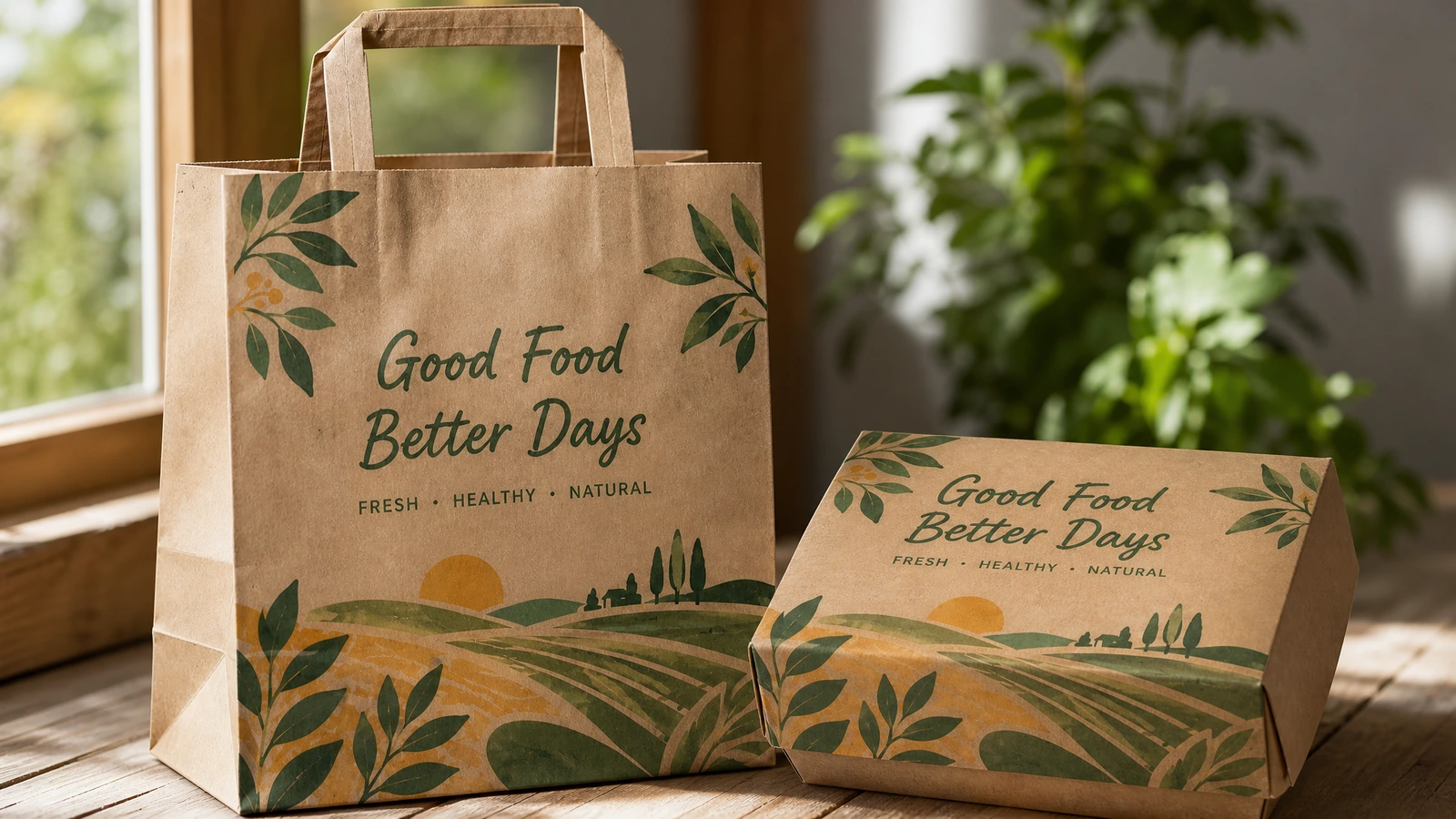
Illustrative application concept. Depicted containers do not establish a tested fit or carrying capacity.
On this page
What is confirmed about this product? ↑
The product identity is Custom Brown Kraft Paper Takeaway Bags with Flat Handles, within Custom Paper Bags → Custom Kraft Paper Bags. Its provisional reference is NSKU-723-02. Flat handles distinguish this format from twisted-handle shoppers and handle-free sacks; they do not, by themselves, establish greater strength.
No product-specific factory measurements or certification records are provided for this reference. The following specification sheet separates its confirmed identity from details that must be quoted, sampled, or tested.
| Specification | Current position | Purchasing requirement |
|---|
| Material and appearance | Brown kraft paper | Confirm paper grade, fiber composition, and surface treatment |
| Handle style | Flat handles | Approve attachment construction and any reinforcement |
| Dimensions | Pending quotation and sampling | Record width × gusset depth × height in mm |
| Paper weight | Pending specification | Record g/m² separately from finished unit weight in g/bag |
| Load and container fit | Pending physical validation | Test the actual packed arrangement and handling conditions |
| Printing | Custom branding scope to be confirmed | Approve process, colors, printable areas, and physical proof |
| Commercial terms | MOQ, price, and production time pending quotation | Separate production, transport, and any setup charges |
Use this table as a quotation checklist, not a completed technical data sheet. Competitor dimensions, minimum orders, and load claims are not specifications for this product.
How should size and logo readability be approved? ↑
Measure the outside dimensions of the closed container, including projecting lids. Then reproduce the complete order arrangement with sauce cups, cutlery, and any separate wrapping. Check usable internal space rather than assuming a nominal bag measurement equals unobstructed packing space.
Leave the closure and handle access requirements visible in the sample brief. A container may fit at the bottom while making the opening awkward to fold or the handles difficult to grasp. Have the person who packs orders evaluate insertion, removal, and carrying—not just someone reviewing a photograph.
Evaluate artwork on the selected brown paper. Pale colors and fine reversed lettering may lose contrast against the substrate. Check the logo at normal viewing distance and under counter lighting, then inspect smaller text for clarity. A screen proof establishes placement; it does not establish the final appearance of ink on kraft.
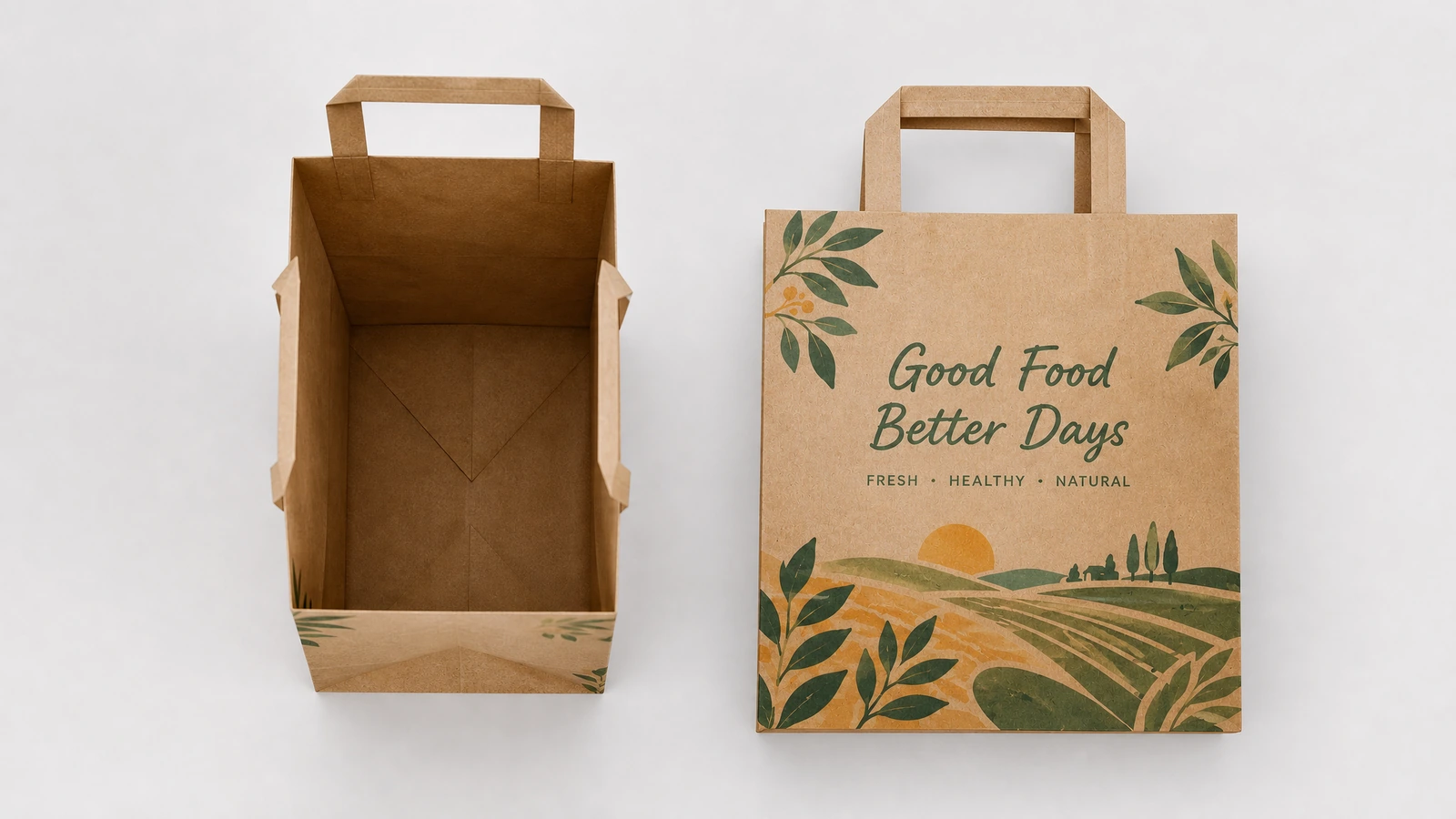
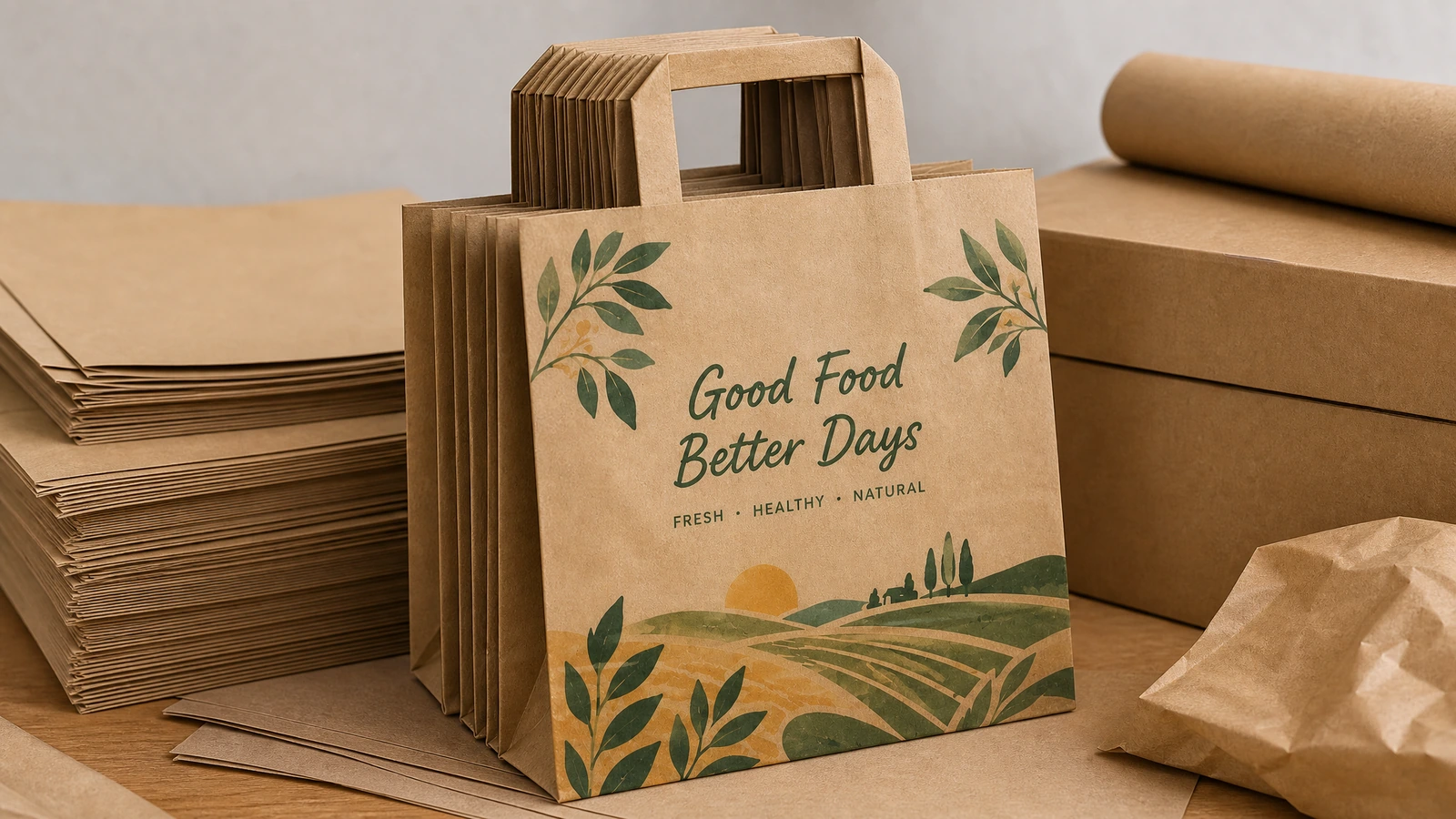
Approve measurements and color appearance on a physical sample; the illustration supplies no dimensions or fit guarantee.
Which surface and handle details need separate approval? ↑
Brown kraft describes the base material and appearance, not a verified barrier performance. Request confirmation of whether the proposed construction is untreated, coated, or lined. Do not infer waterproofing, grease resistance, or direct-food-contact suitability from color, stiffness, or paper weight.
For flat handles, inspect attachment areas on both faces and inside the bag. The review should cover bonding, any reinforcing patches, and how force transfers into the bag wall. This is a handle-attachment decision, not a rear-buckle selection: no buckle or mechanical back fastener is established for this product.
| Construction to discuss | Reason to investigate | Boundary to confirm |
|---|
| Uncoated kraft outer bag | Packaged orders without a requirement for the bag itself to contain oil | Do not assume resistance to leakage or condensation |
| Water-based or other nonfluorinated barrier | A specific grease-resistance requirement | Availability, composition, food-contact basis, and actual-use performance need confirmation |
| PE-lined construction | An identified moisture or grease exposure | Review the complete structure and disposal route; paper content does not establish compostability |
| Separate protective inner packaging | Keeping oily food or sauces away from the carry bag | Validate the container or liner together with the outer bag |
These are routes for technical discussion, not a confirmed option catalog for NSKU-723-02. Changing a coating or liner can change cost, testing requirements, and environmental wording.
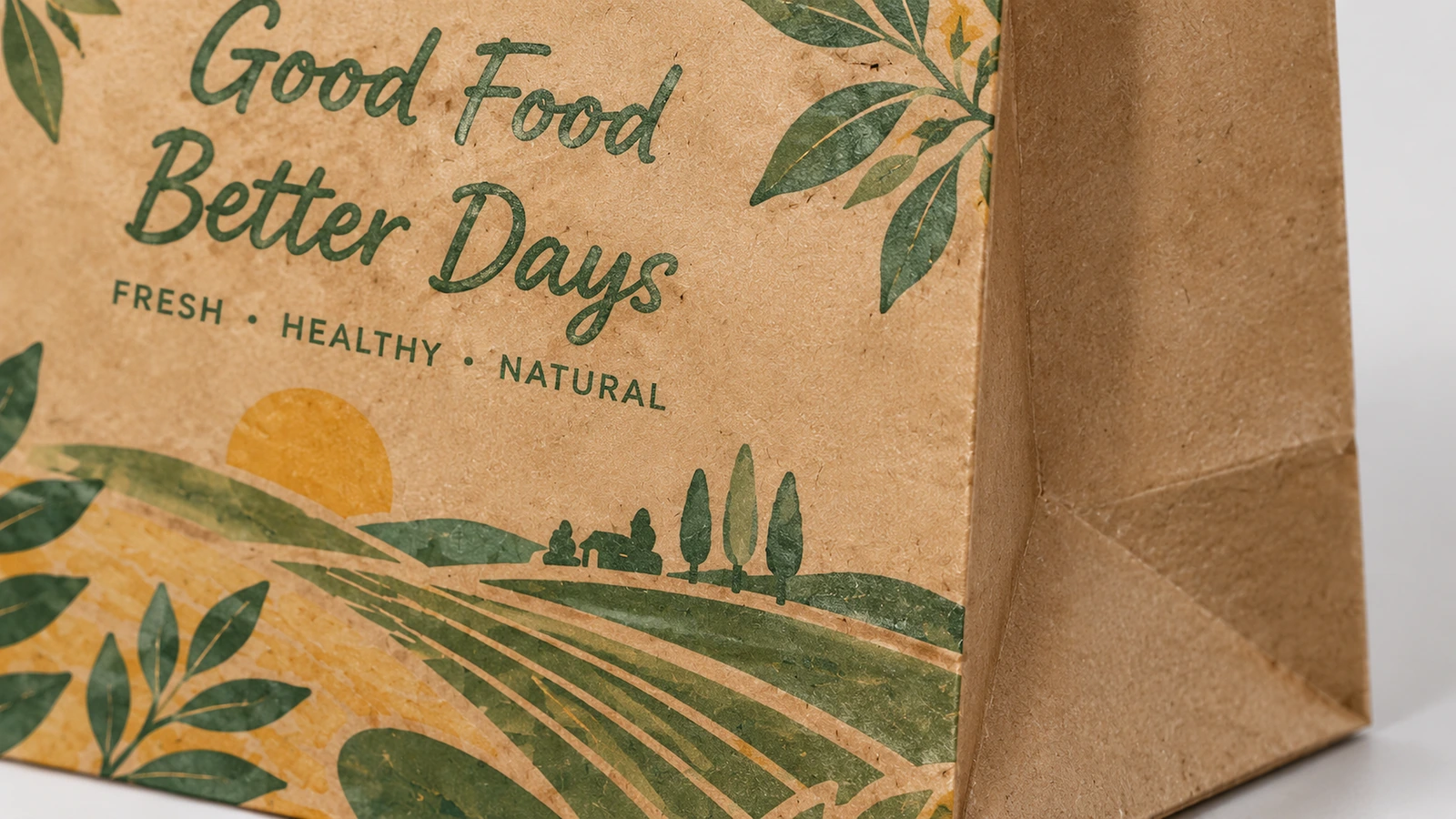
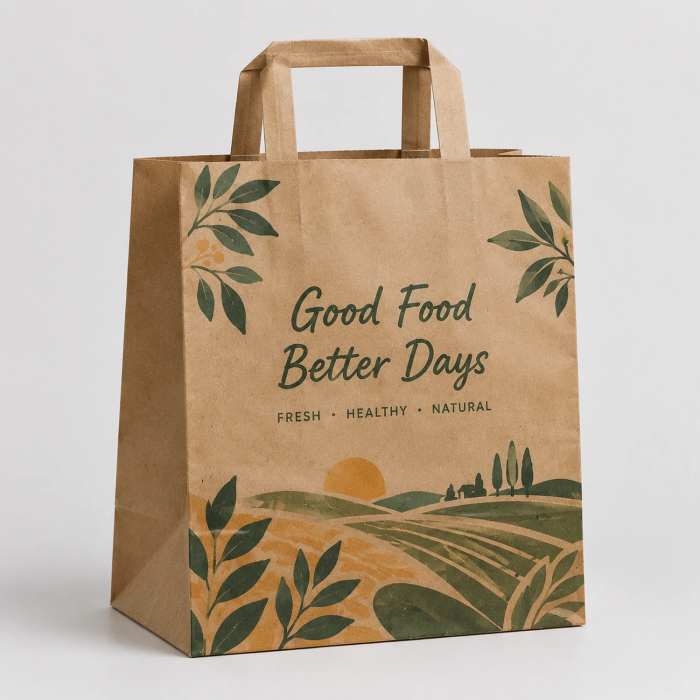
Conceptual material and attachment review; finishes and reinforcement remain subject to quotation and approval.
What should be checked before artwork approval? ↑
Work from the confirmed bag drawing. Identify front and back panels, gussets, folds, handle attachment areas, and the agreed print boundary. Specify which surfaces carry artwork rather than assuming every visible area can be printed in the same way.
- Color: identify the intended color references and evaluate them against the selected paper.
- Legibility: inspect small type, fine lines, and reversed details at actual size.
- Placement: keep essential information clear of folds and attachment areas according to the approved drawing.
- Claims: remove unsupported food-safety, certification, and environmental statements before proof approval.
- Version control: identify the approved artwork and sample so an old design cannot silently become the reorder reference.
Food-contact review should distinguish the paper surface from other components. 21 CFR 176.170[1] addresses paper and paperboard components for aqueous and fatty foods and directs specified dry-food applications to 176.180. Ask for the applicable basis for paper, ink, adhesive, and any coating under the intended use conditions; a generic “food grade” description is insufficient.
How should production approval protect the agreed specification? ↑
Freeze the intended use and construction before approving bulk production. Otherwise, an artwork change can conceal a material change, or a cheaper revised quotation can describe a bag that no longer matches the tested sample.
- Define the use: document food packaging, temperature exposure, packed arrangement, and handling route.
- Confirm the construction: agree dimensions, paper, surface treatment, bottom construction, and flat-handle attachment.
- Approve printing: confirm artwork placement and the appropriate physical color reference.
- Evaluate the sample: record fit, opening, carrying, and exposure observations.
- Release the order: tie the purchase specification to the approved sample and written commercial terms.
A typical paper-bag workflow includes paper selection, printing, cutting, forming, bottom construction, handle attachment, and inspection. That sequence is useful for locating a problem, but it is not evidence of this supplier’s equipment, capacity, or lead time.
Require proposed substitutions to be disclosed before acceptance. A different paper source, adhesive, coating, or ink system can require renewed review. Keep the approved sample available to production and receiving teams rather than treating artwork approval as approval of the entire bag.
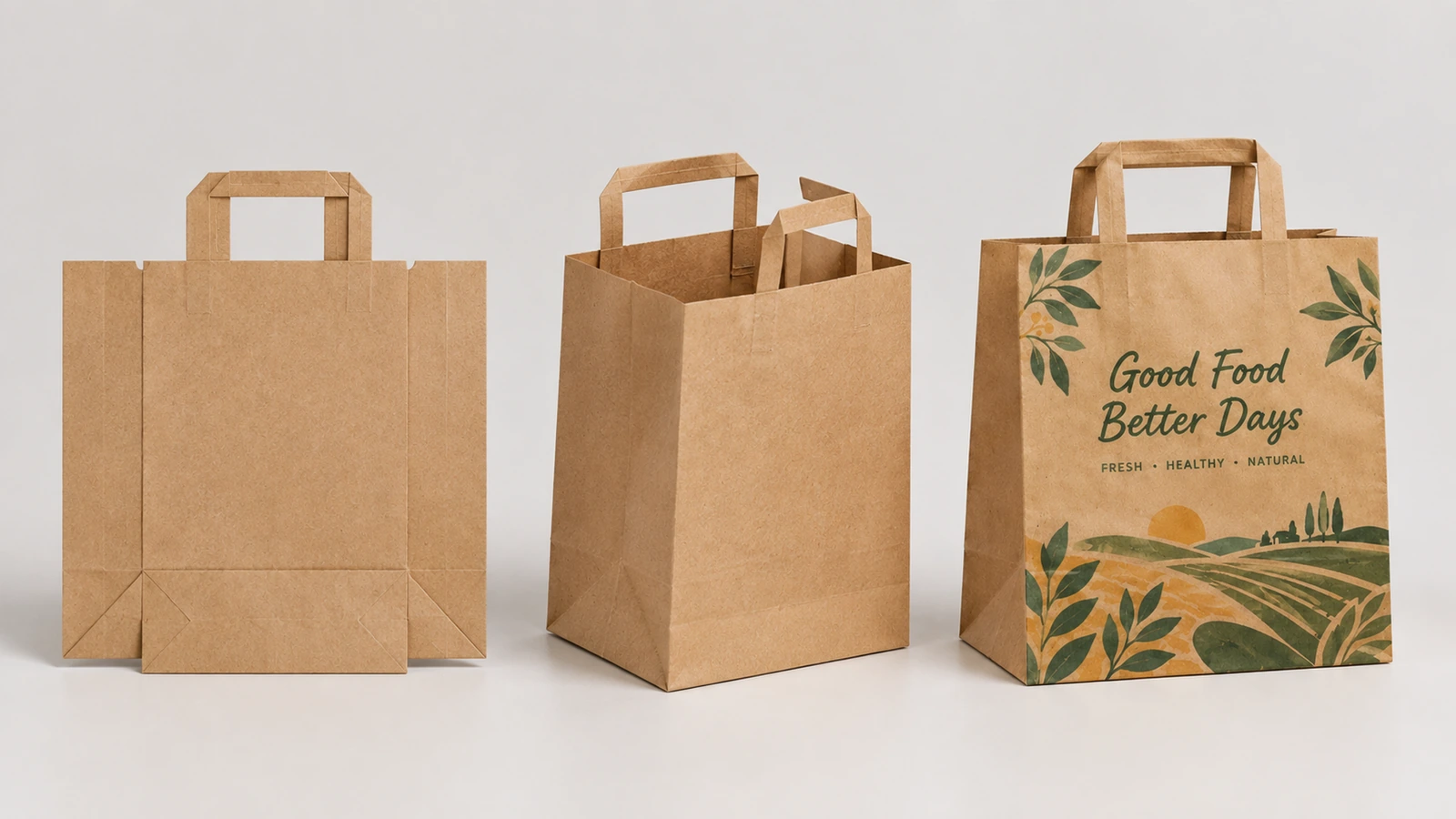
Illustrative process sequence, not a photograph documenting factory facilities or production capability.
Which sample checks matter before bulk purchasing? ↑
Separate paper-level measurements from finished-bag performance. The TAPPI T 559 kit test[2] describes surface repellency testing primarily developed for fluorochemical treatments; its suitability for film-like barriers or nonfluorinated treatments requires evaluation. A reported kit result is not a universal finished-bag approval or a food-safety certificate.
Smithers’ grease-testing guidance[3] explicitly treats laboratory results as performance guidance rather than a substitute for prototype testing with actual product oils or greases. For an outer bag, evaluate the complete packed order, including its primary containers.
| Check | What to observe | Record for approval |
|---|
| Opening and forming | Stuck panels, tearing during opening, incomplete bottom formation | Defect location and sample identification |
| Container fit | Lid interference, unstable placement, difficult insertion | Container dimensions and packed arrangement |
| Carry handling | Handle lifting, attachment separation, bottom or side-seam damage | Actual packed mass in kg and handling conditions |
| Exposure | Condensation, oil marking, softening, leakage at folds | Contents, temperature in °C, and elapsed time in minutes |
| Print and cleanliness | Color mismatch, rubbing, transfer, dirt, objectionable odor | Comparison with the approved reference |
Agree the sample quantity, test conditions, and acceptance criteria before testing. None of these checks has a published result for this product. Its capacity and container count remain dependent on physical dimensions, loading conditions, and validated samples.
Include the expected waiting period before pickup and the journey afterward. Inspect the bag again when lifted, not only while stationary. Record where a failure starts so the corrective action addresses the handle, seam, container, or barrier rather than automatically increasing paper weight.
Inspection concept only; no test result or certified load is represented.
Which purchasing route fits your volume and risk? ↑
Compare equivalent specifications before comparing unit prices. A quotation for an untreated carry bag is not interchangeable with one for a lined bag, and a stock size with limited printing is not the same purchase as a fully customized format.
| Route | Useful when | Main trade-off |
|---|
| Stock bag with a label or stamp | You are evaluating branding or demand before committing to printed inventory | Additional application work and a different finish from direct printing |
| Custom-printed flat-handle kraft bag | The packed order and artwork are stable enough to specify | MOQ, setup charges, and production schedule need a product-specific quotation |
| Alternative handle or reinforced structure | The proposed flat-handle sample does not meet the agreed handling test | A changed structure requires a new cost and performance comparison |
| Protective inner packaging plus carry bag | Oil, sauces, or condensation need control before reaching the outer bag | Additional components and packing steps |
These routes support different purchasing needs; they are not a ranking of universally better materials. Compare the cost of a usable packed order, including rejects, extra bags, setup, transport, and storage—not just the quoted price per bag.
Keep environmental wording tied to the complete bag
Under the FTC Green Guides[4], compostability needs reliable evidence and appropriate qualifications about disposal conditions and facilities. Recyclability concerns the complete item and available collection systems; recycled-content claims need substantiation. These are separate claims, not interchangeable meanings of “eco-friendly.”
For polymer-coated paper, the Compost Manufacturing Alliance’s standards guidance[5] explains the relevance of ASTM D6868 to coated and multilayer structures. Do not infer finished-bag compostability from the paper alone or from a “water-based” coating description. No compostability certification is established for this product.
Before approving disposal instructions, confirm the selected construction and whether local programs accept it in its expected food-soiled condition. Review destination-specific requirements separately; a material description does not settle every jurisdiction’s rules.
How can shipping and reorders stay consistent? ↑
The quotation should distinguish sample preparation, production after approval, and transportation. Confirm the schedule’s starting point, shipment destination, packing method, carton quantity, and storage requirements. None of those commercial details has been established for this reference.
Inspect incoming cartons for damage or moisture, then check bags for stuck panels, missing or poorly attached handles, open seams, and print differences. Agree receiving criteria in advance so acceptance does not depend on whether the stock happens to look usable during a quiet shift.
For repeat orders, retain the approved bag, artwork version, material specification, and relevant documentation. Record complaints by failure type and packed configuration. If problems cluster around a particular menu item, reassess that arrangement before ordering the same specification again.
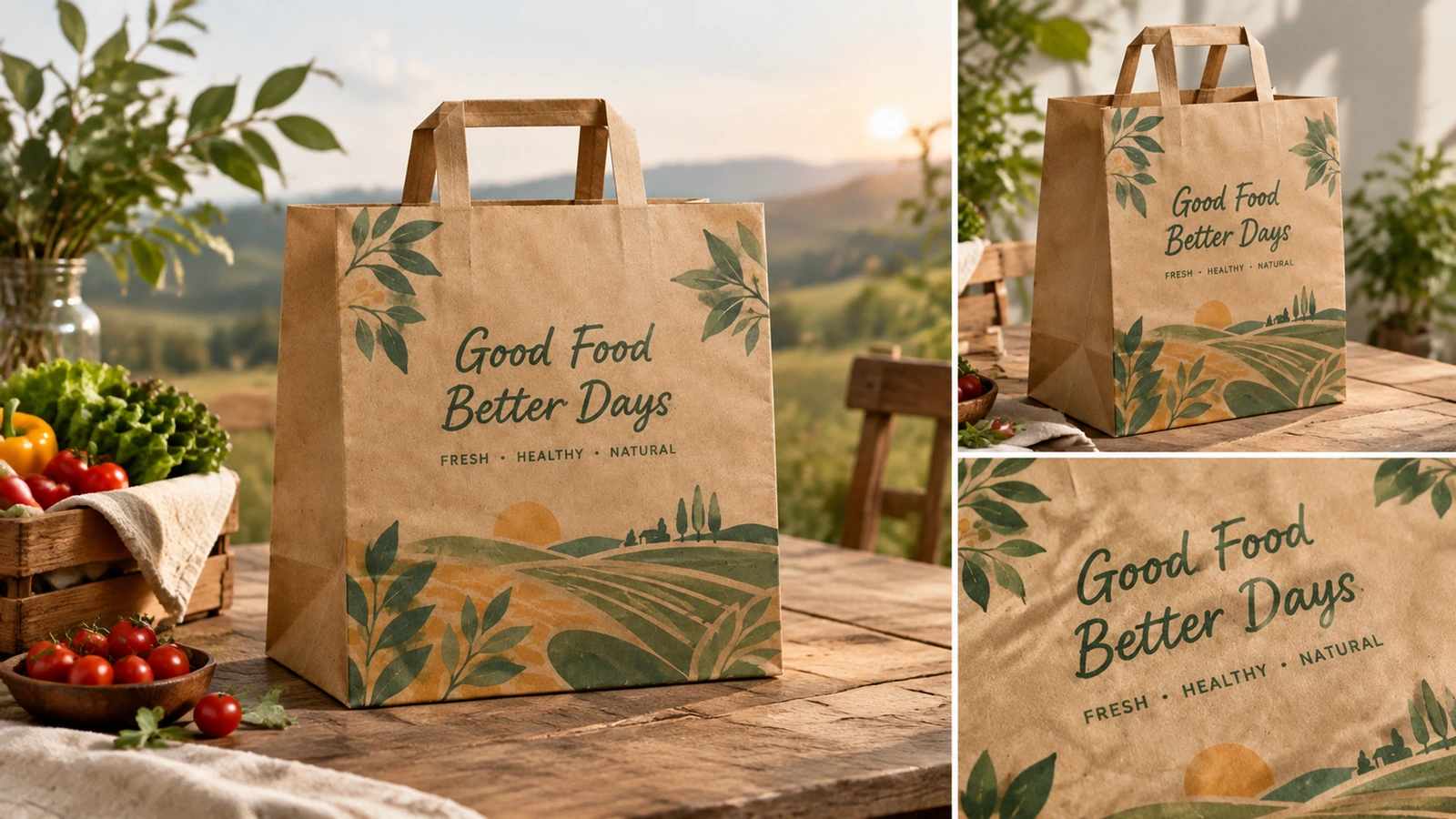
Illustrative packing arrangement; carton quantities and shipment specifications require confirmation.
Key purchasing takeaways ↑
- The confirmed format is brown kraft with flat handles. Dimensions, paper weight, unit weight, print scope, and protective treatments still need specification.
- Capacity comes from the packed sample, not the product name. Validate physical dimensions, loading conditions, container arrangement, and handling before accepting a load or fit claim.
- Relevant PFAS food-contact authorizations are no longer effective. — 35 FCNs became ineffective on January 6, 2025; the FDA set June 30, 2025 as the compliance date for certain earlier paper-packaging stocks (Source[6]). This concerns specified paper-packaging grease-proofing uses, not proof that this bag is PFAS-free.
- Written material evidence matters. Request the relevant supplier declarations and testing scope; do not equate “no intentionally added PFAS” with proof of zero detectable contamination.
- Commercial terms must describe the same approved construction. MOQ, production time, pricing, and transport remain quotation items, not borrowed competitor promises.
Build the quote around your actual takeaway order ↑
A useful packaging specification connects the bag to the way your business packs, carries, and presents food. For this flat-handle kraft format, the next decision is a documented sample and quotation—not an unsupported strength, certification, or delivery promise.
Request a quotation for NSKU-723-02 with your container dimensions, packed weight, intended quantity, delivery destination, artwork, and food-handling conditions.




The information below is required for social login
Sign In
Create New Account