


 Blog PDF for offline reading
Quick answer: Choose custom take out containers for your hardest menu item, not your average one. Hot, steamy food needs vented lids. Fried food needs a grease barrier you can verify. Sauces need sealed lids, and cold items need packs that tolerate condensation. Confirm food-contact documents before you print, then size the takeout bag to the container footprint and stack height.
Most packaging complaints start inside the bag. A clamshell sweats, a sauce lid lifts, or oil wicks through a folded corner, and the outer bag gets the blame. This guide is for restaurant and food-service buyers planning custom take out containers. It treats the containers and the bag as one system: first choose the right container for each menu category, then make sure that container fits the bag it travels in.
Why takeout packaging fails after it leaves the counter
Packaging can look fine at the pass and still fail in the car. A widely shared example came in March 2026. Customers of a burger chain complained after fry cups were replaced with paper bags. One customer wrote that "the grease soaks through much faster," and another said the old cup had kept oil off car seats on the drive home, as reported by the New York Post[1]. The food had not changed. Only the primary container had.
The cost of that failure grows quickly. Staff double-bag every order to compensate. Delivery drivers hand over wet bags. Reviews mention the mess rather than the meal. There is also a compliance side. Several U.S. states now ban intentionally added PFAS in food packaging, so the grease-proofing that once hid the problem is no longer available.
The fix is to plan in the right order. Define the failure mode for each menu item, pick a container that resists it, document that the container is suitable for food contact, and only then choose the bag that carries the set.
What custom take out containers are, and what they are not
Custom take out containers are primary food packaging. They are the clamshells, bowls, folding cartons, cups and trays that touch the food, specified or branded for one operation. The takeout bag is secondary packaging. It carries the containers, keeps an order together and carries the brand out of the restaurant. In practice, a custom food containers bag program covers both layers.
Keeping the two layers separate prevents a common buying mistake: expecting a paper carrier bag to do a container's job. A kraft carry bag is not a leak barrier. Soups, dressings and fried items need to be contained at the primary level. The bag's job is to carry weight evenly and keep lids level. When buyers ask a bag to stop leaks, they usually end up with heavier paper, double-bagging and the same leaks.
There is also no single U.S. federal standard called a "takeout container standard." What you can verify is a stack of separate requirements: FDA food-contact rules for the materials, test methods for grease resistance, FTC rules for environmental claims, and state laws on PFAS and packaging. Each section below maps to one of these.
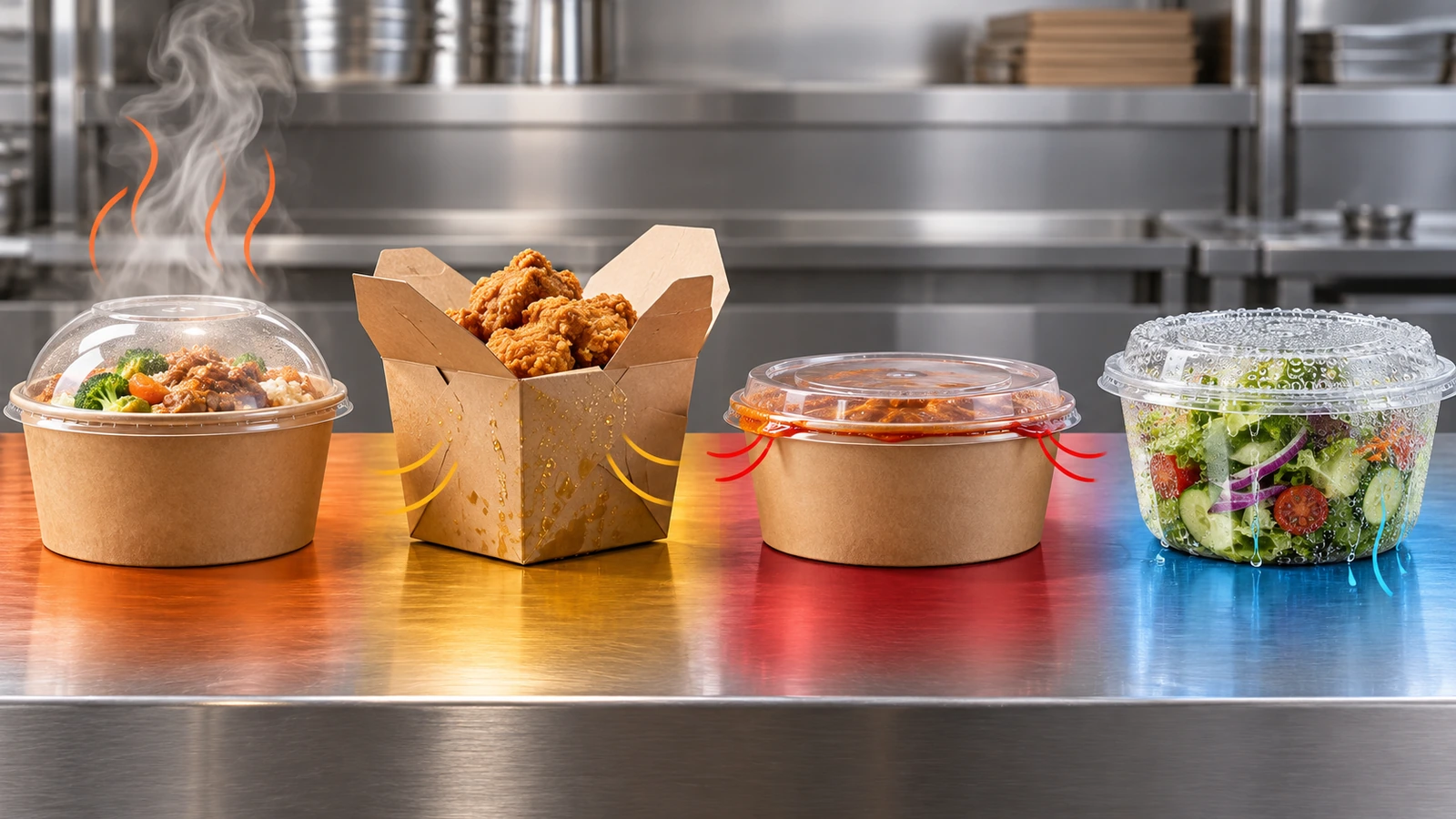
How to choose custom take out containers in six steps
Step 1: Sort the menu into four failure modes
List every item that leaves the building and put each one in a single bucket based on how it fails, not where it sits on the menu:
- Hot and steamy (rice dishes, noodles, roasted vegetables): steam condenses under the lid, softens paperboard and makes crisp food soggy.
- Greasy (fried chicken, fries, burgers, pastries made with butter): free oil wicks into untreated fiber and shows through.
- Saucy or liquid (curries, soups, dressings, dipping sauces): liquid escapes at lid seams, folded corners and vents.
- Cold (salads, desserts, cold drinks): outside condensation wets anything it touches, including the bag.
Specify each bucket for its worst item. If the container holds your oiliest fried item, it will hold the rest of that category. A container chosen for the average item will fail on the busiest night.
Step 2: Match heat and steam performance
Hot food does more damage through moisture than through temperature. A sealed lid traps steam, the steam condenses, and the water collects on the food and the container walls. For fried or crusted items, use vented lids or venting slits so steam can escape. For braised or saucy dishes, use a sealed lid, because they need moisture retention more than crispness.
If customers are likely to reheat food in the container, ask the supplier for written confirmation that the material and lid are suitable for microwave use. Do not infer it from how the material looks. Also plan for transport: hot and cold containers should not share a bag. Heat travels to the cold item and condensation runs back the other way.
Step 3: Specify grease and leak barriers you can verify
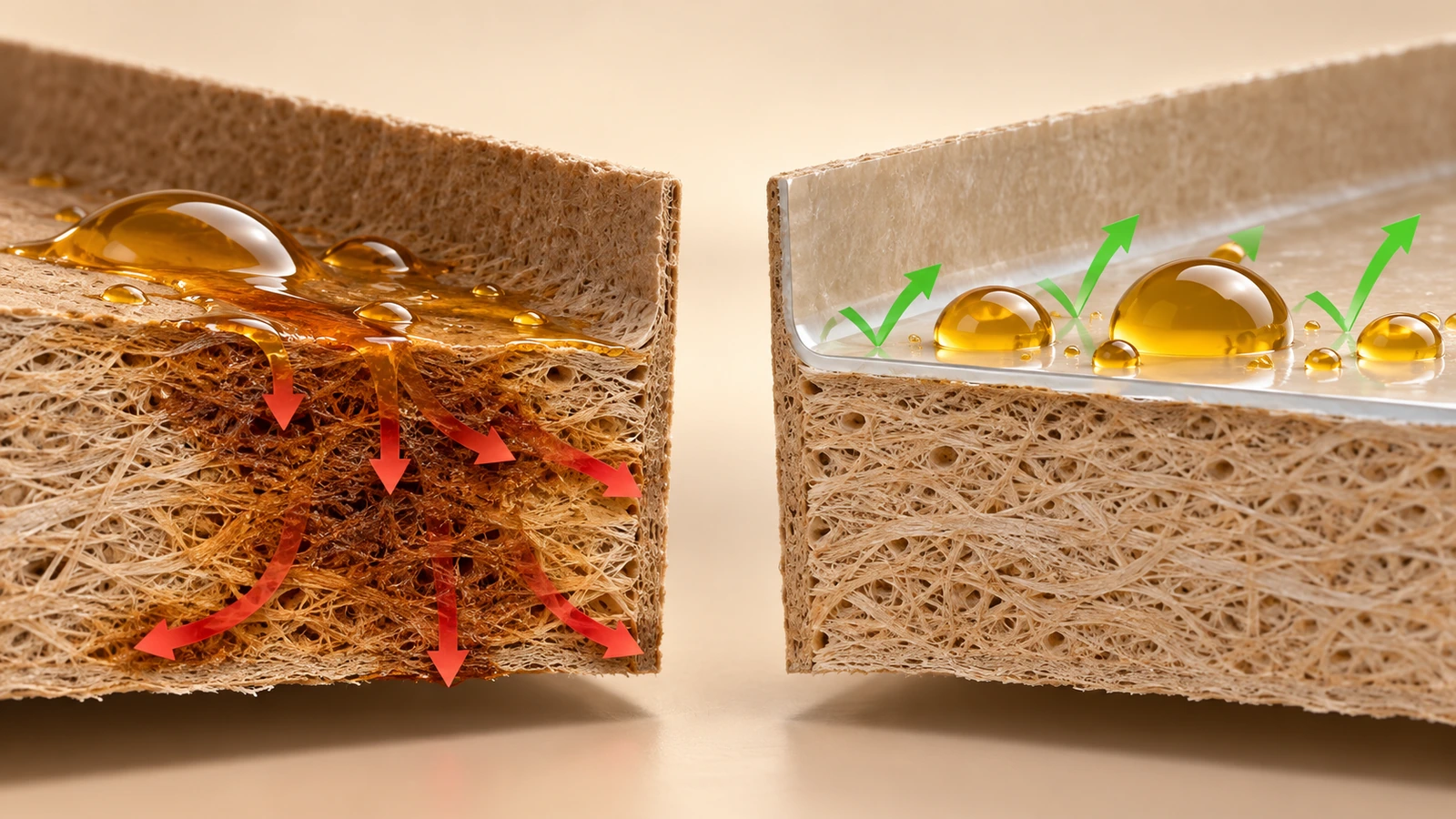
Making the paperboard thicker does not make it grease-proof. Paper weight measures stiffness and strength, not oil resistance. Fried and buttery foods need a barrier: a water-based dispersion coating, a polyethylene (PE) lining, a biopolymer lining such as PLA, or a separate greaseproof liner.
Many buyers miss how much this market has changed. In February 2024, the FDA announced that PFAS-containing grease-proofing materials were no longer being sold for U.S. food packaging[2]. That included fast-food wrappers and take-out paperboard containers. The FDA then determined that 35 related food contact notifications were no longer effective as of January 6, 2025[3], with a June 30, 2025 compliance date for certain existing paper packaging stock. Grease resistance now comes from non-fluorinated chemistry or film barriers. Those perform differently, so they need to be tested.
The common lab benchmark is the kit test, TAPPI T 559[4]. It rates resistance from 1 to 12. TAPPI notes that the method was designed mainly for fluorochemical surface treatments, and that its use on film-like or non-fluorochemical barriers "would have to be evaluated." A high kit number on a PE-lined board can still hide leaks at folds and glued corners. Ask for the kit rating, then run a kitchen trial:
- Pack your oiliest and saucier items at service temperature in the candidate container.
- Hold them for 15, 30 and 60 minutes, which covers counter pickup through a long delivery.
- Tilt each container about 45 degrees for ten seconds at each checkpoint to stress the lid seam.
- Note where oil or liquid appears: wall, base, corner fold or lid seam. Each location points to a different fix.
Step 4: Lock food-contact paperwork before anything is printed
"Food grade" is a marketing phrase, not a specification. In the U.S., paper and paperboard in contact with aqueous and fatty foods falls under 21 CFR 176.170[5]. Dry foods fall under 21 CFR 176.180. Section 176.170 also limits net chloroform-soluble extractives from the finished food-contact surface to 0.5 mg per square inch under conditions that represent the intended food and use. A bakery box for dry cookies and a bowl for hot curry are therefore covered by different rules.
Ask for a written guarantee that covers the finished article: base board, coating, adhesive and any ink on a surface that may touch food. Assurance that only covers the raw board is not enough. Confirm whether the fiber is virgin or recycled. Recycled fiber needs documented contaminant control before it is used in direct contact with wet or fatty food. If a coating or ink changes after approval, the documentation has to be updated too.
State law adds another layer. California's AB 1200[6] has banned plant-fiber food packaging containing regulated PFAS since January 1, 2023. That includes PFAS intentionally added and total organic fluorine at or above 100 ppm, and the California Attorney General's October 2023 enforcement advisory states that it applies to restaurants selling take-out food. Illinois banned intentionally added PFAS in food packaging from January 1, 2026. Maine's rules on plant-fiber packaging, including bags, containers and pizza boxes, took effect May 25, 2026, according to Packaging Dive's 2026 state-law roundup[7]. Put "no intentionally added PFAS" in the specification, and request total organic fluorine results when you sell into California.
Step 5: Print only the environmental claims you can prove
Words such as "compostable" on a custom container are regulated claims. Under the FTC Green Guides, 16 CFR 260.7[8], a marketer needs competent and reliable evidence that all materials in the item break down into usable compost in a safe and timely manner. If composting facilities are not available to a substantial majority of customers where the product is sold, the claim must be qualified.
Coated paperboard is evaluated as a whole item. The Compost Manufacturing Alliance[9] explains that multilayer and coated paper is assessed under ASTM D6868, and the coating must pass biodegradation testing whatever its share of the product. A PE-lined bowl cannot be called compostable because of its paper base. Recyclability claims fall under 16 CFR 260.12. Food residue and linings often decide the outcome, so qualify those claims as well.
California brings another requirement. Under SB 54, which CalRecycle administers as an extended producer responsibility program[10], plastic coatings and plastic components can bring a fiber container into plastic reduction accounting. Choosing a barrier is therefore also a reporting decision.
Step 6: Match container footprints and stack heights to the takeout bag
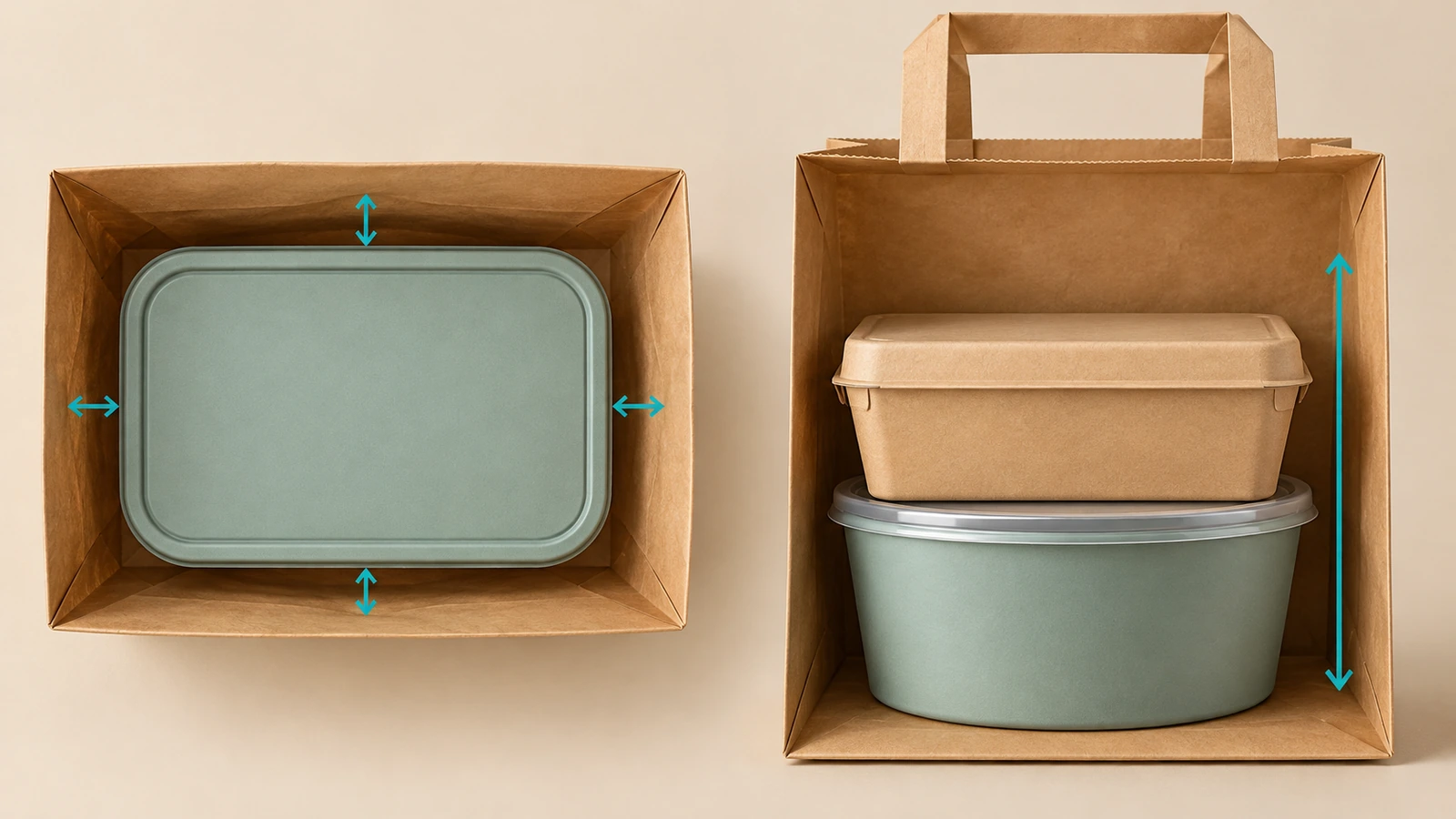
Once the containers are chosen, size the bag to them, not the other way around. Restaurant takeout bags fail most often when containers sit at an angle, when stacks lean, or when the heaviest liquid item ends up on top. Use this sequence:
- Measure the footprint. Record the base length and width of your largest container, measured at the lid rim where it is wider than the base.
- Standardize to a footprint family. Choose one or two base footprints that most of the menu can share. Containers with the same footprint stack flat. Mixed footprints create gaps that let the stack shift.
- Count real orders. Pull a week of tickets and note how many containers a single, double and family order usually contains. That usually gives two or three bag sizes, not one per menu item.
- Calculate stack height. Add the container heights for each order tier, then add clearance for side cups and for the bag top to close or the handles to meet without pressing on the top lid.
- Check the base against the footprint. The bag's flat base, width by gusset, should hold the container footprint level with room for fingers. A gusset narrower than the container makes it ride on its edge, which is where lids open.
- Set a packing order. Heaviest and liquid items go on the bottom, dry and light items go on top, and hot and cold items go in separate bags.
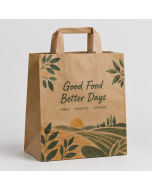
Bag size approval, print readability and handle details are covered on the product page for custom kraft takeout bags with flat handles. Bring your footprint and stack-height numbers so the quote is based on your real orders.
Container materials compared by menu type
This table compares common material families by performance and by the claims you can make about them. Results depend on the exact coating, lid design and supplier documentation, so use it to build a shortlist before testing.
| Material | Hot and steamy | Greasy | Saucy or liquid | Cold | Claim caution |
|---|---|---|---|---|---|
| Uncoated kraft paperboard carton | Fair for short trips; softens with steam | Poor; oil wicks into fiber | Poor; folded corners leak | Fair if kept dry | Recyclable claim only if qualified for local acceptance and food residue |
| Paperboard with water-based barrier coating | Good with vented lid | Good; verify with a kitchen trial, as the kit test may not reflect it | Fair; depends on lid seal | Good | Compostable only with evidence covering the coating |
| PE-lined paperboard | Good | Strong | Good with sealed lid | Good | Do not claim compostable; may count as plastic under California SB 54 |
| PLA-lined paperboard | Fair; check heat limits with the supplier | Good | Good with sealed lid | Strong | Industrial compostability claim needs ASTM D6868 evidence and facility qualification |
| Molded fiber (for example, bagasse) | Good; absorbs some steam | Depends on non-fluorinated treatment; confirm PFAS status | Fair; lids are the weak point | Fair | Confirm no intentionally added PFAS and total organic fluorine where state law requires it |
| Polypropylene container | Strong; ask about microwave suitability | Strong | Strong with tight lid | Strong | Recyclability varies by location; local plastic rules may apply |
Most operations use more than one row. A typical program might use molded fiber or coated board for hot dry items, a sealed PP or PE-lined bowl for soups, and a separate vented carton for fried food. All of them share one or two footprints so they fit the same takeout bags.
Customers do notice this kind of planning. The National Restaurant Association[11] links better takeout packaging to customers ordering across more menu categories. It also notes that kraft boxes and bowls used for soups or sauced foods need a moisture barrier, or they will leak.
FAQ
FAQ: Are kraft paper containers automatically food safe?
No. Brown kraft describes the fiber, not compliance. The finished container, including board, coating, adhesive and any ink that may touch food, needs a documented basis under 21 CFR 176.170 for wet or fatty food or 176.180 for dry food. Ask for a supplier guarantee that covers the full article and the intended food.
FAQ: Do grease-resistant containers still use PFAS?
PFAS grease-proofing agents for paper food packaging are no longer sold into the U.S. market, and 35 related FDA notifications stopped being effective on January 6, 2025. That does not cover every possible source of fluorine. Put "no intentionally added PFAS" in writing, and request total organic fluorine testing where state law sets a limit, such as California's 100 ppm threshold.
FAQ: Is a higher kit rating always better?
Not necessarily. The TAPPI T 559 kit test (1 to 12) was designed mainly for fluorochemical surface treatments. Film and non-fluorinated barriers can score well and still leak at folds or glued seams. Use the rating to compare candidates, then decide based on a timed trial with your oiliest real menu item.
FAQ: Can I print "compostable" on PE-lined containers?
No. The FTC requires evidence that all materials in the item will compost. Coated paper is evaluated as a whole under ASTM D6868, and a conventional PE lining does not meet that requirement. Use a qualified recyclability statement only if it is accurate for your market, or leave the claim off.
FAQ: Should the takeout bag stop leaks if a container fails?
No. A paper carry bag carries weight and the brand. It is not a liquid barrier. Steam and condensation weaken paper over time, so prevent leaks at the container: sealed lids for sauces, vents for fried food, and separate bags for hot and cold items.
FAQ: How many bag sizes does a typical menu need?
Usually two or three. If the containers share one or two footprints, a week of order tickets will show the common container counts for single, double and family orders. Size each bag to the stack height of its tier rather than creating one bag per menu item.
Key takeaways
- Grease-proofing in 2026 means non-fluorinated or film barriers, so test them. — PFAS grease-proofing sales ended February 28, 2024, and 35 notifications lapsed January 6, 2025 (Source)
- Food-contact compliance covers the finished container, not just the board. — 21 CFR 176.170 sets a 0.5 mg/in² extractives limit for wet and fatty food contact (Source)
- Kit ratings help compare materials but cannot replace a kitchen trial. — The TAPPI scale runs from 1 to 12 and was built mainly for fluorochemical treatments (Source)
- State PFAS laws already apply to restaurant packaging. — California restricts 100 ppm or more total organic fluorine in plant-fiber food packaging (Source); Illinois and Maine rules took effect in 2026 (Source)
- A federal PFAS packaging ban is proposed, not yet law. — The reintroduced Senate bill would take effect January 1, 2028 if passed (Source)
- Coated paper can only be called compostable when the coating is proven compostable too. — Substrate acceptance requires at least 95% fiber and less than 1% of any single additive, and acceptance is not certification (Source)
Build the container and bag set together
Good custom take out containers follow a clear order: classify the menu by failure mode, choose a barrier you can verify, file the food-contact and PFAS documents, print only the claims you can prove, and standardize footprints so every order stacks flat. After that, choosing the bag is mostly arithmetic.
Keep an eye on federal PFAS legislation. A reintroduced Senate bill[12] would ban intentionally added PFAS in food packaging nationwide if it passes, so specifications written now should already meet that requirement. When your container footprints and order tiers are ready, send them with a quote request for branded kraft takeout bags sized to your container set. Pricing, quantities and timing will be quoted for your specification.
Sources
- New York Post, "Five Guys customers fume as chain ditches fry cups for paper bags," March 21, 2026. ↩
- U.S. FDA, "FDA, Industry Actions End Sales of PFAS Used in US Food Packaging," February 28, 2024. ↩
- U.S. FDA, "FDA Determines Authorization for 35 Food Contact Notifications Related to PFAS Are No Longer Effective," January 3, 2025. ↩
- TAPPI, T 559 "Grease resistance test for paper and paperboard." ↩
- eCFR, 21 CFR 176.170, Components of paper and paperboard in contact with aqueous and fatty foods. ↩
- California Legislative Information, AB 1200 (2021–2022), bill text. ↩
- Packaging Dive, state packaging laws taking effect in 2026, January 5, 2026. ↩
- eCFR, 16 CFR 260.7, FTC Green Guides: Compostable claims. ↩
- Compost Manufacturing Alliance, position on ASTM D6868 and D8410. ↩
- CalRecycle, Packaging Extended Producer Responsibility (SB 54) program. ↩
- National Restaurant Association, "Increased sales come in the right packages," May 21, 2025. ↩
- Packaging Dive, federal PFAS food packaging bill reintroduced, September 30, 2026. ↩












The information below is required for social login
Sign In
Create New Account