Custom white kraft paper bags combine a white branding surface with twisted handles for shopping and gift presentation. Specify the packed product, dimensions, artwork and carrying conditions before ordering. Paper weight, reinforcement, load capacity, finishes, minimum order quantity and delivery timing require quotation, sample approval or testing for the selected configuration.
For retail buyers, brand owners and event planners: this shopping-bag format is worth evaluating for boutique purchases, boxed cosmetics, wrapped accessories, gift sets and prepacked bakery goods. It keeps the focus on your branding without changing the product into a ribbon-handle luxury bag, a handleless food bag or a shipping mailer.
The problem: a bag can look right in a photograph yet disappoint at checkout. Poor opening, detached handles, uneven printing or crushed surfaces can leave otherwise saleable packaging unusable. For white bags, visible marks also undermine the clean presentation that motivated the purchase.
The purchasing consequence: a lower quoted unit price does not necessarily mean a lower usable-bag cost. Rejected bags, replacement packaging and delayed launches belong in the comparison. The practical solution is to approve the bag as a complete system: paper, dimensions, handle attachment, printing, contents and transit protection.
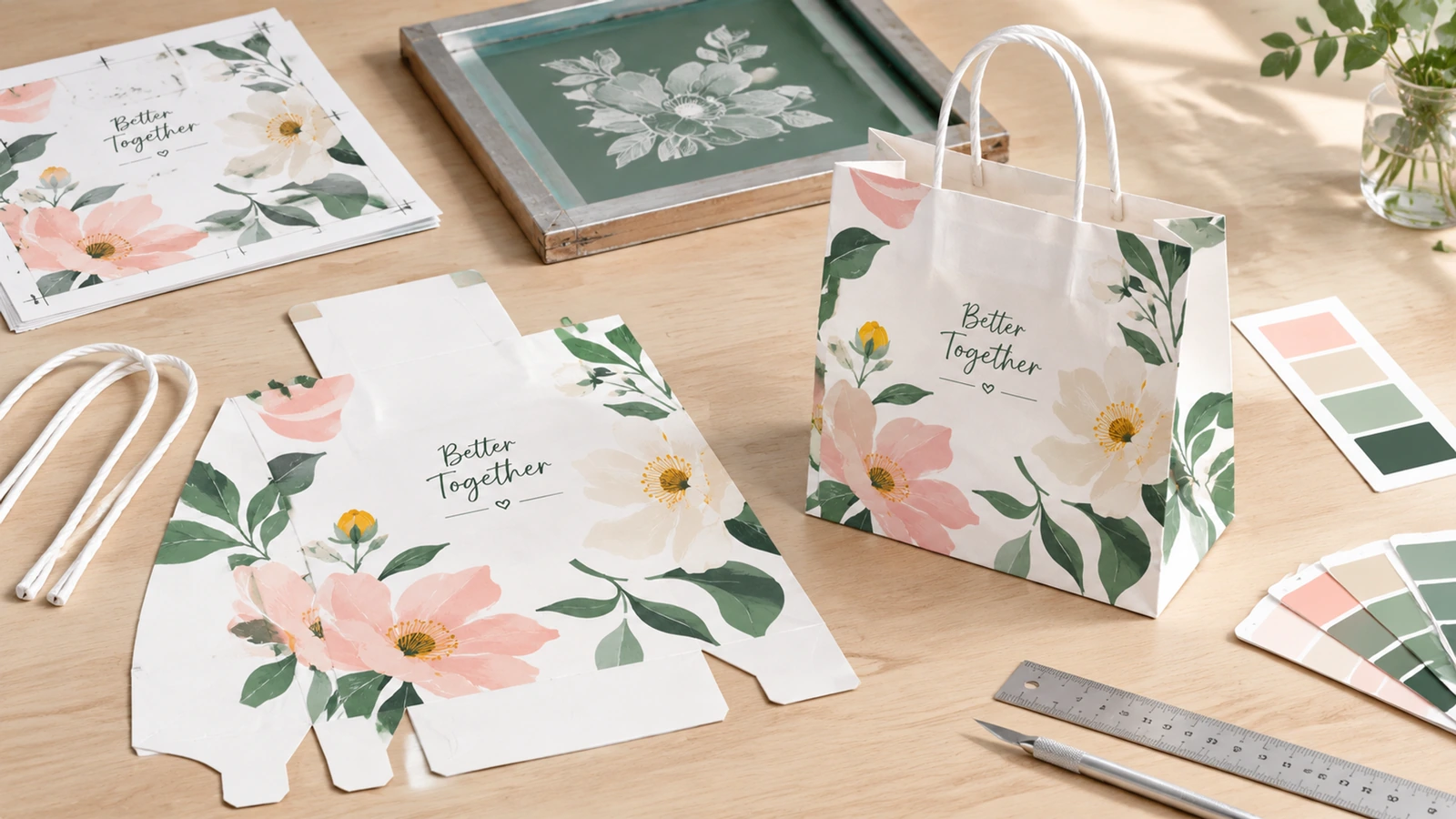
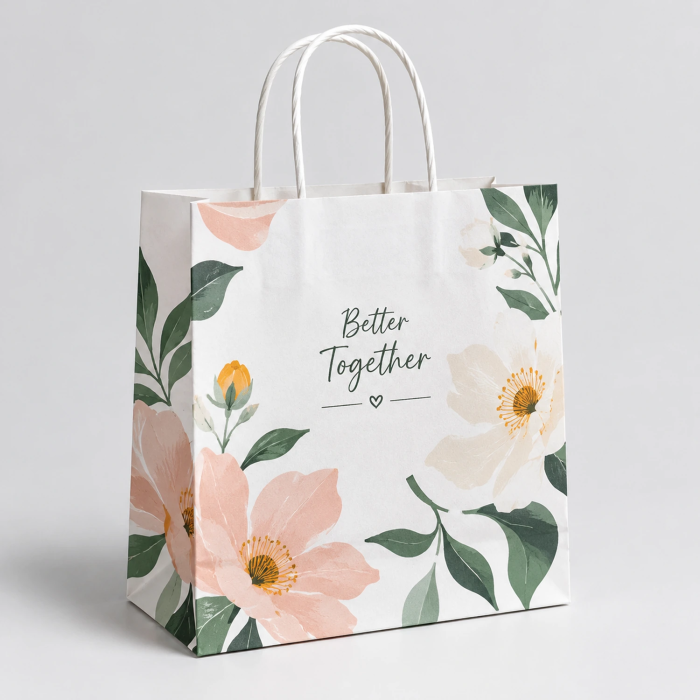
Illustrative application concept. Product fit, item count and carrying suitability depend on actual dimensions, loading arrangement and sample validation.
Find the right specification for your order
What defines this white kraft shopping bag? ↑
The product is Custom White Kraft Paper Shopping Bags with Twisted Handles, within Custom Paper Bags and Custom White Kraft Paper Bags. Its provisional reference is NSKU-722-01. These identifiers establish the product family; they do not establish a stocked size, tested carrying load or approved material specification.
The white surface provides a neutral background for branding. Whether your design uses a restrained logo or a larger graphic, approve its appearance on the selected paper rather than treating a screen preview as a physical color standard. Paper shade, texture and the chosen printing process belong in that approval.
Separate appearance from performance. A clean white appearance does not prove food-contact suitability, and a substantial feel does not establish handle strength. Likewise, the word “kraft” does not establish recycled content, certification or resistance to rain. Each requirement needs its own specification or supporting document.
No product-specific factory test results or confirmed commercial terms are available for this reference. The following fields therefore distinguish the established identity from items requiring a quotation or validation.
| Field | Current product information | Required purchasing confirmation |
|---|
| Product format | White kraft paper shopping bag with twisted handles | Final construction drawing and approved sample |
| Dimensions | Not specified | Width × gusset × height in mm; identify internal or external measurements |
| Paper weight | Not specified | Selected grade and basis weight in g/m² |
| Carrying capacity | No verified rating | Test with actual contents and agreed handling conditions |
| Printing and finish | Configuration to be agreed | Artwork, printed faces, colors and surface treatment |
| MOQ and price | Pending quotation | Quantity per size/design, unit price and setup charges |
| Sampling and production time | Pending quotation | Separate approval, production and transportation stages |
| Finished unit weight | Not provided | Measure the approved configuration in g/bag if needed |
This is a specification checklist, not a stock catalog. Figures from other suppliers cannot establish the dimensions, strength or commercial terms of this product.
How do you specify fit, handles and surface finish? ↑
Start with the packed item, not its sales description
Measure the product in the condition in which customers receive it, including its box, protective wrapping and presentation materials. Record the intended orientation and loading arrangement. A garment, a rigid cosmetics carton and a bakery box present different fit questions even when all are described as “small.”
State bag dimensions consistently as width × gusset × height. Identify whether height excludes the handles and whether measurements describe the outside or usable inside space. Then check the physical sample: contents should enter without forced stretching, and the handles should remain accessible after loading.

Specify the attachment, not just the handle name
Twisted handles are part of this product’s identity, but their attachment details remain to be agreed. Review the inside attachment area, reinforcement where proposed, handle position and clearance. Changing to flat handles, cotton rope or ribbon would create a different configuration rather than an assumed option on this reference.
Paper weight should be recorded in g/m², but it is not a load rating. Paper properties, seams, bag geometry, attachment quality and the distribution of contents all affect the finished bag. Any carrying capacity or item count must be determined by actual dimensions, loading conditions and sample testing.
Choose a surface treatment for a defined reason
Discuss an untreated paper finish, a protective coating or decorative processing only against a specific objective: appearance, print protection or exposure conditions. Availability is subject to quotation. A requested coating must not be treated as proof of waterproofing, food-contact suitability or recyclability.

The relevant fastening detail is the interior handle attachment, not a back clasp. Surface swatches and reinforcement details illustrate matters to evaluate, not confirmed supplied options.
How do you protect artwork readability and color? ↑
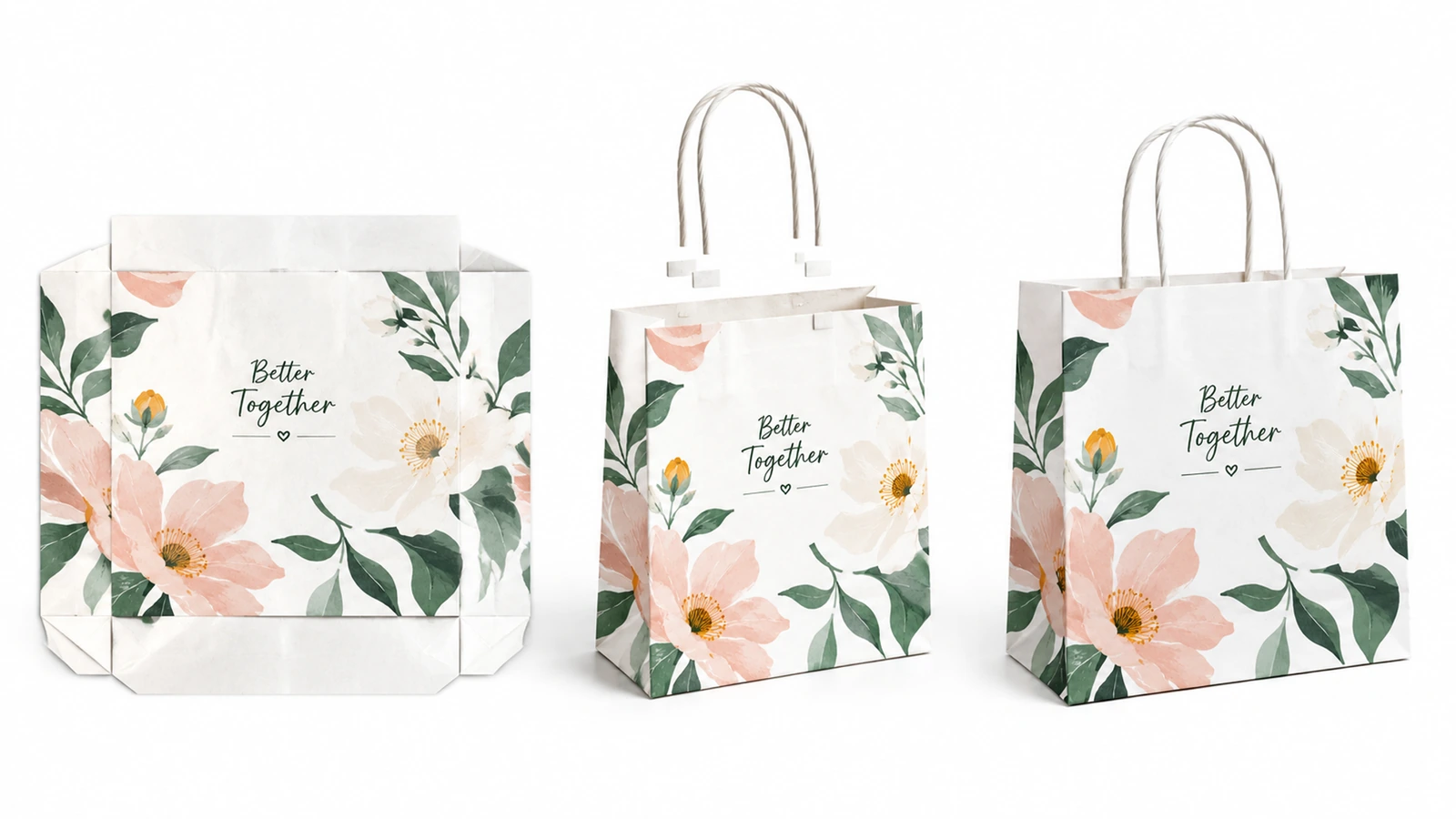
A print-ready brief should identify the front, back and any gusset printing separately. Include the logo file, required wording, color references and intended placement. Do not assume that an image covering the entire digital mockup can be reproduced across folds, seams and attachment zones without adjustment.
- Confirm the drawing. Match the artwork to the agreed bag dimensions and printing area before approval.
- Check important content at actual size. Review the smallest text, fine lines and website address, rather than judging only an enlarged preview.
- Separate color instructions. Specify whether the design calls for process color or a named spot-color reference; ask which production route is proposed.
- Agree the color reference. Use a physical proof on the intended substrate when appearance is critical. A digital proof primarily establishes layout.
- Record the approved revision. Retain the artwork version, paper reference, printed faces and any agreed registration or color tolerances.
If the design includes a barcode or QR code, check the printed sample rather than relying on the source file alone. Keep essential information away from folds and other areas that could disrupt readability. Any tolerance must be agreed for this job; another supplier’s published color-control figure is not a promise for this bag.
How should sampling and acceptance work? ↑
Use sampling to answer specific questions, not simply to confirm that a bag exists. A structural sample can establish fit and opening behavior. A printed sample can establish visual expectations. Neither should be assumed to validate every performance requirement unless the relevant material, construction and testing are included.
Agree the production sequence before approving the order
A general paper-bag workflow moves from paper selection and artwork preparation to printing, forming, seam and bottom bonding, handle attachment, inspection and packing. For this order, ask which operations and materials the proposed quotation covers. This sequence describes a planning framework, not a verified factory process or equipment claim.
Make the acceptance criteria observable
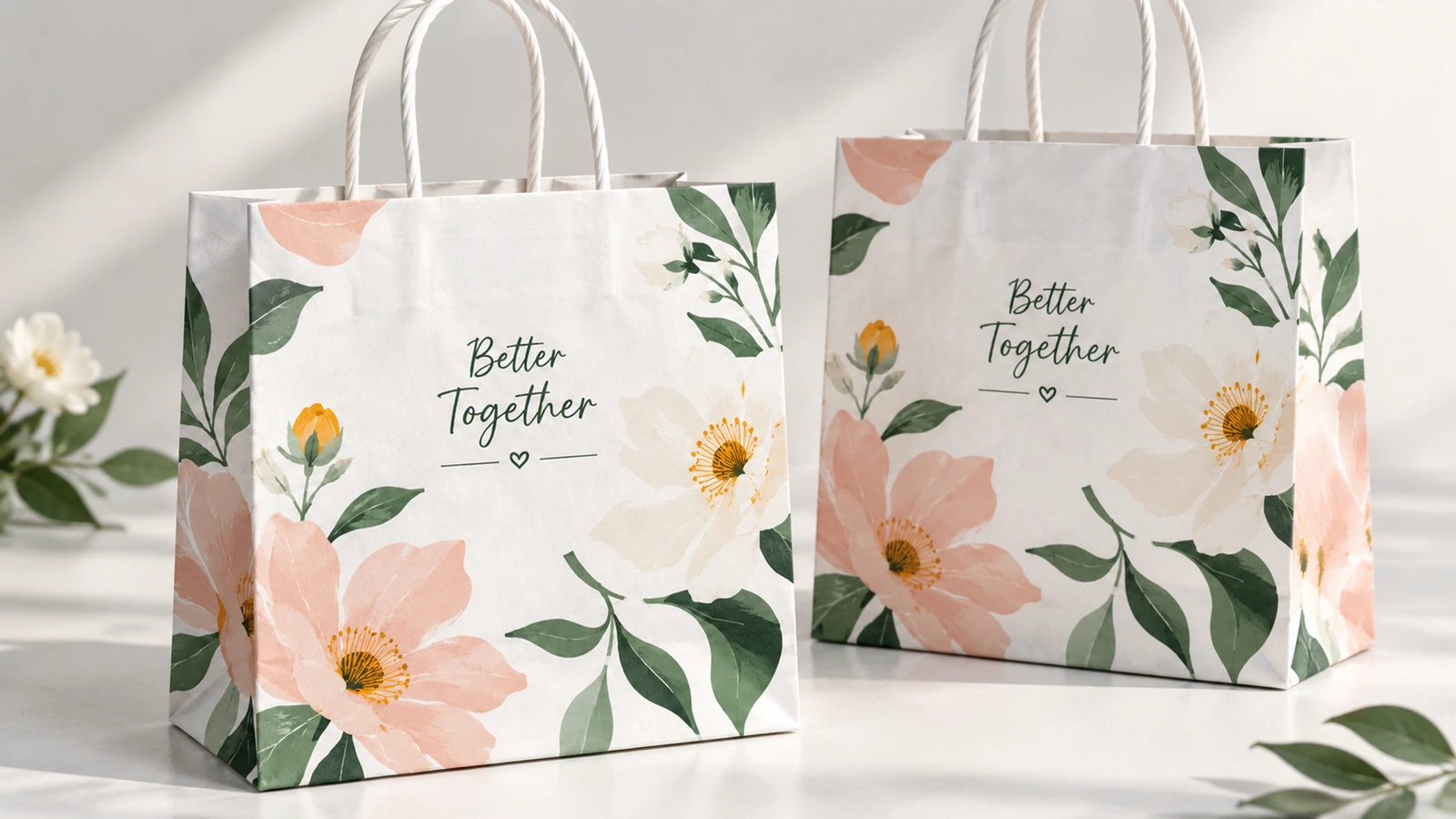
Define defects before production: missing or detached handles, bonded inner walls that prevent opening, open seams, incorrect artwork, unacceptable stains and transit deformation. Agree how these defects will be classified, sampled and resolved. A sampling plan is not a substitute for a functional carrying test.
| Inspection area | Suggested verification | Record to retain |
|---|
| Size and opening | Measure the sample and open it fully without tearing | Drawing, measured dimensions and agreed tolerances |
| Paper | Check the specified grade and basis weight | Material reference and relevant measurements |
| Handles and seams | Inspect attachment areas and test with intended contents | Loading arrangement, handling method and observations |
| Print and appearance | Compare against the approved physical reference | Artwork revision, color reference and defect photographs |
| Exposure | Evaluate expected moisture, condensation or oil exposure where relevant | Exposure conditions and acceptance criteria |
| Carton packing | Inspect bags after packing and representative transport handling | Packing arrangement and deformation findings |
These are proposed purchasing checks, not completed tests. Set the sample quantity, loading duration, handling sequence and pass/fail criteria in writing; no tested load or defect rate is claimed here.
For carrying evaluation, reproduce how the filled bag will actually be lifted and moved. Record whether the contents load the bottom evenly or concentrate force in a corner. An empty-bag handle check can reveal an attachment defect, but cannot establish the performance of a fully packed order.

Which packaging route fits your priorities? ↑
Compare alternatives against the same packed product and presentation goal. Mixing a plain handleless bag, a printed shopping bag and a decorated luxury tote in one unit-price comparison hides differences in construction and finishing.
| Route | Reason to evaluate it | Main purchasing caveat |
|---|
| Printed white kraft with twisted handles | White-background branding and shopping presentation | Validate color, attachments, fit and carrying conditions |
| Plain white bags with a label or stamp | Flexible branding for changing designs or limited demand | Include application labor and consistency in the cost comparison |
| Natural brown kraft shopping bags | A brown-paper visual direction and simpler graphic treatment | Check artwork contrast; do not assume a strength advantage without samples |
| Coated art-paper gift bags | A different surface and decorative presentation | Compare finishing, construction and disposal requirements separately |
| Handleless food bags | A different service format where handles are unnecessary | Food-contact and barrier suitability still require documentation |
These are alternative buying routes, not confirmed inventory. None carries a transferable price, minimum order quantity or load rating for NSKU-722-01.
Compare the complete quotation
Ask for paper specification, bag size, artwork count, printing, finishing, reinforcement, sampling, setup, packing and freight to be identified. Where alternatives are proposed, keep the remaining fields unchanged so you can see what actually causes the price difference.
For small or changing orders, compare the total cost of printed bags with plain bags plus branding labor. For repeat orders, compare usable packaging cost rather than assuming the lowest initial quote wins. Do not assign a sales uplift to printed packaging: a more deliberate presentation is not evidence of measurable repeat purchases.
Separate sample preparation, approval, production and transit in the schedule. A requested arrival date is not a confirmed production commitment. MOQ, pricing and all timing remain pending a configuration-specific quotation; there is no basis here for a factory-direct, low-MOQ or rapid-delivery claim.
Which food-contact and environmental claims need evidence? ↑
Distinguish carrying packaged food from direct food contact
A shopping bag carrying a sealed bakery box has a different intended use from paper touching an oily pastry. Describe the food, its primary packaging, expected temperature and contact duration. Do not describe this product as food-safe merely because it is white kraft paper.
For applicable aqueous and fatty food-contact uses, assess the paper and paperboard components against the conditions in 21 CFR 176.170[1]. Request documentation matched to the intended use, including relevant coatings and other contact-surface components; a generic material description is insufficient.
Dry food of the specified category has a separate component framework under 21 CFR 176.180[2]. Neither reference certifies this particular bag. Food-contact suitability remains unconfirmed until the selected construction and use conditions are documented.
Treat barrier performance as a separate requirement
Do not assume an untreated paper bag is waterproof or greaseproof. Where condensation, leaking containers or oily contents are foreseeable, request an appropriate barrier or separate primary packaging and validate the complete arrangement. Added thickness alone is not evidence that the problem has been solved.
FDA reports that relevant PFAS grease-proofing substances for paper food packaging stopped being sold by manufacturers into the U.S. market in February 2024, and that 35 related food contact notifications became ineffective following its January 2025 determination. See FDA’s PFAS food-contact update[3]. For a proposed barrier, request current supporting documentation rather than relying on an old authorization or an unsupported “PFAS-free” label.
Keep sourcing, recycled content and disposal claims distinct
For an FSC-labeled order, request the applicable certificate, product scope, claim documentation and label authorization for verification. No FSC status is claimed for this reference. A sourcing certificate should not be used as a substitute for food-contact evidence or a finished-bag recycling assessment.
Ask separately about recycled content and the complete material construction, including coatings and attachments. Water-based ink does not by itself establish that the bag is accepted locally. Compostability also needs evidence for the actual structure and intended disposal setting; it must not be inferred from paper appearance.
How do you protect delivery quality and repeat orders? ↑
Approve the packing arrangement alongside the bag. Inspect how handles sit within the stack, whether printed faces rub together, and whether outer packaging protects against crushing and contamination. The aim is to preserve the approved appearance through delivery, not merely to fit the largest number of bags into a carton.
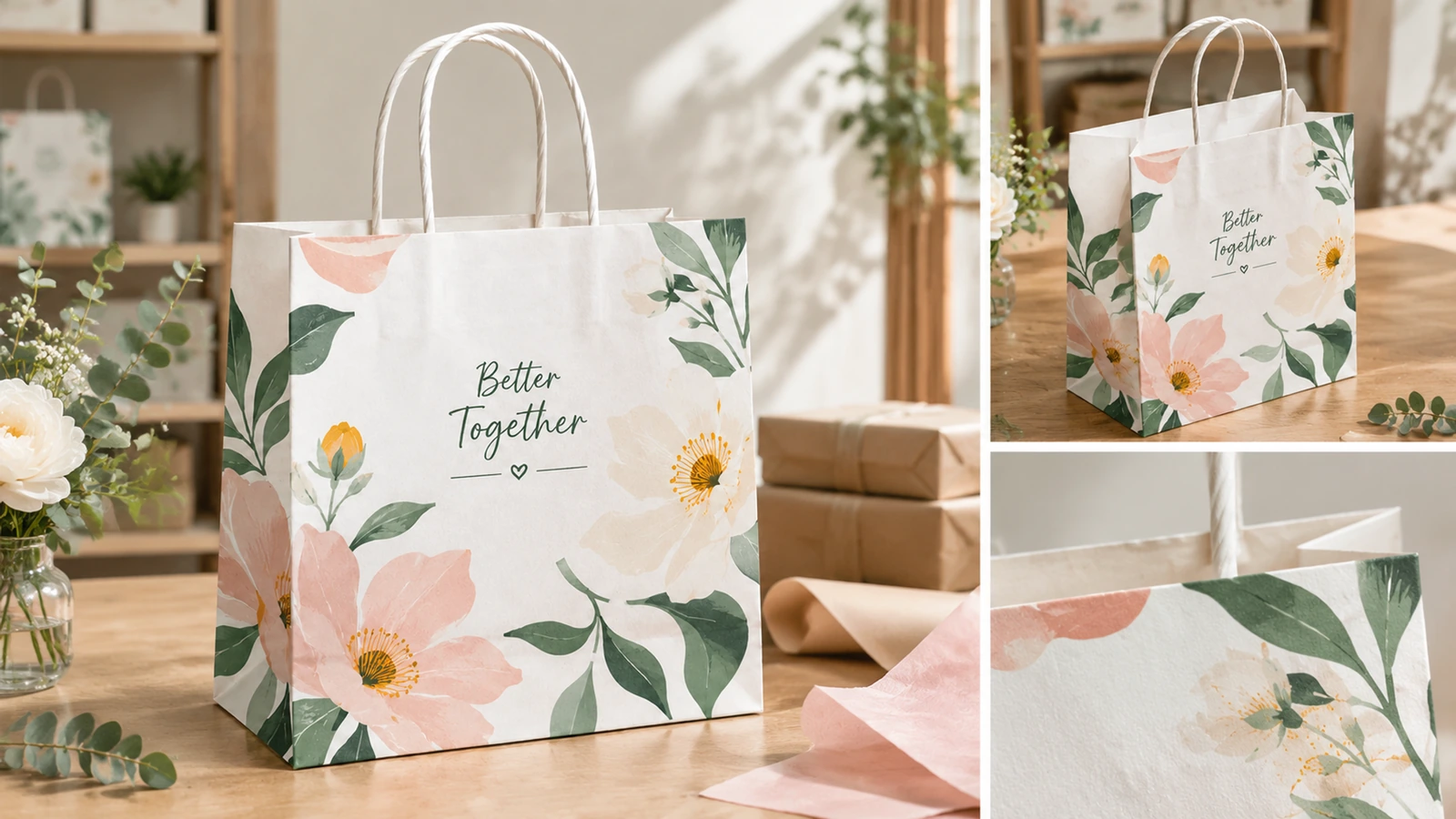
On receipt, check bags from different parts of the shipment for opening, surface marks, handle attachment and deformation. Photograph defects with their carton or batch reference. Agree the reporting window and remedy before dispatch rather than assuming a replacement or refund policy exists.
Store unused bags in clean, dry conditions that avoid unnecessary compression. Obtain storage guidance for the approved material and finish; a shelf-life statement from another supplier does not establish this product’s usable storage period.
For reorders, retain the signed sample, drawing, artwork revision, material reference and inspection findings. Require proposed changes to paper, adhesive, printing or packing to be identified before approval. Repeating a product name alone does not ensure the next batch matches the previous one.
What matters most before purchase? ↑
- Buy against a complete specification. Connect dimensions, paper, handle attachment, artwork and packing to one approved configuration.
- Validate fit and carrying performance together. Capacity and item count depend on actual dimensions, loading arrangement and sample testing—not a generic GSM description.
- Keep commercial terms explicit. MOQ, unit price, sampling time and production time require a quotation; no verified values are available for this reference.
- Approve the relevant physical evidence. Layout approval, color approval and functional testing answer different questions.
Unqualified U.S. recyclable claims require substantial access to appropriate recycling facilities, alongside product recyclability. — At least 60% of consumers or communities where the item is sold (Source[4]).
Turn your packaging brief into a comparable quote ↑
The right white kraft shopping bag should match both the presentation you want and the way customers carry their purchases. A clear brief makes price comparisons more useful and exposes requirements that need sampling before an order is approved.
Request a configuration-specific quote for NSKU-722-01 with your packed-product dimensions, intended contents and weight, quantity per design, artwork, exposure conditions, destination and required arrival date.




The information below is required for social login
Sign In
Create New Account