We use cookies to enable our websites to remember information, to help some website functionalities to work properly, to understand how you interact with and use our websites and to display you content and ads that are relevant and engaging for you.
By clicking Accept All you consent to the use of these cookie.
The store will not work correctly when cookies are disabled.
Quick answer: In the white kraft vs brown kraft paper bags decision, choose white (bleached) kraft when your artwork depends on light colors, full-color CMYK or exact brand hues and you want a clean, premium look. Choose brown (unbleached) kraft when you print one or two dark inks, need more tear and burst strength per gram, and want a lower unit cost and a natural look. Neither color is automatically food-safe, waterproof or "greener." Those properties depend on the coatings, construction and documents behind the bag.
Most brand and procurement teams treat the white kraft vs brown kraft paper bags question as a matter of taste. A designer picks white because it "looks premium," or a buyer picks brown because it "looks eco." The substrate then quietly overrides the brief. A forest-green logo prints olive on brown stock. White reversed text disappears into the paper. A white bag arrives with scuffs that would be invisible on brown. A bleached sheet at the same weight tears sooner under a heavy order.
These failures are expensive because they show up after the run is paid for, at the point where a customer carries your brand out the door. This guide compares bleached and unbleached kraft bag stock across six factors: color fidelity, ink behavior, brand perception, strength, environmental profile and unit cost. It also gives you a short decision process so you can choose the substrate based on your artwork and use case rather than on instinct.
What is the difference between white and brown kraft?
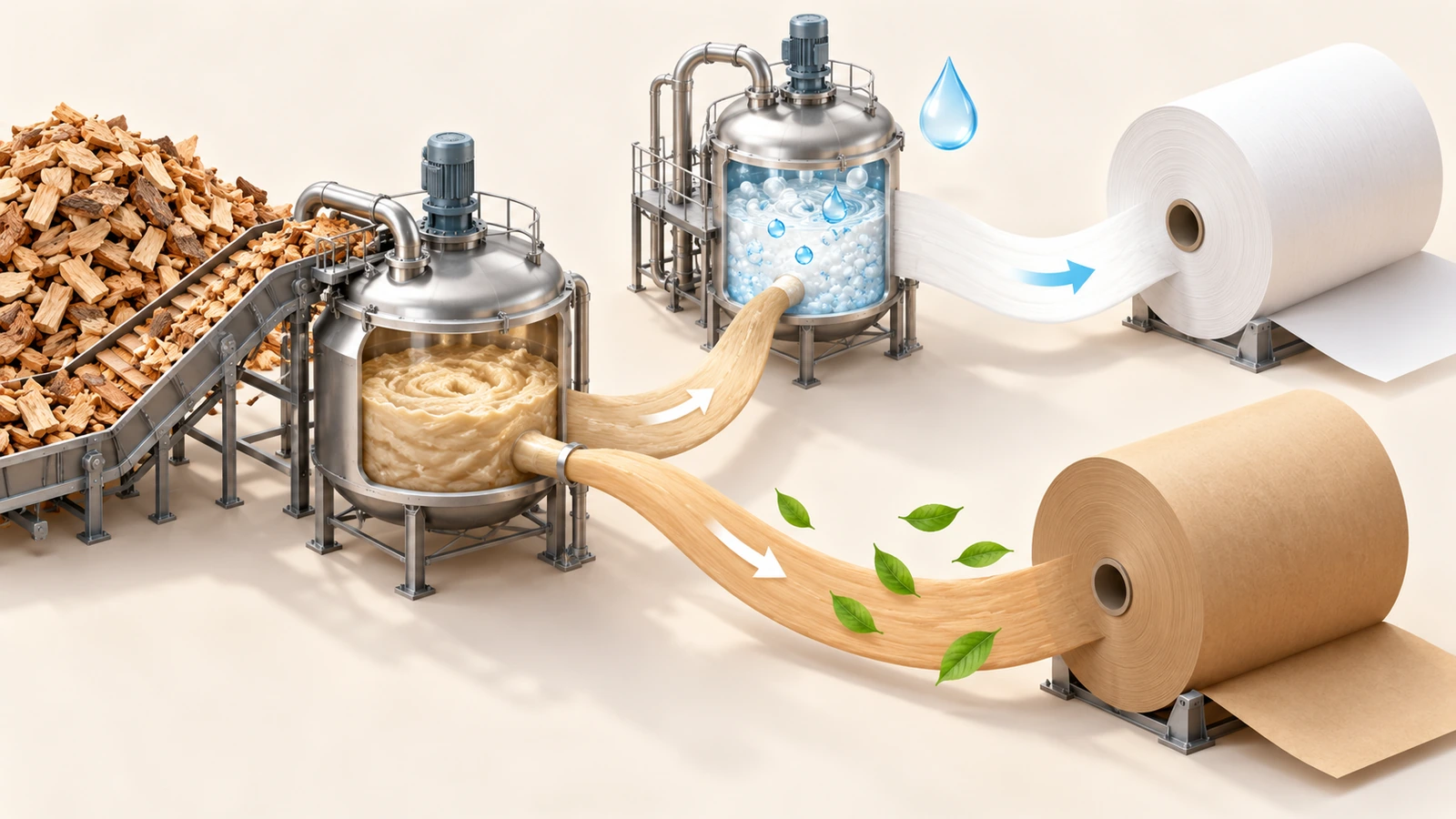
Both papers start the same way. Wood chips are cooked in the kraft (sulfate) pulping process, which keeps cellulose fibers long and produces a strong sheet. Brown kraft is that pulp left unbleached, so its tan color comes from residual lignin. White kraft goes through an additional bleaching stage that removes most of the remaining lignin and color. The result is a brighter, more uniform surface. It is still uncoated kraft paper, which separates it from clay-coated "art paper" used for glossy luxury totes.
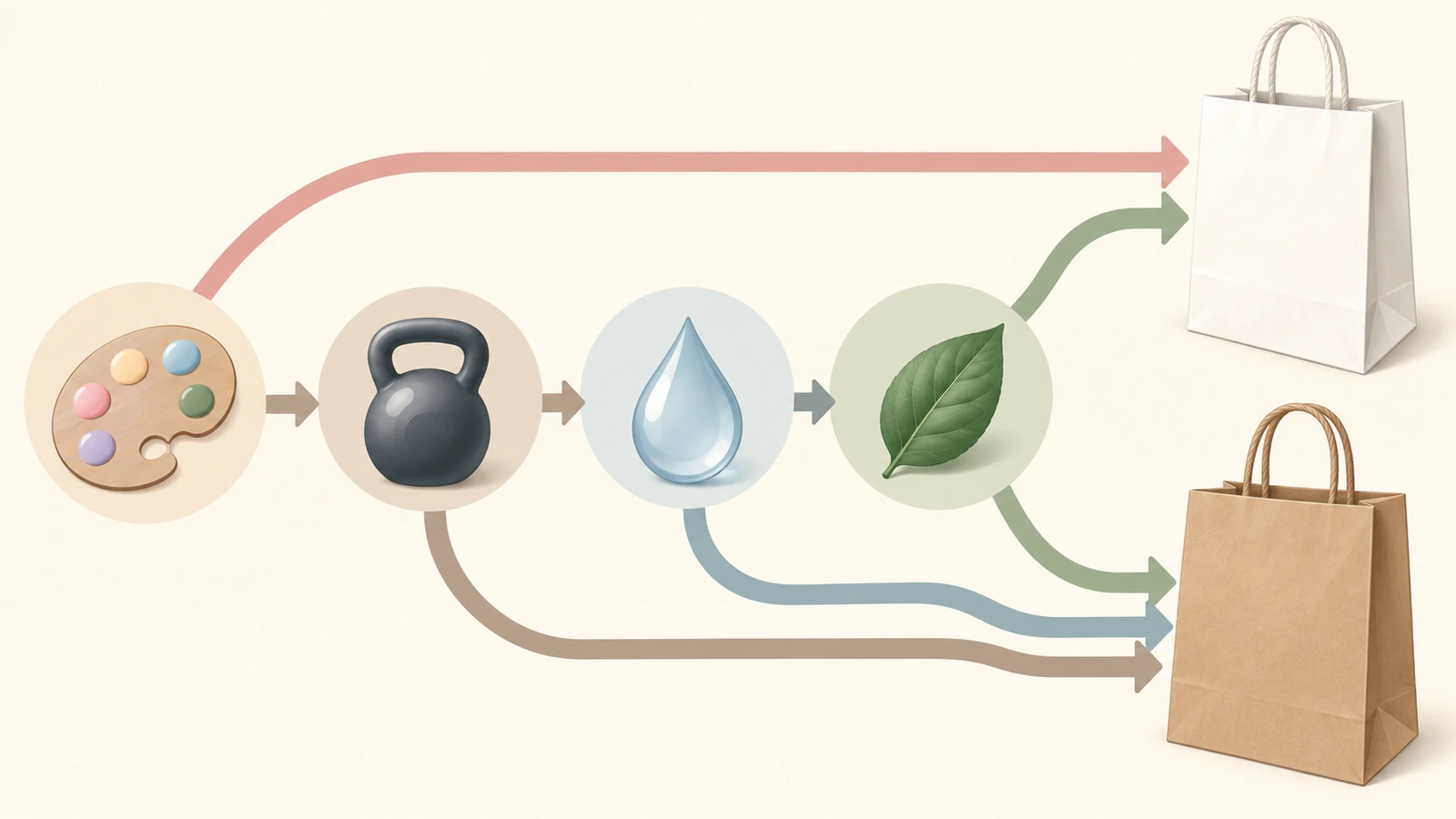
That single extra processing step explains nearly every trade-off in this article. It creates a better print surface, a slightly weaker fiber network, a more premium look, a higher production cost and a different environmental story. Brown still dominates by volume. Grand View Research puts brown kraft at more than 66.4% of the global kraft paper bag market in 2024 and identifies white kraft as the fastest-growing paper type, in a market valued at about USD 4.5 billion that year (Grand View Research kraft paper bag market report[1]). A separate US-focused study reaches the same split: brown is the largest material segment and white kraft is the fastest growing (Market Research Future US paper bags study[2]).
Printing on white vs brown kraft paper: color and ink behavior
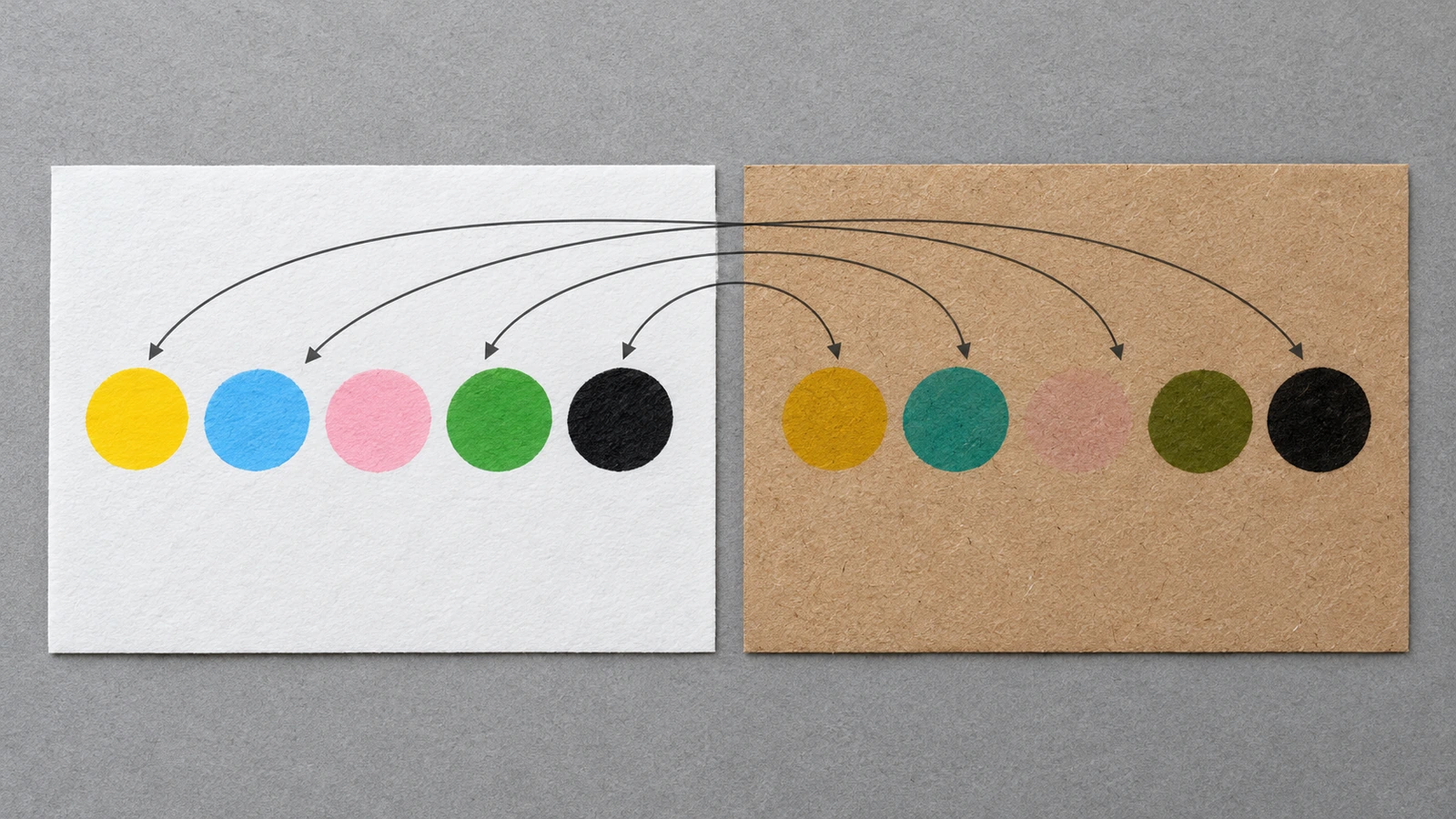
Print fidelity is the biggest practical difference, and the cause is physical. Flexographic and offset inks used on paper bags are largely transparent, so the paper color sits underneath every ink layer and changes it. On brown kraft, yellows turn mustard or muddy. Reds darken toward brick. Light blues and greens shift toward teal or olive. Pastels and white cannot appear at all unless the printer lays down an opaque white base first. That underlay adds a print pass and can still look slightly grey or mottled on a fibrous surface.
White kraft removes most of that tint, so light colors, multi-color artwork and CMYK images read much closer to the approved design. It does not turn kraft into coated stock, though. Both white and brown kraft are uncoated and absorbent. Ink spreads into the fibers, an effect called dot gain, which fills in fine halftones, hairline rules and small serif type. Practical consequences:
Match against uncoated references. Specify Pantone "U" (uncoated) targets, not "C," and approve color on the actual paper rather than on screen or on coated proofs.
Design brown kraft for contrast. One or two dark, saturated inks such as black, navy, deep green or burgundy look intentional on brown. Gradients and photographs usually do not.
Keep detail generous on both. Use coarser screens, heavier minimum line weights and larger minimum text sizes than you would on coated paper.
Agree on a color tolerance. A measurable ΔE limit against a signed drawdown turns "the green looks off" into a pass/fail check.
White kraft also varies in brightness between mills and paper batches, so a reorder can look cooler or warmer than the first run. If color consistency matters across seasons, ask for the paper source to stay fixed. The product page explains how artwork readability and color are protected on custom white kraft paper bags, so this guide does not repeat that workflow.
Strength: what bleaching does to the sheet
Bleaching strips lignin, and the chemical treatment can shorten and weaken some fibers. Industry procurement comparisons commonly estimate that unbleached kraft delivers roughly 20–30% higher burst strength than bleached kraft at the same basis weight. Treat that figure as a planning range, not a certified value, because pulp blend, mill and moisture content all move the result. Tear resistance follows the same direction.
In practice, color is rarely the root cause when bags fail. Buyer complaints about paper bags focus on handles pulling loose, bottoms opening along the glue line and seams splitting. Those are construction and gluing defects that show up on both colors. What bleaching changes is the margin. If you move from brown to white at the same paper weight, you lose some headroom, so the usual fix is to step up the basis weight or add handle patches and bottom board. Uncoated kraft of either color also loses much of its strength when wet. A white bag is not more fragile in rain than a brown one; neither is water-resistant without a coating.
To compare the two stocks objectively, request test results under recognized methods instead of adjectives like "heavy duty." Useful references are ISO 2758 for burst, ISO 1974 for tear, ISO 1924-2 for tensile strength and the Cobb test (ISO 535) for water absorption. Ask for both papers to be tested at the same basis weight, so the comparison isolates the bleaching effect.
Brand perception and real-world wear
Shoppers read the two colors differently before they see the logo. White kraft signals clean, modern and clinical, which is why it shows up in pharmacies, cosmetics, boutiques, bakeries and upscale food service. Brown kraft signals natural, artisanal and unprocessed, which fits organic grocery, coffee, farm goods and brands built around a handmade story. Neither reading is right or wrong. The mistake is choosing a color that contradicts the rest of your identity, such as a black-and-gold luxury brand on rustic brown, or a zero-waste brand on bright bleached white.
White has an operational cost that brown hides. Fingerprints, shoe marks from a factory floor, grease spots, carton rub and bent handles all stand out on a light surface. On brown kraft, the same defects often go unnoticed. If you choose white, plan for it: tighter cosmetic acceptance criteria, better inner packing, and a store routine that keeps stock off the floor. For takeaway food with visible grease, brown or a barrier-lined bag may protect the brand impression better than plain white.
Environmental profile: bleached vs unbleached kraft paper
Brown kraft has the simpler story. It skips the bleaching stage and the chemicals and energy that stage uses, and it is more widely available with recycled content. White kraft is mostly made from virgin fiber because recycled pulp rarely reaches a bright, even white. Neither is automatically the sustainable choice, though. The claims you can print depend on construction and evidence, not on color.
Recyclable. Under the US FTC Green Guides, an unqualified "recyclable" claim requires recycling access for a substantial majority of consumers, defined as at least 60% (16 CFR 260.12[3]). Plastic lamination, PP rope handles and metal eyelets weaken that claim for either color.
Recycled content. Partial recycled content has to be qualified, typically as a percentage by weight (16 CFR 260.13[4]). This area is easier to support with brown stock.
Responsible sourcing. Bleached and unbleached papers can both carry FSC claims. The supplier's chain-of-custody certificate must cover the product, and you can check it in the FSC certificate database[5].
Compostable. Plain paper does not earn a compostability label because it is "natural." When a polymer coating or film is added to paper and the bag is labeled compostable, ASTM D6868[6] sets the labeling requirements for industrial composting.
Food use works the same way. A bag's color says nothing about food contact. In the US, paper contacting aqueous and fatty foods falls under 21 CFR 176.170[7], which includes an extractives limit of 0.5 mg per square inch of food-contact surface. Dry foods fall under 21 CFR 176.180[8]. Grease resistance can no longer rely on PFAS treatments. The FDA reported in February 2024 that PFAS grease-proofers are no longer sold for US food packaging[9], and later determined that 35 related food contact notifications are no longer effective[10]. In the EU, PFAS limits for food-contact packaging have applied since 12 August 2026. A recent review found no single fluorine-free material that matches PFAS everywhere, although application-specific systems can perform competitively (New Food Magazine[11]). European paper sack makers have also updated their food-contact guideline[12], which ties compliance to sack composition, food type, temperature and storage time. The documents to request are listed on the white kraft bag product page.
How to choose in five steps
Audit your artwork first. List every ink in the logo and layout. If any element is white, pastel, yellow or photographic, or if your brand color is a light or mid-tone hue, start from white kraft. If the design works as one or two dark solids, brown is a real option.
Define load and handling. Write down the heaviest realistic fill, how far customers carry it, and whether bags meet rain, condensation or grease. Heavy, damp or oily use cases favor brown or a heavier white sheet with reinforcement.
Decide which claims you need. If "recycled content" is central to your messaging, brown is easier to source. If you need a premium look plus FSC, white works as long as the certificate covers the order.
Print-test both stocks. Put the same artwork on both papers and judge it in store lighting, next to your other packaging. Approve color on paper, not on a monitor. The product page covers sampling and acceptance in detail.
Quote like for like. Request prices for both papers at the same size, basis weight, ink count, handle type and quantity. Bleached stock usually costs more because of the extra processing step, and the difference only matters once the rest of the specification is identical.
White kraft vs brown kraft paper bags: side-by-side comparison
Factor
White (bleached) kraft
Brown (unbleached) kraft
Processing
Kraft pulp plus a bleaching stage that removes residual lignin
Kraft pulp without bleaching; lignin gives it the tan color
Color fidelity
Close to design intent for light colors, CMYK and brand hues
Base shifts most colors; light inks need an opaque white underlay
Ink behavior
Uncoated and absorbent; dot gain still limits fine detail
Uncoated and absorbent; best with bold, dark solids
Brand signal
Clean, modern, premium, clinical
Natural, artisanal, eco, rustic
Strength at equal weight
Slightly lower; compensate with weight or reinforcement
Higher burst and tear (commonly estimated at roughly 20–30% for burst)
Wet performance (uncoated)
Weakens when wet
Weakens when wet
Dirt and scuff visibility
High
Low
Recycled content
Mostly virgin fiber
Widely available with recycled content
Food contact
Depends on paper, coating and documents, not color
Depends on paper, coating and documents, not color
Relative unit cost
Higher at the same specification
Lower at the same specification
Typical fit
Boutique, cosmetics, pharmacy, bakery, events
Grocery, takeaway, coffee, farm and craft brands
FAQ
FAQ: Can you print white ink on brown kraft paper bags?
Yes, with an opaque white ink or a white underlay printed before the colors. It adds a pass, increases cost and registration risk, and on rough kraft fibers the white often looks slightly translucent or grey. If several design elements depend on white, starting from white kraft is usually simpler and more consistent.
FAQ: Is white kraft the same as white coated paper?
No. White kraft is bleached but uncoated, so it keeps a matte, slightly fibrous surface and absorbs ink. Coated art paper has a mineral coating that gives sharper photographs and gloss but feels different and is usually chosen for luxury totes rather than everyday kraft bags.
FAQ: Is brown kraft always more eco-friendly than white?
It skips bleaching and is easier to source with recycled content, which helps. Lamination, plastic handles or an unsupported claim can cancel that advantage, while a white bag with paper handles and no film remains recyclable as paper. Judge the full construction and the evidence for each claim, not just the color.
FAQ: Which color is better for bakery or takeaway food?
Color does not determine food safety. Brown hides grease spots better, while white supports a cleaner bakery look. For oily or moist foods, both need a suitable food-contact barrier or liner, supported by documentation that matches the food type and conditions of use.
FAQ: Will my reorder look the same as my first white kraft run?
Not necessarily. Whiteness and shade vary between mills and paper lots, which changes how inks appear. Keep a signed print sample, record the paper source, and ask for the same paper on repeat orders if color consistency matters.
FAQ: Can brown kraft bags look premium?
Yes, when the design is built for the substrate: one strong dark ink, generous negative space, and quality details such as cotton or ribbon handles. Brown looks cheap mainly when artwork designed for white paper is printed on it unchanged.
Key takeaways
Brown kraft still leads the market, but white is the faster-growing segment. — 66.4%+ brown share of global kraft paper bags in 2024 (Source)
Demand for both substrates is growing steadily in the US. — 4.42% projected CAGR for US paper bag packaging, 2025–2035 (Source)
"Recyclable" claims are governed by access, not paper color. — at least 60% consumer access required for an unqualified claim (Source)
Food-contact compliance is set by regulation, not by "kraft" or "white." — 0.5 mg/in² extractives limit for aqueous and fatty foods (Source)
Grease resistance can no longer rely on PFAS treatments in the US. — 35 PFAS food contact notifications no longer effective (Source)
EU food-contact bags now face PFAS limits. — applicable since 12 August 2026 (Source)
Conclusion
White kraft improves how your brand reads on the bag. Brown kraft gives more strength per gram, hides wear and supports a simpler environmental story at a lower cost. Let your artwork make the first decision, use load and handling conditions to set the paper weight, and base every claim on documents rather than color. If your audit points to white, review the options for custom white kraft paper bags with twisted handles and request a quote built on your actual size, quantity and artwork.
Footnotes
Grand View Research, Kraft Paper Bag Market Size and Share Report, 2025–2030. grandviewresearch.com↩
Market Research Future, US Paper Bags Packaging Market (MRFR/PCM/18661-HCR), updated 2026-08-24. marketresearchfuture.com↩
U.S. Federal Trade Commission, Green Guides, 16 CFR §260.12 Recyclable claims (eCFR). ecfr.gov↩
U.S. Federal Trade Commission, Green Guides, 16 CFR §260.13 Recycled content claims (eCFR). ecfr.gov↩
Forest Stewardship Council, public certificate database. info.fsc.org↩
ASTM International, ASTM D6868-21, labeling of end items that incorporate plastics and polymers as coatings or additives with paper and other substrates designed to be aerobically composted. astm.org↩
U.S. FDA, 21 CFR §176.170, Components of paper and paperboard in contact with aqueous and fatty foods (eCFR). ecfr.gov↩
U.S. FDA, 21 CFR §176.180, Components of paper and paperboard in contact with dry food (eCFR). ecfr.gov↩
U.S. FDA, constituent update: PFAS used in grease-proofing agents for food packaging no longer being sold in the U.S., 2024-02-28. fda.gov↩
U.S. FDA, constituent update: authorization of 35 food contact notifications related to PFAS no longer effective, January 2025. fda.gov↩
New Food Magazine, "New Food explains: what viable PFAS-free food packaging really requires," 2026-09-23. newfoodmagazine.com↩
CEPI Eurokraft, European Paper Sack Research Group food-contact guideline update, May 2025. cepi-eurokraft.org↩
Hi there! I'm Bruce, proud dad to my amazing son. I'm the founder of Zigpac, a printing and packaging company empowering small and medium-sized businesses with custom solutions. Let's create something great together!



 Blog PDF for offline reading













The information below is required for social login
Sign In
Create New Account