Custom holographic stickers use 2 mil metallized polyester film with light-diffracting properties to create dynamic rainbow spectra; they require CMYK color mode at minimum 300 DPI resolution and white ink underbase for accurate color reproduction, with UV laminated versions lasting 1-3 years outdoors.
User/Scenario: Artists, small business owners, and event planners seeking eye-catching branded merchandise, product labels, or promotional materials that stand out in crowded markets.
You have invested hours perfecting your design, only to receive stickers with washed-out colors that look nothing like your digital artwork. The rainbow effect overwhelms your logo, and customers struggle to read your brand name against the dazzling holographic background.
This guide reveals the technical specifications, design workflows, and material selection criteria that separate professional-grade holographic stickers from disappointing results.
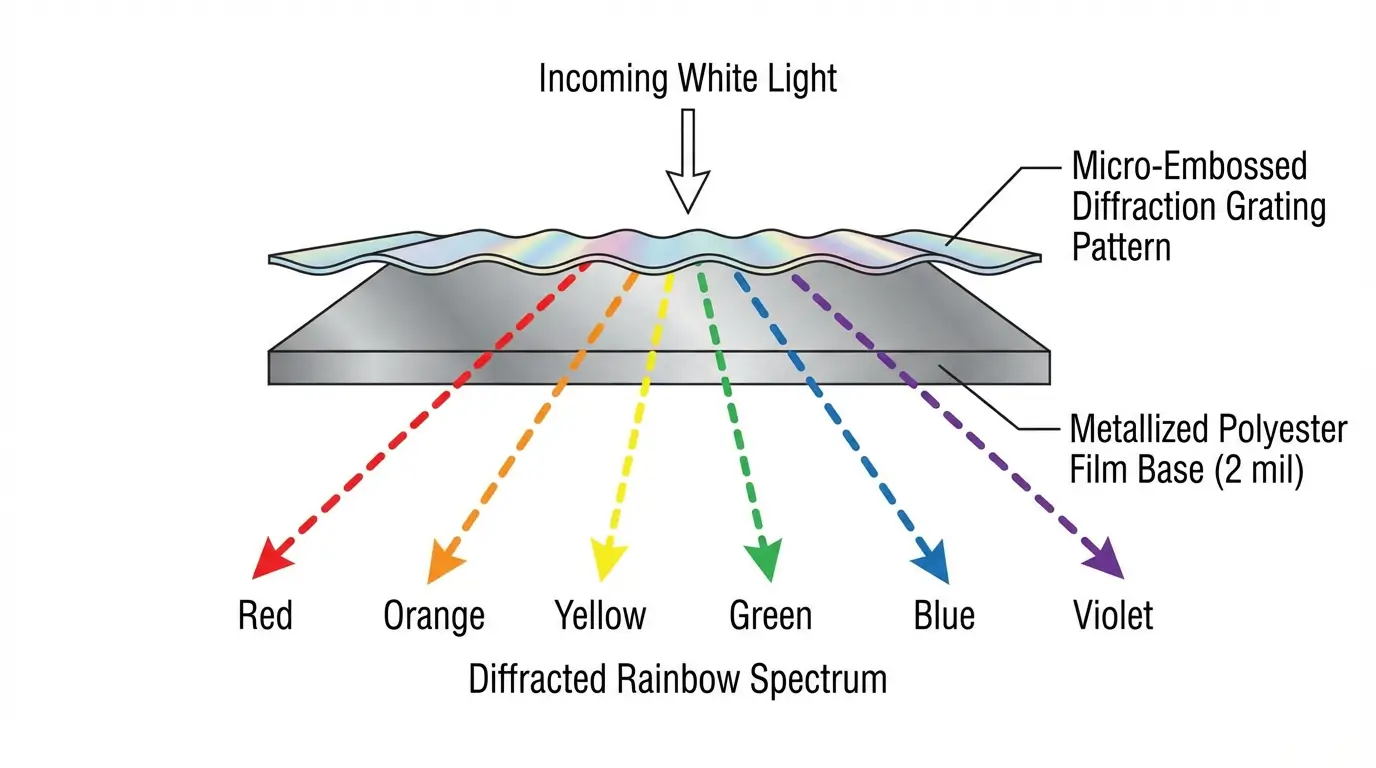
Table of Contents (Click to Expand)
What exactly is a custom holographic sticker?↑
Holographic stickers represent one of the fastest-growing segments in the custom printing industry, with the global market projected to reach $9.10 billion by 2033. Understanding their physical properties and technical requirements prevents costly production errors.
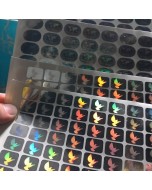
A custom holographic sticker consists of metallized polyester film (typically 2 mil thickness) that uses optical diffraction gratings to separate white light into its component wavelengths, creating dynamic rainbow color shifts that change based on viewing angle and light source direction.
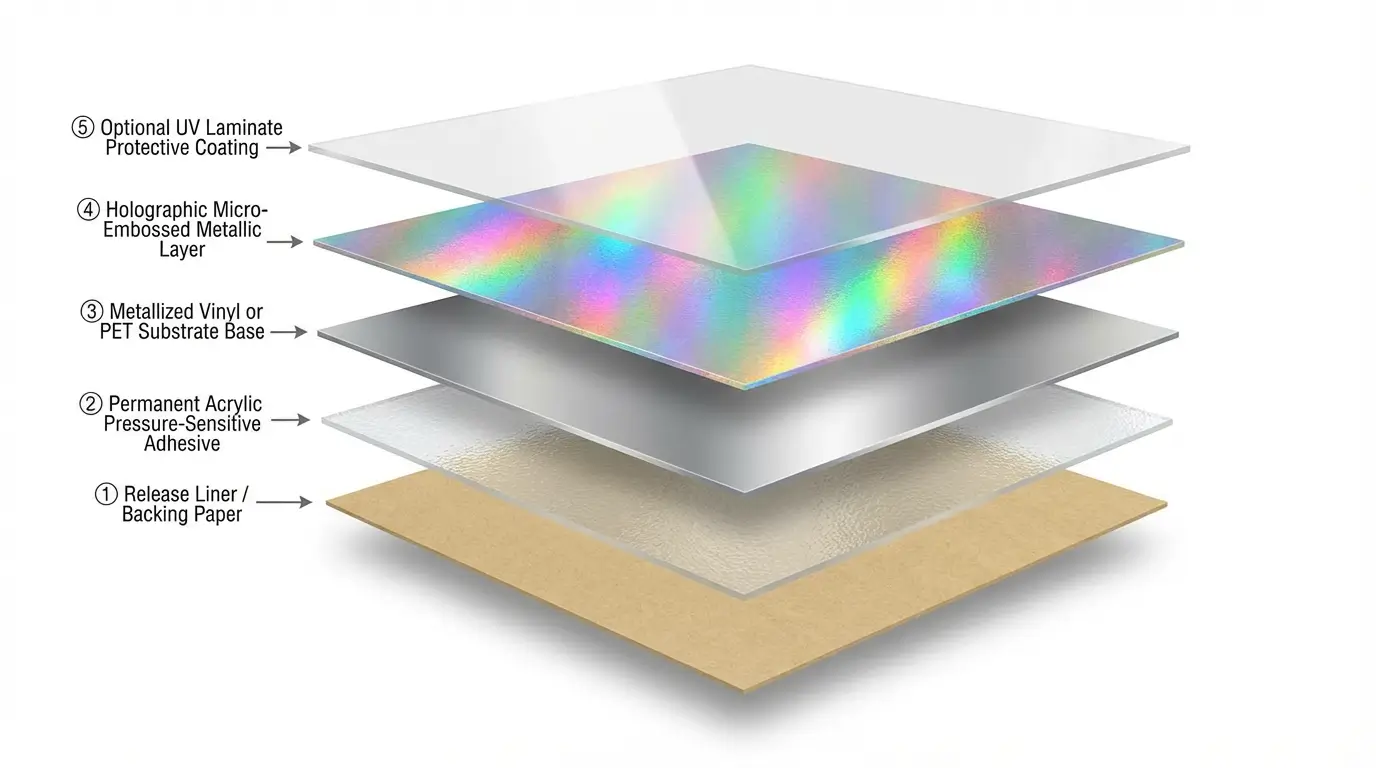
Essential attributes and scope
● Core attributes: The base material is metallized vinyl or PET (polyethylene terephthalate)[1] substrate with micro-embossed surface patterns that create interference-based iridescence. The total thickness including release liner ranges from 6-12 mil, with the sticker and laminate layer measuring 3.4-3.6 mil.
● Applicable range: Applications span from water bottle decoration and laptop personalization (representing 43.21% of consumer purchases) to product labels, packaging seals, brand merchandise, and anti-counterfeiting security labels. The material bonds to glass, plastic, metal, and painted surfaces with permanent acrylic pressure-sensitive adhesive.
● Compliance: Quality verification follows ASTM D3330[2] for peel strength testing (minimum 10 N/25mm for outdoor applications) and ISO 4892[3] accelerated weathering tests using xenon arc lamps to simulate full-spectrum solar exposure.
How do I prepare artwork for holographic printing?↑
The transparent nature of printing inks creates the single largest source of holographic sticker failures. Social media feedback from Reddit communities reveals that proof-to-product color mismatches account for the majority of user complaints, typically stemming from improper white ink layer configuration.
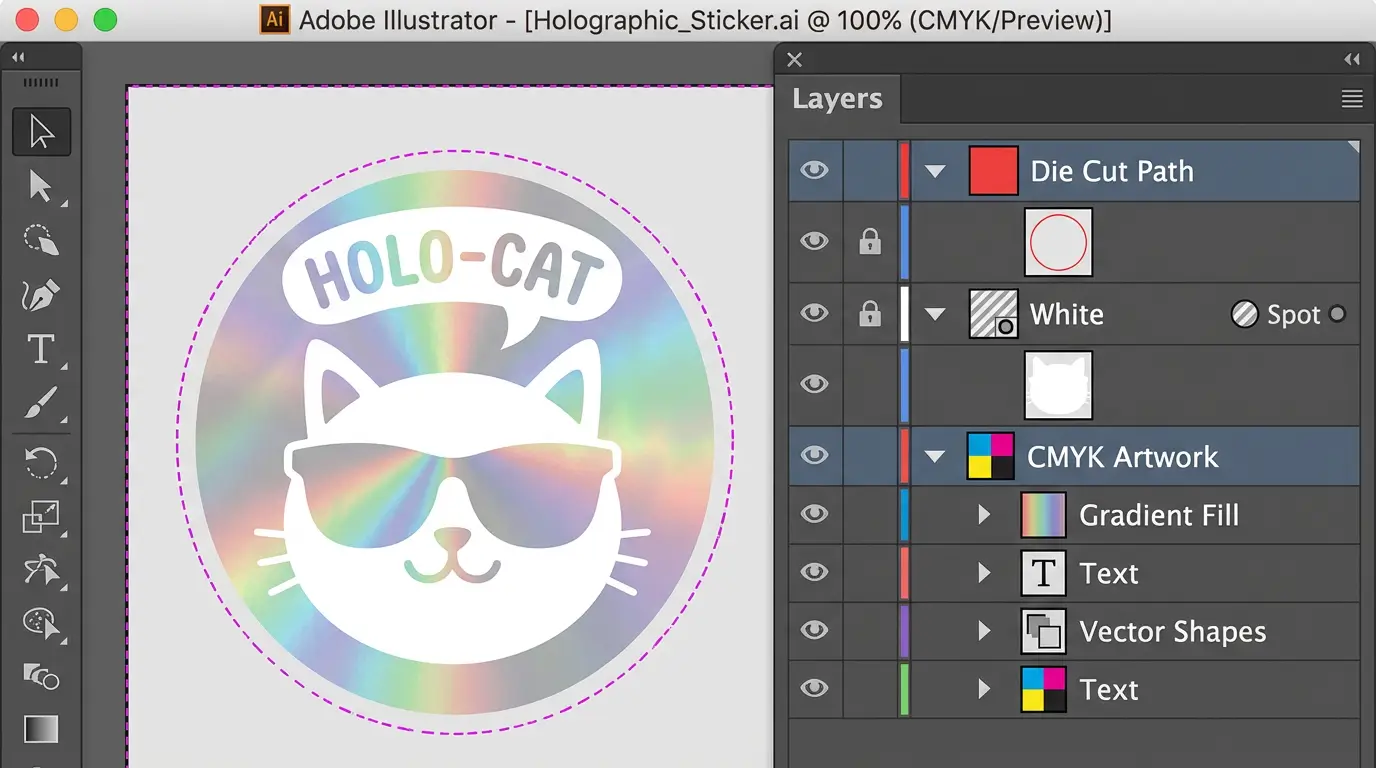
Successful holographic sticker production requires creating a dedicated white ink (spot color) layer in vector software that precisely defines which design areas should block the rainbow effect versus which areas should allow holographic shine-through.
Actionable steps
1) Input: Original design file (AI, EPS, or PDF) → Action: Convert color mode from RGB to CMYK[4] using destination profile matching your print provider specifications → Output: Color-corrected file with accurate ink coverage expectations (increase saturation by 20-30% to compensate for metallic substrate absorption).
2) Input: Color-corrected artwork → Action: Create new layer named "White" and define as spot color; paint 100% white coverage under areas requiring solid color reproduction (logos, text, skin tones); leave 0% white coverage in areas where rainbow effect should show through; optionally use 30-50% white halftone for pearlescent metallic color blending → Output: Production-ready file with separated white ink channel.
3) Input: Separated artwork file → Action: Set document resolution to minimum 300 DPI (higher resolution reduces visible jagged edges against holographic background); outline all fonts; expand all strokes → Output: Final vector artwork ready for print provider upload.
4) Input: Final artwork → Action: Request digital proof with white ink layer visualization; verify on-screen preview shows correct blocking/transparency zones → Output: Approved proof confirmation with production timestamp.
5) Acceptance: Production-ready artwork passes when: all text areas have 100% white underbase; no yellow or light pastel colors appear in areas without white ink; minimum line weight exceeds 0.5pt for legibility against dynamic background; die-cut paths maintain 1/8 inch minimum from design edges.
Which material and finish options fit my application?↑
Selecting appropriate holographic material involves matching substrate properties to your specific durability requirements, adhesion surface characteristics, and visual effect preferences. The distinction between vinyl and PET substrates significantly impacts both performance and cost.
Material selection decisions should prioritize: (1) substrate flexibility for curved versus flat surfaces, (2) adhesive tack level for target surface energy, (3) laminate finish for gloss intensity versus fingerprint resistance, and (4) holographic pattern style for design compatibility.
| Material Type | Thickness | Flexibility | Best Application | Outdoor Durability | Key Consideration | Source |
| Vinyl (Metallized) | 3-6 mil | High | Curved surfaces, helmets, bumpers | 2-4 years (UV laminated) | Softer material conforms to compound curves |
ASTM D6862 |
| PET (Polyester) | 2-3 mil | Low | Flat surfaces, packaging, labels | 3-5 years (UV laminated) | Thinner profile, superior dimensional stability |
ISO 4892 |
| Standard Adhesive | N/A | N/A | Glass, smooth plastic, painted metal | N/A | Adequate for high surface energy materials |
ASTM D3330 |
| Hi-Tack Adhesive | N/A | N/A | Powder-coated surfaces, textured finishes | N/A | Required for low surface energy substrates |
ASTM D3330 |
| Gloss Laminate | 1.6 mil | Medium | Maximum rainbow intensity display | +1-2 years protection | Enhances holographic brilliance; shows fingerprints |
ISO 4892 |
| Matte Laminate | 1.4 mil | Medium | Refined aesthetic, frequent handling | +1-2 years protection | Softens effect to anodized metal appearance |
ISO 4892 |
The table above compares fundamental material properties. Additional holographic pattern options include standard rainbow (linear spectrum shift), cracked ice (irregular geometric facets popular in trading card aesthetics), stardust (fine scattered sparkle), prismatic (bold angular reflections), and dot matrix (structured point pattern). Pattern selection should complement rather than compete with your design elements.
Cut style selection guide
Two primary cutting methods serve different distribution and application contexts. Die-cutting penetrates both the sticker face material and release liner, producing individual pieces ideal for giveaways, samples, and retail packaging. Kiss-cutting penetrates only the face material while leaving the backing sheet intact, maintaining stickers on a carrier sheet for easier peeling and allowing additional branding space around each piece. Kiss-cut format works best for sticker sheets, product inserts, and applications where users peel and apply multiple pieces.
Surface preparation requirements
Adhesion failures on powder-coated surfaces (common with premium insulated tumblers and outdoor equipment) stem from the low surface energy and microscopic texture of these finishes. The coating creates an irregular contact area that reduces effective adhesive bonding. Solutions include: specifying hi-tack adhesive formulation during ordering, cleaning the application surface with isopropyl alcohol immediately before application, and using a heat gun or hair dryer to warm the sticker during application (softening the adhesive allows it to flow into surface texture irregularities).
Key takeaways & proof↑
- The global holographic sticker market reaches $7.43-7.99 billion in 2025 with projected growth to $9.10 billion by 2033-2034, representing 5.73-8.56% compound annual growth driven by e-commerce branding and creator economy expansion.
- User satisfaction analysis across 162 verified purchases shows 74.07% cite "high quality" as the primary positive attribute, while 33.95% of negative reviews identify size discrepancy as the leading complaint—clear size specifications during ordering prevent 1 in 3 dissatisfied outcomes.
- White ink underbase layer configuration determines color accuracy: 100% white coverage blocks holographic effect for true CMYK reproduction, 0% coverage maximizes rainbow shine-through, and 30-50% halftone creates premium metallic color blends unavailable in standard printing.
- Outdoor durability spans 1-5 years depending on UV lamination presence, with ISO 4892[3] accelerated aging tests providing laboratory validation equivalent to real-world exposure periods.
- Standard production turnaround follows: 1-2 business days proof approval, 2-5 business days manufacturing, 1-5 days shipping—rush services compress timelines but typically require advance coordination for holographic substrate availability.
Conclusion↑
Custom holographic stickers deliver exceptional visual impact when technical specifications align with application requirements. The critical success factors involve proper white ink layer configuration during artwork preparation, appropriate material selection for your target surface and environment, and realistic durability expectations based on lamination choices. Understanding that CMYK inks become semi-transparent on reflective substrates—and that this transparency creates both the distinctive appeal and the primary design challenge—positions you to leverage holographic effects intentionally rather than fighting unexpected color shifts.
Request a sample pack to evaluate rainbow intensity, laminate finish, and adhesive performance on your specific application surfaces before committing to production quantities.




The information below is required for social login
Sign In
Create New Account