Custom auto lock bottom boxes are folding cartons with a pre-glued base that opens and locks as the carton is squared. They can reduce bottom-closing steps, ship flat, support custom graphics, and provide a more secure base for products such as candles, cosmetics, bottled goods, dry foods, supplements, and retail accessories. Final dimensions, board grade, load limit, MOQ, production time, and unit weight remain subject to quotation, physical sampling, and application-specific testing.
Who Benefits Most from Auto-Lock Bottom Cartons?↑
These cartons are primarily intended for B2B packaging programs where assembly speed, repeatable presentation, and bottom security matter at the same time. Typical buyers include e-commerce brands, retail product teams, contract packers, purchasing managers, subscription-box operators, and independent makers moving beyond stock cartons and labels.
Common applications include candle vessels, cosmetic jars, body-care bottles, tea and coffee products, dry foods, supplements, small electronics, gift items, and other products that need a folding carton with a more secure base than a basic tuck closure. A paperboard version may suit lightweight retail presentation, while a corrugated or heavier-caliper structure may be considered for greater point loads or distribution exposure. Neither choice should be treated as a universal load rating: suitability depends on the product’s dimensions, packed orientation, center of gravity, board specification, inserts, and verified sample performance.
Auto-lock cartons are especially relevant when one carton size is packed repeatedly. At very low daily volumes or across many changing SKU dimensions, the extra converting and pre-gluing cost may outweigh the labor benefit. The buying decision should therefore compare total packing cost—not carton price alone.
Why Do Conventional Carton Bottoms Create a Packing Bottleneck?↑
A low-priced carton can become expensive after it reaches the packing table. Operators may need to fold several flaps in sequence, hold the base square, apply tape, inspect the seal, and correct cartons that were closed unevenly. Each additional motion becomes more significant as order volume grows. Tape use also adds purchasing, replenishment, disposal, and workstation-management tasks.
The pain becomes more serious with glass jars, bottles, or other concentrated loads. A weak board, poorly fitted product, inaccurate crease, or incompletely closed bottom can cause sagging, skewed cartons, damaged graphics, or product loss. Brand teams then face a second problem: a generic or distorted carton weakens shelf presentation even when the product itself is premium.
An auto-lock bottom addresses these connected issues through a pre-glued folding structure. When the flat carton is opened and squared, the bottom panels move into their locking position. The solution is not “strong by default,” however. Structural accuracy, adhesive performance, board selection, correct erection, and load testing remain essential.
Contents
What Is a Custom Auto-Lock Bottom Folding Carton?↑
A custom auto-lock bottom carton—also called an auto-bottom or crash-lock carton—is supplied flat with its bottom panels already glued in a connected folding arrangement. Squaring the carton causes those panels to unfold and form the base. No additional tape or glue is normally required to form the bottom at the packing station. Commercial product references describe a pre-glued base that quickly pops into shape and is intended to hold heavier products than simple folding closures, subject to the chosen material and approved application.pre-glued auto-lock structure[1]
The structure is part of the broader ready-glued case family documented through the FEFCO packaging design code[2]. A tuck top is a frequent pairing, but the top closure, dust flaps, locking details, insert, window, and tamper label area should be engineered around the actual product and sales channel.
The carton’s load capacity cannot be inferred from the words “auto lock.” The bottom geometry is only one part of the package. Board caliper, fiber composition, flute profile where applicable, panel dimensions, grain direction, crease quality, adhesive coverage, product weight distribution, and storage humidity can all change performance. Corrugated selections should be evaluated using appropriate stacking and puncture considerations rather than relying on a generic board name; an industry overview of corrugated construction explains why flute, liner, medium, and test method must be considered together.corrugated-board selection principles[3]

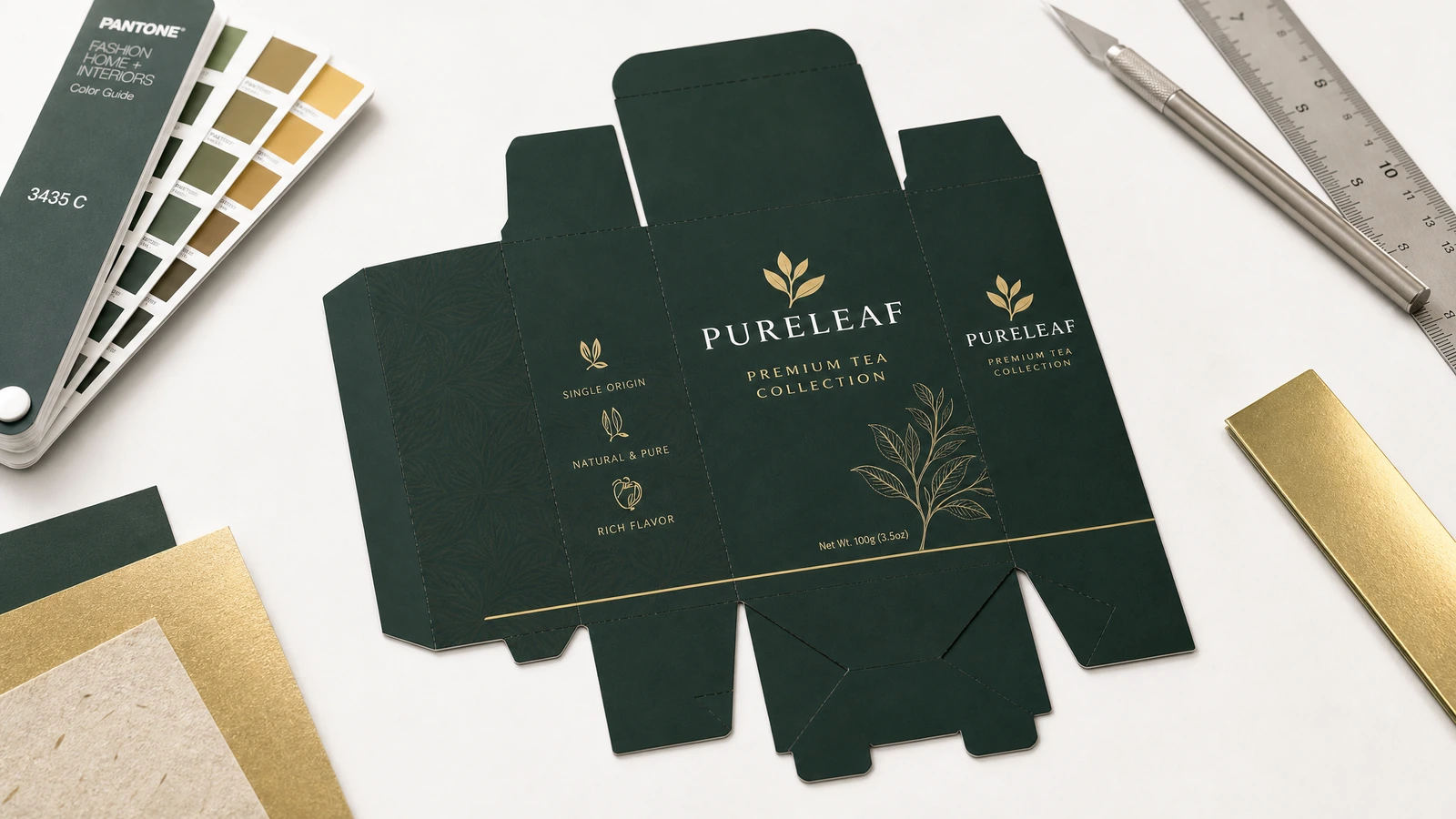
Available design candidates may include CMYK or spot-color printing, exterior or interior graphics, matte or gloss treatments, soft-touch lamination, foil stamping, embossing, debossing, spot UV, windows, hang tabs, inserts, and tamper labels. Confirm these customization possibilities for the project before production. Each option must be confirmed during quotation because coatings and laminates can affect recyclability, adhesive selection, crease behavior, cost, and production routing.
How Should the Carton Be Specified and Approved?↑
1. Define the packed product before choosing the board
Record the product’s maximum external dimensions, packed weight, orientation, center of gravity, contact points, fragility, and whether an insert or protective bag will be used. Specify whether the carton is a retail unit, an e-commerce shipper, or an inner carton placed inside a separate transport case. A folding carton that performs well on a shelf may still require outer protection for parcel distribution.
2. Confirm internal dimensions and loading clearance
Quote requests should state whether length, width, and height are internal or external measurements. Internal dimensions are generally more useful for product fit, but the structural drawing must account for material thickness, folds, inserts, and loading clearance. Avoid copying dimensions from a competitor’s box without checking the actual product.

Artwork readability must be reviewed on the assembled carton, not only on the flat dieline. Keep essential text, barcodes, regulatory copy, logos, and opening instructions away from cut lines, creases, glue areas, and panel transitions. Check how the front, side, rear, top, and bottom panels align when the carton is erected.
3. Select a material candidate through engineering review
Paperboard, kraft board, recycled-content board, and corrugated grades appear across the market, but no grade should be accepted solely because it is commonly used for a similar product. For corrugated packaging, ECT and Mullen tests measure different properties: ECT focuses on edgewise compression and stacking contribution, while the Mullen test measures resistance to bursting. A technical comparison explains why the selected method should match the distribution hazard rather than be treated as an interchangeable strength label.ECT and Mullen test selection[4]
4. Build the dieline around the chosen material
The dieline should be created after the material and product dimensions are known. It must identify cut lines, crease lines, glue zones, bleed, safety margins, panel orientation, and closure sequence. Auto-bottom and 1-2-3 bottom dielines are not interchangeable: the automatic version uses pre-glued connected panels, while the snap-lock version requires the packer to fold several flaps into place. Structural guidance comparing the two layouts illustrates why the bottom mechanism must be engineered before artwork is finalized.auto-bottom dieline planning[5]
5. Preflight artwork before making a physical sample
Preflight should check dieline version, document dimensions, image resolution, color mode, fonts, overprint settings, barcode contrast, bleed, safe zones, spot colors, and white-ink layers where applicable. The approved proof should clearly distinguish structural lines from printable content and identify any finish plates.

6. Approve an erected physical sample
A screen preview can help identify layout problems, but it cannot prove fit, board stiffness, crease behavior, adhesive integrity, or load performance. The approval sample should be erected, filled with the actual product, opened and closed repeatedly as relevant, and reviewed under realistic lighting. If the package will be shipped, a representative packed sample should undergo a documented distribution test appropriate to the sales channel.
7. Lock the approved specification
The purchase specification should record the final dieline revision, internal dimensions, material designation, print standard, finishes, adhesive areas, inspection criteria, packing method, artwork file, and approved sample reference. This prevents a visually approved proof from becoming the only source of truth.

Which Bottom Style Fits Your Operation?↑
| Decision factor |
Auto-lock bottom |
Snap-lock / 1-2-3 bottom |
Basic tuck or taped bottom |
| Bottom formation |
Pre-glued panels move into position as the carton is squared |
Several tabs are manually folded and interlocked |
Flaps are tucked, glued, or taped depending on the design |
| Packing priority |
Fast, repeatable erection for recurring packing work |
Lower converted-carton cost with manual assembly accepted |
Simple, economical construction for suitable lightweight applications |
| Cost tendency |
Usually higher converting cost because of added gluing and structural steps |
Often less expensive than auto-lock while retaining an interlocking base |
Often the lowest structural cost, although packing labor and tape may increase total cost |
| Strength decision |
Depends on material, dimensions, glue integrity, loading, and sample tests |
Can provide a strong manual interlock; still requires application testing |
Must be matched carefully to weight and closure method |
| Best-fit operating pattern |
Repeated SKUs, higher packing frequency, presentation consistency |
Lower volumes, cost-sensitive programs, manual packing |
Light products or operations where basic closure is sufficient |
| Main risk |
Mis-locking, weak adhesion, overloading, or poor dimensional tolerance |
Incorrect folding sequence or slower operator assembly |
Bottom opening, tape dependence, or weak presentation |
The table separates converted-carton cost from total operating cost. Industry comparisons consistently note that snap-lock cartons cost less to produce because they omit the automatic pre-gluing arrangement, while auto-lock cartons prioritize erection speed.auto-lock versus snap-lock cost trade-off[6] The correct choice depends on carton usage per shift, labor cost, tape consumption, number of SKUs, damage exposure, and the value assigned to presentation consistency.
Choose auto-lock when repeated fast erection is valuable and the physical sample passes the required tests. Choose snap-lock when operators can accept additional folding steps and the carton-cost difference matters more than throughput. Choose a simpler tuck or taped structure when product weight and distribution hazards do not justify the more complex bottom.
What Should Be Tested Before Production Approval?↑
Acceptance should begin with fit and function. Erect the carton from its flat condition and confirm that the base opens without tearing, skewing, or excessive force. Verify that the bottom panels reach their intended positions and that glue joints do not lift, wrinkle, overflow, or interfere with product loading. Repeat the check across samples rather than approving a single ideal carton.

- Dimensional inspection: compare internal dimensions, panel squareness, flap alignment, and product clearance with the approved specification.
- Bottom engagement: confirm full locking after erection and inspect for incomplete overlap or panel interference.
- Adhesive inspection: check bond placement, curing, fiber tear where appropriate, overflow, and compatibility with printed or laminated surfaces.
- Load and orientation trial: use the actual product, insert, and intended packed orientation. Capacity and suitable quantity must be decided through this physical evaluation.
- Compression and stacking review: test when warehousing, palletization, or stacked retail display creates sustained compression.
- Distribution simulation: evaluate shock, vibration, compression, handling, and environmental conditions when the carton participates in shipment.
- Print inspection: compare color, registration, coating, barcode readability, finish placement, scuffing, and text legibility with the approved proof.
ASTM D4169 provides a recognized framework for performance testing shipping containers and systems through planned distribution-cycle hazards.shipping-container performance testing The exact assurance level, test sequence, conditioning, sample count, and pass criteria must be selected for the real distribution environment; merely naming a standard does not prove that a carton has passed it.
Food, cosmetics, supplements, or children’s products may introduce additional material, labeling, traceability, and regulatory obligations. Those requirements depend on the packaged product and whether the carton has direct or indirect contact. Compliance should therefore remain a documented project input rather than an assumed property of a paperboard carton.
What Affects Cost, MOQ, and Lead Time?↑
Quotation requires more than a box size. Important price variables include board grade and thickness, flat blank area, order quantity, number of artwork versions, print method, ink coverage, interior printing, tooling, pre-gluing, window patches, inserts, specialty finishes, proofing, inspection requirements, packing configuration, freight method, and destination.
Confirm MOQ, production time, unit weight, load capacity, certification, and material range through quotation, sampling, or testing. Do not infer them from competitor listings.
Public supplier timelines vary widely. An industry procurement guide reports that packaging lead time can range from days to months and gives overseas benchmarks extending to 6–15 weeks including freight for some packaging routes.packaging lead-time benchmarks[8] These figures are market references, not promised production times for this product.
Low-volume buyers should also expect setup economics to affect unit price. Quote the required quantity and a few higher-volume breaks, then compare inventory risk against unit-cost savings.
A safer cost model includes carton price, tooling, proofs, freight, import costs where applicable, storage, packing labor, tape, rejects, damage, and rework. Auto-lock construction is most compelling when its added converting cost is offset by repeatable packing efficiency or reduced closure handling.

For delivery and repeat orders, cartons should remain flat, dry, protected from crushing, and labeled by SKU, artwork revision, quantity, and batch. A reorder should reference the approved dieline and physical sample while still checking whether the product, artwork, board supply, shipping route, or compliance requirements have changed.
What Are the Key Procurement Takeaways?↑
- Published operating comparisons show a meaningful assembly-speed advantage. — Auto-lock cartons are estimated at 2–5 seconds per carton versus 10–20 seconds for manually folding and taping an RSC bottom, or approximately 2–4 times faster (Source[11]).
- Auto-lock does not equal unlimited strength. — Product dimensions, packed orientation, board specification, adhesive integrity, inserts, environmental exposure, and sample-test results determine capacity.
- The best comparison is total packed cost. — Include converting, labor, tape, storage, rejects, freight, damage, and inventory exposure instead of choosing solely by unit carton price.
How Should You Move from Concept to Production?↑
Custom auto lock bottom boxes can combine efficient erection, a secure pre-glued base, flat storage, and branded retail presentation. Their value is highest when the same carton is packed repeatedly and when the structure is engineered around the real product rather than selected from a generic strength claim.
A dependable project starts with internal product dimensions and packed weight, then moves through material selection, structural design, artwork preflight, an erected physical sample, load and distribution testing, and a locked purchasing specification. This sequence reduces the main risks: incorrect fit, mis-locking, weak adhesive bonds, print-to-cut errors, unstable loading, and unexpected lead-time or unit-cost trade-offs.
Request a specification-based quotation and physical prototype using your product dimensions, packed weight, quantity, artwork, finish requirements, destination, and intended distribution method.





The information below is required for social login
Sign In
Create New Account