Custom counter display boxes convert limited retail space into an organized, branded selling point. A specification-led project defines the footprint, capacity, board grade, print, inserts, opening method, and packout—then validates those decisions with a physical, fully loaded sample before committing to volume.
Who Should Use Custom Counter Display Boxes—and Where?↑
Counter displays exist for small products that need visibility, fast access, and disciplined presentation in a tight footprint. Typical buyers include food and confectionery brands, cosmetics companies, personal-care manufacturers, pharmacies, toy and electronics suppliers, subscription brands entering physical retail, and distributors preparing retailer-specific promotions.
The format proves most useful when the commercial task is specific: launch a new SKU, group multiple flavors, reduce loose-item clutter, place a prepacked assortment near checkout, or give store employees a unit they can open and merchandise quickly. Suitable locations include staffed checkout counters, pharmacy desks, convenience stores, service counters, trade-show tables, pop-up shops, and selected self-checkout exits. Placement should be verified from the store's actual traffic pattern rather than assumed from historical checkout behavior.
- Brand founders: test a retail concept without committing to permanent fixtures.
- Retail marketers: coordinate a campaign message across the header, front lip, side panels, and product packaging.
- Packaging buyers: combine a shipper, replenishment unit, and display where the product and distribution route permit it.
- Retail operators: reduce shelf preparation when the unit is engineered for genuine open-and-sell deployment.
A Display That Looks Good but Fails in Store Is an Expensive Packaging Problem↑
Problem: A buyer approves an attractive rendering, but the physical unit arrives with undersized slots, weak front walls, obstructed product labels, or perforations that tear unpredictably. A design may stand upright when full yet tip forward after shoppers remove the first row. Another may survive a studio photograph but soften during humid distribution or collapse when store employees lift it from one corner.
Agitation: The damage runs deeper than the cost of paperboard. Missed promotion dates, manual repacking, retailer complaints, discarded inventory, and emergency airfreight can exceed the original display budget. Store employees will abandon a supposedly shelf-ready unit the moment tape, labels, or poorly cut perforations make opening slower than stocking products individually. Social discussions among retail workers repeatedly describe this gap between "pretty darn quick" packaging and real deployment.
Solution: Treat the display as a measured retail system, not decorative print. Supply the factory with the physical product, loaded weight, retailer restrictions, distribution method, assembly target, and expected display duration. Approve the structure through white samples, printed samples, load testing, opening trials, and documented inspection criteria. No factory performance dataset was supplied for this page, so load capacity, color tolerance, setup time, and shipping survival must be measured for the specific project rather than represented by invented universal values.

Table of Contents
What Is a Custom Counter Display Box?↑
A custom counter display box is a compact point-of-purchase package designed to organize and present products on a counter, service desk, checkout fixture, or small shelf area. It may be supplied flat, preassembled, prefilled, or integrated into an outer shipping case. "Counter display," "countertop POP display," and "PDQ display" overlap in commercial use, although exact construction and retailer requirements differ by project.
Common structures include an open-front tray, a tray with a raised header, a stepped display, multiple product bays, die-cut dividers, an auto-bottom unit, and a tear-away shipper-display. A header provides communication space but raises the total height and can affect case packing. Dividers control product movement but add material and assembly. A tear-away cover can reduce store labor only when perforations, tape placement, and removal clearances work under real operating conditions.
For corrugated projects, board selection should be documented by grade, flute, basis or performance specification, liner construction, and flute direction. The relevant engineering reference depends on the package. For example, ASTM D4727/D4727M-22[1] addresses container-grade corrugated and solid fiberboard sheet stock, while ASTM D5118/D5118M[2] covers practices for fabricating fiberboard shipping boxes. Citing a standard does not make an untested display "ASTM certified"; the specification, specimen, method, and result must be stated.
How Do You Engineer the Right Size, Capacity, and Stability?↑
Begin with product data, not a preferred box template. Measure the maximum physical length, width, and height of the sale unit—including seals, caps, hang features, and dimensional variation. Record the weight of one item, quantity per display, maximum loaded weight, center of gravity, desired product exposure, replenishment direction, and clearance needed for fingers to remove the product.
A useful specification sheet captures every unit and method of measurement:
| Engineering field |
Required input |
Approval evidence |
| Product fit |
Maximum L × W × H in mm; production tolerance |
Physical product fit in a white sample |
| Load |
Unit weight, count, and full-load weight in kg |
Fully loaded static test for an agreed duration |
| Retail footprint |
Maximum width × depth × total height |
Retailer drawing or written approval |
| Accessibility |
Front-wall height and removal clearance |
Repeated removal and replenishment trial |
| Distribution |
Flat, assembled, prefilled, parcel, case, or pallet |
Packout drawing and distribution test plan |
| Environment |
Humidity, grease, moisture, light, and display duration |
Material and coating decision linked to exposure |
This table converts subjective requests such as "strong enough" or "easy to use" into buyer-approved measurements. Final tolerances should come from the structural design, converting process, material behavior, and product requirements—not from a generic website promise.
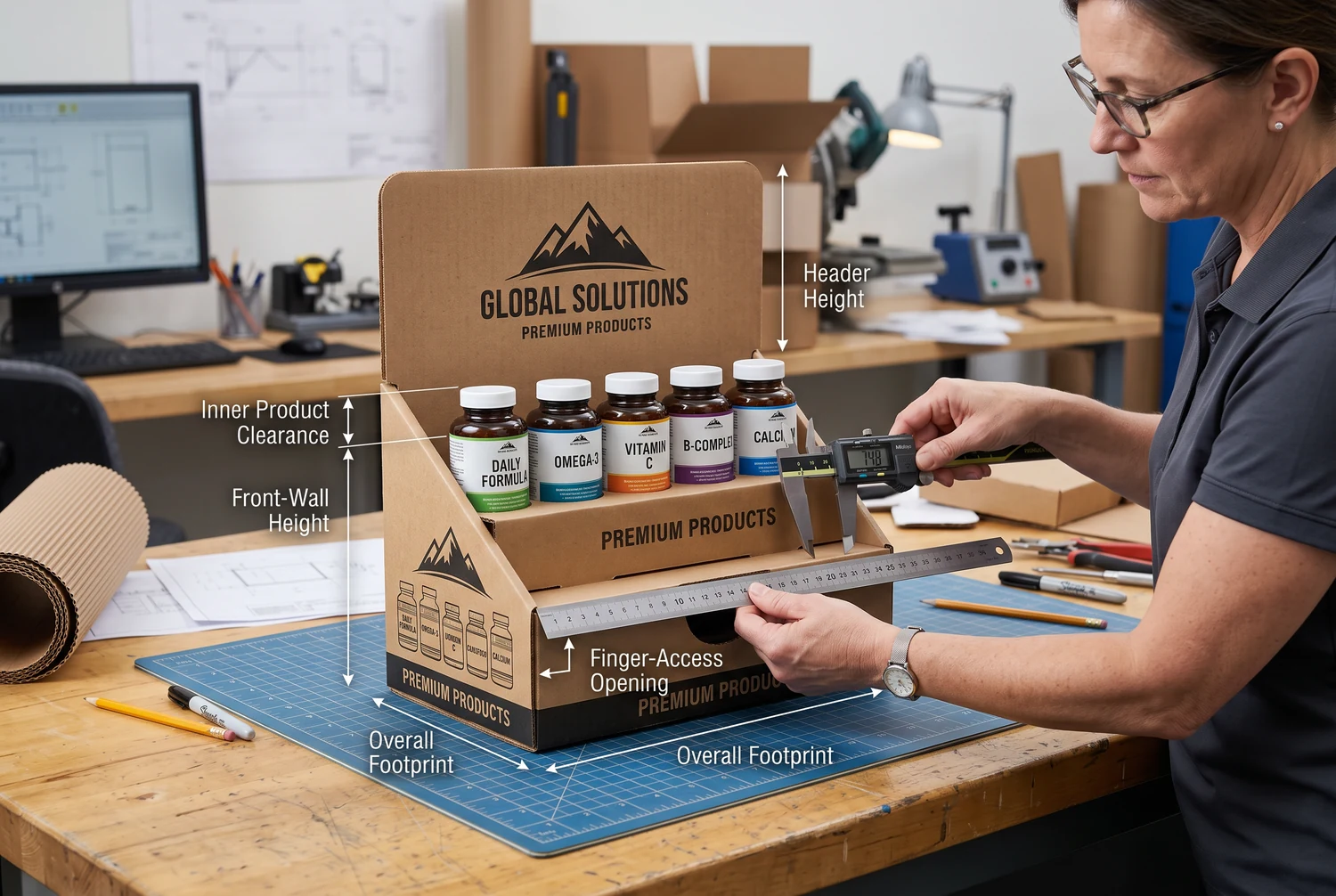
Stability must be evaluated across more than one inventory state. Test the display full, half-full, front-row depleted, and loaded unevenly. Apply the handling actions expected in store: product removal, replenishment, counter movement, and a light lateral push. If the display also protects goods in distribution, develop a test sequence that represents its route. The ISTA test procedures[3] provide packaged-product test frameworks, but the appropriate procedure and assurance level must be selected for the actual distribution system.
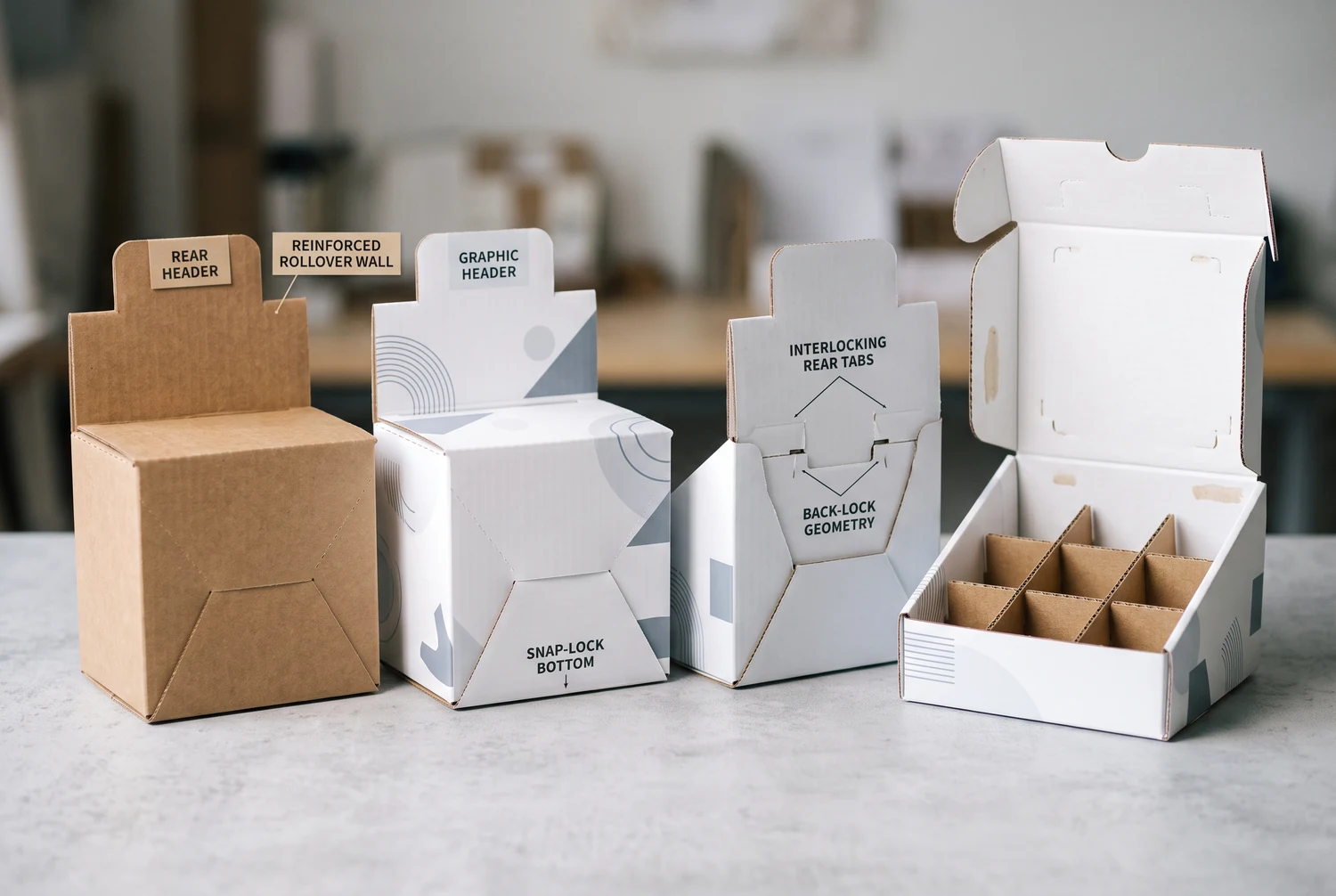
Back panels, locking tabs, rollover walls, dust flaps, inserts, and bottom locks should each have a defined job. Added board is not automatically a better solution: an engineered fold or load path may improve performance with less material than indiscriminate reinforcement.
How Should Artwork and Print Files Be Prepared Before Sampling?↑
Request the final production dieline only after structural dimensions are approved. Artwork created on an early template will shift when board caliper, locking geometry, or product clearance changes. Keep graphics on a dedicated artwork layer and preserve the factory's cut, crease, perforation, glue, and no-print layers. Do not flatten structural lines into the design.
- Build at final scale: verify panel dimensions rather than scaling a low-resolution mockup.
- Add the specified bleed: use the converter's documented value because process requirements differ.
- Protect critical content: keep logos, claims, QR codes, and legal copy away from cuts, folds, glue areas, and tear lines.
- Define color: identify CMYK builds and any named spot colors; request a physical color target when color is commercially critical.
- Inspect images and type: confirm effective resolution, embed or outline approved fonts, and check small reversed text.
- Review every viewing state: examine the packed shipper, unopened display, opened display, partially depleted display, and side views.
For food projects, determine whether the display touches unpackaged food or only holds sealed primary packages. If inks, coatings, adhesives, or paper components have an intended food-contact use, the buyer and supplier should verify the applicable regulatory status through the FDA food-contact substance resources[4]. A food brand logo or the use of water-based ink alone is not evidence of food-contact compliance.

A Controlled Factory Workflow Protects the Promotion Date↑
A reliable schedule separates engineering, approval, manufacturing, and freight into independently tracked phases. "Ten working days" may describe production only—it may exclude structural development, sample revisions, transit, customs clearance, appointment delivery, or replacement of rejected goods. The quotation should identify the event that starts each lead-time clock.
- Commercial brief: confirm channel, retailer, quantity, destination, launch date, budget, and Incoterm.
- Product intake: receive physical samples or controlled drawings plus load and handling data.
- Structural development: produce the dieline and unprinted prototype.
- White-sample approval: validate fit, access, assembly, stability, footprint, and packout.
- Artwork preflight: review separations, bleed, content position, barcode, and finish layers.
- Printed sample or proof: establish the approved visual target and record any limitations.
- Production setup: release controlled files, material specifications, tooling, and job instructions.
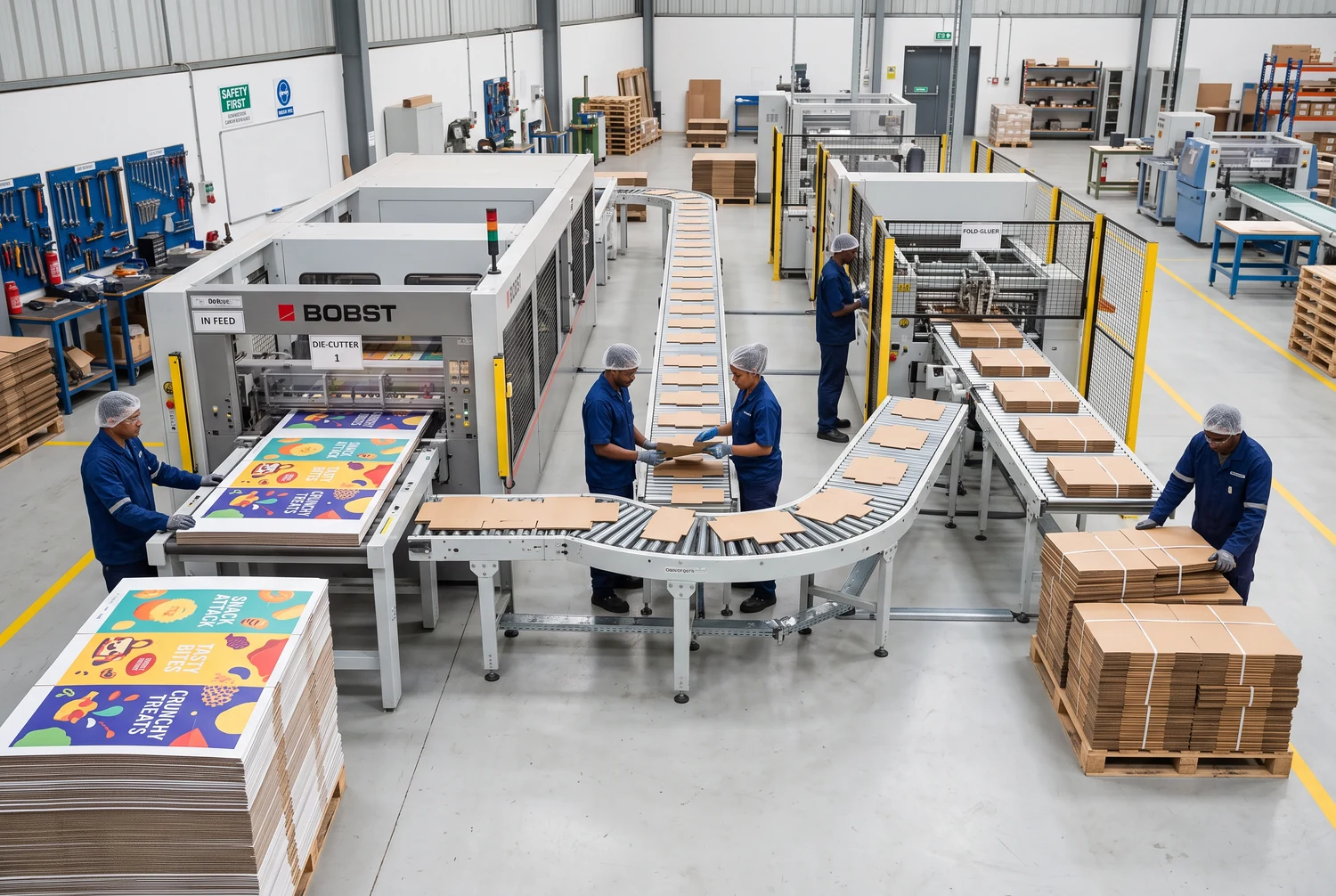
- Printing and converting: print, laminate if required, die-cut, strip, glue, fold, and bundle.
- Inspection and packing: inspect against the approved sample and written acceptance criteria.
- Shipping release: provide packing data, carton marks, shipping documents, and inspection status.
Surface treatments should solve a defined exposure or branding requirement. Film lamination, plastic windows, metallic layers, and certain barriers can complicate fiber recovery. AF&PA's design guidance for recyclability[5] notes that non-fiber elements, including some coatings and adhesives, can create challenges for paper mills. Ask what each finish changes, whether it can be eliminated, and what recovery route exists in the destination market.
Which Quality Checks Should Be Completed Before Shipment?↑
An approved sample is useful only when backed by written specifications. Create a golden sample or signed proof, then define the inspection method, sampling plan, defect classes, measurement tools, and remedy for nonconforming goods. Do not import arbitrary dimensional, color, or defect-rate limits from another packaging project.
| Inspection area |
What to verify |
Commercial risk controlled |
| Identity |
SKU, revision, language, quantity, and carton marks |
Wrong version shipped to a campaign |
| Material |
Specified board, flute, liner, surface, and documented source |
Sample-to-production substitution |
| Dimensions |
Critical fit, footprint, height, slots, and tab geometry |
Poor fit or retailer rejection |
| Print |
Content, color target, registration, legibility, and barcode |
Brand damage or scan failure |
| Converting |
Creases, cuts, perforations, glue, locks, and stripping |
Tearing or slow assembly |
| Performance |
Assembly, full and depleted stability, product access |
In-store collapse or abandonment |
| Packout |
Bundle count, protection, compression exposure, pallet pattern |
Transit damage and receiving errors |
This inspection matrix establishes traceability from the purchase specification to the shipping decision. The buyer should identify which failures block shipment, which permit rework, and which require replacement or credit.

Environmental claims require the same discipline. FSC-certified paper and packaging[6] can support responsible sourcing and chain-of-custody claims when the certificate scope and transaction documentation cover the actual product. It does not prove that every finished display is accepted by every local recycling program.
Which Material and Display Format Offers the Best Buying Fit?↑
| Option |
Best use |
Primary advantage |
Main limitation to test |
| SBS or folding carton board |
Light cosmetics, confectionery, samples, accessories |
Smooth graphics and compact folds |
Loaded stiffness, humidity, and edge wear |
| E-flute corrugated |
Light-to-medium retail displays requiring structure |
Fine flute profile with added rigidity |
Crease quality and printed-surface expectations |
| B-flute corrugated |
Heavier goods or shipper-display concepts |
More cushioning and structural depth |
Bulk, fold geometry, and graphic surface |
| Kraft-faced board |
Natural, craft, and reduced-ink presentations |
Distinct fiber appearance |
Color shift on the brown substrate |
| Rigid board or acrylic |
Longer-term premium counters |
Durable, fixture-like presentation |
Weight, price, freight, and end-of-life route |
| Counter display |
Small SKUs and limited retail footprint |
Low space requirement and easy testing |
Capacity and dependence on placement |
| Floor display |
Large campaigns or multiple SKUs |
Higher capacity and distant visibility |
Floor allocation, logistics, and setup |
There is no universally superior material. Choose against loaded weight, display duration, graphics, distribution, labor, retailer specification, recovery options, and total cost. Paper-based displays are generally more suitable for short campaigns than permanent wet or high-abuse environments.
Recycling statistics also require precise scope. AF&PA reported that 69%–74% of cardboard available for recovery was recycled in the United States in 2024[7]. This updated estimate should not be plotted as a direct decline from the older 91.4% corrugated-packaging figure because the statistical methods and boundaries differ.
Exporters serving European customers should also review the EU Packaging and Packaging Waste Regulation[8], which entered into force on February 11, 2025 and generally applies from August 12, 2026. U.S. brands should separately monitor state packaging programs through current resources such as the U.S. EPR laws map[9], because producer definitions, reporting duties, and fees vary by jurisdiction.
How Do You Compare Landed Cost and Prove Retail ROI?↑
A low unit quote can conceal tooling, export packing, duties, appointment delivery, inspection, assembly, storage, and expected waste. Compare suppliers on the same quantity, specification, Incoterm, destination, and service scope.
Landed cost = production + samples and tooling + packing + freight + insurance + duties and taxes + customs and delivery + assembly + storage + expected defects or rework.
For China-origin orders, classification and tariff treatment must be checked for the actual merchandise and transaction. The U.S. Customs and Border Protection resource covering Section 301 remedies for certain products of China[10] is a starting point, not a substitute for confirming the HTS classification, origin, entry date, exclusions, and other applicable charges with a qualified customs professional.
Calculate commercial viability using contribution margin rather than revenue:
- Incremental gross profit = baseline unit sales × measured lift × unit contribution margin.
- Break-even lift = total display-program cost ÷ baseline contribution margin for the test period.
- Payback period = total program cost ÷ incremental contribution margin per measurement period.
Use comparable test and control stores where practical. Track baseline sales, price, inventory availability, promotion, placement, replenishment, damage, and employee execution. Historical POP studies and supplier testimonials may suggest a hypothesis, but they should not become a guaranteed uplift in the financial model.
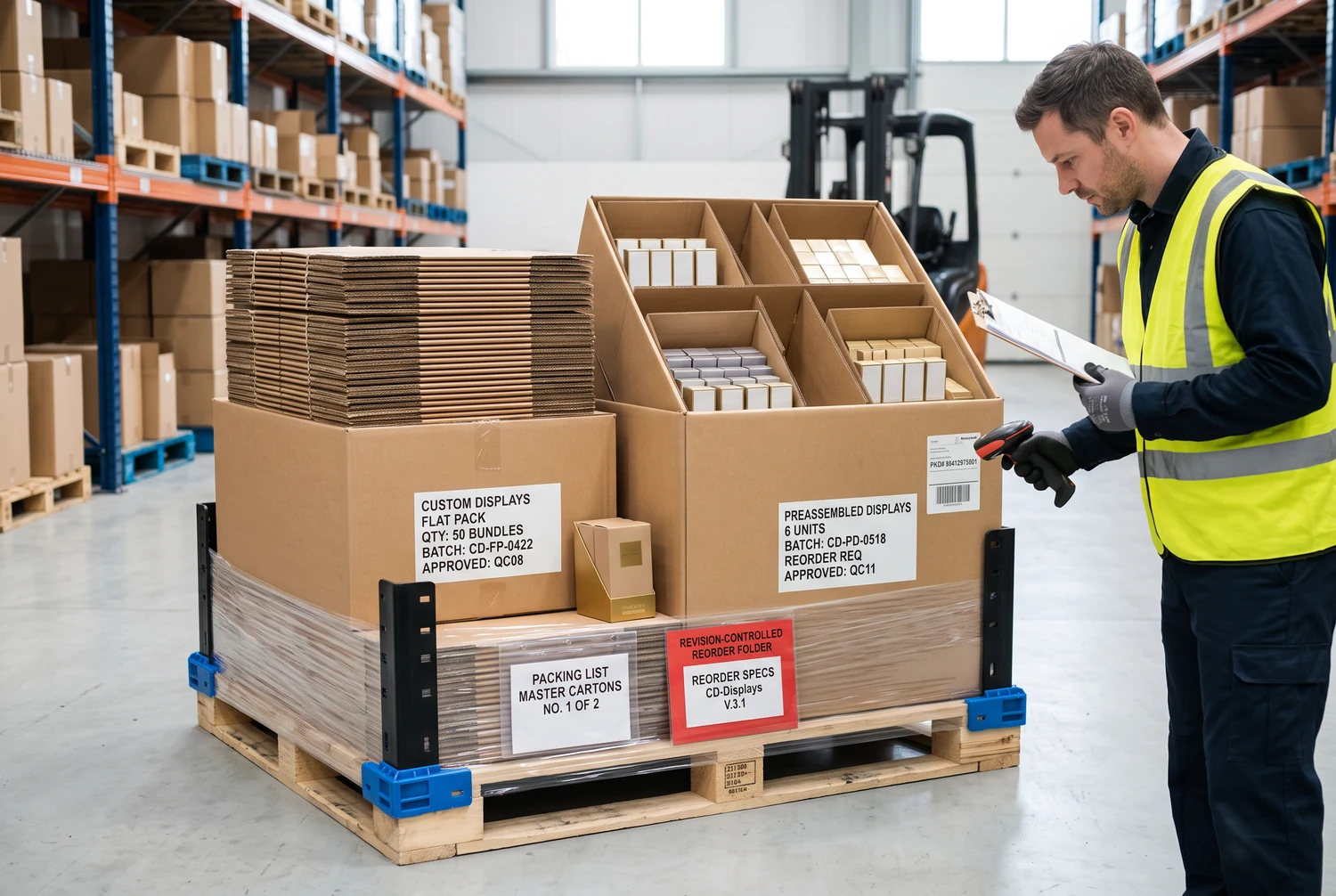
Retain the approved dieline, material specification, artwork revision, golden-sample record, inspection criteria, packing configuration, and defect findings for repeat orders. This controlled reorder pack prevents an old file, substituted board, or changed pallet arrangement from becoming a second source of truth.
Key Takeaways for a Lower-Risk Display Program↑
- Approve performance with the real product, not a rendering. — Test at least 4 inventory states: full, half-full, front-depleted, and unevenly loaded (Source)
- Separate production lead time from the complete launch schedule. — Track 4 phases independently: engineering, approval, manufacturing, and logistics (Source)
- Use the latest recycling statistic with its stated scope. — U.S. cardboard available for recovery recorded a 69%–74% recycling range for 2024 (Source)
- Treat sustainability as documented material data. — Verify 5 fields: fiber source, recycled content, coating, adhesive, and non-paper components (Source)
- Do not purchase against a supplier's universal sales-lift claim. — Use 2 store groups where feasible: a measured test group and a comparable control group (Source)
The broader POP display market was estimated at USD 17.14 billion for 2026 and USD 22.23 billion for 2031, with a 5.35% forecast CAGR for 2026–2031, according to Mordor Intelligence's POP display market estimate[11]. Those figures describe the broader POP category, not the counter-box segment alone, and should not be used as a proxy for an individual SKU's demand.
Ready to Turn Your Product Data into a Production-Ready Display?↑
The strongest counter display program begins with measurable inputs: physical product dimensions, loaded weight, retailer footprint, sales channel, distribution route, display duration, artwork requirements, quantity, destination, and launch deadline. Those inputs allow the factory to recommend a structure, prepare a controlled dieline, build a representative sample, and quote a transparent production and logistics scope.
Before scaling, approve a fully loaded physical sample, confirm how the unit opens and depletes, document critical specifications, and test the concept in representative stores. This sequence reduces structural failure, hidden cost, execution friction, and unsupported ROI assumptions—while preserving the speed and flexibility that make paper-based counter displays useful.
Send your product dimensions, unit weight, quantity per display, destination, order volume, and target delivery date to request a structural proposal and itemized quotation.





The information below is required for social login
Sign In
Create New Account