We use cookies to enable our websites to remember information, to help some website functionalities to work properly, to understand how you interact with and use our websites and to display you content and ads that are relevant and engaging for you.
By clicking Accept All you consent to the use of these cookie.
The store will not work correctly when cookies are disabled.
Quick answer: Retail display boxes come in six main formats: floor displays, pallet displays, endcap and sidekick units, shelf-ready trays, dump bins, and counter units. Choose a format by checking four things in order: where the unit will stand in the store, what the retailer's written specification allows, the full-load product weight, and how long the promotion runs. After that, shortlist only suppliers who can show a loaded sample of that same format.
The Format Decision Comes Before the Supplier Decision
Most category managers start a display program by asking for quotes. That is usually one step too early. Retail display boxes fail in store for format reasons more often than print reasons. A tall floor unit gets placed where only a shelf tray fits. A counter tray is loaded with a product too heavy for its base. A seasonal corrugated unit is still standing on the floor four months after the promotion ended.
Store associates see the result firsthand. In a long-running thread among Walmart associates, one employee wrote about shelf-ready PDQs: "They're supposed to save time Nope Often it would have been easier and looked better stocking without the pdq." Another called the shelf-ready promise "the biggest lie in the company" associate feedback on PDQ perforations[1]. A separate 2023 thread on toy-aisle units opens with "Most of the pdqs in toys are terrible" toy-aisle PDQ complaints[2].
These complaints carry a real cost. A display that store labor won't set up never reaches the sales floor, so its print, freight, and design spend produce nothing. This guide covers the decision that comes before supplier selection: which format fits your store placement, the retailer's rules, your product weight, and your promotion window.
What Are Retail Display Boxes?
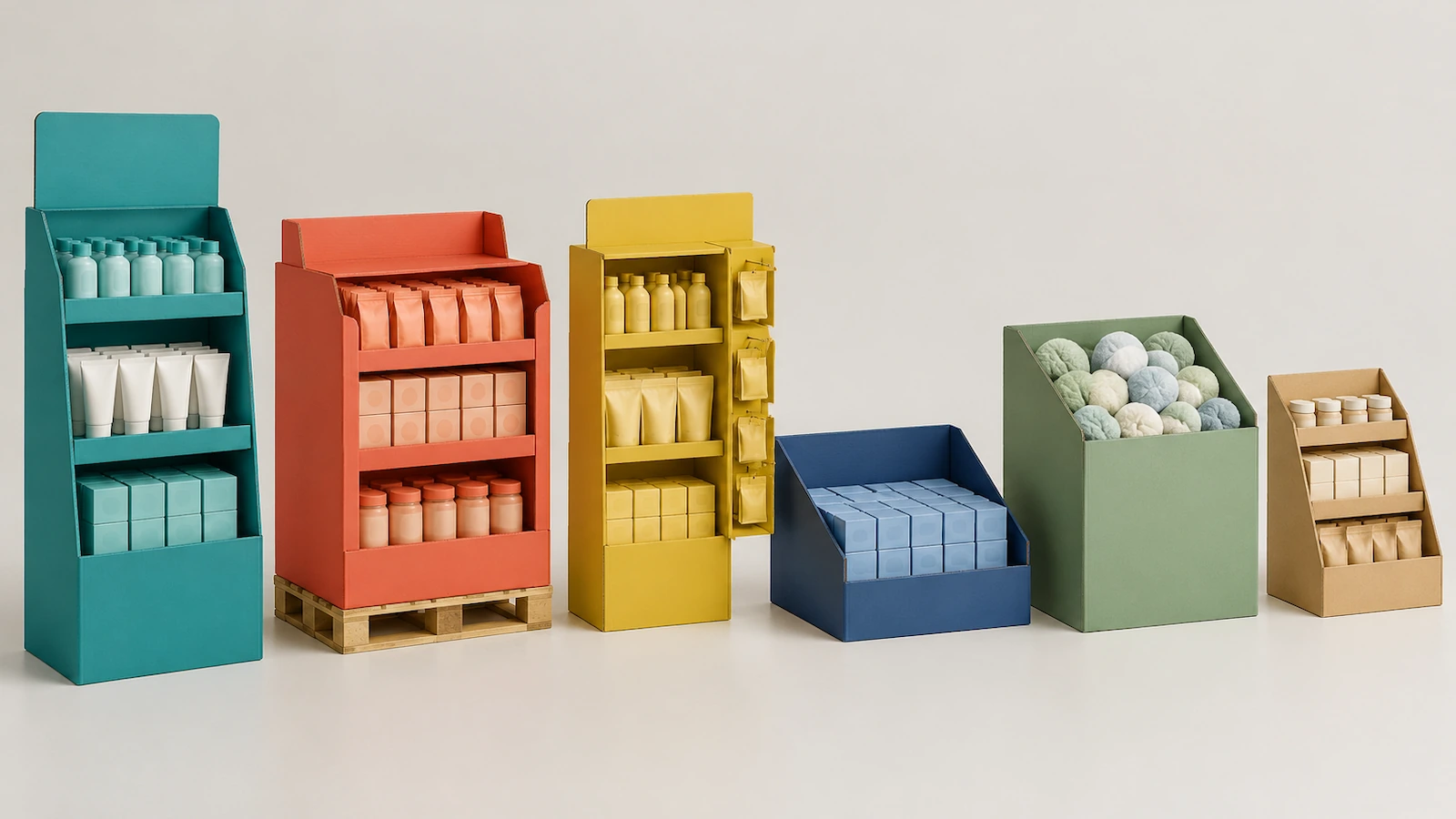
Retail display boxes are printed paperboard or corrugated structures that hold, present, and often ship product at the point of purchase. Many double as the shipping container. The product leaves the factory packed inside the unit, and store staff open it, remove a tear-away panel, and place it on the floor, shelf, or counter. When the structure is mostly corrugated board, buyers usually call these cardboard display boxes. When the focus is on presentation, they are called product display boxes. The six formats below share the same materials but differ sharply in footprint, load path, and store labor.
Floor displays: Freestanding shelved units, usually with a header panel. They are often shipped flat or partly assembled and stand in open floor space or near aisle entrances.
Pallet displays: Full, half, or quarter pallet units shipped fully loaded and rolled straight onto the sales floor. Shoppers can usually reach them from all four sides.
Endcap and sidekick units: Endcap units fill the end of a gondola aisle. Sidekicks are slim units that hang from or attach to the side of an endcap or fixture.
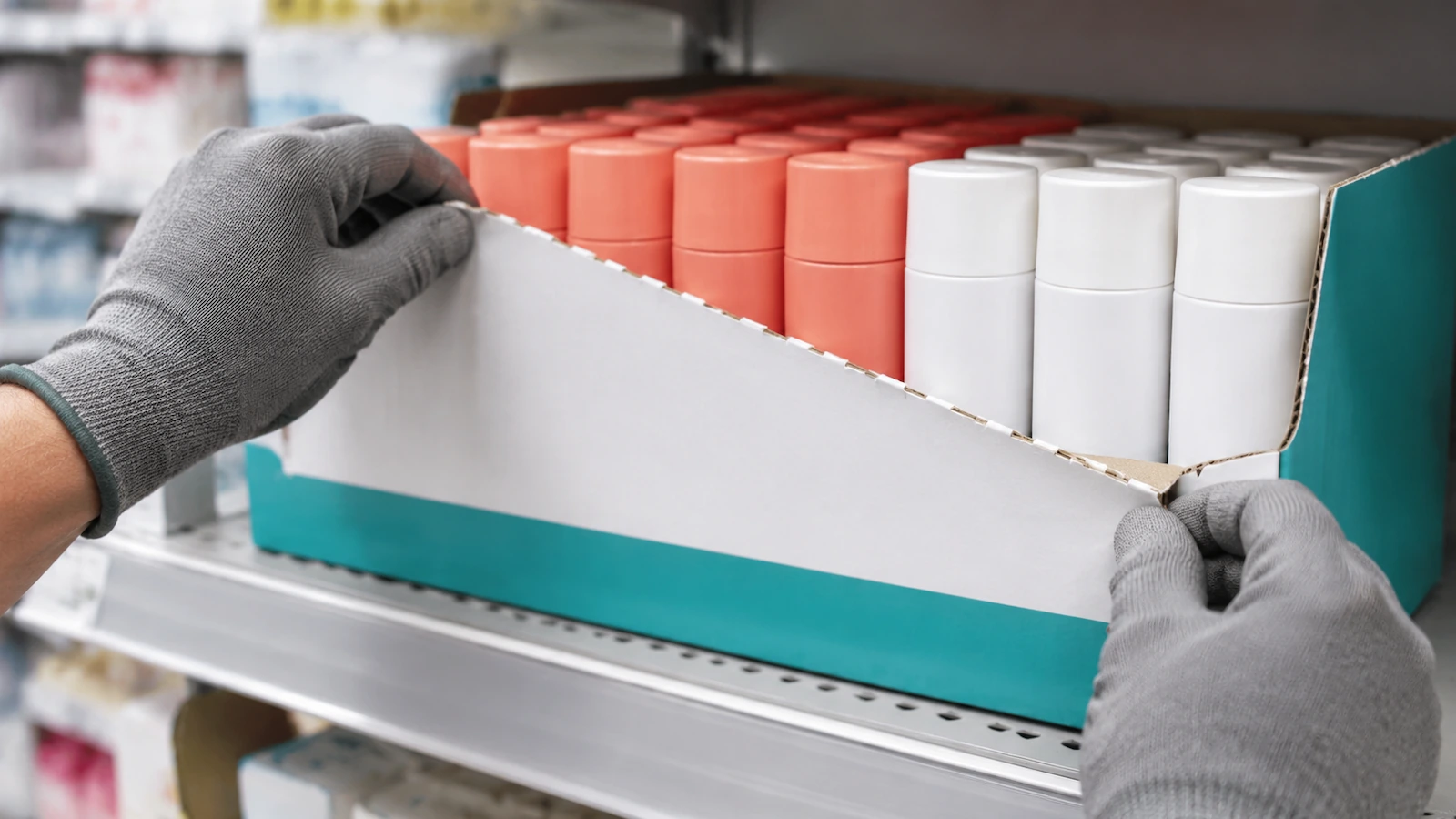
Shelf-ready trays (SRP/PDQ trays): Shipping cases with a tear-away front or lid. The bottom stays on the regular shelf as the display.
Dump bins: Open bins for loose, bulk, or irregularly shaped items. Shoppers reach in from the top.
Counter units: Compact trays or tiered boxes for checkouts and service counters. They suit small, low-ticket items.
The category is large enough that retailers have formal rules for it. Mordor Intelligence estimates the global point-of-purchase display market at USD 17.14 billion in 2026, growing to USD 22.23 billion by 2031 (5.35% CAGR). Corrugated material accounted for 35.05% of the market in 2025 POP display market estimate[3]. These figures cover all POP displays, not boxes alone, so treat them as context rather than a size for any single format.
A note on sales-lift claims: the widely quoted figure that POP displays lift sales 32% comes from a 2014 SHOP!/POPAI study of mass-merchandise channels. It is historical data. Checkout behavior has changed since then, and we found no recent public study that reproduces it. Use your own pilot data instead.
How to Match a Display Format to Your Program in Six Steps
Step 1: Start from the store location, not the box
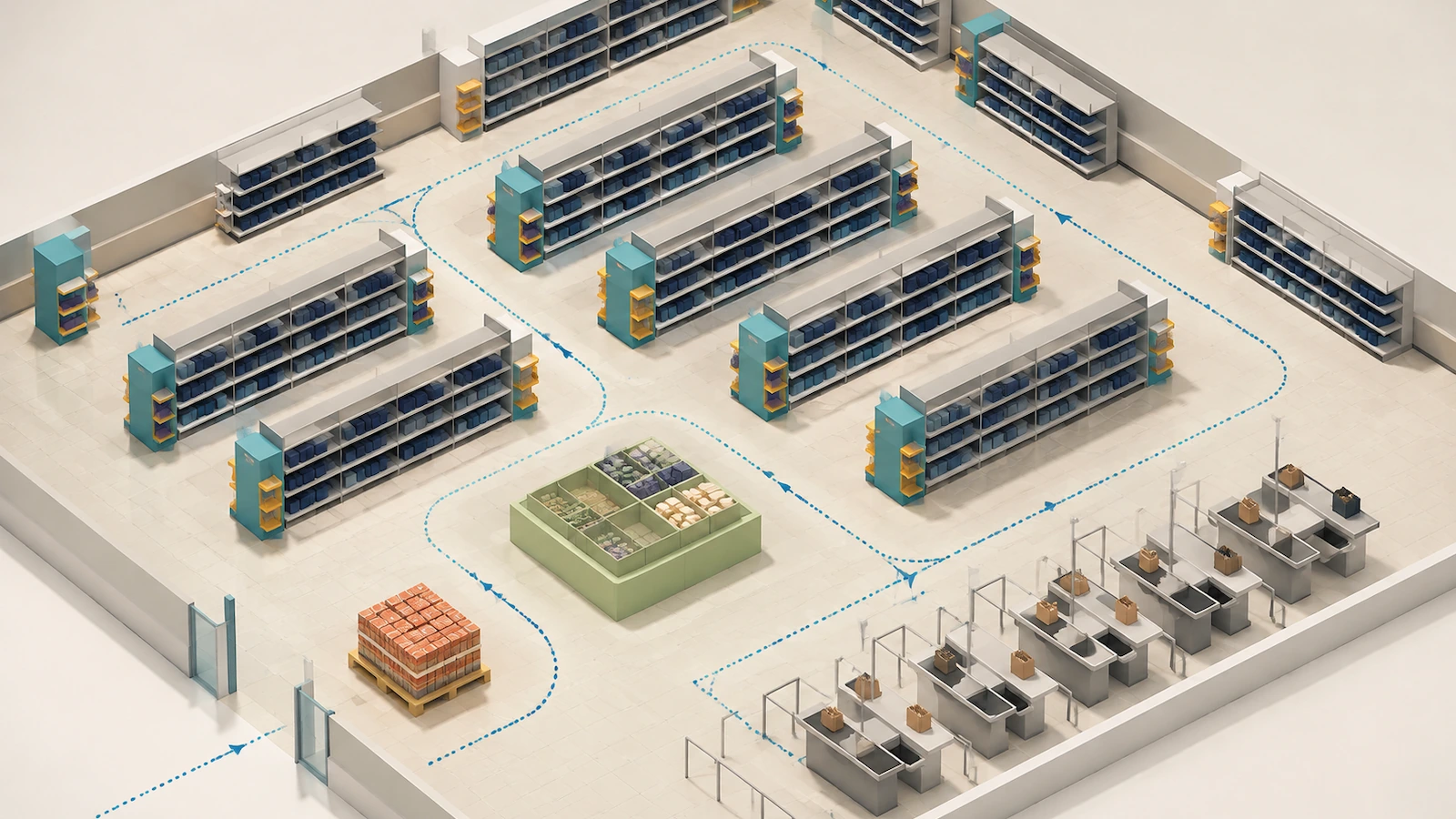
Each zone of a store favors one or two formats:
Entrances and main aisles: pallet and floor displays.
Aisle ends: endcap units and sidekicks.
Regular shelf positions: shelf-ready trays.
Seasonal and center-floor areas: dump bins.
Checkouts, pharmacy counters, and service desks: counter units.
Before choosing a format, confirm whether you have actually secured that location. Secondary placements such as endcaps and floor spots are typically negotiated with the retailer, not assumed. If the placement is still unsecured, design for the regular shelf.
⚠️ Counter placement needs extra checking. Self-checkout and scan-and-go lanes can shorten the time shoppers wait at a traditional register. Older checkout research may not apply to your stores. Walk the actual checkout layout before committing to a counter program, and consider service desks or self-checkout exits as alternative locations.
Step 2: Get the retailer's written specification before any design work
Large retailers publish vendor packaging or display guides, and many changes can be avoided by reading them first. Ask your buyer or category manager for the current version. Confirm which of these items it covers:
Maximum footprint and height
Header position
Pallet type and overhang rules
Barcode and label location
How the tear-away must open
Whether assembly instructions must be printed on the unit
Who approves the prototype
The Walmart thread cited above shows what goes wrong without a spec. Associates describe perforations "barely scratched on" and "mummified in packing tape and DC stickers," which means staff have to cut units open [1]. Treat tear-away behavior after distribution-center handling as a written requirement, not an assumption.
Step 3: Classify the product by full-load weight and center of gravity
Weight drives the choice of format more than any other factor. Calculate three numbers:
Single-unit weight
Total weight when the display is fully loaded
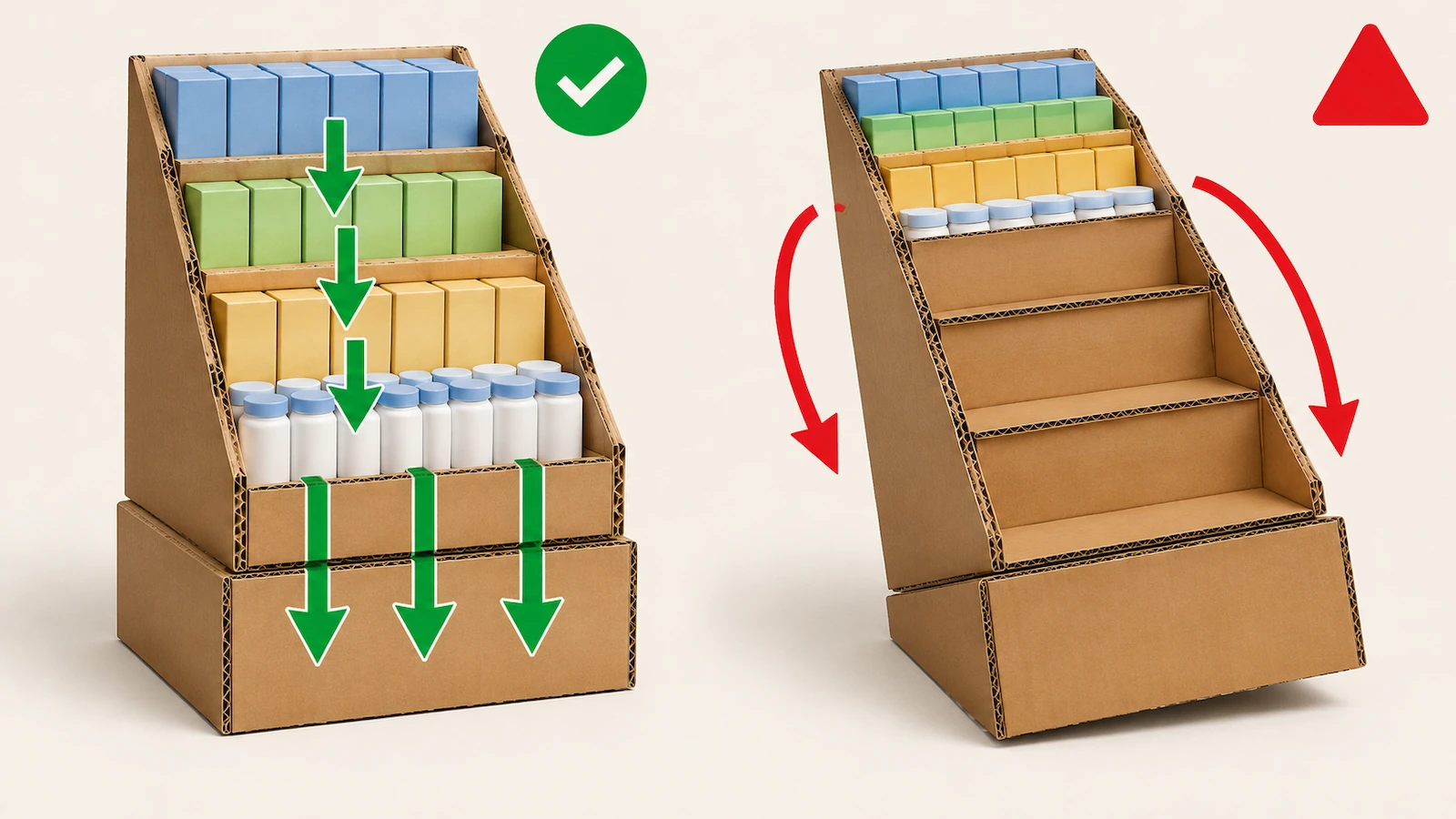
How the weight shifts as shoppers remove product
The third number explains many failures. A tiered unit that is stable when full can tip forward once the front rows are gone.
Match weight to format:
Light, single-serve items: counter units, sidekicks, and shelf-ready trays.
Mid-weight multi-packs: floor displays with reinforced shelves.
Heavy, liquid, or bulk products: pallet displays (the weight rests on the pallet deck) or dump bins with reinforced bases.
Two standards help you describe the board in neutral terms. ASTM D4727/D4727M-22[4] specifies corrugated and solid fiberboard sheet stock. ASTM D5118/D5118M-15(2020)[5] covers how fiberboard shipping boxes are manufactured. Compression (ASTM D642) and drop (ASTM D5276) tests can be used to plan validation. Passing one test does not make a whole display "ASTM certified." For counter units, the sizing and stability engineering is covered on our custom counter display boxes page.
Step 4: Match material life to the promotion window and the store environment
Corrugated formats work best for defined, short promotions such as seasonal launches, holiday windows, and trial programs. Longer placements need heavier board, coatings, or a permanent fixture. Also check the conditions in the store:
Humidity near produce or entrances
Condensation near chilled cases
Frequent shopper handling
Floor-cleaning routines
All of these shorten the life of paper-based units. A dump bin in a busy seasonal area wears out faster than a sidekick on a quiet endcap.
Plan the end of the display's life at the same time. The AF&PA Design Guidance for Recyclability[6] warns that barrier coatings and some adhesives can make paper hard for mills to recycle. Laminations or plastic windows chosen for durability can therefore work against recycling claims.
If a dump bin or open tray will hold unwrapped food, check the requirements in the FDA's food contact substances program[7] for the board, inks, adhesives, and coatings. Individually wrapped products fall under different rules.
Step 5: Decide who assembles, fills, and replenishes
Each format moves work to a different place:
Pallet displays and pre-packed shelf-ready trays: the labor moves upstream to the factory or co-packer. Store staff only unwrap and position the unit.
Floor displays shipped flat: freight volume is lower, but store staff must assemble them, and headers and shelf locks are easy to skip.
Dump bins: need ongoing refills from case stock.
Counter units: empty quickly in busy locations.
Write down who refills each unit, how often, and what happens to it after sell-through. A display that cannot be refilled easily will stand empty while still taking up its paid location.
Step 6: Shortlist suppliers by experience with that specific format
Only now should you request quotes. Ask each candidate for:
A loaded physical sample of the same format, not a 3D rendering
Evidence that a similar unit has passed retailer approval
Material and board-grade documentation
For FSC claims, the certificate and confirmation that it covers the producing facility
A supplier that is strong at counter units may have no pallet-display experience, and the reverse is also true. Detailed sampling, quality control, and landed-cost comparison for counter programs are covered in the counter display buying guide.
Retail Display Boxes Compared: Which Format Fits Which Job?
Use the table to narrow your options to one or two formats before you write a brief. Load tolerance and promotion fit are relative rankings for typical corrugated builds. They are not engineering limits. Confirm actual limits with a loaded sample.
Counter space limits, self-checkout traffic, tipping as it empties
Quick rules of thumb:
Heavy product and a confirmed club-store slot: start with a pallet display.
Everyday shelf SKU with no secondary placement: a shelf-ready tray is usually the only realistic format.
Small item with an approved counter location: a counter unit gives the lowest-cost test.
Program that must last beyond one promotional cycle: price a sturdier or permanent alternative next to corrugated before deciding.
FAQ
FAQ: What is the difference between a PDQ, a shelf-ready tray, and a counter display?
PDQ ("pretty darn quick" or "product displayed quickly") describes how a unit is used: it arrives pre-packed and goes on display almost immediately. A shelf-ready tray is a PDQ that sits on the regular shelf. A counter display is a PDQ or tray sized for checkouts and service counters. One unit can fit all three labels, which is why you should use the retailer's own term in your brief.
FAQ: Are cardboard display boxes recyclable, and what is the recycling rate?
Plain corrugated is widely recyclable, but coatings, laminations, plastic windows, and some adhesives can complicate repulping [6]. AF&PA reports a 2024 U.S. recycling rate of 69% to 74% for old corrugated containers under its updated method 2024 U.S. paper recycling rates[8]. The often-quoted 91.4% figure from 2021 used an older method, so the two numbers cannot be compared as a trend.
FAQ: Does FSC certification mean my display is recyclable?
No. FSC chain-of-custody certification[9] verifies where the fiber came from and how it was tracked through the supply chain. Whether a display is recyclable depends on its construction and on local collection systems. Ask for the certificate and confirm it covers the facility that actually produces your units.
FAQ: Which format works best for heavy products?
Pallet displays are usually the safest choice because the product weight rests on the pallet deck, not on paperboard shelves. Dump bins with reinforced bases come second. Counter units and sidekicks are designed for light items. Whatever you choose, test a fully loaded unit and a partly emptied unit, since emptying the front rows changes the center of gravity.
FAQ: Do counter displays still work in stores with self-checkout?
Sometimes. Self-checkout and scan-and-go can reduce how long shoppers wait at a register, and no current public study measures the effect on corrugated counter units. Run a small pilot comparing similar stores, and test service desks and self-checkout exits as alternative locations before rolling out widely.
FAQ: Do packaging regulations apply to temporary displays?
They may. The EU Packaging and Packaging Waste Regulation (EU) 2025/40[10] entered into force on February 11, 2025 and has applied generally since August 12, 2026. In the U.S., as of October 1, 2025, seven states had enacted packaging EPR (extended producer responsibility) laws: Maine, Oregon, Colorado, California, Minnesota, Maryland, and Washington state EPR law map[11]. Whether display material counts toward your reporting depends on each state's definitions. Check with the state or the relevant producer responsibility organization.
FAQ: How do I know whether a display program is worth it?
Measure baseline sales in comparable stores, run the display in a test group, and compare incremental gross margin against the full program cost. Do not rely on the 2014 lift figures. The calculation framework for counter programs is on our counter display product page.
Key Takeaways
Corrugated is the leading material in POP displays, so retailers have formal rules for it. — 35.05% of the 2025 POP display market by material; USD 17.14 billion total market in 2026 (Source)
Tear-away failure is a format-level risk you can see in store feedback. — Associates in a 2019 r/walmart thread describe perforated PDQs they had to cut open (Source)
Describe board grade with a published standard, not adjectives. — ASTM D4727/D4727M-22 specifies corrugated and solid fiberboard sheet stock (Source)
Recyclability claims need the current method and year. — 69% to 74% U.S. OCC recycling rate in 2024, not comparable to the older 91.4% figure (Source)
Packaging rules now cover display material in more markets. — EU PPWR has applied generally since August 12, 2026 (Source)
U.S. EPR exposure depends on the states where you sell. — 7 states had enacted packaging EPR laws as of October 1, 2025 (Source)
Conclusion
Choosing among retail display boxes is a matching exercise. Confirm the placement, read the retailer's specification, weigh the fully loaded unit, and size the material to the promotion window. Once those four are settled, the right format is usually clear and supplier selection becomes simpler. If your program points to a checkout or service-counter unit, share your product dimensions, weights, retailer specification, and launch date on our custom counter display boxes page, and we will respond with a structural recommendation and a quote.
Footnotes
r/walmart, "Oh perforations, let me try to open this without…", associate discussion, posted 2019-10-19. reddit.com. Retrieved 2026-07-28. ↩
r/walmart, "And the award for worst PDQ design goes to…", posted 2023-07-06. reddit.com. Retrieved 2026-07-28. ↩
Mordor Intelligence, POP Display Market: 2025 to 2031 estimates. Market-wide POP figures, not specific to display boxes. mordorintelligence.com. Retrieved 2026-07-28. ↩
ASTM International, D4727/D4727M-22, Standard Specification for Corrugated and Solid Fiberboard Sheet Stock. astm.org. Retrieved 2026-07-28. ↩
ASTM International, D5118/D5118M-15(2020), Standard Practice for Fabrication of Fiberboard Shipping Boxes. astm.org. Retrieved 2026-07-28. ↩
American Forest & Paper Association, Design Guidance for Recyclability, May 2022. afandpa.org (PDF). Retrieved 2026-07-28. ↩
U.S. Food and Drug Administration, Packaging & Food Contact Substances (FCS). fda.gov. Retrieved 2026-07-28. ↩
American Forest & Paper Association, "Paper Industry Announces 2024 U.S. Paper Recycling Rates," 2025. Uses the updated methodology. afandpa.org. Retrieved 2026-07-28. ↩
Forest Stewardship Council, Paper & Packaging for businesses. fsc.org. Retrieved 2026-07-28. ↩
European Commission, Packaging and Packaging Waste Regulation (EU) 2025/40. environment.ec.europa.eu. Retrieved 2026-07-28. ↩
Product Stewardship Institute, EPR Laws Map. State status as of 2025-10-01; recheck before making compliance claims. productstewardship.us. Retrieved 2026-07-28. ↩
Hi there! I'm Bruce, proud dad to my amazing son. I'm the founder of Zigpac, a printing and packaging company empowering small and medium-sized businesses with custom solutions. Let's create something great together!



 Blog PDF for offline reading













The information below is required for social login
Sign In
Create New Account