SEO title: Custom Tin Fridge Magnets | Stamped & Embossed Designs
Meta description: Plan custom tin fridge magnets for souvenirs and promotions. Compare embossed designs, magnetic backing, sample checks, packaging, and quote requirements.
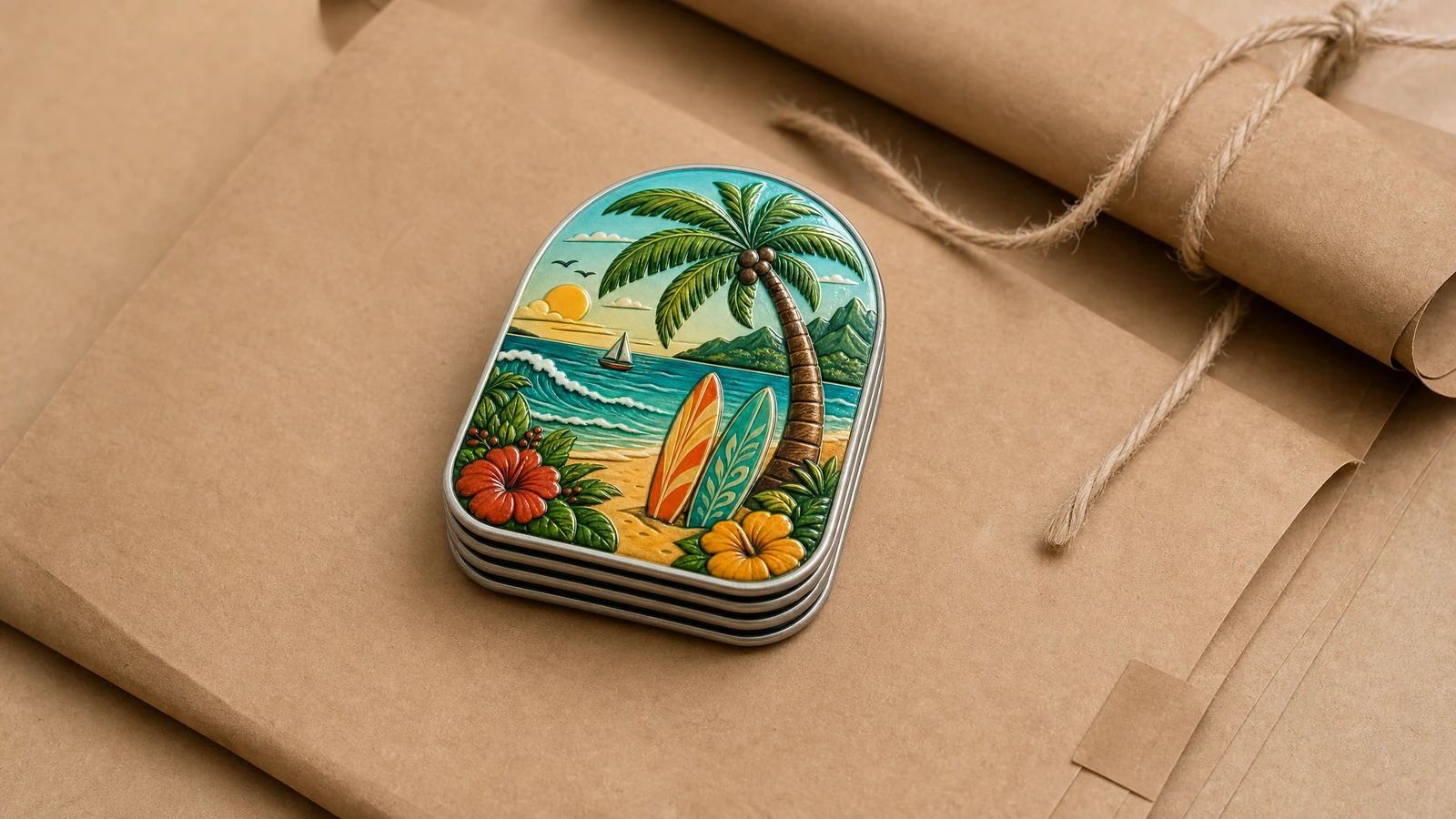
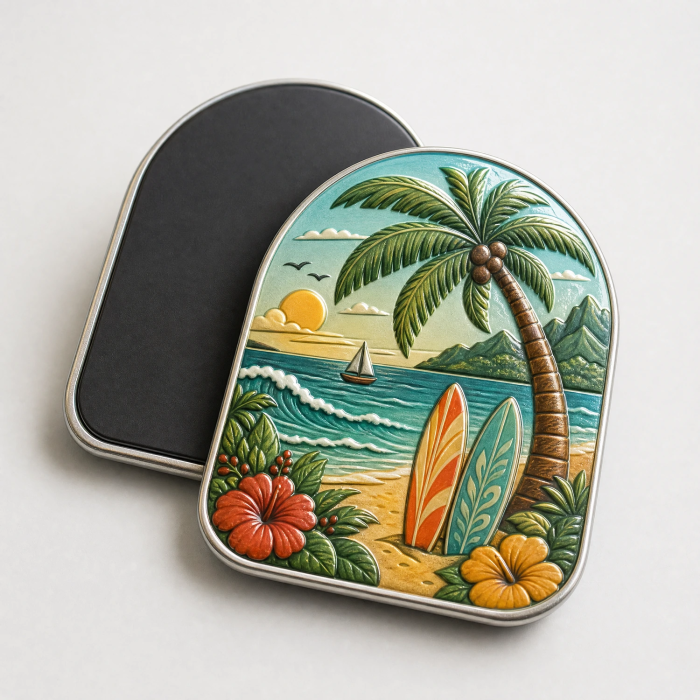
Custom tin fridge magnets combine a shaped tinplate face with magnetic backing for personalized souvenirs, branded gifts, and retail collections. This stamped and embossed product format brings raised detail to your artwork. Final dimensions, finishes, backing, pricing, minimum order quantity, and delivery timing require a project-specific quotation and approved sample.
For souvenir buyers, museum shops, promotional distributors, and brand teams: develop a destination design, recognizable logo, or coordinated collection around a metal face rather than choosing artwork alone. The right brief connects appearance with the intended display surface, packaging format, and purchasing budget.
A magnet can look convincing in an online preview yet disappoint when delivered. Small lettering may become difficult to read, raised artwork may not match the intended effect, or the finished piece may slide on its intended surface. Those problems leave retailers handling complaints and campaign teams distributing an item that does not perform as expected.
The practical solution is to approve the complete construction: artwork, relief, edges, magnetic attachment, and packaging. Start with the display purpose, turn each expectation into a sample check, and compare quotations against that same specification. This makes the purchasing decision about an agreed product, not competing descriptions of “premium quality.”
Explore this product and buying guide
What makes this stamped tinplate format different? ↑
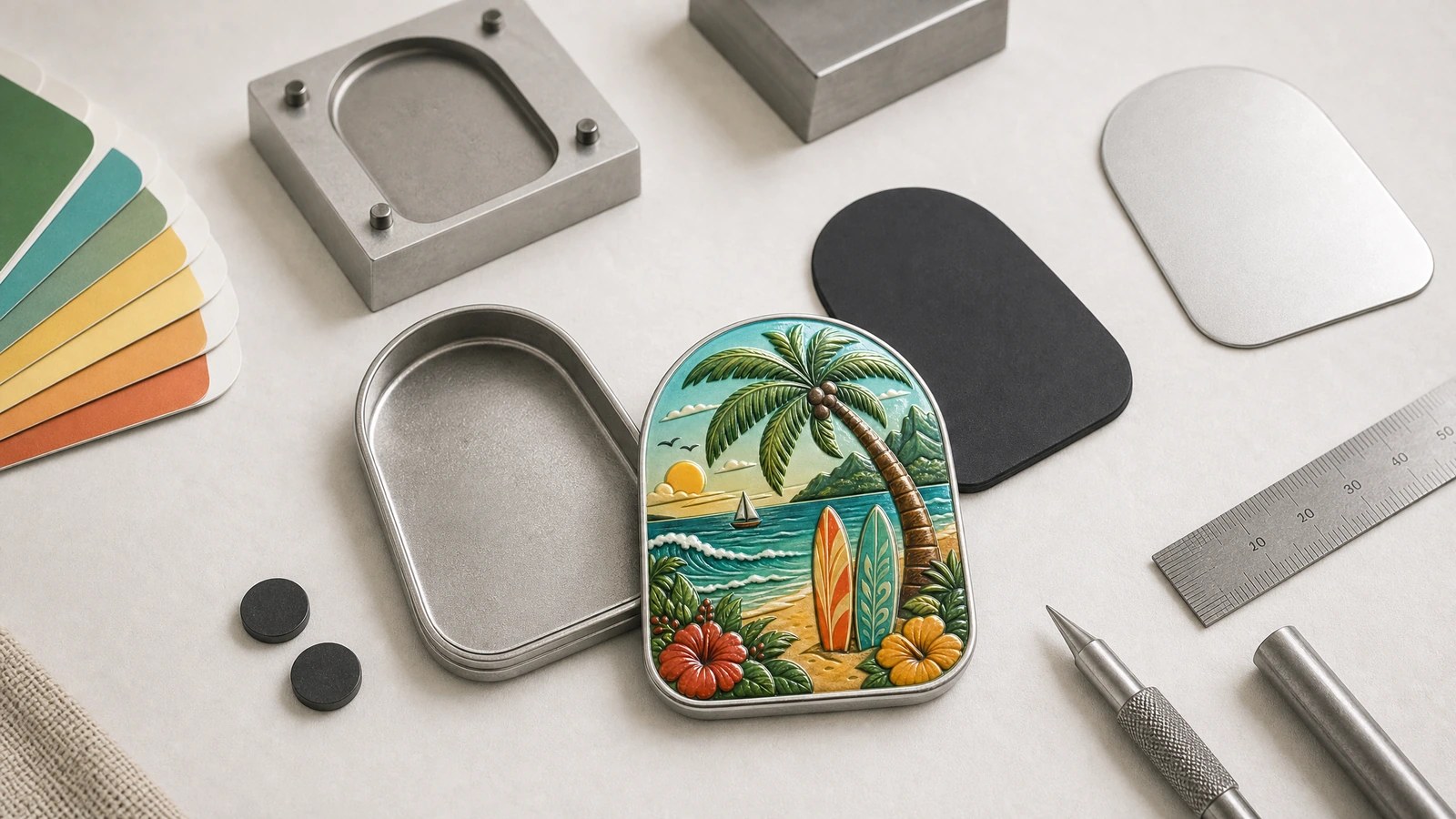
Tinplate means tin-coated steel, not a solid piece of pure tin. For this product, the defining features are the stamped metal construction and embossed decoration. The face provides the visual design; a separate magnetic backing provides attachment. These are different components with different approval requirements.
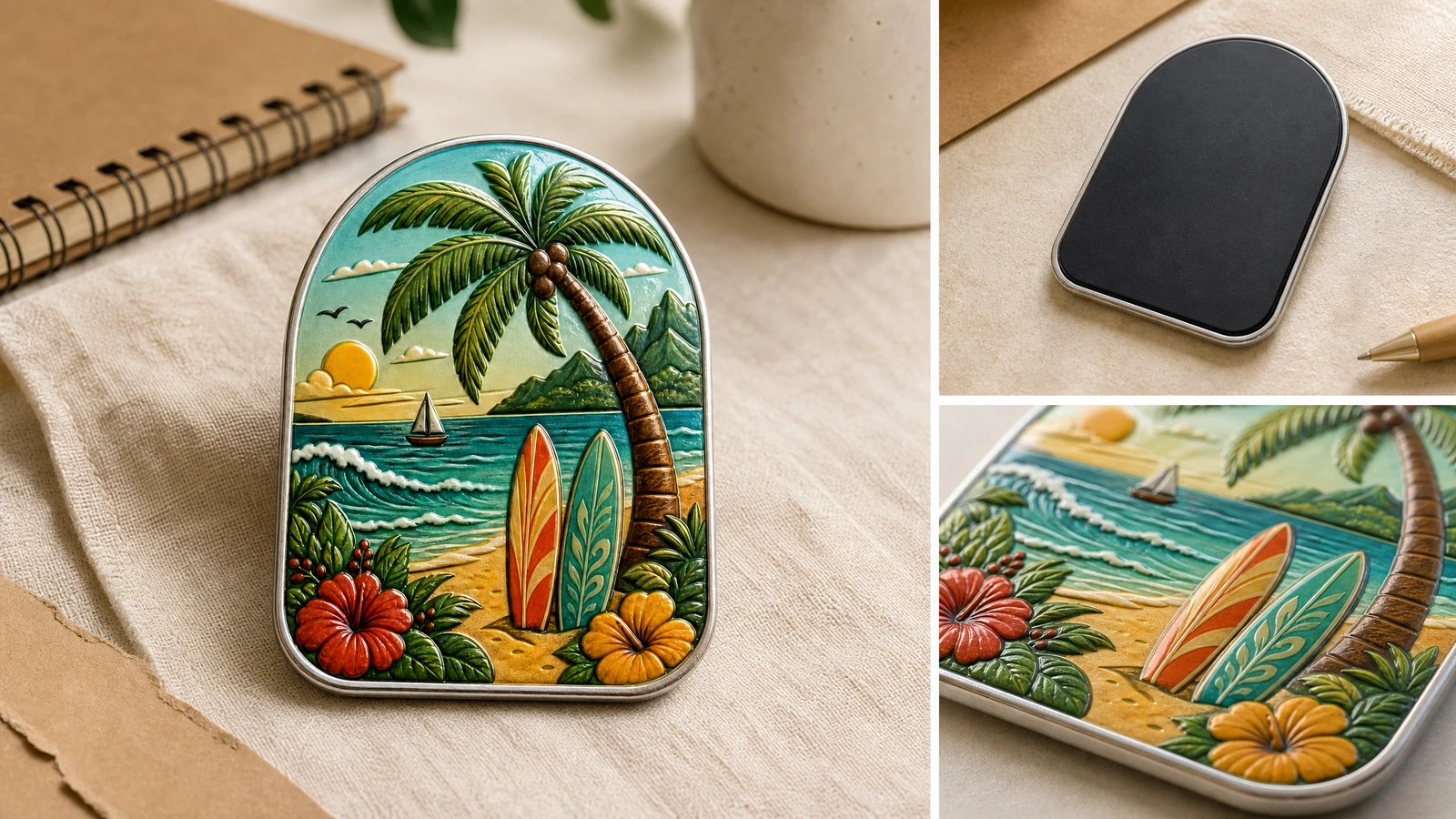
Embossing creates raised detail instead of relying entirely on a flat printed image. That makes the format worth considering for a landmark outline, a prominent emblem, or a design where surface relief matters. However, a detailed illustration is not automatically suitable for the same treatment: the proposed relief and its relationship to the printed artwork need physical sample review.
The broader category also includes paper-wrapped tin magnets. For example, Jin Sheu’s published construction[1] uses printed paper over a metal sheet with magnetic backing. That is a supplier-specific example, not the construction specification for this stamped and embossed product. Do not transfer its material thickness, stock sizes, or order terms into your purchase order.
Product reference: Custom Stamped and Embossed Tinplate Fridge Magnets, provisional SKU NSKU-741-02, within Custom Magnets / Custom Metal Fridge Magnets. No product-specific factory measurements or test results are supplied for this reference. The checklist below therefore identifies what to specify and verify rather than presenting untested performance as established fact.
Turn your application into a clear specification ↑
Match the design to the buying occasion
For tourism retail, prioritize recognizable imagery and a destination name that remains readable on the finished piece. For a museum collection, identify the detail that must survive reduction. For promotional distribution, decide whether the main purpose is logo display, contact information, or a useful reminder. Trying to give every element equal emphasis makes sample approval harder.
Collection buyers should specify which features stay consistent across designs: outer shape, visual scale, relief treatment, or packaging. Separate those shared requirements from artwork-specific changes. Ask whether each design needs separate tooling or setup and whether the minimum order applies per design rather than across the combined order.
Choose dimensions by readability, not the screen preview
Record finished width and height in millimeters, then review the artwork at that physical size. Distinguish the outer dimensions from the usable design area. Borders, shaped edges, and raised features can leave less space for lettering than a flat digital mockup suggests.
Keep critical text and logos away from the proposed forming boundary. Ask for a production template before finalizing placement; do not assume that another supplier’s bleed or safe-area settings apply. Where a QR code is requested, assess scanning on the finished sample rather than relying on the original digital file.
Specify the face and magnetic backing separately
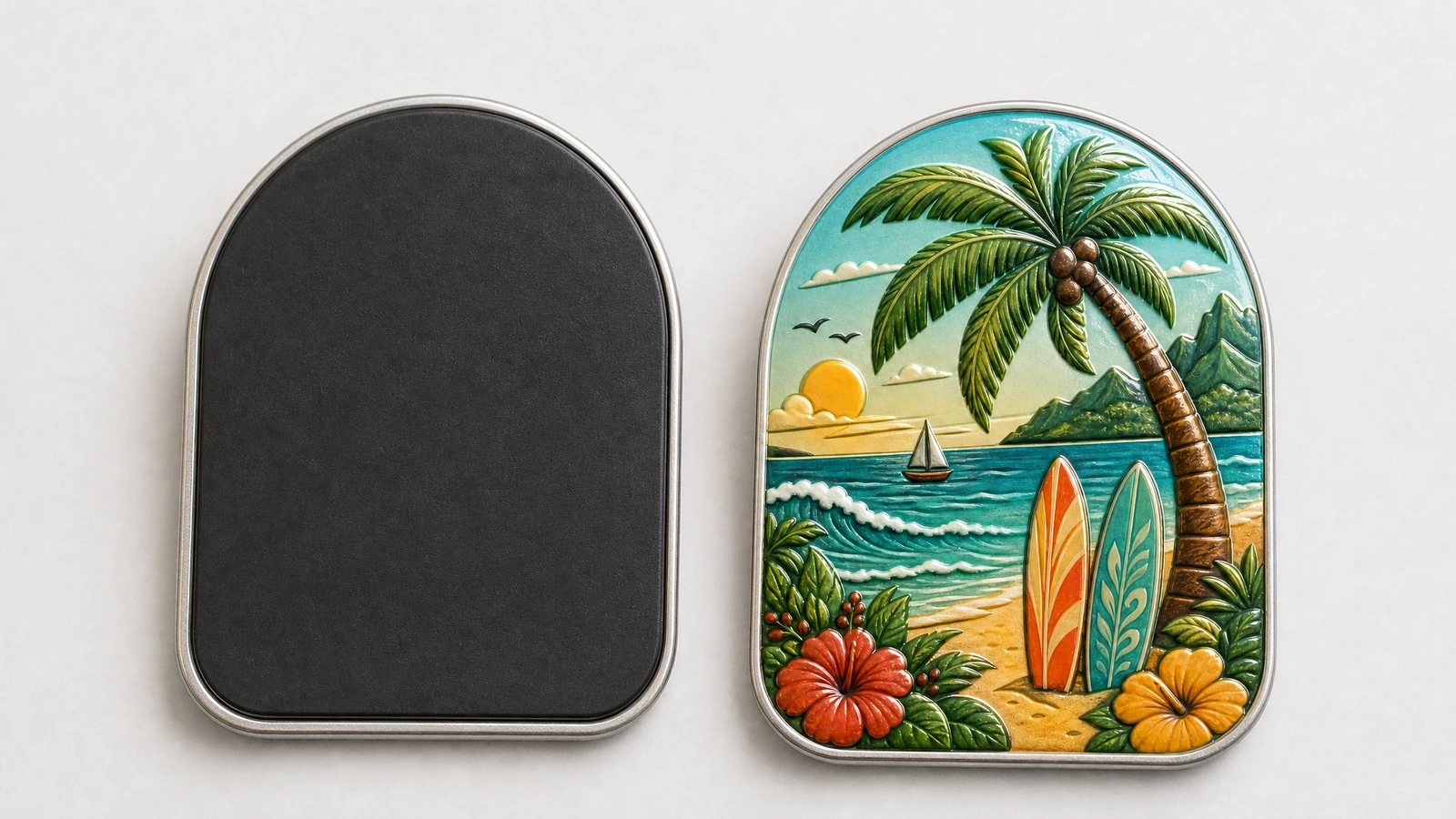
Describe the desired face treatment using a visual reference: printed detail, raised areas, and preferred surface appearance. Gloss, matte, metallic effects, or other treatments should be quotation requests, not assumed inclusions. Availability and the effect on fine detail need confirmation for the chosen construction.
For the back, request the magnetic material, thickness, coverage, and attachment method. A full-area magnetic sheet and a localized magnetic component are different constructions; neither should be selected from a photograph alone. Ask how the proposed backing works with the finished shape and weight, and have that assembly sampled.
Do not confuse fridge-magnet backing with badge hardware. Pin posts, butterfly clutches, and similar fasteners are not part of the verified product identity. Any alternative attachment would need a separate specification.

How do you prepare artwork for sampling? ↑
Prepare artwork that explains both the printed image and the intended physical relief. A single flattened picture may communicate color while leaving the embossing ambiguous. Mark which elements should be raised, which should remain flat, and where the design must align with the outer shape.
- Provide the design source. Supply available AI or PDF artwork for review, with image files for photographic elements. Confirm accepted production formats before treating a preview file as print-ready.
- Identify essential details. Highlight small lettering, logos, faces, and architectural features that must remain recognizable after forming.
- Provide color references. Specify whether approval depends on a brand color reference or the overall appearance of the physical sample.
- Separate relief instructions. Mark the proposed embossed areas clearly so that printed shading is not mistaken for a request for raised metal.
- Check the complete layout. Review the front, reverse, orientation, packaging artwork, and any retail information together.
For raster artwork, the supplied research recommends at least 300 DPI at final size as a starting point for preflight. That does not guarantee print quality: source sharpness, reproduction scale, the selected print process, and the finished surface still require review. Increasing a file’s resolution setting alone does not repair missing image detail.
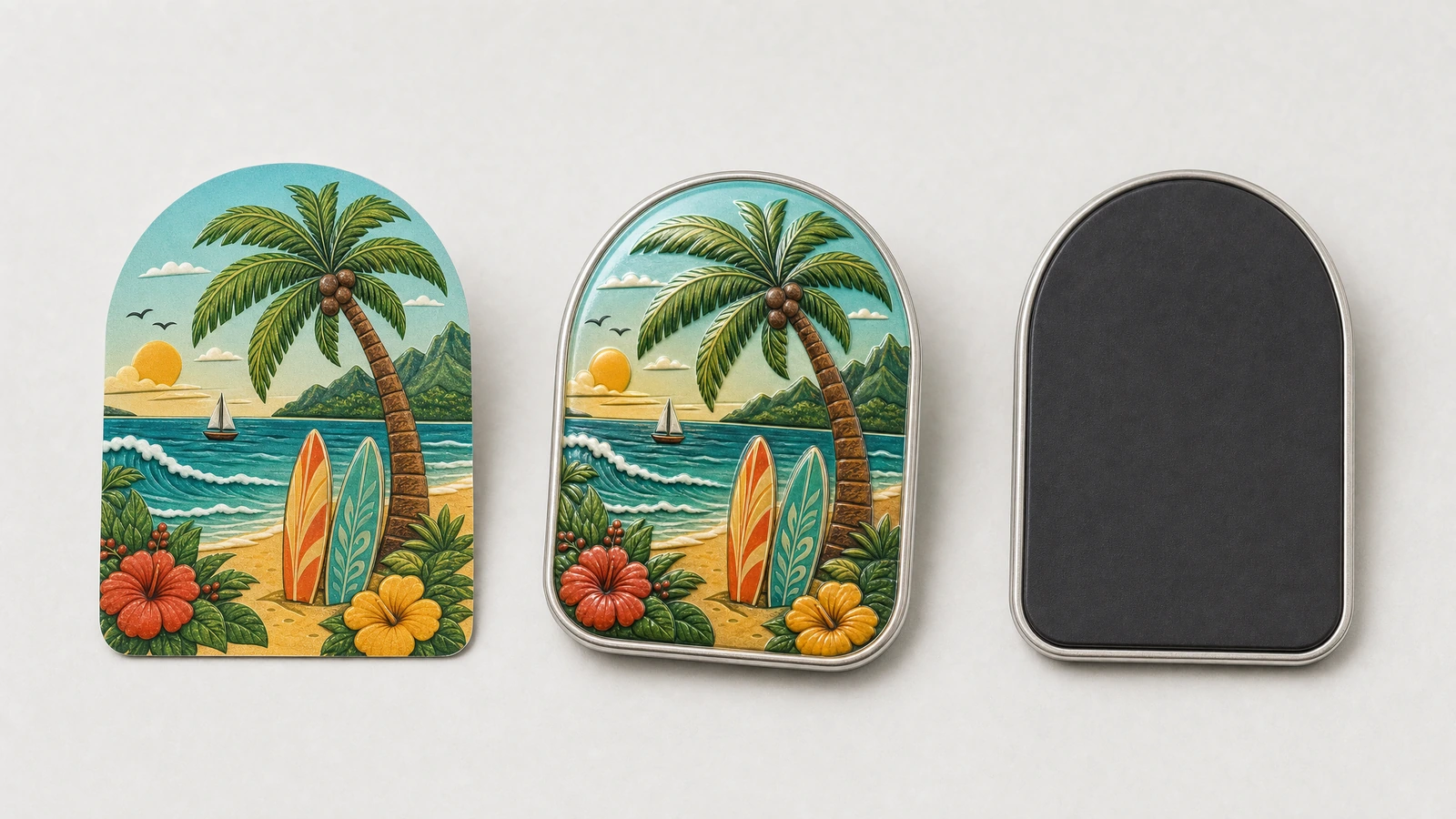
Use the digital proof to approve content and placement. Use the physical sample to approve color appearance, relief, edges, and assembly. Keep the final approved file version with the sample reference so a later artwork change cannot silently become part of the production order.
Approve the construction before production ↑
A useful production discussion follows the product from material selection through decoration, forming, magnetic assembly, inspection, and packing. The precise sequence depends on the agreed construction. Treat this as a review framework, not a statement that a particular factory uses an independently verified process.
| Review stage | What to establish | Approval evidence to request |
|---|
| Material and tooling | Tinplate specification, outer shape, and embossed design | Agreed drawing and itemized tooling scope |
| Decoration | Print method, color reference, and surface treatment | Physical appearance sample |
| Forming | Relief definition, edge condition, and artwork alignment | Close-up views and finished sample inspection |
| Magnetic assembly | Backing construction, coverage, and attachment method | Complete assembled sample and agreed checks |
| Packing | Individual protection, separation, and carton arrangement | Packed sample representative of the proposed shipment |
Each stage should answer a purchasing question. If the backing changes after approval, revisit attachment testing. If the artwork or relief changes, revisit appearance approval. An approval for one construction should not be treated as permission to substitute a different material or assembly.
Separate sampling, sample revisions, production, and transport in the schedule. Ask what starts each period and which approvals must be complete first. Published timelines for unrelated stock magnets do not establish a delivery commitment for a new embossed design.
What should the sample inspection cover? ↑
Test attachment on the intended surface
Check the actual refrigerator door, cabinet, or display panel before specifying a holding requirement. Not every stainless-steel surface accepts a magnet, and a metallic appearance does not establish compatibility. A stronger backing is not a substitute for checking the target surface.
Holding capacity, paper count, and suitability for a particular load depend on physical dimensions, loading conditions, and sample validation. No measured holding capacity is established for this product. If holding a photo or document is part of the brief, include that exact use in the sample test.
Record the surface, magnet orientation, inserted material, load, observation period, and any movement. Agree on acceptance criteria before testing. This produces a reproducible check instead of a vague conclusion that the magnet “feels strong.”
Inspect appearance, bonding, and contact surfaces
- Appearance: compare color, image clarity, print-to-relief alignment, and border placement with the approved sample.
- Dimensions: measure finished width, height, and relevant thicknesses against the agreed drawing and tolerances.
- Edges and reverse: look for rough areas, exposed edges, contamination, or damage that could affect handling or the display surface.
- Assembly: inspect for lifting corners, loose backing, and visible separation after the agreed handling checks.
- Environmental exposure: request suitable humidity, heat, abrasion, or light-exposure testing where the intended use requires it; do not infer durability from a coating name.
Specify ordinary indoor display unless another environment has been evaluated. Avoid describing the product as waterproof, scratch-proof, rust-proof, or suitable for outdoor use without supporting tests. For care, keep contact surfaces clean and dry, use a soft cloth, and avoid dragging the magnet across trapped grit.
Include magnet retention in the safety review
A decorative purpose does not remove the need to assess detachable components. CPSC explains that swallowed magnets can attract internally and cause serious injury in its magnet safety guidance[2]. Include backing retention and the intended audience in the review, particularly for designs likely to attract children.
Agree on inspection records and defect handling before shipment. Define what happens when delivered goods differ from the approved sample, what evidence is needed, and how claims will be handled. Do not assume a replacement policy or warranty that has not been included in the order terms.
Compare materials, costs, and delivery requirements ↑
Choose the format around the design objective
| Format | Consider it for | Questions to resolve through samples |
|---|
| Stamped and embossed tinplate | A metal face with raised graphic detail | Is the relief clear, is the artwork aligned, and are the edges acceptable? |
| Flexible printed magnet | A flat graphic, contact card, or schedule | Does the complete construction stay flat and attach adequately? |
| Soft PVC or rubber-style magnet | Molded character shapes and colored relief | Are fine details, material feel, and backing retention suitable? |
| Acrylic magnet | A clear-layer or cut-shape visual treatment | Are edge quality, scratching, and breakage risks addressed? |
| Resin or epoxy-style magnet | Sculpted decoration or a domed surface | Is the finish consistent, and does packaging protect the shape? |
| Wooden magnet | Visible grain, engraved artwork, or a natural visual theme | Are appearance variation, surface finishing, and moisture exposure acceptable? |
This comparison separates design choices from performance claims. Face material alone does not establish magnetic strength, service life, child safety, or environmental benefit. Compare complete products with the same intended use rather than assigning a universal quality ranking to materials.
Compare the complete order cost
Request separate figures for unit price, tooling, sampling, artwork setup, packaging, testing, and transport. Identify the quotation currency and shipping basis, including which charges are excluded. A low advertised unit price for a flat stock design is not a reliable budget for custom embossed tooling.
Minimum order quantity, production time, unit weight, and available dimensions are not verified for this product reference. These remain quotation or measurement items. Ask for quantity breaks against an unchanged specification so a price reduction is not achieved through an undisclosed change in backing or finish.
Make packaging part of the product approval
Plan protection for both the decorated face and formed edges. Ask for a packed sample showing how pieces are separated and restrained. Evaluate the proposed package for rubbing, bending, denting, and damage during the expected distribution route rather than selecting packaging only by appearance.
For repeat orders, retain the approved sample, artwork version, construction specification, and packaging reference together. Confirm whether tooling is retained and whether a revised quotation changes any component. This gives the next order a concrete reference without assuming permanent pricing or automatic repeatability.
Request evidence for safety and environmental claims
Determine the intended audience, destination market, and applicable product classification before requesting compliance documentation. No certification, regulatory approval, or product-specific laboratory report is established here. Supplier badges and reports for a different material or design are not evidence for the ordered construction.
For environmental wording, distinguish the metal face from the complete assembly. Do not describe the finished magnet as universally recyclable, recycled-content, biodegradable, or “eco-friendly” without supporting documentation and a relevant disposal route. Packaging claims should be assessed separately from the magnet itself.
Key takeaways for a better purchasing decision ↑
- Approve the relief as well as the print. — A physical sample should establish raised detail, alignment, edges, and finished appearance.
- Attachment is a test requirement, not a material promise. — Holding capacity depends on physical dimensions, loading conditions, the target surface, and sample validation.
- Commercial terms remain project-specific. — Obtain confirmed MOQ, production timing, measured unit weight, and an itemized quotation for the selected construction.
- The U.S. magnet threshold is conditional, not a blanket certification. — For products within the scope of the magnet rule, loose or separable magnets that fit entirely inside the small-parts cylinder must have a flux index below 50 kG² mm² (Source[3]). CPSC separately identifies toys governed by the mandatory toy standard; classification must precede the testing decision.
Start with a quote-ready product brief ↑
Custom tin fridge magnets are a format to consider when your design calls for a shaped metal face and embossed detail. The purchasing decision becomes clearer when the artwork, backing, sample checks, and packaging are specified together. That approach preserves the intended appearance while making cost and acceptance criteria explicit.
Request a project-specific quote with your artwork, preferred dimensions, quantity per design, intended display surface, packaging needs, delivery destination, and required arrival date.




The information below is required for social login
Sign In
Create New Account