Custom bamboo notebooks combine a bamboo cover with a personalized stationery concept for employee gifts, conferences, and client presentations. Choose the cover construction, paper, decoration, and packaging together. For this product, dimensions, available customization methods, minimum order quantity, pricing, and delivery timing require a product-specific quotation and sample confirmation.
A welcome gift should feel considered, and a meeting notebook should be useful after the presentation ends. Custom Bamboo Cover Notebooks offer a material-led starting point for HR teams preparing onboarding packs, marketers planning event merchandise, and businesses developing personalized client gifts.
The right specification depends on the recipient. Conference buyers need a convenient writing format and reliable delivery planning. Employee programs need enough usable paper for the intended purpose. Client gifts place more emphasis on the cover finish, readable branding, and presentation. None of these requirements is resolved by choosing a bamboo-looking photograph alone.
The purchasing problem: similar-looking notebooks can have different cover constructions, paper weights, sheet counts, and included accessories. An attractive mockup may conceal a smaller writing area, an unsuitable decoration method, or a pen that was never included in the price.
The consequence: those differences become expensive after personalization. A logo may lose detail, the paper may not suit the recipient’s pen, or the gift box may arrive without a required component. Replacement production can also put an event deadline at risk.
The practical solution: build the order around a written specification and an approved physical sample. Resolve material identity, artwork, writing performance, accessories, and shipment requirements before authorizing production—not after the finished notebooks arrive.
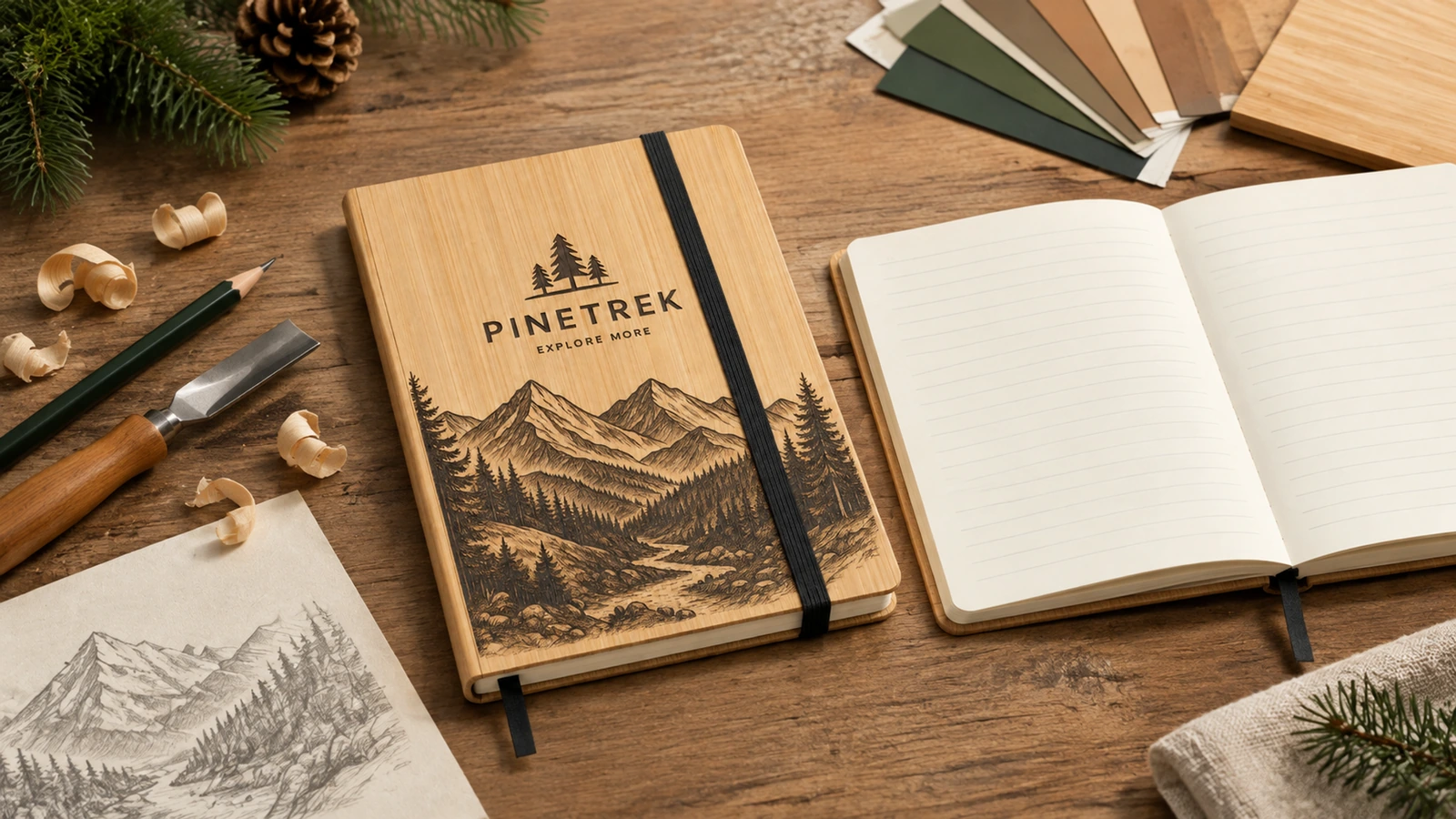
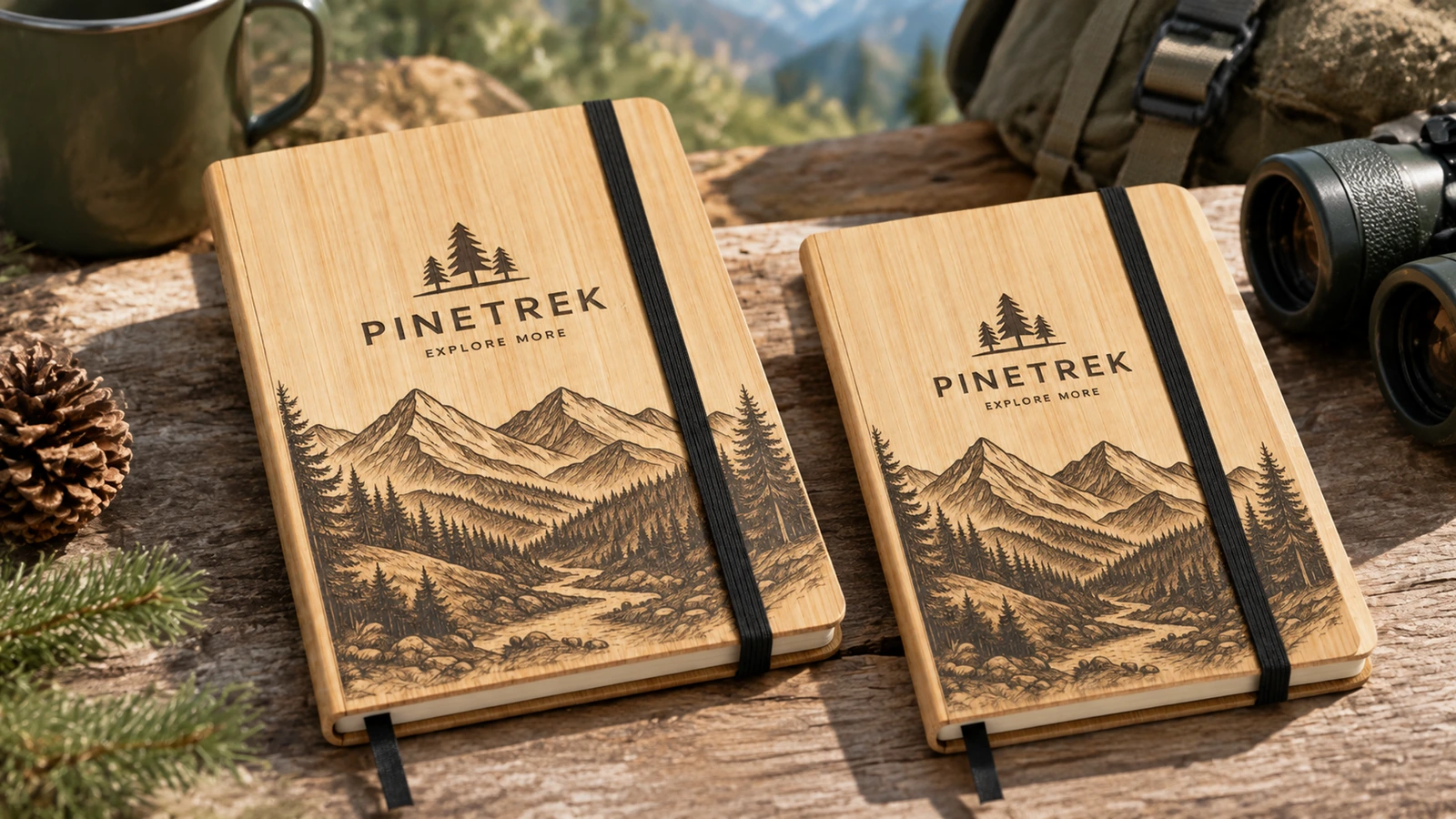
Illustrative application concept. Any pictured pen, packaging, closure, or interior layout must be specified separately; imagery does not establish included accessories or confirmed construction.
Explore the product and purchasing guide
What makes this a bamboo cover notebook? ↑
This product is identified as Custom Bamboo Cover Notebooks, within Custom Notebooks and Custom Wooden Notebooks. Its provisional reference is NSKU-764-02. Bamboo describes the cover identity; it does not establish that the inner pages are bamboo paper or that every component is bamboo.
The precise construction still matters. A bamboo board, a bamboo veneer over a supporting core, and a bamboo-fiber fabric cover are different specifications. The current product information does not establish the board structure, cover thickness, adhesive, or finish. These details need confirmation rather than substitution with another supplier’s specification.
Likewise, a bamboo cover does not imply erasable pages, a scanning app, refillable construction, or artist-grade paper. Those belong to separately specified products. A wood-grain synthetic cover should not be substituted without agreement or described as real bamboo.
| Specification field | Current product status | What the quotation or sample should establish |
|---|
| Product identity | Custom Bamboo Cover Notebooks | Matching product reference on quotation and approval records |
| Cover construction | Bamboo cover; detailed structure unconfirmed | Board or veneer construction, core, finish, and thickness in mm |
| Finished dimensions | To be specified | Cover and inner-page dimensions in mm; overall thickness |
| Paper and page count | To be specified | Paper composition, weight in g/m², layout, sheets, and pages |
| Binding and closure | To be confirmed | Binding construction, opening behavior, and any closure hardware |
| Decoration | Subject to feasibility review | Method, position, artwork size, and approved appearance |
| Accessories and packaging | Not established as included | Pen, loop, insert, individual packaging, and shipping carton |
| Commercial terms | Quotation required | MOQ, price, sample charges, production timing, freight, and payment terms |
| Unit weight and test evidence | Not supplied | Measured weight in g and any agreed product-specific inspection results |
This table separates confirmed identity from purchasing choices. No factory test results or confirmed commercial specifications accompany the current product information. Published specifications for other notebooks are comparison material, not a specification for this item.
Configure the notebook around its actual use ↑
Start with the writing area, not the size label
Record the finished cover size separately from the usable page size. A notebook described as approximately A5 may have a different footprint or writing area from another A5-labeled product. Binding clearance, margins, and page layout also affect how comfortably the recipient can take notes.
Specify both sheets and pages to avoid a quantity misunderstanding: a sheet has two sides. Ask whether the stated page count includes title pages or other printed inserts. Paper weight belongs in the same specification, but it should not replace a writing test with the intended pen.
For onboarding packs or event bags, check the physical notebook together with the other contents. Fit and packing capacity depend on actual dimensions, the loaded arrangement, and sample validation. A styled photograph is not evidence that the complete kit fits.
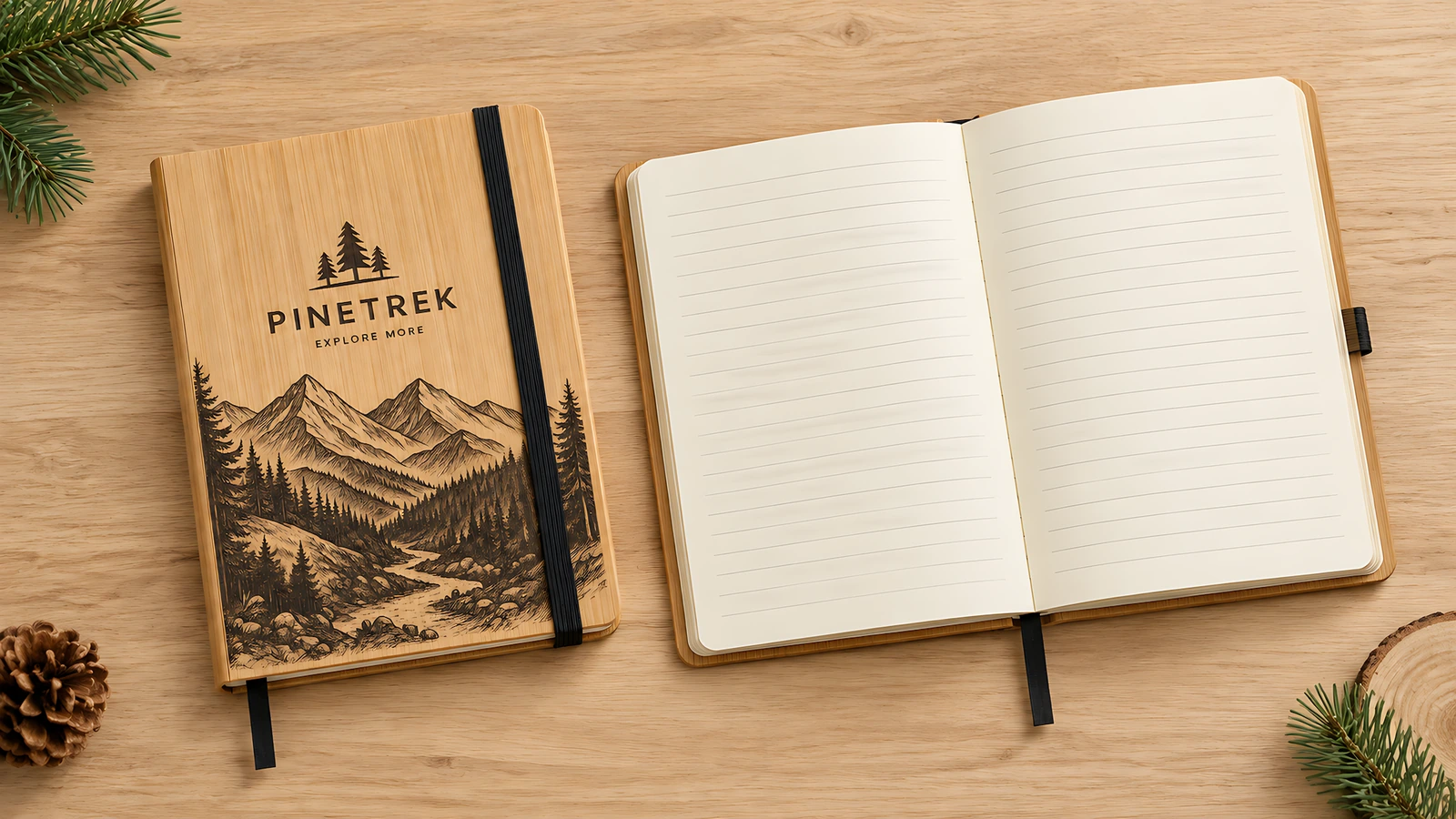
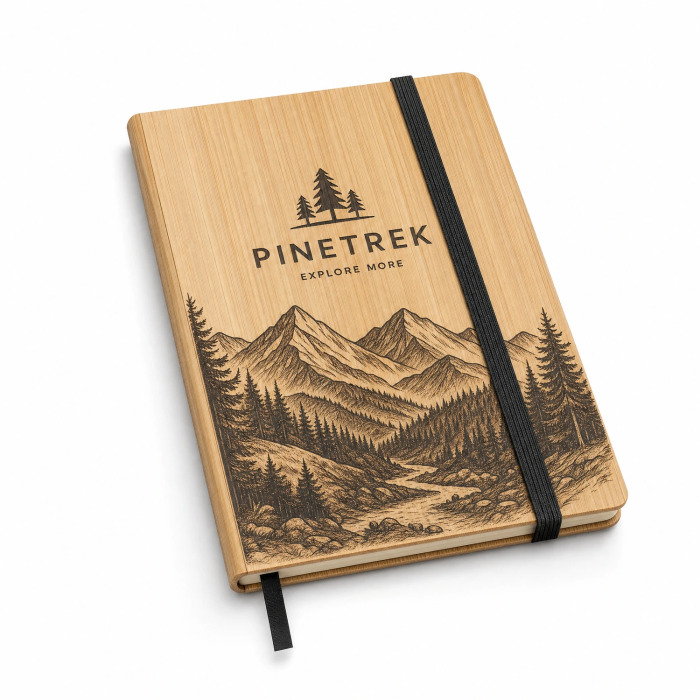
Confirm dimensions on the physical sample and inspect the proposed logo at its actual production size. No measurement is established by this illustration.
Choose the surface treatment and closure as separate decisions
Engraving and printing create different visual results. A natural etched mark does not behave like a printed brand color. Good Things documents natural grain and branding variation on its bamboo-veneer journal and notes that PMS matching is generally unavailable for laser engraving. This supports a material-specific limitation, not a confirmed decoration capability for this product. See its bamboo engraving guidance[1].
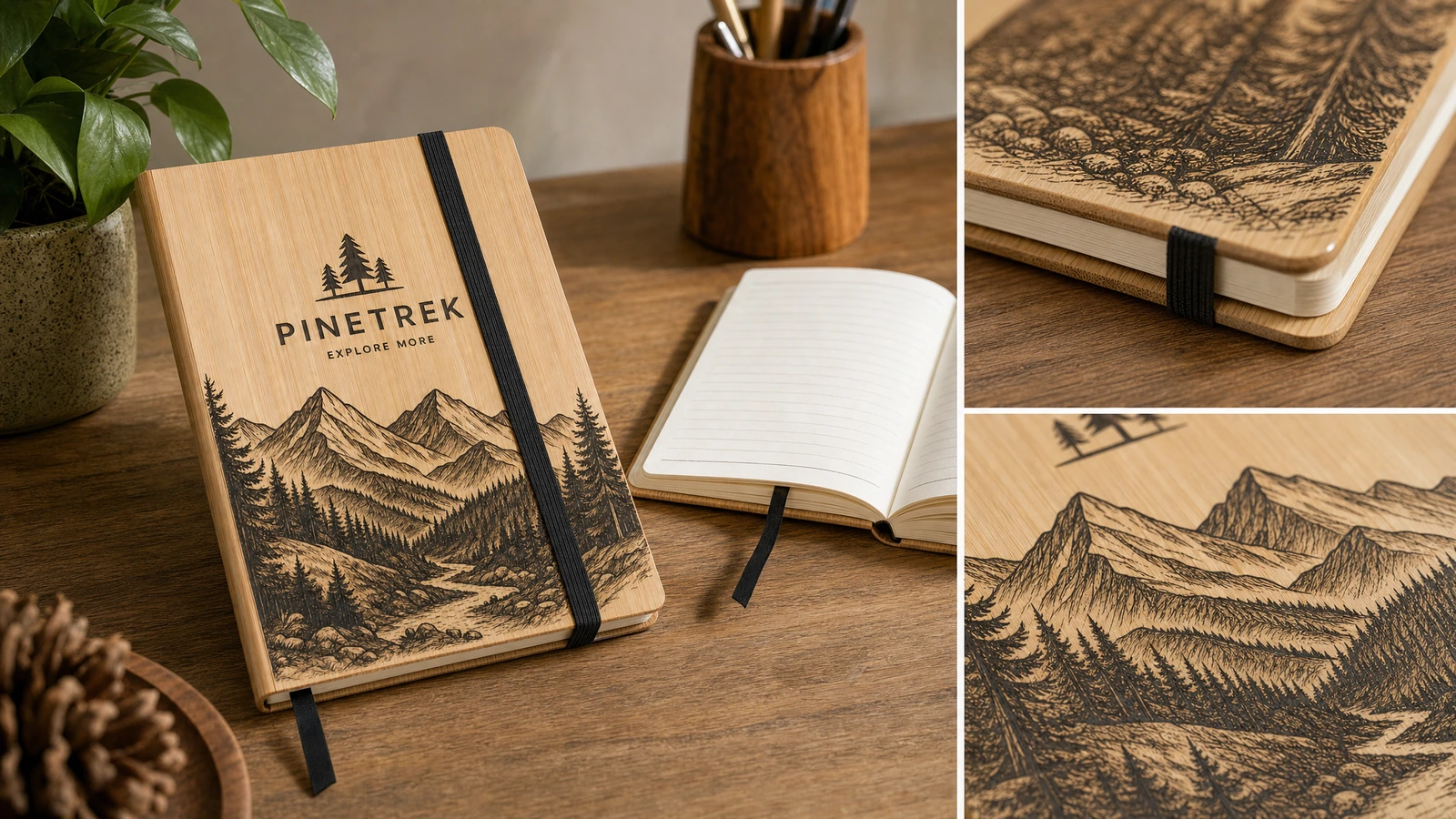
Discuss an elastic band, pen loop, or other closure only as a requested configuration until availability is confirmed. Review the back-cover attachment area as well as the front: its position can affect appearance and use. Do not assume that a magnetic closure, buckle, or pen holder is standard.
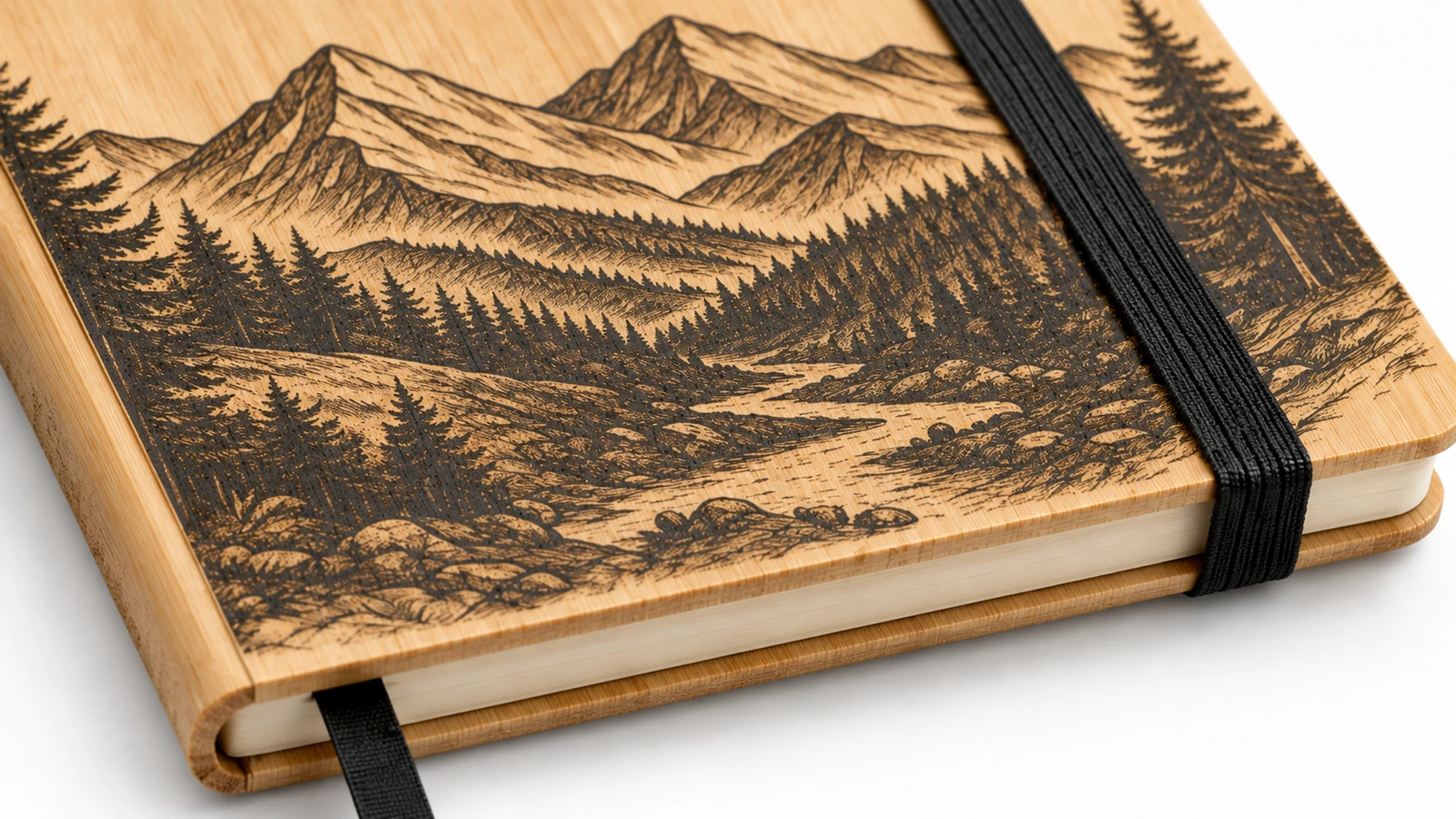
Surface and closure concepts for discussion, not an inventory of confirmed options. Final availability and construction require quotation and sampling.
How should artwork be prepared and approved? ↑
Begin with the original logo file rather than a screenshot. Vector AI, EPS, or vector PDF artwork is a useful starting point for review. If the design contains photographs, gradients, fine lines, or small lettering, identify those elements before selecting a decoration method.
- Define the content. Separate the shared company logo from individual names, departments, dates, or recipient-specific messages.
- Define the placement. Specify front cover, back cover, or another requested location. Record artwork width and height in mm.
- Review production limits. Confirm the usable decoration area, minimum readable text, line detail, and clearance from the binding or closure.
- Check the proof. Review spelling, orientation, positioning, and file version at actual size—not only as an enlarged screen image.
- Approve appearance separately. Use a physical decorated sample to judge contrast, surface feel, and interaction with the bamboo grain.
A digital proof establishes layout; it cannot establish the exact shade of a natural substrate or demonstrate ink adhesion. Where brand-color accuracy is important, request a printed sample and agree an acceptance reference. Do not approve a color-critical job using an engraving mockup.
For personalized names, approve the recipient list alongside the design. Keep one final artwork version and one approved data list so that later changes do not enter production unnoticed. Any revision affecting placement, text, or method should be reflected in the approval record.
How should sampling and production be planned? ↑
For an event order, work backward from the date the notebooks must be available for distribution. Design review, physical sampling, production, inspection, and shipping are separate stages. A production estimate alone is not a delivery commitment.
| Planning stage | Required decision or evidence | Timing basis |
|---|
| Brief and quotation | Quantity, destination, specifications, artwork, and required arrival date | Quotation-specific |
| Artwork review | Approved placement and final file version | Allow for revisions |
| Physical sample | Accepted material, decoration, paper, binding, and accessories | Sample preparation and shipment quoted separately |
| Production release | Written approval and agreed commercial conditions | Record the exact production start trigger |
| Final inspection | Results against the approved specification and sample | Include in the agreed schedule |
| Shipment | Packing details, transport service, and tracking arrangements | Transit and customs considered separately |
The schedule must identify whether production begins after payment, artwork approval, sample approval, or completion of all agreed prerequisites. Sample charges, revision costs, and payment terms also need written confirmation. No fixed sampling or production duration is established for this product.
The manufacturing sequence can be discussed in terms of material preparation, incoming checks, decoration, binding, assembly, final inspection, and packing. This is a planning framework, not a representation that a particular factory has already completed those stages or passed an audit.
For urgent projects, identify which customization requirements are essential before shortening the schedule. Removing a sample review leaves appearance or performance questions unresolved; a fast digital approval does not make those questions disappear.
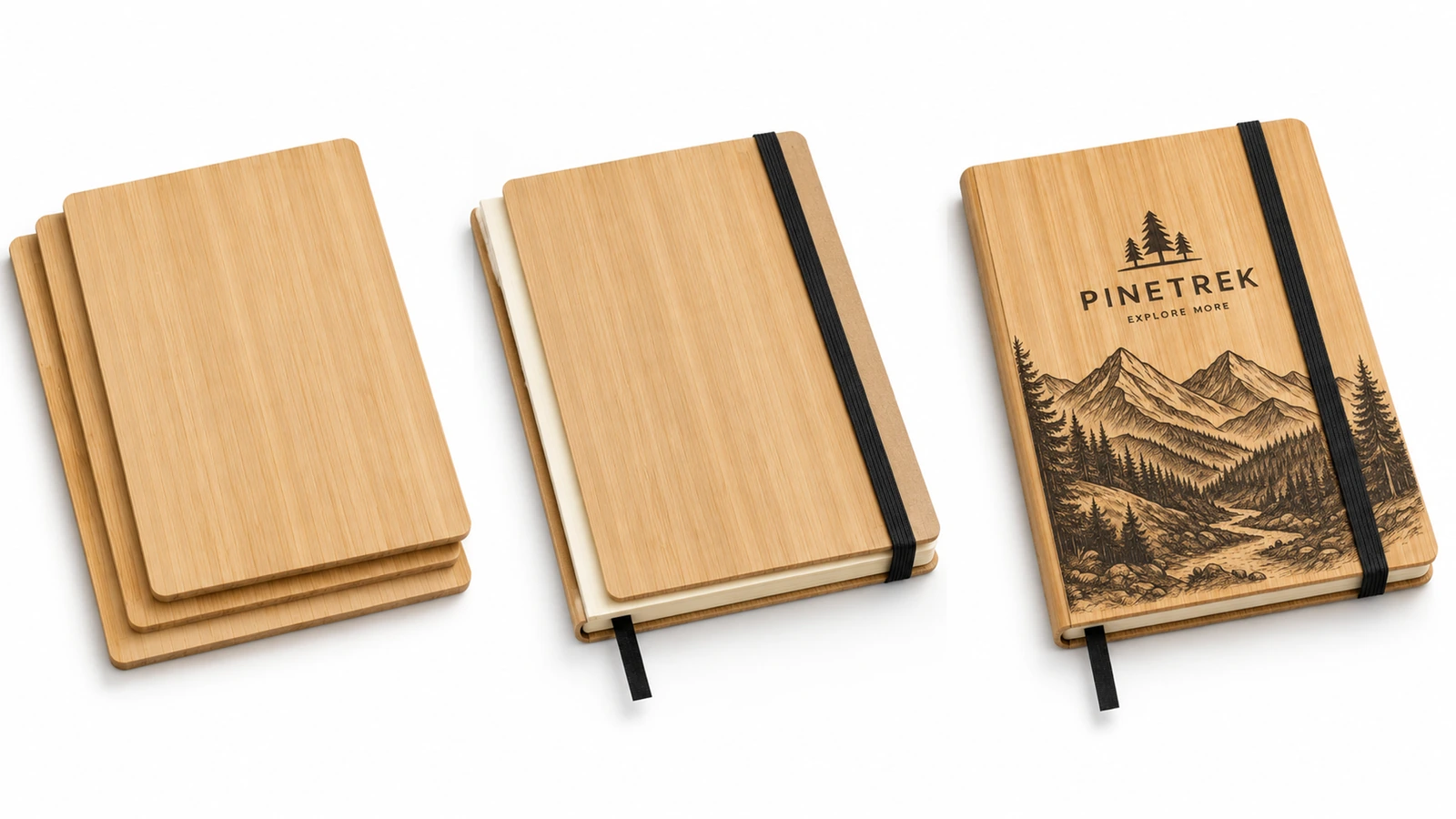
Conceptual process illustration only; it does not depict a verified production facility or completed quality-control operation.
Which material and branding route fits your brief? ↑
Compare proposals by construction and intended use rather than by the word “bamboo.” A bamboo-fiber fabric journal, a bamboo-cover paper notebook, and an erasable notebook may serve different purposes despite appearing in the same search results.
| Route | Reason to consider it | Important boundary | Approval priority |
|---|
| Bamboo cover with proposed engraving | Material-led presentation with a simple logo or name | Engraving is not a printed brand-color match; availability requires confirmation | Contrast and small-detail readability |
| Bamboo cover with proposed color printing | Artwork that needs color rather than a natural etched mark | Method and coating compatibility must be established for the selected cover | Color, adhesion, and surface appearance |
| Bamboo-fiber fabric cover | A fabric-covered stationery format | Not equivalent to a bamboo board or veneer cover | Material composition and print sample |
| Bamboo-paper interior | A brief focused on writing paper rather than cover material | Paper composition does not establish cover identity or ink performance | Composition evidence and writing tests |
| Bamboo-look synthetic cover | A wood-grain visual alternative | Must be identified as synthetic, not real bamboo | Accurate material description |
| Erasable bamboo-cover notebook | A specifically requested reusable writing system | Requires compatible pages and pens; not an established feature here | Writing, drying, and erasing behavior |
These are purchasing alternatives, not confirmed variants of NSKU-764-02. For example, Flashbay describes both engraving and full-color photo printing on its own Grove notebook, showing why decoration possibilities must be checked against the actual product rather than assumed from the material name. See its product-specific decoration options[2].
Compare complete quotations, not isolated unit prices
A useful price comparison includes the notebook, decoration setup, additional print locations, individual personalization, sample costs, accessories, packaging, inspection, and freight. Taxes and import charges should have an explicitly stated treatment. Compare currencies and delivery terms consistently.
A low price for an undecorated notebook is not comparable with a packed gift set. Equally, a supplier’s minimum for stock decoration may differ from the minimum for custom pages or construction. Request the MOQ for the configuration you actually intend to order.
Keep environmental claims specific and supported
A bamboo cover does not by itself establish that the complete notebook is plastic-free, compostable, carbon-neutral, or environmentally superior. The FTC’s guidance emphasizes substantiation and clear qualification of environmental claims. Use the FTC Green Guides[3] as the reference for evaluating proposed US-facing environmental wording.
If certification matters to your procurement policy, establish which component a claim covers and obtain the applicable documentation. An FSC claim for paper should not become a claim about the entire notebook. No product-specific certification is established here. Similarly, recycling instructions must account for the complete construction and the receiving collection system; the bamboo name alone does not justify a whole-product recycling claim.
Supply-chain concerns also need correct context. FSC has reported licensing and fiber-content integrity risks in bamboo household and sanitary paper. That is a reason to check supporting documents, not evidence that this notebook failed a test. See the FSC supply-chain notice[4].
What should a sample and shipment inspection verify? ↑
A useful sample review tests the features that could disappoint the recipient. Agree the inspection method and acceptance criteria before production. The following checks are proposed purchasing controls, not completed tests or certified performance results.
- Cover condition: examine edges, corners, surface smoothness, cracks, warping, and visible separation between layers.
- Branding: compare placement, spelling, detail, and appearance with the approved artwork and decorated sample.
- Writing performance: use the intended ballpoint, gel pen, or fountain pen; inspect spreading, reverse-side show-through, and ink penetration separately.
- Binding: turn the pages, inspect attachment points, and check whether the book opens comfortably without pages loosening.
- Accessories: verify that any ordered pen writes and that the loop, closure, and other components match the agreed configuration.
- Packing: check the specified contents, protection, labels, and carton condition before shipment.
For writing tests, record the paper specification and pen used, then photograph both sides of the page. Do not extend a successful ballpoint test into a promise of compatibility with alcohol markers or wet media. Paper weight alone cannot establish “no bleed-through.”
Natural grain variation should be distinguished from damage. Agree acceptable appearance using samples, but do not treat cracks, loose pages, missing accessories, or incorrect artwork as automatically acceptable because the cover is natural. Any durability or humidity testing should have a defined method and recorded result.
Approval also affects after-sales expectations. Zigpac’s published policy distinguishes subjective dislike of a custom product from quality problems and states that cancellation is unavailable after production starts. Review the applicable custom-order return terms[5] before release, and retain photographs, the specification, and approval records.
Protect delivery quality and simplify repeat orders ↑
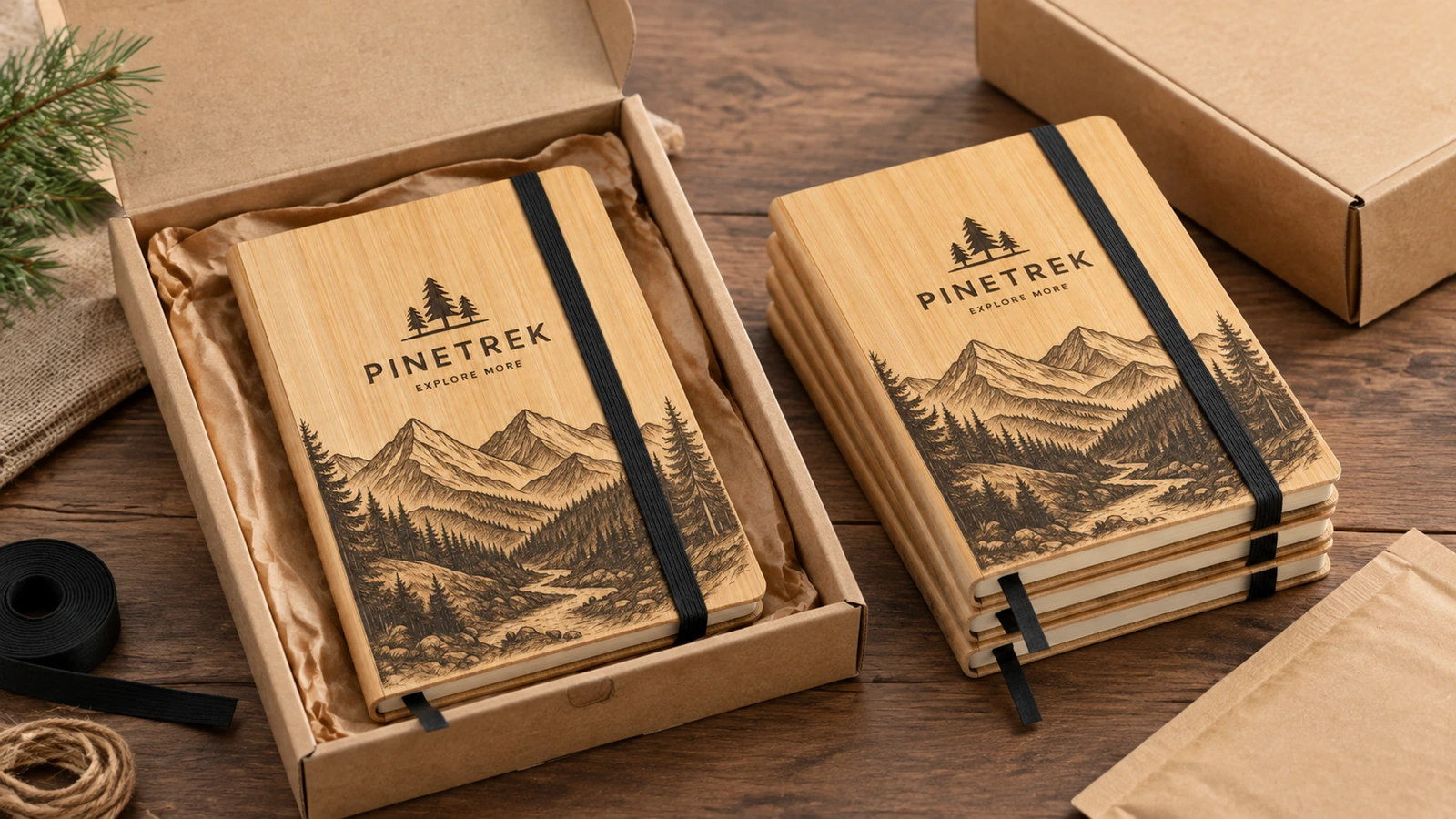
Packaging should protect the agreed product rather than merely improve its photograph. Discuss edge protection, separation between decorated surfaces, and how pens or other accessories will be secured. A display box and a shipping carton perform different jobs; specify both where needed.
Do not estimate carton capacity or kit compatibility from another notebook’s dimensions. Confirm these using actual product size, the loaded packing arrangement, and a packing sample. Shipping weight must also be measured for the selected configuration, including packaging where relevant.
For transport and storage, include care guidance that avoids prolonged damp conditions and direct wetting. If moisture protection is proposed, confirm the packing method rather than assuming that a sealed bag eliminates all risk. On receipt, document visible carton damage and missing contents before discarding the packaging.
For repeat orders, retain the approved sample, artwork version, paper specification, decoration method, packaging description, and inspection records. Ask whether any material or process has changed before repeating the order. A retained sample helps compare appearance, but it does not guarantee identical natural grain across later batches.
Key takeaways for a better purchase decision ↑
- Buy a defined construction. The confirmed identity is a bamboo cover notebook; detailed cover structure and inner-page specifications still require agreement.
- Separate layout approval from appearance approval. A digital proof checks the artwork, while a decorated physical sample addresses material and finish.
- Test the intended writing experience. Specify paper and inspect it with the pens recipients will actually use.
- Budget for the complete order. Include decoration, accessories, packaging, samples, freight, and clearly allocated taxes or import costs.
- Keep the delivery plan explicit. MOQ, production timing, unit weight, and arrival arrangements are not established for this product and require quotation or measurement.
Turn your gift concept into a specific quotation ↑
The strongest bamboo notebook order starts with a clear use case and ends with an agreed specification. Bring together the recipient, writing requirements, brand artwork, packaging, and delivery destination so the proposed product can be evaluated as a complete gift—not just a decorated cover.
Request a quotation for Custom Bamboo Cover Notebooks, reference NSKU-764-02, with your quantity, logo file, preferred dimensions, paper requirements, accessories, destination, and required arrival date.




The information below is required for social login
Sign In
Create New Account