We use cookies to enable our websites to remember information, to help some website functionalities to work properly, to understand how you interact with and use our websites and to display you content and ads that are relevant and engaging for you.
By clicking Accept All you consent to the use of these cookie.
The store will not work correctly when cookies are disabled.
Quick answer: Bamboo notebooks can be a credible sustainable gift. The bamboo has to be real and verifiably sourced, ideally under an FSC license. Adhesives and coatings need to be disclosed, the paper content has to be documented, and the eco claim should be worded narrowly. A bamboo cover alone does not make the whole notebook "eco-friendly."
Are bamboo notebooks sustainable, or is "bamboo" mostly a marketing story? Corporate gift buyers ask this more often now, because the answer shows up in CSR reports, supplier questionnaires and sometimes regulators' inboxes. The honest answer depends on which part of the notebook is bamboo, how it was processed, and what you say about it. This guide covers the evidence on each of those points, so you can decide when a bamboo-cover notebook earns its green reputation and how to describe it without greenwashing risk.
The Problem: "Bamboo" Is Doing Too Much Work on the Label
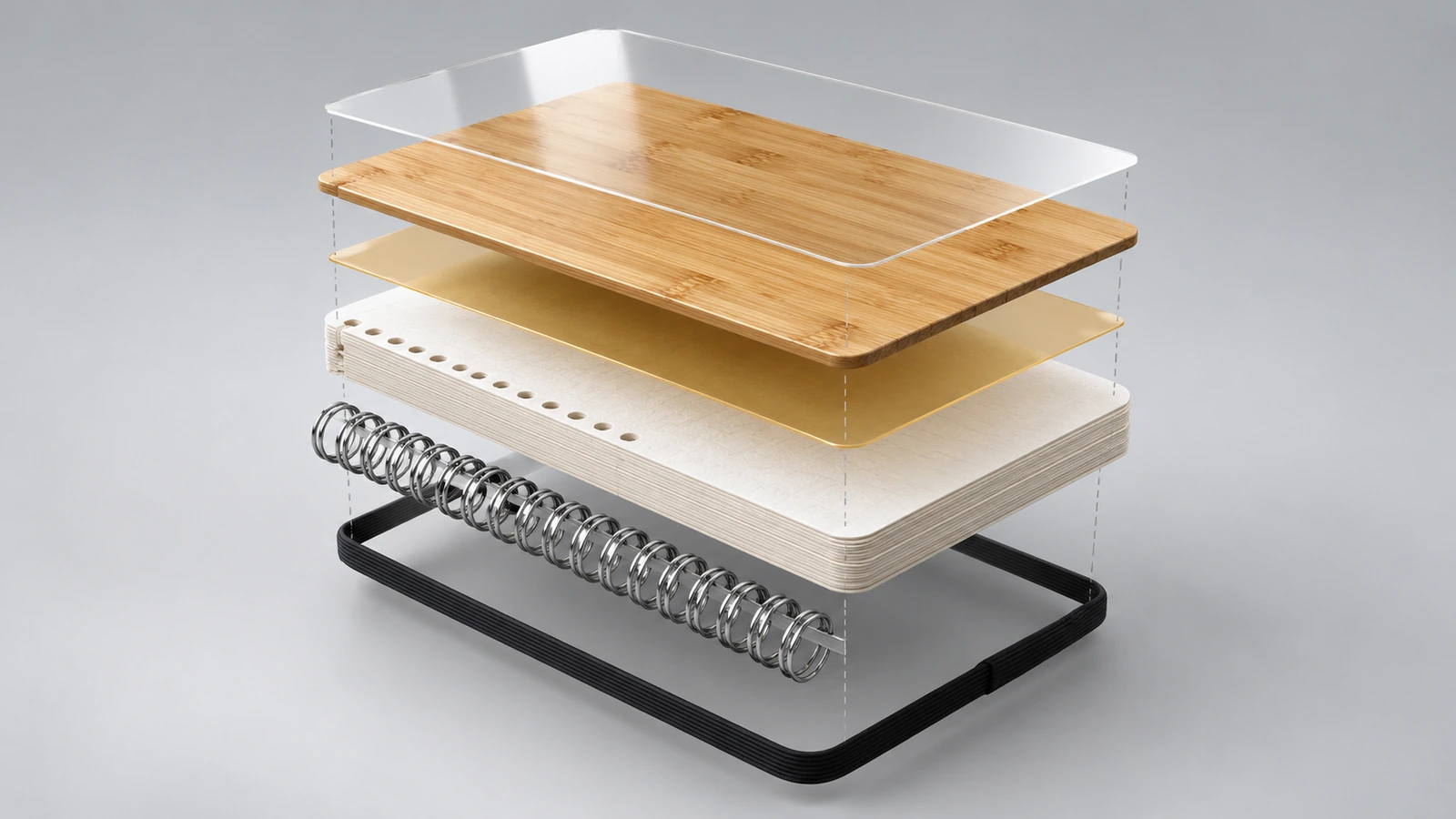
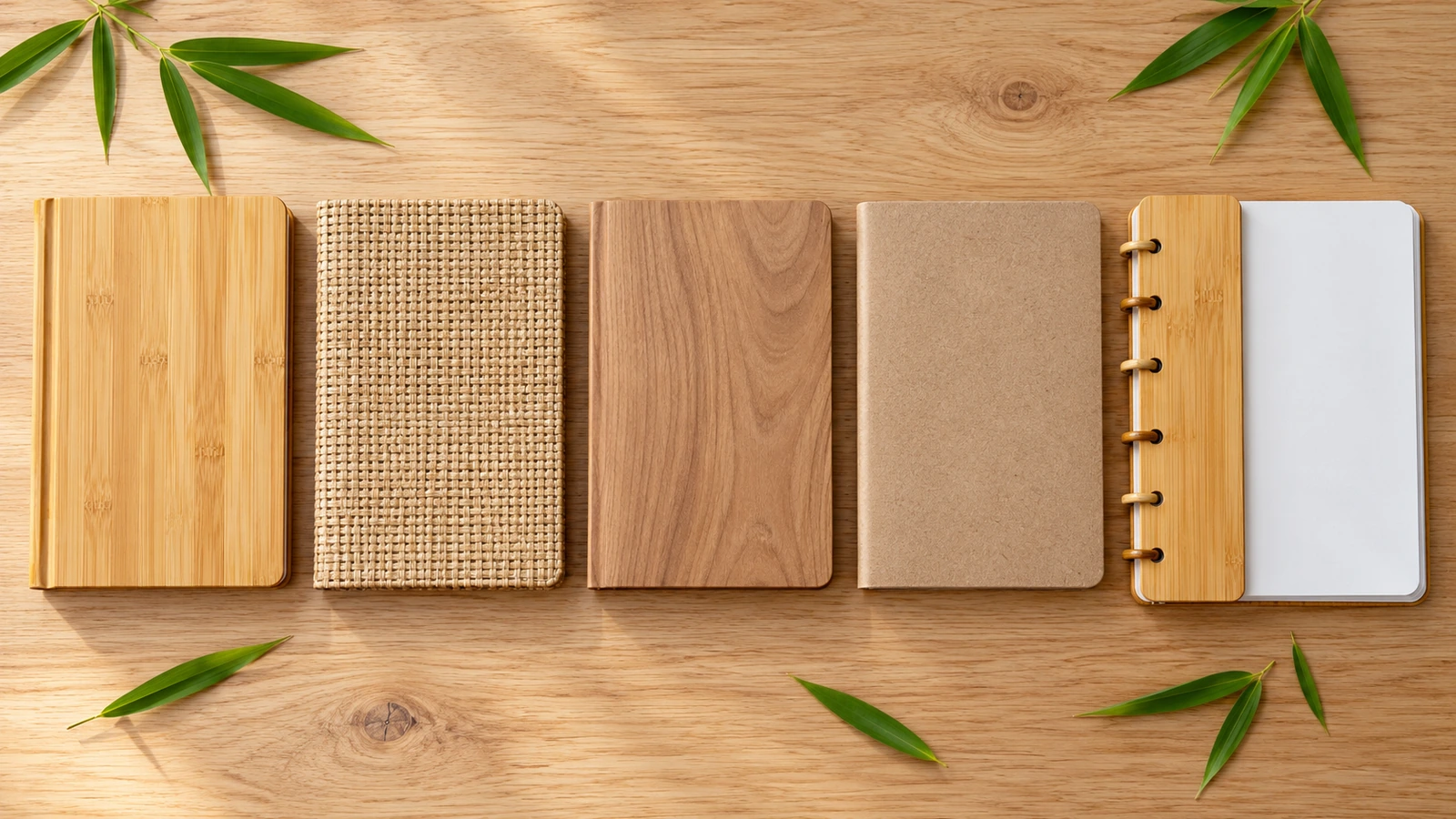
Most buyers assume a bamboo notebook is a single, simple material choice. In practice, the word covers at least five different constructions. One is a solid or veneer bamboo board. Another is a woven bamboo-fiber fabric over board. A third is a bamboo-look polyurethane cover with no bamboo in it. A fourth is bamboo-pulp paper inside an ordinary cover. The last is a reusable erasable notebook with a bamboo shell. Each one has a different environmental profile, and only some of them support the claims printed on the gift box.
The agitation comes from enforcement. Regulators have already penalized bamboo marketing that outran the facts. The US Federal Trade Commission's action against two large retailers, reported by the promotional products association ASI, required payments of $2.5 million and $3 million[1], $5.5 million in total. The products were textiles sold as eco-friendly "bamboo" that were in fact chemically processed rayon. Notebooks were not involved, but the principle carries over directly. If a corporate gift is later shown to be mostly plastic, wood fibre or resin, the reputational damage lands on the brand whose logo is on the cover.
The solution is not to avoid bamboo. Buyers need to treat sustainability as a set of checkable facts about sourcing, processing, paper, end-of-life and transport, and then write a claim that matches only what has been verified. The rest of this article walks through that process.
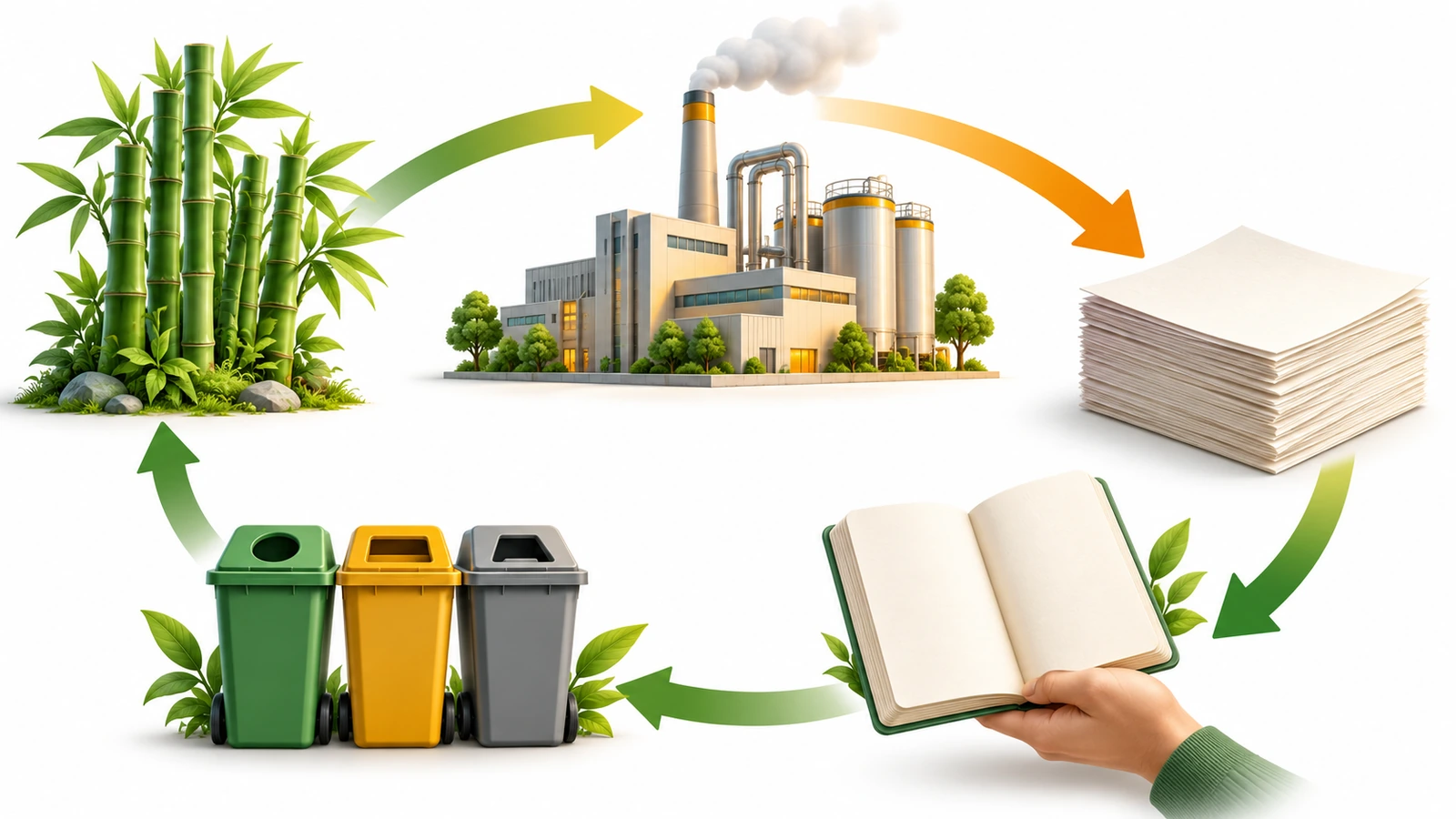
A notebook is sustainable when its total footprint across five stages is defensibly lower than a reasonable alternative, and when that difference can be documented. The five stages are raw material, processing, paper content, use life and end-of-life. Bamboo is an advantage at the first stage only. It does not automatically carry over to the other four.
Bamboo does start from a genuine material advantage. Moso bamboo (Phyllostachys edulis), the main commercial species, has a documented peak growth rate of 114.5 cm per day[2]. That figure comes from a 2022 study in The Plant Cell covering more than 500 culms. Bamboo also regrows from its root system after harvest, so a managed grove is not replanted the way a clear-cut forest is.
Carbon storage is where the definition gets more precise. A review of 184 studies across 70 bamboo species estimated total ecosystem carbon at 94–392 Mg C per hectare[3], with annual accumulation of roughly 8–14 Mg C/ha. The same authors warn that harvested bamboo only keeps carbon locked away when it becomes a durable product. A notebook cover that is used for a year and then landfilled is not a long-term carbon store. Hectare-level sequestration figures therefore should not appear in notebook marketing.
Are Bamboo Notebooks Sustainable? What the Evidence Says by Component
Bamboo sourcing and FSC certification
The fastest-growing plant still needs a credible chain of custody. That chain is also where the largest current integrity problem sits. In July 2026 the Forest Stewardship Council and Assurance Services International launched a transaction verification loop on FSC-certified bamboo household paper. It covers 411 active and suspended certificate holders[4] and runs from July 2026 to January 2027. The release names two specific problems: companies promoting FSC bamboo without a license, and "100% bamboo" claims on products that were mostly wood fibre.
Independent testing points the same way. Consumer group Which? found that one product marketed as bamboo toilet paper contained only 2.7% bamboo fibre[5]. These cases involve tissue rather than stationery. The lesson for notebooks is still clear: a bamboo-pulp paper claim needs fibre evidence, and an FSC logo needs a license code you can look up.
Processing, adhesives and coatings
Processing is where bamboo's natural advantage can disappear. Life-cycle research on 60 bamboo products made in China found cradle-to-grave footprints ranging from −0.55 to 4.02 kg CO₂e per kg[6], with processing energy and auxiliary materials as the main hotspots. Pulping is especially energy-intensive. A 2025 study reported by ScienceDaily estimated that producing one ton of bamboo tissue in China emits about 2,400 kg CO₂e[7]. Depending on energy mix and transport, the result can be better or worse than wood-pulp alternatives.
Covers raise a separate question about adhesives. Laminated bamboo boards and veneers are held together with glue. A bamboo product bound with melamine resin is not compostable, and engineered panels with adhesives can fall under US formaldehyde rules (CARB Phase II and TSCA Title VI). Some covers also carry UV or lacquer coatings. One reusable bamboo-shell notebook maker openly states that its coating means the product is "not completely plastic-free." That kind of candour is a good benchmark for what suppliers should disclose. If inks, metal clips or coatings contain listed chemicals above safe-harbor levels, California's Proposition 65[8] warning requirements may apply to gifts distributed in California.
Paper content
In a typical bamboo-cover notebook the paper weighs far more than the cover, so the paper often determines the footprint. Many bamboo-cover gift notebooks use ordinary wood-pulp or recycled pages. Others use bamboo-pulp paper. Recycled paper avoids virgin fibre altogether. FSC also distinguishes "FSC 100%," "FSC Mix" and "FSC Recycled," and these labels cannot be used interchangeably. Paper quality matters for sustainability too, because a notebook that bleeds or falls apart gets thrown away early. An independent review of a 180 gsm bamboo-paper sketchbook found that fountain pens performed well but alcohol markers bled through[9]. "Bamboo paper," in other words, does not guarantee any particular performance.
End-of-life and transport
Bamboo is biodegradable in principle. A finished notebook, however, combines glued board, coated surfaces, paper, a metal spiral or thread binding, and often an elastic band and a pen. None of that is compostable as a single unit. The realistic end-of-life message is "separate the components": paper into paper recycling, metal into metal recycling, and the cover into general waste unless the supplier can document an untreated, glue-free cover. Transport also counts. Most bamboo is processed in Asia, so shipping mode (sea versus air) and consolidated deliveries affect the result more than marginal differences in material.
Regulation is narrowing the room for vague claims
Two developments matter for 2026 buyers. In the EU, Delegated Regulation (EU) 2026/2102 confirmed that bamboo products fall outside the EU Deforestation Regulation's wood scope. According to Wood Central's analysis[10], the exclusion applies only "to the extent" a product is made of bamboo, so any wood components of a mixed product still need due diligence. Separately, EU rules applying from 27 September 2026 ban generic environmental claims such as "eco-friendly" or "green" that are not backed by recognized excellent environmental performance. They also ban claims about one component that are presented as if they applied to the whole product.
In the US, the FTC's Green Guides (16 CFR Part 260)[11] remain the reference point. Claims must be substantiated, qualified, and must not imply general environmental superiority. Standards work is also maturing. ISO/TC 296 (Bamboo and rattan)[12] has a working group on bamboo articles for daily use and is scheduled to meet in Hangzhou on 19–23 October 2026. Over time, that should standardize the terminology and test methods buyers can ask for.
How to Verify a Bamboo Notebook Before You Make an Eco Claim
The steps below cover the sustainability evidence only. Artwork, sampling and shipment inspection are covered on our bamboo cover notebook product page, so they are not repeated here.
Name the bamboo component. Ask the supplier to state in writing whether the cover is solid bamboo board, bamboo veneer on another core, bamboo-fiber fabric, or bamboo-look synthetic. Ask the same about the paper: bamboo pulp, wood pulp or recycled. This one sentence determines every claim that follows.
Request the FSC license code and claim type. A logo is not evidence. Ask for the certificate or license code and the exact claim (FSC 100%, FSC Mix or FSC Recycled), and check which component it covers. Verify the code in FSC's public certificate database. Given the 2026 verification loop, ask whether the supplier's bamboo inputs fall within its scope.
Get adhesive and coating disclosure. Ask what binds laminated boards (for example, melamine or other resins) and what coats the surface. For engineered bamboo panels, ask for formaldehyde emission test reports. For gifts distributed in California, ask for a Prop 65 assessment of inks, coatings and metal parts.
Document the paper. Record recycled content percentage, fibre source and certification for the page block separately from the cover. If bamboo pulp is claimed, ask for fibre composition evidence.
Plan end-of-life honestly. Consider designs that are easy to separate: removable binding, minimal coating, no mixed laminate. Include a short disposal note that tells recipients which parts go where.
Account for transport and lifespan. Consolidate shipments, prefer sea freight when timelines allow, and choose paper and binding the recipient will actually use to the last page. A notebook that is kept and filled outperforms one that is discarded early.
Write a qualified claim. Describe the verified component, not the whole product. "Cover made with FSC-certified bamboo; pages from 100% recycled paper" is defensible if documented. "100% eco-friendly bamboo notebook" is not.
Bamboo vs Recycled Paper Notebooks and Other Options
No single option wins on every measure. The table compares common notebook constructions by where their environmental benefit comes from and what claim each can honestly support.
Construction
What is actually bamboo
Main sustainability lever
Main risk
Defensible claim (if documented)
Solid or veneer bamboo cover
Cover board or surface layer
Fast-renewing raw material for a durable cover
Adhesives, coatings, cracking in dry or humid climates
"Cover made with FSC-certified bamboo"
Bamboo-fiber fabric cover
Woven fibre over a board core
Renewable fibre; often paired with recycled pages
Fibre may be chemically processed; the core is not bamboo
"Bamboo-fiber cover fabric" plus the paper claim
Bamboo-look PU or printed paper cover
Nothing
None from bamboo
Misleading if called bamboo
Do not use "bamboo"; describe it as a wood-grain finish
"Pages made with FSC bamboo pulp," backed by fibre evidence
Recycled paper notebook
Nothing
Avoids virgin fibre entirely
Less of a material story for gifting
"100% recycled paper," FSC Recycled where licensed
Reusable erasable notebook with bamboo shell
Shell
Replaces many paper notebooks over time
Coated pages are not plastic-free; benefit depends on actual reuse
"Reusable pages" plus the shell claim, with reuse assumptions stated
On bamboo vs recycled paper notebooks specifically, the recycled page block usually does more for the footprint than the cover material does. The strongest combination for a corporate gift is a verified bamboo cover and verified recycled or FSC-certified pages, with both claims stated separately. For reusable designs, one maker cites a 2020 life-cycle assessment showing slightly higher production emissions than a standard paper notebook (about 10%). The benefit only appears after repeated reuse replaces several paper notebooks, so the claim should state that assumption.
FAQ
FAQ: Is bamboo really eco friendly?
Bamboo is a fast-renewing raw material that regrows after harvest, which is a real advantage. Whether a bamboo product is eco-friendly overall depends on processing energy, adhesives, coatings, transport and lifespan. Published footprints for bamboo products range from net negative to over 4 kg CO₂e per kg, so the product matters more than the plant.
FAQ: Are FSC certified bamboo products more trustworthy?
Yes, provided the certification can be verified. FSC chain-of-custody certification traces fibre back to certified sources. Because FSC itself has flagged unlicensed bamboo promotion and false "100% bamboo" claims, always ask for the license code, check it publicly, and confirm which component the claim covers.
FAQ: Bamboo vs recycled paper notebooks: which is greener?
It depends on the component. The page block usually makes up most of a notebook's material, so recycled pages often have the largest effect. A bamboo cover adds a renewable, durable outer layer. A bamboo cover with recycled pages, each documented separately, is generally the most defensible combination.
FAQ: Can a bamboo cover notebook be composted or recycled?
Not as a whole. Glued or resin-bound bamboo boards are not compostable, and covers with coatings are hard to recycle. Recipients should separate the parts: paper to paper recycling, metal binding to metal recycling, and the cover according to local rules.
FAQ: What eco friendly corporate gift claims are safe to use?
Use specific, documented, component-level statements, such as "cover made with FSC-certified bamboo" or "pages from recycled paper." Avoid unqualified terms like "eco-friendly," "green," "carbon neutral" or "100% bamboo." These conflict with the FTC Green Guides and with EU rules in force from 27 September 2026.
FAQ: Does the EU Deforestation Regulation apply to bamboo notebooks?
Delegated Regulation (EU) 2026/2102 excludes products made of bamboo from the EUDR wood scope, but only to the extent they are made of bamboo. Wood-pulp pages or wooden components in the same notebook may still need due diligence.
Key Takeaways
Bamboo grows fast, but growth alone does not make a notebook sustainable: peak growth of 114.5 cm/day (Source)
Grove-level carbon storage does not carry over to a short-lived product: 94–392 Mg C/ha at the ecosystem level, not per notebook (Source)
Processing decides the footprint: −0.55 to 4.02 kg CO₂e/kg across 60 bamboo products (Source)
FSC bamboo claims are under active verification: 411 certificate holders in the 2026–2027 loop (Source)
"Bamboo" labels can be badly wrong: one tested product contained 2.7% bamboo fibre (Source)
Overstated bamboo claims carry real penalties: $5.5 million combined in the FTC rayon cases (Source)
Conclusion
A bamboo-cover notebook can be a credible sustainable corporate gift when four conditions hold. The bamboo is real and traceable. Adhesives and coatings are disclosed. The paper is documented on its own terms. The claim on the box describes only what has been verified. Where any of these is missing, the honest move is to narrow the claim, not to drop the product. If you are planning a gift program, collect the FSC license code, material disclosures and paper documentation before the artwork stage. Then request a quotation for custom bamboo cover notebooks and ask for the supporting documents with it, so your sustainability wording is settled before production starts.
Hi there! I'm Bruce, proud dad to my amazing son. I'm the founder of Zigpac, a printing and packaging company empowering small and medium-sized businesses with custom solutions. Let's create something great together!



 Blog PDF for offline reading













The information below is required for social login
Sign In
Create New Account