Custom Kraft Paperboard Saddle-Stitched Notebooks combine a kraft paperboard cover with saddle-stitched binding for branded stationery projects. Specify the finished size, inner paper, page count and artwork before requesting a quote. Minimum order quantity, production timing, pricing and performance remain subject to product-specific confirmation and sample approval.
Product: Custom Kraft Paperboard Saddle-Stitched Notebooks
Category: Custom Notebooks / Custom Paperboard Notebooks
Provisional product reference: NSKU-761-02
Content date: October 1, 2026
For event teams, workplace buyers and independent brands
Consider this format for conference notes, training sessions, employee welcome packs or branded workshop stationery. Promotional distributors can use the same specification brief when sourcing for clients. Independent brands can assess it for retail or order inserts, provided the approved sample matches their presentation and writing requirements.
A notebook can look right in an artwork preview and still disappoint when someone writes in it. An unsuitable cover, distracting show-through or an unclear page count can undermine an otherwise well-designed project. For a dated event, discovering those differences after delivery also leaves little room for correction.
The practical solution is to approve the notebook as a complete writing product, not simply a printable cover. Define what recipients will do with it, establish the paper and construction requirements, and check a physical sample before committing to the production specification. The following guide separates confirmed product identity from choices that still need quotation or testing.
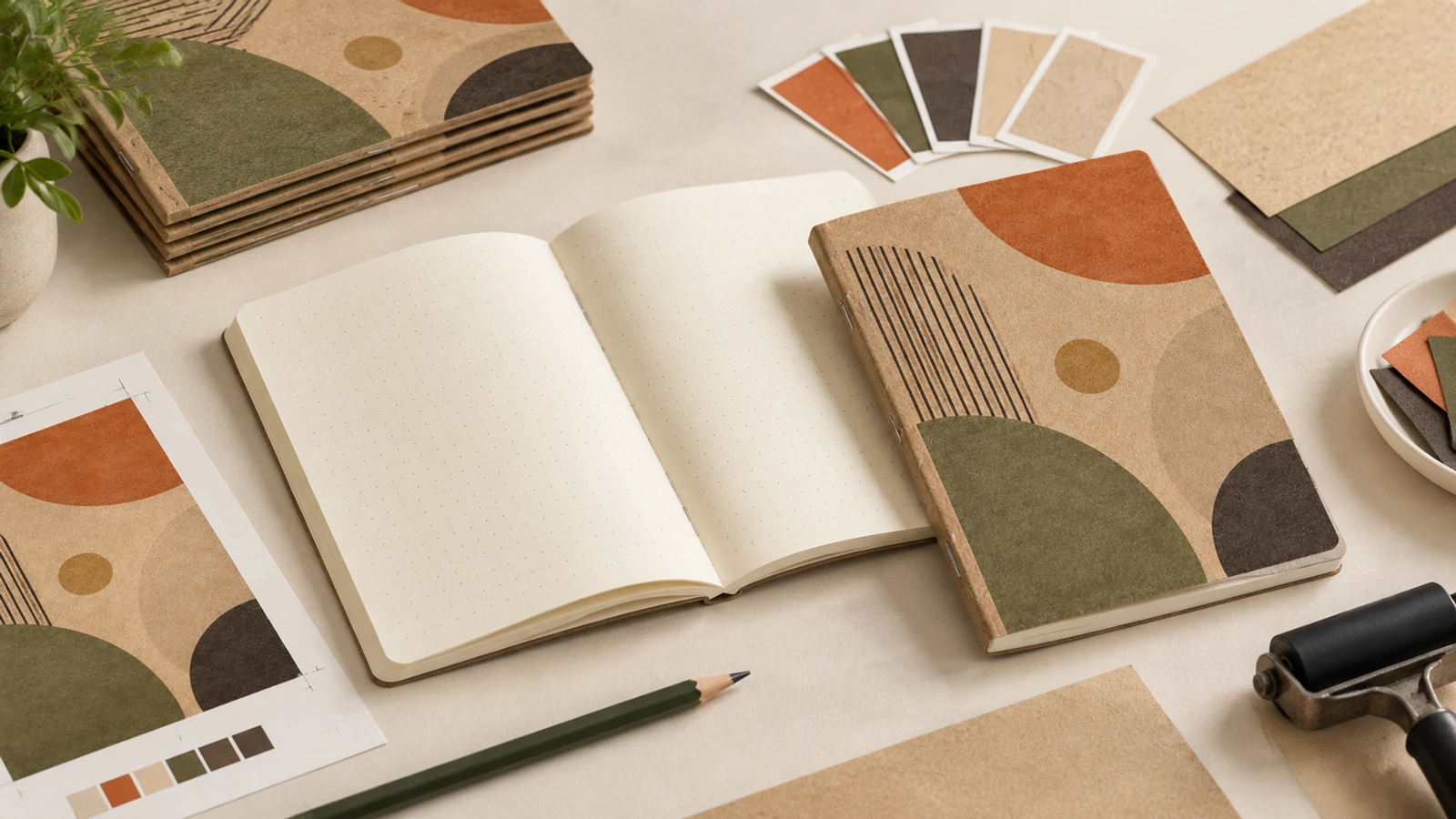
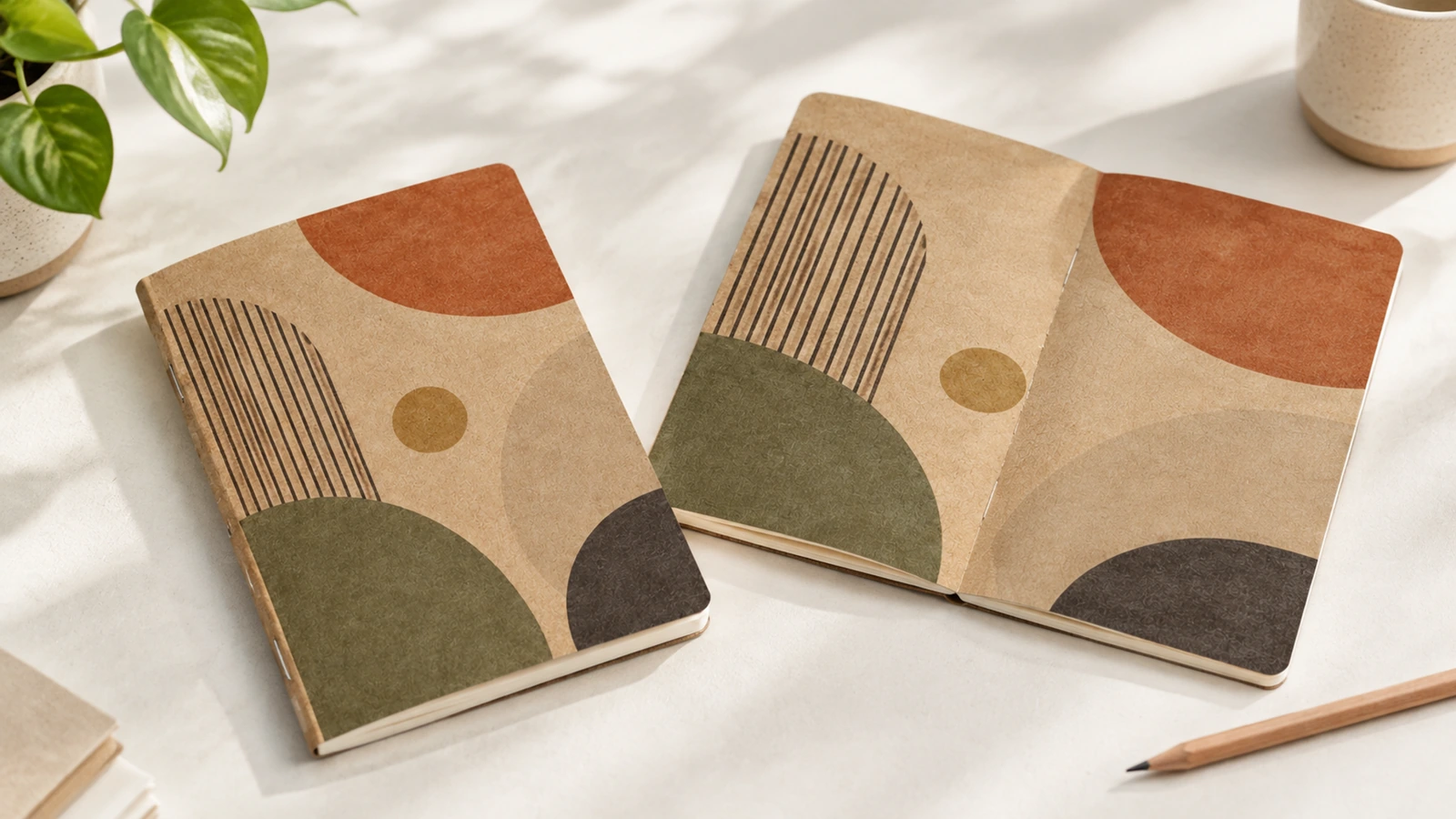
Illustrative application concept; pictured branding, dimensions and accessories are not confirmed order specifications.
Contents
What exactly is this notebook?↑
The confirmed product is a kraft paperboard notebook with saddle-stitched binding. “Cardboard” identifies the cover category; it does not establish the inner paper, board thickness or recycled content. This product should not be described as a spiral notebook, a wrapped-greyboard hardcover or a thread-sewn journal.
Those distinctions affect the buying decision. A specification copied from a spiral notebook may include features that do not belong to this construction. Likewise, an impressive review of a different kraft-covered notebook does not establish this product’s writing quality, durability or suitability for a particular pen.
Only the product identity and category are confirmed here. No product-specific factory measurements, certifications, minimum quantity, production time or unit weight have been supplied. The specification below therefore identifies what to request, rather than presenting assumptions as available stock options.
Which size and paper details belong in your brief?↑
Specify finished dimensions, cover material and inner paper separately. “A small kraft notebook” is not precise enough for comparing quotations or checking whether the finished item fits your intended presentation.
As dimensional references, A4 is 210 × 297 mm, A5 is 148 × 210 mm and A6 is 105 × 148 mm. These are reference sizes, not a confirmed size menu for this product; the relevant framework is ISO 216[1].
| Specification field | What to put in the request | Current product status |
|---|
| Finished size | Width × height in mm; portrait or landscape | To be quoted and sampled |
| Cover | Kraft paperboard; requested grammage and thickness | Material identity confirmed; measurements unconfirmed |
| Binding | Saddle-stitched construction | Confirmed product identity |
| Inner paper | Paper type, shade and grammage in g/m² | To be quoted and tested |
| Page count | Writing pages, with cover inclusion explicitly stated | To be confirmed |
| Page layout | Requested blank, ruled, dotted or custom layout | Availability subject to review |
| Commercial details | Quantity, destination, deadline and packing requirements | Product-specific quotation required |
Use this table as a brief, not a catalogue of guaranteed configurations. Keep dimensions in mm and paper grammage in g/m² throughout the quotation and approval documents. Record thickness independently rather than treating it as interchangeable with grammage.
Grammage describes mass per unit area, not a guarantee of writing performance. Request a documented measurement method, such as ISO 536[2], and specify ISO 534 if thickness measurement is part of acceptance. Neither reference means this notebook has already been tested.
Page count also needs a shared definition. A page is one side of a leaf; supplier terminology for “sheets” can create confusion. State the required writing-page count and whether covers or introductory pages are included. Check the physical sample against that definition.
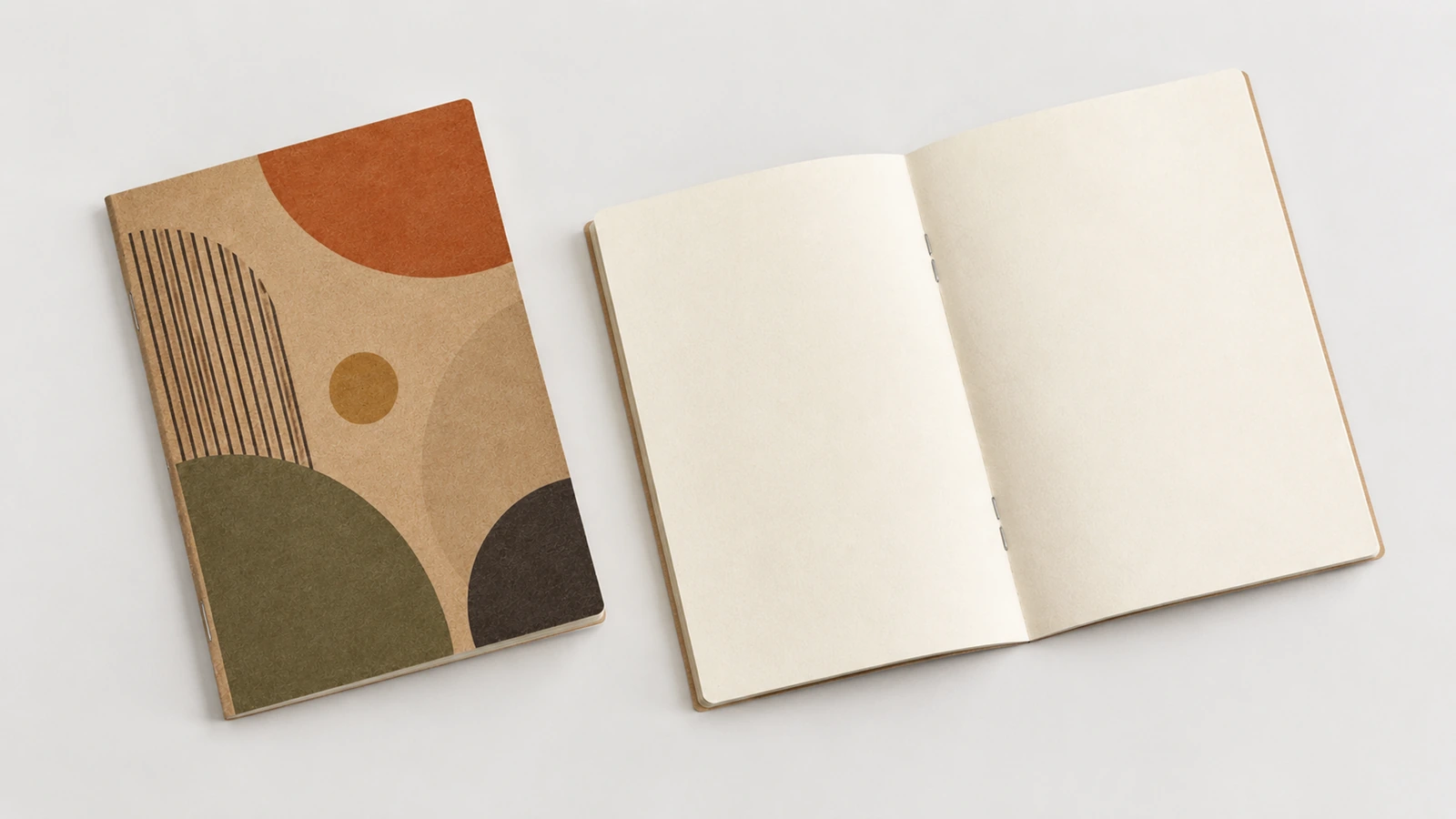
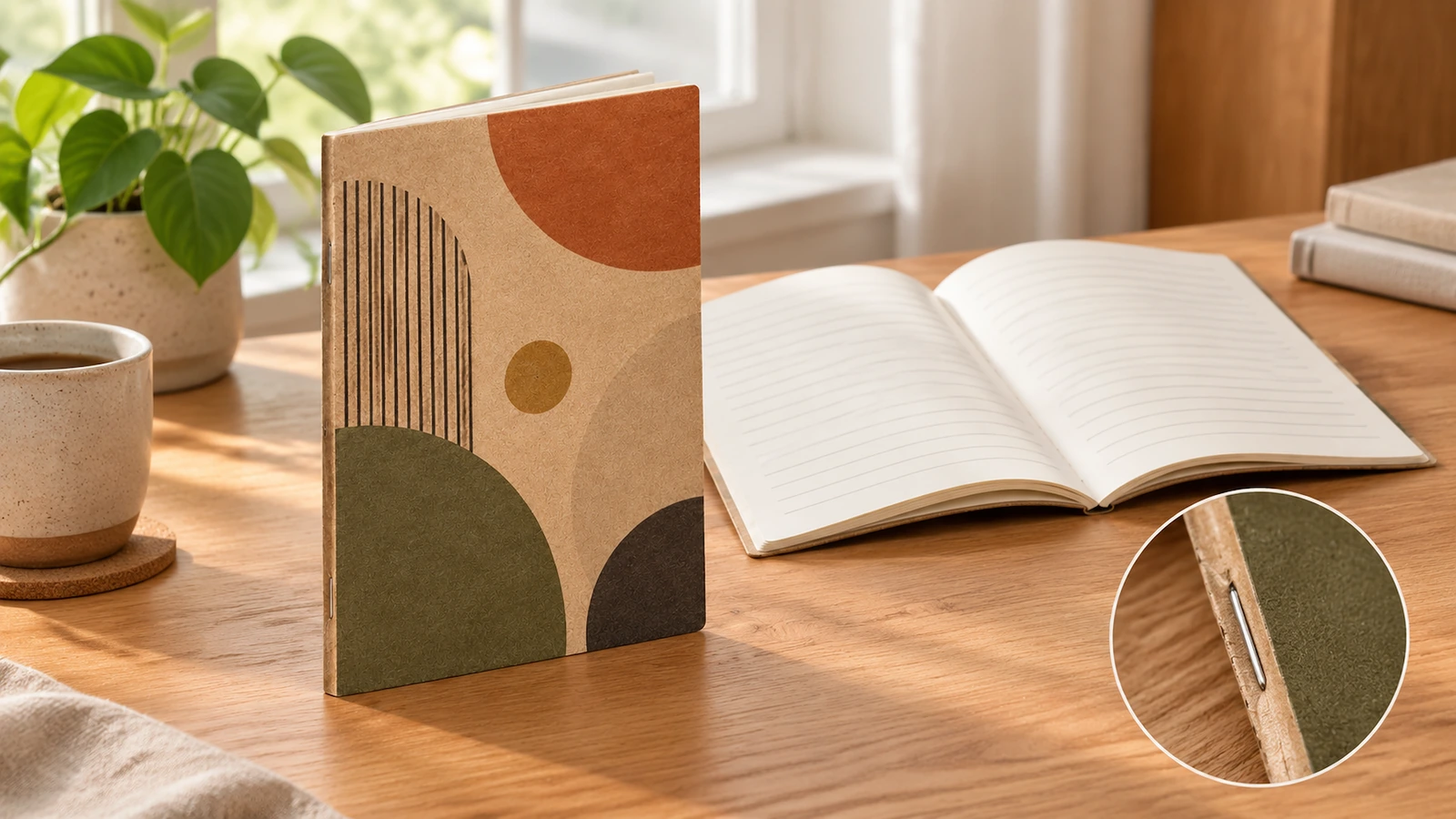
Size and layout review concept; no illustrated measurement represents a confirmed product dimension.
Which surface and back-cover details need approval?↑
Treat every decorative finish as a request to assess on the actual cover material. Printed branding, foil, debossing and surface coatings appear across the wider notebook market, but their availability and suitability have not been verified for this product.
Start by identifying the visual priority: a simple logo, a larger illustration or a tightly controlled brand colour. Then ask which process can reproduce it on the proposed kraft paperboard. A digital preview cannot settle the finished colour, surface feel or adhesion of a decorative treatment.
For this notebook, back-cover and binding details are the relevant checks—not badge-style back fasteners. No rear clip, closure strap, pen loop or pocket is verified as included. If an accessory is essential, describe it separately and request confirmation of feasibility, added cost and construction changes.
Assess surface treatment at the fold as well as on the front panel. The supplied research identifies cracking, peeling and edge lifting as possible finishing failures. Ask for these areas to be checked on a sample; do not interpret a decorative finish as proof of waterproofing or whole-product recyclability.
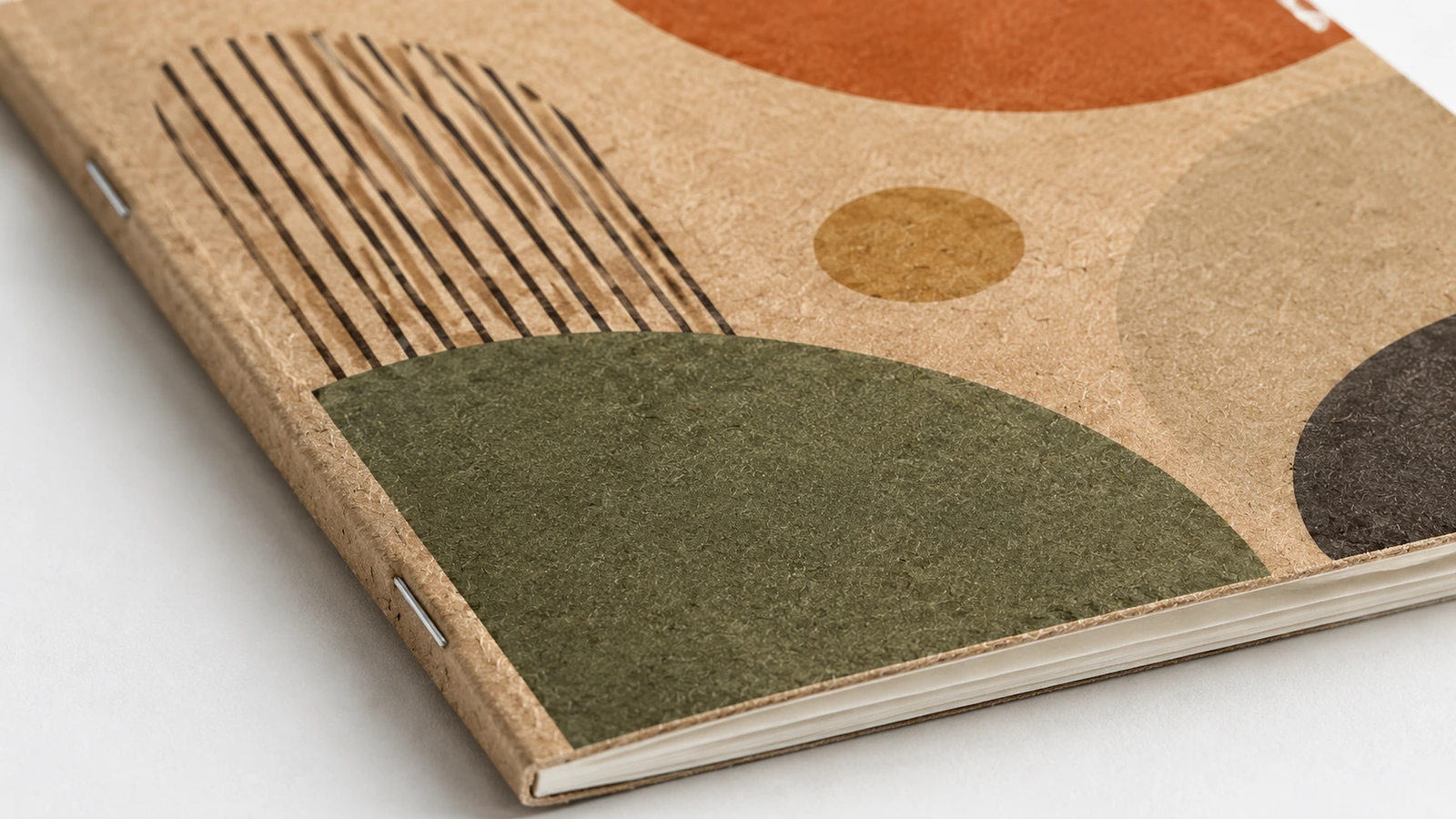
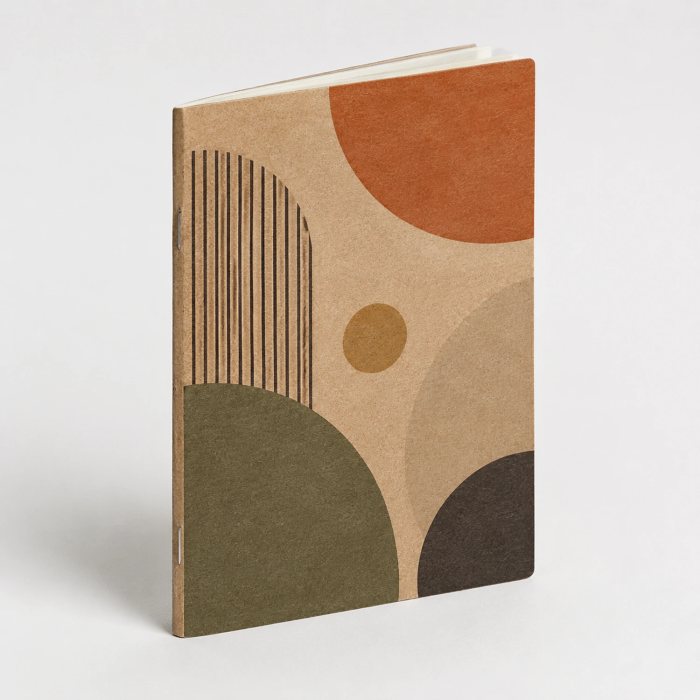
Finish-assessment concept; decorative samples do not establish available production options or included accessories.
How should artwork be checked before sampling?↑
Artwork approval should cover placement and content before physical sampling addresses appearance. A beautiful cover file can still contain the wrong dimensions, an outdated event date or branding placed too close to a trim or fold.
- Obtain the product template: use the confirmed trim, fold, bleed and safe-area requirements rather than borrowing another notebook’s template.
- Identify colour requirements: supply brand references and ask whether process colour or a matched spot colour is appropriate and available.
- Check reproduction quality: review logos and images at finished size, including small lettering and fine details.
- Review the inner layout: confirm page order, writing space, line visibility and any printed introductory content.
- Control revisions: attach a version identifier to the approved file and record subsequent changes explicitly.
Keep marketing content proportionate to the notebook’s purpose. A workshop may need an opening instruction page; a general welcome-pack notebook may benefit from more uninterrupted writing space. Decide this deliberately instead of treating every available page as advertising inventory.
A digital proof is useful for spelling, alignment and page sequence. It is not evidence of paper feel, fold quality or ink behaviour. Where those attributes matter to acceptance, approve them through a physical sample made to the proposed specification.
How can approval stages reduce production surprises?↑
Separate specification approval, artwork approval and physical-sample approval. The sequence below is a proposed procurement workflow, not a statement that a particular factory process or service level has already been verified.
- Define the use: identify recipients, expected writing tools, intended presentation and required arrival date.
- Freeze the quotation basis: document dimensions, paper, page count, binding, artwork, quantity and packing.
- Approve the digital proof: check the content, page sequence and placement against the agreed brief.
- Evaluate the physical sample: inspect writing performance, cover finish, opening behaviour and construction.
- Authorize the agreed production specification: identify the approved sample and resolve deviations before release.
- Inspect and dispatch: use the agreed inspection criteria, packing specification and transport arrangements.
Ask the quotation to distinguish sample preparation, revisions, production, inspection and transport. Confirm which approval or payment event starts each stage. A sales-response estimate is not a production commitment, and a production estimate is not an arrival guarantee.
No numerical turnaround is confirmed for this product. If an event deadline is fixed, provide the destination and required receipt date at the beginning. A proposed schedule should show dependencies and transit assumptions rather than borrowing timing from another supplier’s listing.
Workflow illustration, not a photograph of a verified production facility.
What should a physical sample prove?↑
A useful sample demonstrates fitness for your intended use, not just resemblance to a mockup. Include the intended pens and handling conditions in the review. Without product-specific test results, descriptions such as “bleed-proof,” “waterproof” or “fountain-pen friendly” remain unsupported.
| Inspection area | Check to request | Acceptance record |
|---|
| Cover and fold | Surface condition, creasing, cracking and visible distortion | Sample photographs and agreed defect limits |
| Writing performance | Show-through, bleed-through and smudging with intended pens | Pen and ink identification with front-and-back samples |
| Binding | Page retention, attachment condition and repeated opening | Agreed test procedure and recorded observations |
| Print and trim | Logo placement, colour, page alignment and cut edges | Approved reference and agreed tolerances |
| Odour and presentation | Condition on opening the proposed packaging | Observations before prolonged airing |
| Specification match | Dimensions, page count, paper and finish | Comparison with the signed specification |
Agree measurable tolerances and inspection procedures before production. This table proposes checks; it does not report completed tests or impose universal pass limits. A result from a different binding or paper stock cannot establish acceptance for this notebook.
Distinguish ghosting from bleed-through when reviewing paper. Ghosting is visible writing showing through from the opposite side; bleed-through involves ink penetrating the paper. Both may affect double-sided use, but they are different observations and should be recorded separately.
If purchasing uses AQL sampling, agree the sampling plan and defect definitions in writing. Likewise, specify any opening-cycle, handling or packed-transport test before ordering. Do not substitute another printer’s published tolerance for an agreed requirement, or assume a sample check is equivalent to inspecting the production batch.
Inspection concept; no pass result, measured tolerance or certification is represented.
How should buyers compare formats and quotations?↑
Compare quotations only after aligning the product construction and included services. An inexpensive notebook with different paper, fewer writing pages or excluded transport is not a like-for-like alternative.
| Format or purchasing route | Reason to assess it | Decision boundary |
|---|
| This kraft paperboard saddle-stitched notebook | A kraft-cover concept for branded writing projects | Confirm size, writing capacity and handling through sampling |
| Spiral or wire-bound notebook | A different opening and page-turning format | Not a binding variant confirmed on this page |
| Wrapped-greyboard hardcover | A more structured cover presentation | Different construction requiring its own quotation |
| Existing notebook with added logo | Fewer changes to an established format | Material, layout and decoration choices may be restricted |
| Broader bespoke specification | Closer control over paper, layout and presentation | Feasibility, setup costs, minimums and timing require review |
Use the comparison to identify which compromise matters most: construction, writing space, presentation or customization depth. It is not a price ranking, and it does not imply that every route is offered for this provisional product.
Request an itemized quotation covering notebook production, artwork or setup charges, any tooling, sampling, packaging and international transport. Have the supplier state currency, quote validity and the responsibilities for duties and clearance. Compare the delivered scope, not an isolated unit price.
No minimum order quantity or quantity discount is verified here. Submit your intended quantity and any alternative order quantities for assessment. Website-wide minimums, competitor prices and reviews of retail multipacks should not be treated as commercial terms for this saddle-stitched product.
What evidence supports material claims?↑
Kraft appearance does not prove recycled content or certification. If a material claim is important to your purchasing policy or campaign, make the required documentation part of the brief before artwork includes that claim.
For partially recycled products, identify the claimed component and substantiate its recycled proportion by weight. Distinguish post-consumer content only when supporting evidence exists. These boundaries follow recycled-content guidance[3]; no recycled percentage is established for this notebook.
An FSC claim requires applicable certification and chain-of-custody evidence, not simply a supplier’s general reference to responsible paper. Request the certificate holder, scope and product claim, and verify the relevant FSC chain-of-custody documentation[4]. This page makes no FSC-certified product claim.
Keep paper permanence separate from cover appearance and writing performance. ISO 9706[5] addresses permanent unprinted document paper and excludes boards. If permanence is required, request evidence for the inner paper; do not infer it from a thick or recycled-looking cover.
Recycling assessment should consider the finished construction, including any applied finish, rather than paperboard alone. Product and packaging claims also need separate scopes. For public-sector purchasing, obtain the buyer’s actual material criteria instead of treating a procurement programme’s requirements as universal notebook specifications.
How should packing and repeat orders be specified?↑
Packaging should protect the approved presentation through the intended delivery route. Request a packing proposal that addresses corner damage, bending and moisture exposure. A presentation wrap and a transport carton serve different purposes; neither should be assumed adequate without review.
Carton capacity and suitability for welcome packs depend on actual product dimensions, loaded condition and sample validation. No units-per-carton figure, packed weight or bag-fit promise is confirmed. Obtain those values after the notebook and any accompanying items have been specified.
Agree how arrival damage and manufacturing defects will be documented and assessed. Keep the approved sample, quotation and packing requirements accessible, and establish the notification and remedy process in writing. This page does not promise automatic replacement, refunds or a particular warranty.
For repeat orders, retain the artwork version, material specification, sample reference and inspection notes. Reconfirm paper availability and commercial terms before placing the reorder. If a material or finish changes, review its effect rather than assuming an unchanged logo produces an identical notebook.
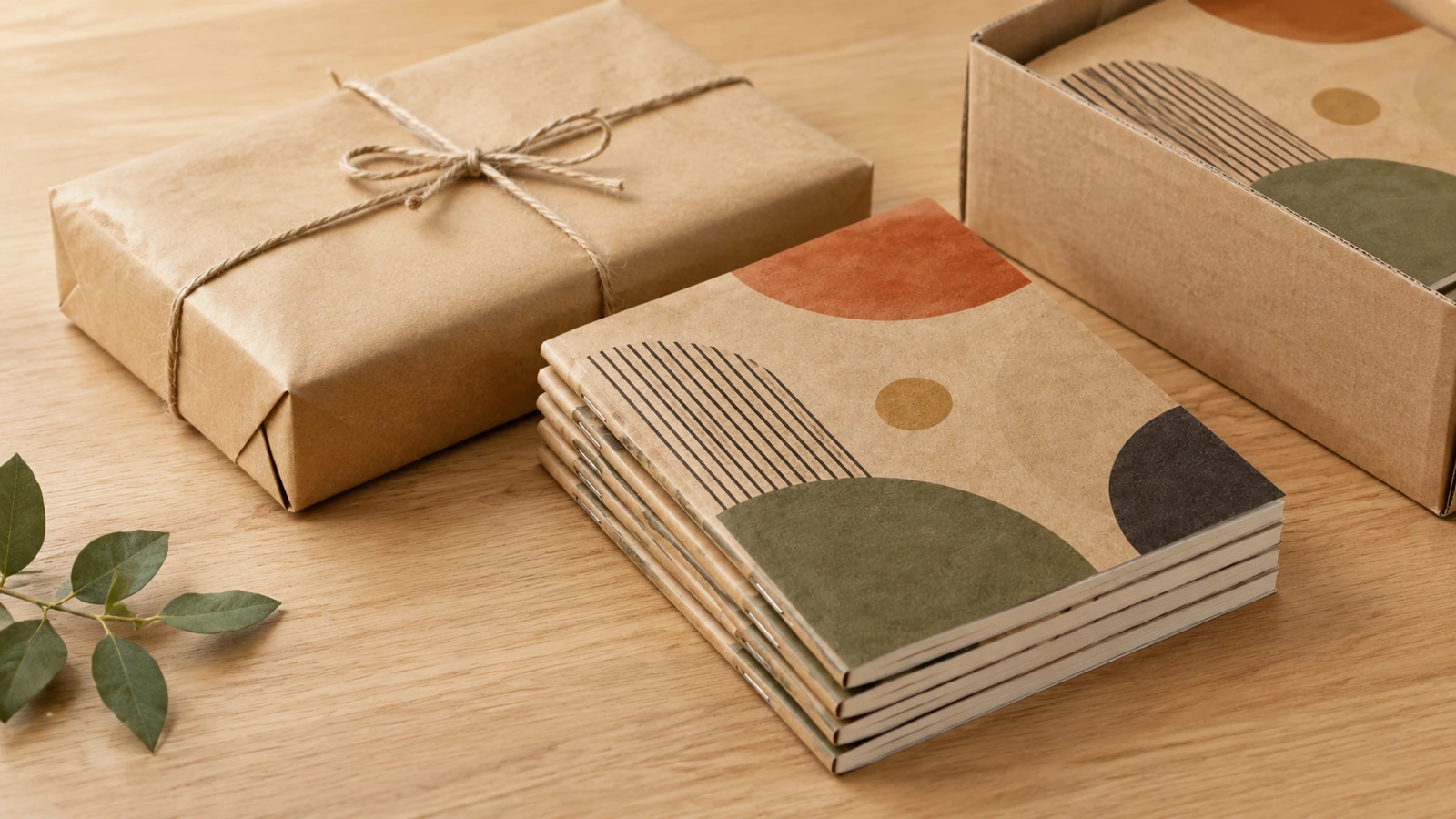
Packing concept only; carton dimensions, pack quantity and shipping weight require confirmation.
Key takeaways for a purchase-ready specification↑
- Keep the product identity precise. This is a kraft paperboard saddle-stitched notebook, not a spiral or hardcover product.
- Approve the writing experience as well as the cover. Record intended pens, paper requirements and physical-sample observations.
- Compare the complete quoted scope. Separate production, setup, sampling, packaging and delivery responsibilities.
- Do not infer environmental credentials from appearance. Recycled content and certification remain unverified for this product.
- Recycling claims depend on access to appropriate facilities. — The FTC guidance uses 60% of consumers or communities where the product is sold as the access threshold below which recyclable claims should be qualified (Source[6]).
Start with a brief that can be quoted accurately↑
The useful starting point for custom cardboard notebooks is a clear specification: the intended use, finished dimensions, writing-page count, paper requirements and artwork. That gives the quotation and sample review a shared basis, while keeping untested performance and unconfirmed commercial terms out of the purchase decision.
Request a product-specific quote for NSKU-761-02 with your quantity, size, page requirements, artwork, destination and required arrival date.




The information below is required for social login
Sign In
Create New Account