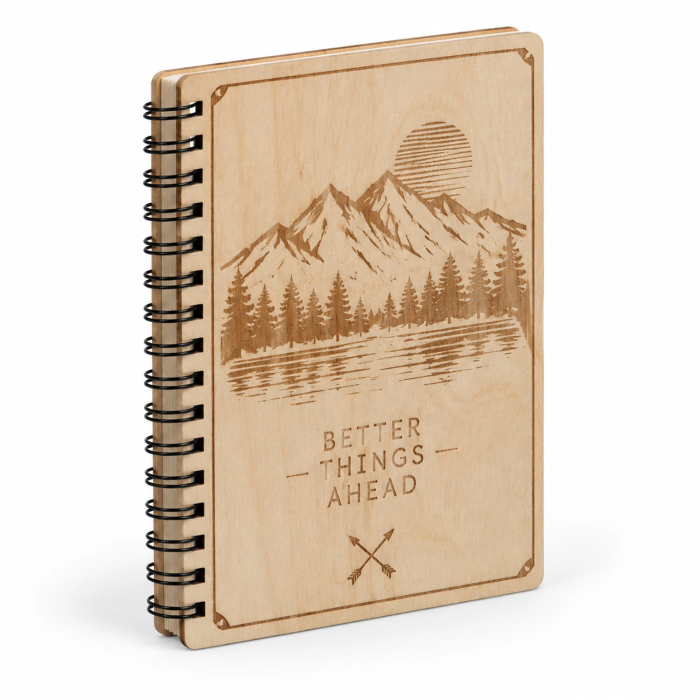
Custom wooden notebooks with laser-engraved plywood covers turn a name, logo, or message into the focus of a practical gift. This product uses plywood—not solid hardwood. Size, cover thickness, paper, binding, packaging, minimum order quantity, and delivery timing require a project-specific quotation and sample confirmation.
Product: Custom Laser-Engraved Plywood Cover Notebooks. Category: Custom Notebooks / Custom Wooden Notebooks. Provisional reference: NSKU-764-01. Product information reviewed: October 2, 2026.
Make the notebook personal to the recipient and useful for the occasion ↑
A client thank-you, employee milestone, graduation gift, or personal journal needs more than a decorative cover. The message should suit the recipient, while the format should suit what they will actually write. A discreet company logo and a personal name serve a different purpose from an illustrated keepsake or a notebook intended for meeting notes.
For corporate gifting, begin with the recipient list and distribution plan. Decide whether every notebook carries the same artwork or whether names change across the order. For personal gifts, prioritize the exact wording and intended use. These choices determine the artwork workload, sample requirements, and packing instructions before price comparisons become meaningful.
A memorable cover should not hide an uncertain specification ↑
The purchasing problem is straightforward: a product photograph cannot confirm how the cover feels, how clearly a small logo engraves, or how the paper behaves with the recipient’s pen. When those details remain undefined, an attractive gift concept can become a difficult approval decision—or an expensive disappointment after personalization.
A digital layout can show a correctly spelled name yet still leave the physical engraving unresolved. A substantial-looking cover does not establish paper quality. A dispatch estimate does not establish arrival before an event. For an order with individual names, even an otherwise acceptable notebook becomes unusable when it reaches the wrong recipient.
The solution is to separate design approval from product approval. Specify the construction, assess engraving on the proposed material, test the selected paper, and agree how finished goods will be checked and packed. No factory test results or confirmed commercial specifications accompany this product record; the checks below are purchasing requirements to agree, not claims of completed testing.
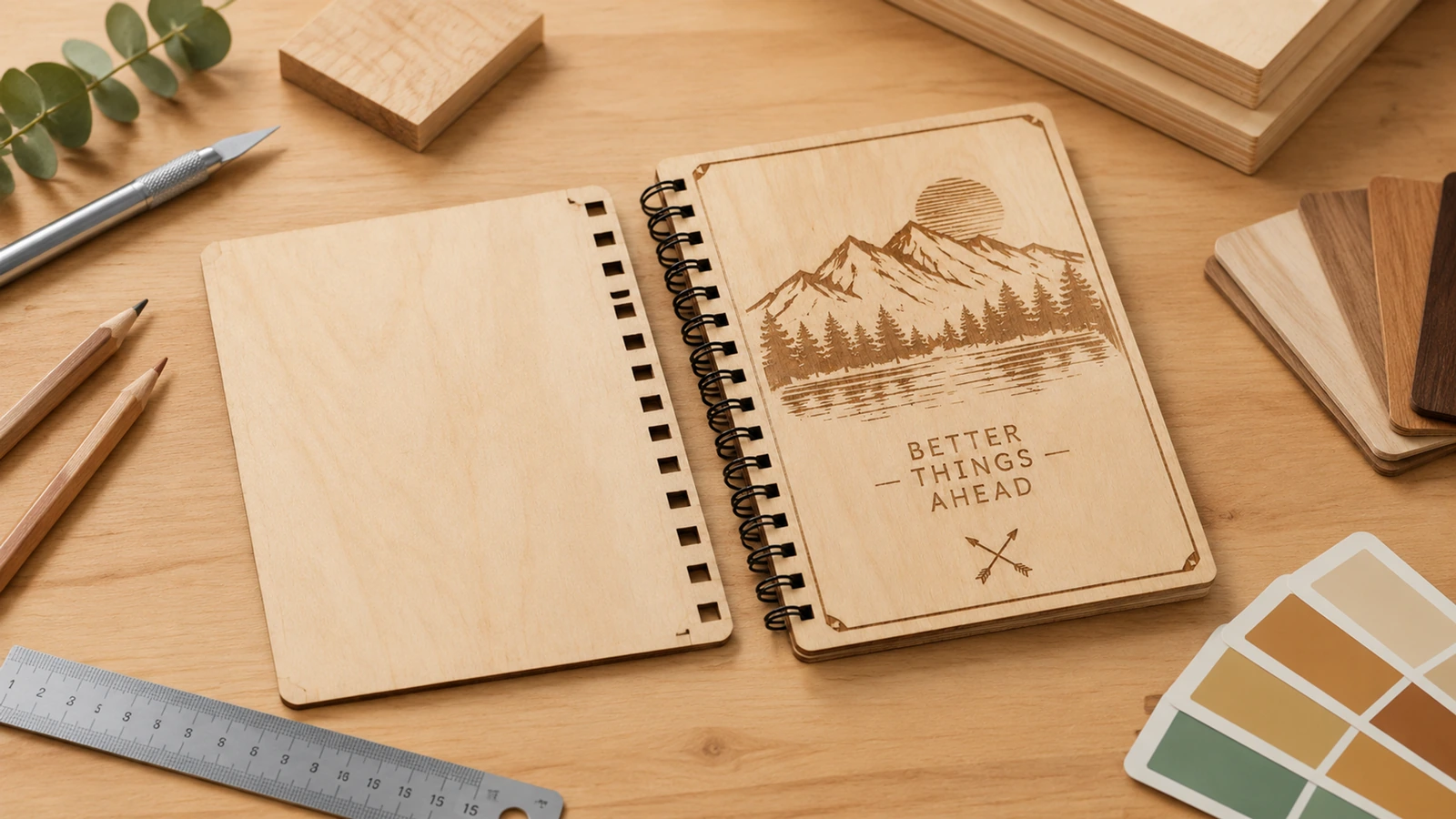
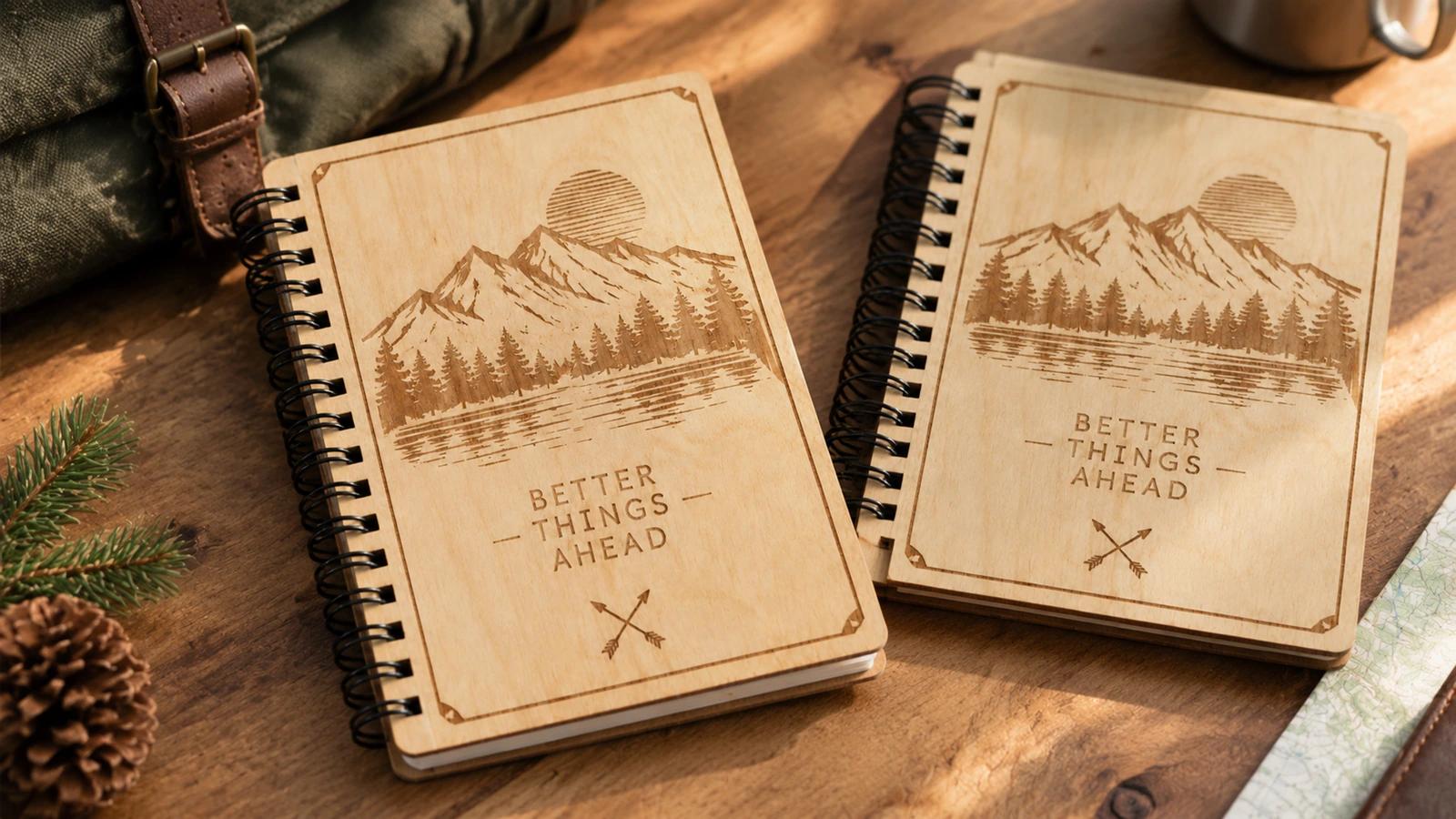
Illustrative application concept. Shown accessories and packaging are not confirmed inclusions.
Explore this product
What does “plywood cover” mean for this notebook? ↑
The verified product identity is a notebook with a laser-engraved plywood cover. Plywood is a layered wood construction, not a single solid-hardwood board. It should not be described as solid walnut, solid maple, bamboo, cork, or a wood-grain synthetic cover without separate evidence establishing that material.
“Wooden” describes the cover here; it does not establish wooden writing pages. Paper composition and performance need their own specification. Likewise, a visible wood surface does not establish the species, adhesive, finish, certification status, or resistance to moisture. Those details belong in the material schedule and sample record.
| Specification field | Current status | What to establish before ordering |
|---|
| Product construction | Laser-engraved plywood cover notebook | Exact cover build and assembled sample |
| Wood species and cover thickness | Not specified | Material description and thickness in mm |
| Finished dimensions | Not specified | Cover and inner-page dimensions in mm |
| Paper and page count | Not specified | Paper weight in g/m², layout, sheets, and pages |
| Binding and closure | Not specified | Construction, opening behavior, and accessory details |
| Unit weight | Not provided | Measured sample weight in g; packaging stated separately |
| MOQ, price, and production time | Awaiting quotation | Order quantity, currency, exclusions, and timing basis |
This table separates the confirmed product identity from unresolved buying decisions. Competitor dimensions, paper weights, lead times, and minimum quantities are not specifications for this notebook.
How do you choose dimensions without sacrificing engraving clarity? ↑
Start with the writing task rather than a familiar size label. Meeting notes need a usable writing area; a keepsake may prioritize the cover composition. Record both the finished cover size and the inner-page size because the binding and cover overhang can make them different. No standard size is confirmed for this product.
Assess the artwork at its intended physical dimensions. Fine lettering, narrow gaps, and intricate symbols need a sample to establish whether they remain distinct. A logo that looks sharp when enlarged on a monitor may not be readable at notebook scale. Character limits and minimum line widths remain subject to artwork review and engraving trials.
For variable names, check the longest entry as well as the shortest. Keep a consistent placement rule without shrinking longer names until they become difficult to read. Agree whether line breaks, font size, or artwork position may change, then include those decisions in the approved proof.
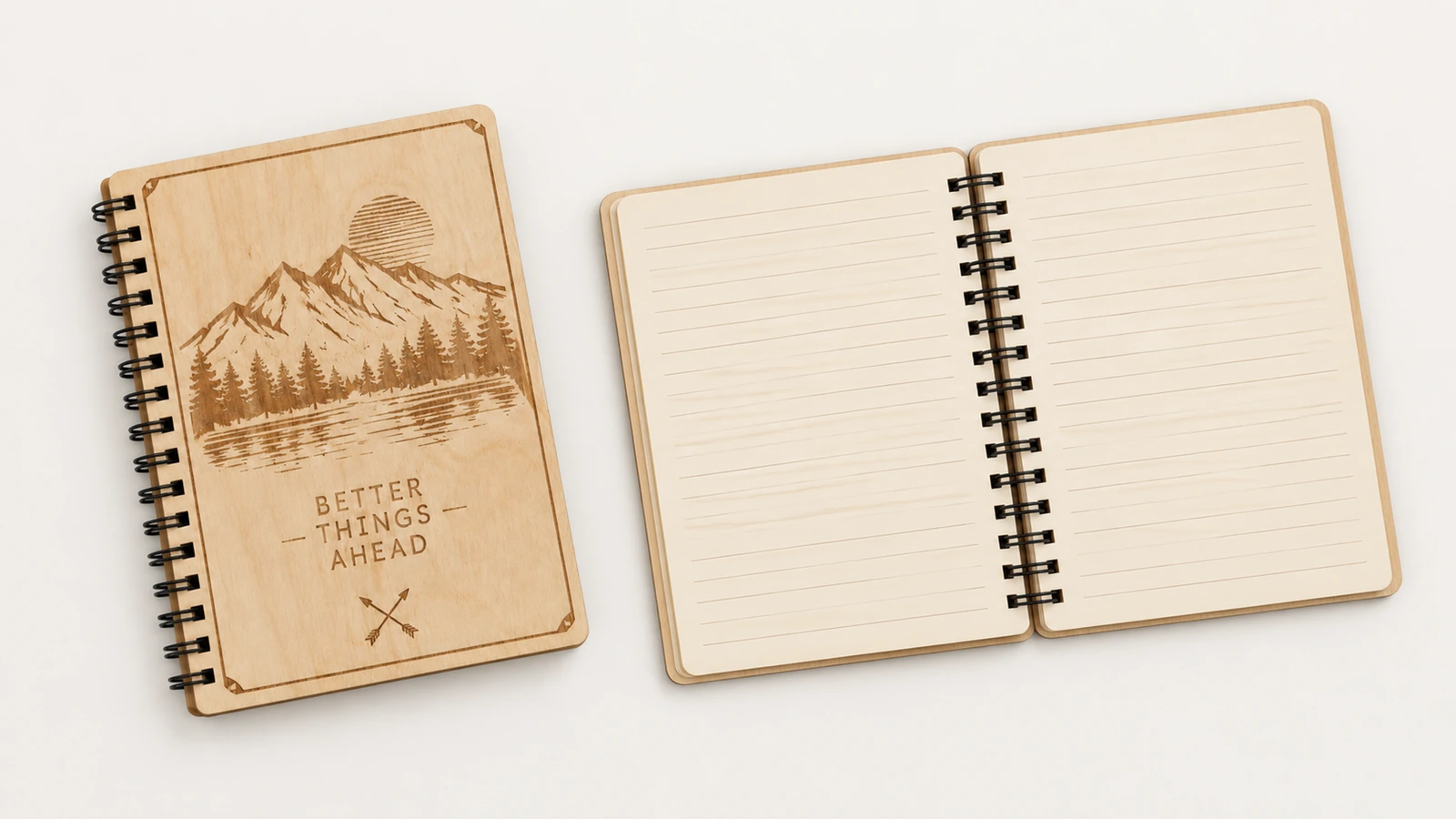
Illustrative layout review. Dimensions and engraving limits must come from the selected sample, not this image.
Which surface, binding, and closure details belong in the brief? ↑
Specify whether the cover is intended to be unfinished or supplied with a protective finish. These are different purchasing requirements: a craft blank intended for further treatment is not the same as a finished gift. Ask for the proposed finish description and inspect the front, reverse, edges, and binding holes rather than judging only the decorated face.
Review binding and closure as part of the assembled notebook. A spiral, ring mechanism, flexible spine, or elastic closure changes how the book opens and feels in use. These are configurations to discuss, not confirmed options for this SKU. A back clasp or other fastening should never be assumed from a styling image.
If refillability matters, establish the actual replacement-paper dimensions and attachment pattern. Replacement capacity and fit depend on physical dimensions, the loaded configuration, and sample validation. An “A5” description alone does not confirm that a particular refill will fit or that the assembled notebook will close properly.
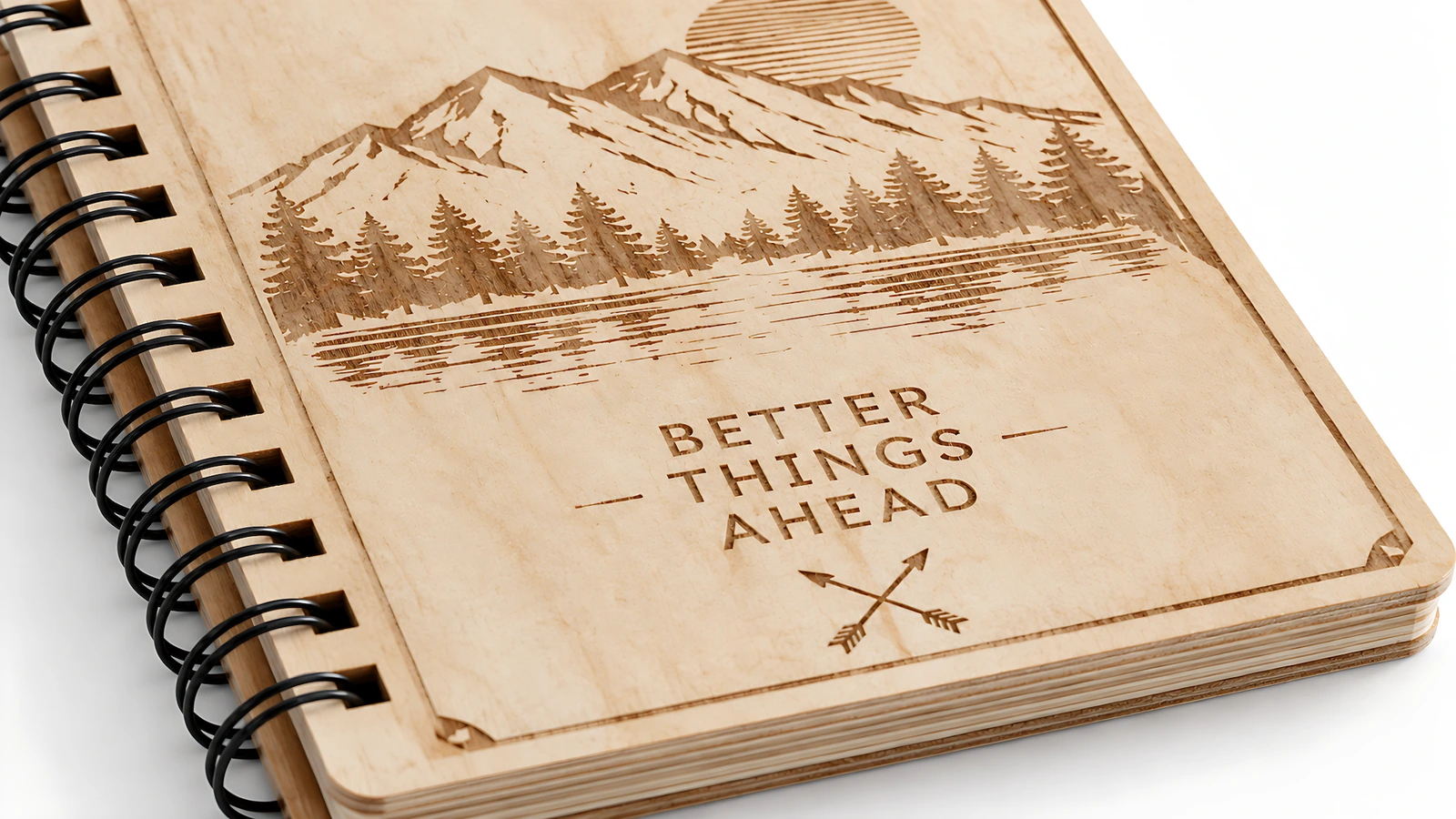
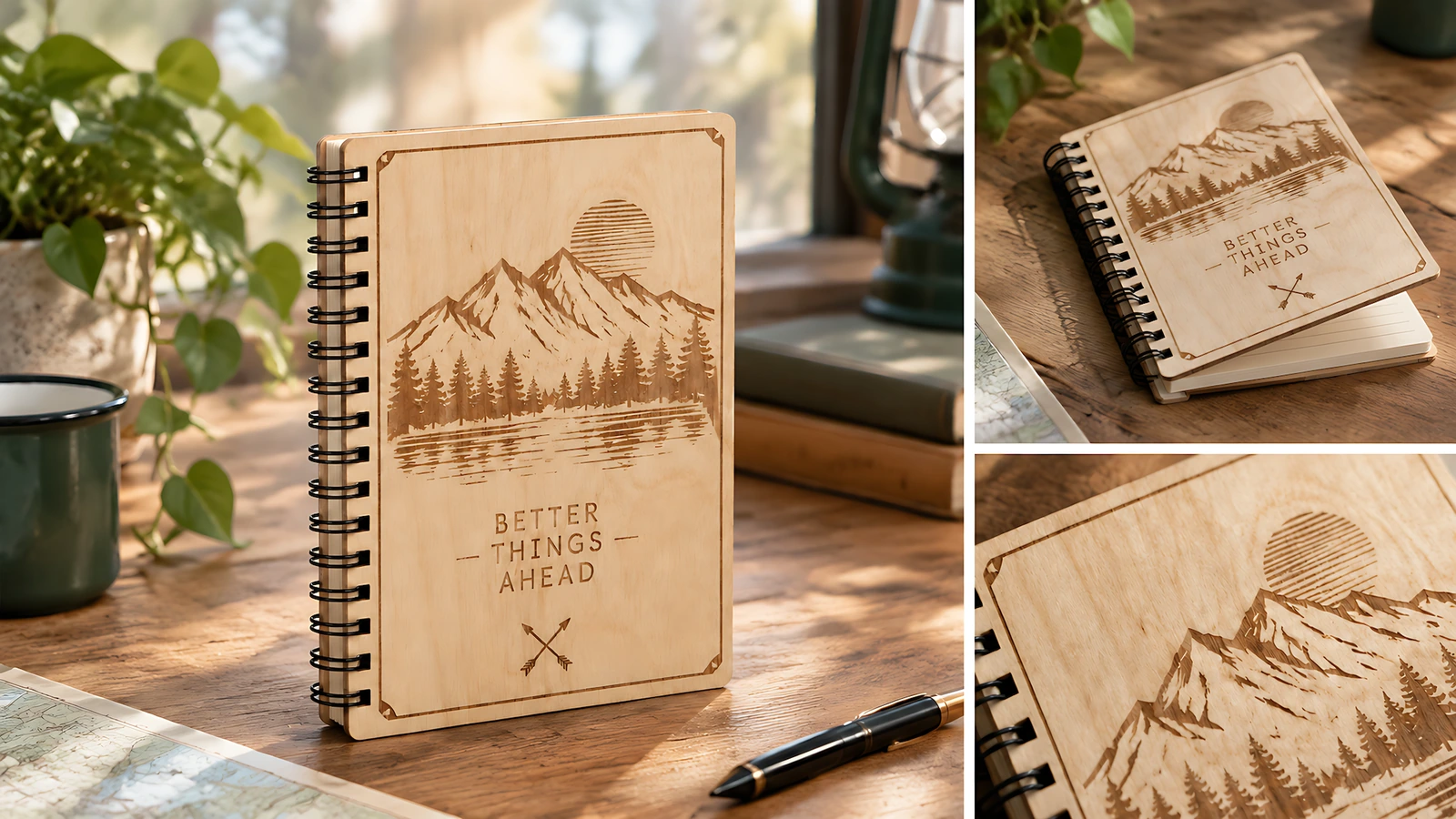
Concept components shown separately for discussion; finishes, bindings, and closures remain subject to feasibility and quotation.
How should engraving files be prepared for reliable approval? ↑
Begin with the cleanest available artwork. Vector artwork is preferable for reviewing logo outlines and lettering; a screenshot or pixelated image can conceal problems until engraving. If the brief includes a photograph or detailed illustration, its suitability must be assessed separately. Photo reproduction is not a verified capability for this product.
- Content: Confirm spelling, capitalization, punctuation, dates, and permission to use the artwork.
- Typography: Identify the intended font and agree how it will be preserved in the production file.
- Placement: Mark the engraving area, orientation, and clearance from binding features and edges.
- Legibility: Review small text, fine details, and filled areas at the proposed output size.
- Personalization: Match each variable name to its required quantity and packing identifier.
- Version control: Give the approved artwork an unambiguous revision reference.
A screen proof establishes content and layout, not the precise engraved shade or tactile result. Include a physical engraving sample in the approval process when contrast, fine detail, or presentation is important. Do not substitute a printed mockup for evidence of how the proposed plywood engraves.
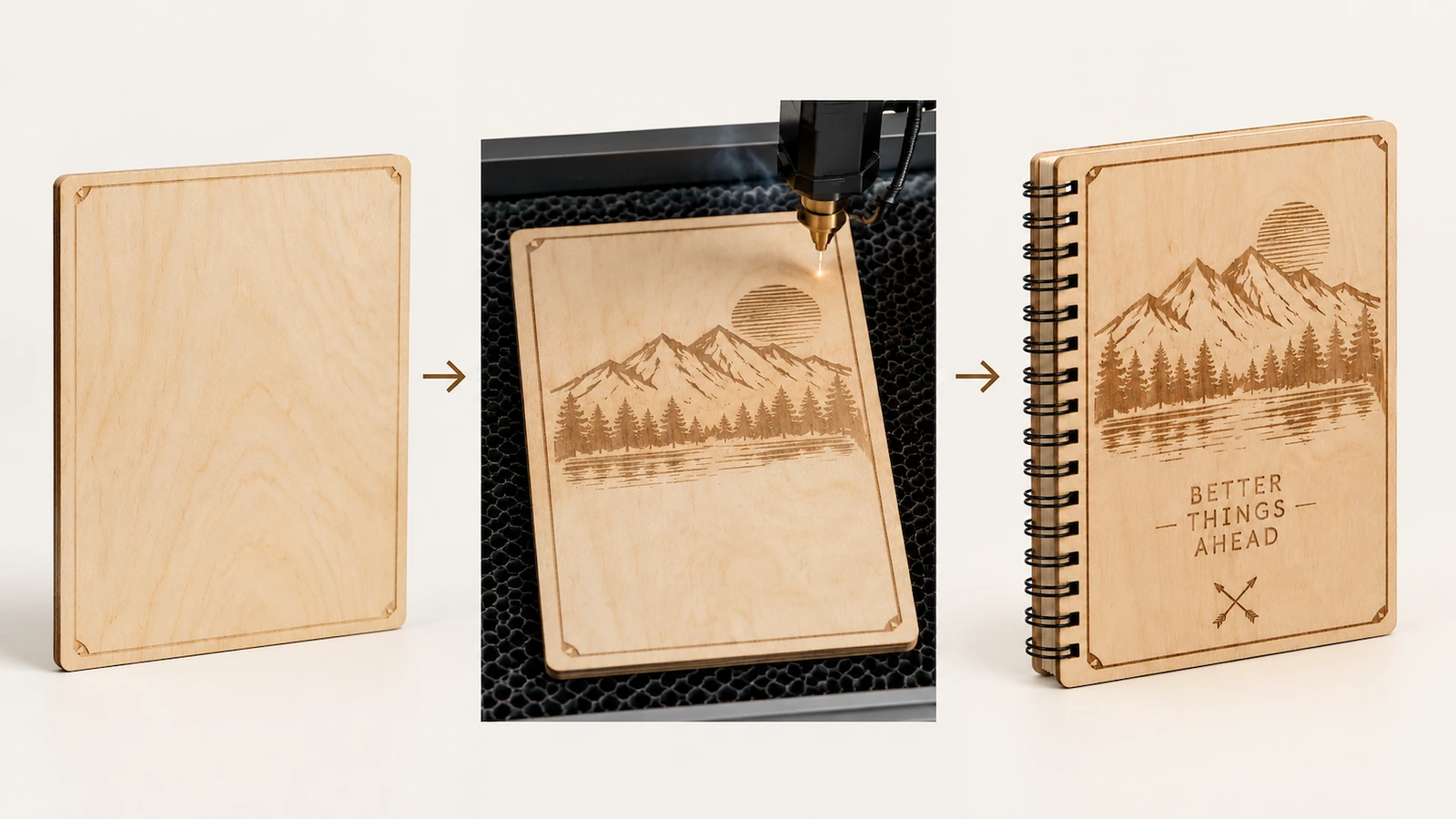
Workflow illustration, not a photograph of an approved customer file or completed production sample.
A complete sample creates a clearer route to production ↑
Use the assembled sample to connect the separate decisions: material, artwork, paper, binding, and packaging. A cover offcut can help assess engraving, but it cannot confirm page turning, writing comfort, closure fit, or the condition of a packed notebook.
- Define the brief: Record intended use, quantity, personalization, delivery destination, and required arrival date.
- Establish feasibility: Obtain the proposed construction, available materials, commercial terms, and sample arrangements.
- Approve the artwork: Resolve content, dimensions, placement, and variable-data handling.
- Assess the complete sample: Check the engraved cover, selected paper, assembly, opening action, and proposed pack.
- Freeze the order specification: Record the approved revision and any expressly accepted variation.
- Agree production release and inspection: Define when manufacturing may begin and what evidence is required before dispatch.
These are recommended order checkpoints, not a claim about an existing factory workflow. Sample charges, revision allowances, manufacturing duration, and shipping arrangements need written agreement. Separate sample preparation, buyer approval, production, transit, and customs handling when working backward from an event date.
Conceptual process illustration. It does not document a specific factory, production line, or manufacturing capacity.
What should the sample and shipment inspection actually check? ↑
Define acceptance around observable features rather than words such as “premium.” Record the sample reference, inspection method, agreed tolerance, and result. No thickness threshold, flatness limit, opening-cycle result, or defect-rate commitment has been verified for this product.
| Check | Practical assessment | Decision to document |
|---|
| Cover construction | Inspect exposed layers, edges, faces, and binding holes | Material match; acceptable edges; no unacceptable splitting or separation |
| Engraving | Compare wording, alignment, detail, and contrast with the approved sample | Correct personalization and agreed visual range |
| Surface condition | Inspect finish consistency, stains, loose residue, and handling surfaces | Agreed gift-ready condition |
| Paper performance | Write with the intended pen and inspect both sides after drying | Acceptable feathering, show-through, bleed-through, and drying behavior |
| Assembly | Turn pages and operate the selected binding and closure | Secure pages and acceptable opening and closing action |
| Packed condition | Inspect the assembled notebook in its proposed shipping protection | Suitable fit, identification, and protection criteria |
Paper weight alone is not an ink-performance guarantee. Test the actual paper with the intended pen and ink combination. Likewise, a clean-looking surface does not prove the absence of an objectionable odor; assess the packaged sample separately. A smell check is not an emissions test.
Moisture deserves its own assessment. Wood exchanges moisture with its surroundings, and coatings can slow rather than eliminate that exchange, as explained by Oregon State University Extension[1]. Agree relevant conditioning and flatness checks for the proposed construction and destination; do not promise that plywood will never warp.
For larger orders, agree sampling, defect categories, and corrective-action terms before production. Natural appearance variation and manufacturing defects should be distinguished using an approved reference, not a blanket statement that every difference is acceptable because wood varies.
Inspection concept only. No test readings, pass results, or product performance certifications are represented.
How should you compare wooden notebook constructions and quotations? ↑
Compare like-for-like specifications before comparing unit prices. “Wooden notebook” can describe materially different products, so a lower price may reflect another cover construction, less paper, different decoration, or simpler packaging rather than a better offer.
| Construction | Material distinction | Most useful buying question |
|---|
| This plywood-cover product | Layered wood cover with laser engraving | What are the exact board, finish, paper, and sample acceptance terms? |
| Solid-hardwood cover | Solid wood rather than plywood | Are species, thickness, weight, and care requirements documented? |
| Wood veneer on paperboard | Wood surface over a different supporting core | Is the core disclosed, and does the sample meet tactile expectations? |
| Bamboo cover | A different material specification | Is the cover solid bamboo or a composite construction? |
| Wood-grain synthetic cover | Wood appearance without a wooden cover | Does the material suit the brief without implying real wood? |
| Wooden-page notebook | Wood used as the writing surface | Are its writing limitations acceptable for the intended use? |
This is a construction comparison, not a tested durability ranking. Performance, handling, and appearance depend on the specific materials and assembled product. No alternative’s price or lead time should be transferred to this provisional SKU.
Ask quotations to distinguish the notebook, engraving setup, variable names, samples, packaging, freight, and taxes or duties. Clarify the currency and delivery basis. A simple shared logo and a list of individual names are different production briefs; compare them separately.
Agree cancellation and defect remedies as part of the purchase terms. Do not assume that a change of mind after engraving, a seller’s production error, and transport damage receive the same treatment. Record the proof-approval point, reporting procedure, and available remedy without importing another seller’s return policy.
Which sourcing and compliance documents matter for a US order? ↑
Because the confirmed cover is plywood, its exact panel classification matters. CARB identifies hardwood plywood, particleboard, and medium-density fiberboard as regulated composite-wood categories, including their use in finished goods. Establish applicability and request the relevant panel documentation and labeling evidence; this page makes no product compliance claim. See CARB’s composite-wood guidance[2].
If certified sourcing is a purchasing requirement, verify the certificate holder, scope, and transaction claim before approving any label. Cover wood and paper should be checked separately; evidence for one component does not automatically establish the other. FSC chain-of-custody documentation[3] provides the relevant framework. FSC certification has not been verified for this SKU.
For imports, determine whether a Lacey Act declaration is required using the finished product’s classification and shipment circumstances—not the word “wooden” alone. Where applicable, establish the required species, harvest-country, quantity, and value information with the importer. Consult USDA APHIS declaration requirements[4] rather than assuming processing or plywood construction creates an exemption.
If the intended audience makes the notebook a children’s product, arrange a separate compliance assessment. CPSC identifies a total-lead limit of 100 ppm for accessible components of children’s products; specified material testing exemptions do not remove the limit or applicable certification obligations. See CPSC’s total-lead guidance[5]. No child-safety testing is established by this product description.
Protect the presentation through shipping and repeat orders ↑
Packaging should protect the engraved face, exposed edges, binding, and any selected closure without adding unapproved pressure or abrasion. Confirm whether individual presentation packaging is required, how personalized units will be identified, and what protection is proposed for the shipping carton.
Carton capacity and packing fit depend on actual product dimensions, the loaded configuration, and sample validation. Freight estimates should use the confirmed packed dimensions and weight, not a competitor’s notebook weight. Separate the requested arrival date from the dispatch date and identify responsibility for customs clearance and import charges.
For repeat orders, retain the approved artwork revision, personalization template, material specification, sample photographs, packing instructions, and acceptance record. Recheck availability and approve material substitutions before release. A retained reference makes differences visible; it does not guarantee identical wood appearance across future batches.
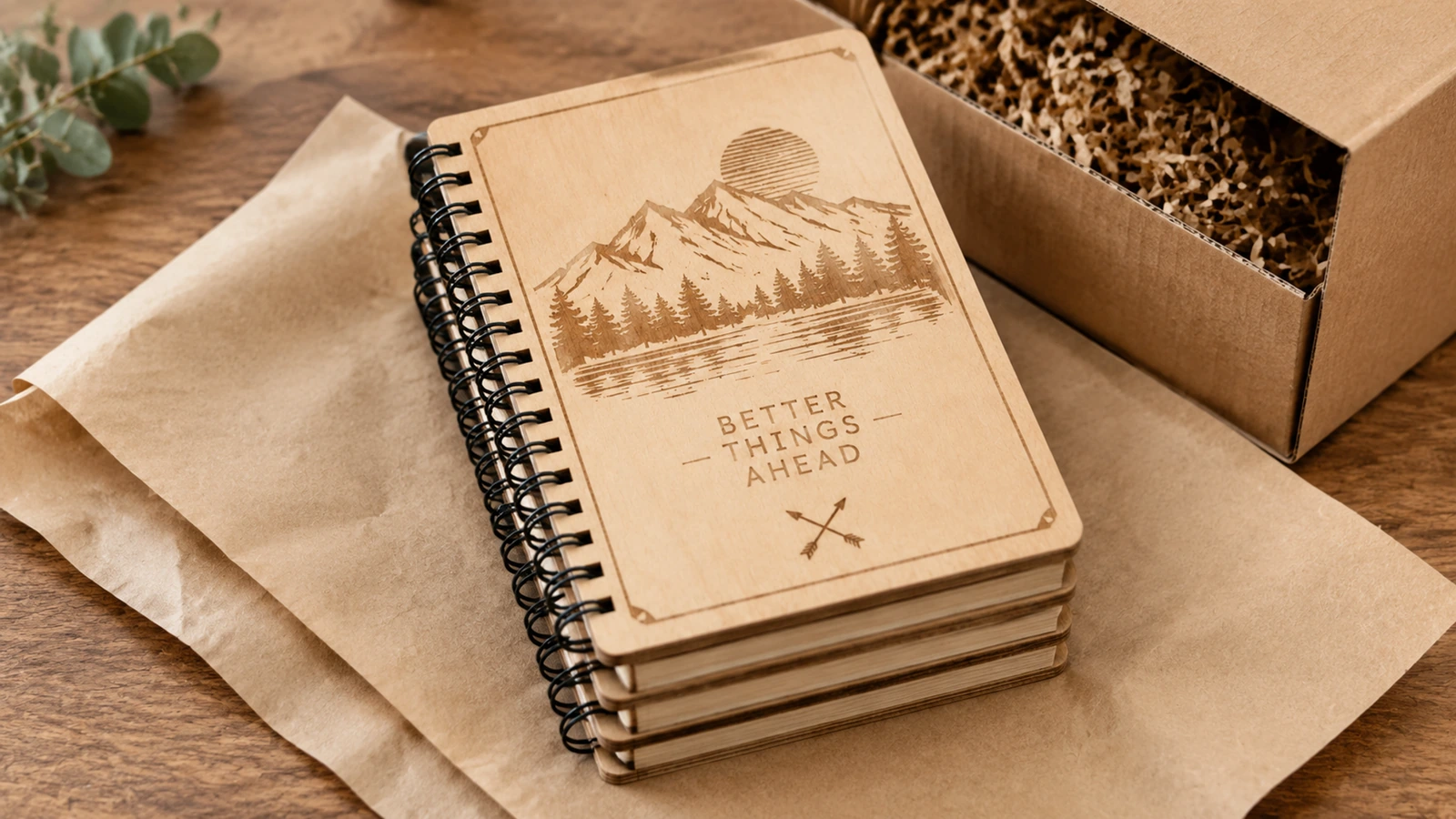
Illustrative packing proposal. Packaging materials, carton capacity, and shipment performance require confirmation.
Key takeaways for a better-specified purchase ↑
- The confirmed construction is plywood with laser engraving. Solid hardwood, bamboo, specific wood species, and certified sourcing are not established product attributes.
- Approve the complete notebook, not just its cover artwork. Paper behavior, assembly, surface condition, and packing need separate sample checks.
- Commercial terms remain order-specific. MOQ, production time, unit weight, and price require a quotation or measured sample; no factory figures have been provided.
- Recycling claims require evidence of appropriate collection access. — The FTC advises qualifying recyclable claims when suitable facilities are unavailable to at least 60% of consumers or communities where the product is sold (Source[6]). This is an access criterion, not this notebook’s recycling rate.
Do not treat a wood cover as proof that the assembled notebook is recyclable, biodegradable, or broadly “eco-friendly.” Identify the specific component and documented benefit; coatings, adhesives, paper, and hardware require consideration rather than an unsupported whole-product claim.
Turn your gift idea into a clear purchasing brief ↑
A useful quotation begins with the recipient, artwork, quantity, desired writing format, destination, and arrival requirement. From there, the proposed plywood construction and assembled sample can establish what is being purchased—and what remains to be tested—before personalization makes changes more difficult.
Request a project-specific quote for NSKU-764-01 with your artwork, quantity, preferred dimensions, paper requirements, packaging brief, and delivery destination.




The information below is required for social login
Sign In
Create New Account