SEO title: Custom PU Leather Notebooks | Hardcover Branding
Meta description: Plan custom PU leather notebooks with clear cover, logo, paper and packaging requirements. Request a project-specific quote and sample review.
Custom PU leather notebooks combine a synthetic leather-look cover with a hardcover structure for branded stationery and business gifting. Specify the paper, binding, logo treatment and packaging together, then assess a physical sample. Dimensions, available finishes, minimum order quantity, pricing and delivery timing require project-specific confirmation.
For marketing teams, HR buyers and stationery brands: this format is worth considering for employee welcome packs, client gifts, conferences and private-label collections. Each application calls for different decisions: an event notebook needs a workable delivery schedule, a meeting notebook needs comfortable writing, and a retail product needs accurate material descriptions and consistent presentation.
A good-looking cover is only the beginning. A faint logo, disappointing paper or closure that marks the surface can undermine the finished gift. These details are difficult to judge from a digital mockup, especially when the cover, decoration and interior are selected separately.
The practical solution is to review one complete specification and one representative sample. Treat appearance, writing performance, construction and packaging as connected purchasing decisions—not independent upgrades added after the price has been agreed.
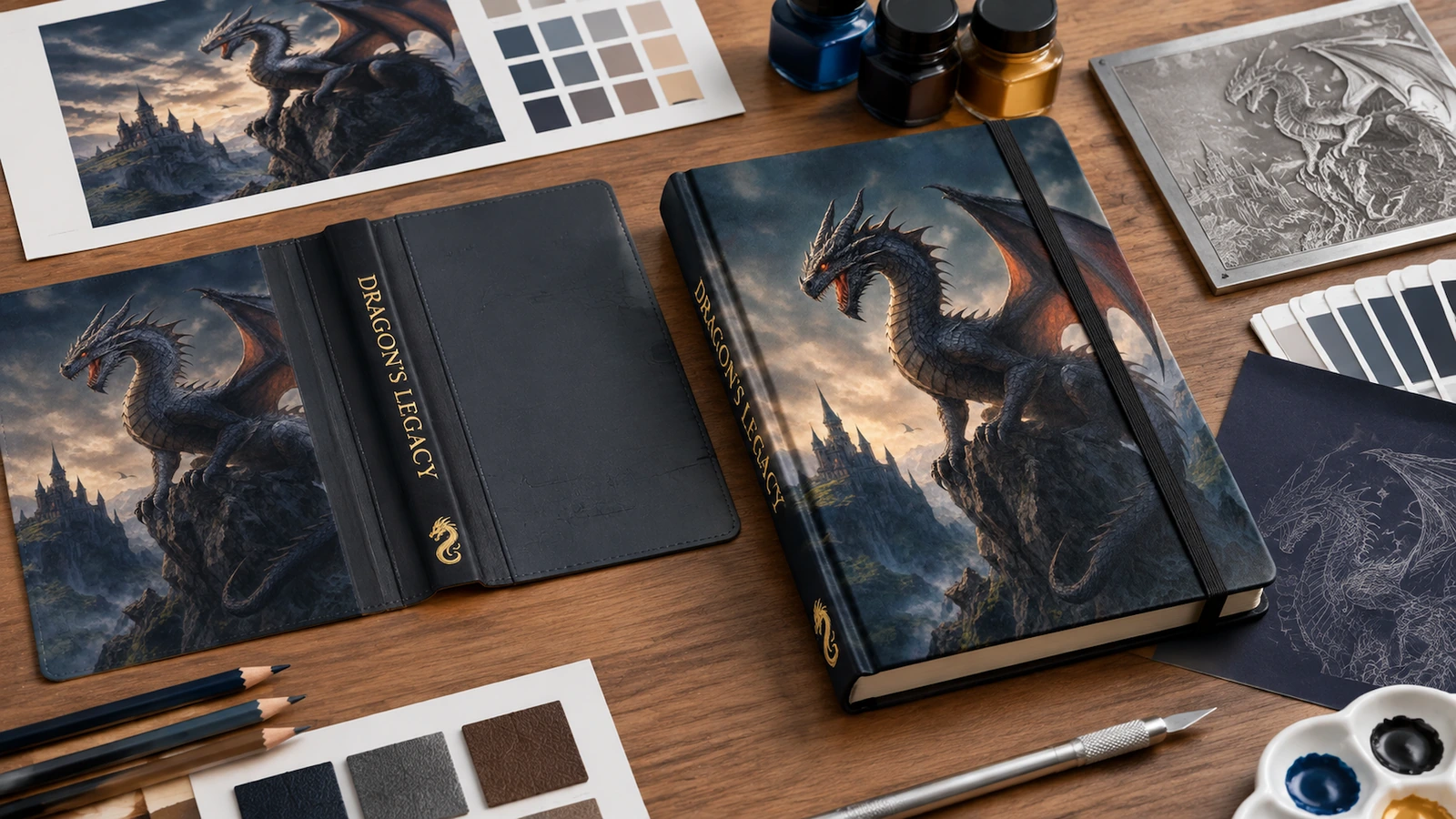
Illustrative configuration concepts throughout this page are not production samples or confirmation of available options.
Explore specifications, sampling and purchasing decisions
What does PU leather hardcover mean? ↑
PU identifies the synthetic covering; hardcover identifies the rigid construction. Neither term establishes the paper grade, binding method or ability to lie flat. The product identity here is Custom PU Leather Hardcover Notebooks, within Custom Notebooks and Custom Leather Notebooks; the provisional reference is NSKU-762-01.
PU leather is not genuine leather. In this application, the material generally consists of a polyurethane surface over a fabric backing, mounted onto a rigid board. Surface grain, covering thickness, board thickness and finished cover thickness are separate specification fields.
Keep the material description explicit in your purchasing brief and customer-facing copy. The FTC Leather Guides[1] address disclosure of leather-like materials that are not leather. Their listed scope includes ring binders and similar articles, rather than expressly naming every hardcover notebook. This page therefore identifies PU directly without presenting the guides as a notebook-specific certification.
Do not interpret a leather-like appearance as evidence of genuine-leather aging, a particular service life or an animal-free finished product. Claims about the complete notebook require information about its other components as well.
Which specifications make the notebook practical? ↑
Specify what the recipient will handle and write on—not just what the cover will look like. Use the following checklist to build a comparable quotation. The entries describe information to request, not confirmed specifications for this product.
| Field | What to specify | What to verify |
|---|
| Size | Trimmed page dimensions and overall closed dimensions in mm | Whether a size label refers to the paper or outer cover |
| Cover | PU reference, grain, color and covering thickness in mm | Physical swatch and construction sample |
| Board | Board material and thickness in mm | Rigidity, corners and finished bulk |
| Interior | Paper reference, color and grammage in g/m² | Writing performance with intended pens |
| Page count | Sheets and pages stated separately | Whether endpapers and printed inserts are included |
| Layout | Ruled, dotted, plain or proposed custom printing | Spacing, contrast and usable writing area |
| Binding | Proposed construction and opening behavior | Page security and writing near the gutter |
| Accessories | Requested bookmark, pen loop, pocket or closure | Availability, placement and sample fit |
Separating these fields prevents unlike quotations from appearing equivalent. A thicker board does not establish better paper, and a higher paper grammage does not by itself prove resistance to ink bleed-through.

Review the page layout at its intended physical size. Check whether line spacing suits the user, whether printed elements distract from handwriting, and whether writing close to the spine is comfortable. Compare the reverse of a written page as well as its front.
Ask for an unambiguous page-count definition. A sheet has two faces, but quotation conventions may treat printed inserts and endpapers differently. The approved specification should eliminate that ambiguity before artwork pagination begins.
Any pocket capacity or pen-loop compatibility must be determined by physical dimensions, loading conditions and sample validation. Do not assume that a pictured phone, pen or stack of cards establishes a guaranteed fit.
Which cover finish and closure suit your design? ↑
Choose decoration against the actual PU surface. Blind debossing creates a recessed mark without colored foil; foil stamping introduces a contrasting finish. Neither treatment should be approved solely from a simulated image, particularly when the artwork includes small lettering.
As a supplier-specific starting point, QinPrinting’s leatherette guidance[2] specifies a minimum foil line weight of 0.3 mm, advises against text below 6 pt, and recommends clearance of 6–8 mm from cover edges and 8–12 mm from the spine hinge. These are reference preflight values, not validated production tolerances for this notebook.
For a subtle corporate identity, ask to evaluate a bold debossed mark. For greater visual contrast, compare a foil sample. Heat-reactive PU may be considered where a tonal change is desired, but its availability and response require confirmation. Do not assume that every PU material darkens under heat.

Closures should support the intended use without damaging the cover. If requesting an elastic band, assess its tension and contact marks. For a magnetic flap, review alignment and the closed profile. Check any rear attachment area as carefully as the front-facing detail.
Printed color artwork needs a separate compatibility review. Screen printing, UV printing and laser marking are not interchangeable promises. A proposed technique remains pending until the selected material and artwork have been evaluated together.
How should your artwork be prepared? ↑
Provide artwork that separates design intent from production instructions. Include an editable vector logo, a visual placement proof and clear notes identifying each requested finish. A photograph of an existing notebook can communicate direction, but it does not define reproducible dimensions.
- Supply an AI, EPS or PDF vector file with lettering outlined.
- Keep debossing, foil and printed elements on separately identified layers.
- State logo dimensions and placement offsets in mm.
- Provide brand color references while treating screen previews as non-binding.
- Flag fine lines, small reversed text and details crossing textured areas.
- Identify which elements belong on the cover, endpapers, interior or packaging.
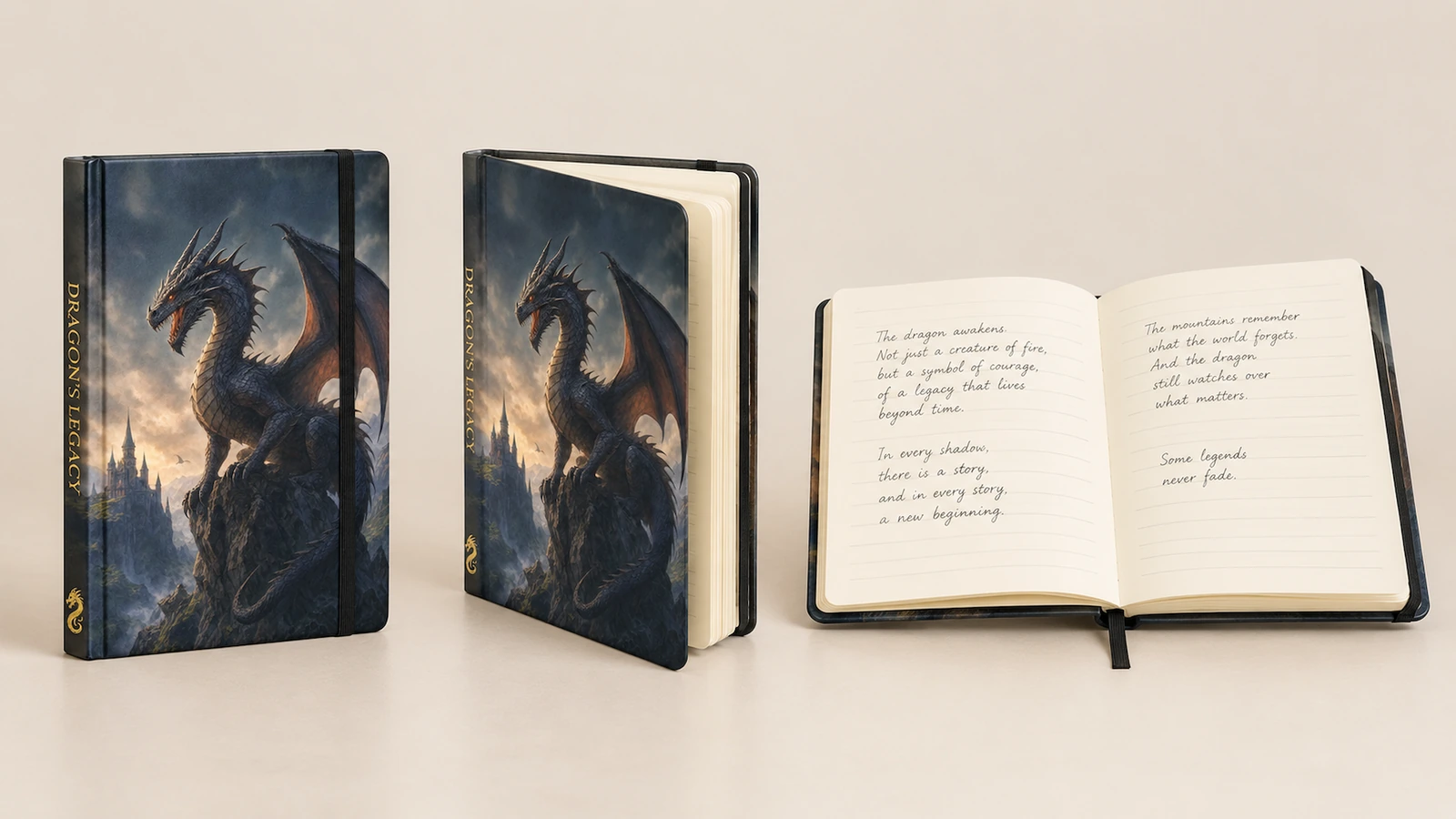
Use the production drawing to establish safe areas around hinges, edges and accessory attachments. If a design requires unusually fine detail, resolve the artwork or material choice before tooling rather than relying on pressure adjustments to rescue it later.
Approve color using a physical reference. A Pantone number communicates the target, but it does not establish that a matching PU stock exists or that a custom material run is economical. Any color tolerance should identify the reference, viewing or measurement conditions, and acceptance method.
How do you move from brief to production? ↑
Put the approval sequence into the order before committing to a deadline. A proposed workflow should connect commercial terms with the material and artwork actually being purchased.
- Define the brief: quantity, intended use, destination, required arrival date and budget basis.
- Resolve the specification: cover, interior, binding, decoration, accessories and packaging.
- Review the quotation: identify tooling, samples, revisions, testing, freight and excluded charges.
- Approve artwork: confirm placement, dimensions, finish layers and interior pagination.
- Evaluate the physical sample: record accepted features and any remaining changes.
- Authorize production: agree the written approval gate and inspection requirements.
- Review shipment readiness: check inspection records, packing information and required documents.

There is no verified minimum order quantity, sample duration, production duration, unit weight or price for this product in the available product information. Each remains a quotation or sample-confirmation item. Another supplier’s advertised terms do not establish this product’s terms.
Require the schedule to distinguish working days from calendar days and to identify its starting event. Artwork approval, sample approval and payment may occur on different dates. Revisions should show their price and timing effects before another sample is commissioned.
What should a physical sample prove? ↑
A sample should demonstrate the agreed construction and appearance; it cannot prove years of service through a brief inspection. Establish which assessments are visual, which are functional, and which require laboratory testing.
| Checkpoint | Proposed assessment | Record to retain |
|---|
| Cover and corners | Inspect wrapping, grain, finish and visible damage | Material reference and close-up photographs |
| Logo | Check placement, readability and agreed adhesion or flex assessment | Approved artwork and physical reference |
| Paper | Write with intended pens and examine both faces | Paper reference, pens and observed results |
| Binding | Open, turn pages and assess attachment and gutter access | Construction details and agreed acceptance criteria |
| Accessories | Check closure action, attachment and intended fit | Loaded sample photographs where relevant |
| Odor and chemicals | Review packed-sample odor and separately scoped chemical testing | Assessment conditions and applicable reports |
These are proposed checks, not completed tests. An acceptable smell does not establish chemical compliance, and a material test does not automatically establish the performance of the finished notebook.

For cover durability, discuss hydrolysis, flexing, abrasion and coating adhesion with the testing provider. The agreed method must suit the actual coated material. Define conditioning, test duration or cycles, and failure criteria rather than asking only for a generic “durability certificate.”
Write the treatment of defects into the order: missing decoration, loose pages, damaged corners and coating separation should not disappear inside an undefined “minor variation” allowance. Inspection sampling, remedies, reporting deadlines and any warranty coverage require agreement; none is established here.
Which purchasing route fits your priorities? ↑
Compare the degree of customization before comparing unit prices. A stocked notebook with an added logo and a notebook manufactured around custom interior artwork are different purchasing projects.
| Route to investigate | Potential fit | Main trade-off |
|---|
| Existing notebook plus logo | A brief centered on cover branding | Available dimensions, paper and colors constrain the design |
| Selected PU cover with standard interior | A coordinated corporate appearance | Material availability and tooling still require confirmation |
| Custom cover and custom interior | Private-label stationery or branded layouts | Additional artwork, sampling and production decisions |
| Alternative cover material | A brief prioritizing a different feel or material story | Decoration, construction and costs must be assessed again |
These are purchasing models to discuss, not confirmed service packages. Ask each supplier to quote the same paper, page count, binding, decoration and packaging before interpreting a lower price as better value.
If PU does not meet the brief, compare genuine leather, cloth or paper-covered board against the actual priority. A genuine-leather requirement should remain explicit rather than being satisfied with a leather-look substitute. A paper-focused environmental brief should not be redirected to ordinary PU simply because it is described as vegan.
Request a cost breakdown covering the notebook, decoration setup, samples, custom printing, accessories, packaging and required tests. Then separate freight, import charges and destination delivery from the product price. An FOB quotation and a delivered quotation cannot be compared without accounting for their different inclusions.
For a fixed event date, compare feasible arrival schedules rather than advertised production speed alone. A simpler available configuration may be preferable to a deeply customized specification whose material sourcing or approval sequence cannot fit the deadline.
Which material and compliance documents matter? ↑
Documentation should identify the supplied materials, intended market and applicable scope. A company-level logo or certificate list is not evidence that a particular notebook configuration has been assessed.
Paper sourcing claims
The FSC chain-of-custody standard[3] governs claims for forest-based products. If an FSC claim is required, check the applicable certificate scope, covered components and sales documentation. Paper documentation does not certify the PU coating, and purchasing certified paper alone does not establish entitlement to label the finished notebook.
No FSC certification is established for this product. Recycled-content, water-based PU, solvent-free and animal-free claims likewise remain documentation requests, not default attributes. “Vegan” should not be used as a substitute for evidence of recyclability, biodegradability or lower environmental impact.
Destination-specific chemical assessment
For California distribution, OEHHA’s Proposition 65 guidance[4] explains the role of anticipated exposure and warning obligations. Do not reduce this assessment to a universal notebook concentration limit or describe it as a generic product certification.
For an EU-bound order, provide the destination and buyer’s restricted-substances requirements to the laboratory. Covering, inks, adhesives and accessories should be considered within the agreed assessment scope. A report for another color or material formulation may not support the proposed order.
Keep similarly abbreviated chemicals separate. ECHA’s N,N-dimethylformamide restriction text[5] concerns the solvent and occupational-exposure conditions; it should not be presented as a simple finished-notebook residue limit. Dimethyl fumarate, associated with anti-mold treatments, is a different substance.
Ask the laboratory to determine whether any PFAS-related requirements apply to the actual product and destination; apparel restrictions should not be copied onto stationery without a scope assessment. If the notebook is intended for children, disclose that intended use before defining the testing brief.
How should packaging, delivery and reorders be planned? ↑
Packaging should protect the approved notebook and fit the distribution plan. Discuss individual protection, optional gift presentation and outer shipping cartons separately. A presentation box may improve the gifting format, but it is not automatically suitable as a shipping container.
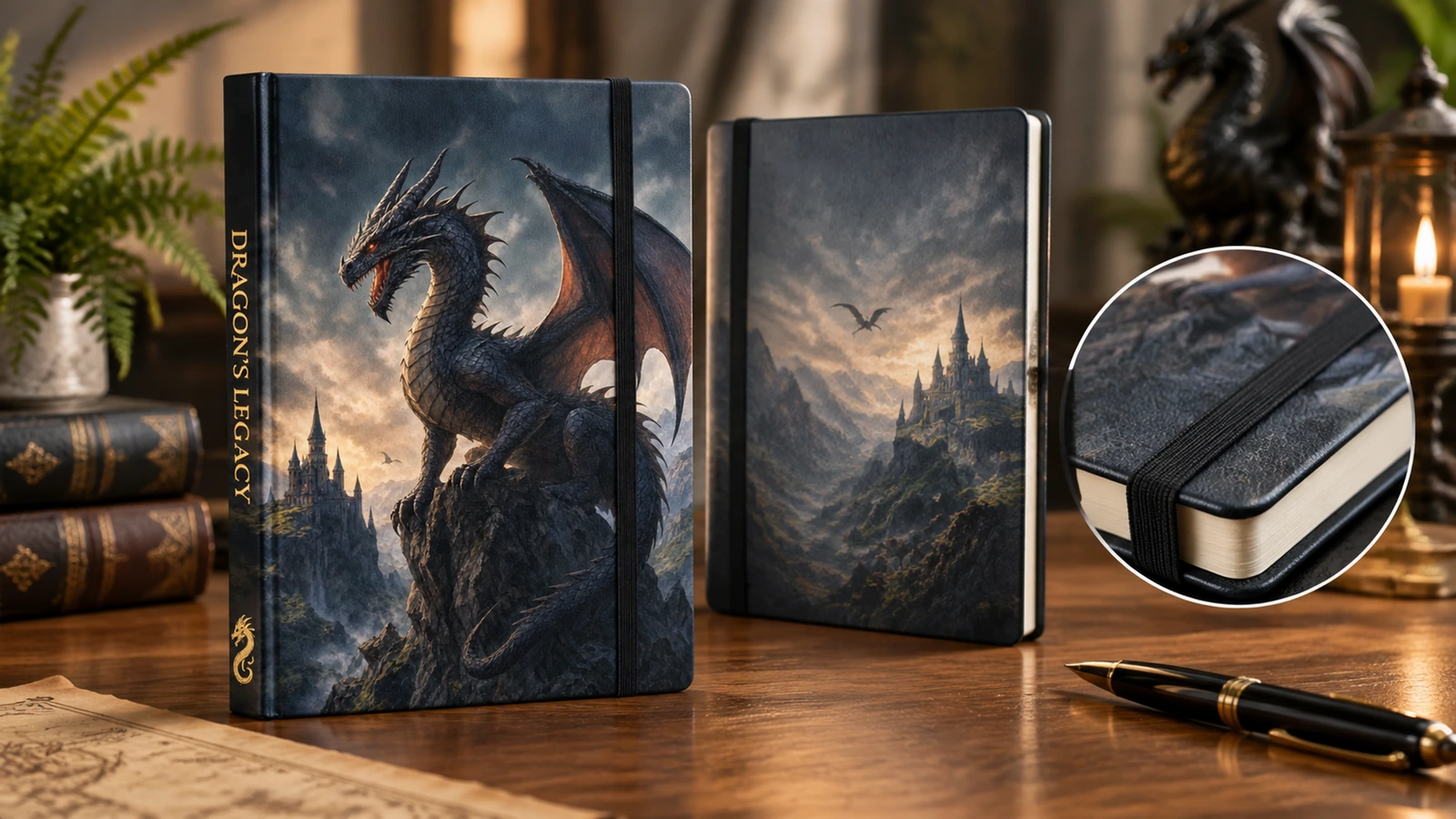
Request packed dimensions, measured weights and the proposed packing arrangement before comparing freight. Carton capacity must be determined by physical dimensions, loading conditions and packing-sample validation. Do not infer a shipping weight or carton quantity from a styled photograph.
For repeat orders, retain the accepted notebook, material reference, artwork version and packing specification. Record substitutions explicitly. A matching color name does not establish a matching shade, texture or paper feel across different production batches.
Agree receiving checks before shipment so discrepancies can be documented consistently. Keep transit estimates separate from production timing, and include the destination details needed for a meaningful delivery quotation.
What should buyers take away? ↑
- Accelerated aging is not a service-life warranty. — ACT recommends a 5-week minimum ISO 1419 hydrolysis assessment for indoor contract upholstery, not a notebook-specific pass requirement, and rejects a direct conversion from test weeks to service years (Source[6]).
- Approve the complete configuration. — Cover, paper, binding, decoration and packaging should refer to the same specification.
- Keep commercial unknowns visible. — MOQ, sample timing, production timing, price and unit weight remain unverified for this product.
- Use evidence at the right level. — Material reports, finished-product checks and supply-chain claims answer different purchasing questions.
Turn your notebook brief into a clear quotation ↑
A useful branded notebook starts with a specification that connects the recipient’s needs to the cover, writing experience and delivery plan. Establish the essentials first, then use sampling to resolve appearance and performance questions before production approval.
Request a project-specific quotation with your quantity, preferred dimensions, logo file, interior requirements, destination and required arrival date.





The information below is required for social login
Sign In
Create New Account