Custom paperboard hardcover notebooks combine a rigid board cover with a printed paper wrap and a separately bound writing block. Specify the cover construction, interior paper, binding, artwork and packaging together, then evaluate a physical sample before approving a bulk order.
For procurement teams, event organizers and creative brands: this format puts illustrations, photography or campaign graphics across a book-style cover. It suits onboarding materials, conference notebooks, workshop journals and retail stationery where the cover design matters as much as the space inside for writing.
A corporate buyer may prioritize brand color and an event deadline. An illustrator may need the cover artwork to reproduce accurately. The eventual user needs readable ruling, comfortable opening and paper that works with their pen. A useful specification connects these priorities rather than treating the notebook as a blank item with a logo added.
The problem with buying by appearance alone: an attractive mockup cannot reveal cover curl, weak hinges, distracting show-through or a pocket that prevents the book from closing. Discovering those differences after delivery can mean unusable event stock, customer complaints or a replacement order.
The practical solution: approve the construction and the writing experience alongside the artwork. For Custom Rigid Paperboard Hardcover Notebooks, reference NSKU-761-01, the configurations below are quotation and sampling requests—not confirmed specifications. Product-specific MOQ, production time, unit weight, certification and performance results have not been supplied.

Illustrative concepts throughout this page show details to discuss and sample; they are not photographs of approved production or evidence of available configurations.
Explore the buying guide
What makes this a paperboard hardcover notebook? ↑
The rigid board is the structural core; the printed wrap is the visible surface. In paper-over-board construction, printed paper covers the board and turns around its edges. The finished case connects to the writing block through the endpapers and binding structure. This is different from a flexible card cover, even when both products are described as “cardboard notebooks.”
QinPrinting’s grayboard material guide[1] distinguishes the board from the paper or other material wrapped over it. That distinction matters when requesting full-cover artwork: the print specification belongs to the wrap, while thickness and rigidity belong to the board.
“Hardcover” does not identify the internal binding. A case can contain a sewn or adhesive-bound block. Likewise, a paperboard core does not establish recycled content, fountain-pen compatibility or resistance to moisture. These are separate purchasing questions, each needing its own specification or evidence.
Choose dimensions and pages around the writing task ↑
Begin with the usable page rather than the outside cover. A meeting notebook needs room for headings and notes; a workshop journal may need custom exercises; an illustrated retail notebook may favor an uncluttered interior. Check margins, ruling and the space near the binding at actual size before approving the layout.
| Specification field | Request to evaluate | Confirmation needed |
|---|
| Page trim | A5: 148 × 210 mm | State whether dimensions describe trimmed pages or the outside case. |
| Alternative format | 5.5 × 8.5 in | Review separately; it is not interchangeable with A5. |
| Board thickness | Discuss 2.0 or 2.5 mm | Confirm suitability for the selected format and book block. |
| Printed wrap | Discuss 157 gsm coated paper with matte lamination | Approve the actual paper, finish and corner construction. |
| Writing paper | Compare 80, 100 and 120 gsm samples | Evaluate the intended pens on the actual stock. |
| Interior layout | Ruled, dotted, plain, squared or custom | Confirm spacing, margins, numbering and print orientation. |
| Extent | Specify pages and sheets separately | Define whether endpapers are included in the count. |
These are discussion examples drawn from the supplied industry material, not an available-options list for this SKU. Changing the paper, page count or board thickness can change the spine, finished weight and packaging requirements.
GSM measures mass per unit area, not thickness or ink resistance. ISO 536[2] provides a grammage measurement method; it does not certify that a notebook will resist bleeding. Request actual paper thickness for construction planning rather than treating GSM as a universal spine-width calculator.
Separate three writing outcomes: ghosting is visible show-through, bleeding is ink penetrating to the reverse, and feathering is spreading along the written edge. Test the intended ink and pen combination. A heavier sheet alone is not sufficient evidence for a “no bleeding” claim.
Match the cover finish and closure to daily use ↑
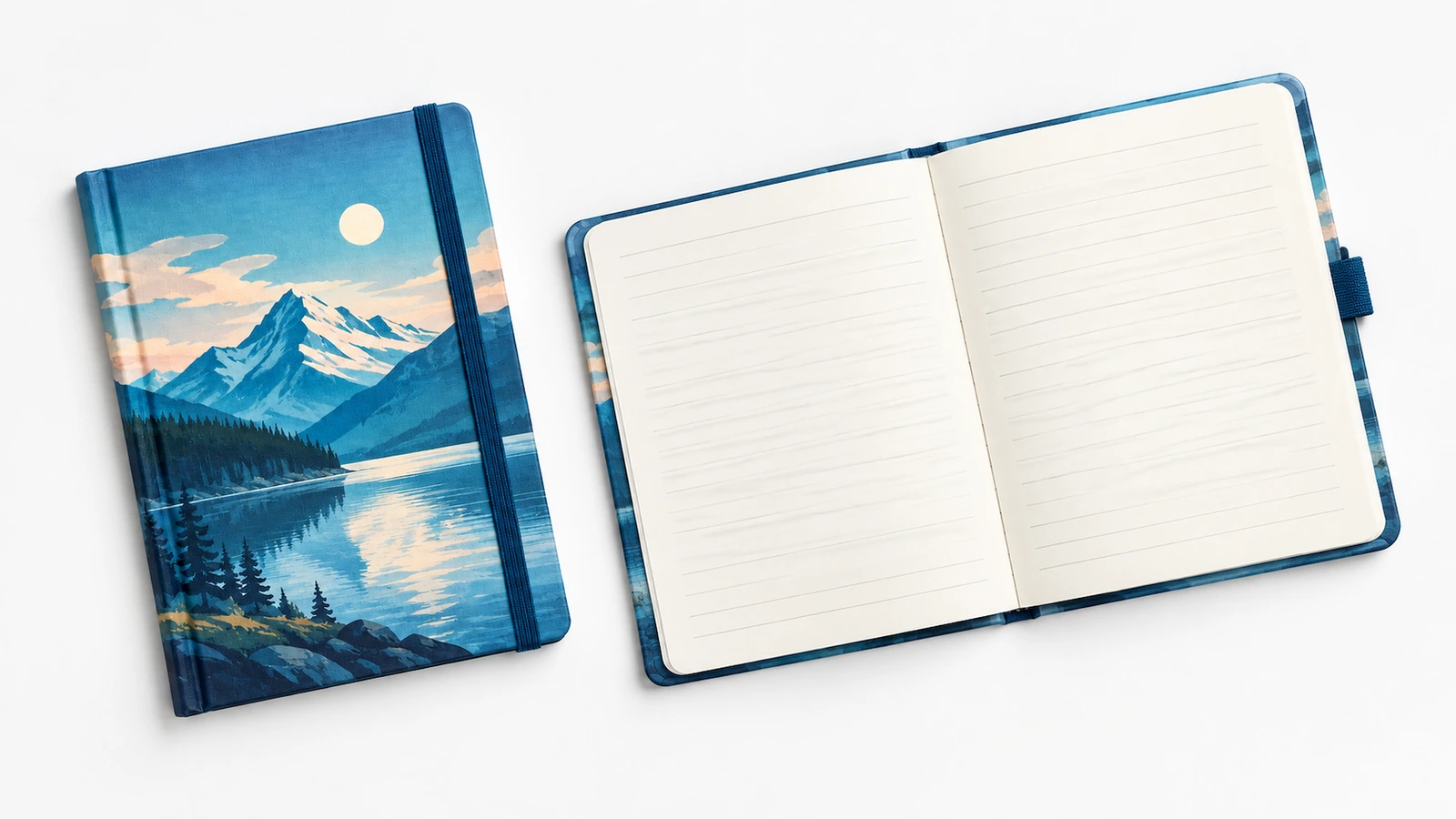
Printed paper wrapping is a suitable route to discuss when the design depends on photographs, gradients or edge-to-edge illustration. Matte, gloss and soft-touch treatments should be evaluated on physical samples. The choice affects appearance and handling; none should be described as scratchproof or waterproof without applicable testing.
Request samples that include dark printed areas, corners and the hinge—not just a flat swatch. These locations help reveal scuffing, lifting and differences in surface appearance. Foil, embossing, debossing and spot UV are separate feasibility and quotation items, with detail reproduction to be checked on the selected construction.
For organization, consider a ribbon marker, elastic closure or rear paper pocket. Confirm availability and placement before showing them as included features. Pocket fit and capacity depend on physical dimensions, the loaded condition and sample verification; a photograph cannot establish how many cards or receipts it holds.

How should you prepare artwork for a wrapped cover? ↑
Freeze the size, paper, page count and binding before finalizing the cover artwork. A wrapped case needs front and back panels, a spine, hinge areas and turn-ins. An ordinary single-page cover file does not describe that geometry. Request a production-specific template instead of calculating the case from the visible front cover alone.
- Confirm the template: identify panel boundaries, spine, hinges, turn-ins and safe areas.
- Prepare print color: use the requested CMYK setup and provide any brand spot-color reference separately.
- Separate special finishes: supply distinct artwork for foil, embossing, debossing or spot UV.
- Check personalization: review spelling, names, orientation and each artwork version.
- Approve at actual size: inspect small text, fine lines, ruling and critical elements near folds.
China Printing 4U describes a typical 3 mm page bleed[3]. That page-layout allowance is not a complete hardcover-wrap specification. The selected printer’s case template must define the larger wrapping and hinge allowances.
A digital proof checks layout and content but cannot establish paper feel, foil sharpness or the finished surface. For color-sensitive work, agree on a physical reference and viewing conditions. Late paper or extent changes should trigger a spine and artwork review before production proceeds.
Turn the approved design into a controlled production brief ↑
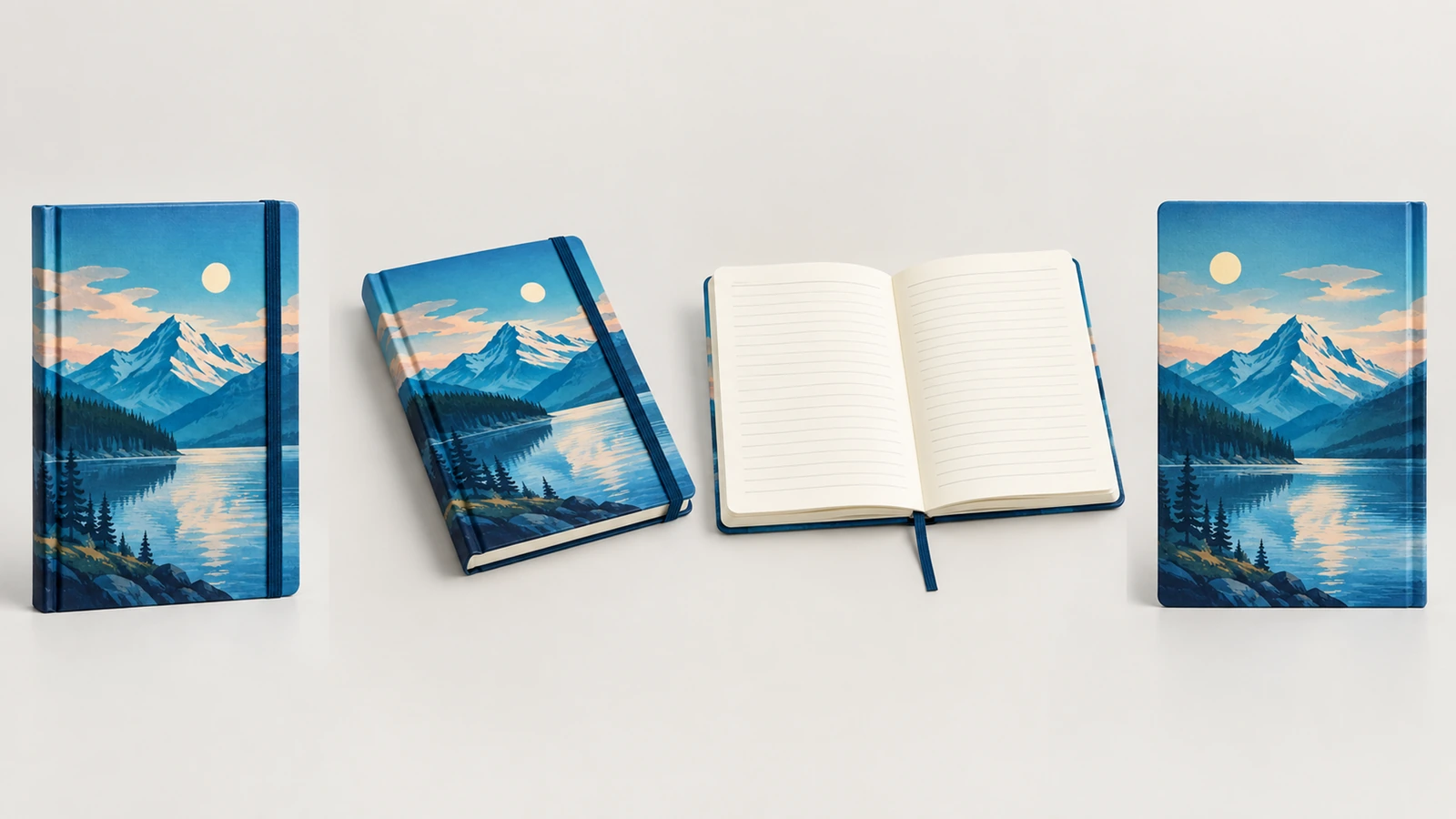
Specify the book-block construction explicitly. Sappi’s binding guide[4] describes Smyth sewing as joining folded sections with thread. This offers a relevant construction to evaluate for frequent handling and comfortable opening, but the finished sample still determines whether the chosen notebook meets the intended writing requirement.
Do not translate “sewn” into an automatic promise of unrestricted 180-degree opening. Paper thickness, section arrangement, endpapers and case construction all belong in the evaluation. Equally, do not assume every adhesive-bound block will fail; assess the actual construction instead of accepting or rejecting it by label.
A proposed approval sequence is specification confirmation, artwork preflight, material selection, physical sampling, written approval, production and inspection. The manufacturing route generally includes printing, folding or gathering, block binding, case preparation and casing-in. Finishing order depends on the selected process and should be confirmed by the producer.
Record what the approved sample represents. A visual mockup, construction dummy and production-representative sample answer different questions. Keep the signed specification and reference sample together, and require agreement on substitutions before materials or processes change.

Which checks belong in sample approval? ↑
Agree on acceptance criteria before evaluating the sample. “Premium quality” does not define an acceptable color difference, a loose page or a distorted cover. Record the intended test conditions, comparison sample and defect classifications so inspection can resolve differences rather than introduce new expectations.
| Check | Practical assessment | Record to retain |
|---|
| Cover and corners | Inspect flatness, wrapped edges, lifting, exposed board and surface marks. | Photographs and agreed cosmetic acceptance criteria. |
| Binding and endpapers | Open and turn pages; inspect attachment, hinge movement, bubbles and loose sections. | Agreed handling method and observed defects. |
| Writing performance | Use specified pens and inks; inspect the front and reverse after drying. | Pen, ink, paper identity and marked test sheets. |
| Print and personalization | Compare color, spelling, placement and special finishes with the approved reference. | Artwork revision and signed proof. |
| Dimensions and extent | Measure the page and case; verify page sequence and count. | Measurements, counting convention and tolerances. |
| Accessories | Check ribbon attachment, elastic placement, pocket fit and closing behavior. | Loaded sample condition and agreed findings. |
This is a proposed inspection framework, not a record of completed testing. Sampling frequency, handling cycles, transport tests and pass/fail thresholds must be agreed for the order; no factory results are available for this product.
Moisture-related distortion needs particular care. A flat sample at approval does not establish performance across different storage or transit conditions. Discuss conditioning, packing and destination conditions, then verify the agreed approach with representative samples rather than promising a warp-free cover.

Compare structures before comparing prices ↑
The right alternative depends on the job. A photographic retail cover, a discreet corporate logo and a workbook used across open spreads create different requirements. Compare complete constructions rather than assuming every hardcover offers the same printing, opening or handling experience.
| Option | Useful buying direction | Trade-off to verify |
|---|
| Printed paper-over-board | Full-cover illustrations, photography and coordinated brand graphics. | Corner wear, surface scuffing, print consistency and wrap quality. |
| PU-wrapped hardcover | A tactile cover with a restrained stamped logo. | Printing and decoration compatibility with the exact surface. |
| Cloth-wrapped hardcover | A textured, book-like presentation. | Fine-detail reproduction and marking during use. |
| Flexible card cover | A lighter construction for a cost-sensitive brief. | Different rigidity and page protection from a board case. |
| Spiral or Wire-O notebook | Frequent open-spread writing. | A different appearance without the conventional printable case spine. |
| Print-on-demand hardcover | Testing individual designs without a conventional stock order. | Provider-specific restrictions on paper, interiors and binding. |
This table identifies selection questions, not a performance ranking. Alternative cover materials are not confirmed options for NSKU-761-01. Assess their own samples and quotations if the brief changes away from printed paperboard construction.
What should a complete quotation include? ↑
A notebook price is meaningful only beside its specification. Separate an existing notebook decorated with a logo from a newly printed cover, and separate both from a fully customized interior and binding. They involve different preparation and production work.
Ask the quotation to identify quantity per design, materials, extent, printing, finishes, accessories and packaging. Itemize sample charges, setup or tooling, production, freight and any destination charges included. Keep currency and trade terms visible: an EXW unit price is not a delivered price.
For this SKU, MOQ, sampling charges, production time and unit weight remain to be quoted or measured. A general website minimum or another supplier’s timetable is not a substitute. The schedule should distinguish artwork approval, sampling, production, dispatch and arrival, with the event’s required delivery date stated explicitly.
Cost reduction should preserve the reason the notebook is being purchased. Compare fewer decorative operations, a simpler interior or revised packaging before accepting a paper or binding substitution. If a lower-cost proposal changes the writing experience or construction, evaluate it as a separate sample.
Protect the shipment and preserve the reorder specification ↑
Packaging should be evaluated with the finished notebook, including accessories and any retail presentation. Assess corner protection, movement inside the carton, surface contact and exposure to moisture. Carton quantity and protective fit depend on physical dimensions, loading conditions and sample verification—not on a generic packing illustration.
Record packing arrangements, labels and any agreed transport test. At receipt, retain photographs of damaged packaging and affected products, along with order and batch identification. Confirm the reporting window and remedy process in the order terms; do not assume all customized goods qualify for the same return treatment.
For repeat orders, preserve the artwork revision, paper identity, board specification, finish reference and approved sample. Recheck proposed substitutions and any changes affecting spine width or packaging. Reordering the same design does not by itself establish that materials and construction remain unchanged.
Keep sourcing and environmental claims specific ↑
Request evidence for the particular materials and order before using certification language. FSC chain-of-custody documentation[5] concerns traceable certified claims through the supply chain. Confirm the applicable certificate, claim category, sales documentation and label authorization. Recycled board alone does not establish that the finished notebook may carry an FSC label.
Keep acid-free and permanent-paper claims separate. ISO 9706:2025[6] applies to unprinted document paper and excludes boards. Evidence for an interior paper cannot be presented as certification of the grayboard cover or the entire notebook.
Recyclability also needs a defined scope. Assess the paper, lamination, adhesives and accessories against the relevant collection route; neither “paper-based” nor an FSC claim proves universal curbside acceptance. For EU destinations, evaluate the gift box and transport packaging separately under the applicable packaging regulation[7], rather than treating the stationery product itself as packaging.
Key takeaways for a better purchase decision ↑
- Buy a defined construction, not just a hardcover label. Record the board, wrap, book block and endpaper arrangement.
- Approve writing performance with the intended pens. GSM is a specification field, not proof of bleed resistance.
- Keep commercial commitments product-specific. MOQ, production time and unit weight for this SKU have not been verified.
- Public-procurement recycled-content guidance is not a universal retail requirement. — EPA’s category including book covers recommends 75–100% postconsumer fiber and 90–100% total recovered fiber (Source[8]). These are procurement recommendations, not this notebook’s measured content.
Start with a specification that can be quoted ↑
A useful brief connects the cover artwork to the people who will write inside. Include the page size, quantity per design, intended pens, preferred interior, binding requirement, finishes, accessories, delivery destination and required arrival date. Identify which requirements are essential and which may change after sampling.
Request a specification-based quotation for NSKU-761-01 with your artwork and purchasing brief.





The information below is required for social login
Sign In
Create New Account