We use cookies to enable our websites to remember information, to help some website functionalities to work properly, to understand how you interact with and use our websites and to display you content and ads that are relevant and engaging for you.
By clicking Accept All you consent to the use of these cookie.
The store will not work correctly when cookies are disabled.
Quick answer: Plan custom business notebooks around each program instead of placing one order. Onboarding kits need an evergreen design matched to hiring waves. Trade-show giveaways need event artwork and a realistic take-rate estimate. Client gifts need restrained branding and a named recipient list. Training notebooks need structured interior pages matched to each cohort. For every program, define the audience, the quantity driver, the branding placement and the delivery route before you ask for a quote.
Why one notebook order rarely fits every program
Most teams buy custom business notebooks the same way. Someone collects requests from HR, marketing, sales and learning and development, merges them into one design, and orders a single quantity. The trouble starts a few months later. Conference notebooks printed with last spring's show artwork are still sitting in boxes. New hires in September receive covers celebrating an event they never attended. Key clients get the same giveaway that was handed to booth visitors. Trainees end up with blank pages when the course was built around worksheets.
The audiences for these programs differ in ways that matter. PPAI Research surveyed more than 3,000 US consumers and found that office items rank highest with Gen X, at about 55%, and lowest with Gen Z, at about 27% (PPAI generational preference study[1]). An early-career onboarding cohort and a group of senior client stakeholders will not value the same notebook the same way. Treating them as one audience is how budget turns into storage costs.
The fix is to plan per program. This guide walks through a five-step method and a comparison table that you can hand to procurement. It covers what each program needs and leaves construction details to the product specification.
What are custom business notebooks?
Custom business notebooks are notebooks an organization commissions with its own identity applied, then gives away as working tools to employees, prospects, clients or trainees. They are not resold. That separates them from branded journal notebooks sold in retail shops and from personal gift notebooks bought for one recipient. The buyer is usually a department, not the person who writes in the book, and that gap between purchaser and user shapes every planning decision below.
The category is growing at the premium end. Industry Today, summarizing a Mordor Intelligence estimate, puts the global paper notebook market at USD 76.28 billion in 2025, rising to USD 89.72 billion by 2030, a 3.30% CAGR. The same estimate gives hardcovers a faster 4.27% CAGR, and it names corporate gifting and personalization as growth drivers (paper notebook market report[2]). For trade and customs purposes, these items fall under US tariff heading 4820, which covers "notebooks… of paper or paperboard." That heading becomes relevant once you start shipping across borders.
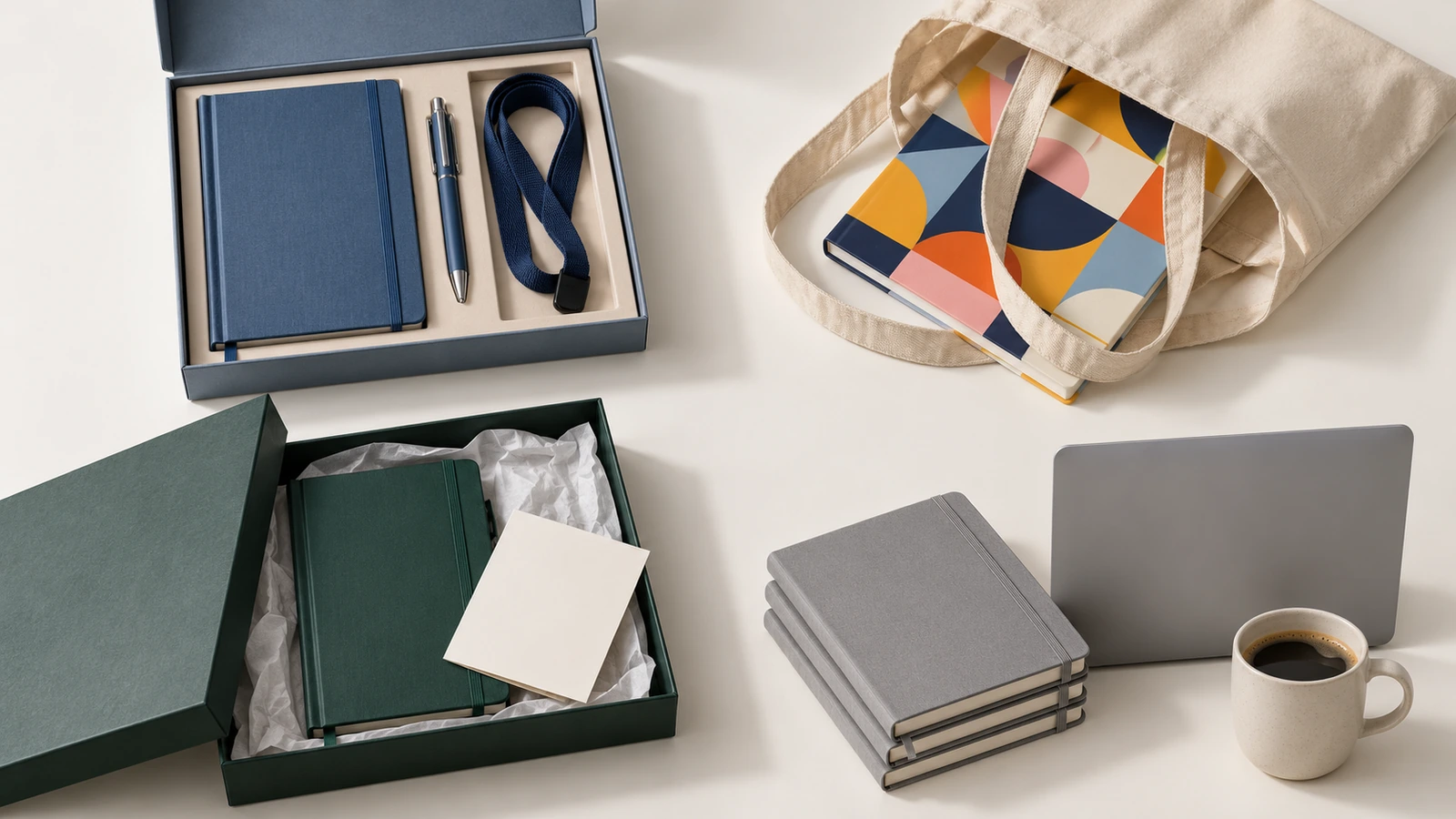
A rigid paperboard case is a common format for business programs because the full cover can carry printed artwork and the book stays flat in a bag. You can see the construction options on our custom paperboard hardcover notebooks page. This article focuses on the planning work that comes before that specification.
How to plan custom business notebooks for each program
Step 1: Name the program, the end user and the decision owner
Write one line per program covering who receives the notebook, who approves the purchase and what the recipient will actually do with it. The approver matters because approvals sit higher than many teams expect. PPAI's 2025 retail-industry buyer profile found that most promotional-product decision makers are managers or directors, with directors at about 41% (PPAI end-buyer infographic[3]). Build the approval step into your timeline from the start.
Onboarding kits: The recipients are new hires in their first weeks, and HR or people operations owns the budget. The notebook goes into one-on-ones and orientation sessions, so it needs to look current for at least a year of start dates.
Conference and trade-show giveaways: The recipients are booth visitors and attendees, and marketing or events owns the budget. The notebook has to earn a place in a crowded tote bag and still be in use after the show.
Client gifts: The recipients are named stakeholders at accounts, and sales or account management owns the budget. The notebook signals the relationship, so it should never look like swag.
Internal training: The recipients are cohort participants, and learning and development owns the budget. The notebook works as course material, which means interior pages may matter more than the cover. When you brief paper, state the weight in g/m², the unit defined by ISO 536[4], so every supplier quotes against the same measure.
The decision owner also determines which documents you will need. Training programs run for government clients often come with recycled-content rules. The US EPA's procurement guidelines recommend 75–100% postconsumer fiber for book covers (EPA Comprehensive Procurement Guidelines[5]). California's Public Contract Code §12209 sets at least 30% postconsumer fiber for printing and writing paper and requires the list to be updated from 1 January 2026 (California PCC §12209[6]). CalRecycle requires suppliers to certify recycled content in writing (CalRecycle guidance[7]).
Client gift programs bring a different requirement. Corporate clients may check gifts against their own sourcing policies, and an FSC label is valid only when an unbroken chain of certified organizations covers every change of ownership (FSC-STD-40-004[8]). Over 50,000 companies hold FSC chain-of-custody certification (FSC US[9]), so ask for a certificate number rather than accepting a general "eco" label. The product page explains how to keep these claims specific.
Step 2: Choose the quantity driver, not just a number
Each program has a different variable that sets the quantity. Pick that variable first, then calculate.
Onboarding: Forecast hires per planning period, multiply by the number of periods one design should cover, and add a reserve for replacements and late joiners. Hiring forecasts change, so split the total into a core run and a top-up instead of one large order.
Trade shows: Start from expected booth traffic or registrations, then apply a take rate based on your last event. If you have no history, keep notebooks behind the counter for qualified conversations and put cheaper items on the open table.
Client gifts: Use your account list. Count named recipients per account, then add a small reserve for new contacts and replacements during the year. These quantities are small, so cost per unit matters less than presentation.
Training: Multiply cohort size by the number of sessions scheduled, then add facilitator and observer copies. If the curriculum is due for revision, order only for the confirmed sessions.
Once you have these drivers, ask the supplier which order tiers make sense for each. Minimums and price breaks depend on the specification, so request a quote per program rather than one combined figure.
Step 3: Decide where the branding goes
Branding placement does more than any other decision to separate a giveaway from a gift. Treat each surface as a separate decision.
Front cover: This is the loudest surface. Full-cover event artwork suits conferences. A small, quiet mark suits client gifts. For onboarding, use your core brand identity rather than a campaign that will look dated by next quarter.
Spine and back cover: These carry branding without dominating the design. They work well for client gifts, where the front can stay understated.
Inside front cover and first pages: Use these for a welcome letter or company values in onboarding kits, a session agenda for training, or a short personal note to a client. Interior branding persists after the recipient forgets the cover.
Removable belly band or sleeve: A band lets one evergreen notebook serve several programs. The same core stock can go out with a conference band in spring and an onboarding band all year, which also reduces leftover stock.
Personalized client gifts add a proofing risk. Check every name in the recipient list against your CRM before artwork goes out, because one misspelled name makes the notebook unusable for that person. If you describe a gift notebook as a keepsake, note that ISO 9706:2025[10] covers permanent paper but explicitly excludes board, so a permanence claim can only apply to the interior pages. For artwork setup on a wrapped cover, follow the file guidance on the paperboard hardcover notebook product page.
Step 4: Map the distribution route before production
Where the notebooks go is usually the most expensive part of the plan, and it is often overlooked until the end. Draw the route for each program before you approve production.
Onboarding: Decide whether kits are assembled at headquarters or sent directly to remote hires. Direct shipping requires home addresses from HR and a release schedule tied to start dates. Central kitting requires storage space and someone responsible for the shelf.
Trade shows: Show organizers set advance-warehouse and venue receiving windows, and missing one means paying for rush handling. Hardcover cartons are heavy, so plan a return shipment or a local destination for leftovers before the show ends.
Client gifts: Ship individually with a card, and time delivery to a meaningful date in the relationship, such as a renewal or project launch, rather than the year-end rush. For clients in the EU, the Packaging and Packaging Waste Regulation has applied to gift boxes and mailers since 12 August 2026 (Regulation (EU) 2025/40[11]). It governs the packaging, not the notebook itself.
Training: Deliver notebooks with the course materials to each training room, and assign a named recipient at every site. Keep the approved specification on file so the next cohort gets an identical reorder. The product page covers how to protect cartons in transit and preserve the reorder specification.
For any program that involves importing, confirm the classification under heading 4820 with your broker. The general duty rate is not the full landed cost, because additional duties can apply depending on origin.
Step 5: Work back from the hand-out date and measure use
Fix the hand-out date for each program, then work backward through kitting, delivery, production, sample approval, artwork and the internal approval from Step 1. Ask the supplier for its current production and sample schedule rather than assuming one, and leave room for at least one round of revisions. When the program is running, check whether the notebooks are being used. Ask new hires after their first quarter, count how many booth notebooks went out after qualified conversations, and ask account managers whether clients mentioned the gift. That data should shape the next order more than this year's unit price.
Program comparison table
Program
Primary user
Decision owner
Quantity driver
Branding placement
Interior focus
Delivery route
Main risk
Employee onboarding kits
New hires
HR / people ops
Hiring forecast × periods + reserve
Core brand on cover; values page inside
Everyday note pages
Central kitting or direct-to-home
Dated campaign artwork
Conference and trade-show giveaways
Attendees, prospects
Marketing / events
Traffic × take rate
Full-cover event art or swappable band
Standard ruled or dot pages
Advance warehouse or venue
Leftover stock after the show
Client gifts
Named stakeholders
Sales / account management
Account list + reserve
Quiet front mark; spine or back; personal note
Premium writing feel
Individual shipments with a card
Looking like swag; name errors
Internal training
Cohort participants
Learning and development
Cohort × sessions + facilitators
Program name; agenda pages
Worksheets or structured layouts
Training rooms, one site contact each
Curriculum changes before the reorder
If two programs end up with nearly identical rows, merge them into one notebook with different bands or inserts. If the rows differ on audience and branding, keep the orders separate even when a combined order looks cheaper. Construction trade-offs, such as how the binding and cover choices compare, are covered on the product specification page.
FAQ
FAQ: Can one notebook design serve all four programs?
Sometimes, if the cover uses your core identity and program-specific branding goes on removable bands, inserts or first pages. It usually fails for client gifts, because recipients who see the same notebook handed out at a booth will read the gift as promotional stock.
FAQ: How many onboarding notebooks should we order?
Base the quantity on your hiring forecast rather than headcount. Multiply expected hires per period by the number of periods one design should last, then add a replacement reserve. Ordering a core run plus a later top-up lowers the risk of leftover stock if hiring slows.
FAQ: Where should the logo go on gift notebooks for clients?
Keep the front cover understated, with a small mark or none at all, and put stronger branding on the spine, back cover or a printed note inside. Proof every personalized name against your CRM before artwork approval.
FAQ: Do trade-show notebooks need to be hardcover?
Not always. A rigid cover survives a tote bag and looks like something worth keeping, which is useful when notebooks are reserved for qualified conversations. For open-table handouts with high volume and low intent, a lighter giveaway is usually the better use of budget.
FAQ: What documents do public-sector training clients ask for?
Expect requests for postconsumer recycled-content percentages and written certification, particularly under California rules and US federal procurement guidelines. If an FSC claim is involved, buyers will ask for a valid chain-of-custody certificate number. Confirm what the client requires before you finalize the specification.
FAQ: What are the minimum order and lead time?
Both depend on the specification, quantity and finishing you choose for each program. Send your program brief with the quantity driver, branding placement and hand-out date, and we will quote current minimums and schedules.
Key takeaways
Match the notebook to the audience's generation and role. — Office items appeal to about 55% of Gen X but only about 27% of Gen Z (Source)
Build senior approval into the timeline. — About 41% of promotional-product decision makers in retail are directors (Source)
Hardcover business programs sit in the faster-growing part of the market. — 4.27% CAGR for hardcovers against 3.30% for the overall market, 2025–2030 (Source)
Federal training clients may expect high recycled content in covers. — EPA recommends 75–100% postconsumer fiber for book covers (Source)
California public buyers set a recycled-content floor. — At least 30% postconsumer fiber for printing and writing paper (Source)
EU client gifts face new packaging rules. — The PPWR has applied to packaging since 12 August 2026 (Source)
Verify FSC claims with a certificate number. — More than 50,000 companies hold FSC chain-of-custody certification (Source)
Conclusion
The best custom business notebooks result from planning, not from the largest combined order. Give each program its own row: who uses it, who approves it, what drives the quantity, where the brand appears and how the notebooks reach recipients. Merge programs only when those rows match. When the brief is ready, review the construction options for custom paperboard hardcover notebooks and send us one brief per program so the quote reflects how each notebook will actually be used.
Sources
PPAI Research, "Promo Preferences by Generation," September 2025. ppai.org↩
Industry Today, "Paper Notebook Market Set to Reach USD 89.72 Billion by 2030," 22 December 2025. industrytoday.co.uk↩
PPAI, "Retail Industry End Buyers Infographic," 2025. ppai.org↩
ISO 536:2019, Paper and board — Determination of grammage. iso.org↩
US EPA, Comprehensive Procurement Guidelines for Paper and Paper Products. epa.gov↩
Hi there! I'm Bruce, proud dad to my amazing son. I'm the founder of Zigpac, a printing and packaging company empowering small and medium-sized businesses with custom solutions. Let's create something great together!



 Blog PDF for offline reading
















The information below is required for social login
Sign In
Create New Account