Custom straight tuck end boxes pair a clean, uninterrupted front panel with same-direction tuck closures, full-color printing, and flat shipping. They suit lightweight retail products that demand precise sizing and strong shelf presence—not standalone parcel boxes for heavy or fragile goods.
Who Gets the Most Value From Custom Straight Tuck End Boxes?↑
Straight tuck end (STE) cartons serve brands that need more than a generic stock box but less than a rigid gift box or corrugated shipping case. Typical buyers include cosmetics manufacturers, skincare brands, supplement companies, confectionery producers, specialty food businesses, electronics-accessory sellers, subscription programs, and multi-SKU direct-to-consumer brands.
The structure earns its place when the primary display panel must remain visually continuous. Both tuck flaps close in the same direction and can be positioned toward the back, leaving the front free for a logo, product name, instructions, window, or promotional graphic. That makes STE cartons a natural fit for shelf-facing products—serums, soap, tea, candy, perfume, small bottles, and branded sample kits.
Order volume alone is not the decisive buying criterion. Product weight, dimensions, sales channel, required finishes, regulatory exposure, number of artwork versions, and delivery deadline usually influence the correct specification more than piece count. A 100-piece launch across five SKUs has a different cost structure from a single 10,000-piece production run, even when both use the same carton style.
Demand for customized presentation is commercially significant beyond this individual box type. Fortune Business Insights reported a 40.09% North American share of the global custom-packaging market in 2025. That figure describes the broader market—not the STE segment—but it underscores the importance of short-run customization, branding, and recyclable paper-based formats in the region. See the North American custom-packaging share[1].
How Do Poor Specifications Turn a Simple Carton Into an Expensive Problem?↑
Problem: A carton can look correct in a PDF while still failing during packing. An internal dimension may be mistaken for an external one, dust flaps may collide, a window may expose the wrong area, small text may cross a crease, or a coating may shift the expected color and feel.
Agitation: These errors compound after mass production. Cartons that are too tight slow the packing line; cartons that are too loose let products shift; weak scores crack; mismatched colors erode brand consistency; and an untested retail carton may collapse when someone uses it as a courier box. Inventory then consumes cash and warehouse space while the launch date keeps moving.
A small Amazon marketplace sample illustrates the mixed outcomes possible in low-volume custom packaging. The listed product held a 4.1-star average from 10 ratings: positive reviewers praised customization and price, while other feedback reported a 16-day order-to-receipt period, lighter-than-expected color, thin material, ink streaking, and a size that did not fit the intended bottles. This is a small product-specific sample rather than an industry benchmark, but it demonstrates why proofing and physical fit checks matter. Review the marketplace review sample[2].
Solution: Treat the carton as an engineered packaging component. Define the product, specify internal dimensions, verify a structural sample, approve a printed proof, record measurable acceptance criteria, and compare total landed cost—not just the displayed unit price. This workflow moves risk forward, where corrections cost less.

Table of Contents
What Is a Straight Tuck End Box—and What Is It Not?↑
A straight tuck end box is a folding carton whose top and bottom tuck flaps close in the same direction. The layout normally includes four main body panels, a glued manufacturer's joint, two principal tuck flaps, dust flaps, cut lines, and score lines. It ships flat and is opened into shape during packing.
Positioning both closures toward the back preserves a cleaner front panel than many alternative layouts and supports front-window designs because the display face is not interrupted by opposing closure directions. The same-direction geometry may, however, use more paperboard in some sheet layouts than a reverse tuck end structure. That material effect depends on carton dimensions, sheet size, grain direction, and nesting—not on the style name alone.
STE is primarily a retail carton. It protects lightweight and moderately weighted products from handling, surface damage, dust, and casual opening, but ordinary paperboard lacks the corrugated fluting needed for parcel compression and impact resistance. Heavy bottles, glass containers, fragile products, and direct-to-consumer shipments may require an insert, snap-lock bottom, auto-lock structure, micro-corrugated carton, or separate shipping case.
Public supplier specifications show why "paperboard" is not a sufficiently precise material description. One market example offers 14 pt, 18 pt, and 24 pt cardstock, corresponding to stated thicknesses of 0.014, 0.018, and 0.024 inch. These are supplier-specific options, not universal load ratings. See the published STE material specifications[3].
How Should You Specify Size, Material, and Readability Before Quoting?↑
Start with the physical product, not an estimated box size. Measure the maximum length, width, and depth across actual production units—including caps, seals, dispensers, labels, and any protruding component. Record product net weight and packed gross weight separately. If the carton will contain an insert, leaflet, sachet, or multiple units, assemble the complete pack before defining the internal dimensions.
- State the dimensional convention. Label values as internal length × width × depth and identify which panel is the front.
- Measure variation. Test more than one product unit when bottles, handmade goods, or filled pouches vary.
- Define fit behavior. Specify whether the product should slide out freely, remain friction-fit, or be restrained by an insert.
- Verify closures. Confirm that tuck flaps seat fully and dust flaps neither overlap nor push the panels outward.
- Check readable areas. Keep ingredients, warnings, barcodes, and small type away from cuts, folds, glue zones, and window edges.
- Approve a white sample. Use production-equivalent thickness where possible; a thin paper mockup cannot validate board stiffness or score behavior.
Stock selection should follow the product and channel. SBS offers a bright printing surface for cosmetics and premium retail goods. Kraft or unbleached board provides a natural appearance but changes color reproduction. Recycled board can support material-reduction goals while introducing shade or surface variation that should be represented in the proof. FBB balances stiffness and weight, while E- or F-flute micro-corrugated material may be more appropriate when protection outweighs presentation as the primary requirement.
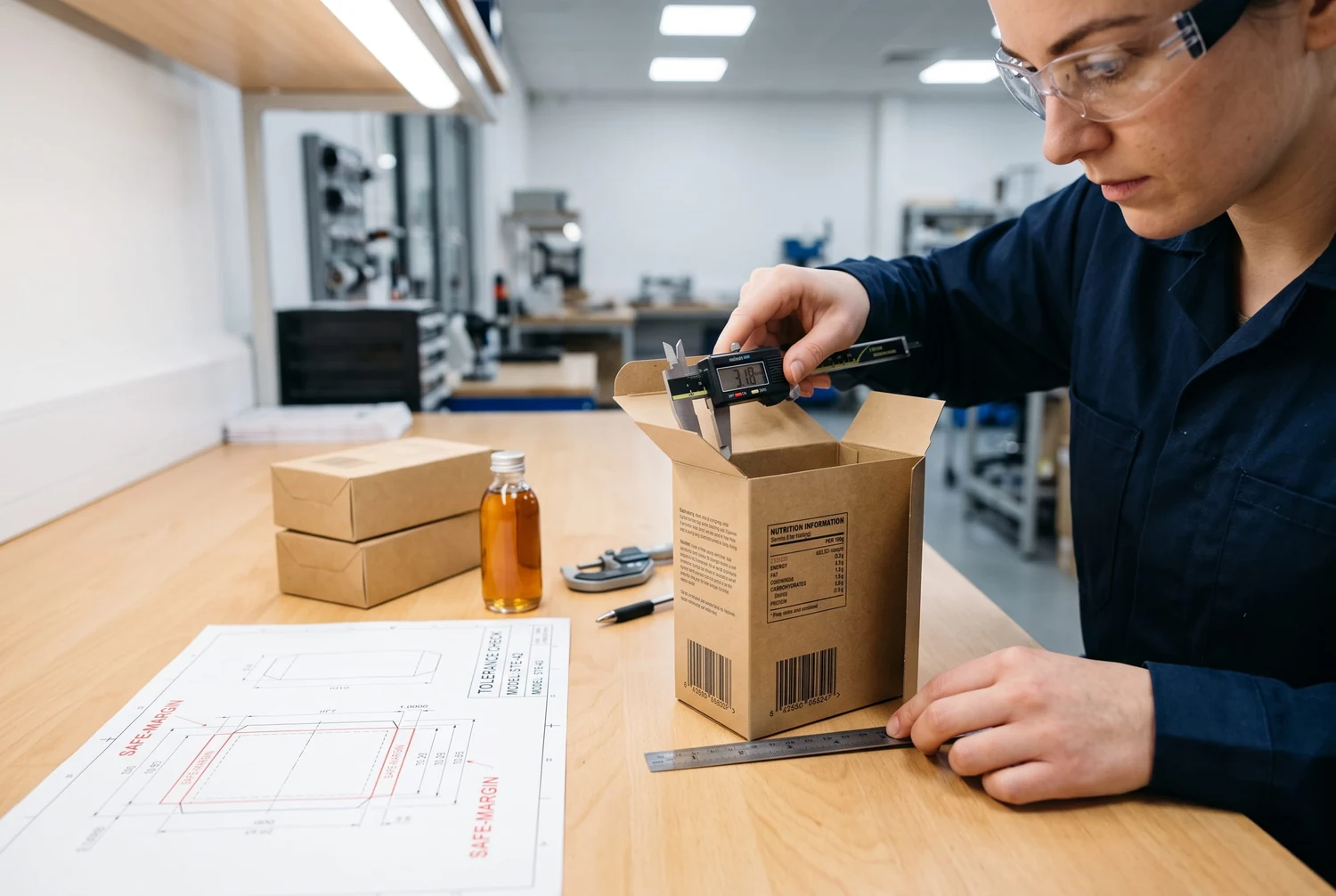
A practical RFQ should therefore contain the internal dimensions, product weight, board grade or target caliper, quantity by SKU, printing coverage, finish, insert or window requirements, packed destination, deadline, and intended use. Without these fields, two supplier quotations may describe materially different boxes.
Which Surface and Closure Options Protect the Design Without Adding Unnecessary Complexity?↑
| Option |
Primary value |
Buying consideration |
| Aqueous gloss |
Brighter color and light scuff resistance |
Confirm gloss level and compatibility with the selected board |
| Aqueous matte |
Lower glare and a restrained retail finish |
Dark solids may show handling marks differently |
| UV or spot UV |
High contrast or localized visual emphasis |
Adds registration requirements and may affect recycling decisions |
| Soft-touch film |
Premium tactile effect |
Increases cost and introduces a plastic layer |
| Foil or embossing |
Metallic or dimensional brand detail |
Requires tooling, minimum workable line widths, and physical proofing |
| Window |
Direct product visibility |
Reduces local panel area and may introduce a separate film material |
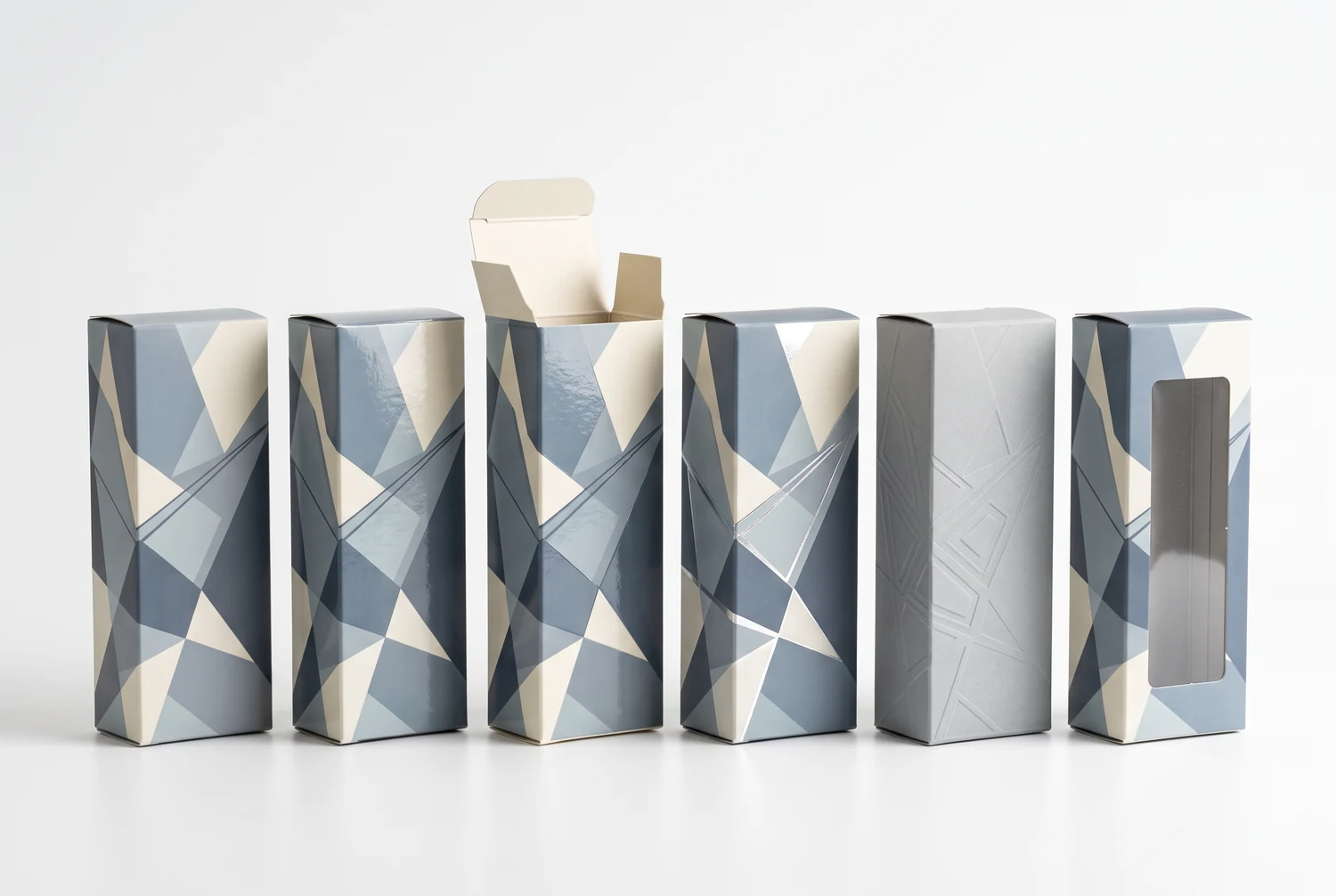
The table separates visual effect from engineering consequence. A finish should solve a defined problem—scuff control, contrast, or tactile positioning—rather than accumulate simply because it is available.
Closure orientation also affects daily use. Back-tucking flaps preserve a cleaner front and normally suit a front window or uninterrupted brand panel. Front-tucking flaps may be easier to access when the package is opened repeatedly. A slit lock can improve closure retention, while a tamper label or glued seal may be necessary where opening evidence matters. None of these additions automatically converts a standard STE carton into child-resistant or heavy-duty packaging.
How Should Artwork Be Prepared Before a Carton Reaches the Press?↑
Artwork should be built on the approved supplier dieline—not on a generic online template with similar dimensions. Keep the structural layer separate from the print layers and identify cut lines, crease lines, perforations, glue areas, windows, and safe zones. Lock the dieline so it cannot shift while the design is being edited.
- Extend backgrounds and images to the bleed specified by the printer; 0.125 inch is common but not universal.
- Use linked or embedded images at an effective resolution normally near 300 dpi at final size.
- Convert or package fonts according to the supplier's file policy.
- Define CMYK builds and PMS colors explicitly rather than relying on screen appearance.
- Check minimum type size, reverse text, thin rules, rich black, overprint, and transparency behavior.
- Verify barcode size, contrast, quiet zones, orientation, and placement on the assembled carton.
- Keep essential text and logos away from scores, cut edges, tabs, glue zones, and window borders.
- Review every panel in three dimensions so side and back copy is not upside down after folding.
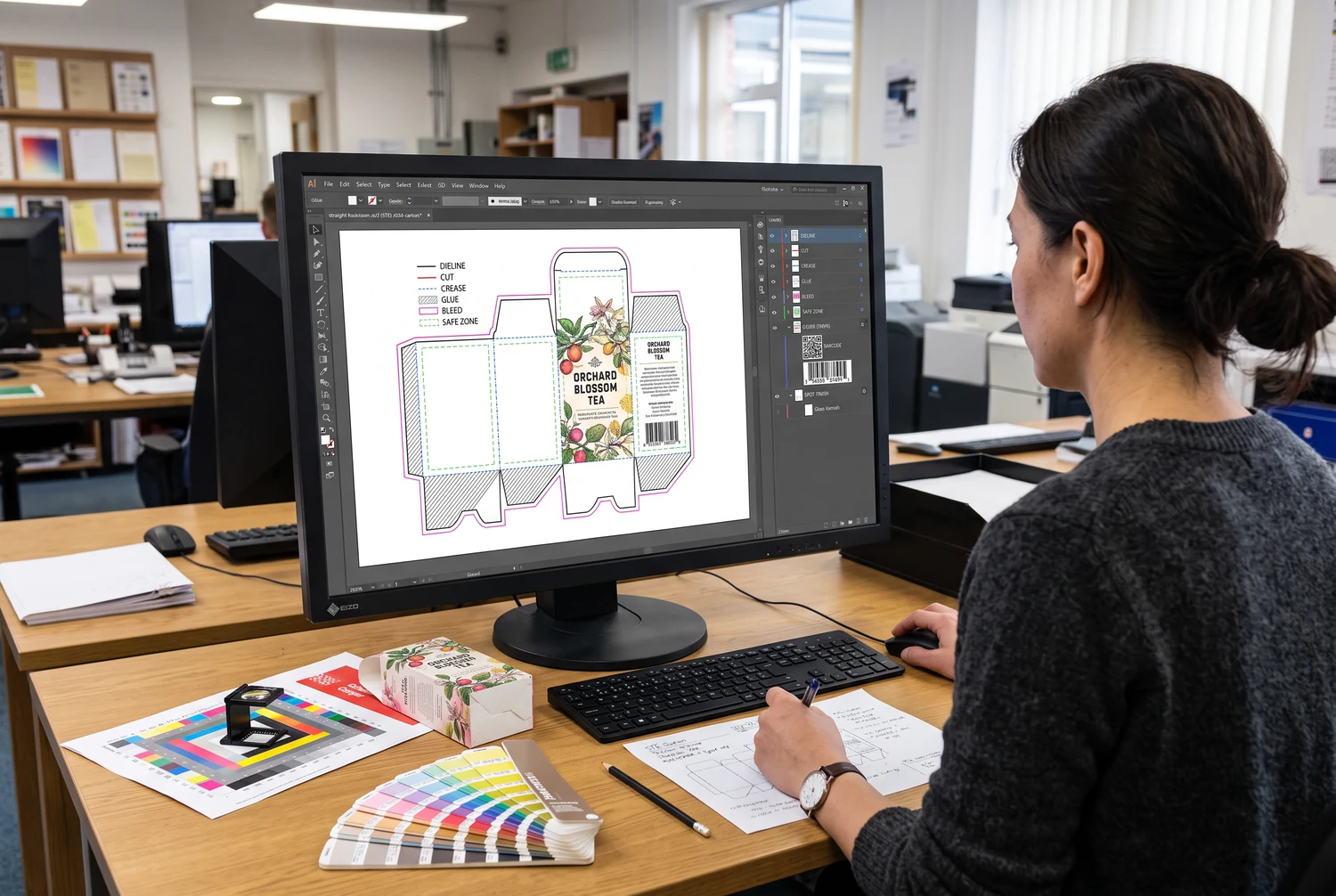
A PDF proof confirms layout, copy, and separations; it does not reproduce board texture, coating feel, metallic reflection, or exact press color. Approve a physical printed sample when color, finish, fit, or retail presentation is commercially important. Record the approved file name, revision, proof date, material, and sample identifier so the factory and buyer share one production reference.
How Does a Factory-Direct Production Workflow Reduce Cost and Schedule Risk?↑
A controlled workflow breaks the project into decisions that can be approved before value is added irreversibly. It also exposes the gap between production time and total delivery time—two numbers that are often confused.
- Requirement review: Confirm dimensions, weight, application, quantity by artwork version, destination, and regulatory constraints.
- Structural engineering: Create the dieline, select the board, and evaluate tuck depth, dust flaps, grain direction, window support, and glue joint.
- White sample: Check product fit, packing sequence, closure retention, panel deformation, and shelf orientation.
- Artwork preflight: Validate bleed, fonts, images, colors, barcode placement, and finishing layers.
- Printed proof: Approve color direction, text, finish placement, and assembled appearance.
- Mass production: Print, coat or laminate, die-cut, strip, fold, glue, count, and flat-pack the cartons.
- Inspection and dispatch: Compare the batch with the approved sample, pack against moisture and crushing, and release shipping documents.
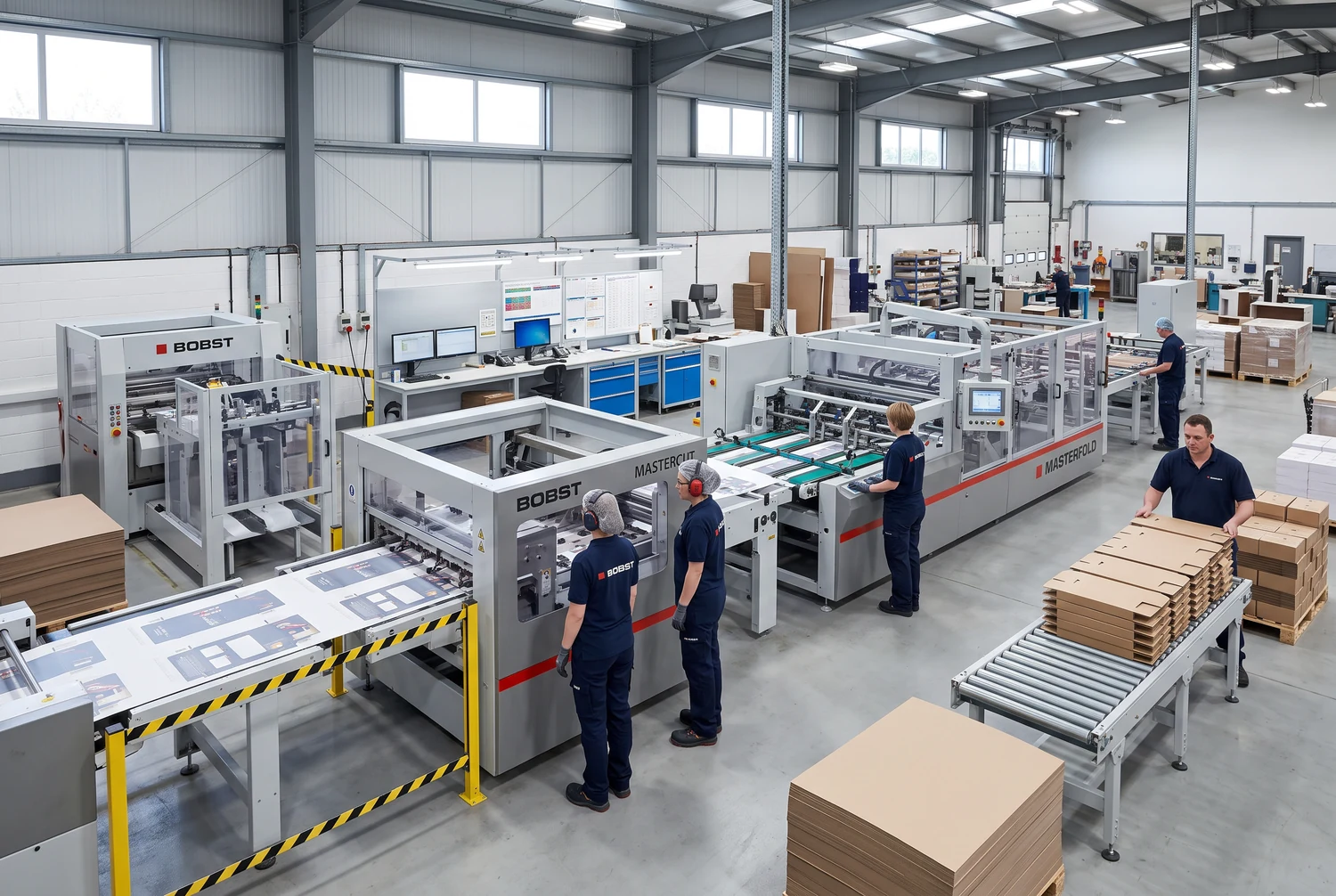
Digital printing often fits samples, short runs, variable data, and frequent artwork changes because it can reduce conventional plate and setup requirements. Offset printing can become more economical for stable medium-to-large runs and may offer stronger control for specified spot colors and complex finishing. A reported crossover around 500–1,500 pieces is only a planning hypothesis; size, nesting, board, color count, finishing, and spoilage can shift it substantially.
For evidence-based comparison, request matched quotations at 250, 500, 1,000, 1,500, and 3,000 pieces using exactly the same specification. Separate sampling, structural work, tooling, printing, finishing, packing, freight, taxes, customs clearance, and applicable duties. "No MOQ" means an order may be accepted; it does not mean setup costs or unfavorable unit economics disappear.
What Should a Measurable Quality Plan Inspect Before Shipment?↑
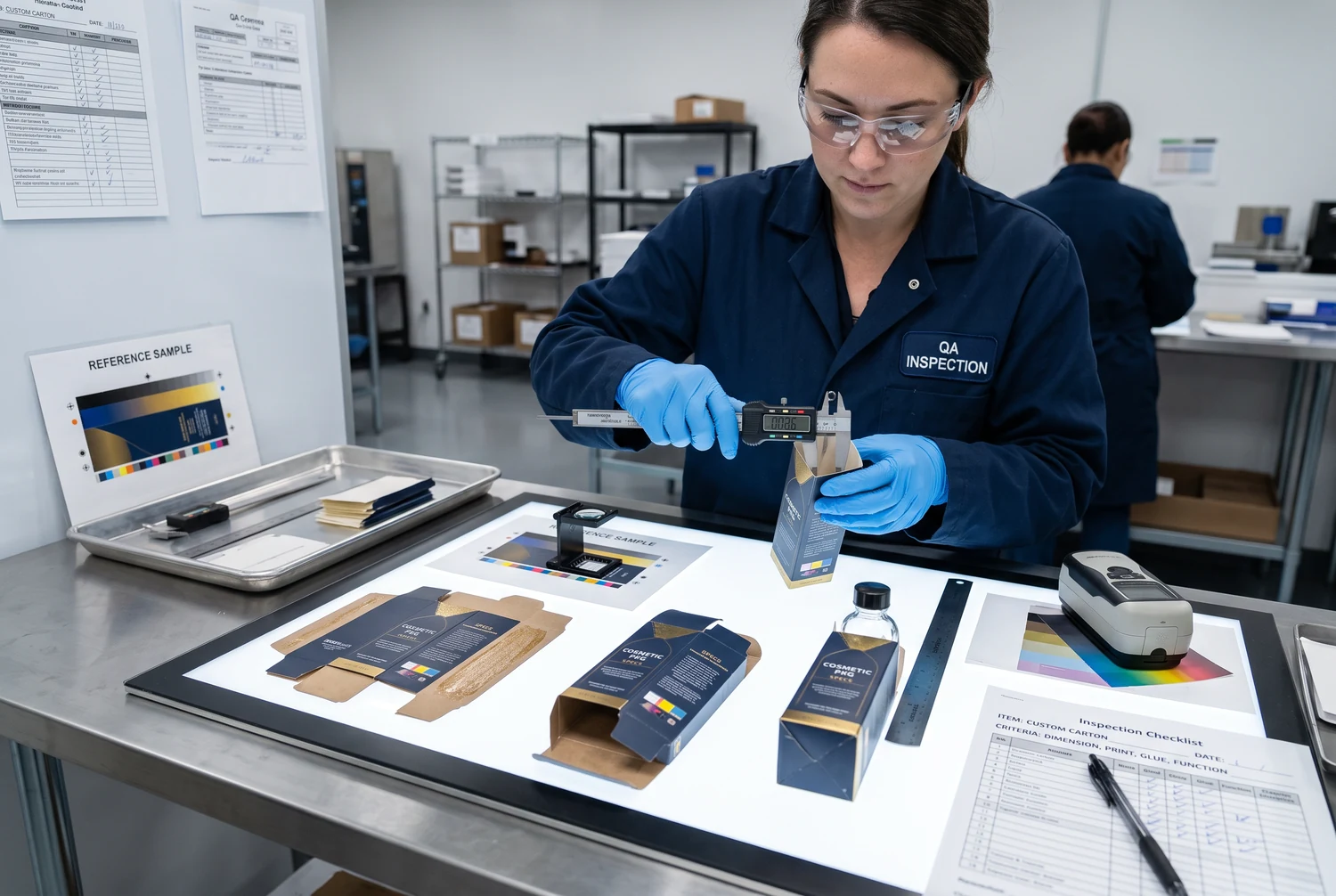
Quality language should be numerical wherever the factory and buyer have validated a method. Instead of "accurate size," record nominal internal dimensions, measurement locations, units, sample size, and permitted deviation. Instead of "good color," identify the approved physical sample, lighting condition, measurement method, and tolerance. Do not advertise adhesion cycles, colorfastness, UV-weathering hours, or compression values unless the exact material and construction have been tested and the report can be supplied.
| Inspection field |
Measurable evidence |
Failure prevented |
| Dimensions |
Recorded L × W × D readings against an approved drawing |
Loose fit, crushed product, or slow packing |
| Print registration |
Measured position of text, foil, window, and cut edges |
Misaligned graphics and exposed safe zones |
| Color |
Approved press sample or agreed instrumental tolerance |
Batch-to-batch brand mismatch |
| Score and fold |
Visual crack check plus repeated sample assembly |
Fiber cracking and distorted panels |
| Glue joint |
Defined joint location, coverage, and pull-check method |
Open seams and contamination from excess adhesive |
| Fit and closure |
Assembly using actual products from the intended range |
Overlapping dust flaps and disengaged tuck tabs |
| Count and packing |
Bundle quantity, carton quantity, lot code, and packing list |
Short shipment and mixed revisions |
This table is a framework, not a claim of completed factory testing. The final inspection plan should identify the agreed sampling method, tolerance, responsible party, and disposition for nonconforming cartons.
Transport standards must also be applied to the correct object. ASTM D5118/D5118M[6] covers fabrication controls for fiberboard shipping boxes and explicitly does not establish adequacy under every shipping condition. When distribution performance must be evaluated, ASTM D4169[7] may inform testing of the complete shipping container and packaging system. A retail carton packed inside a corrugated shipper should be evaluated as part of that system.
Which Carton Structure and Buying Model Should You Choose?↑
| Structure |
Best reason to select it |
Main limitation |
| Straight tuck end |
Clean front panel, window compatibility, simple retail packing |
Sheet utilization may be lower; not a heavy-duty shipper |
| Reverse tuck end |
Potentially better nesting and material utilization |
Closure direction can complicate front-panel planning |
| Snap-lock bottom |
Improved bottom support for moderately heavier products |
More manual assembly steps |
| Auto-lock bottom |
Fast setup and stable pre-glued base |
Higher converting complexity and cost |
| Micro-corrugated carton |
Greater compression and handling protection |
Thicker profile and different print/fold behavior |
| Corrugated mailer or shipper |
Direct parcel distribution and protective outer packaging |
Consumes more material and storage volume than paperboard |
The comparison shows that STE is strongest when presentation and packing simplicity lead the decision. A structure upgrade is preferable to adding tape or excessive board thickness when the product's weight or distribution hazards exceed the original design boundary.
Compare suppliers using landed cost and evidence, not slogans. Confirm the final production site, whether work is subcontracted, sample sequence, reprint terms, quote validity, production calendar, freight method, trade term, duty responsibility, and the difference between "production," "dispatch," and "delivery." For imported cartons, tariff exposure must be checked against the actual HS classification, origin, and effective tariff list; a generic percentage cannot be applied to every paperboard box.
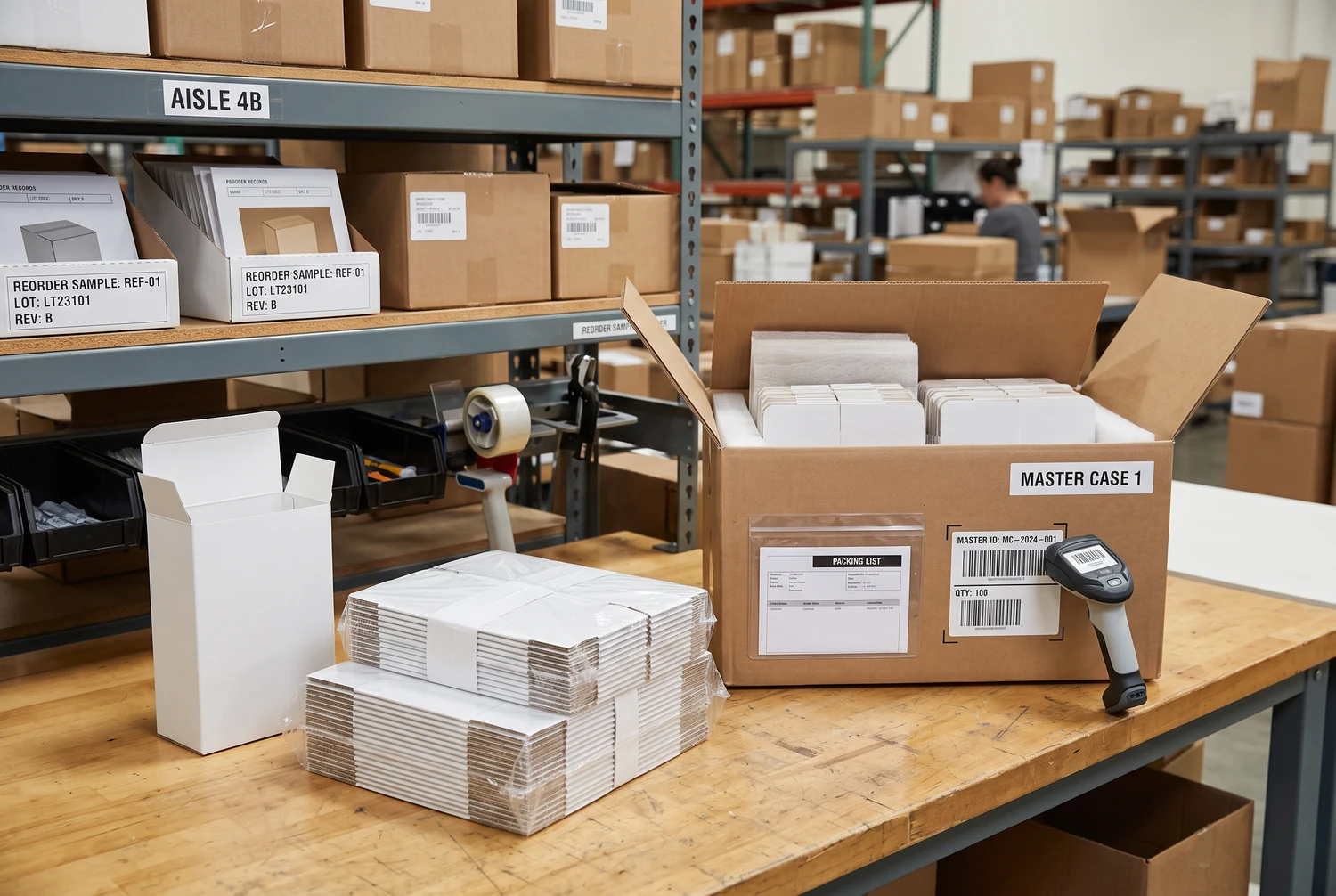
For repeat orders, retain the signed sample, dieline revision, color reference, board specification, finish map, packing method, purchase-order history, and issue log. These records let a reorder reproduce a controlled specification instead of relying on the phrase "same as last time."
How Can Food-Contact, Fiber-Sourcing, and Recycling Claims Be Substantiated?↑
"Food-safe" is not a universal certificate. First determine whether the carton directly contacts food or serves as secondary packaging around a sealed inner pack. The board, ink, coating, adhesive, and window film must then be reviewed for their intended conditions of use. The FDA food-contact framework[4] explains that packaging components such as adhesives and colorants can be food-contact substances and that applicable uses require appropriate authorization.
Fiber sourcing should be stated separately from end-of-life performance. FSC-certified paper and packaging[5] can provide chain-of-custody evidence for responsible forest-based material. It does not, by itself, certify food-contact suitability, carbon neutrality, compostability, or acceptance by every local recycling program.
Recycling statistics also need a date and denominator. The EPA reported an 80.9% recycling rate for U.S. paper and paperboard containers and packaging in 2018, using generation-based historical data. See the EPA 2018 packaging dataset[8]. AF&PA reported a 69%–74% cardboard recycling rate for 2024 under an updated recovery methodology; that category and calculation are not directly equivalent to the EPA figure. Review the AF&PA recycling methodology[9].
Windows, film laminates, metallic layers, grease contamination, and multi-material inserts may change practical recyclability. Where recovery is a design priority, evaluate a paper-only structure, separable window, reduced material mass, aqueous coating, and clear material documentation. Claims should describe conditions rather than promising that every consumer can recycle the package locally.
Regulatory exposure is also becoming state-specific. A 2025 legal review identified seven U.S. states with comprehensive packaging EPR laws as of October 1, 2025, while emphasizing differences in covered materials, producer definitions, exemptions, reporting, and fees. See the state packaging EPR overview[10]. Brands selling across states should retain material weights and component-level data rather than recording the package only as "paper."
Which Numbers Should Packaging Buyers Remember?↑
- North America represented a major—but broad—custom-packaging market. — 40.09% share in 2025, not an STE-specific share (Source)
- Paperboard caliper must be specified rather than described as simply "thick." — 14, 18, and 24 pt are published supplier examples (Source)
- A physical sample can be ordered before bulk production in some configurations. — quantity 1 is a published market option (Source)
- Current recycling claims should retain their category and methodology. — 69%–74% U.S. cardboard recycling in 2024 (Source)
- Packaging EPR obligations are no longer limited to a single state model. — 7 states had enacted comprehensive laws as of October 1, 2025 (Source)
How Do You Move From Concept to a Production-Ready Carton?↑
A successful STE project begins with the product and its distribution route—not a decorative template. Define internal dimensions, gross weight, board, closure, print coverage, finishing, compliance exposure, quantity by SKU, acceptance criteria, and landed-cost components. Validate structure with a white sample, validate appearance with a printed proof, and preserve the approved specification for inspection and reorders.
Send your product dimensions, packed weight, quantity by artwork version, destination, and desired finish to receive one factory-direct specification and quotation.





The information below is required for social login
Sign In
Create New Account