We use cookies to enable our websites to remember information, to help some website functionalities to work properly, to understand how you interact with and use our websites and to display you content and ads that are relevant and engaging for you.
By clicking Accept All you consent to the use of these cookie.
The store will not work correctly when cookies are disabled.
Quick answer: Tuck and fold packaging is a family of folding paperboard cartons that ship flat and close by sliding a curved flap into the carton body, so the ends need no tape or glue. The four core styles are straight tuck end, reverse tuck end, tuck-top auto-bottom, and tuck-top snap-lock. They differ in the direction the end flaps fold, in how the bottom locks, and in how quickly each style can be packed by hand or by machine.
Most brands choose a carton by its appearance. The problems tend to surface later, at the packing bench. Tuck and fold packaging covers several structures that look alike once they are closed but behave very differently when a 300 g glass jar presses on the bottom flap, when a horizontal cartoner plows the end flaps shut, or when a temporary worker has to erect 2,000 snap-lock bottoms before lunch. If the wrong style is picked, the bottom can pop open in a shopper's hand, the front artwork can be interrupted by a cut edge, or an automated line can stall because the knocked-down carton is too thick for its magazine. This guide explains how each tuck style is engineered, why its closure holds, and where it fits on manual and automated lines, so the structure can be decided before any artwork is drawn.
What Is a Tuck Box? The Meaning and Anatomy
A tuck box is a folding carton made from a single die-cut sheet of paperboard. One side seam is glued at the converter, and the carton is shipped to you flat. At least one end closes with a tuck flap, a tongue-shaped extension of a closure panel that slides inside the carton wall and is held there by friction. When people search for the tuck box meaning, this is the defining feature: the end is closed by the tuck rather than by adhesive. International packaging vocabulary such as ISO 21067-1:2016[1] gives buyers and converters common terms such as "carton" and "folding carton," which helps keep a specification from being misread.
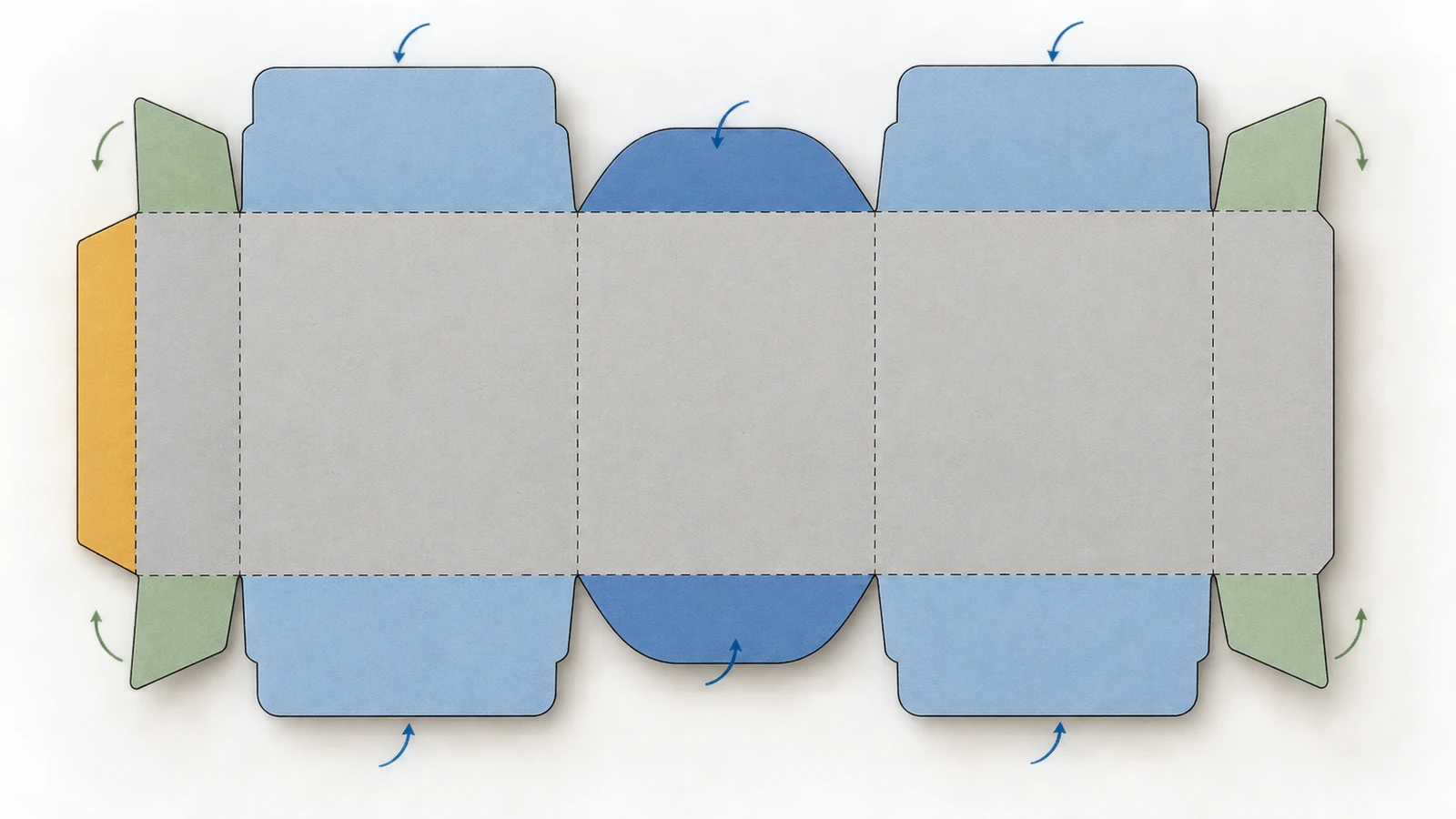
Every tuck-style blank has the same set of parts:
Four main panels (front, back, and two sides) that wrap around the product.
A glue flap, also called the manufacturer's joint, which is bonded to the opposite edge to form a sleeve.
Closure panels at the top and/or bottom that cover the opening.
Tuck flaps on those closure panels, which slide into the carton.
Dust flaps on the side panels, which fold in first, fill the corners, and give the tuck something to bear against.
Score lines, which are pressed creases that make each panel fold at a controlled point.
A tuck box is not a shipping box. Corrugated shipping containers fall under a separate body of practice, for example ASTM D5118/D5118M for fabricating fiberboard shipping boxes[2]. Paperboard tuck cartons are retail and primary-display packaging. When they travel through a parcel network, they usually do so inside an outer shipper.
How Tuck and Fold Packaging Holds Shut: Flap Engineering
No glue holds a tuck end closed. The closure depends entirely on geometry and friction, so small details in the dieline decide whether a carton feels crisp or flimsy.
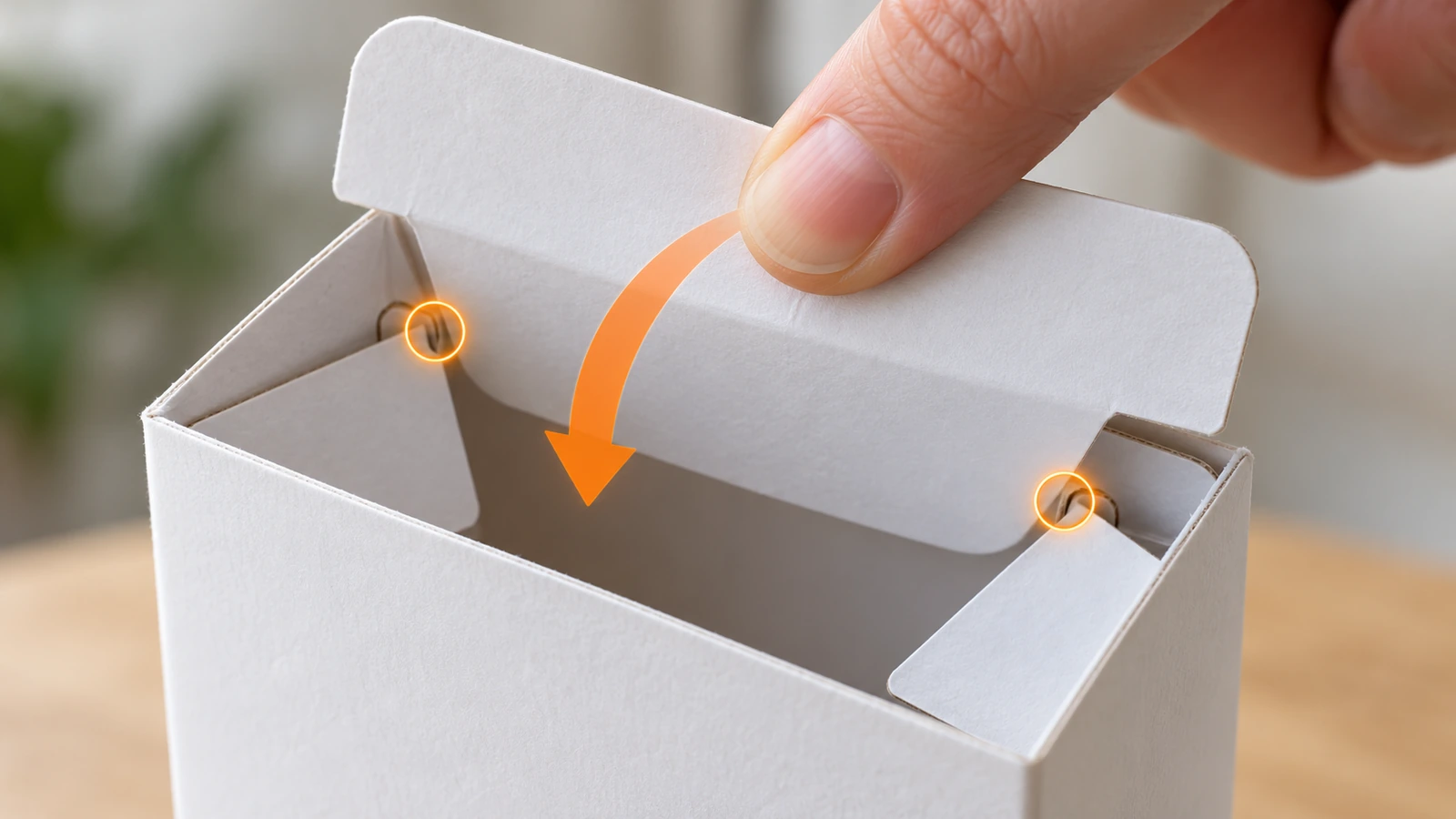
Friction lock. The tuck flap has a slightly curved or angled edge and is cut a little wider than the opening. As it slides in, its edges rub against the inside of the panel walls and against the folded dust flaps. If the fit is too loose, the end springs open. If it is too tight, the flap buckles or the user tears the score while closing it.
Slit lock (lock tab). Small slits are cut where the tuck flap meets its closure panel, and they catch on matching shoulders cut into the dust flaps. Once the tuck is pushed past the shoulders, it cannot back out unless someone pulls it deliberately. This simple die feature is the most common way to add holding power to a tuck end without adding any material.
Dust flap shape. Dust flaps are often tapered or radiused so they do not collide with the tuck flap. If they are cut too long, they overlap and push the closure panel outward, which shows up as the "bulged end" that buyers complain about. If they are too short, they leave gaps at the corners, and the tuck has nothing to press against.
Thumb notch and scores. A half-moon notch in the front panel lets a finger reach the tuck to open it. The depth of the score and the grain direction of the board relative to the main folds determine how sharply each panel turns and how well the carton resists bowing. The converter sets both for each board grade, which is why a dieline that works in one caliper may not work in another.
The Four Core Tuck Styles, One by One
1. Straight Tuck End (STE)
Both closure panels hinge from the same main panel. As a result, the top and bottom tucks fold in the same direction, typically toward the back, and the front panel reads as one uninterrupted face from top edge to bottom edge. That clean front is the main reason STE is so common in cosmetics, personal care, and window cartons. The trade-off appears on the press sheet: because both tucks extend from the same side, the blanks cannot nest head-to-tail, and some industry analyses estimate that certain layouts use roughly 8–10% more board than a reverse tuck. That figure describes material use in specific layouts, not a fixed price difference. If STE is the style you are leaning toward, our custom straight tuck end boxes page covers sizing, materials, and quoting in detail.
2. Reverse Tuck End (RTE)
The top closure hinges from one main panel and the bottom closure from the opposite one, so the two tucks fold in opposite directions. This lets blanks interlock on the sheet, which often improves yield. Its symmetrical shape is also well suited to high-volume end-load cartoning. The cost is visual: one end shows a cut edge on the front panel, so the artwork has to be arranged around it.
3. Tuck-Top Auto-Bottom (Crash Lock)
The bottom flaps are partly pre-glued at the converter. When the flat carton is squeezed open, the bottom swings into place and locks in a single motion, and the top closes with an ordinary tuck. The glued bottom carries more weight than a tucked bottom, which suits candles, jars, and bottles. Knocked-down cartons are thicker, and some converters add a gluing step, so this style is usually priced higher than plain tuck ends.
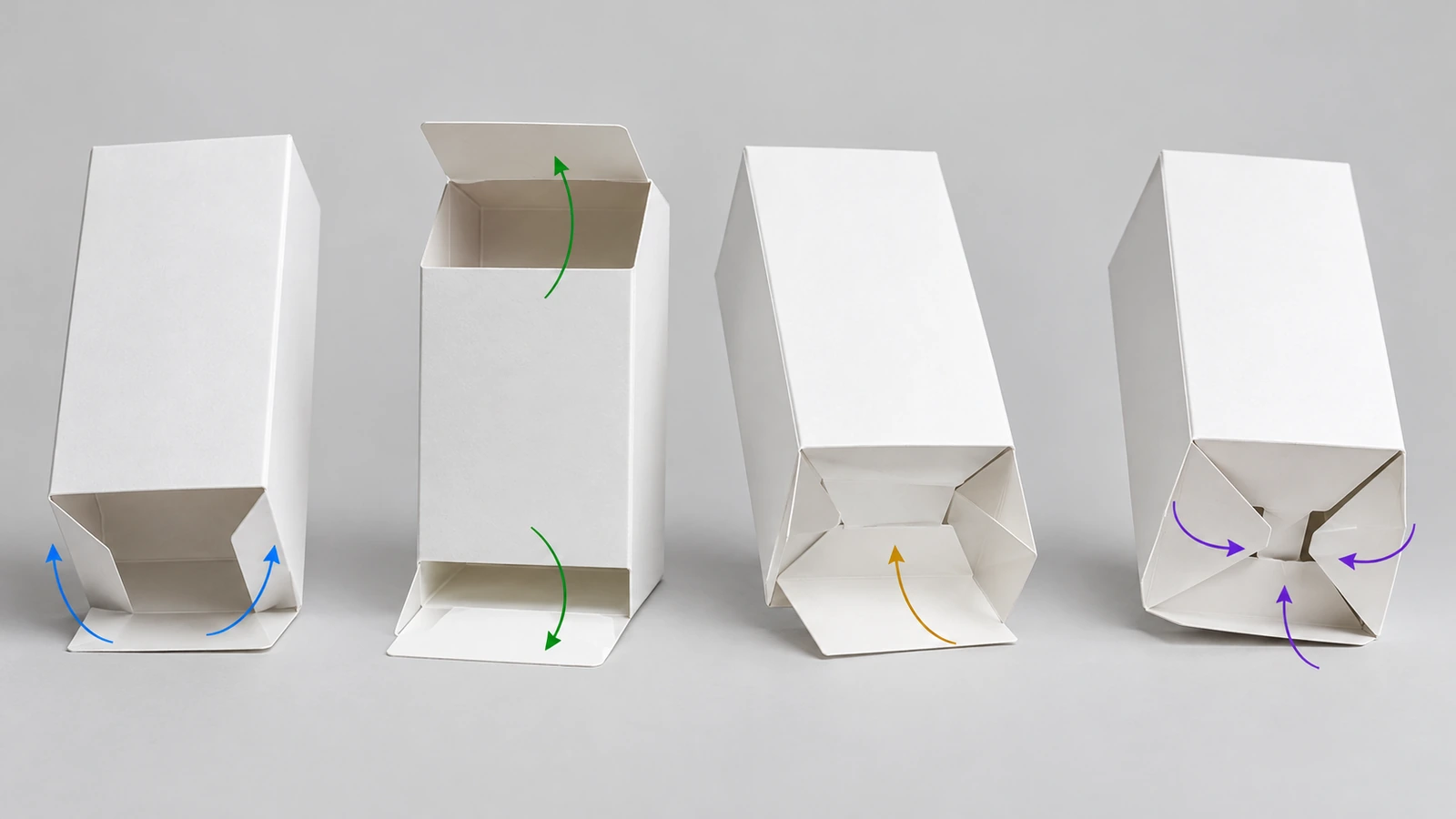
4. Tuck-Top Snap-Lock (1-2-3 Bottom)
The bottom is made from four flaps that are folded in sequence and pressed until they interlock. No pre-glue is involved, so the converter's work stays simple and the carton ships completely flat. The locked bottom carries more load than a tuck end. The cost is labor: every carton has to be locked by hand, and if the sequence is done wrong, the bottom does not seat.
Pack-Out Behavior on Manual and Automated Lines
The structure of a carton determines how many hand motions it takes to pack. Counting those motions from each design gives a dependable way to compare styles before running a line trial.
Style
Manual sequence (from the structure)
Typical motions
Automation fit
STE
Open sleeve, fold bottom dust flaps, tuck bottom, load, fold top dust flaps, tuck top
About 5–6
Suited to horizontal end-load cartoners set up for same-direction tucks
RTE
Same steps as STE, with the tucks closing in opposite directions
About 5–6
Very common on end-load cartoners and widely used in pharma
Auto-bottom
Squeeze open (bottom forms), load, fold top dust flaps, tuck top
About 3–4
Fastest by hand; machines need erecting or top-load setups that handle pre-glued bottoms
Snap-lock
Open sleeve, fold four bottom flaps in order, press to lock, load, close top
About 6–8
Mostly packed by hand; seldom chosen for high-speed automation
Manual lines. Auto-bottom styles need the least training and stay consistent across temporary staff. Snap-lock bottoms need the most practice and are where most "the bottom fell out" complaints come from. STE and RTE sit in between, and slit locks noticeably reduce the number of ends that spring back open during packing.
Automated lines. On a horizontal cartoner, the machine pulls a flat carton from a magazine, opens it, pushes the product in from the side, and plows the dust flaps and tucks closed. Tuck ends are ideal for this because both ends close by folding alone. What matters is that the tuck direction, board caliper, and score quality match the machine's setup, so confirm which carton styles and dimensions your cartoner accepts before you lock the dieline. Tuck ends can be reopened, so if you need tamper evidence, add a seal label or a perforated tear feature as a separate design decision.
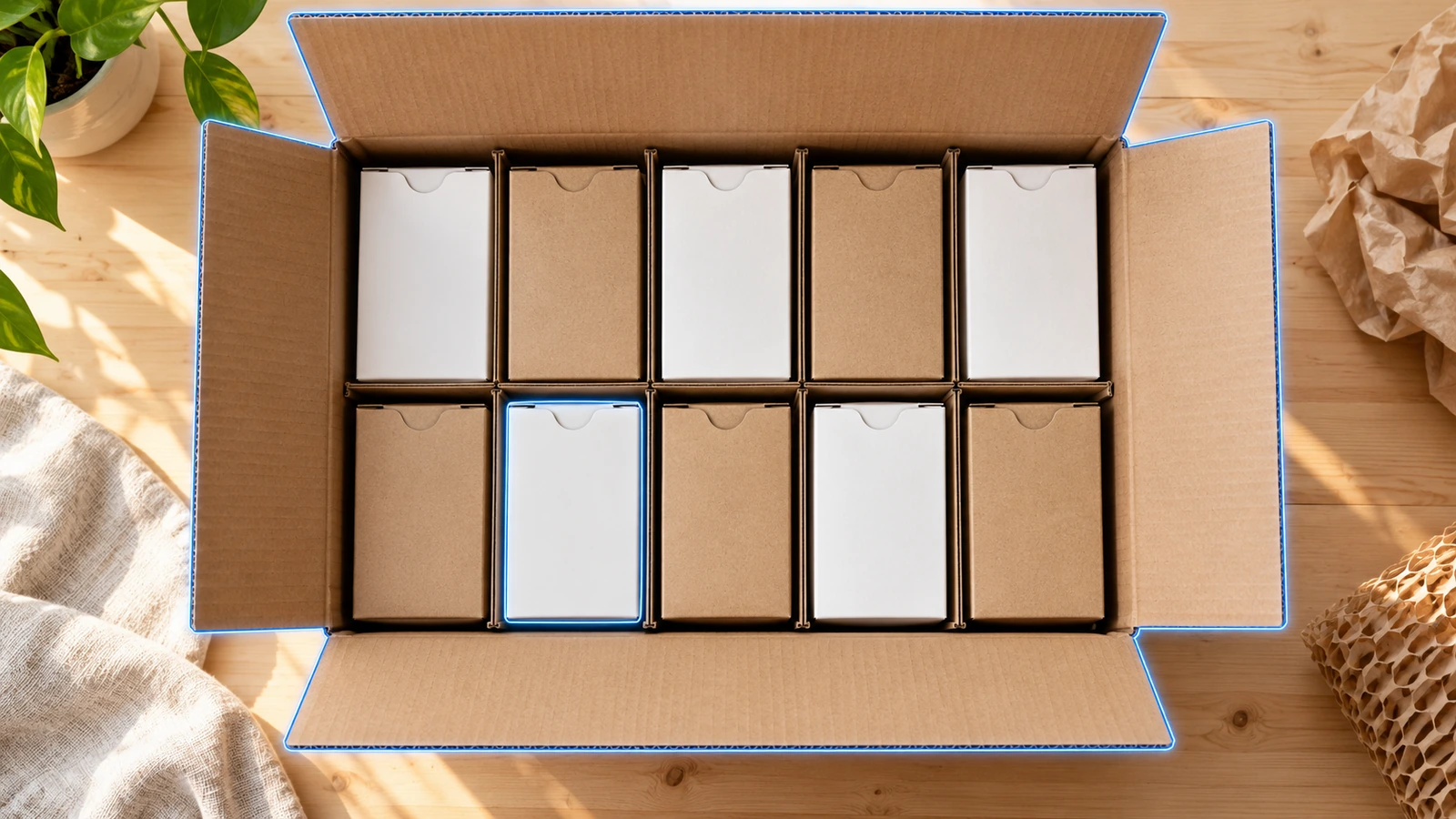
Transit. A paperboard tuck carton that ships inside a corrugated outer should be tested as part of that complete system. ASTM D4169[3] sets out distribution-hazard sequences for whole shipping systems, including handling, vibration, and compression. Drop-testing a single retail carton on its own can be misleading.
Tuck and Fold Packaging Styles Compared
Factor
STE
RTE
Auto-Bottom
Snap-Lock
Flap direction
Both tucks the same way
Tucks opposite
Tuck top, glued bottom
Tuck top, interlocking bottom
Front panel
Uninterrupted
One cut edge on the front
Clean top, flat base
Clean top, flat base
Sheet yield
Often lower
Often higher
Depends on layout
Depends on layout
Bottom load capacity
Light
Light
Medium to higher
Medium to higher
Converter operations
Side seam glue
Side seam glue
Side seam plus bottom glue
Side seam glue
Best pack-out mode
Hand or end-load machine
End-load machine or hand
Fast hand pack
Low-volume hand pack
Typical uses
Cosmetics, window cartons, gifts
Pharma, high-volume retail
Candles, jars, bottles
Heavier retail items, short runs
How to Choose a Tuck Style in Five Steps
Weigh the filled product. Light items such as lipsticks, sachets, and cards can use a tuck bottom. Jars, bottles, and anything that loads the base when lifted should go to auto-bottom or snap-lock. No single weight limit applies to every tuck carton, because board grade, carton size, and inserts all change the result, so confirm with a physical sample.
Decide how important the front panel is. If the artwork or a window has to run edge to edge, STE protects that face. If sheet yield and machine speed come first, RTE usually comes out ahead.
Match the style to your line. Hand packing at high volume favors auto-bottom. An existing end-load cartoner favors STE or RTE in the dimensions it already runs. Short, hand-packed runs can absorb snap-lock labor.
Check the regulatory boundary. If the carton touches food or sits close to it, review the board, inks, coatings, and adhesives against FDA food-contact guidance[4], because a "food-safe" label on its own proves nothing. Regulated household substances can trigger CPSC child-resistant packaging requirements[5], and a standard tuck end does not meet them.
Plan for end of life. Choose plain paperboard with aqueous coatings over film laminates when recyclability matters, and verify fiber claims through FSC chain-of-custody labels[6] (FSC 100%, FSC Mix, FSC Recycled). Keep in mind that FSC certifies where the fiber came from, not whether the carton can be recycled. For current context, AF&PA reports[7] a 2024 U.S. paper recycling rate of 60–64% and a cardboard rate of 69–74%. The EPA's 2018 figure of 80.9%[8] for paper and paperboard packaging uses a different method and should not be compared directly with the AF&PA numbers. The Sustainable Packaging Coalition[9] notes that U.S. recyclability definitions are getting stricter, so windows and laminates deserve a closer look.
Once the style is decided, the remaining work of measuring internal dimensions, choosing board grade, preparing artwork, and setting inspection criteria is product-specific. Those steps are covered on our straight tuck end box product page and are not repeated here.
FAQ
FAQ: What is tuck and fold packaging?
It is a family of folding paperboard cartons that are die-cut from one sheet, glued along a single side seam, shipped flat, and closed with tuck flaps instead of tape. Straight tuck, reverse tuck, auto-bottom, and snap-lock are its four core variants.
FAQ: What is the difference between a straight tuck and a reverse tuck box?
In a straight tuck box, both end tucks fold in the same direction, which keeps the front panel uninterrupted. In a reverse tuck box, the tucks fold in opposite directions. That lets blanks nest on the sheet for better yield, but it leaves one cut edge on the front.
FAQ: Which tuck style is strongest for heavy items?
Auto-bottom and snap-lock bottoms carry more load than a tucked bottom because the base is glued or interlocked rather than held by friction. For glass or anything heavy that ships by parcel, add an insert and an outer shipper.
FAQ: Can tuck boxes run on automated cartoning machines?
Yes. STE and RTE are standard on horizontal end-load cartoners because both ends close by folding alone. Auto-bottom cartons need equipment designed for pre-glued bottoms, and snap-lock is mostly packed by hand. Confirm with your machine supplier which styles and dimensions your equipment accepts.
FAQ: Do tuck end boxes need glue?
The converter glues the side seam, and auto-bottom cartons also have a glued base. The end closures themselves stay shut through friction and slit locks. Heavy products or tamper-evidence requirements may call for an additional seal label or tape.
FAQ: Are tuck boxes recyclable?
Plain paperboard tuck cartons generally fit paper recycling streams. Film laminates, plastic windows, metallized coatings, and food residue can reduce recyclability, and acceptance varies by local program.
Key Takeaways
Tuck cartons share standard terminology, so specifications can be written unambiguously. — ISO 21067-1:2016 defines general packaging terms (Source)
Test the complete shipping system, not the retail carton alone. — ASTM D4169 sequences cover handling, vibration, and compression hazards (Source)
Fiber certification and recyclability are separate claims. — FSC uses 3 label types: 100%, Mix, Recycled (Source)
Use current, consistent recycling data in sustainability messaging. — 60–64% U.S. paper recycling rate in 2024 (Source)
Folding carton demand is growing slowly, which puts the focus on efficiency. — About 0.8% average annual demand growth projected for 2024–2029 (Source)
Conclusion
Tuck and fold packaging is a set of trade-offs you can engineer, not a matter of taste. STE gives up some sheet yield in exchange for a clean front. RTE gives up a clean front in exchange for yield and cartoner speed. Auto-bottom adds a gluing step so the carton erects in one motion and holds more weight. Snap-lock avoids pre-glue but adds hand labor. With demand for folding cartons expected to grow only modestly, by roughly 0.8% a year through 2029 according to Packaging Dive's coverage of industry forecasts[10], the advantage goes to brands that match the structure to the product weight and the packing line before printing. If a clean, continuous front panel is your priority, review our factory-direct straight tuck end boxes and request a quote for your exact dimensions.
Hi there! I'm Bruce, proud dad to my amazing son. I'm the founder of Zigpac, a printing and packaging company empowering small and medium-sized businesses with custom solutions. Let's create something great together!



 Blog PDF for offline reading














The information below is required for social login
Sign In
Create New Account