We use cookies to enable our websites to remember information, to help some website functionalities to work properly, to understand how you interact with and use our websites and to display you content and ads that are relevant and engaging for you.
By clicking Accept All you consent to the use of these cookie.
The store will not work correctly when cookies are disabled.
Quick answer: A straight tuck end box is a folding carton whose top and bottom tuck flaps both hinge from the same panel and close in the same direction. Both ends of the front panel stay clean. It suits shelf-facing retail, premium cartons and window-patch designs, but it usually needs slightly more board per carton than a reverse tuck.
Why Closure Direction Matters Before You Approve a Dieline
Most buyers choose a carton from a photo of the finished box. The closure style, though, is set much earlier, when the structural designer decides which panel the top and bottom tucks hinge from. That one decision affects how the front panel looks on a shelf, where your artwork can run, how many cartons fit on a press sheet, and how the box behaves when a shopper opens it.
The cost of getting it wrong shows up late. A brand approves flat artwork and only sees the folded carton at the sample stage. At that point the lid art reads upside down from the front, a window sits too close to a crease, or the tuck edge interrupts a logo that was supposed to run edge to edge. Fixing any of these means a new dieline, a new proof round and often a new cutting die.
This guide explains how straight tuck end boxes are constructed, how the two closures share one panel side, where the format earns its slightly higher board use, and what to check on the dieline and print file before you commit. Where a reverse tuck is the better fit, we say so and point you to the right resource.
What Is a Straight Tuck End Box?
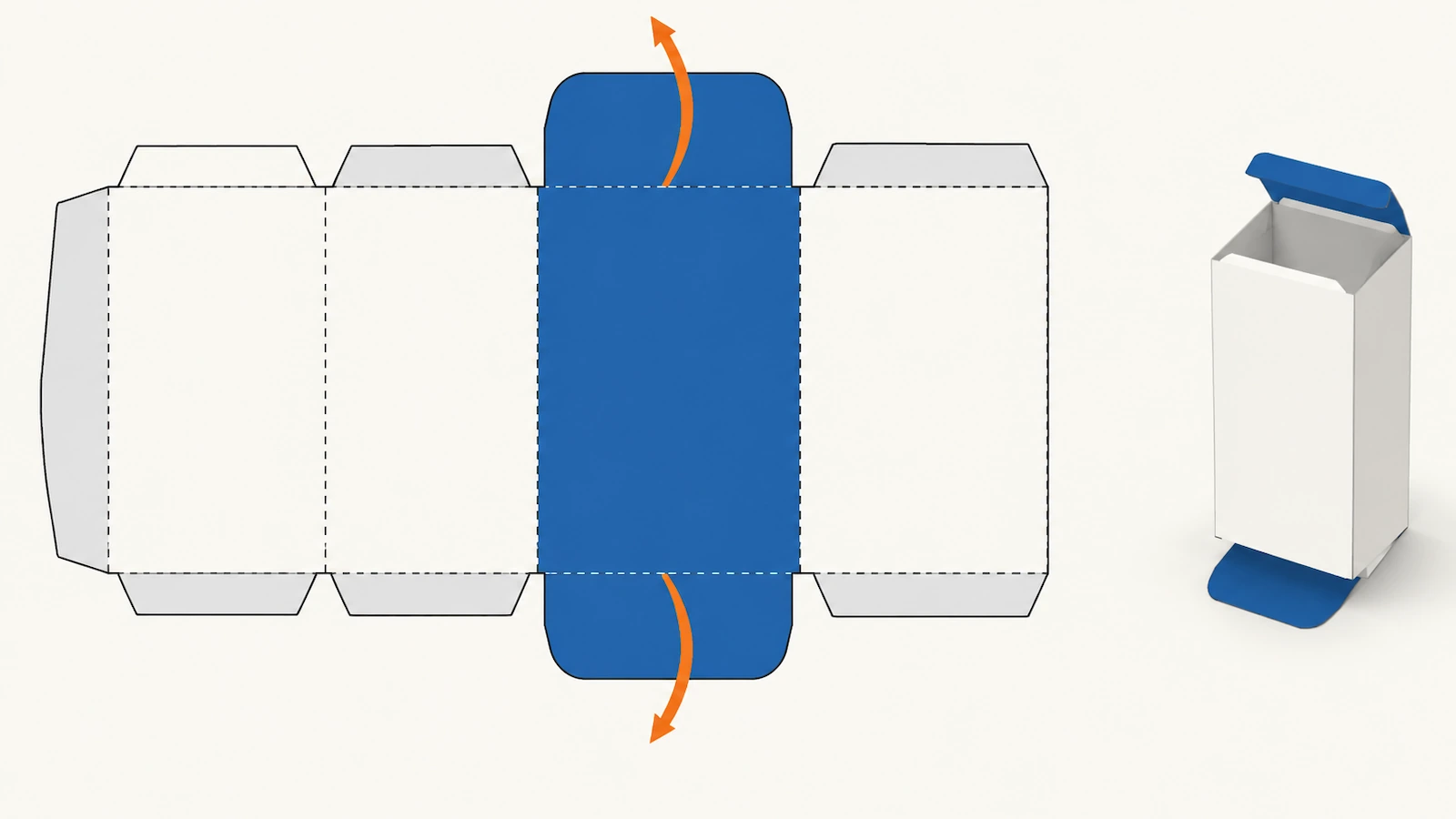
A straight tuck end box, often shortened to STE, is a four-panel folding carton with a tuck closure at each end. It ships flat with its side seam already glued, and the user squares it up and folds the ends closed by hand or on a cartoning line. What separates it from other tuck end boxes is the hinge position: the top closure and the bottom closure both attach to the same body panel, normally the back panel.
A standard straight tuck carton has these parts:
Four body panels: front, back and two sides, joined by vertical scores.
A glue flap (the manufacturer's joint), which is bonded to the inside of the opposite edge panel to form the tube.
Two closure panels with tuck flaps, one at the top and one at the bottom, both hinged from the back panel.
Four dust flaps hinged from the side panels, which fold in first and keep the closure panels square.
The board is usually a folding boxboard grade, not corrugated. The Paperboard Packaging Council describes solid bleached sulfate (SBS) as a premium grade with a bright white appearance and a clay-coated surface that supports high-quality printing[1]. That is why SBS is the common choice when the front panel carries most of the brand message. Recycled and unbleached grades also work in this structure. The trade-off is surface brightness and how crisply the board folds, not how the closure works.
How Both Closures Sit on the Same Panel Side
When both closure panels hinge from the back, each one swings forward over its open end, and its tuck slips down behind the top or bottom edge of the front panel. Seen from the front, the carton has two matching cut edges, one at the top and one at the bottom. The hinge creases for both lids sit on the back. That symmetry is the main reason designers choose a straight tuck for retail.
A reverse tuck works differently. One closure hinges from the front and the other from the back, so the front panel has a folded hinge at one end and a cut tuck edge at the other. Buyers often describe this as a visible tuck edge on the front. It is a small detail, but it matters on a shelf where hundreds of cartons face the shopper.
Closure security depends on lock details, not on direction. Tuck flaps usually hold by friction, sometimes helped by small slit locks cut into the shoulder where the tuck meets the closure panel. A straight tuck can use the same locks as a reverse tuck. If a closure pops open in transit, look at tuck depth, score quality and board stiffness before blaming the closure style.
The same-side hinge also gives a predictable opening. Both lids lift from the front edge toward the back, so a shopper who opens the top sees the same motion they would see at the bottom. For products that are opened, sampled and returned to the shelf, such as testers, card decks and small accessories, that consistency is part of the experience.
Where Straight Tuck Boxes Fit Best
The format is most useful where the front panel does the selling. In the US folding carton market, which Future Market Insights values at USD 15.6 billion in 2026, rising to USD 24.0 billion by 2036[2], growth is driven by beauty, personal care, healthcare and specialty food. These are the categories where shelf presentation and labeling space compete for the same panel.
Front-facing and front-loading displays. On counter units, gravity-feed trays and shelves where cartons stand face-out, a clean front panel lets the artwork read as one block across a row of boxes. When staff restock from the front or shoppers lift the top to look inside, both ends open the same way, so the face of the display stays orderly.
Premium retail cartons. Cosmetics, fragrance samples, candles and gift accessories rely on unbroken graphics, foil that reaches the panel edge and a lid that opens to a printed reveal. Under US rules, the label information for many cosmetics must appear on the outer container, which FDA notes is usually a box or folding carton[3]. The principal display panel must carry the product identity and net quantity. A front panel with no tuck edge leaves the full face free for that required copy plus the brand design.
Window-patch cartons. A window is cut from the front panel and backed with a film patch glued inside before the side seam is closed. Because no tuck edge sits on the front, the window can sit closer to the top or bottom edge without a closure crease cutting through the frame. Remember that the inside dust flaps and tucks still take up space near the ends, so check that the product, not a flap, shows through the window.
Where it is a weaker choice. Dense or heavy products load the bottom tuck, which is held only by friction and the dust flaps. For those products a lock bottom (auto-lock or crash-lock) is the usual upgrade. For high-volume, cost-driven runs where nobody sees the front panel at the point of sale, such as mail-order inner cartons, a reverse tuck usually makes better use of the board.
How to Plan a Straight Tuck End Box Dieline and Print Layout
The steps below cover what is specific to a straight tuck. General sizing, material selection and artwork handoff are covered in our guide to specifying custom tuck end cartons for branded retail, so they are not repeated here.
Confirm the hinge panel. Ask the structural designer to mark which body panel carries both closure panels. In most files it is the back, but some brands hinge from the front so the lid opens away from the shopper. Lock this before any artwork is placed.
Rotate the lid artwork. On the flat sheet, the top closure panel extends upward from the back panel. Once it folds forward, the edge that was furthest from the back panel ends up nearest the shopper. As a result, lid graphics usually have to be rotated relative to the back-panel art to read correctly from the front. The bottom panel follows the same rule in reverse.
Keep critical copy off scores and tuck zones. Text and barcodes that cross a fold or sit on a tuck can crack, scuff or disappear behind the front panel. Ask the supplier for their safe-zone and bleed guidance and apply it to every panel, including the tucks.
Place the side seam on purpose. The glue flap creates a double-board seam on one edge panel. Keep barcodes, regulatory panels and fine type off that seam. Ask whether the glue flap joins to a side panel or to the back.
Design the inside of the lid. Because both closure panels hinge from one panel, the inside of the top lid is the first surface a shopper sees when opening the box. Printing the reverse side costs extra but turns a plain board surface into a branded reveal.
Clear the window from the flaps. If the front panel has a window, overlay the folded positions of the dust flaps and tucks on the artwork to confirm none of them shows through the film.
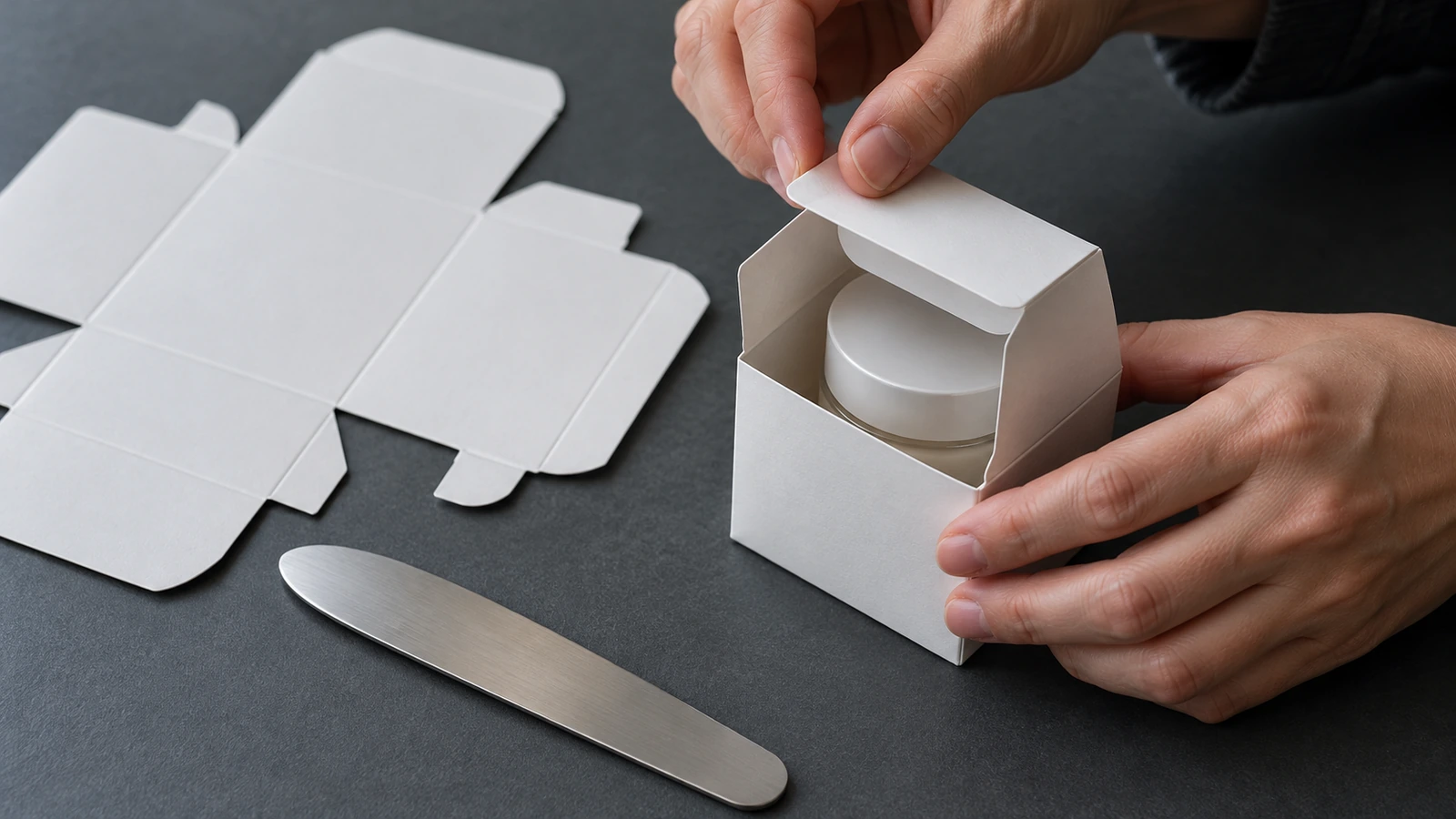
Fold a printed proof. A flat PDF hides orientation errors. Print the file at actual size on similar board, cut it, fold it and close both ends with the real product inside. Lid orientation, seam placement and window clearance all become obvious within a minute.
Board Waste and Unit Cost: Why the Hinge Position Shows Up on the Sheet
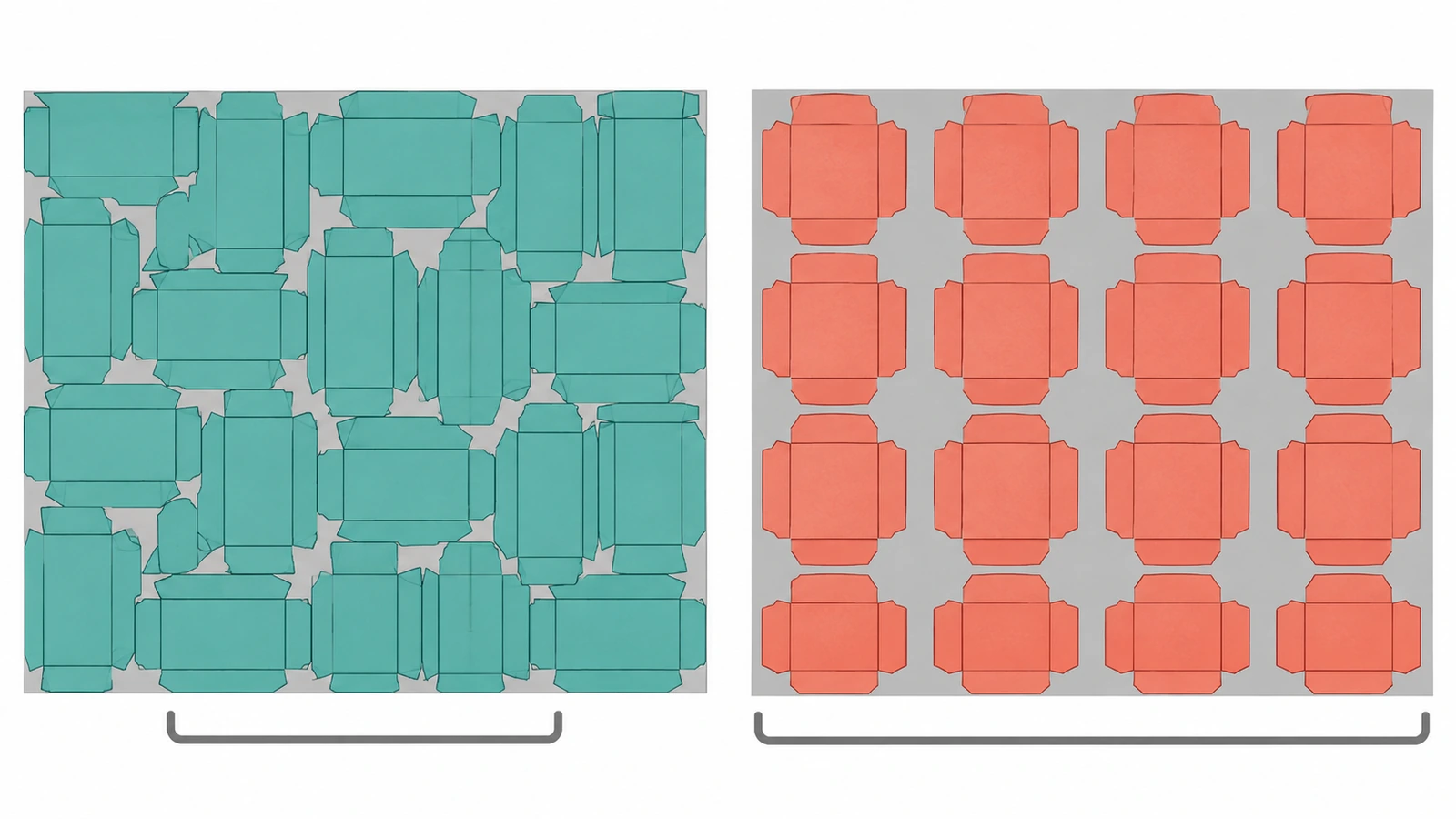
Folding cartons are die-cut from large printed sheets, with as many layouts placed on each sheet as will fit. The tuck flaps stick out above and below the body panels. In a reverse tuck, the top tuck sits on one side of the layout and the bottom tuck on the other. Neighboring cartons can therefore be rotated so that one carton's tuck slots into the space next to another's. A straight tuck has both tucks on the same panel column, so the layouts cannot interlock as tightly. The result is a little more offcut between cartons.
How much extra board this costs is not a fixed percentage. It depends on the carton's proportions, tuck depth, the press sheet size and how many layouts already fit. Tall, narrow cartons can show almost no difference, while short, wide ones can lose a whole carton per sheet. The reliable way to find out is to ask for the number of cartons per sheet ("number up") for both styles at your exact size. Then compare board cost per thousand alongside any change in the finishing setup.
Board is not the only cost driver. Ink coverage, coatings, foil, window patching and gluing speed often outweigh the layout difference, especially on short runs where make-ready time dominates. If the straight tuck's clean front lets you drop an extra finishing step, or improves sell-through on a shelf, the extra board can pay for itself. If the carton is a shipper's inner box, it usually will not.
Material choice also feeds into this decision. Smithers reports that folding boxboard and coated recycled board/white-lined chipboard account for 83.8% of current cartonboard demand[4]. Those grades are therefore widely stocked. Quoting both a virgin and a recycled grade at your layout is a quick way to see which cost lever moves more.
Straight Tuck vs Reverse Tuck vs Lock Bottom
All three styles are standard folding carton constructions. The table compares them on the points that most often decide a buyer's choice. These are general differences, and actual performance depends on board grade, size and lock details.
Factor
Straight tuck end
Reverse tuck end
Lock bottom with tuck top
Closure hinge
Both ends hinge from the same panel
Ends hinge from opposite panels
Tuck top; bottom panels interlock or are pre-glued
One market signal is worth noting. In public buyer discussions, manual packers report that tuck cartons can add noticeable handling time compared with bags, and some worry about corner dents in transit. Neither concern is specific to the straight tuck, but both are reasons to time a hand-pack trial and run a shipping test with real product before you choose a closure on looks alone.
Sustainability and Compliance Checkpoints
Recyclability. A paperboard tuck carton is a mono-material format until you add laminates or large film windows. Pro Carton's study on the recyclability of folding cartons[6] found that conventionally printed and varnished cartons perform well in the paper recycling stream. If full recyclability matters, ask whether a window film or soft-touch laminate changes that result for your spec.
Fiber sourcing claims. To print a certified-forest logo on the carton, every company that takes ownership of the material must hold FSC chain-of-custody certification[7]. Ask for the supplier's certificate code before you add the claim to your artwork. Do not assume certified board alone permits it.
EU market access. The EU Packaging and Packaging Waste Regulation entered into force on 11 February 2025 and has generally applied since 12 August 2026. It sets the goal of making all packaging on the EU market recyclable in an economically viable way by 2030[8]. Brands selling into Europe should keep carton specs simple: paperboard, water-based coatings and minimal plastic.
Tamper evidence for OTC drugs. A tuck closure is not a tamper-evident seal. FDA's compliance policy guide notes that paperboard cartons sealed only by gluing the end flaps do not meet tamper-resistant packaging requirements[9]. An unglued friction tuck offers even less evidence of opening, so add a separate tamper-evident feature such as a seal label, a tear strip or an inner seal on the container.
Drug labeling controls. For drug products, the carton is labeling material. It falls under 21 CFR Part 211, Subpart G[10], which covers how labeling is examined, issued and reconciled. Version control on the dieline and artwork matters as much as print quality. Detailed quality and compliance steps are covered on the product page.
Market direction. Folding cartons are gaining share as brands move away from plastic secondary packaging. The Paperboard Packaging Council's market outlook[11] tracks steady growth in the category. That means converters are generally well equipped for both straight and reverse tuck work, so price and quality, not availability, should drive your choice of supplier.
Straight Tuck End Box FAQ
FAQ: What is the difference between a straight tuck end and a reverse tuck end?
In a straight tuck end, both closure panels hinge from the same body panel and tuck in the same direction, so the front shows two matching clean edges. In a reverse tuck end, the closures hinge from opposite panels. The front then shows a hinge at one end and a tuck edge at the other, and the layouts nest more tightly on the press sheet.
FAQ: Is a straight tuck end box more secure than a reverse tuck?
Not inherently. Both styles rely on friction tucks and optional slit locks. Holding strength comes from tuck depth, score quality, board stiffness and lock design. For tamper evidence, neither style is enough on its own; add a seal or tear feature.
FAQ: Why does a straight tuck box usually cost a little more?
Because both tucks sit on the same side of the layout, cartons cannot interlock as closely on the sheet, which leaves more offcut. The difference depends on carton proportions and sheet size, so ask for a number-up comparison of both styles at your exact dimensions.
FAQ: Can I add a window to a straight tuck end box?
Yes, and it is one of the format's strengths. The window is cut from the front panel and backed with a film patch glued inside. Check that the dust flaps and tucks do not show through the window when the carton is closed, and consider whether the film affects recyclability.
FAQ: Which way should the lid artwork face on the dieline?
Because the lid folds forward from the back panel, its graphics usually need to be rotated relative to the back-panel art to read correctly from the front. Always confirm by folding a printed proof at actual size before you approve production.
FAQ: When should I choose a lock bottom instead?
Choose a lock bottom when the product is dense or heavy enough to stress a friction bottom tuck, or when the packing line needs a carton that sets up its base in one motion. You can keep a straight tuck top for a clean opening experience.
Key Takeaways
The US folding carton market that straight tuck boxes compete in is still growing. — USD 15.6 billion in 2026 to USD 24.0 billion by 2036, a 4.4% CAGR (Source)
Folding boxboard and recycled grades dominate cartonboard supply, so both are easy to quote for this structure. — 83.8% of current cartonboard demand (Source)
Global folding carton value keeps rising, which keeps converter capacity broad. — USD 132.8 billion in 2025 to USD 159.6 billion by 2030 (Source)
Reverse tuck remains the larger volume choice for cost-driven runs. — USD 3.90 billion in 2025, projected at USD 7.19 billion by 2035 (Source)
EU sales require cartons that are designed to be recyclable. — all EU-market packaging recyclable by 2030 under the PPWR (Source)
Tuck closures need a separate tamper-evident feature for OTC drugs. — FDA CPG Sec. 450.500 (Source)
Conclusion: Choose the Closure for the Panel That Sells
A straight tuck end box costs a little more board in exchange for a symmetrical front panel and a consistent opening at both ends. Choose it when the front face, a window or a printed lid reveal drives the purchase. Choose a reverse tuck when the carton mainly protects and ships, and choose a lock bottom when the product's weight is the main concern. Whichever direction you take, request a number-up comparison and fold a printed proof before approving the file. If a reverse tuck is the better fit, our custom reverse tuck end boxes page explains the next steps and how to request a quote and a physical sample.
Hi there! I'm Bruce, proud dad to my amazing son. I'm the founder of Zigpac, a printing and packaging company empowering small and medium-sized businesses with custom solutions. Let's create something great together!



 Blog PDF for offline reading














The information below is required for social login
Sign In
Create New Account