Embossed labels feature raised three-dimensional surfaces created through mechanical die pressure or UV polymer stacking, adding tactile luxury that increases perceived product value by 24% according to consumer sensory research. They perform best on premium cosmetics, spirits, and specialty foods.
User/Scenario: Brand owners, packaging designers, and e-commerce sellers seeking to differentiate products through premium tactile packaging that justifies higher price points and strengthens brand recognition.
Your beautifully formulated product sits on a crowded shelf. The competition is fierce, prices are comparable, and customers scroll past your listing in seconds. How do you make them stop, reach out, and remember? The answer lies beneath their fingertips: tactile packaging that transforms passive viewing into active engagement.
This guide walks you through everything you need to know about embossed labels, from selecting the right technique for your application to avoiding common production pitfalls that waste time and budget.
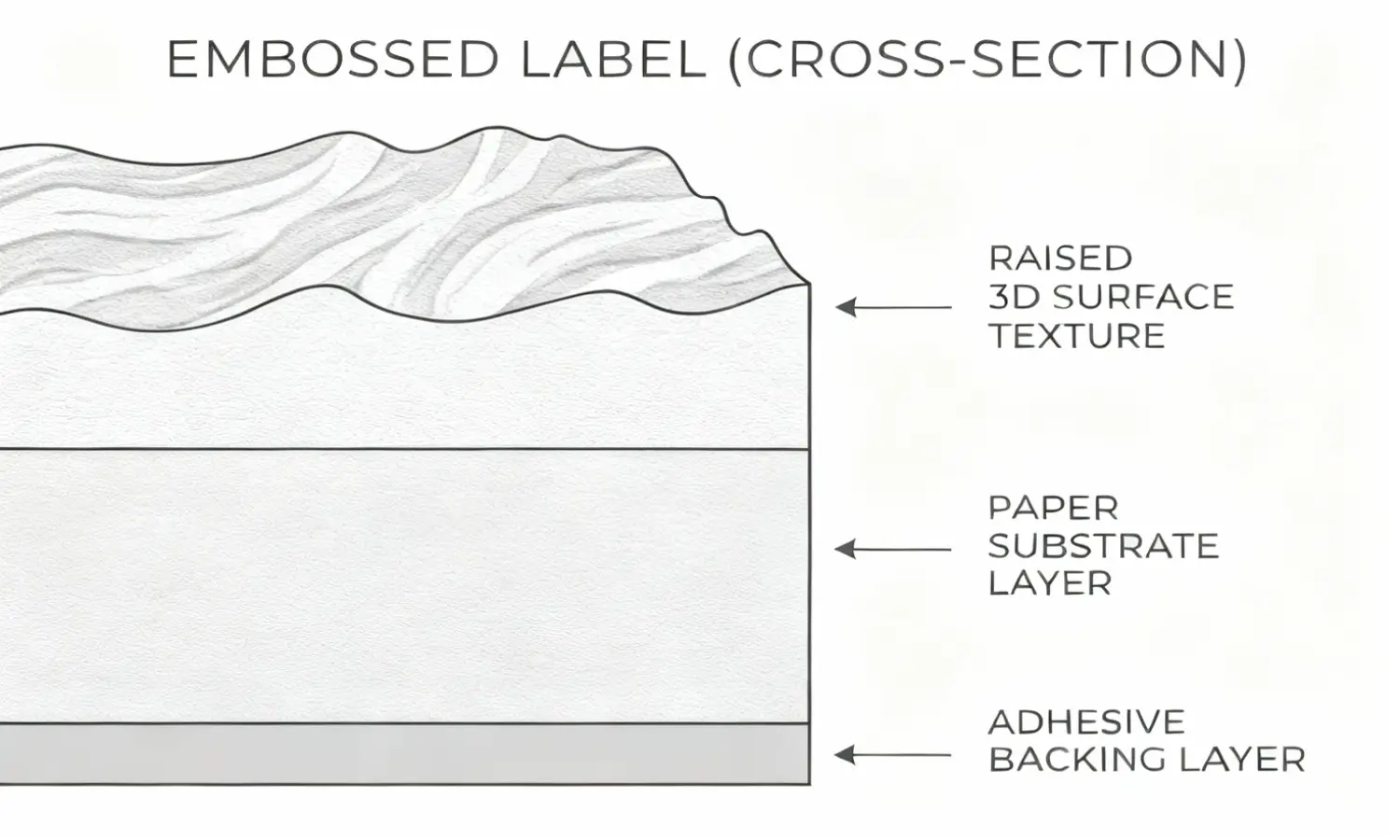
Table of Contents (Click to Expand)
What exactly is an embossed label?↑
Embossing transforms flat label stock into a three-dimensional surface that customers can feel. This tactile dimension creates what researchers call haptic information, sensory data processed through touch that significantly influences purchase decisions.
An embossed label is a pressure-sensitive or paper label featuring raised surface elements created through mechanical die impression or UV-cured polymer[1] stacking, producing tactile relief heights typically ranging from 0.1mm to 0.5mm for standard applications.
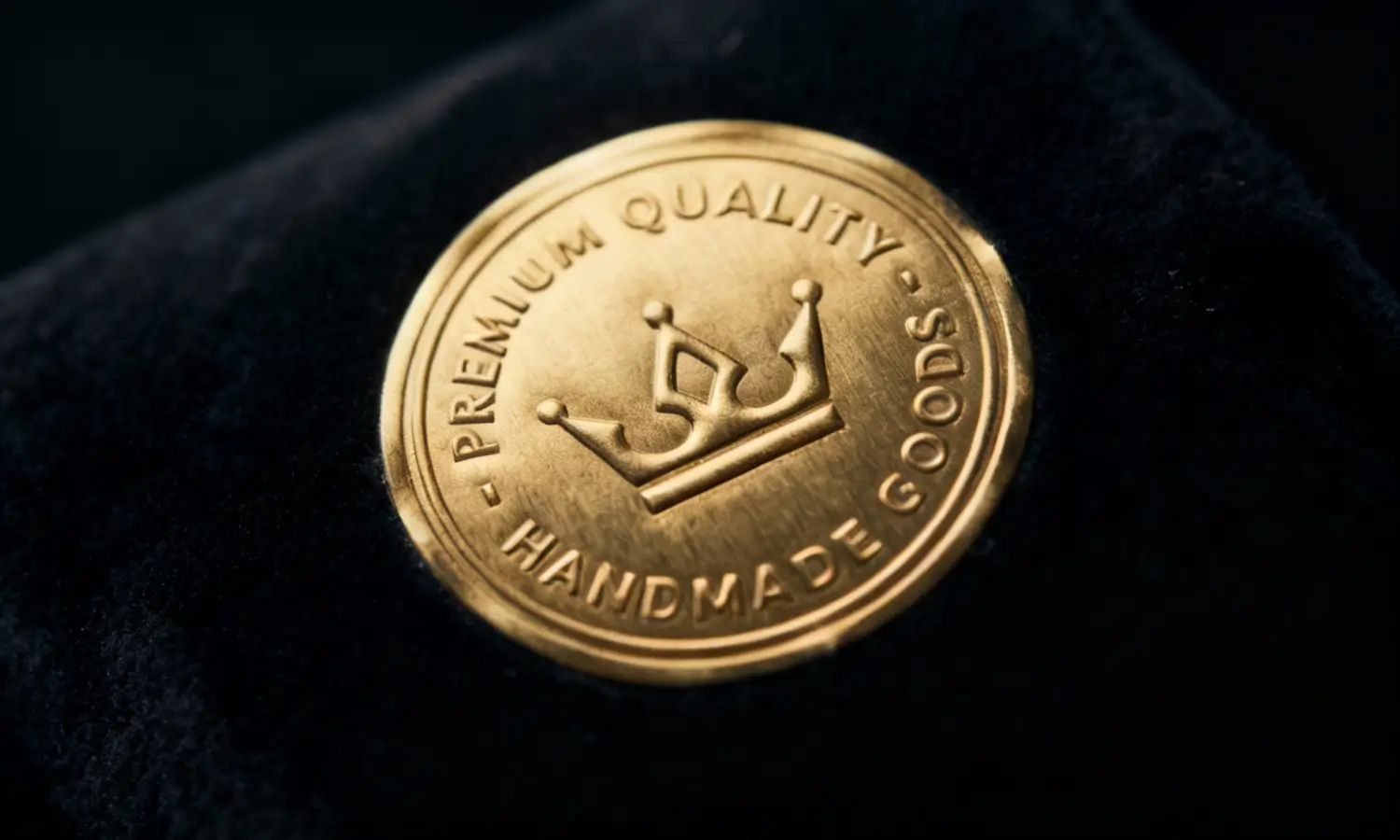
Essential attributes and scope
Embossed labels serve specific functions that justify their premium positioning in the packaging market.
● Core attributes: Three-dimensional raised surfaces (positive relief) or recessed impressions (debossed/negative relief), enhanced light interaction creating visual depth, and tactile feedback that triggers sensory memory. The raised height typically measures between 0.1mm for subtle effects and 0.5mm for pronounced dimensional impact.
● Applicable range: Premium spirits and wine bottles, luxury cosmetics and skincare containers, specialty food packaging, candle jars and artisanal products, corporate gift packaging, and high-end consumer electronics. According to market research, the cosmetics and fragrances segment accounts for the largest share of luxury packaging[2] demand at approximately 44% of the secondary paper and paperboard luxury packaging market.
● Compliance considerations: Food-contact applications require materials meeting FDA food contact[3] requirements. Alcoholic beverage labels must comply with TTB labeling regulations. Sustainability-focused brands can specify materials with FSC certification[4] to document responsible sourcing.
How do I create embossed labels step by step?↑
Successful embossed label production follows a systematic workflow that prevents the most common failure points: artwork incompatibility, material mismatch, and adhesion problems on challenging surfaces.
The embossed label creation process involves four critical phases: design preparation with proper layer separation, material selection based on application surface, production method selection, and quality verification before full production runs.
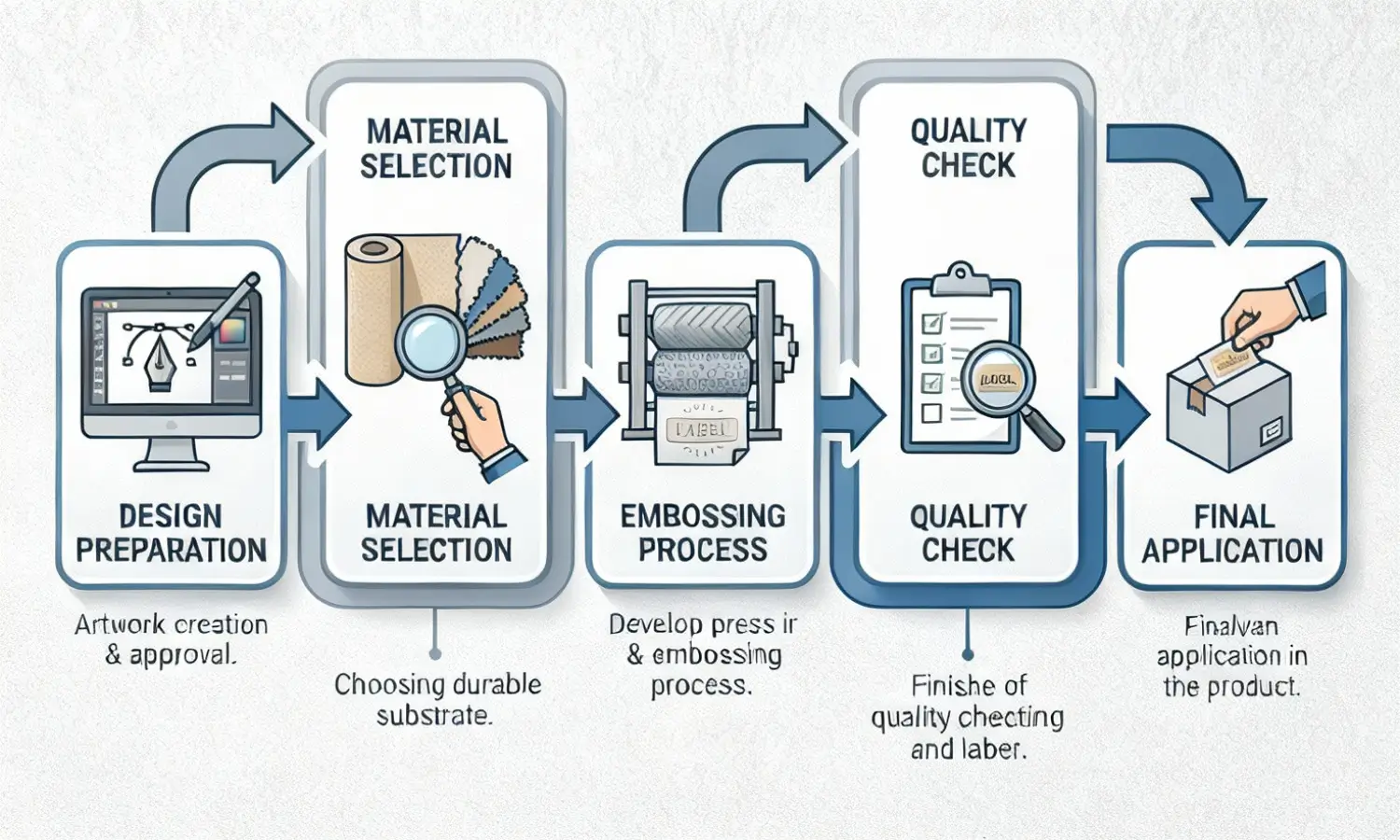
Actionable steps
1) Input: Vector artwork file (AI, EPS, or PDF format) with minimum 300 DPI for any raster elements → Action: Separate design into distinct layers: Layer 1 for print elements, Layer 2 for foil areas (if applicable), Layer 3 for emboss/deboss zones → Output: Production-ready file with clear layer identification and 3mm safety margin from die-cut edges.
2) Input: Container specifications including material type, surface texture, and curvature radius → Action: Select substrate material based on application requirements. For curved surfaces with radius below 25mm, choose flexible BOPP (Biaxially Oriented Polypropylene)[5] with high-tack adhesive. For flat paper boxes, textured paper stock (minimum 90 gsm) accepts traditional mechanical embossing well → Output: Material specification sheet matched to container requirements.
3) Input: Order quantity and budget parameters → Action: Determine production method. Traditional die embossing requires tooling investment but delivers organic paper texture; digital UV embossing eliminates tooling costs and suits quantities from 25 pieces upward → Output: Production method selection with cost-per-unit calculation.
4) Input: Pre-production sample → Action: Verify emboss depth uniformity, registration accuracy between print and emboss layers, and adhesion performance on actual container surface. Test adhesion after 24-hour dwell time under expected storage conditions → Output: Approved sample with documented quality parameters.
5) Acceptance criteria: Emboss registration within ±0.3mm of print elements, no visible fiber cracking on paper substrates, label edges remain flat without lifting after 72-hour room temperature storage on target container.
Which embossing technique fits my product?↑
Choosing between embossing methods depends on your production volume, budget constraints, and the specific tactile effect you want to achieve. Each technique produces distinctly different results.
Traditional mechanical embossing creates organic paper texture with visible back-side impression, while digital UV embossing produces smooth polymer relief without deforming the substrate. Your choice impacts cost structure, minimum quantities, and the sensory experience delivered to customers.
| Technique |
Relief Height |
Texture Feel |
Tooling Required |
Best For |
Key Consideration |
| Traditional Die Emboss |
0.2-0.5mm |
Organic paper fiber, back shows indent |
Yes (metal die) |
Paper labels, high volume |
Higher setup cost, authentic texture |
| Digital UV Emboss |
0.1-0.3mm |
Smooth polymer, back remains flat |
No |
Film labels, low-medium volume |
No tooling, faster turnaround |
| Blind Emboss |
0.2-0.4mm |
Unprinted raised area, shadow effect |
Yes (male/female die) |
Subtle luxury, minimalist brands |
Relies on light and shadow only |
| Foil + Emboss Combo |
0.2-0.5mm |
Metallic raised surface |
Yes (registered dies) |
Premium spirits, cosmetics |
Highest visual impact, registration critical |
| Multi-Level Emboss |
Varies by level |
Sculpted dimensional effect |
Yes (precision die) |
Detailed logos, artistic designs |
Requires skilled die making |
When evaluating options, consider your container surface. Curved bottles and jars demand flexible film substrates like BOPP that conform without edge lifting. Flat cartons and rigid boxes accept traditional paper embossing beautifully. Low surface energy plastics (HDPE, PP containers) require corona-treated films with aggressive adhesives to prevent label migration.
Material selection guide for common applications
Your substrate choice directly impacts both aesthetic outcome and functional performance. Match material to application for optimal results.
● Wine and spirits bottles (glass): Textured paper stock with wet-strength properties handles condensation. Choose minimum 80 gsm weight for substantial feel. Mechanical embossing creates the authentic tactile signature luxury brands require.
● Cosmetic jars and tubes (plastic): Clear or white BOPP film with conformable adhesive. Digital UV embossing provides clean dimensional effects without substrate distortion. Film flexibility prevents edge lifting on curved surfaces.
● Candle containers (glass jars): Consider heat-stable adhesives rated for wax pour temperatures if labels apply before filling. Paper substrates with matte finishes complement artisanal aesthetics; UV embossing adds dimension without competing with handcrafted brand positioning.
● Food packaging (various): Ensure all materials meet food-contact requirements for your market. Grease-resistant coatings protect embossed surfaces from oil migration in specialty food applications.
Frequently asked questions↑
See the FAQ section provided separately.
Key takeaways and evidence↑
- Tactile packaging influences purchase behavior: Research published in the Journal of Marketing[6] demonstrates that haptic information significantly affects product evaluation confidence, with high-touch consumers showing measurably stronger purchase intent when tactile exploration is available.
- Luxury packaging market continues expanding: The global luxury packaging market reached approximately USD 18.5 billion in 2025, growing at 4.2% CAGR with paperboard-based solutions including embossed labels holding significant market share.
- Material selection prevents common failures: BOPP films with high-tack adhesive resolve edge lifting on curved containers, while minimum 90 gsm paper weight prevents fiber cracking during mechanical embossing.
- Line width thresholds protect design integrity: Maintain line weights above 0.35 points (1 point preferred) for embossed elements to ensure clean reproduction without detail loss.
- Sustainability options exist without compromising quality: FSC-certified[4] paper substrates and thin metallic foils (under 2.5 microns) that separate during recycling allow brands to maintain premium tactile packaging while supporting environmental commitments.
Conclusion↑
Embossed labels transform ordinary product packaging into memorable tactile experiences that command attention and justify premium pricing. Success requires matching the right embossing technique to your container type, selecting appropriate materials for your application environment, and preparing artwork with proper layer separation. Whether you choose traditional die embossing for its authentic paper texture or digital UV methods for flexibility and lower quantities, the dimensional quality of your labels directly communicates brand value to every customer who picks up your product. Start with a sample order to validate material compatibility and emboss quality before committing to production quantities.
Request a custom embossed label sample to see and feel the quality difference for your specific application.




The information below is required for social login
Sign In
Create New Account