Custom sticker printing transforms digital designs into durable adhesive products using CMYK offset or digital presses, with quality determined by material grade (cast vs. calendered vinyl), resolution (minimum 300 DPI), and UV lamination. Premium polymeric vinyl with UV coating achieves 5-7 year outdoor durability per manufacturer specifications.
User/Scenario: Artists, e-commerce sellers, and brand marketers seeking weather-resistant custom stickers for water bottles, vehicles, packaging, and promotional materials—without color mismatches or premature peeling.
You uploaded your vibrant design, paid for premium stickers, and waited excitedly for delivery. Then the package arrived—and your electric blue looked muddy, the edges showed white borders, and within weeks outdoors, the colors faded to a ghostly version of your original vision. Sound familiar? The gap between screen preview and physical product frustrates thousands of buyers annually.
This guide decodes the technical realities behind custom sticker printing, explaining why certain failures occur and how to prevent them through informed material selection, proper file preparation, and strategic vendor choice.
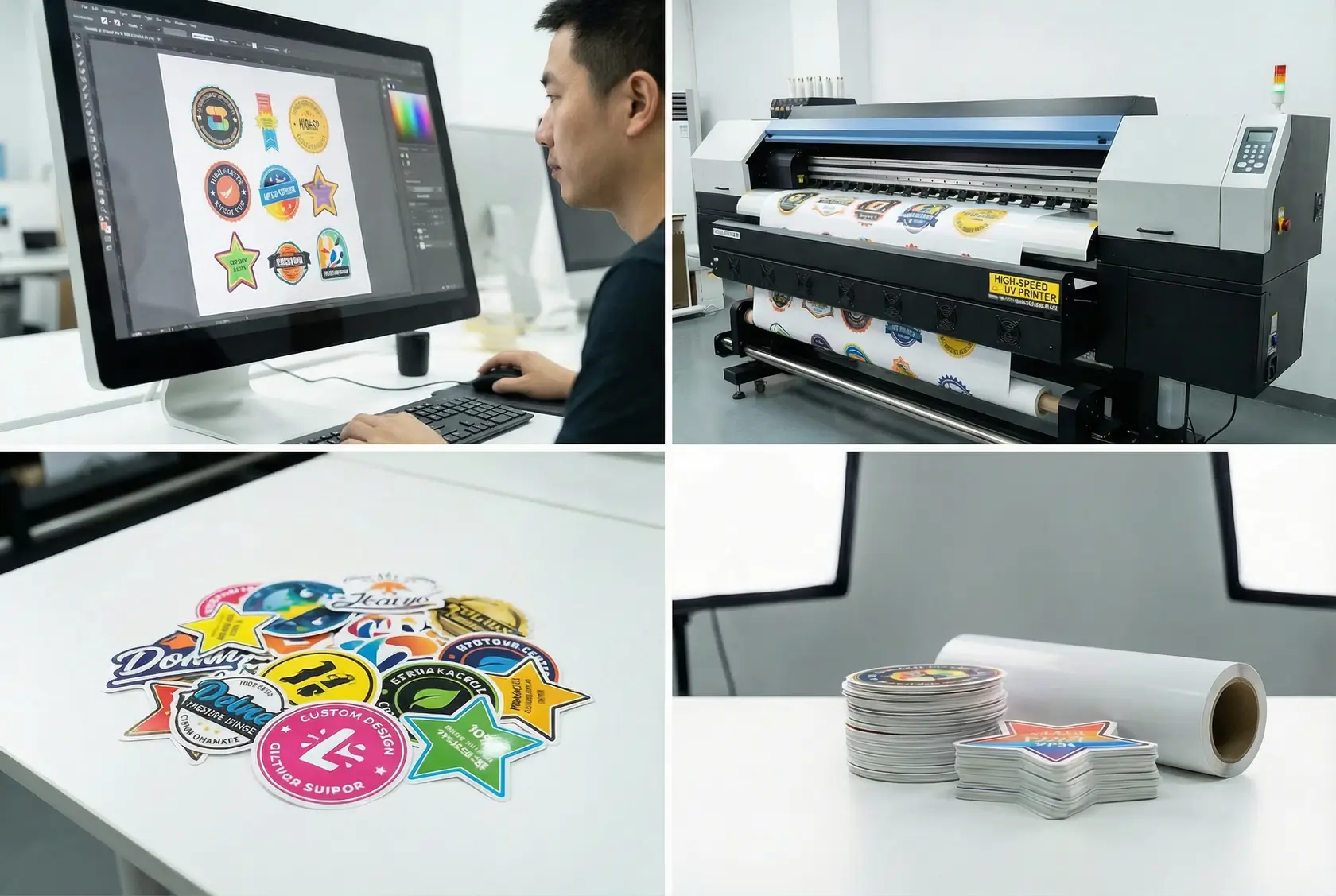
Table of Contents (Click to Expand)
What exactly is custom sticker printing?↑
Custom sticker printing converts digital artwork into adhesive-backed products through commercial printing processes. Unlike pre-made stickers, custom printing allows precise control over shape, size, material, and finish—critical for brand consistency and durability requirements.
Custom sticker printing is a commercial manufacturing process that applies CMYK[1] or digital inkjet technology to pressure-sensitive vinyl or paper substrates, followed by die-cutting to produce adhesive labels matching customer specifications for shape, durability, and visual appearance.
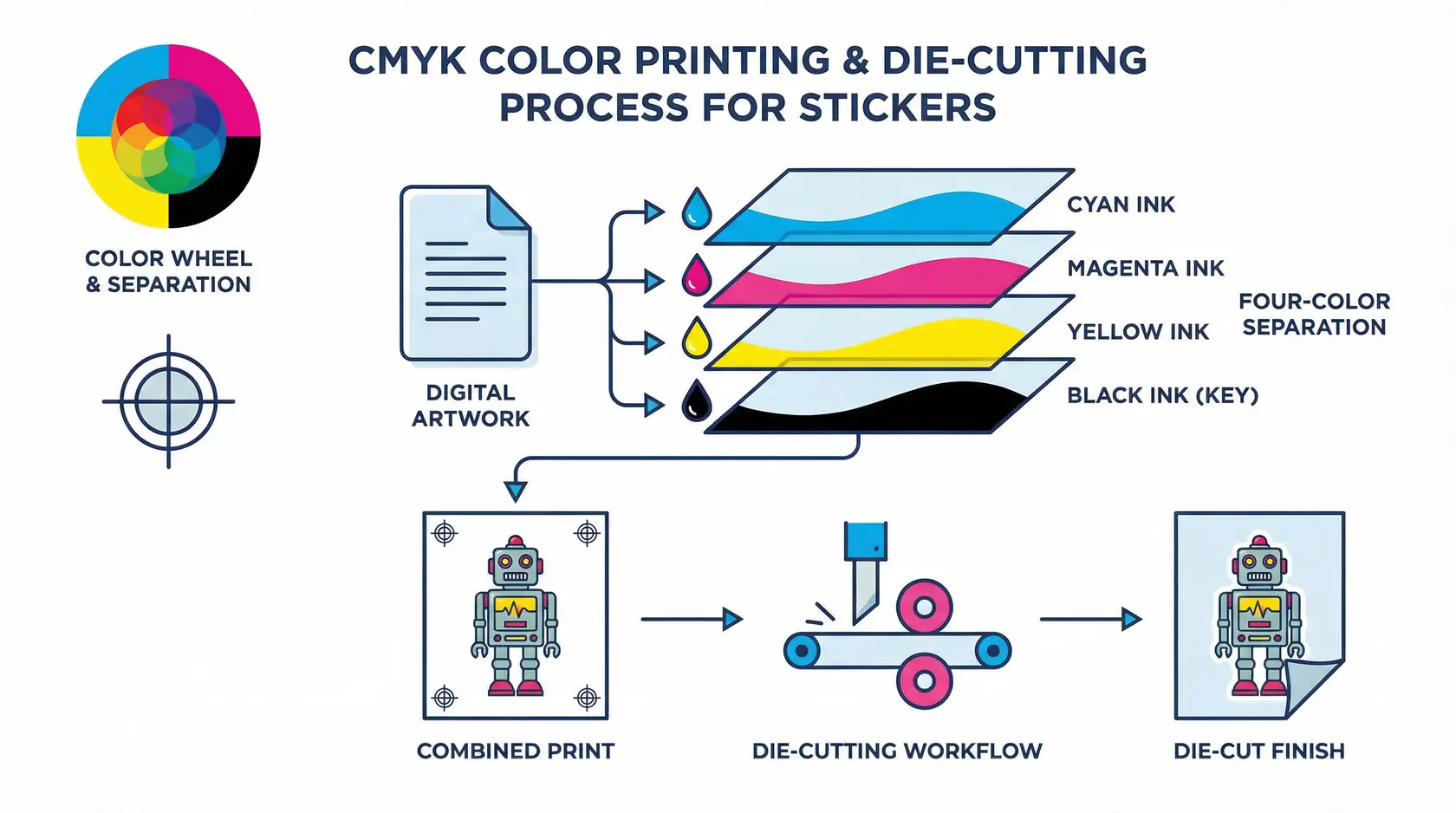
Essential attributes and technical scope
● Core attributes: Resolution requirement of 300 DPI minimum; CMYK color mode for commercial printing; bleed area extension of 3mm (1/8 inch) beyond trim line; safety zone of 3mm inward from trim for critical elements.
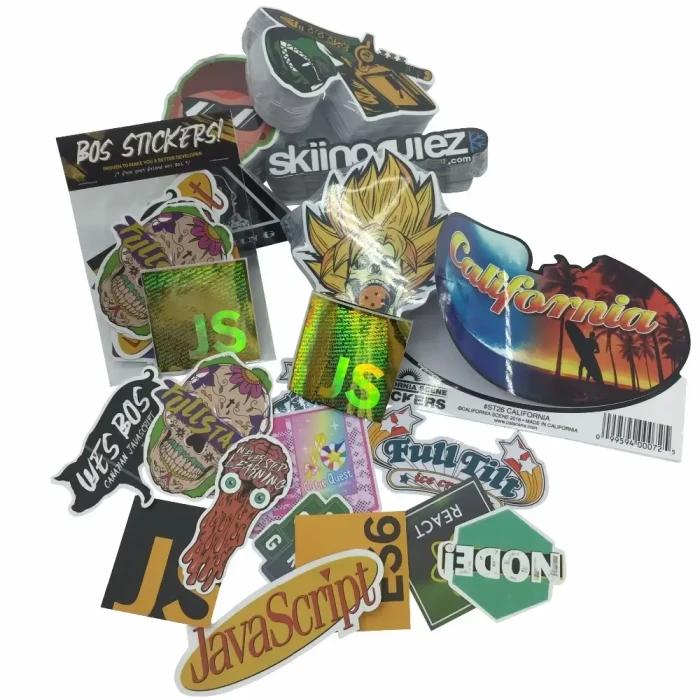
● Material categories: Paper stickers for indoor temporary use; matte vinyl for non-reflective surfaces; glossy vinyl for vibrant color pop; holographic and specialty films for premium applications.
● Durability grades: Indoor-only paper (6-12 months); standard vinyl (1-3 years outdoor); polymeric cast vinyl[2] with UV lamination (5-7 years outdoor exposure).
Understanding the RGB-CMYK color gap
The single largest source of customer complaints stems from color expectation mismatch. Computer monitors display colors using RGB (Red, Green, Blue) additive light, producing a gamut containing millions of perceivable hues. Commercial printing uses CMYK (Cyan, Magenta, Yellow, Black) subtractive ink, which physically cannot reproduce certain colors—particularly vibrant neons, electric blues, and fluorescent tones. When your screen shows saturated lime green, the printed result may appear as muted olive because that specific wavelength falls outside printable range. Professional vendors offer digital soft-proofing or physical proofs specifically to preview this unavoidable translation before production commitment.
Material science fundamentals
Vinyl sticker materials divide into two manufacturing categories with dramatically different performance characteristics. Calendered vinyl is produced by pressing PVC through heated rollers, creating a cost-effective but memory-prone material that may shrink or curl when exposed to temperature fluctuations—problematic for curved vehicle surfaces or outdoor applications. Cast vinyl is poured into thin films and cured, resulting in superior conformability, dimensional stability, and longevity. Premium brands like 3M and Avery Dennison[3] manufacture cast films rated for 5-12 years outdoor durability depending on application conditions.
How do I prepare files and order custom stickers correctly?↑
Proper file preparation eliminates the majority of production issues before they occur. Following industry-standard specifications ensures your design translates accurately from screen to physical product without costly reprints or quality disputes.
Successful custom sticker ordering requires CMYK color mode, 300+ DPI resolution, 3mm bleed extension, vector-converted text, and explicit material/finish selection during checkout—verified through digital proof approval before production begins.
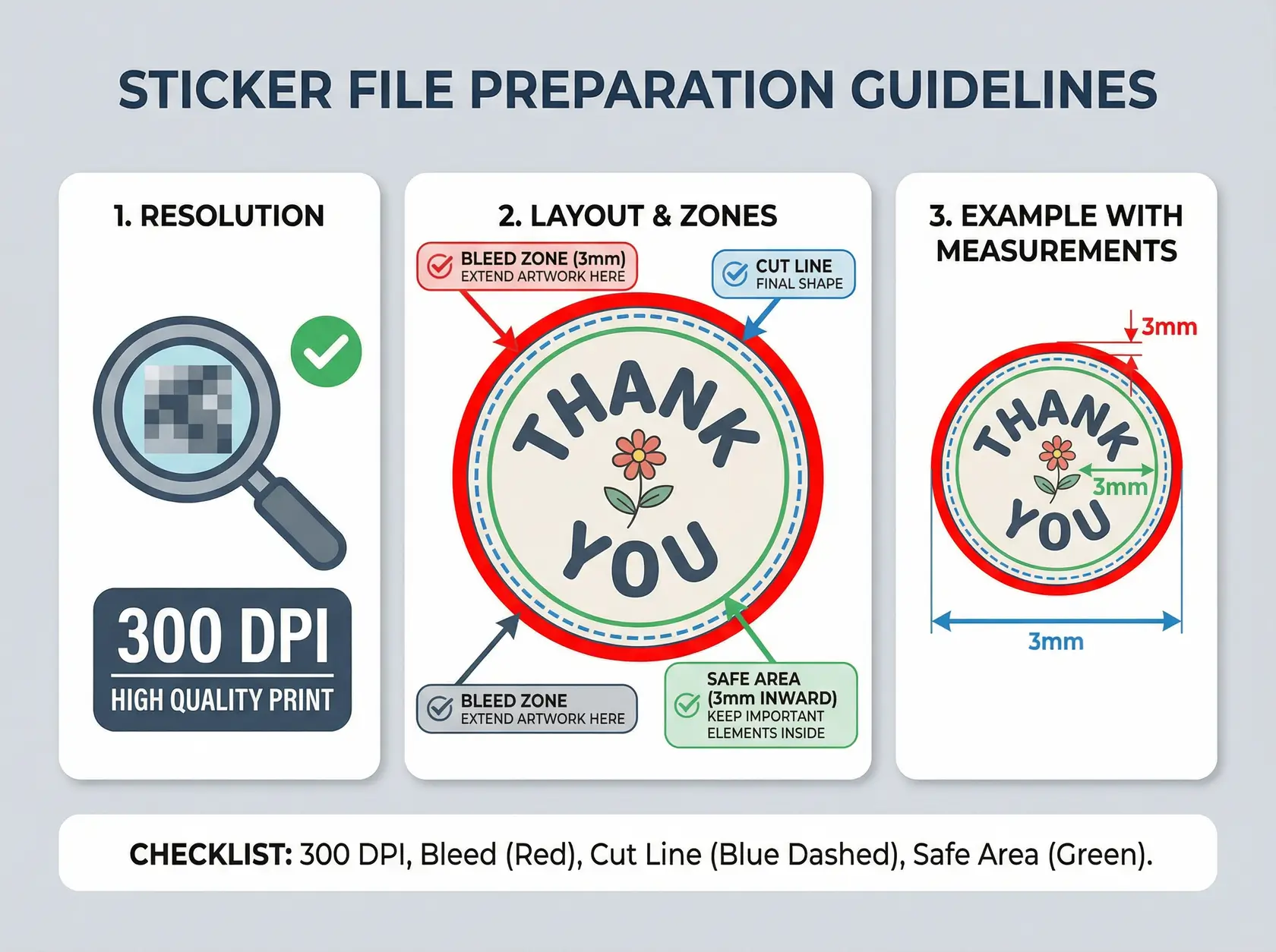
Actionable file preparation steps
1) Input: Original design file (AI, PSD, or high-res PNG) → Action: Convert color mode from RGB to CMYK in design software; check for out-of-gamut warnings on neon or highly saturated colors → Output: Print-ready file with realistic color expectations.
2) Input: Design at final dimensions → Action: Extend background elements 3mm (1/8 inch) beyond intended cut line to create bleed area; keep text and critical elements 3mm inward from cut line for safety margin → Output: File with proper margins preventing white edges or cut-off elements.
3) Input: Text layers in design → Action: Convert all fonts to outlines/curves to prevent font substitution on vendor systems → Output: Vector-safe file maintaining exact typography.
4) Input: Completed design file → Action: Export as PDF (Press Quality), EPS, or AI format; verify minimum 300 DPI resolution for raster elements → Output: Production-ready file.
5) Acceptance criteria: Request and carefully review digital proof; verify spelling, color appearance, cut line placement, and any QR codes function correctly when scanned. Approve only after confirmation—automated approval after 48-72 hours is common vendor policy.
Material selection decision framework
Match material to application environment: For water bottles and dishware, select permanent vinyl with high peel adhesion[4] and UV lamination—note that "waterproof" does not mean "dishwasher-safe," as high-temperature steam and detergents accelerate edge lifting regardless of material grade. For vehicle applications, cast vinyl with automotive-grade adhesive prevents shrinkage and edge failure on curved panels. For packaging and short-term promotions, paper or economy vinyl provides cost efficiency without unnecessary durability investment.
Common pitfalls to avoid
The "waterproof" marketing claim causes significant confusion. Water resistance means the printed surface repels liquid—not that adhesive bonds survive submersion, mechanical scrubbing, or dishwasher cycles. User communities consistently report sticker failure on water bottles after machine washing despite waterproof labeling. Hand washing with mild soap maintains adhesion; dishwasher exposure voids performance expectations.
Holographic and specialty materials present additional complexity. These films achieve visual effects through light-refracting layers that may not adhere consistently to curved surfaces or high-heat environments. Vehicle applications for holographic decals frequently experience edge peeling within months—requiring edge sealing or alternative material selection for automotive use cases.
How to evaluate a custom sticker printing service↑
Not all sticker printing services deliver equal results. Before committing to an order, evaluate providers against specific criteria that directly impact your final product quality, timeline, and total cost. The following checklist helps you ask the right questions.
A reliable custom sticker service should offer transparent pricing, clear material specifications, proofing options before production, responsive customer support, and realistic turnaround commitments—verified through their product pages and order process.
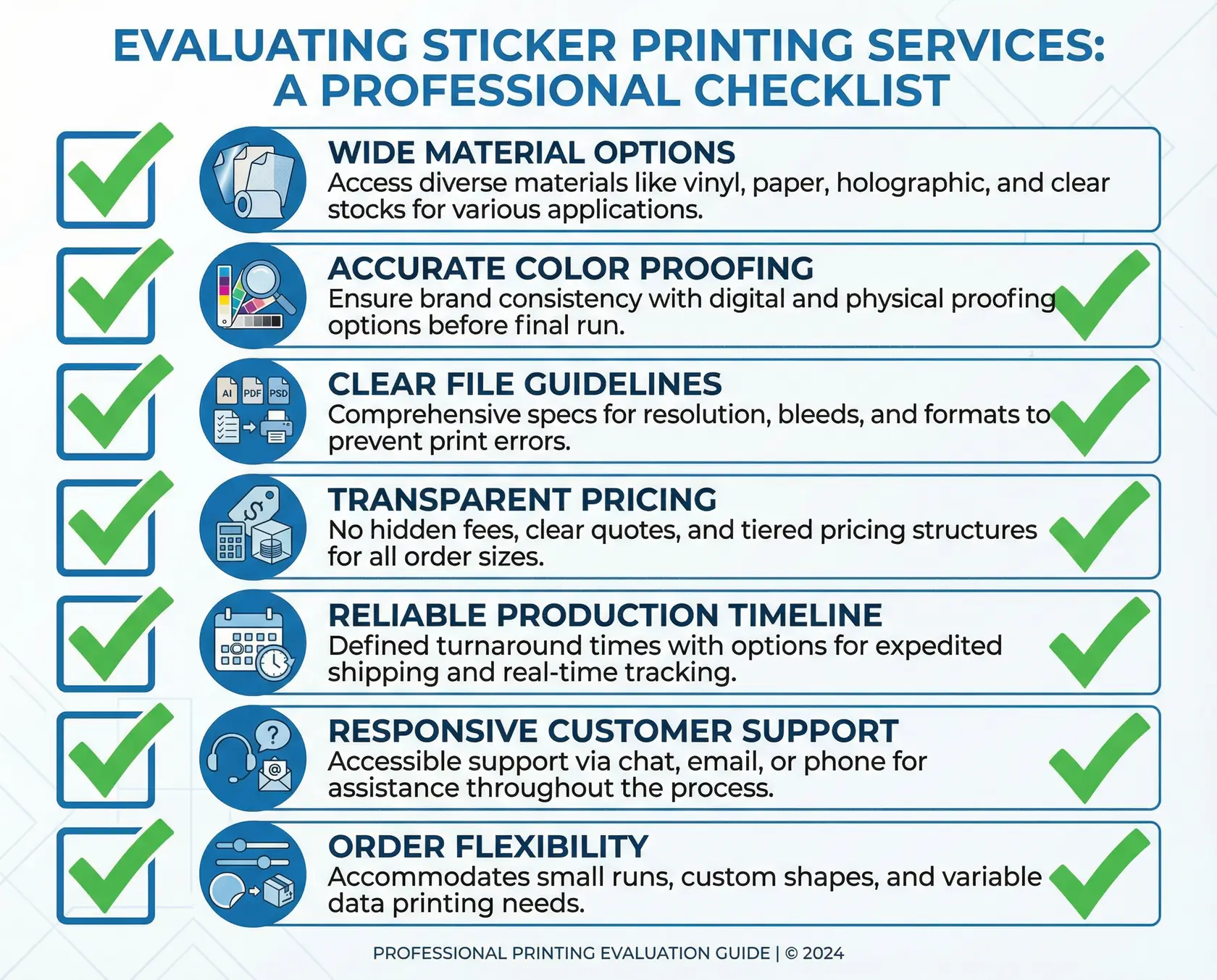
Evaluation criteria checklist
1. Material options and specifications
Does the service clearly explain the difference between paper, vinyl, and specialty materials? Can you see durability ratings (indoor vs. outdoor lifespan)? Are material samples or descriptions detailed enough to match your application? Services that only list vague terms like "premium vinyl" without specifying cast vs. calendered or UV lamination options may deliver inconsistent results.
2. Color accuracy and proofing process
Does the service offer digital proofs before production? Is there an option for physical proofs on actual material for color-critical orders? Do they provide guidance on RGB-to-CMYK conversion limitations? A vendor that auto-approves files after 48 hours without requiring explicit confirmation puts the risk of errors on you.
3. File preparation guidance
Does the website clearly explain bleed requirements (typically 3mm), safety zones, resolution requirements (300 DPI minimum), and accepted file formats? Are templates available for download? Services that provide comprehensive pre-press guides demonstrate production expertise and reduce rejection rates.
4. Transparent pricing structure
Can you see the final price before checkout, including shipping? Are there hidden setup fees, die-cutting charges, or artwork preparation costs? Does pricing scale reasonably with quantity? Calculate per-unit cost at your expected order volume—some services have attractive minimums but poor bulk pricing, or vice versa.
5. Production and shipping timeline
Is turnaround time clearly stated as business days? Does the service distinguish between production time and shipping time? Are rush options available for urgent orders? Be cautious of services that only show "estimated delivery" without breaking down production vs. transit—delays often hide in ambiguous timelines.
6. Customer support accessibility
Can you reach support before placing an order? Is there live chat, phone support, or email-only communication? What are stated response times? Test the support channel with a pre-sale question—response speed and quality before purchase typically reflects post-purchase service levels.
7. Order flexibility
What is the minimum order quantity? Can you order samples or small test batches before committing to large quantities? For artists and small businesses testing new designs, high minimums (500+ units) create unnecessary inventory risk. Low or no minimums allow market validation before scaling.
Red flags to watch for
Certain patterns indicate potential quality or service issues. Vague material descriptions without technical specifications suggest inconsistent sourcing. No proofing option means you accept all risk for color and layout errors. Pricing that seems significantly below market average often reflects inferior materials or overseas production with extended shipping. Customer reviews mentioning "smaller than expected" or "color looked different" point to systemic issues with file handling or material quality. Finally, services that make it difficult to contact support before ordering rarely improve after they have your payment.
Key takeaways & proof↑
- Market growth trajectory: The global stickers market reached USD 4.61 billion in 2024[5], projected to reach USD 7.67 billion by 2033 at 5.81% CAGR, with personalized/custom segments growing faster at approximately 5.73% annually.
- Color accuracy standard: Commercial printing follows ISO 12647-2[1] process control parameters; acceptable color deviation (ΔE) should remain below 3.0 for quality production—values exceeding 5.0 indicate visible mismatch requiring correction.
- Material durability benchmarks: Cast vinyl from premium manufacturers (3M, Avery Dennison) achieves 5-7 year outdoor durability with proper UV lamination; calendered vinyl typically lasts 1-3 years before shrinkage or fading becomes visible.
- File specification requirements: Industry standard demands 300 DPI minimum resolution, CMYK color mode, 3mm bleed extension, and outline-converted fonts—deviation from these specifications causes approximately 60% of customer service disputes according to vendor reports.
- Customer preference data: Research indicates 68% of consumers prefer customized products[6] for personal use, with quality (75% mention rate) and fast delivery (31% mention rate) ranking as top satisfaction drivers in review analysis.
Conclusion↑
Custom sticker printing success depends on understanding the technical realities that separate professional results from frustrating failures. Color translation from screen to print involves unavoidable physics—not vendor incompetence. Material selection determines whether your stickers survive months or years of real-world exposure. File preparation following industry specifications prevents the cutting errors and resolution problems that generate negative reviews across every platform.
Armed with this knowledge, you can confidently specify materials matching your durability requirements, prepare files that translate accurately to physical products, and select vendors whose strengths align with your priorities—whether that's speed, special effects, environmental responsibility, or geographic convenience.
Ready to create professional custom stickers? Contact our team for personalized material recommendations based on your specific application requirements.




The information below is required for social login
Sign In
Create New Account