We use cookies to enable our websites to remember information, to help some website functionalities to work properly, to understand how you interact with and use our websites and to display you content and ads that are relevant and engaging for you.
By clicking Accept All you consent to the use of these cookie.
The store will not work correctly when cookies are disabled.
Custom sticker printing requires matching material grade to application environment: polymeric vinyl with UV laminate delivers 5-7 years outdoor durability while paper-based options suit indoor use under 12 months. Color accuracy depends on CMYK-mode design files at 300 DPI with 3mm bleed margins.
User/Scenario: E-commerce brand owners, independent artists, event planners, and small business operators seeking reliable sticker suppliers for packaging, merchandise, or promotional materials.
You've spent weeks perfecting your sticker design. The colors pop on screen, the artwork looks stunning. Then the package arrives—and your vibrant electric blue has turned into a dull navy, the die-cut is off-center, and there's an unexpected £18 customs fee. Sound familiar?
This guide transforms that frustration into informed purchasing decisions with material science, vendor analysis, and production specifications drawn from 160+ Amazon reviews and cross-platform user feedback.
What Is Custom Sticker Printing and Why Material Grade Matters?↑
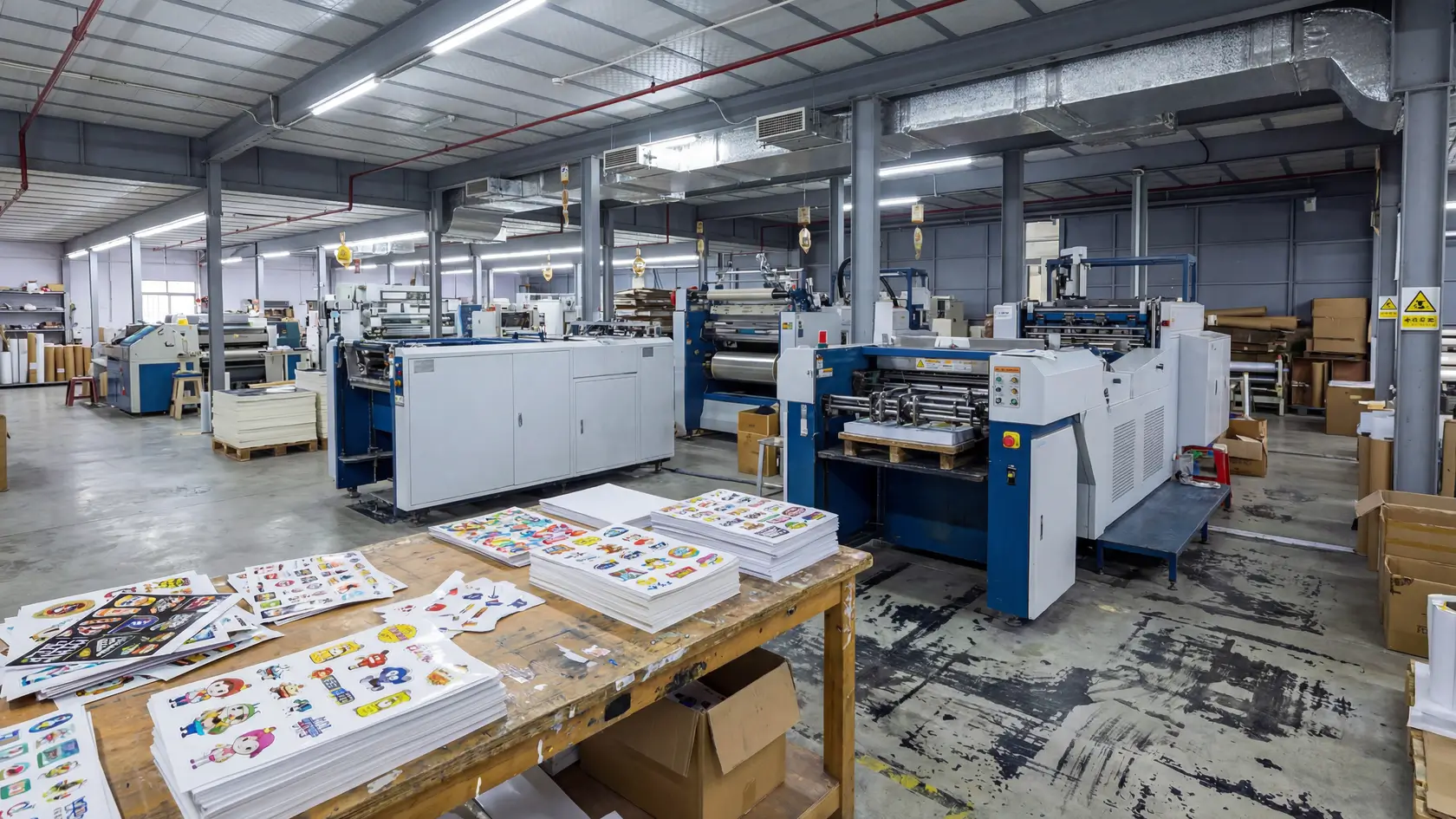
Custom sticker printing transforms digital artwork into adhesive-backed media through digital or offset printing processes. The global custom printing market reaches approximately $33.84 billion in 2025, with the sticker segment growing at a CAGR of 10.5%[1]—significantly outpacing the broader label market's 5-8% growth rate.
Custom sticker printing is the process of producing adhesive labels with customer-specified designs, materials, and finishes, typically using digital die-cutting technology that enables economical short runs without tooling fees.
Material Grades and Performance Specifications
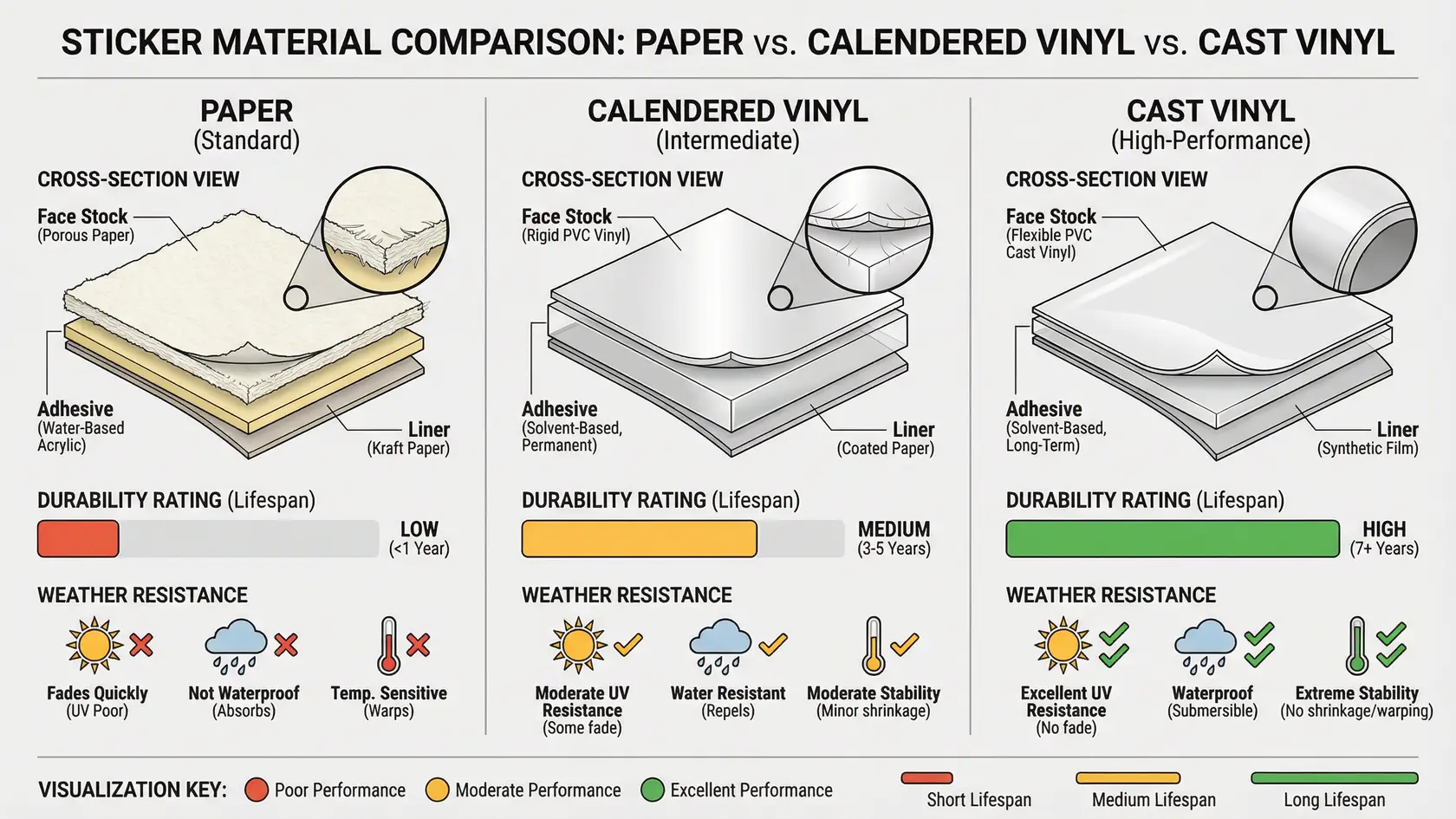
● Polymeric Vinyl: Longer molecular chains provide dimensional stability with minimal shrinkage. Outdoor lifespan reaches 5-7 years when combined with UV-resistant laminate. Ideal for vehicle graphics, outdoor signage, and water bottle applications where thermal cycling occurs. ● Monomeric Vinyl: Budget-friendly option with memory effect—material attempts to return to production-state tension after temperature fluctuations, causing edge lifting and adhesive residue. Suitable for indoor temporary applications under 2 years. ● Paper-Based: Cost-effective for indoor stationery, packaging seals, and promotional handouts. Lifespan typically 6-18 months. Not waterproof without specialized coating.
Understanding the Color Accuracy Challenge
The single largest complaint source in custom sticker printing stems from RGB-to-CMYK color conversion. Design monitors display colors using additive RGB color space (16.7 million colors), while commercial printers use subtractive CMYK color space[2] with approximately 55% of the RGB gamut reproducible.
Fluorescent greens, electric blues, and hot pinks suffer the most dramatic shifts. Professional print standards define acceptable color deviation (ΔE) at ≤2-3, but environmental factors like humidity can push actual production to ΔE 5-6—a difference visible to untrained eyes.
Die-Cut Precision and Physical Tolerance
All mechanical die-cutting introduces 1-2mm physical tolerance. When registration marks read slightly off, the result is asymmetric white borders or artwork intrusion. According to user feedback analysis, "cut not centered" represents one of the most frequent negative review triggers across platforms.
The solution lies in proper file preparation: extending artwork into bleed zones ensures edge-to-edge coverage despite minor cutting variations.
How to Prepare Print-Ready Sticker Files Step by Step?↑
Proper file preparation eliminates 60% of production issues before they occur. This section provides the exact specifications professional printers require, based on industry standards and vendor documentation.
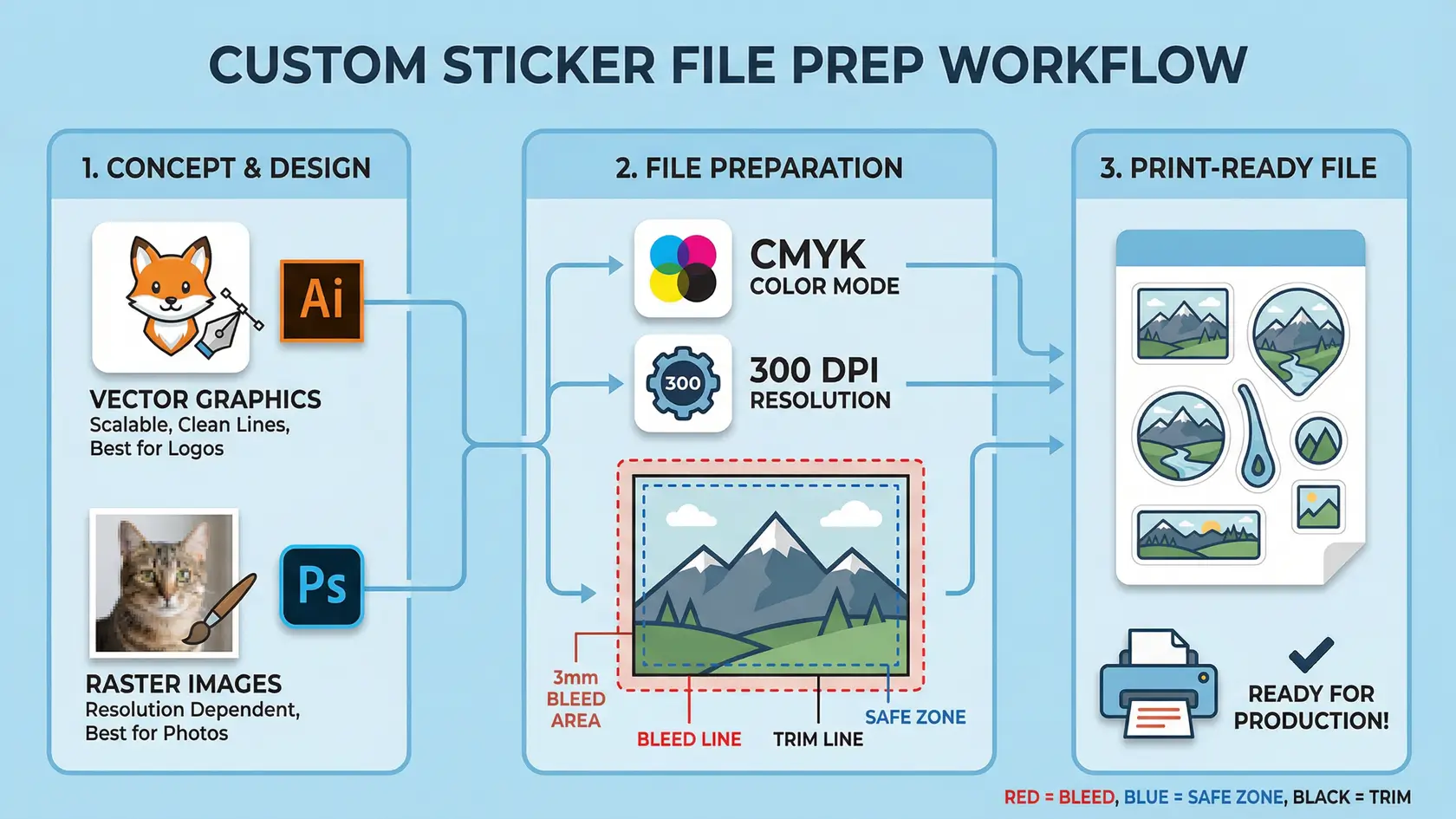
Print-ready sticker files require 300 DPI resolution in CMYK color mode, with 3mm (1/8 inch) bleed extension and 3mm safety margin for critical content, all fonts converted to outlines.
Step 1: Configure Document Settings
Input: New document in Adobe Illustrator, Photoshop, or equivalent → Action: Set dimensions to final sticker size plus 6mm total (3mm bleed per side), resolution 300 DPI, color mode CMYK → Output: Properly dimensioned canvas ready for artwork placement.
Common mistakes at this stage include starting in RGB mode (default in many applications) and working at screen resolution (72 DPI). Converting later introduces quality loss and color shifts.
Step 2: Establish Safety Zones
Input: Configured document → Action: Create guides at 3mm inside trim line for safety margin; extend background artwork 3mm beyond trim line into bleed zone → Output: Visual framework ensuring no critical content risks trimming.
The safety zone protects text, logos, and essential design elements from cutting tolerance. The bleed zone ensures artwork extends to the edge even if cutting shifts slightly.
Step 3: Convert Typography and Finalize
Input: Completed artwork with live text → Action: Select all text, convert to outlines/curves (Illustrator: Type > Create Outlines) → Output: Font-independent vector artwork printable on any system.
Unconverted fonts cause text substitution when printers lack your specific typeface. The resulting output may display entirely different letterforms.
Step 4: Export and Verify
Input: Finalized artwork → Action: Export as PDF (Press Quality), AI, or EPS; verify color mode shows CMYK in document properties → Output: Print-ready file with embedded fonts and correct color profile.
Acceptance Criteria: File opens without font warnings, displays CMYK color mode, measures correct dimensions including bleed, resolution reads 300 DPI or higher.
Proofing Checklist Before Production
Digital proofing catches errors before they become expensive reprints:
● Verify spelling accuracy—analysis shows 60% of customer complaints trace to unchecked typos ● Test QR codes with multiple scanning apps to confirm functionality ● Compare critical colors against physical Pantone swatches where possible ● Review cut line placement relative to artwork edges ● Confirm quantity and material selection match intended application
Most vendors allow 24-48 hours for proof review. Unresponded proofs may auto-approve, triggering production with any existing errors.
Which Sticker Printing Service Fits Your Business Needs?↑
The custom sticker market features specialized vendors optimized for different use cases. This comparison synthesizes review data, pricing structures, and operational characteristics to match services with buyer profiles.
Service selection depends on three primary factors: turnaround requirements, material specialization needs, and geographic location affecting shipping costs and customs complexity.
Table data reflects publicly available ratings and vendor-stated specifications as of December 2025. Actual experience may vary based on order complexity and seasonal demand.
Regional Considerations and Hidden Costs
For buyers outside the United States, shipping economics fundamentally change the value equation:
● United Kingdom: Post-Brexit regulations require VAT collection at point of sale for items under £135, or border collection with £8-£12 handling fees for items above. UK-based Zap! Creatives eliminates this complexity. ● Canada: Under CUSMA trade agreement[3], US-manufactured stickers enter duty-free but remain subject to 5-15% GST/HST. StickerYou offers domestic Canadian production. ● Australia: 3-4 week shipping from US vendors represents a critical pain point. Local provider Stickeroo delivers within 3-5 days.
The Sticker Mule Situation
Sticker Mule previously dominated the US market with streamlined ordering and fast delivery. Following controversial political statements by company leadership in 2024, significant customer migration occurred. Review platform ratings dropped substantially, and many independent artists publicly documented their switch to alternatives. Current buyers should evaluate recent reviews rather than historical reputation.
No—waterproof does not equal dishwasher-safe. High-temperature steam combined with cleaning agents accelerates edge lifting and color fading. Even premium vinyl stickers should be hand-washed only. This distinction appears repeatedly across Reddit communities (r/stickers, r/Hydroflask) as a common misconception causing product returns.
How long do vinyl stickers last outdoors?
+
Polymeric vinyl with UV laminate coating lasts 5-7 years in outdoor conditions. Monomeric vinyl typically degrades within 1-2 years, showing edge shrinkage and color fade. Geographic location matters—stickers in Arizona's UV-intense environment degrade faster than those in Seattle's overcast climate. For vehicle applications, specify automotive-grade materials tested to ASTM G154[4] weathering standards.
Why do holographic stickers peel at the edges?
+
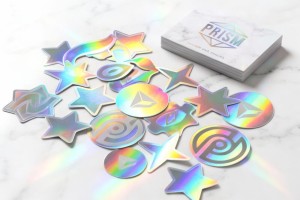
Holographic and opal films have multi-layer construction that responds differently to thermal cycling than standard vinyl. The adhesive-to-substrate bond may weaken when laminate, adhesive, and base film expand at different rates. Reddit r/cricut users specifically report opal holographic variants as more prone to edge lifting. Request samples before bulk ordering specialty materials for outdoor applications.
2. Design and Production Questions
+
Why do my sticker colors look different from the screen?
+
Screen displays use RGB color (light emission) while printers use CMYK (ink absorption). RGB gamut exceeds CMYK by approximately 45%. Neon colors, fluorescent tones, and highly saturated hues cannot physically reproduce in standard printing. Solution: design in CMYK mode from the start, use digital proofing tools, and reference physical Pantone swatches for critical brand colors.
What causes white borders on die-cut stickers?
+
White borders result from insufficient bleed in design files or cutting tolerance variation. All mechanical die-cutting has 1-2mm physical tolerance. If artwork ends exactly at the trim line, any cutting shift exposes the unprinted substrate. Extend all edge-touching artwork 3mm beyond the trim line (bleed zone) to ensure coverage despite cutting variation.
Can I print one sticker or is there a minimum order?
+
Digital printing enables economical short runs. StickerYou offers single-unit ordering with their patented die-cut technology. Most vendors set minimums based on economics rather than capability—StickerApp starts at $26, StickerGiant at $59. Print-on-demand (POD) services like Printful allow single-unit fulfillment at 40-60% higher per-unit cost but zero inventory risk.
3. Ordering and Delivery Questions
+
How long does custom sticker production take?
+
Standard production runs 3-5 business days after proof approval. Rush services deliver in 24-48 hours at 50-75% premium. Add shipping transit time based on destination. During peak seasons (Black Friday through Christmas), expect 30-50% longer turnaround due to order volume. StickerGiant offers 2-day production for time-critical B2B orders.
Will I be charged customs duties on international sticker orders?
+
Depends on destination and order value. UK orders from US vendors trigger 20% VAT plus £8-£12 carrier handling fees. Canadian buyers pay GST/HST but no duty under CUSMA. Australian orders face GST on imports. Consider regional vendors (UK: Zap! Creatives; Canada: StickerYou; Australia: Stickeroo) to avoid cross-border complexity and reduce delivery times from weeks to days.
What if my stickers arrive damaged or incorrect?
+
Contact customer service within 48 hours with photographic documentation. Most reputable vendors offer free reprints for legitimate quality issues. Keep original packaging until inspection is complete. Note that ±5% quantity tolerance is industry standard—receiving 95-105 stickers on a 100-unit order is considered acceptable. Review vendor policies before ordering; response times vary from same-day to 3-5 business days.
Market Growth: Custom sticker printing segment grows at CAGR 10.5%[1], outpacing overall label market (5-8%), driven by e-commerce branding and creator economy expansion.
User Demographics: B2B clients represent 74% of market volume; B2C individual buyers (Gen Z/Millennials prioritizing personalization) show fastest growth at 7.5% annually. According to Statista research[5], 68% of consumers prefer customized products.
Quality Standard: Professional print color deviation should measure ΔE ≤2-3 per ISO 12647-2[2]; environmental factors may increase actual production to ΔE 5-6.
Material Performance: Polymeric vinyl with UV laminate achieves 5-7 year outdoor durability; monomeric vinyl suitable for indoor use under 2 years; paper-based materials last 6-18 months without waterproofing.
Top Complaints: Amazon review analysis of 160 reviews shows size accuracy issues at 18.75%, quality inconsistency at 15.63%, and customer service problems at 9.38%. High-quality printing praised by 75% of reviewers remains the primary competitive advantage.
File Requirements: Production-ready files require 300 DPI resolution, CMYK color mode, 3mm bleed extension, and converted typography—addressing these specifications prevents 60% of production errors.
Regional Economics: UK buyers face 20% VAT + handling fees on US imports; Canadian orders duty-free under CUSMA but subject to 5-15% GST/HST; Australian shipping takes 3-4 weeks from US vendors versus 3-5 days from local suppliers.
Emerging Trends: QR code integration appears in 58% of marketing stickers; FSC-certified[6] eco-materials growing at CAGR 7.5%; AI design tools (Canva AI) report 300% monthly generation increase but face unresolved copyright questions.
Custom sticker printing success depends on three controllable factors: proper file preparation (CMYK, 300 DPI, 3mm bleed), appropriate material selection for intended environment (polymeric vinyl for outdoor, paper for indoor), and vendor matching to specific requirements (turnaround speed, specialty finishes, geographic proximity). The 75% positive quality rating in user reviews confirms that when buyers understand production constraints and suppliers deliver consistent output, custom stickers effectively serve branding, merchandising, and personal expression needs.
Start with a sample order from your shortlisted vendor to verify color accuracy and material quality before committing to production quantities. Request your custom sticker quote today and receive a digital proof within 24 hours.
[1]Custom Printing Market CAGR: Grand View Research reports the digital printing market, including custom sticker production, growing at 10.5% compound annual growth rate through 2030, driven by e-commerce packaging demand and short-run economics enabled by digital technology. ↩
[2]ISO 12647-2 Graphic Technology Standard: International standard for process control in offset lithographic and digital printing, defining color accuracy tolerances and measurement methods for commercial print production. ΔE (Delta E) values measure perceptual color difference. ↩
[3]CUSMA Trade Agreement: Canada-United States-Mexico Agreement (successor to NAFTA) provides duty-free treatment for qualifying goods manufactured in member countries. Printed materials including stickers qualify when produced in the US for Canadian import. ↩
[4]ASTM G154 UV Weathering Standard: ASTM International standard practice for operating fluorescent ultraviolet lamp apparatus for exposure of materials, used to test outdoor durability of vinyl films and printed graphics against UV degradation. ↩
[5]Consumer Personalization Preferences: Statista 2023 survey data indicating 68% of global consumers express preference for customized or personalized products, driving demand growth in custom printing services including stickers and labels. ↩
[6]FSC Forest Stewardship Council: International non-profit organization certifying sustainable forestry practices. FSC-certified paper and packaging materials verify responsible sourcing, increasingly requested by environmentally-conscious brands for marketing materials. ↩
Hi there! I'm Bruce, proud dad to my amazing son. I'm the founder of Zigpac, a printing and packaging company empowering small and medium-sized businesses with custom solutions. Let's create something great together!



 Blog PDF for offline reading





The information below is required for social login
Sign In
Create New Account