We use cookies to enable our websites to remember information, to help some website functionalities to work properly, to understand how you interact with and use our websites and to display you content and ads that are relevant and engaging for you.
By clicking Accept All you consent to the use of these cookie.
The store will not work correctly when cookies are disabled.
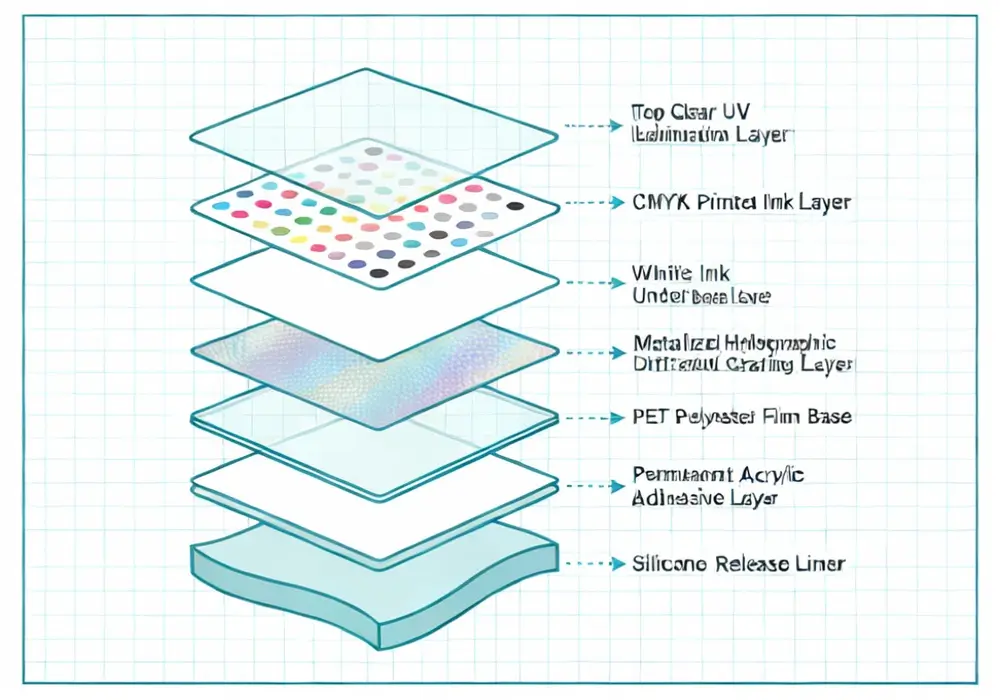
Custom holographic stickers use metallized polyester film (2 mil thickness) with diffraction gratings to create rainbow color-shift effects. Critical success factors include white ink underbase for color accuracy, minimum 300 DPI resolution in CMYK mode, and UV-protective lamination for 1-5 year outdoor durability.
User/Scenario: Artists, small business owners, brand marketers, and event planners seeking premium visual impact for merchandise, packaging, or promotional materials while navigating technical specifications and supplier selection.
You've designed the perfect artwork, envisioned how that rainbow shimmer will catch every customer's eye—then received stickers with muddy colors, peeling edges, or that dreaded "scratched" appearance. The holographic sticker market is booming toward $9.10 billion by 2033, yet 33.95% of buyer complaints center on size mismatches and color accuracy failures.
This guide decodes the white ink mystery, compares seven major suppliers with real pricing, and delivers production-ready specifications that prevent costly reprints.
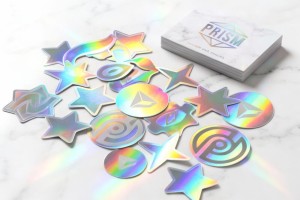
Custom holographic stickers represent the intersection of optical physics and brand aesthetics. Unlike standard vinyl decals, these products leverage light diffraction to create dynamic visual effects that shift with viewing angle—a phenomenon that drives exceptional engagement on social media platforms and retail shelves.
Custom holographic stickers are pressure-sensitive labels printed on metallized polyester or vinyl substrates featuring microscopic diffraction gratings that decompose white light into rainbow spectra, conforming to ASTM D3330[1] adhesive standards for commercial applications.
Essential Attributes and Technical Scope
● Base Material: Metallized vinyl (3-6 mil thickness, flexible for curved surfaces) or PET polyester (2-3 mil, more rigid but environmentally stable). Total thickness including release liner ranges from 6-12 mil per industry benchmarks.
● Optical Mechanism: Diffraction gratings embossed at microscopic scale (typically 1,000+ lines per millimeter) break incident light into component wavelengths, creating angle-dependent color shifts from silver-rainbow base.
● Adhesive System: Permanent acrylic pressure-sensitive adhesive with initial tack force and sustained holding power. Standard adhesives achieve peel strength of 10+ N/25mm per ASTM D3330[1] testing; Hi-Tack variants required for low surface energy substrates like powder-coated water bottles.
Holographic Texture Varieties
The market has evolved beyond single rainbow holographic effects. Current texture options include:
● Standard Rainbow: Classic linear prismatic effect with smooth color transitions
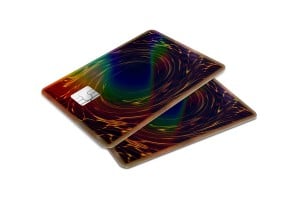
● Cracked Ice: Irregular geometric facets resembling shattered glass or diamond cuts—highly popular for trading cards and anime merchandise
● Stardust: Fine scattered sparkle pattern with cosmic aesthetic
● Prismatic: Bold geometric rainbow patterns with defined angular shifts
● Glitter: Visible metallic flake distribution for textured sparkle effect
Market Context and Growth Trajectory
The global holographic sticker market reached approximately $7.43-7.99 billion in 2025, with projections toward $9.10 billion by 2033-2034 at a compound annual growth rate (CAGR)[2] of 5.73-8.56%. Key growth drivers include the creator economy expansion, e-commerce packaging differentiation needs, and social media's appetite for visually dynamic content. The upstream holographic films market shows even stronger momentum at 9.88% CAGR, indicating robust supply chain investment.
How Do I Design and Order Holographic Stickers Without Color Disasters?↑
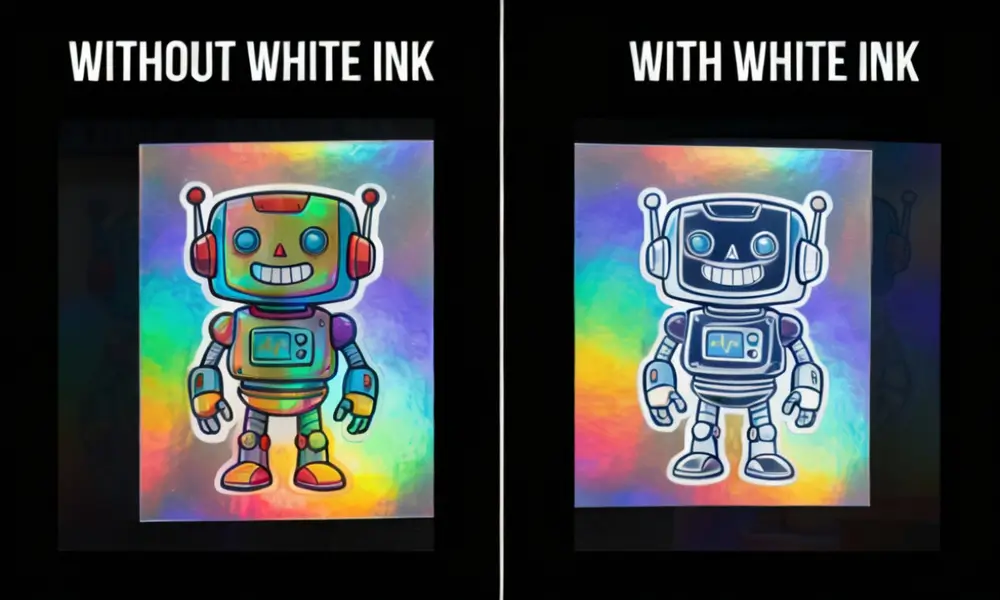
The single largest source of holographic sticker disappointment stems from misunderstanding the white ink underbase requirement. Standard CMYK inks are translucent—when printed directly on reflective metallic substrates, colors shift dramatically. Yellow becomes gold-green, skin tones turn grayish with metallic interference, and overall saturation drops 15-20%.
Successful holographic sticker production requires a dedicated white ink layer beneath CMYK colors to block substrate reflectivity, with files prepared in CMYK color mode[3] at minimum 300 DPI resolution using vector formats (AI, EPS, PDF) for optimal edge definition.
Phase 1: File Preparation and White Ink Layer Setup
1) Input: Original artwork in RGB → Action: Convert to CMYK using appropriate ICC profile; increase color saturation 20-30% to compensate for metallic substrate absorption → Output: Print-ready CMYK file with adjusted color values
2) Input: Converted artwork → Action: Create separate spot color layer named "White" in Adobe Illustrator; define regions requiring opacity control → Output: Multi-layer file with distinct white ink mapping
3) White Ink Transparency Gradient Application:
● 0% White (Transparent Zone): Maximum rainbow holographic effect shows through—ideal for background sparkle areas
● 30-50% Halftone White: Creates pearlescent shimmer effect—advanced technique for gradient transitions
● 100% White (Solid Zone): Complete substrate blockage for true color reproduction—required for text, barcodes, QR codes, and skin tones in character illustrations
Phase 2: Printing Technology Selection
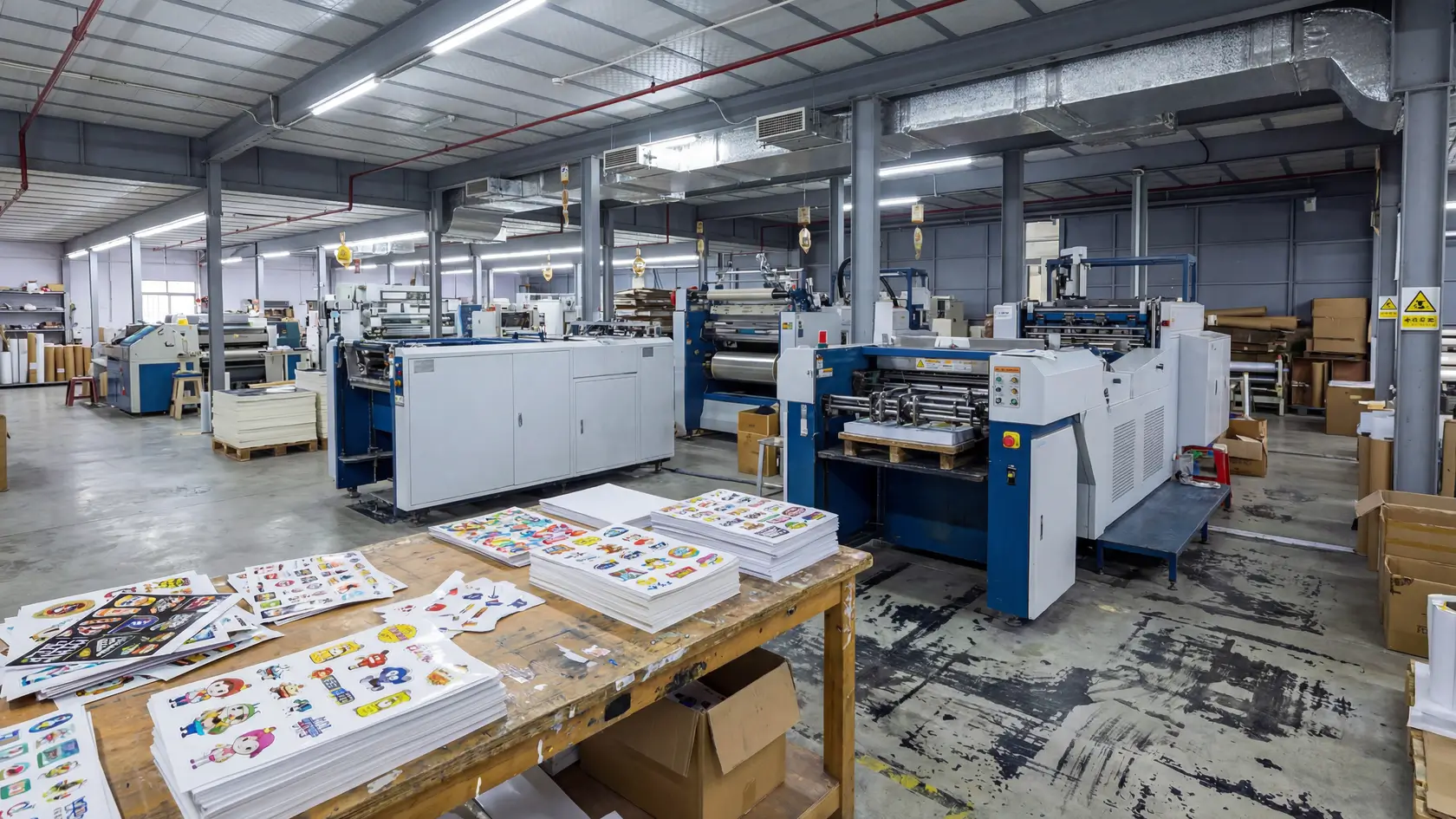
Industrial holographic sticker production relies on two primary digital printing technologies:
● HP Indigo ElectroInk: Liquid electrophotographic process producing exceptionally sharp images on non-absorbent metallic surfaces. Industry standard for high-volume commercial production with precise color matching.
● Roland UV Inkjet: Ultraviolet-cured inks that polymerize instantly upon exposure, critical for non-porous holographic substrates where solvent-based inks cannot properly dry. Offers flexibility for smaller runs and specialty applications.
Phase 3: Lamination and Cutting Specifications
Post-printing protective lamination is non-negotiable for holographic stickers. The laminate layer serves dual functions: scratch resistance and UV absorption to prevent metallic layer oxidation.
● Gloss Laminate (1.6 mil): Maximizes holographic brilliance and color contrast but shows fingerprints readily
● Matte Laminate (1.4 mil): Softens effect to anodized metal aesthetic, superior fingerprint resistance
Cutting Methods:
● Die-Cut: Blade penetrates through face material and release liner, producing individual contour-shaped stickers ideal for event distribution
● Kiss-Cut: Blade cuts face material only, leaving liner intact as rectangular backing—enables brand messaging on liner and easier peeling
Standard Production Timeline
● Proof Approval: 1-2 business days
● Production: 2-5 business days
● Shipping: 1-5 days (domestic US)
Rush services can compress timelines to 1-2 days post-approval at premium pricing. Total turnaround for standard orders typically falls within 7-12 business days.
Which Holographic Sticker Supplier Fits My Budget and Timeline?↑
The 2024-2025 holographic sticker market has undergone significant brand reshuffling. Sticker Mule's political controversy triggered measurable customer migration, while Chinese suppliers like Vograce continue expanding market share through aggressive pricing. Understanding each supplier's strengths, limitations, and actual user experiences enables informed procurement decisions.
Supplier selection should balance five factors: price per unit (ranging $0.50-$1.60 for 50-piece orders), texture variety, white ink customization capability, production location (affecting shipping time and quality consistency), and current brand reputation based on 2024-2025 community feedback.
Price analysis reveals significant variance across the competitive landscape. Budget suppliers (Vograce, The Sticky Brand, CustomStickers.com) cluster around $0.50-0.80 per unit for 50-piece orders, while premium suppliers (Sticker Mule, StickerGiant) command $1.30-1.54 per unit—a 2-3x price differential that reflects production location, quality consistency, and service levels.
Critical Supplier Evaluation Notes
StickerApp (Recommended for Artists): Swedish-origin company with strongest online editor allowing real-time holographic/matte zone designation. Texture library exceeds competitors significantly. Reddit community sentiment extremely positive following Sticker Mule exodus. Primary limitation is shipping time (1-2 weeks vs. domestic competitors).
Sticker Mule (Brand Risk Alert): Historically the industry standard for speed and ease-of-use. However, 2024 political statements by co-founder triggered substantial customer boycott, particularly among artist communities. Reddit r/stickers shows active migration discussions. Product quality remains high; brand alignment now factors into purchasing decisions for many creative professionals.
Vograce (Budget Champion with Caveats): China-based manufacturer offering lowest per-unit pricing and extensive product range beyond stickers (acrylic charms, badges). Trade-off involves 3-4 week shipping times with limited tracking visibility, and color accuracy consistency below Western suppliers. Essential for anime convention vendors managing tight margins.
StickerGiant (B2B Premium): Colorado-based operation specializing in enterprise accounts with exceptional customer service responsiveness. Unique back-slit release liner for easy peeling. Premium pricing justified for time-sensitive corporate projects requiring domestic production and quality guarantees.
DieCutStickers.com (Specialist Approach): Seattle manufacturer with explicit no-white-ink default policy—intentionally allows dark inks to interact with holographic substrate for vintage metallic effect. Excellent outdoor durability focus. Requires design adaptation; not suitable for color-accurate illustration reproduction.
Vistaprint (Not Recommended): Despite brand recognition, community feedback indicates persistent quality control issues including color errors, misalignment, and extended delivery delays (3-4 weeks vs. promised 1-2 weeks). Multiple 2024-2025 Reddit threads document refund difficulties. Avoid for important orders.
High-quality UV-laminated holographic stickers maintain appearance for 1-5 years under outdoor exposure conditions, depending on laminate thickness and UV absorber concentration. Per ISO 4892[4] accelerated weathering testing standards, xenon arc lamps simulate full-spectrum solar exposure to validate durability claims. Without UV-protective lamination, holographic metallic layers oxidize within 3-6 months, losing iridescent effect. Variables affecting longevity include vertical vs. horizontal mounting, direct sun vs. shade, and geographic latitude (UV intensity).
Are holographic stickers dishwasher safe?
+
Most premium suppliers (StickerApp, StickerGiant) label products as "dishwasher safe" for occasional cleaning cycles. However, repeated exposure to high temperatures (140-160°F) and alkaline detergents accelerates adhesive edge degradation and laminate hazing. For maximum longevity on water bottles and drinkware, hand washing is recommended. The primary failure mode involves detergent penetration at cut edges rather than surface degradation.
Why won't my stickers stick to my Hydro Flask or Yeti tumbler?
+
Powder-coated surfaces present two adhesion challenges: microscopic texture reducing contact area, and low surface energy (LSE) properties similar to non-stick cookware that repel standard pressure-sensitive adhesives. Solutions include requesting Hi-Tack adhesive upgrade from suppliers, thoroughly cleaning surfaces with isopropyl alcohol before application, and using a heat gun to soften adhesive for improved flow into surface texture.
2. Design and Color Issues
+
Why do my holographic stickers look darker than expected?
+
This universal complaint stems from absent or insufficient white ink underbase. CMYK inks are translucent by design—when printed directly on reflective metallic substrates, the gray-silver base shows through and darkens perceived color by 15-20%. Remedy requires creating a dedicated white spot color layer beneath colored elements in your design file. Additionally, increase color saturation 20-30% during file preparation to compensate for substrate light absorption.
What is cracked ice holographic and when should I use it?
+
Cracked ice holographic features irregular geometric facets creating a shattered glass or diamond-cut light reflection pattern, contrasting with smooth rainbow gradients of standard holographic. Extremely popular for trading card accessories, anime merchandise, and fantasy-themed designs where the fractured light effect complements magical or cosmic visual themes. StickerApp offers the broadest cracked ice product selection among major suppliers.
How do I make text readable on holographic backgrounds?
+
Holographic rainbow interference significantly reduces text contrast and legibility. Essential countermeasures: use bold typefaces (avoid thin/light weights), apply black or white stroke/outline to text (minimum 2pt), ensure 100% white ink underbase beneath all text elements, and avoid yellow or pastel colors which become nearly invisible against holographic shimmer. High-contrast color combinations (black text on white underbase, white text with black outline) perform best.
3. Production and Ordering
+
Can I make holographic stickers at home with a Cricut?
+
Yes, using inkjet-printable holographic vinyl sheets designed for home use. Critical considerations: home inkjet inks are not waterproof and require cold laminate overlay for protection; cutting machine optical sensors frequently fail on highly reflective holographic material due to registration mark reading errors—workarounds include operating in darkened rooms or covering registration marks with matte tape. When DIY failure rates and material waste costs exceed reasonable thresholds, transitioning to professional small-batch services (10-50 pieces from StickerApp or The Sticky Brand) often proves more economical.
What's the difference between die-cut and kiss-cut holographic stickers?
+
Die-cut stickers have cutting blades penetrate through both face material and release liner, producing individual contour-shaped pieces ideal for event giveaways and loose distribution. Kiss-cut stickers cut only through face material, leaving the backing liner intact as a rectangular carrier—this preserves space for brand URLs or messaging on liner margins and makes peeling easier. Kiss-cut is preferred for retail packaging and professional presentation; die-cut for high-volume promotional distribution.
Market Trajectory: Global holographic sticker market reaches $7.43-7.99B (2025) expanding toward $9.10B by 2033-2034 at 5.73-8.56% CAGR, driven by creator economy growth and e-commerce packaging differentiation per industry analysis[2].
White Ink Imperative: CMYK ink translucency causes 15-20% color darkening on metallic substrates—white underbase layer is non-negotiable for accurate color reproduction in character illustrations, logos, and text elements.
Material Standards: Premium holographic stickers require minimum 300 DPI resolution, CMYK color mode per ICC standards[3], 2 mil metallized polyester base, and UV-protective lamination achieving 10+ N/25mm peel strength per ASTM D3330[1].
Supplier Price Spread: 50-piece 3"×3" orders range from $25 (Vograce, China-shipped) to $77 (StickerGiant, US B2B premium)—a 3x variance reflecting production location, texture options, and service tiers. StickerApp at ~$40 offers optimal artist value with industry-leading texture variety.
Durability Reality: UV-laminated holographic stickers maintain outdoor appearance 1-5 years per ISO 4892[4] accelerated weathering methodology; powder-coated surfaces require Hi-Tack adhesive specification; hand washing extends drinkware application lifespan versus dishwasher exposure.
Emerging Trends: Biodegradable holographic materials achieving EN 13432[5] compostability certification enter commercial availability; AR-integrated holographic labels and NFC/blockchain authentication expanding in luxury goods and pharmaceutical sectors.
Custom holographic stickers deliver unmatched visual impact when specifications align with application requirements. The critical success formula combines proper white ink layer configuration for color accuracy, UV-laminated materials meeting ASTM D3330[1] adhesive standards for durability, and supplier selection balancing price, texture options, and production timeline against your specific use case—whether artist merchandise, brand packaging, or event marketing materials.
Ready to create holographic stickers that match your vision? Contact our print specialists for a custom quote with white ink consultation, or browse our holographic material sample kit to evaluate texture options before committing to production quantities.
[1]ASTM D3330/D3330M Standard Test Method for Peel Adhesion of Pressure-Sensitive Tape: Published by ASTM International, this standard defines testing methodology for measuring peel adhesion strength of pressure-sensitive tapes and labels. High-quality outdoor holographic stickers should achieve minimum 10 N/25mm peel strength under standardized conditions. Current version D3330M-24 (2024).
↩
[2]Holographic Films Market Size and Growth Analysis: Fortune Business Insights and allied market research firms project the holographic films market from $13.05 billion (2025) toward $25.23 billion (2032) at 9.88% CAGR. Custom holographic sticker segment represents approximately 8-12% of total holographic films consumption, with personalized sticker market specifically valued at $4.84 billion (2025).
↩
[3]ICC Color Management Standards: The International Color Consortium maintains device-independent color profile specifications ensuring consistent color reproduction across input, display, and output devices. CMYK (Cyan, Magenta, Yellow, Key/Black) subtractive color model is mandatory for print production; RGB files must be converted using appropriate ICC profiles before printing on holographic substrates.
↩
[4]ISO 4892 Plastics Exposure to Laboratory Light Sources: International standard specifying methods for exposing plastics to laboratory light sources (xenon arc, fluorescent UV) to simulate weathering effects. Part 2 (ISO 4892-2) covers xenon-arc lamps providing full-spectrum solar simulation for validating outdoor durability claims of holographic materials and UV-protective laminates.
↩
[5]EN 13432 Packaging Compostability Standard: European standard establishing requirements for packaging recoverable through composting and biodegradation. Certified materials must achieve 90% disintegration within 12 weeks and complete biodegradation within 6 months under industrial composting conditions. Emerging cellulose-based holographic films from manufacturers like 3D AG now achieve this certification.
↩
Hi there! I'm Bruce, proud dad to my amazing son. I'm the founder of Zigpac, a printing and packaging company empowering small and medium-sized businesses with custom solutions. Let's create something great together!



 Blog PDF for offline reading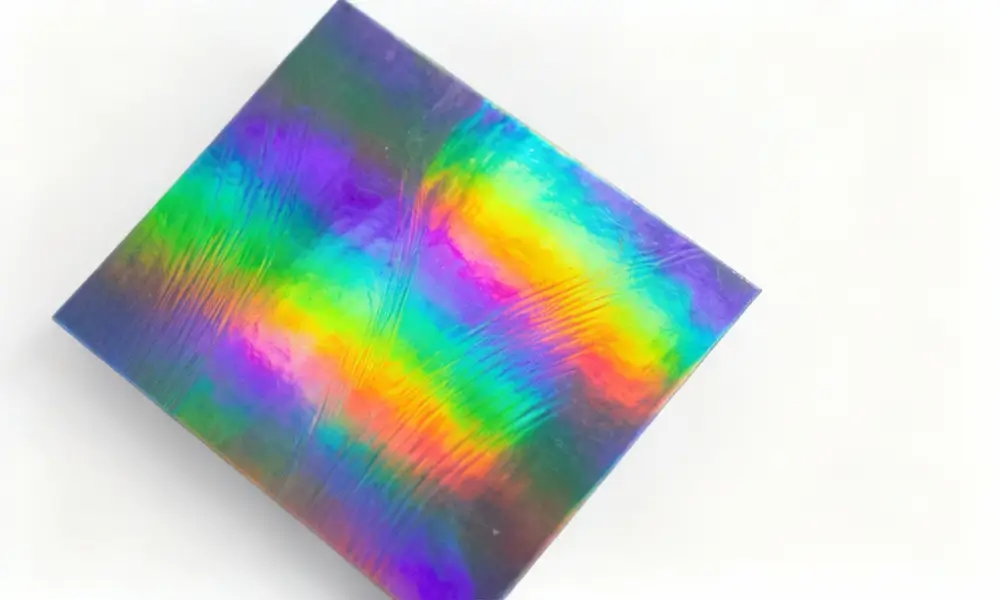





The information below is required for social login
Sign In
Create New Account