
 Blog PDF for offline reading
Quick answer: At Zigpac, the best keychain material for branded merchandise depends on budget and audience: printed acrylic is the lowest-cost, no-mold route for full-color artwork and short runs, with price tiers from 50 pcs, final MOQ on your quote, and a standard 7–10 days. Die-cast metal gives the highest perceived value for client gifts, staff recognition and retail collections, but it needs a mold and costs the most per piece. Molded soft PVC sits between them on price, suits bold solid-color logos and mascots for everyday carry, and also needs a mold. Metal and PVC both have price tiers from 100 pcs, final MOQ on your quote, and a standard 10–15 days.
Why the wrong keychain material costs more than its unit price
Most branded keychain orders start with a logo file and a quantity. Almost none start with the question that decides the result: what job must this keychain do? A trade-show team, an HR manager planning anniversary gifts and a museum shop buyer can all ask for "custom keychains" and need three different products.
The stakes are real. North American promotional products distributors grew sales 4.2% in 2025 to a record US$27.7 billion, according to the Advertising Specialty Institute[1]. A global study commissioned by PPAI with Oxford Economics[2] put 2025 global spending on promotional products at US$108.6 billion. Budgets that size get audited, and a keychain that feels cheap to a VIP client, or one that sits in a drawer because the artwork turned to mush, is money spent with no return.
The pain usually shows up late. The quote looked low until a mold charge appeared. A photo-based design came back as flat color blocks. A metal keepsake was too heavy for the lanyard it was meant for. Each of these traces back to choosing a material before matching it to artwork, audience and quantity. The fix is to compare acrylic, metal and PVC on one basis, which is what the rest of this guide does.
What the material choice actually decides
"Material" is shorthand for three different production methods, and the method matters more than the substance:
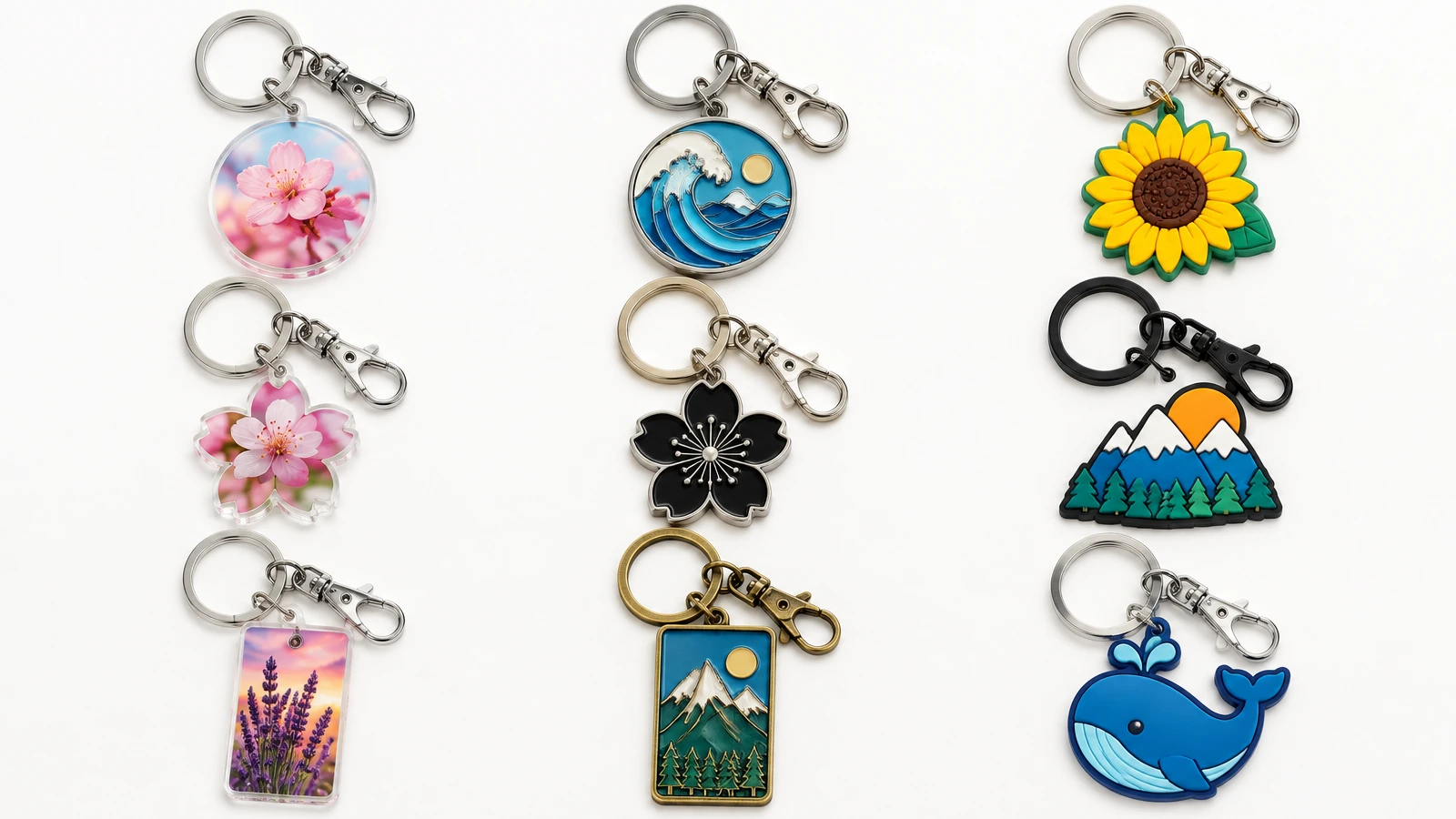
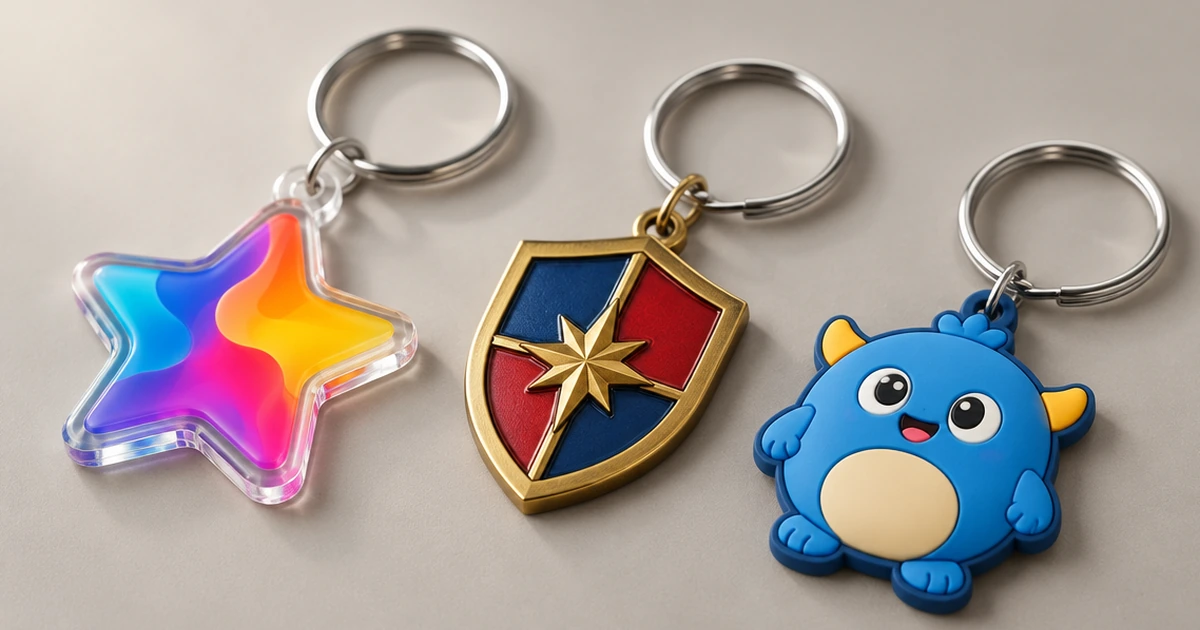
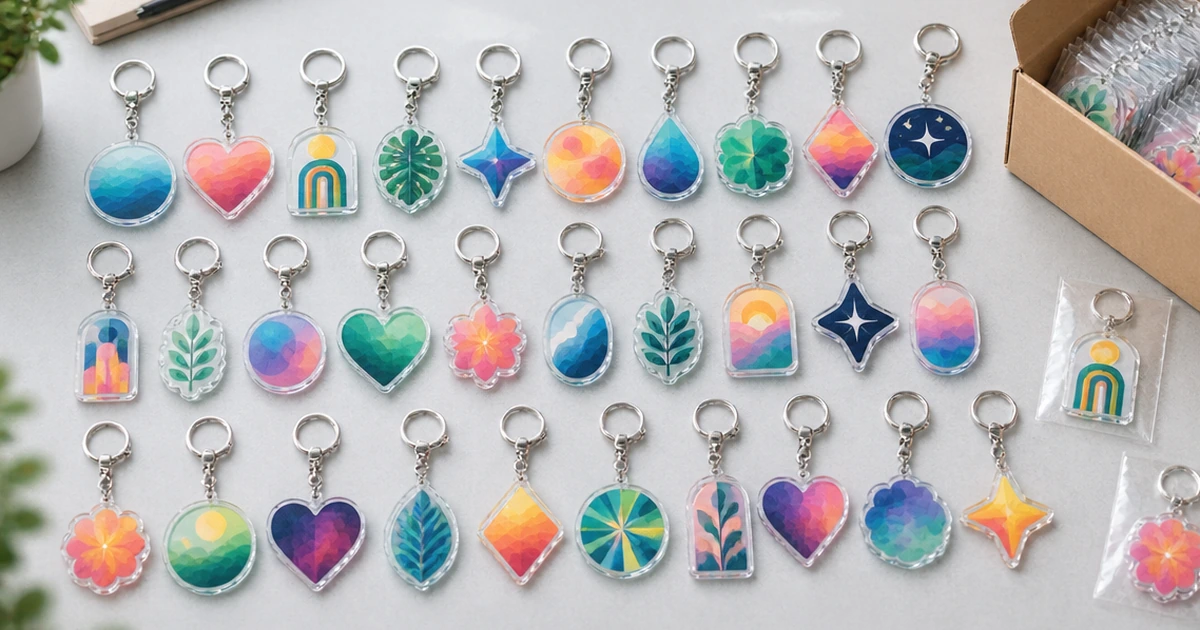
- Printed acrylic: artwork is printed on clear acrylic and cut to your outline. Nothing is molded, so the printer reproduces whatever is in the file, including photos and gradients.
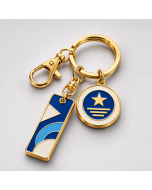
- Die-cast metal: metal is cast in a mold engraved with your design, then plated and filled with color. The design becomes physical relief. Stamped metal is the flatter metal route, struck from metal rather than cast, and suits simpler shapes.
- Molded soft PVC: liquid soft PVC fills a mold color by color. Color is part of the material, so designs are built from solid areas separated by raised outlines. A sculpted 3D PVC version exists for mascots that need volume.
Two consequences follow. First, metal and PVC need a mold before production, while acrylic does not. Second, each method suits a different kind of artwork, so the logo you already have often narrows the choice before price does.
How to choose the best keychain material for branded merchandise in five steps
Step 1: Decide whether the keychain will be displayed, gifted, collected or carried daily
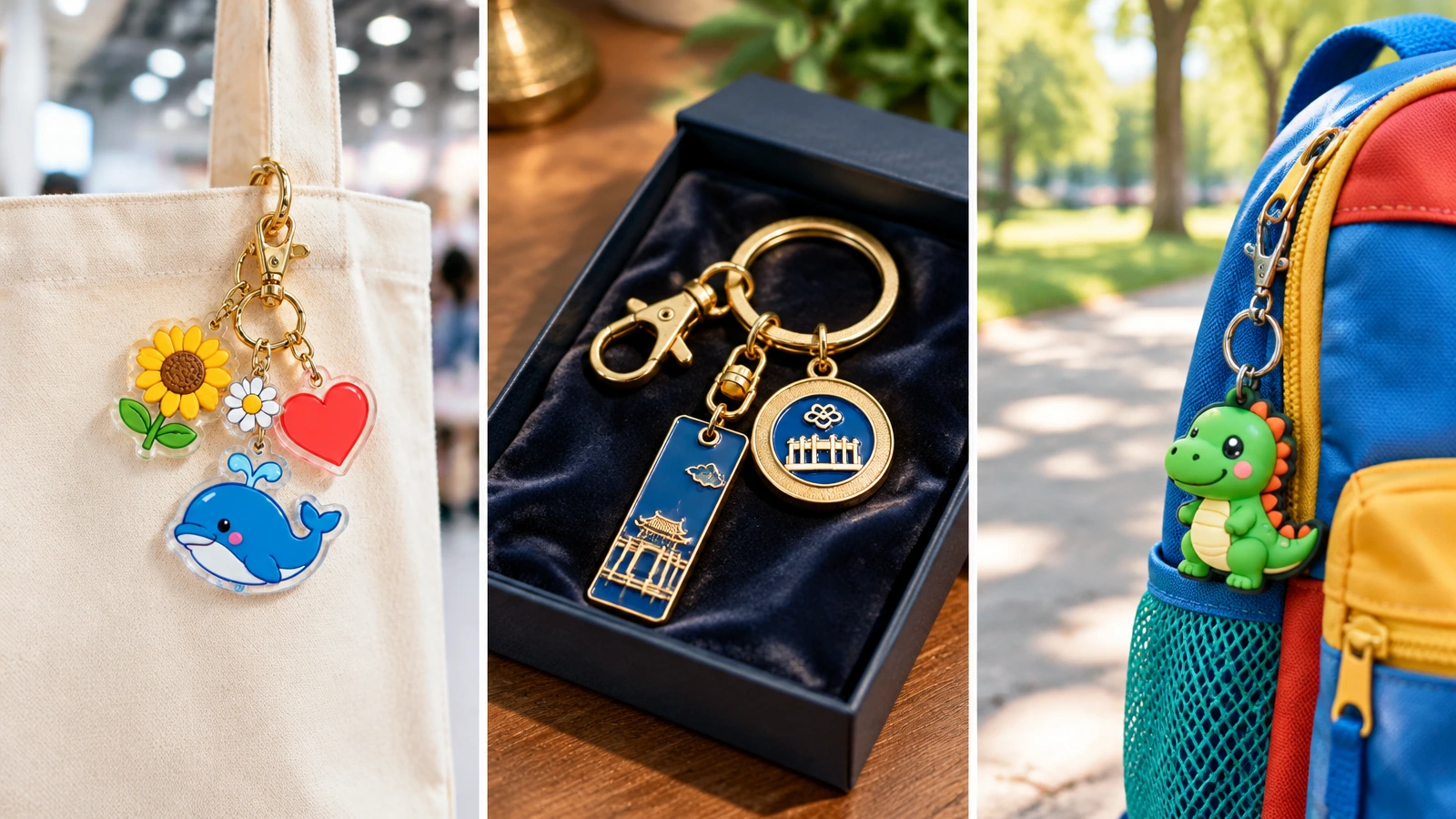
Perceived value follows use. Metal weight, plating and enamel color read as a keepsake, which is why die-cast suits clients, employees, anniversaries and souvenir retail. Acrylic carries photos, characters and gradients, which makes it the natural format for events, creators and fan merch. Soft PVC carries bold mascots and logos and flexes in a pocket, which fits family, school, outdoor and high-volume giveaway programs. Audience age matters too: PPAI's consumer research on Gen Z[3] is a useful reference if your recipients are younger.
Let that use set thickness and weight. A display piece can be heavier than something clipped to a badge reel. A digital proof cannot show weight, feel or surface, so approve those on a physical sample.
Step 2: Match your artwork to the process
Your artwork is the fastest filter:
- Photos, gradients, full-color illustrations: acrylic. It can be single- or double-sided, with transparent or white-ink areas. Proof the front and back separately, because "same on the back" can mirror text. Tiny text and thin lines blur at small sizes, and an off-centre hole makes the piece hang at a tilt.
- Relief, raised metal lines, enamel color: die-cast metal. Soft enamel gives recessed color between raised metal lines; hard enamel gives a smoother surface. Bright, matte and antique finishes are visual directions, and a gold-colored finish is not a gold body.
- Solid color areas with raised outlines: soft PVC. Gradients are converted to solid color areas, and a molded front does not automatically include a decorated back, so specify the reverse.
Step 3: Check whether a mold is involved
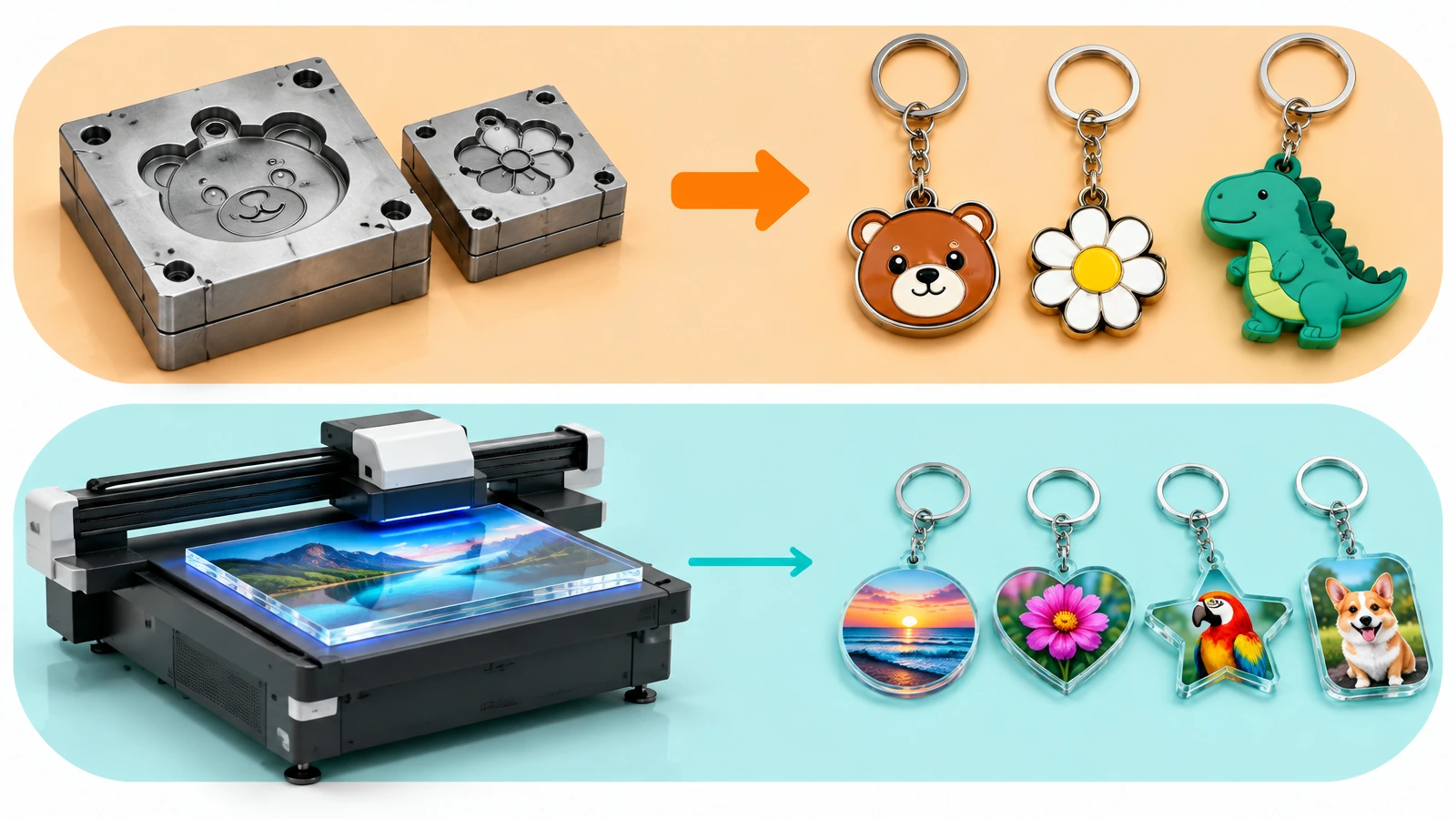
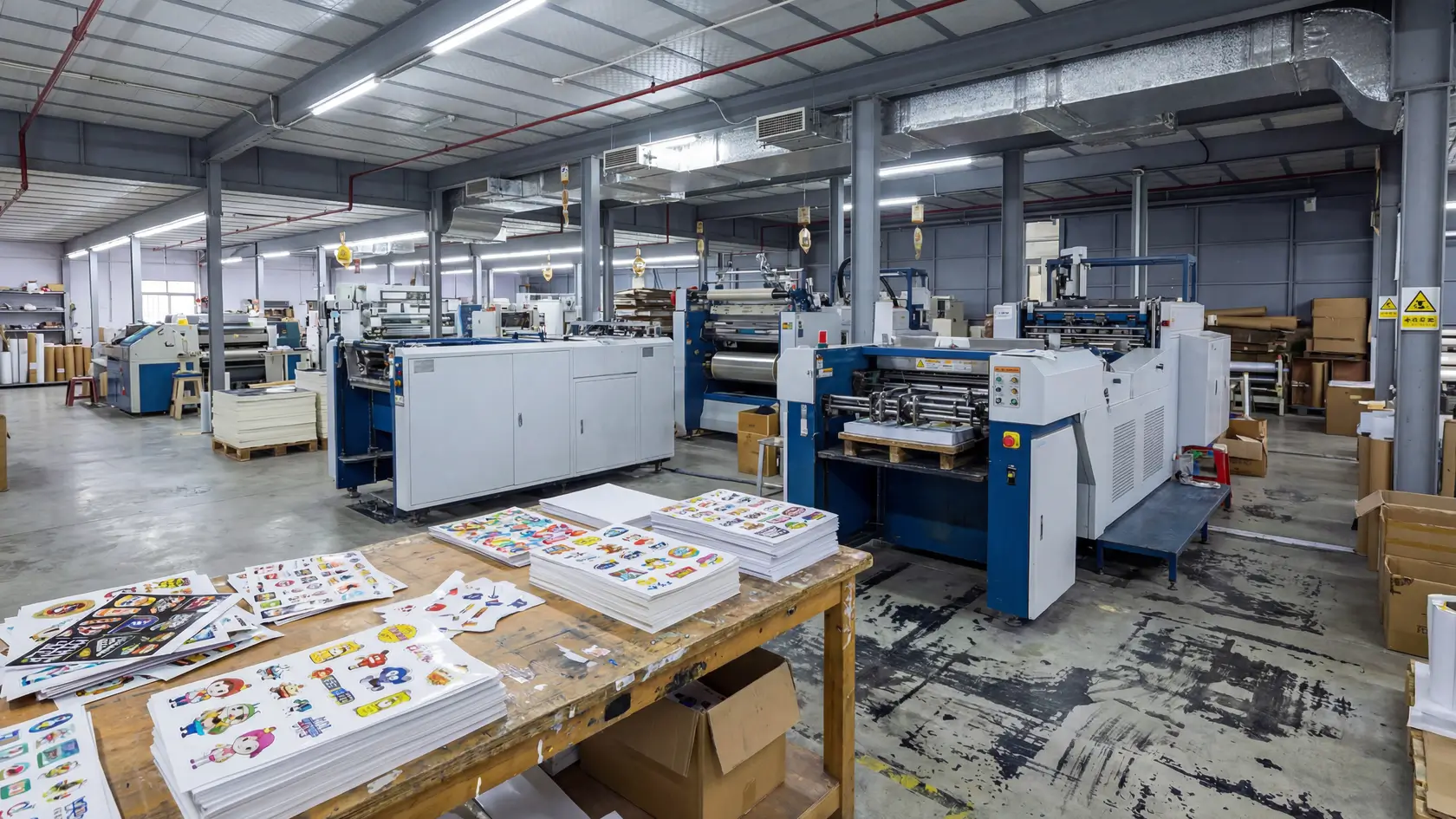
Zigpac's factory footage shows the difference clearly. For die-cast, a CNC machine engraves the steel mold before metal blanks are cast, plated and filled with color. For PVC, soft PVC is dispensed into each mold, heated in an oven, and the mold is opened by hand. For acrylic, the video shows flatbed printing, a roller station and cut shapes on the machine bed, with no mold step at all.
For metal and PVC, the quote therefore carries a one-time development and tooling line separate from the per-piece price. Each additional design may need its own mold, and revisions can change the tooling charge. Write mold ownership, storage and reuse into the quote. For reorders, confirm the mold is still available; unchanged artwork does not by itself mean tooling reuse is free. With acrylic, changing designs or splitting a run across several designs adds no mold work. The cost drivers behind mold charges are covered in our separate post, "How Much Does a Keychain Mold Cost?"
Step 4: Run the cost at your real quantity
The example below uses Zigpac's listed price tiers as of November 2026. It is per-piece price multiplied by quantity, and it excludes tooling, hardware upgrades, packaging and freight. Size, thickness, colors, finish, reverse artwork, attachment and packaging all change the price, and the final price is on your quote.
| Construction | 100 pcs: per piece | 100 pcs: order total | 1,000 pcs: per piece | 1,000 pcs: order total |
|---|---|---|---|---|
| Printed acrylic | US$0.50 | about US$50 | US$0.29 | about US$290 |
| Molded 2D soft PVC | US$0.62 | about US$62 | US$0.30 | about US$300 |
| Sculpted 3D soft PVC | US$0.65 | about US$65 | US$0.33 | about US$330 |
| Stamped metal | US$0.72 | about US$72 | US$0.33 | about US$330 |
| Die-cast metal | US$0.95 | about US$95 | US$0.50 | about US$500 |
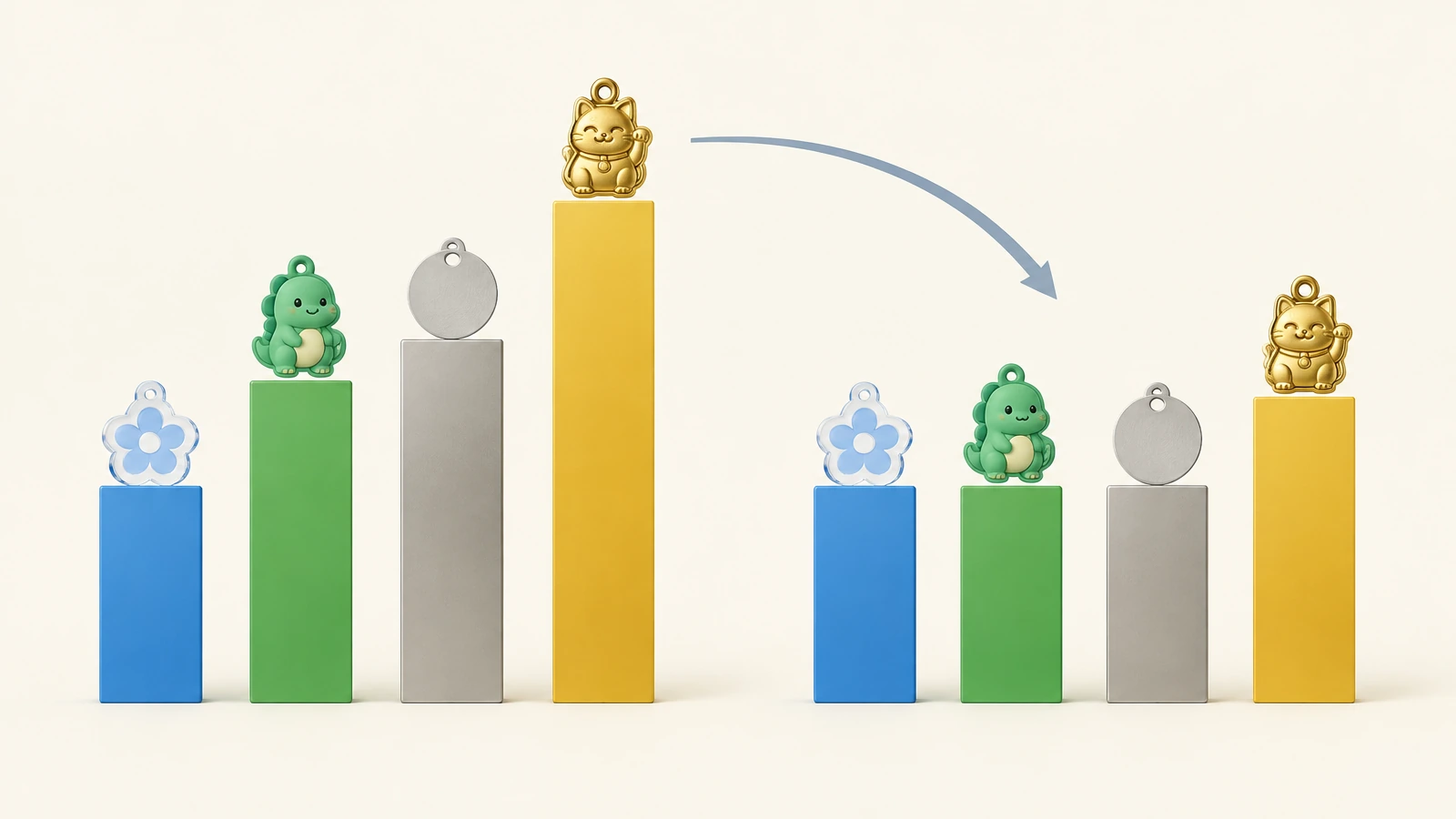
At Zigpac, the mold charge for die-cast, stamped metal and PVC appears as a separate line on the quote, so the table understates their true cost at low volume. That charge is spread across the run. On a 100-piece order it adds the most per keychain; at 1,000 pieces and above it adds the least. Note also how close acrylic (US$0.29) and 2D PVC (US$0.30) get at 1,000 pieces. Once volume is high, the decision between them depends on artwork and feel, plus the PVC mold line, rather than on unit price. A lower unit price is not comparable if it excludes tooling, so compare complete landed cost, including sampling, setup, hardware, packaging, freight and duties.
Step 5: Ask durability and safety questions instead of trusting adjectives
No scratch, fade, drop, salt-spray, plating-thickness or service-life result is verified for any of the three constructions here, and a smooth or textured look is not evidence of scratch resistance. Turn your concerns into a test method and acceptance criteria agreed on a sample. For acrylic, ask about scratching and printed-surface wear. For PVC, ask about how the surface and colors hold up in pockets and outdoors. For plated metal, a neutral salt spray method such as ISO 9227[4] gives both sides a shared reference. For any metal, ask for alloy confirmation, because impurities matter; zinc pest[5] is a documented corrosion failure linked to lead impurities in zinc alloys. Zinc alloy is common in this category, and Zigpac confirms the actual alloy on the quote.
Material safety needs documents for your destination market. On April 18, 2008, the U.S. Consumer Product Safety Commission[6] announced a recall of about 12,000 charm keychains because the charms could contain high lead levels. A year earlier, CPSC announced a recall of metal key chains for a lead poisoning hazard[7]. PVC is not exempt: California's Attorney General lists a Prop 65 60-day notice concerning vinyl keychains[8], and REACH guidance addresses lead in PVC in the EU. State rules keep changing; Axios reported in 2025[9] that a Minnesota law restricts selling keys and other items containing certain levels of lead and cadmium. Standards have scopes too: jewelry specifications such as ASTM F2999[10] define which items they cover. Ask which rules apply to your actual construction, recipients and market. CPSIA, Prop 65, REACH and nickel-release requirements are not blanket claims for any keychain type.
Acrylic vs metal vs PVC keychains: side-by-side comparison
At Zigpac, all three constructions get a free eProof with every order, and physical samples ship for US$5–30. Prices below are Zigpac's listed tiers from November 2026; the final price is on your quote.
| Factor | Printed acrylic | Die-cast metal (stamped as the flatter route) | Molded soft PVC |
|---|---|---|---|
| How it is made | Printed on clear acrylic, cut to your outline | Metal cast in an engraved steel mold, plated, color filled | Soft PVC dispensed into a mold, oven-heated |
| Tooling | No mold step | Mold required; charge itemized on the quote | Mold required; charge itemized on the quote |
| Best artwork | Photos, gradients, full color, characters | Relief, raised metal lines with enamel color | Solid color areas with raised outlines |
| Look and feel | Light, glossy, transparent or white-ink areas | Weighty, plated finish (bright, matte, antique) | Soft, flexible, matte or textured |
| Perceived value | Fun, collectible, campaign-friendly | Highest: keepsake and gift | Friendly, casual, everyday |
| Durability questions to test | Scratching, printed-surface wear | Plating wear, corrosion, attachment strength | Surface wear, color hold outdoors |
| 100 pcs: per piece / total | US$0.50 / about US$50 | Die-cast US$0.95 / about US$95; stamped US$0.72 / about US$72 | 2D US$0.62 / about US$62 |
| 1,000 pcs: per piece / total | US$0.29 / about US$290 | Die-cast US$0.50 / about US$500; stamped US$0.33 / about US$330 | 2D US$0.30 / about US$300 |
| Starting tier | Price tiers from 50 pcs, final MOQ on your quote | Price tiers from 100 pcs, final MOQ on your quote | Price tiers from 100 pcs, final MOQ on your quote |
| Standard production | Standard 7–10 days, final schedule on your quote | Standard 10–15 days, final schedule on your quote | Standard 10–15 days, final schedule on your quote |
| Best audiences | Events, creators, fan merch, multi-design drops | Clients, employees, anniversaries, retail and souvenirs | Families, schools, outdoor programs, mass giveaways |
Zigpac's product lines map directly to these columns: Custom Printed Acrylic Keychains, Custom Rubber Keychains in 2D Molded Soft PVC, Custom 3D Rubber Keychains for sculpted mascots, and Custom Stamped Metal Keychains for flatter metal designs. If metal wins your comparison, our custom die cast keychains for branded gifts and retail collections page covers construction, finishes, sampling and inspection in detail.
Decision guide by audience and budget
- Trade-show and conference giveaways: choose by artwork. Full-color campaign graphics point to acrylic; a bold solid-color logo at 1,000+ pieces makes 2D soft PVC competitive, since its unit price is close to acrylic's and the mold charge is spread thin.
- Event and fan merch: acrylic. Characters, photos and gradients print as drawn, and the standard 7–10 days suits event deadlines.
- Employee recognition and client gifts: die-cast metal. The higher unit cost buys weight and finish that read as a keepsake; stamped metal is the flatter, lower-cost metal option.
- Retail and souvenir collections: die-cast for landmark relief and enamel color; acrylic when the design is photographic or the collection has many designs.
- Kids, family and outdoor programs: soft PVC for flexibility and bold mascots, with material documents requested for the destination market before you approve.
- Multi-design or short-run drops: acrylic. Splitting a run across designs adds no mold work, and tiers start at 50 pcs.
Quote checklist. Send the same brief for every material you want compared: artwork, quantity per design, finished size, front and reverse, finish or color treatment, attachment, packaging, destination and arrival date. With identical inputs, the quotes become comparable line by line, including tooling.
FAQ
FAQ: What is the best keychain material for a trade-show giveaway?
Printed acrylic is usually best for full-color designs, and 2D soft PVC is a strong option for solid-color logos at higher volume. At 1,000 pieces, listed prices are US$0.29 for acrylic and US$0.30 for 2D PVC (November 2026, final price on your quote), so the deciding factors are the artwork and PVC's separate mold charge.
FAQ: Which keychain material is cheapest per unit?
Printed acrylic has the lowest listed price at both 100 and 1,000 pieces: US$0.50 and US$0.29 respectively. It also has no mold line, which widens its cost advantage on small orders, since metal and PVC add a tooling charge to the quote.
FAQ: Do acrylic keychains need a mold?
No. Acrylic is printed on a flatbed and cut to your outline, so you can change designs or split a run across several designs without adding mold work. Die-cast metal, stamped metal and molded PVC all start from a mold.
FAQ: Is die-cast metal worth the extra cost?
It is worth it when the keychain must feel like a gift: client thank-yous, staff milestones and retail souvenirs. For a quick giveaway that people may not keep, the gap between US$0.95 and US$0.50 per piece at 100 pieces is hard to justify.
FAQ: Are metal or PVC keychains safe for children?
Not automatically. Safety depends on the actual alloy or PVC formulation and on the rules of the destination market, so request test documents for your construction. Past CPSC lead recalls involved keychains, so this check belongs in the quote stage, not after delivery.
FAQ: How long does production take at Zigpac?
Zigpac lists a standard 7–10 days for printed acrylic and a standard 10–15 days for die-cast metal, stamped metal and molded PVC, with the final schedule on your quote. Every order includes a free eProof, and physical samples ship for US$5–30.
Key takeaways
- Acrylic is the lowest-cost route for small runs and full-color art. — US$0.50 per piece at 100 pcs with no mold line (Source)
- Die-cast metal costs the most but delivers keepsake value. — US$0.95 at 100 pcs, US$0.50 at 1,000+ (Source)
- Mold-free acrylic also ships on a shorter standard schedule. — standard 7–10 days vs 10–15 days for metal and PVC (Source)
- Lead documentation is a real buying requirement, not paperwork. — CPSC recalled about 12,000 charm keychains for lead in 2008 (Source)
- PVC needs chemical documents as well as metal. — California Prop 65 notice 2013-00806 concerned vinyl keychains (Source)
- Merch budgets are large enough to justify a structured comparison. — US$27.7 billion North American promo sales in 2025 (Source)
Next step: get all three materials quoted side by side
There is no single best keychain material, only the right match between artwork, audience, quantity and deadline. Acrylic wins on full color, short runs and speed. Die-cast metal wins when the keychain must feel like a gift. Soft PVC wins on bold, flexible everyday carry. Send your artwork, quantity per design, finished size, front and reverse, finish or color treatment, attachment, packaging, destination and arrival date, and ask Zigpac to quote acrylic, die-cast metal and soft PVC side by side. Zigpac confirms final MOQ, price, tooling and schedule on the quote, with a free eProof before production and physical samples for US$5–30. Zigpac recommends approving a physical sample before bulk production, because weight, feel and surface never show on screen.
Footnotes
- Advertising Specialty Institute, "North America Promo Industry Grows 4% in 2025," January 21, 2026 ↩
- PPAI with Oxford Economics, global economic impact study of branded merchandise, September 8, 2026 ↩
- PPAI, "Consumer Study: Why Promo Clicks with Gen Z" ↩
- ISO 9227, Corrosion tests in artificial atmospheres: Salt spray tests ↩
- Wikipedia, "Zinc pest" ↩
- U.S. CPSC, recall of charm key chains due to risk of lead exposure, April 18, 2008 ↩
- U.S. CPSC, recall of various metal key chains for lead poisoning hazard, 2007 ↩
- California Office of the Attorney General, Proposition 65 60-day notice 2013-00806 ↩
- Axios Twin Cities, "Minnesota key makers seek metal ban exemption," April 9, 2025 ↩
- ASTM International, F2999 Standard Consumer Safety Specification for Adult Jewelry ↩




The information below is required for social login
Sign In
Create New Account