
 Blog PDF for offline reading
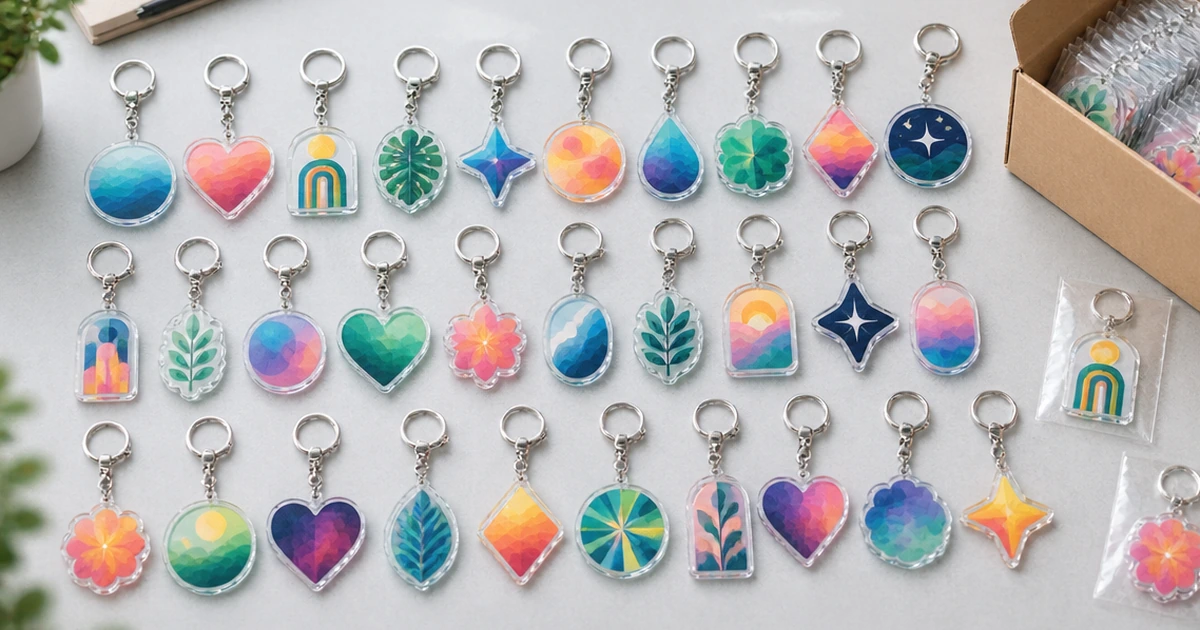
Quick answer: Zigpac makes custom acrylic keychains in bulk factory-direct. It prints your artwork on clear acrylic and cuts it to your outline, with price tiers from 50 pcs, final MOQ on your quote, standard 7–10 days, final schedule on your quote, a free eProof and physical samples for US$5–30. With any supplier, the same factors decide a bulk order: who actually prints and cuts, thickness, print sides, finish, hardware, packaging, proof and sample, and written QC terms.
You need a few hundred to a few thousand printed keychains for a convention table, a product drop or a client giveaway, and every supplier shows a different starting price. Those prices rarely describe the same item. One quote assumes a thinner sheet, another covers a single printed side, and a third leaves out the clasp, the bag and the freight.
Bulk orders usually fail when the spec is loose. Typical results are backward text on the back, washed-out colors because no white layer was printed, and a hole that makes the charm hang crooked. This guide fixes the spec first, so every quote you compare describes the same keychain.
Who Makes Custom Acrylic Keychains in Bulk? Four Supplier Routes
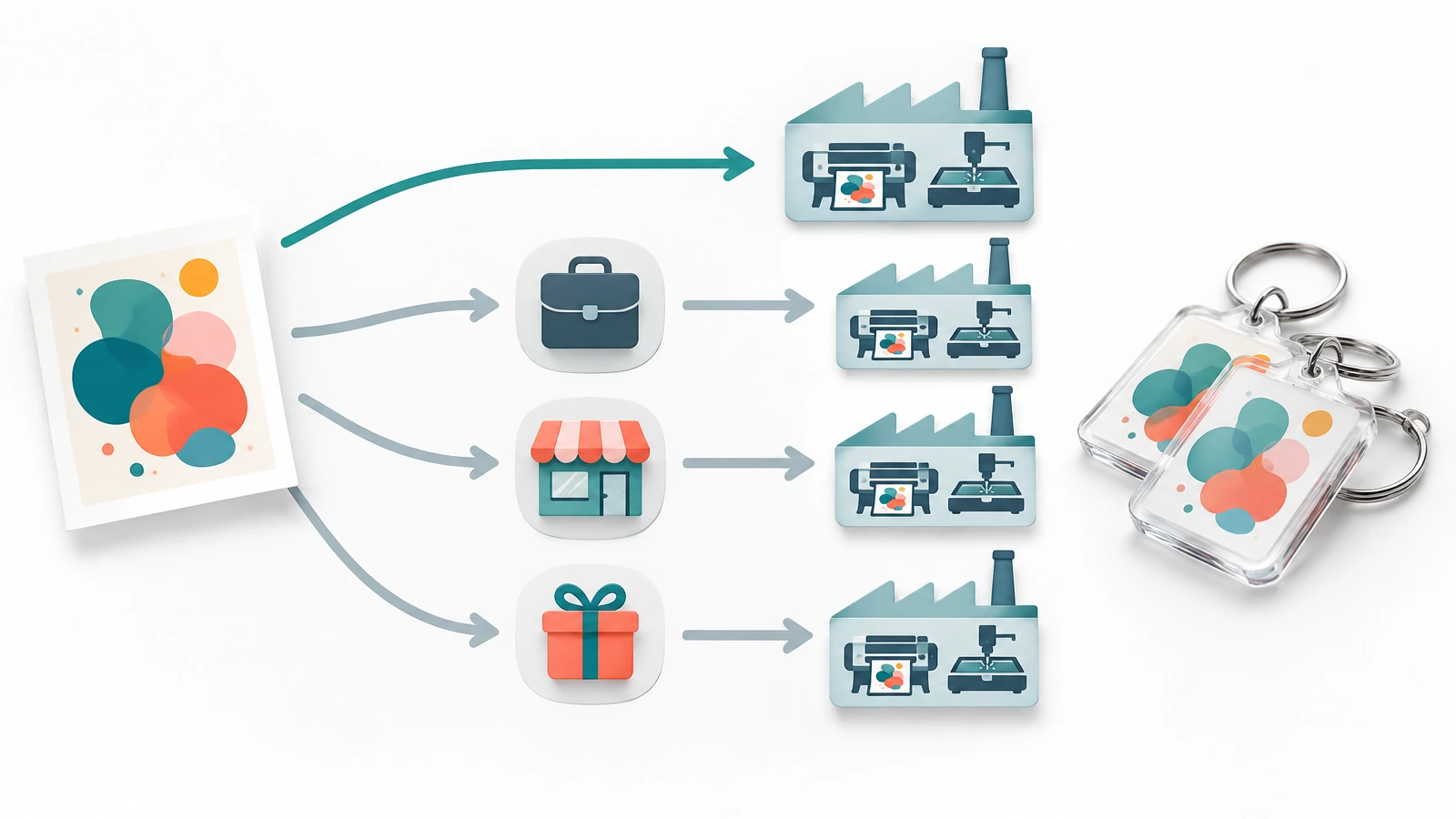
Bulk acrylic keychains for merchandise come from four kinds of supplier. What separates them is who controls printing, cutting and assembly, because that party determines your color, contour and hardware results. A factory-direct manufacturer runs those steps itself. The other three routes pass your brief on to a factory.
| Route | Who prints, cuts, assembles | Typical fit | Spec control | What to ask |
|---|---|---|---|---|
| Factory-direct manufacturer | Its own workshop | Hundreds to thousands per design | Direct | Does my sample come from the bulk line? |
| Trading company or sourcing agent | A partner factory | Multi-category or multi-factory orders | Relayed | Which factory makes it, and who approves samples? |
| Print-on-demand or online custom shop | In-house or partner, fixed menu | Tests and small runs | Listed options only | Does bulk change the spec, or only the price? |
| Promotional-products distributor | A decorating supplier | Clients buying many item types | Through the distributor | Who is the supplier of record, and who handles defects? |
Distributors are an established channel with their own trade body, PPAI[1]. They are most useful when a client buys many item types at once. On a single-item acrylic run, each extra intermediary is another point where a back-side file or a white-ink note can get lost. Ask each route the question in the last column before you compare prices.
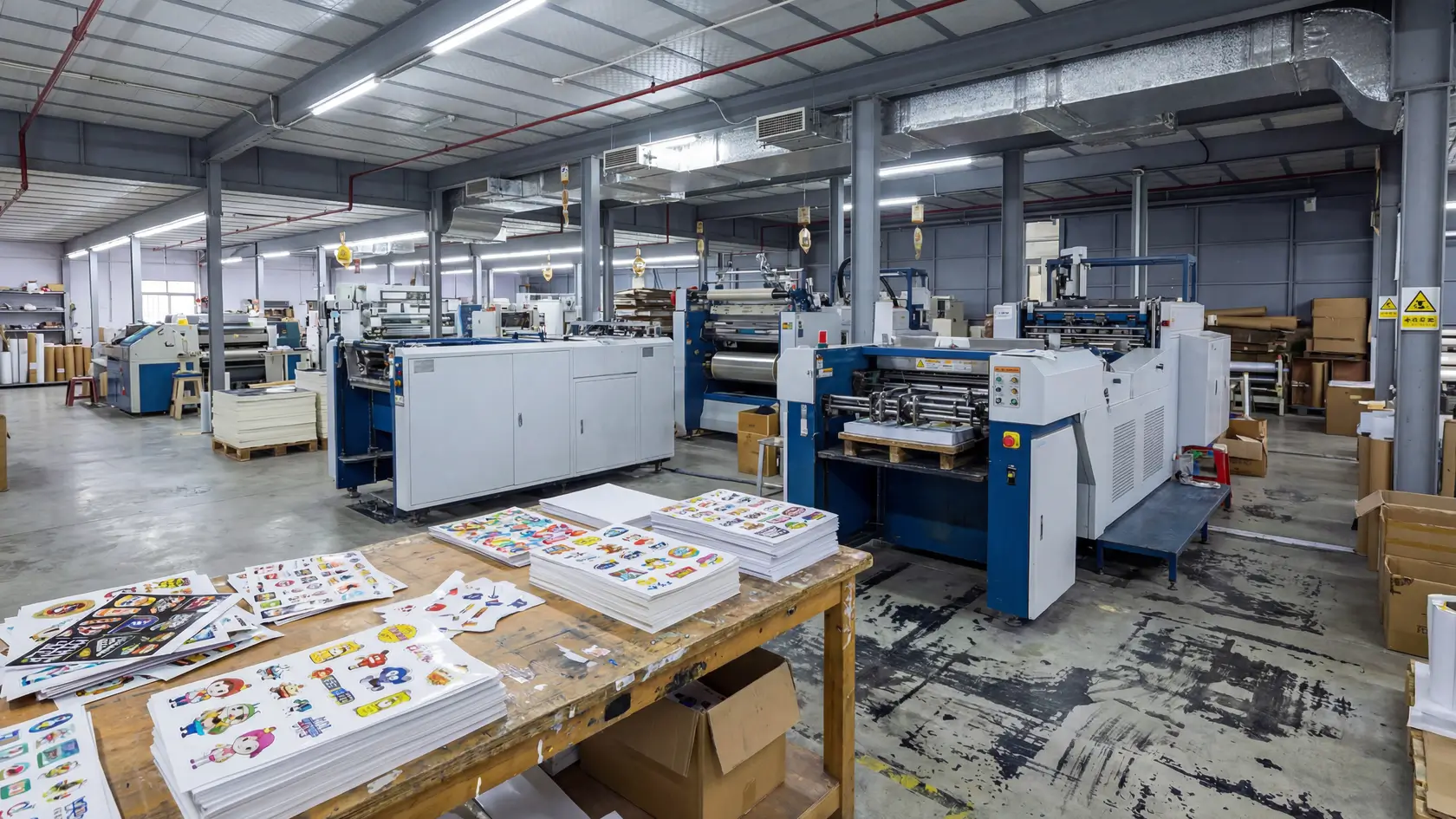
At Zigpac, the product video shows artwork being printed on clear acrylic and cut to the outline inside the factory. It includes the flatbed printing, a roller station, the workshop floor and cut shapes on the machine bed. Wenzhou Zigpac Industry Limited is based in Wenzhou, Zhejiang, China. It returns quotes in 1–6 hours, or in 6–24 hours when a complex project needs engineering review, and bulk buyers can email to get a dedicated manager. The custom printed acrylic keychain page covers artwork preparation and sample evaluation, so this guide stays on the bulk specification.
Acrylic Keychain Thickness: Treat 3 mm and 5 mm as Quote Items
Acrylic is poly(methyl methacrylate), or PMMA[2], a rigid, clear plastic. Sheet thickness affects five things beyond weight:
- Feel: a thicker piece feels more substantial in the hand.
- Edge look: a thicker edge shows more of the cut face and catches light. A thin edge reads flatter.
- Rigidity: slender features such as ears, tails or thin text bridges need enough material to stay stiff.
- Hole area: thickness changes how much material surrounds the hole and how a ring or clasp sits.
- Packaging: thicker pieces need more room per bag or card and add carton weight.
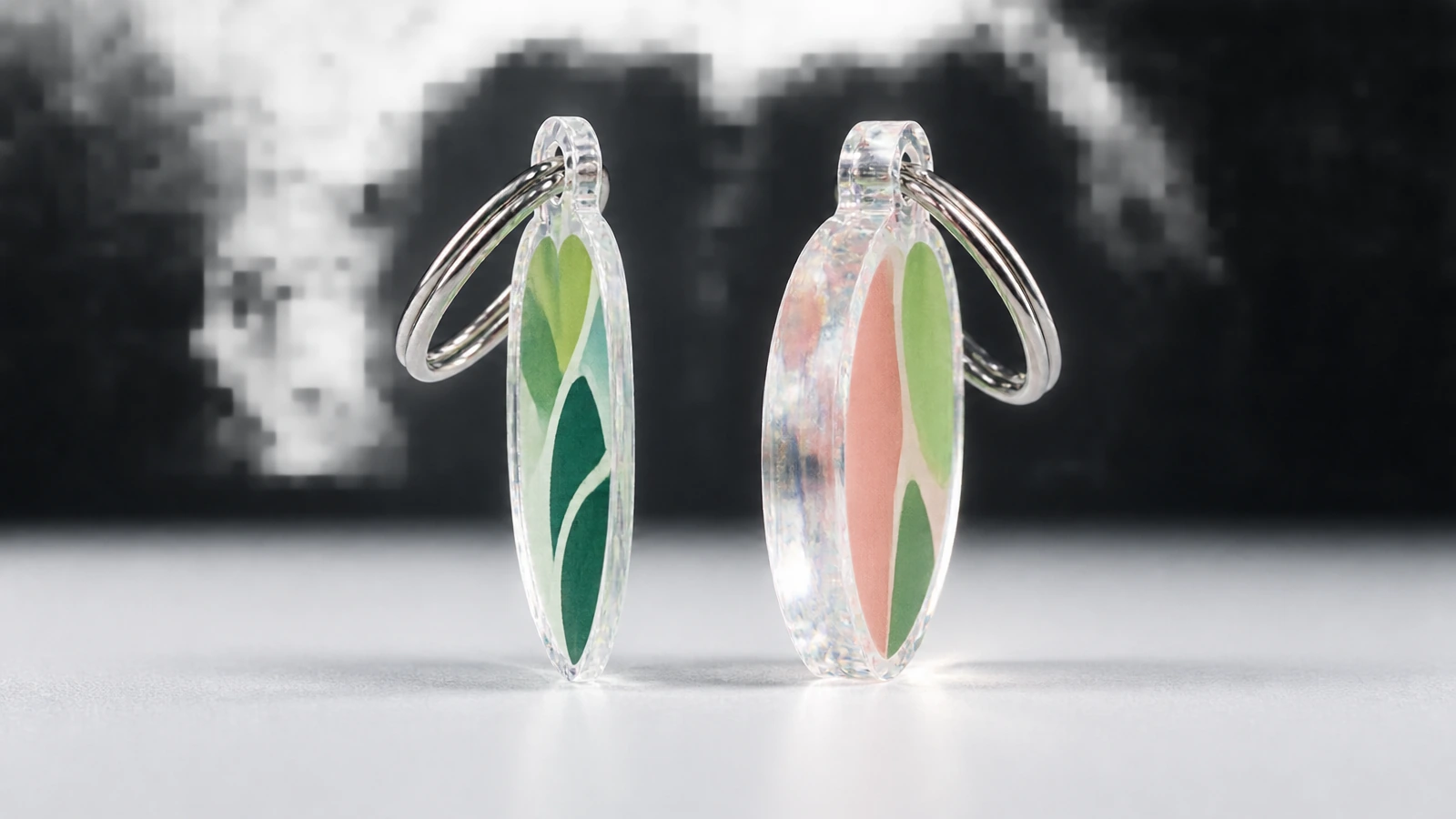
Buyers most often ask for 3 mm or 5 mm. Treat these as market reference points, not as a menu. Zigpac's quote form asks for the thickness you have in mind, and the product page states that final thickness is confirmed in the quote and the approved sample. Write the number in your brief, ask every supplier to quote that same value, and measure the physical sample with calipers before you approve it.
Single vs Double-Sided Print and White Ink on Clear Acrylic
On clear acrylic, the ink sits on a transparent body, so how the print is built shows from both faces.
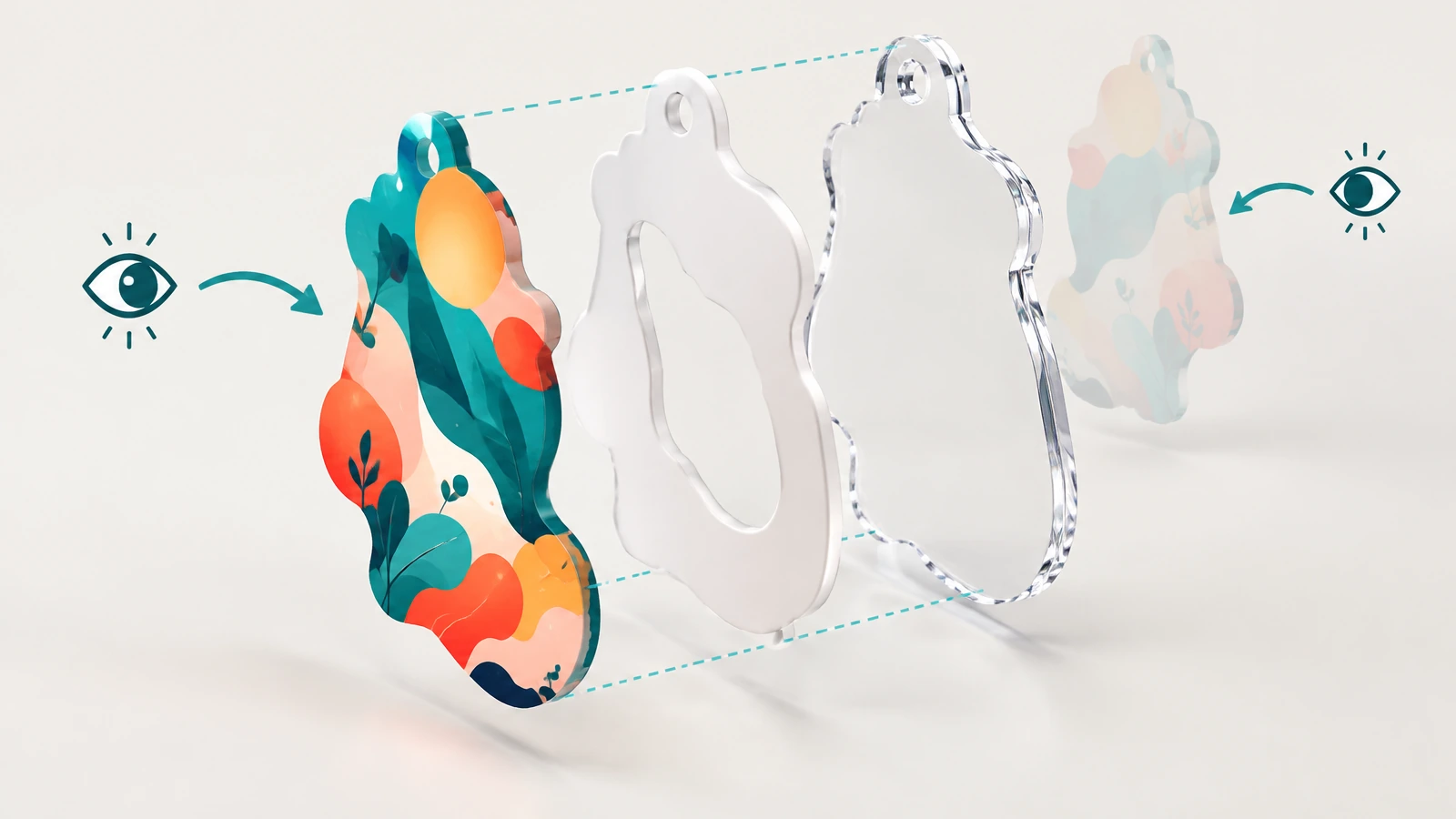
Mirroring. A single print can be seen through from behind, where the image appears reversed. Asking for the back to be "the same" can therefore produce mirrored text, and Zigpac's product page warns about exactly this. If the back must read correctly, as it should on double sided acrylic keychains, supply a separate back file with the text oriented as it will be seen from behind.
White ink. Color inks are translucent. Without a white layer behind them, colors take on the tint of whatever sits behind the keychain. A white layer makes the artwork opaque and brighter. Leaving white out of chosen areas creates deliberate clear windows. Mark both the white-ink areas and the transparent areas in your file, because the quote form asks for both.
Small text and thin lines. Fine strokes are where misalignment between layers shows first. Keep critical text larger and lines heavier than you would on paper, and check them on the proof at 100% scale.
| Factor | Single-sided | Double-sided |
|---|---|---|
| Look from the back | Reversed image or plain layer | Separate artwork that reads correctly |
| Artwork prep | One file plus white and clear areas | Front and back files, orientation marked |
| Proof requirement | Front proof at scale | Both faces proofed, orientation checked |
| Typical use | Logos, giveaways, one viewing side | Hanging merch seen from both sides |
Zigpac's page states that information may appear on one or both sides, depending on the production method confirmed during quoting and sampling. State your choice at the start.
Epoxy Dome, Glitter and Holographic Effects: Sample-and-Quote Items
Merch buyers often ask for more than a flat print. Name each effect explicitly in the brief and verify it with an itemized quote and a physical sample. Do not assume every supplier builds it the same way.
- Epoxy dome coating: a clear resin layer over the print that adds depth and gloss. It adds a process step, it can show bubbles or uneven edges, and it adds cost. Do not assume it protects the print until a test proves it.
- Glitter, holographic or other inserts and backings: layered constructions that shift with light. More layers mean more alignment to check, and misaligned layers are a recurring buyer complaint about layered charms.
- Frosted or colored acrylic: changes how print and white ink read. Judge the colors on a physical sample, not on screen.
Every effect trades a better look against more cost and more sampling. Zigpac's quote form includes a field for the requested print or finish, and construction is confirmed on the quote. Ask about feasibility before you build artwork around an effect.
Hardware, Hole Placement and Packaging
Hardware is the part people touch most. A heavy chain on a light charm or a flimsy clasp undermines even a good print. Specify the attachment type (key ring, lobster clasp, chain or strap), its color, and whether it arrives assembled.
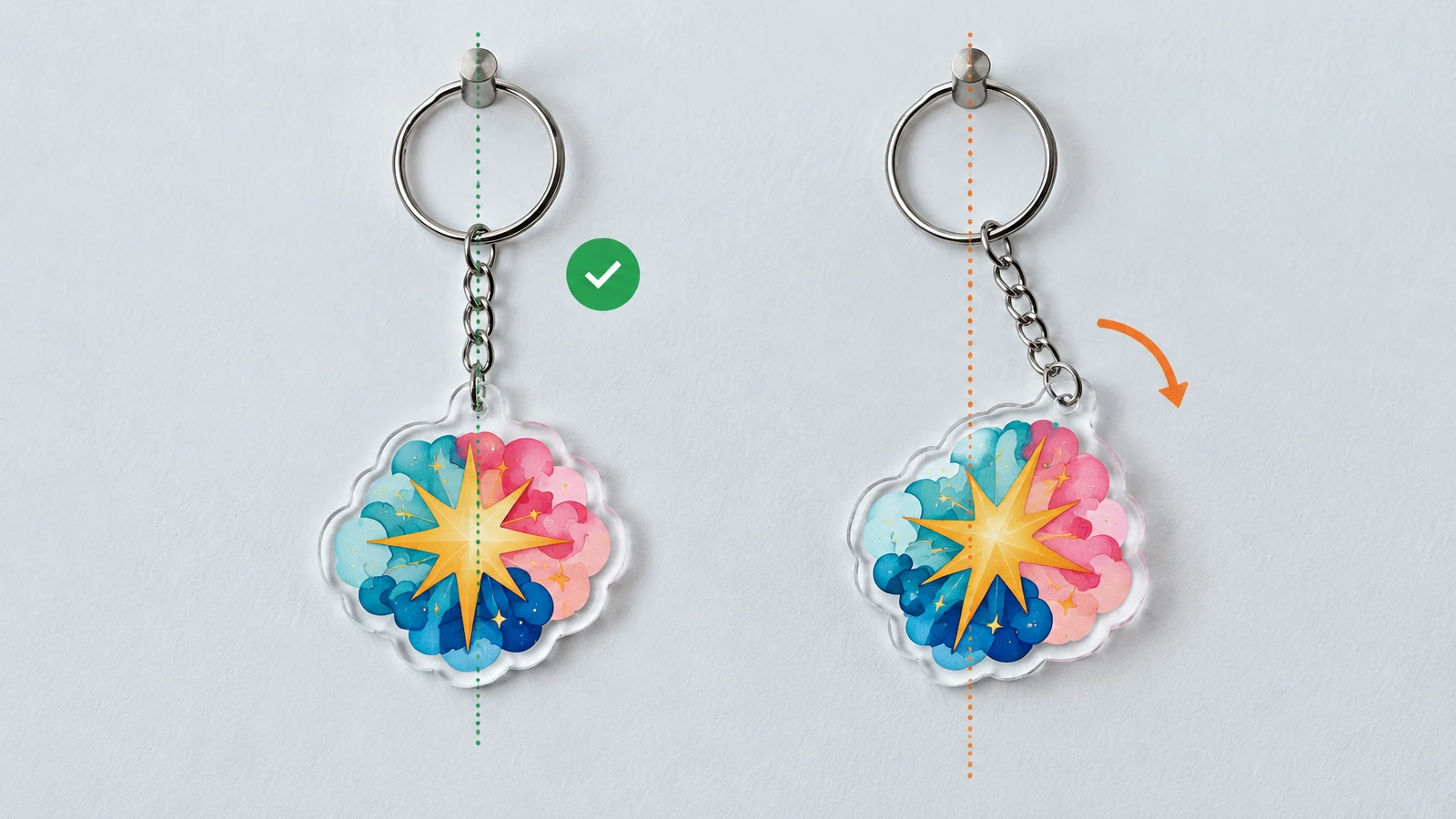
A keychain hangs straight down from its hole, with its balance point directly below. An off-centre hole tilts the design, so place the hole above the balance point of the shape. Leave enough material around the hole, especially on thin shapes.
Packaging depends on the channel. Events usually want pieces bulk-packed or individually bagged, sorted by design for fast handout. Retail usually needs individual bags or backing cards, possibly barcode labels, and the same orientation on every card. State who supplies the card artwork. Approve an assembled sample with print, hardware and pack together, not a loose acrylic piece.
Acrylic Keychain Minimum Order Quantity and Price Tiers
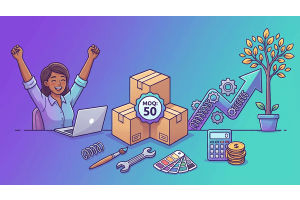
Zigpac's listing gives price tiers from 50 pcs, final MOQ on your quote. The live tiers below are from November 2026, and the final price is set on your quote:
| Quantity | Per piece (Nov 2026) | Example total |
|---|---|---|
| 50+ | US$0.65 | 50 pcs = US$32.50 |
| 100+ | US$0.50 | 100 pcs = US$50 |
| 500+ | US$0.36 | 500 pcs = US$180 |
| 1,000+ | US$0.29 | 1,000 pcs = US$290 |
Worked example: 500 pcs at the 500+ tier cost US$180 before any setup, hardware upgrades, packaging and freight. Size, thickness, print sides, finish, hardware and packaging all change the price, so treat the tier as a starting point rather than a bid.
Quantity per design. Ask whether the tiers apply to the whole order or to each design. Ten designs of 50 pieces is a different job from one design of 500. Each design needs its own artwork check, proof and cut path, and sorting by design adds packing work.
Landed cost per accepted unit. Add product, setup, hardware, packaging, samples, freight and duties. Divide the total by the number of pieces that pass your acceptance check, not by the number ordered. This one figure makes quotes from different routes comparable.
At Zigpac, every order includes a free eProof, and physical samples ship for US$5–30. Put the sample in the budget as its own line rather than skipping it.
Bulk QC and Acceptance Checks
Set the reference before production: a dimensioned proof plus an approved physical sample. Everything delivered is judged against that pair.
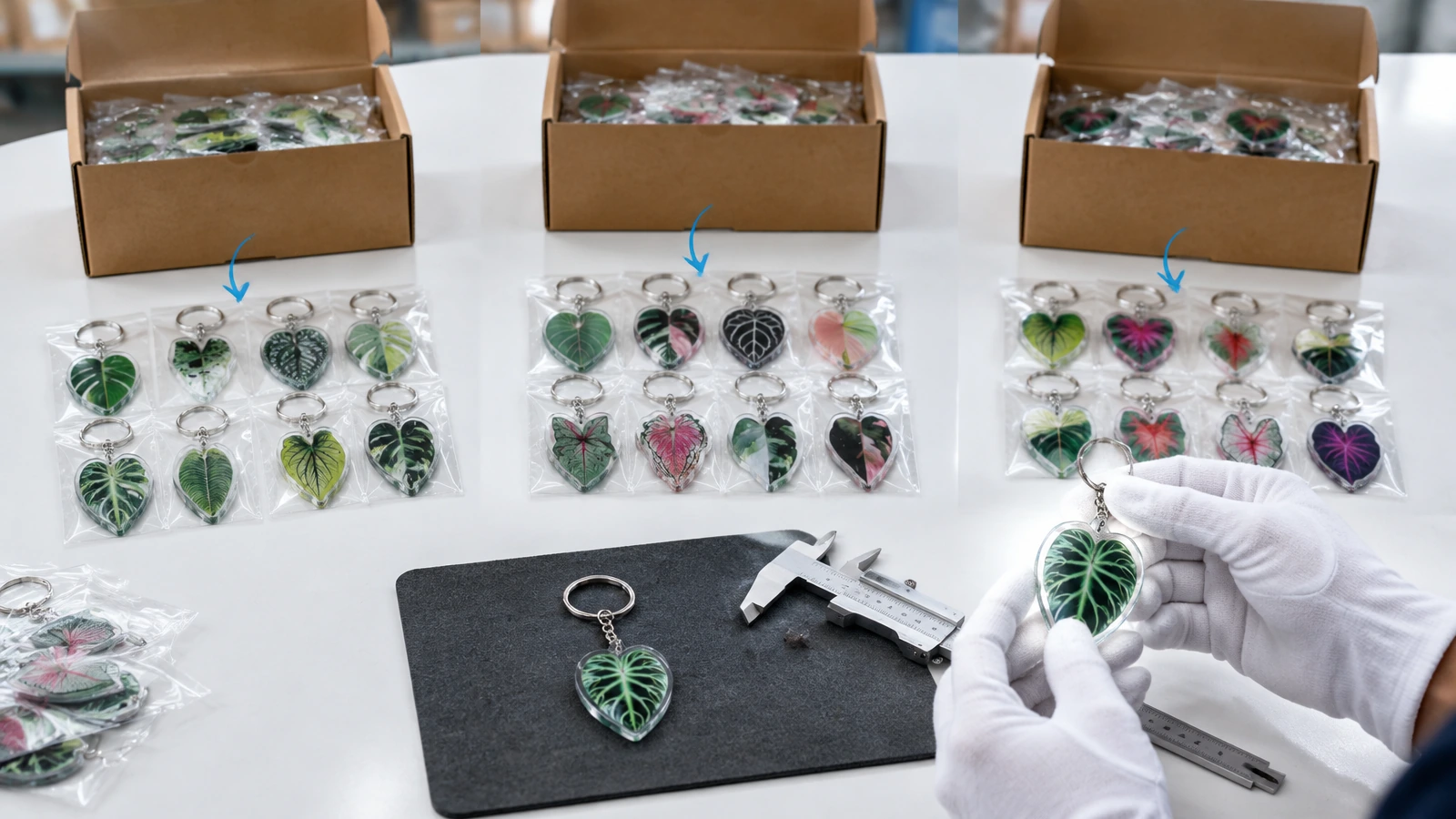
Check a documented selection drawn from several cartons, not just the top of one. Inspect:
- dimensions and contour against the proof
- print position, front/back orientation and white-ink alignment
- edges, hole position and hardware assembly
- protective film, if one was specified
- quantity per design, packaging and labels
Agree any tolerance and the sampling plan in writing before production starts. If the supplier does not state an inspection level, propose your own and have it confirmed. Zigpac's product page itself recommends inspecting against the approved sample or proof, using a documented selection across cartons. Its site footer states: "Quality issue? Full refund, no return needed." Photograph each defect next to the reference so any claim is clear.
Durability is a separate question. The product page does not verify scratch, drop, fade, weather or service-life performance. Agree a test on the sample, such as a tape adhesion check in the style of ASTM D3359, a rub test or a short drop, and write down the pass threshold. If you or your client will advertise durability, FTC business guidance[3] expects objective claims to be substantiated.
Acrylic vs 2D Molded Soft PVC Rubber Keychains for Bulk Merch
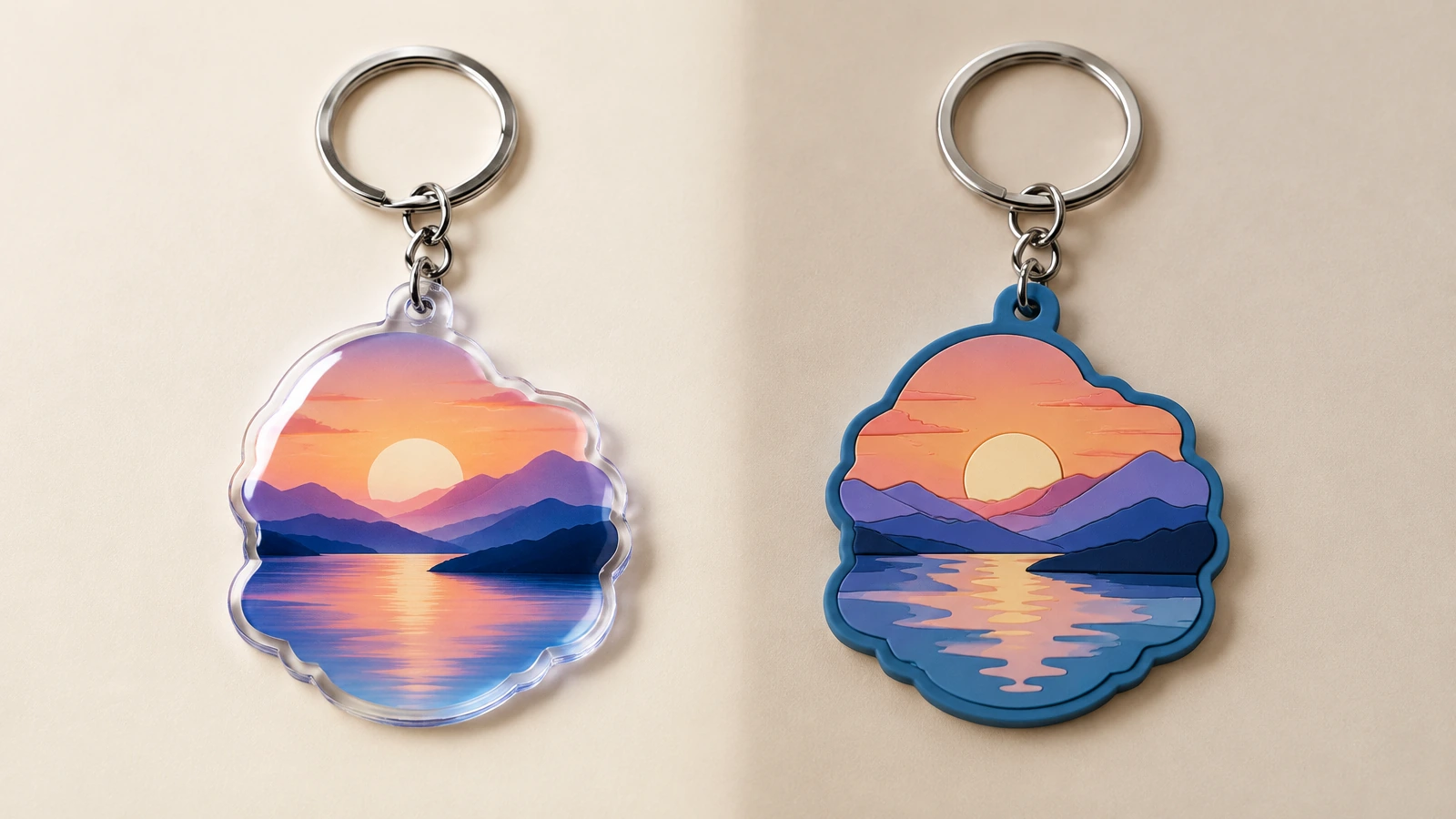
Some buyers choose between printed acrylic and Zigpac's Custom Rubber Keychains in 2D Molded Soft PVC. The artwork usually decides:
| Factor | Printed acrylic | 2D molded soft PVC |
|---|---|---|
| Look | Photographic full-color print | Raised solid-color areas and outlines |
| Route | Printed, then cut to outline | Mold, colored PVC dispensed, heated |
| Price tiers | From 50 pcs, final MOQ on your quote | From 100 pcs, final MOQ on your quote |
| Standard time | 7–10 days | 10–15 days |
| Best fit | Illustrations, gradients, many designs | Flat-color logos, soft feel |
Final schedules for both are set on your quote. Molded colors are solid areas, not photographic gradients, so artwork that depends on shading points to acrylic. Also note that a molded PVC front does not automatically come with a decorated back. Tooling terms for PVC are confirmed on the quote.
FAQ
FAQ: Who makes custom acrylic keychains in bulk for merch?
Factory-direct manufacturers make them, while trading companies, print-on-demand shops and promotional distributors relay or resell that production. Zigpac makes custom printed acrylic keychains factory-direct, printing artwork on clear acrylic and cutting it to your outline. It offers price tiers from 50 pcs, final MOQ on your quote, and standard 7–10 days, final schedule on your quote.
FAQ: What thickness should bulk acrylic keychains be?
There is no universal thickness, so choose by feel, shape and hardware and confirm it on the quote. Buyers most often ask about 3 mm and 5 mm, which are useful market reference points. A thicker sheet feels more substantial and shows more edge but adds weight and packing volume. Measure the physical sample before approving.
FAQ: What is the minimum order quantity for custom acrylic keychains?
It depends on the supplier and your spec, so treat any listed figure as a starting point. Zigpac shows price tiers from 50 pcs, final MOQ on your quote. Its live November 2026 tiers run from US$0.65 per piece at 50+ to US$0.29 at 1,000+, final price on your quote. Ask whether tiers apply per design.
FAQ: Do double-sided acrylic keychains need different artwork?
Yes, if the back must read correctly you need a separate back file. On clear acrylic, a design seen from behind appears reversed, so asking for "the same on the back" can mirror the text. Supply front and back files with orientation marked, show the white-ink and clear areas, and check both faces on the proof.
FAQ: Does an epoxy dome make acrylic keychains scratch-proof?
No coating should be assumed to make a keychain scratch-proof. An epoxy dome adds depth and gloss, but how it holds up depends on materials, process and use. If durability matters, name the effect in your brief, agree a test on the physical sample, such as a rub or tape check, and record the pass threshold in writing.
Key Takeaways
- Budget from live tiers, not guesses. — US$0.36 per piece at 500+ (November 2026), final price on your quote (Source)
- A listed tier is not a fixed MOQ. — price tiers from 50 pcs, final MOQ on your quote (Source)
- Pay for a physical sample before bulk. — free eProof; physical samples US$5–30 (Source)
- Printed acrylic suits tighter timelines than molded PVC. — standard 7–10 vs 10–15 days, final schedule on your quote (Source)
- Acrylic is PMMA, a rigid clear plastic. — classified in ASTM D788-21 (Source)
What to Send for a Comparable Bulk Quote
Send every supplier the same paragraph: "Printed acrylic keychain, [finished size], cut line attached, target thickness [value], [single- or double-sided, back file attached], white ink behind colors except [clear areas], [effect, if any], [hardware], hole at [position], [packaging], [quantity per design × number of designs], in-hand by [date] in [country]. Please itemize setup, hardware, packaging, samples and freight." Zigpac confirms construction, final MOQ, price and schedule on the quote. A free eProof comes before production, and physical samples cost US$5–30.
Supplier checklist:
- Who prints, cuts and assembles?
- Is thickness quoted at your stated value?
- Are both faces proofed, with orientation checked?
- Are effects itemized and sampled?
- Do tiers apply per design or per order?
- Are the tolerance, sampling plan and defect remedy in writing?
Footnotes
- Promotional Products Association International (PPAI), trade association for the promotional products industry, industry data. ppaionline.org. Accessed November 2026. ↩
- ASTM International, D788-21, classification system for poly(methyl methacrylate) (PMMA) molding and extrusion compounds. astm.org. Accessed November 2026. ↩
- U.S. Federal Trade Commission, business guidance resources on promotional items and advertising claims. ftc.gov. Accessed November 2026. ↩


The information below is required for social login
Sign In
Create New Account