
 Blog PDF for offline reading
Quick answer: Zigpac lists 1,000 custom 2-inch white vinyl die-cut stickers at US$139, or about US$0.14 per sticker, and 1,000 2-inch holographic die-cut stickers at US$163, or about US$0.16 per sticker, both with free standard shipping. Reflective die-cut stickers are listed at US$0.32 per piece at 1,000+, with size confirmed on the quote. These are the prices listed on zigpac.com in November 2026. At Zigpac, the final price is confirmed on your quote. Where your design lands on the "how much do custom stickers cost" scale depends on six drivers: size, film, lamination, cut complexity, quantity and shipping.
You have a design, a launch date and a budget line that says "stickers." Then the quotes come back. One supplier is twice another, a third hides shipping until checkout, and nobody explains why. The cost is not just money. If you underbudget a reflective run, you end up switching to plain vinyl at the last minute, and the stickers stop doing the one job they were bought for. This guide breaks the 1,000-piece unit price into its parts. For each driver, it shows how the driver moves the number, with real listed prices as anchors. You can then predict a quote before you request one, and you can tell which line items are worth paying for.
What Does a Custom Sticker "Unit Price" Actually Include?
A sticker unit price is the total order cost divided by the number of stickers. That total has two kinds of cost. Variable costs grow with every sticker: film, ink, laminate, cutting time and packing. Fixed costs are paid once per job, whatever the quantity: file preparation, proofing, press and cutter setup, and quality checks on the first pieces. At 50 pieces, the fixed costs dominate. At 1,000 pieces, they are spread thin, and material choice starts to dominate.
Two things often sit outside the unit price and change the real figure: shipping and samples. A per-piece price that excludes freight is not comparable with a total that includes it. Before you compare suppliers, put every quote on the same basis: the same size, film, lamination, cut, quantity and delivered-to country.

How Much Do Custom Stickers Cost at 1,000 Pieces? Listed Price Anchors
Market ranges for custom stickers are wide because suppliers price different sizes, films and shipping terms. Fixed reference points are more useful than a range scraped from many sellers. The table below uses the three die-cut lines Zigpac publishes prices for. All figures are the prices listed on zigpac.com in November 2026, and the final price is confirmed on your quote.
| Zigpac product (as listed) | Spec used for the price | 50 pcs | 100 pcs | 500 pcs | 1,000 pcs | Shipping |
|---|---|---|---|---|---|---|
| Premium Custom Die Cut Vinyl Stickers | 2-inch, white vinyl, UV laminated, die cut | US$42 total | US$51 total | US$91 total | US$139 total (≈US$0.14 each) | Free standard shipping (online instant price) |
| Custom Holographic Die-Cut Stickers | 2-inch, metallized holographic vinyl or PET, UV laminated, die cut | US$46 total | US$57 total | US$105 total | US$163 total (≈US$0.16 each) | Free standard shipping (online instant price) |
| Custom reflective die-cut stickers | Printed retroreflective vinyl; custom shape and size confirmed on quote | US$1.20 / pc (50+) | US$0.85 / pc (100+) | US$0.45 / pc (500+) | US$0.32 / pc (1,000+) | Confirmed on quote |
At Zigpac, all three lines have price tiers from 50 pcs, final MOQ on your quote. The standard production time is 3–7 days, and the final schedule is set on your quote. Note one limit when you compare the rows. The white vinyl and holographic prices are for a fixed 2-inch size, while the reflective tier is for a custom size. The reflective row shows how the film moves the price. It is not a like-for-like 2-inch comparison.
The Seven Cost Drivers, One by One
1. Size: you pay for area, not width
Film, ink and laminate are used by area, and area grows with the square of the dimension. A 3-inch square sticker uses 2.25 times the material of a 2-inch one, and a 4-inch sticker uses four times as much. The unit price rarely rises by the full multiple. Setup, handling and packing do not grow with size, so larger stickers cost more per piece but less per square inch. Size also affects layout. Odd sizes that nest poorly on the print sheet waste film between pieces, and you pay for that waste.
Practical move: before you request quotes, decide on the smallest size that still reads clearly at the viewing distance you need. Cutting a design from 3 inches to 2.5 inches cuts material by about 30%. That saving usually matters more than any discount you can negotiate.
2. Material: the biggest single jump
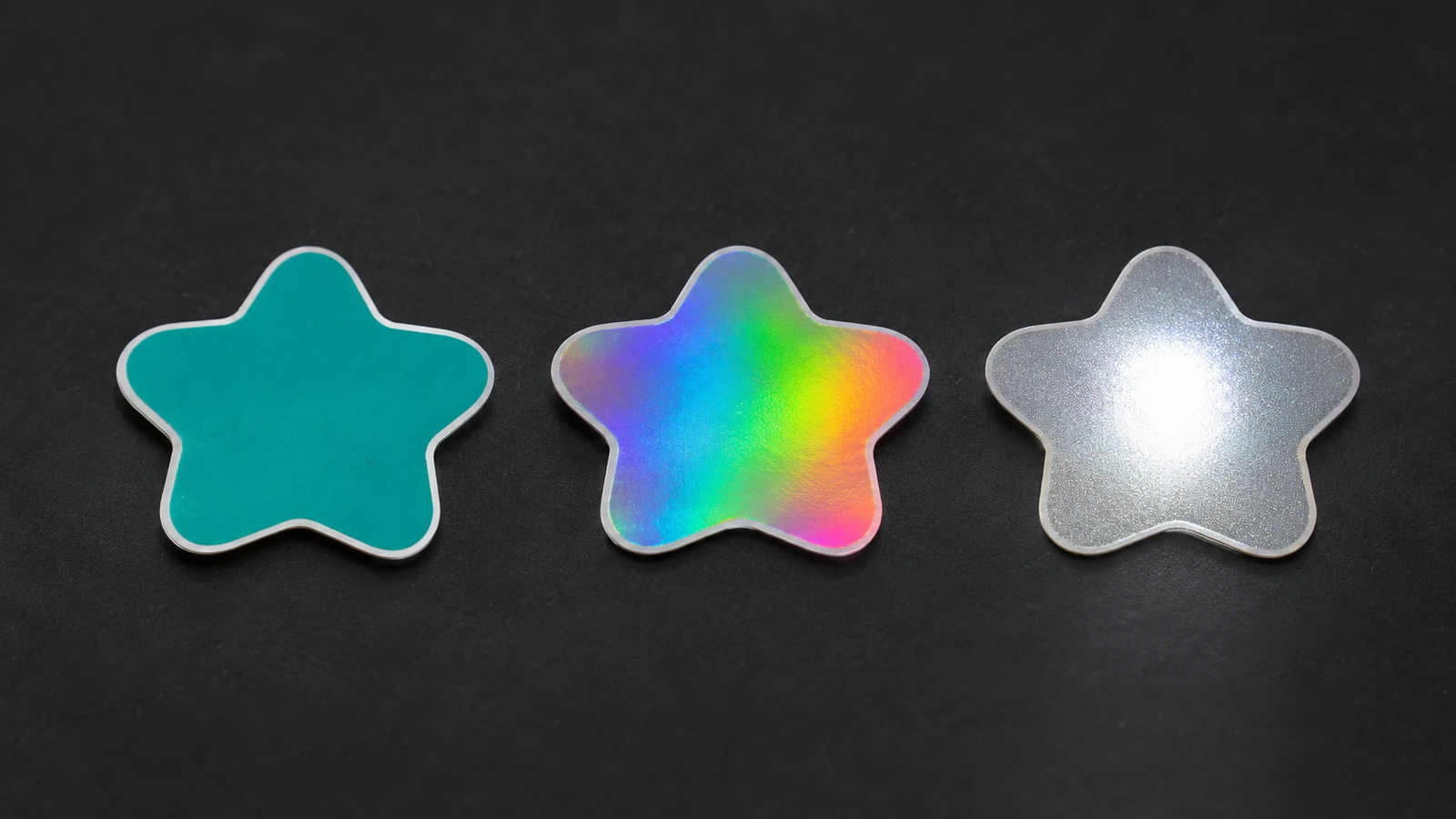
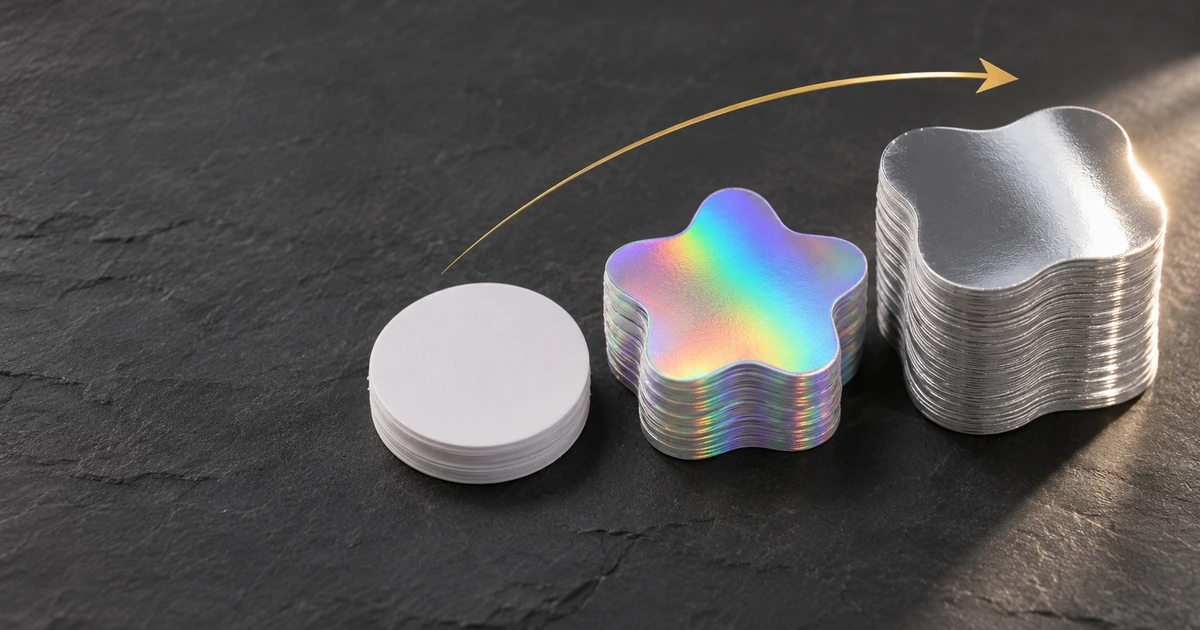
Standard white vinyl is the baseline. Specialty films cost more because the raw material costs more, they print and cut more slowly, and they waste more film. In the listed examples, moving from white vinyl to holographic adds US$24 to a 1,000-piece, 2-inch order (US$139 to US$163). Reflective film costs more again. Retroreflective sheeting returns light toward its source using glass beads or micro-prisms. Its performance is measured as a coefficient of retroreflection under a defined test method, ASTM E810[1]. Reflective films are also thicker and tougher than standard vinyl, so the cutter runs slower and blades wear faster.
Not every film sold as "reflective" is the same grade. U.S. traffic practice classifies retroreflective sheeting under two national specifications, AASHTO M268 and ASTM D4956, and the type numbers do not simply rank brightness, as the Manual of Traffic Signs[2] explains. Higher-intensity prismatic sheeting is a different cost class from printable sticker film. State transportation agencies publish identification guides for these grades, such as Minnesota DOT's sheeting ID guide[3]. If a quote looks too cheap for "reflective," ask which film is being used.
3. Lamination: small cost, large lifespan effect
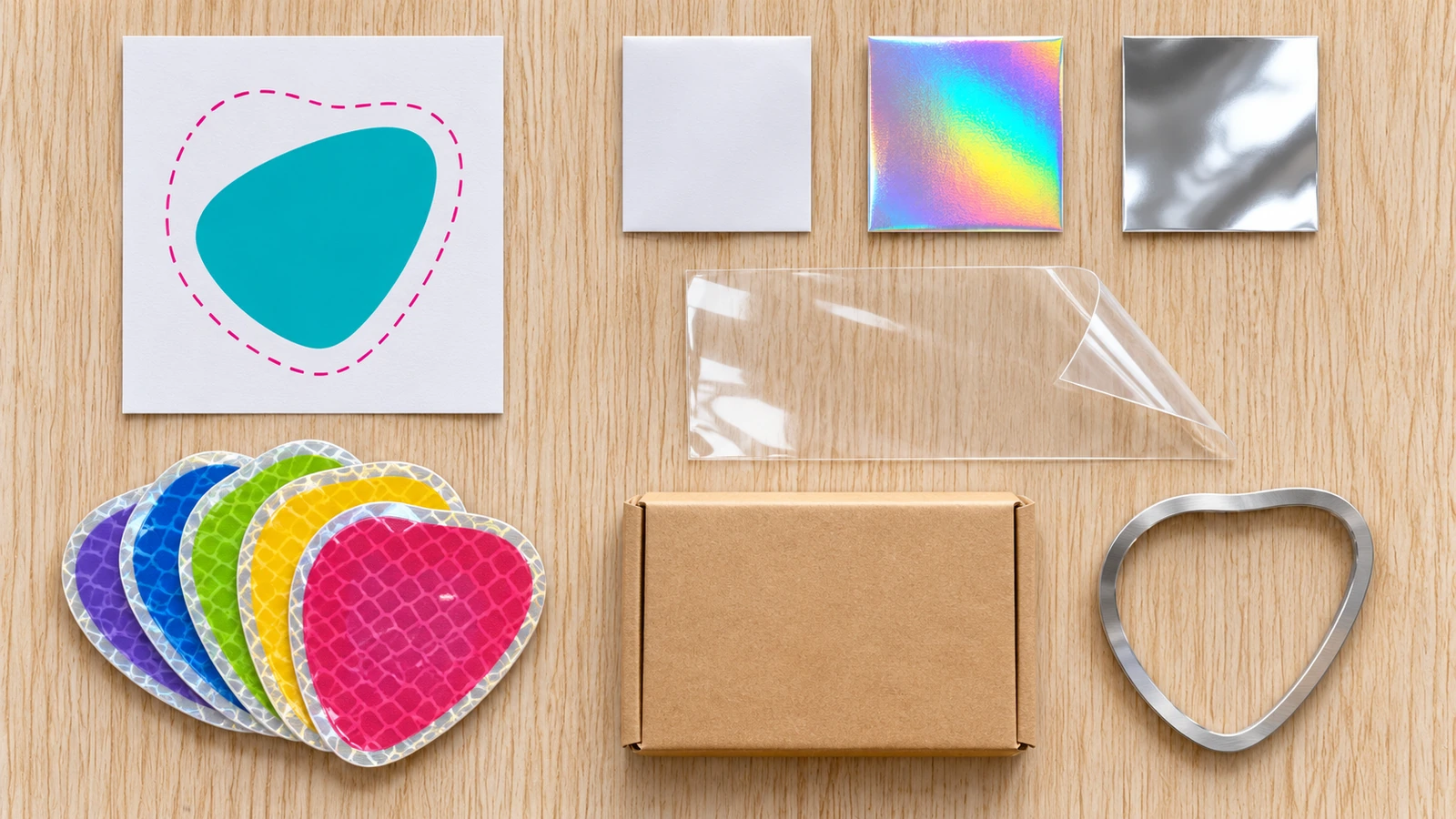
A clear laminate adds a layer of material and one more process step. It protects the ink from abrasion, water and UV, which is why outdoor stickers almost always carry one. Both the white vinyl and holographic examples above already include UV lamination in the listed price. When you compare quotes, check whether lamination is included or charged extra. A cheaper unlaminated quote is not a saving if the stickers fade before the campaign ends. Special finishes cost more than standard gloss or matte, so ask about each one separately.
4. Cut type and contour complexity
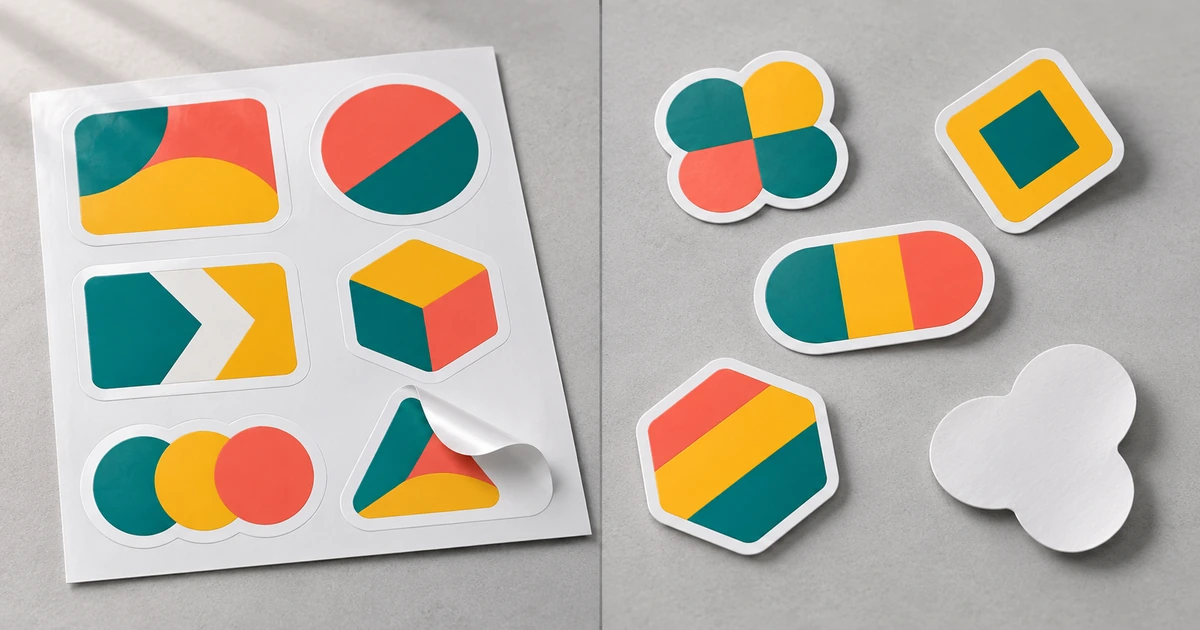
Die cut, kiss cut and sheet formats differ in how much cutting each sticker needs and how the pieces are packed. We compare these formats in separate guides, so here we look only at cost. Two rules hold for most jobs. First, cutting time grows with the length of the cut path, and contours with many tight inner corners take longer and fail more often than circles or rounded rectangles. Second, thick specialty films narrow the margin for error. Reflective and prismatic films need slower speeds or flatbed and laser cutting, so every extra point on the outline costs more. Rounding sharp corners lowers cost and also reduces edge lift.
5. Color count and white ink
With digital printing, full color usually costs the same as one color, so adding colors to a digital job rarely moves the price. With screen printing, each color needs its own screen and setup, so price rises with color count. A hidden extra is white ink. On clear, holographic or metallic films, opaque white has to be printed as a separate underlayer wherever you want solid color. Ask whether the white layer is included. On reflective film, color choice also affects performance. Light colors and open areas reflect best, and large dark ink areas block much of the returned light. Design for the film before you spend on it.
6. Quantity breaks
Quantity is where fixed costs get spread out. In the listed white vinyl example, going from 500 to 1,000 pieces raises the total from US$91 to US$139. The second 500 stickers add only US$48. The reflective tiers fall from US$1.20 per piece at 50+ to US$0.32 at 1,000+. The catch is that you pay more in total, and leftover stock only saves money if you use it. Order the quantity you will actually apply or give away within the sticker's service life. Then check whether the next tier is close enough to be worth it.

7. Shipping, proofs and samples
Freight can erase the gap between two quotes, especially for small orders shipped across borders. Zigpac's online instant-price orders include free standard shipping to 33 countries and regions. Every order includes a free eProof, and physical samples ship for US$5–30. For specialty films, Zigpac recommends approving a physical sample before bulk production. A sample shows how holographic shift, reflective return or a complex contour behaves, which a screen proof cannot. If you need delivery earlier than standard production allows, say so in your request so the schedule is priced up front, not added later.
Cost Driver Table: How Each One Moves the Unit Price
| Driver | What changes the cost | Direction at 1,000 pcs | How to save without losing function |
|---|---|---|---|
| Size | Film, ink and laminate used per piece (grows with area) | Up as area grows; less than proportional | Use the smallest legible size; pick dimensions that nest well on the sheet |
| Material | Film cost, print and cut speed, waste | White vinyl < holographic < reflective | Reserve specialty film for jobs that need it, such as night visibility or shelf impact |
| Lamination | Extra layer and process step | Small increase; large lifespan effect | Confirm it is included; choose a standard finish unless a special one is needed |
| Cut type / contour | Cut path length, corner count, film thickness | Up with complexity, especially on reflective | Round sharp corners; simplify thin spikes and tiny inner holes |
| Color / white ink | Screens (screen print); white underlayer on clear or metallic films | Flat for digital full color; up for spot colors and white layers | Ask whether white ink is included; keep reflective artwork light |
| Quantity | Fixed setup spread over more pieces | Down per unit, up in total | Order for real use within the sticker's service life |
| Shipping & samples | Freight, destination, sample runs | Can outweigh small unit-price gaps | Compare delivered totals; approve one physical sample for specialty films |
At Zigpac, every order starts with a free eProof, so you can check the size, cut line and white-ink areas before any film is printed. That catches the most common reason for a costly reprint. Production time is standard 3–7 days, and the final schedule is set on your quote.
Worked Examples: Same Order, Different Choices
These examples use only the listed figures above. They show how far one decision moves the budget.
Example A: brand giveaway, daytime use. 1,000 stickers, 2-inch, white vinyl, UV laminated, die cut, standard shipping. The listed price is US$139 delivered, about US$0.14 each. This is the cheapest option among the three, and for laptops, bottles and mailers you need nothing more.
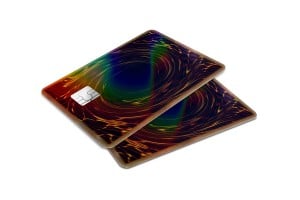
Example B: same design, more shelf impact. Switch the film to holographic and keep everything else the same. The listed price is US$163, about US$0.16 each. The US$24 difference buys a color-shifting finish. It does not buy night visibility: holographic film creates a rainbow effect by diffraction and does not return headlight beams the way retroreflective film does.
Example C: be seen after dark. A cycling club or delivery fleet needs stickers that light up when headlights hit them. The listed reflective tier is US$0.32 per piece at 1,000+, with shape and size confirmed on the quote. That is more than double the per-sticker figure in Example A. The extra cost buys a different function, not just a different look. For film options, adhesive and application, see the reflective die-cut sticker product page.
Example D: the quantity question. If you only need 500 pieces, the listed totals are US$91 for white vinyl, US$105 for holographic, and US$0.45 per piece for reflective. Buying 1,000 lowers the unit price on every line. Do it only if you will use the second 500.
One budget trap is buying cheap reflective film for work that is actually regulated. Decorative reflective stickers add visibility. They do not replace required reflectors or certified trailer conspicuity tape. Federal rules allow additional retroreflective surfaces only "in conjunction with, but not in lieu of" required reflex reflectors (49 CFR 393.26[4]). Certified conspicuity material is its own product and its own price class. Reflective film can also fail at a single test angle: NHTSA recall 23E-033[5] covered 244 rolls of conspicuity tape that measured below 60 cd/lx/m² at a 30° entrance angle. Traffic signs follow yet another set of rules: maintained-retroreflectivity levels measured at a 0.2° observation angle and −4.0° entrance angle in the FHWA MUTCD[6]. High-visibility apparel is covered separately by ANSI/ISEA 107-2020[7]. If your job falls under any of these, budget for certified material instead of sticker film.
Specifications drive cost in public procurement too. For example, TxDOT DMS-8391[8] sets requirements for decal face material and liner, including staying die-cuttable after high-temperature drying. Each added requirement narrows the choice of film and adds testing, which raises the unit price. Write only the requirements your use actually needs into your specification.
Quote Checklist: What to Send for an Exact Price
A complete request gets you one accurate quote instead of three rounds of questions. Send:
- Artwork: vector file (AI, EPS or PDF) with the cut line as a separate closed path.
- Finished size: width and height of the final sticker, not the artboard.
- Material: white vinyl, holographic or reflective, plus where the sticker will go, such as indoors, outdoors, a vehicle or a helmet.
- Lamination: standard UV laminate or a specific finish.
- Cut type: die cut, kiss cut or sheets, and whether the contour can be simplified.
- Quantity: your target, plus the next tier up if you want to compare.
- Shipping country and the date you need the stickers.
- Sample: whether you want a physical sample before bulk production (US$5–30).
Zigpac confirms the unit price and the final MOQ on the quote: price tiers from 50 pcs, final MOQ on your quote.
FAQ
FAQ: How much do 1,000 custom stickers cost?
At Zigpac, 1,000 2-inch white vinyl die-cut stickers are listed at US$139 with free standard shipping, about US$0.14 each. Holographic at the same size is US$163, about US$0.16 each, and reflective is US$0.32 per piece at 1,000+. These are November 2026 listed prices, and the final price is confirmed on your quote. Larger sizes, complex contours and special finishes push the figure up.
FAQ: Why do reflective stickers cost more than regular vinyl?
Reflective stickers cost more because the film itself is a costlier engineered material and it is slower to process. Retroreflective film uses glass beads or micro-prisms to send light back toward its source. It is thicker and tougher to cut, so cutting is slower and waste is higher. The higher price buys night visibility that standard vinyl and holographic film do not provide.
FAQ: Is ordering 1,000 cheaper than ordering 500?
Ordering 1,000 is cheaper per sticker but more expensive in total. In the listed white vinyl example, 500 pieces cost US$91 and 1,000 cost US$139, so the extra 500 add US$48. It is only a saving if you will actually use the extra stickers.
FAQ: Does lamination add to the price?
Lamination adds a little material and one process step. On Zigpac's listed white vinyl and holographic die-cut stickers, UV lamination is already included in the price. With other suppliers, confirm whether it is included before you compare quotes, because unlaminated outdoor stickers wear out much faster.
FAQ: Do I pay for proofs or samples?
Digital proofs are free, and physical samples cost a small fee. Zigpac includes a free eProof with every order, and physical samples ship for US$5–30. A physical sample is worth it for holographic or reflective film, because screen proofs cannot show how the finish looks in real light.
FAQ: What is the minimum order?
Zigpac has price tiers from 50 pcs, final MOQ on your quote. Small runs cost more per piece because setup is spread over fewer stickers.
FAQ: Can cheaper reflective stickers replace DOT conspicuity tape?
No. Decorative reflective stickers add visibility but do not replace required reflectors or certified conspicuity tape. Federal rules allow additional retroreflective surfaces only alongside required reflectors, never in place of them.
Key Takeaways
- A 2-inch white vinyl die-cut sticker is the low anchor at 1,000 pieces. — US$139 total, about US$0.14 each, shipping included (Source)
- Holographic film adds a modest premium at the same size. — US$163 for 1,000, +US$24 vs white vinyl (Source)
- Reflective film is a different price class because it does a different job. — US$0.32 per piece at 1,000+ (Source)
- Quantity breaks cut the unit price, not the total. — the second 500 white vinyl stickers add US$48 (Source)
- Reflective performance is a measured value, not an adjective. — coefficient of retroreflection per ASTM E810 (Source)
- Certified reflective material can fail at a single angle, which is why it is priced separately. — 244 rolls recalled below 60 cd/lx/m² at 30° entrance (Source)
Conclusion: Budget by Function, Then Optimize the Drivers
The fastest route to an accurate sticker budget is to choose the film for its job first. White vinyl suits daytime branding, holographic suits shelf impact, and reflective suits visibility after dark. Then tune the drivers that do not affect function: size, contour complexity, finish and quantity. Compare quotes on a delivered basis, approve one physical sample for specialty films, and write only real requirements into your specification. Send your artwork, finished size, material, lamination, cut type, quantity and shipping country, and Zigpac will confirm the exact unit price and final MOQ on your quote. For night-visible jobs, start from the custom reflective die-cut stickers page.
Prices checked November 2026 on zigpac.com. Listed prices may change; the price on your quote is final.
Footnotes
- ASTM International, ASTM E810-20(2025), Standard Test Method for Coefficient of Retroreflection of Retroreflective Sheeting Utilizing the Coplanar Geometry, reapproved 2025. ↩
- Manual of Traffic Signs, Sign Sheeting: AASHTO M268 and ASTM D4956. ↩
- Minnesota Department of Transportation, Retroreflective Sheeting Identification Guide. ↩
- Cornell Law School Legal Information Institute, 49 CFR § 393.26 Requirements for reflectors. ↩
- National Highway Traffic Safety Administration, Part 573 Safety Recall Report 23E-033, April 2023. ↩
- Federal Highway Administration, MUTCD 11th Edition, Chapter 2A. ↩
- American National Standards Institute / ISEA, ANSI/ISEA 107-2020 High-Visibility Safety Apparel. ↩
- Texas Department of Transportation, Departmental Material Specification DMS-8391. ↩








The information below is required for social login
Sign In
Create New Account