We use cookies to enable our websites to remember information, to help some website functionalities to work properly, to understand how you interact with and use our websites and to display you content and ads that are relevant and engaging for you.
By clicking Accept All you consent to the use of these cookie.
The store will not work correctly when cookies are disabled.
Quick answer: Used woven polypropylene feed bags can be recycled as #5 PP, but they rarely belong in curbside bins. Empty, dry, liner-free sacks go to agricultural plastic or PP recyclers, which shred, wash, float-sort and re-pelletize them. Mono-PP construction, low mineral filler and PP sewing thread make them much easier to recycle.
Every feed mill, dealer and livestock operation ends up with the same problem: a growing pile of empty sacks behind the barn or the loading dock. This guide explains how woven polypropylene feed bags recycle in practice. It covers who accepts them, what happens inside a recycling plant, which bag constructions get rejected, and how a B2B buyer can turn scattered disposal into a documented take-back or recycled-content program.
The difficulty is that "polypropylene" on a spec sheet does not guarantee that a sack is recyclable in your region. Kane County, Illinois, sums up the tension in its public guidance on woven and laminated bags: they are highly reusable, but not as recyclable at the end of life[1]. Mislabeling also carries legal risk. In January 2026, California's Attorney General announced a settlement over plastic bags marketed as "recyclable"[2]. The state's position was that bags which cannot be recycled to any significant degree are not "recyclable." The volume at stake keeps rising. A study reported by Packaging Dive found that after New Jersey's bag ban, polypropylene used for woven and nonwoven bags increased at least sixfold[3]. The study had industry funding, but the direction is clear: heavier PP formats are entering the waste stream, and end-of-life planning can no longer be an afterthought.
The fix is rarely a new material. It is a combination of bag design that recyclers can process, collection habits that keep sacks clean, and claims you can document. The sections below cover all three.
What Counts as a Woven Polypropylene Feed Bag?
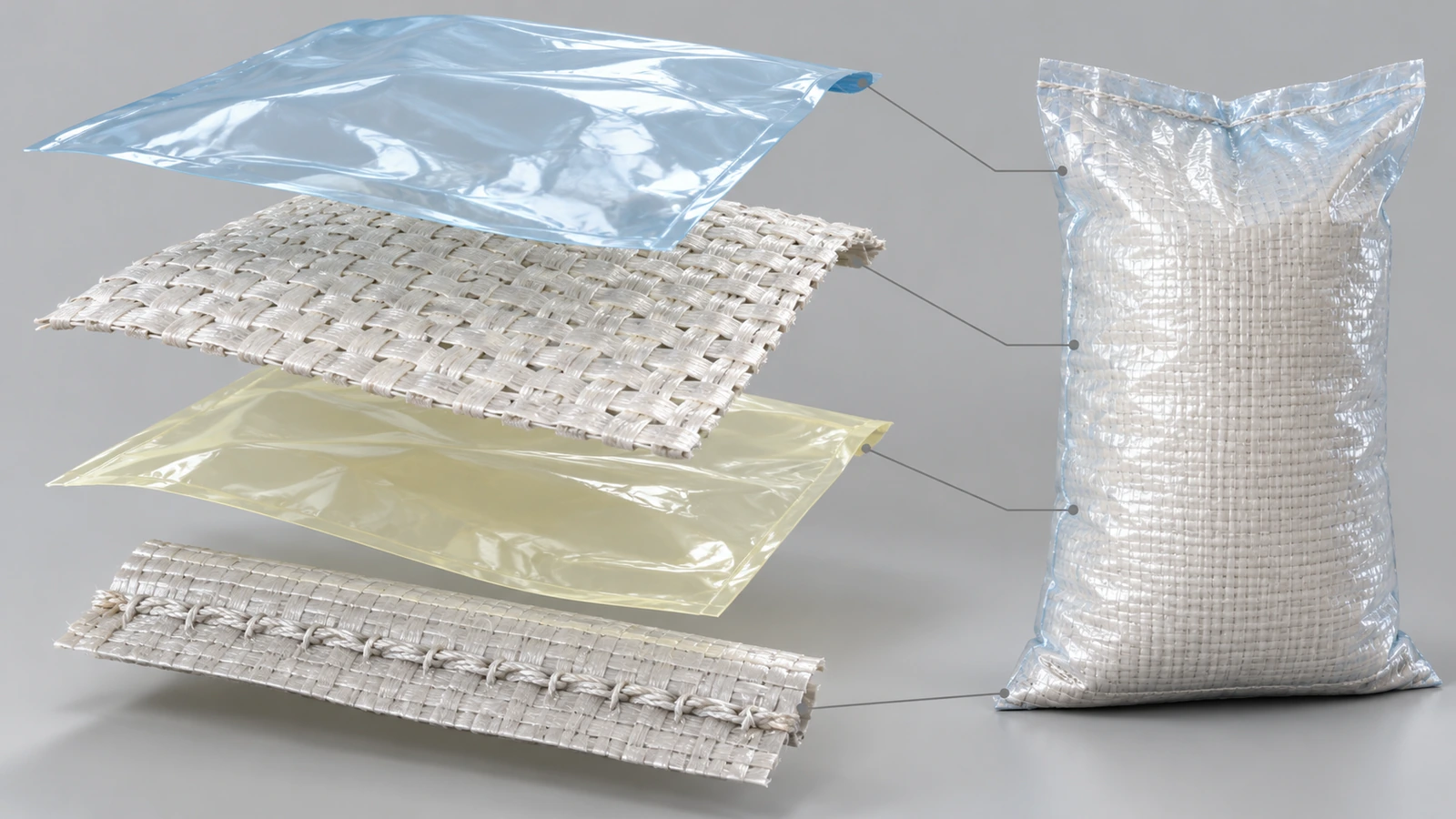
A woven polypropylene feed bag is a sack made from flat PP tapes. The polymer is extruded as film, slit, stretched and then woven on circular or flat looms into a fabric tube or sheet. The fabric is cut, sewn or heat-sealed at the bottom, and usually filled with 25 kg or 50 kg of feed, seed or grain. Those two sizes match the categories in ISO 23560:2015[4], the international standard for woven PP sacks used for cereals, sugar and pulses. That standard sets an average fabric breaking force of at least 918 N for the 50 kg type and 816 N for the 25 kg type. Those values matter later, when you decide how much recycled resin a new sack can carry.
The trade uses several names for the same base material: woven pp sacks, polyweave bags, raffia sacks. For recycling purposes, the name matters less than the layers added to the base fabric:
Base fabric: PP tapes, often with calcium carbonate filler and UV stabilizer. Fabric weight in GSM can be estimated as (warp mesh + weft mesh) × denier ÷ 228.6. This figure excludes coatings and laminates.
Print surface: direct flexo ink on the fabric, or a reverse-printed BOPP film laminated on top. BOPP is also polypropylene.
Moisture barrier: an extrusion coating of PP or PE, or a loose or stitched-in PE liner.
Closure: sewing thread (PP or polyester), crepe tape, or a heat-cut and sealed edge.
The base polymer is resin code 5. Each added layer either stays inside the PP family or introduces a second material that the recycler has to remove. Most acceptance decisions come down to that distinction.
How Do Woven Polypropylene Feed Bags Recycle After They Are Emptied?
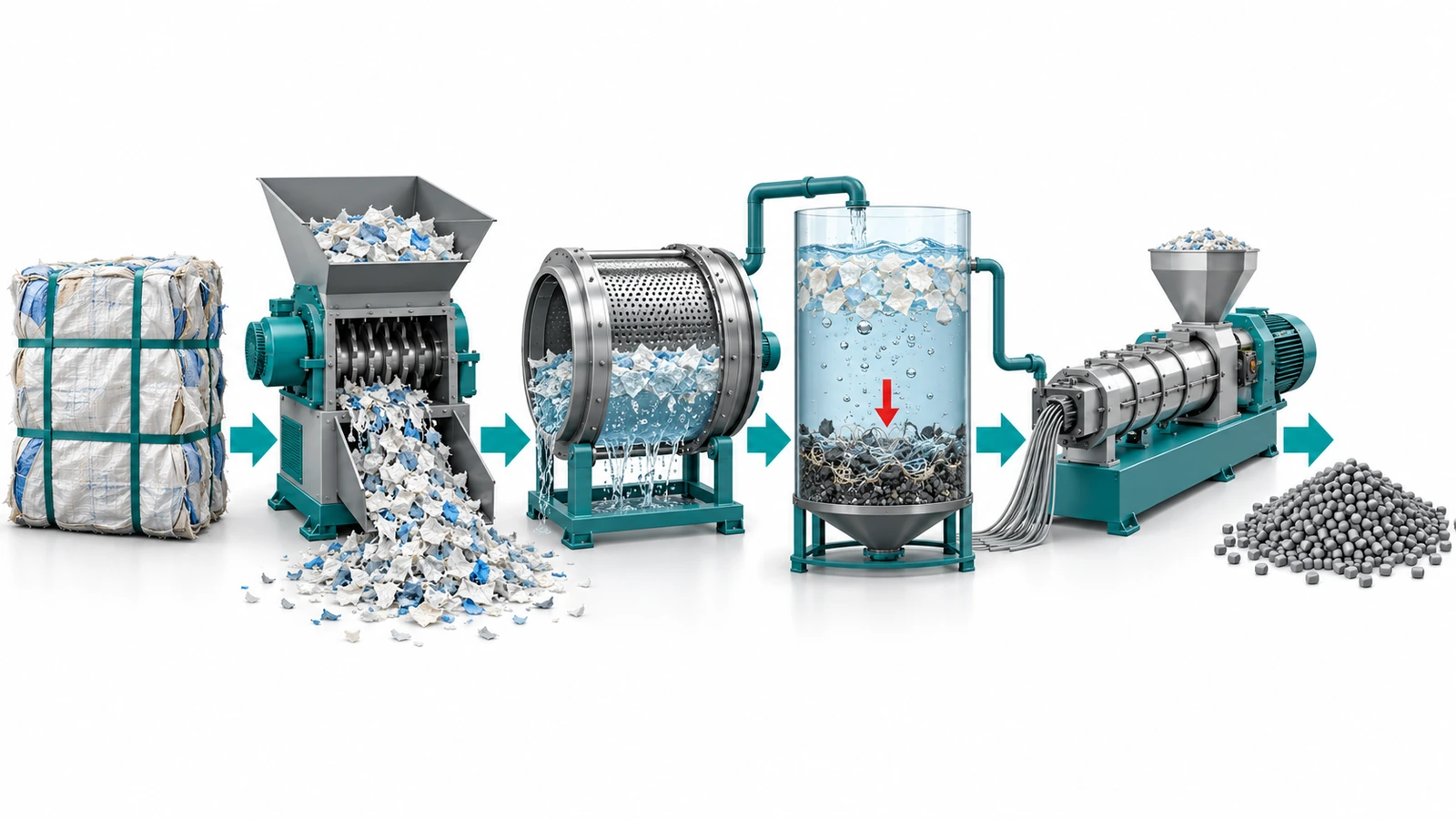
Municipal curbside programs are built around rigid containers and fiber. Most do not accept woven sacks, because the fabric wraps around sorting screens the way film does. Used feed bags therefore usually travel through a separate channel: agricultural plastics collection days, feed dealers that consolidate returns, or regional plastics processors that buy baled PP. Once a load reaches a processor, the steps are fairly consistent:
Inspection and bale opening. The processor checks the load for liners, mixed plastics, wet material and mold. Loads that fail inspection are downgraded or rejected.
Shredding. Sacks are cut into flakes or strips small enough to wash.
Washing. Friction washers remove feed dust, fats and soil. Organic residue is the main cost driver at this step.
Float-sink separation. PP has a density of roughly 0.90–0.91 g/cm³, so it floats in water. Denser plastics such as PET thread, PVC labels and heavily filled tape sink and are separated out.
Drying, extrusion and melt filtration. Clean flakes are melted and pushed through screens that catch unmelted particles. PP is typically processed at around 200–230 °C. Polyester thread does not melt at those temperatures, so it ends up clogging the filters.
Pelletizing. The output is recycled PP (rPP) pellets. They are usually gray or dark because reverse-printed inks are trapped in the laminate. Typical end uses are injection-molded or extruded goods rather than new food-contact packaging.
Float-sink is where filler choice determines the outcome. Woven tape commonly carries 5%, 10% or 15% calcium carbonate by weight to cut resin cost. Calcium carbonate has a density of about 2.7 g/cm³. Using simple mixture math, 10% filler brings tape density to about 0.99 g/cm³, which still floats, but only barely. At 15% filler the density reaches roughly 1.0 g/cm³, the same as water. Heavily filled sacks can therefore sink with the reject fraction and be lost even though they are "PP." The World Food Programme's technical expectations for woven bag manufacturers[5] already require calcium carbonate content to appear on each batch certificate, alongside GSM, mesh, stitch density and tensile strength. Any buyer can ask for the same field.
Step by Step: Preparing Used Sacks for a Recycler
Most rejected loads fail because of handling at the farm or mill, not because of the bag's chemistry. These steps cost little and noticeably improve acceptance:
Empty completely. Turn the sack inside out or shake it over the feed bin. Residual feed adds weight, attracts rodents and molds once it gets damp.
Keep sacks dry and shaded. Wet bales mold, and sunlight breaks down PP tape. Sun-damaged fabric chalks, fades and cracks when folded. Those brittle fragments wash away as fines and lower the yield.
Separate liners and foreign parts. Pull out loose PE liners and keep them in their own film stream. Remove paper tags, wire ties and twine.
Sort by construction when the outlet asks for it. Some processors accept laminated and unlaminated sacks together. Others want paper-laminated or PE-coated sacks kept apart. Follow the written acceptance spec, not assumptions.
Exclude chemically contaminated sacks. Bags that held pesticides or hazardous products usually belong in a separate agricultural chemical container program. Keep them out of a feed-bag load.
Bundle or bale consistently. Flatten the sacks, stack them in the same orientation and strap them. Uniform bundles are easier to inspect and cheaper to ship.
Weigh and record. Log the weight of every outbound load. Those records support the claims and reports covered below.
Which Design Choices Help or Hurt Recyclability?
Collection habits only get you so far if the sack's construction works against the recycler. The table compares common feed-sack constructions by what happens at the plant and what a buyer can change in the spec.
Construction
Material families present
Typical recycling outcome
Design fix
Unlaminated woven PP, flexo print
PP + ink
Easiest to process; lightest-colored recyclate
Keep ink coverage moderate; specify PP thread
BOPP-laminated woven PP
PP fabric + PP film + adhesive or tie layer + ink
Generally processable as PP; darker pellets because inks are trapped between layers
Confirm the lamination or tie layer is PP rather than PE
PE extrusion-coated woven PP
PP + PE
Mixed polyolefin; lower-value recyclate that some outlets refuse
Switch to a PP coating where barrier needs allow
Woven PP with stitched-in PE liner
PP + PE film
Liner is difficult to separate after use; often downgraded
Use a loose liner that can be pulled out, or a PP liner
Kraft-paper-laminated woven PP
PP + paper + adhesive
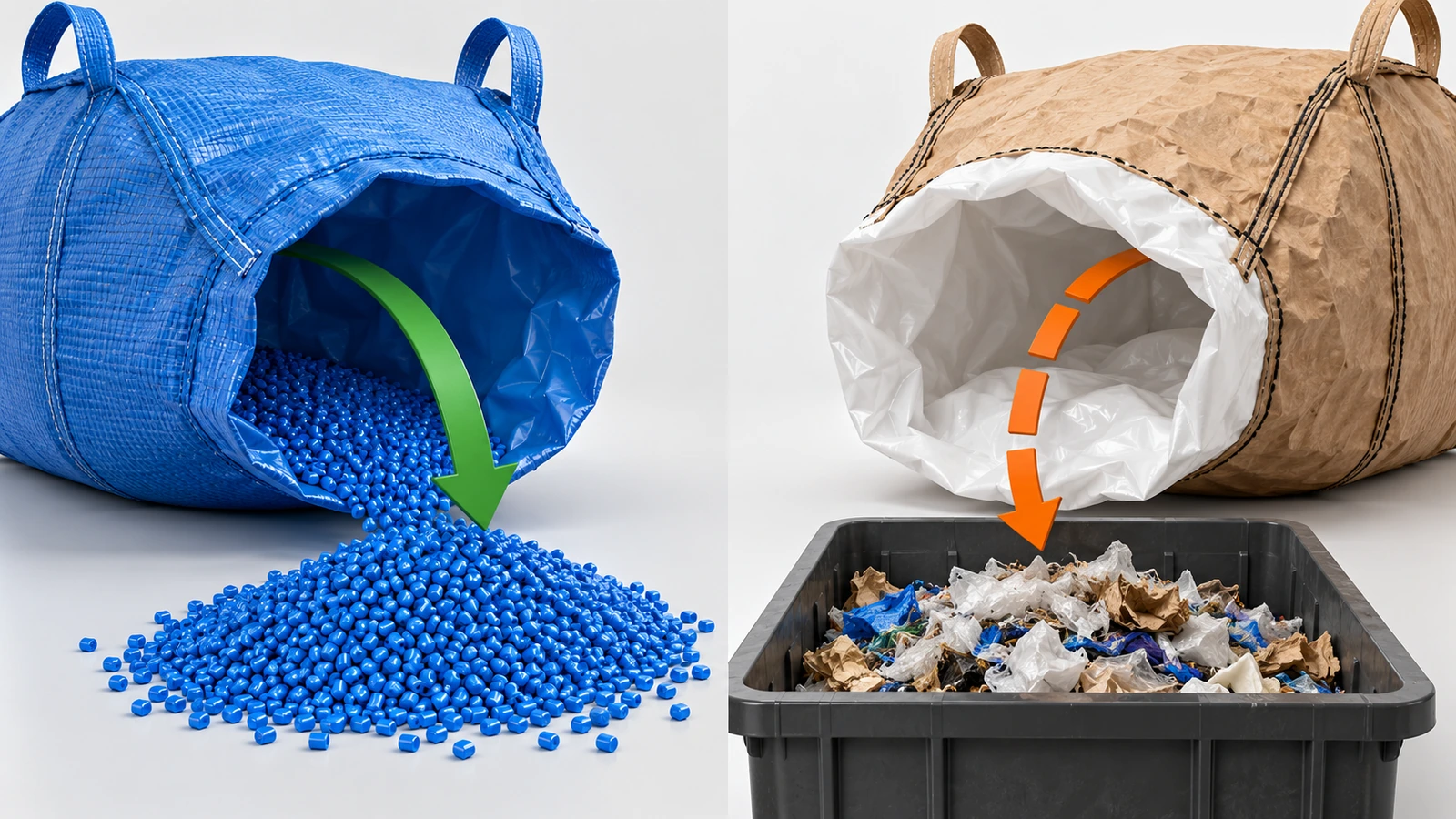
Neither paper mills nor PP recyclers want it; frequently landfilled
Avoid unless paper appearance is essential; consider a matte BOPP finish instead
Cap the filler and require it on batch certificates
Polyester-sewn bottom
PP + PET thread
Thread clogs melt filters; recyclers may cut off sewn ends
Specify PP sewing thread or a heat-sealed bottom
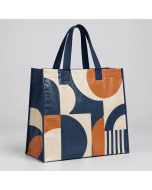
The pattern is straightforward. Every layer that stays polypropylene keeps the sack in one recycling stream. A pp woven sack made of PP fabric, BOPP film, a PP tie layer, PP thread and a removable liner is about as close to mono-material as this format gets. UV stabilizer is not a recyclability problem. It extends outdoor storage life and slows the embrittlement that ruins wash yield. If you also buy branded laminated totes for retail counters, the material, print and inspection details are covered in our laminated PP woven shopping bag specification guide. The end-of-life logic in this section applies to those totes as well.
Durability is a recyclability decision too. A bag reused many times delays the moment it becomes waste. California's former reusable-bag statute set a useful benchmark for fabric bags, including woven polypropylene: sewn, at least 80 g/m², and able to carry 22 lb over 175 ft for at least 125 uses[6]. Feed sacks are rarely reused that many times, but the same test logic can tell you whether a returned sack is fit for a second fill (where that is permitted) or should go straight to recycling.
How to Set Up a Take-Back or Recycled-Content Program
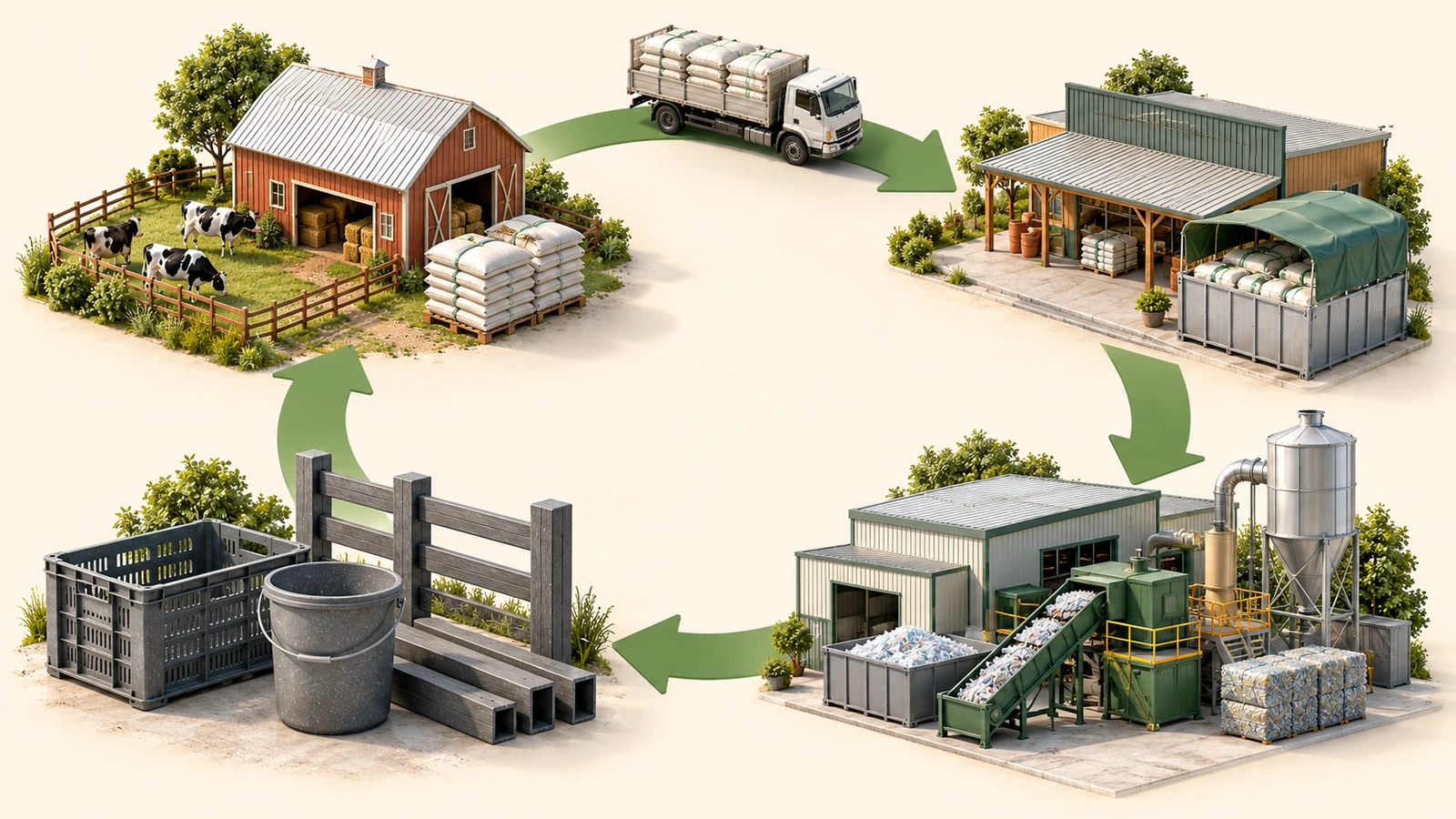
A take-back program turns scattered disposal into a stream that a recycler will actually pay for or accept free of charge. For a feed brand, a cooperative or a dealer network, the build-out usually follows seven steps.
1. Audit what you ship
List every sack SKU by construction, using the table above, and by monthly volume. Mixed fleets are common, and one paper-laminated SKU can contaminate an otherwise clean bale.
2. Secure an outlet before you collect
Ask candidate processors for a written acceptance specification: which constructions they take, the contamination limits, the moisture expectations, the bale format and the minimum load. Collecting without an outlet only moves the pile.
3. Design the return route
Dealers are the natural collection point, since customers already visit them to buy feed. Provide a dedicated, covered collection container. A short instruction printed on the sack itself ("empty, shake out, keep dry, return") plus the resin code reaches every end user at no extra handling cost.
4. Keep chain-of-custody records
Record weights per dealer, per load and per recycler, and ask the recycler for receiving documentation. These records are the only defensible basis for any public statement about collected tonnage.
5. Close the loop with recycled content, carefully
Post-consumer rPP from sacks is usually best placed in non-contact products, or in layers and components that do not touch the feed. Feed and food-contact packaging follows a different rulebook. In the US, olefin polymers used in contact with food are governed by 21 CFR 177.1520[7]. That regulation covers resin and conditions of use; FDA does not approve finished bags. Any recycled resin in a contact layer needs supplier documentation of its suitability. Recycled content also dilutes tape strength, so test new sacks against targets such as the ISO 23560 breaking-force values above before approving a higher blend.
For retail and promotional woven bags, recycled content is already an established purchasing requirement. New York's GreenNY reusable bag specification[8], approved on 11 December 2025, lists woven PP as an eligible material. It requires at least 80 GSM and 50% total recycled content, bans PVC, and encourages printing the recycled-content percentage on the bag or on a permanent tag.
6. Word claims so they hold up
Say what is true and verifiable: "polypropylene (#5); return to participating dealers for recycling" is safer than "100% recyclable." California ties recyclability to real access. Its current carryout bag rules[9] require that checkout paper bags be accepted in a majority of curbside programs. They also set recycled-content floors of 40% for bags rated above 8 lb and 20% for smaller bags, rising to 50% from 1 January 2028. Self-declared environmental claims are commonly structured around ISO 14021, which expects the claim to be specific and supported by evidence.
7. Plan for export markets and trade rules
If you ship packaged goods into the EU, Regulation (EU) 2025/40 (PPWR)[10] brings design-for-recycling requirements into law. An analysis by Strategic Packaging Insights[11] notes that the regulation applied from 12 August 2026. Recyclability grading still awaits implementing acts, and many obligations start on 1 January 2030, so mono-PP redesigns started now will be ready in time. On the sourcing side, recycled content does not change tariff classification. The US International Trade Commission voted in February 2025 to keep antidumping and countervailing duty orders on laminated woven sacks from China[12] in place. Those orders date back to 2008.
FAQ
FAQ: Can I put used feed sacks in my curbside recycling bin?
Usually not. Most curbside programs exclude woven sacks because the fabric tangles in sorting equipment. Check your county's list, and otherwise use an agricultural plastics collection, a feed dealer return point or a PP processor that accepts woven material.
FAQ: Are BOPP-laminated feed bags recyclable?
They are generally processable as polypropylene, because BOPP film is also PP. Recyclability drops if the lamination tie layer is PE, if the sack carries a stitched-in PE liner, or if it is paper-laminated. Ask your supplier to state the material of every layer.
FAQ: Do I need to wash sacks before returning them?
No. Recyclers wash flakes after shredding. What they need from you is sacks that are fully emptied, shaken out and dry. Wet, moldy or residue-heavy bales are the main reason loads get downgraded.
FAQ: Can recycled PP from old sacks go back into new feed bags?
Sometimes, in limited amounts and usually away from the feed-contact side. Recycled content can reduce tape strength, and contact layers need documentation under rules such as 21 CFR 177.1520. Test strength, and get the resin supplier's paperwork before raising the blend.
FAQ: Why do some woven PP sacks get rejected even though they are polypropylene?
The usual causes are high calcium carbonate filler (which can make tape sink in float-sink tanks), polyester sewing thread that clogs melt filters, PE coatings or liners, paper laminates and sun damage that turns the fabric brittle.
FAQ: Can we print "recyclable" on our woven polypropylene sacks?
Only if you can document that collection and processing are actually available to the people who receive your sacks. A specific statement such as "#5 PP — return to participating dealers" is easier to defend than an unqualified claim. California's 2026 settlement over bag recyclability claims shows the risk.
Key Takeaways
Filler content can decide whether a PP sack is recovered at all. — Calcium carbonate content is a per-batch certificate field, and about 15% filler pushes tape density to roughly that of water (Source)
Recycled content is already a written purchasing requirement for woven PP bags. — 50% total recycled content at a minimum of 80 GSM (Source)
Reuse comes before recycling, and it can be tested. — 22 lb carried 175 ft for at least 125 uses (Source)
Strength targets limit how much recycled resin a new sack can take. — At least 918 N fabric breaking force for 50 kg food sacks (Source)
Heavier PP bag formats are growing, so end-of-life planning matters more each year. — At least a sixfold rise in PP for woven and nonwoven bags after one state ban (Source)
EU design-for-recycling rules are now law, with a deadline for redesign. — Applied from 12 August 2026, with many obligations from 1 January 2030 (Source)
Conclusion: Make the Next Sack Easier to Recycle Than the Last
Used feed sacks become a recyclable stream when three things line up. The sack stays within the PP family, the people emptying it keep it clean and dry, and a processor has agreed in writing to take it. None of this requires exotic materials. It requires a specification that names every layer, a filler cap on the batch certificate, PP thread, a removable liner and a collection route your dealers can actually run.
If you are reviewing a sack or woven bag specification for recyclability, recycled content or take-back labeling, send us your current construction and end-use details. We will help you work through the layer-by-layer options and quote against your actual requirements.
Hi there! I'm Bruce, proud dad to my amazing son. I'm the founder of Zigpac, a printing and packaging company empowering small and medium-sized businesses with custom solutions. Let's create something great together!



 Blog PDF for offline reading












The information below is required for social login
Sign In
Create New Account