
 Blog PDF for offline reading
Quick answer: For a high-traffic trade show giveaway, Zigpac's stitched non-woven totes usually give the lowest cost per bag (US$0.48 each at 1,000+, November 2026, final price on your quote), while its lightweight cotton totes (US$0.75 at 1,000+) are the better pick when you want a bag that qualified leads, VIPs or members keep and carry for months. The non-woven tote has price tiers from 500 pcs, final MOQ on your quote; the cotton tote has price tiers from 100 pcs, final MOQ on your quote. Choose by the job the bag must do after the show, not by unit price alone, and approve a physical sample before bulk production.
You have a booth, a registration desk or a community event, and a budget line for a few hundred to several thousand logo totes. The choice usually narrows to non-woven vs cotton tote bags: stitched spunbond polypropylene at the lowest price, or lightweight woven cotton that feels like a real bag. Pick wrong and you either overspend on bags that walk-up visitors drop in a hotel bin, or you hand VIPs something that feels like packaging.
The stakes are real. US promotional product distributor sales reached US$27.1 billion in 2025[1], so your bag competes with a lot of other swag for a place in someone's routine. Critics have long argued that most conference totes "aren't particularly sturdy or well designed" enough to make it to the grocery store, as Fast Company put it[2]. Marketers on forums say the same thing more bluntly: polypropylene totes are for giveaways, while cotton gets reused. This guide turns that instinct into numbers you can put in a budget: cost per bag at real quantities, how logos print on each fabric, which bag people keep, how each one ships to the booth, what environmental wording holds up, and how to order on time.
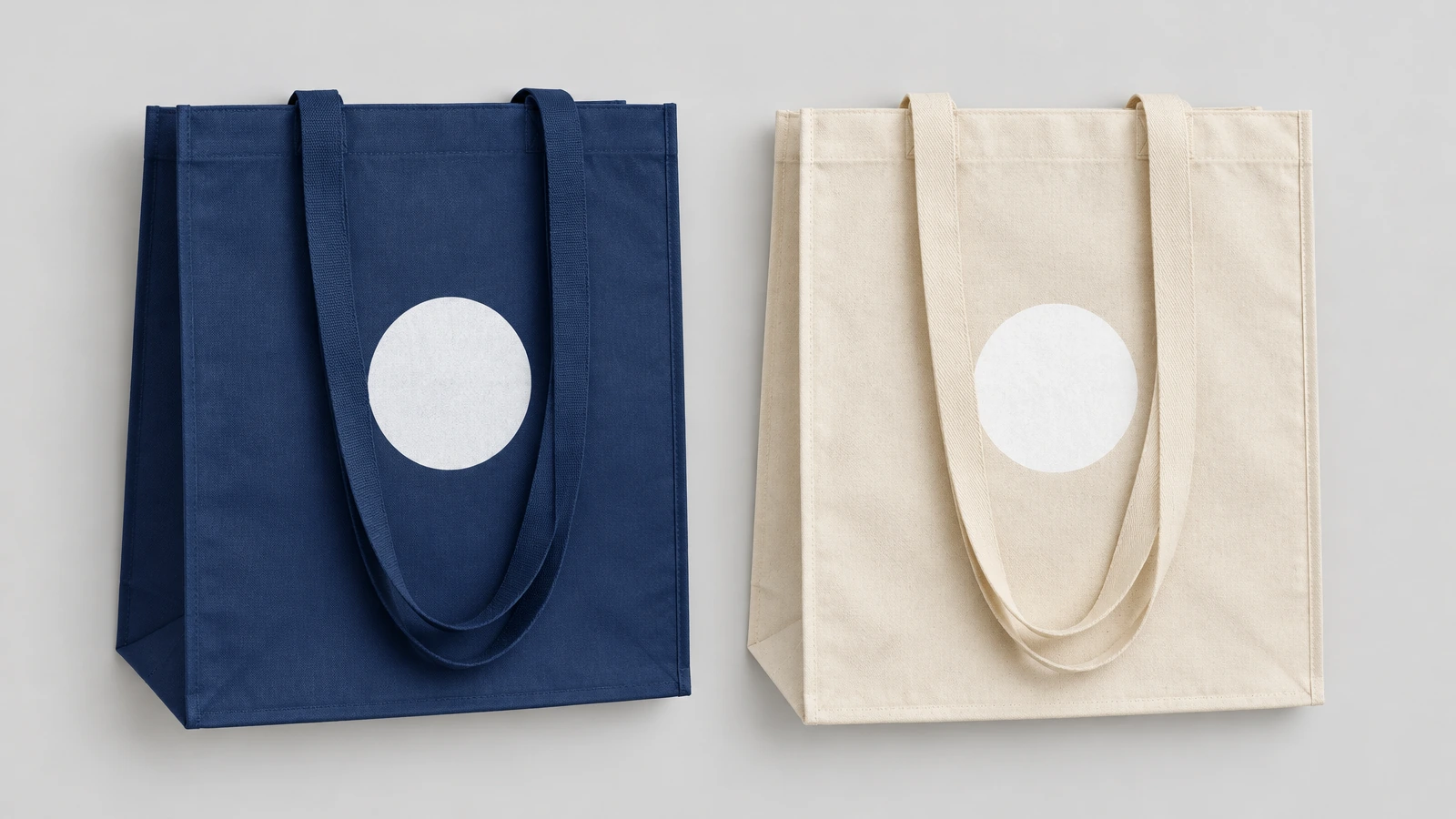
What exactly are you comparing?
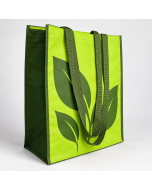
A stitched non-woven tote is cut and sewn from spunbond polypropylene. That material is a sheet of fibers bonded together with heat rather than woven on a loom. Under US textile rules, the generic fiber name for polypropylene is olefin[3]. It is a plastic textile, and that matters for how ink sits on it and what you can claim about it. Fabric weight is specified in GSM. For how to choose GSM, see our separate guide on non-woven bag GSM thickness; this article does not repeat it.
A lightweight cotton tote is woven from cotton at 4–6 oz/yd², which is roughly 136–203 g/m². At equal area, that fabric is about 1.7 to 2.5 times heavier than the 80 GSM non-woven common in US promotional catalogs. The difference shows in the hand feel, in the print and in the shipping weight. Specifications for the non-woven option, including fabric, stitching and acceptance checks, are on the custom non-woven tote bag specification page.
Non-woven vs cotton tote bags: the verdict by event type
Start from what the bag must do on the day and in the weeks after. Use this table to choose, then check the cost and print sections below.
| Event type | Recommended material | Why |
|---|---|---|
| One-day expo, walk-up giveaway | Stitched non-woven | Lowest cost per bag at volume; bright, flat spot colors; visitors need something to carry brochures in on the floor |
| Multi-day conference registration kit | Lightweight cotton (5–6 oz), or non-woven if the headcount is large | Cotton folds flat into kit boxes, and attendees carry it for several days, so exposure lasts longer |
| Retail or brand activation | Cotton if the bag is part of the brand experience; non-woven for high-volume sampling | Perceived value tracks how the brand wants to be seen |
| VIP or speaker gift | Cotton, 8–10 oz if you expect repeated reuse | Heavier woven cotton reads as a gift rather than packaging |
| Outdoor or wet-weather event | Non-woven | Polypropylene does not absorb water; light cotton soaks through and shows mud |
| Sustainability-themed event | Whichever bag your audience will actually reuse, usually cotton | Neither material is "eco-friendly" by itself; the defensible message is reuse (see below) |
Cost per bag at 500, 1,000, 3,000 and 5,000
At Zigpac, both bags have live tier tables. The non-woven tote has price tiers from 500 pcs, final MOQ on your quote; the cotton tote has price tiers from 100 pcs, final MOQ on your quote. Below are the totals at each tier, with every multiplication checked. All prices are from November 2026; the final price is on your quote.
| Quantity | Stitched non-woven (per bag → total) | Lightweight cotton (per bag → total) | Difference |
|---|---|---|---|
| 100 | Below first tier — ask for a quote | US$1.30 → US$130 | — |
| 500 | US$0.65 → US$325 | US$0.95 → US$475 | US$150 |
| 1,000 | US$0.48 → US$480 | US$0.75 → US$750 | US$270 |
| 3,000 | US$0.35 → US$1,050 | US$0.55 → US$1,650 | US$600 |
| 5,000 | US$0.28 → US$1,400 | 3,000+ tier US$0.55 → US$2,750 (larger-run pricing on your quote) | US$1,350 |
Unit price is only part of the cost. The quoted figure moves with bag size, number of print colors and print locations, whether you add a gusset, and how the bags are packed. On non-woven, each added screen color adds a setup charge. Freight and import duty are extra on both bags. Because cotton fabric is heavier per square meter, expect its freight per thousand bags to run higher too. Ask for landed cost to your booth address, not a factory price.
The better metric: cost per bag actually kept
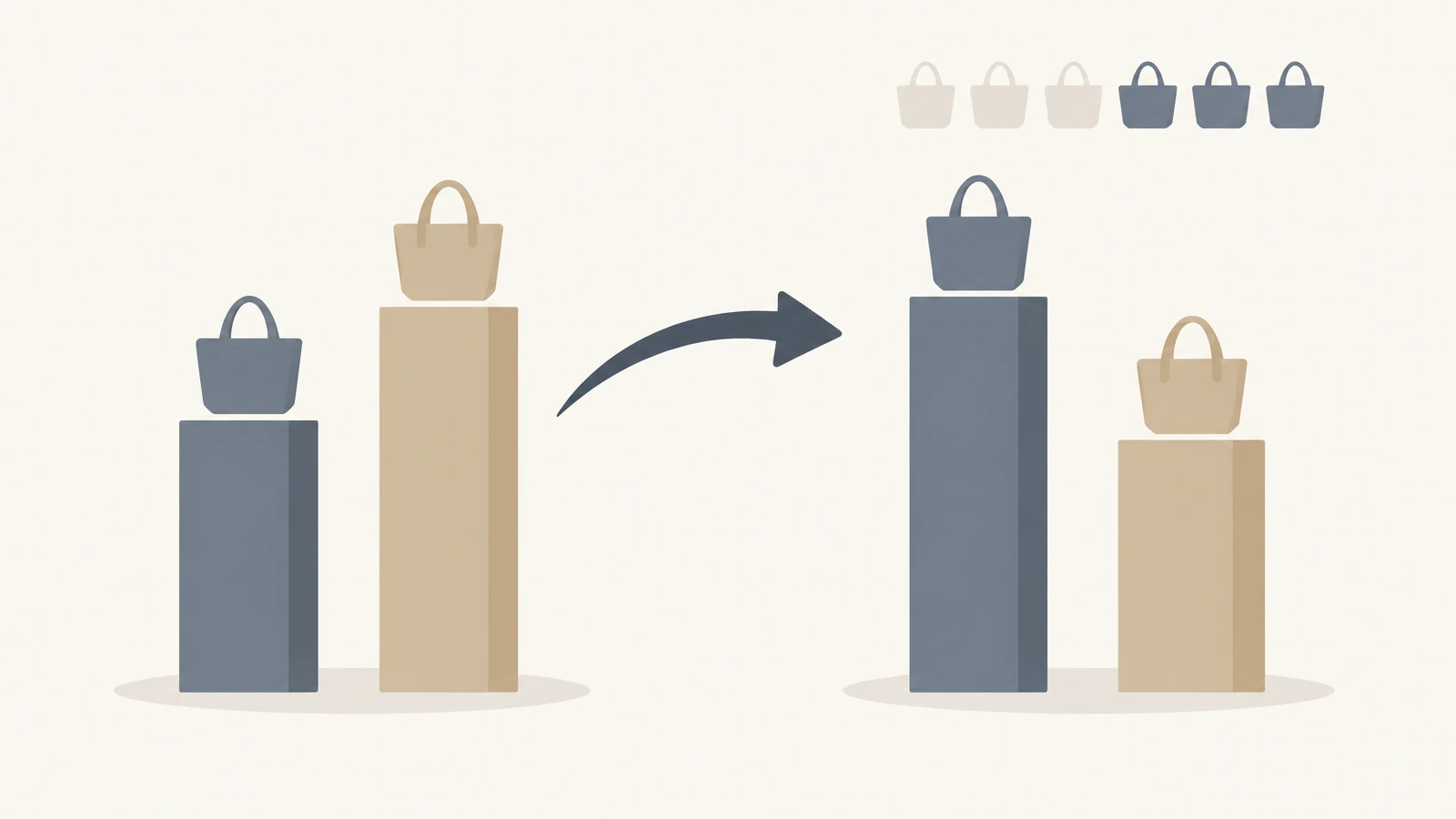
You buy a branded bag for the impressions after the show. A cheaper bag that goes in the bin costs more per carried bag than a pricier one people use. No public study gives a reliable keep rate for either material, so treat the following as a hypothetical illustration, not data. Assume 1,000 of each bag, that 30% of the non-woven bags are still carried a month later, and that 60% of the cotton ones are.
- Non-woven: US$480 ÷ 300 kept bags = US$1.60 per kept bag
- Cotton: US$750 ÷ 600 kept bags = US$1.25 per kept bag
The general rule is simpler than any assumed rate. At 1,000+, cotton costs 0.75 ÷ 0.48 ≈ 1.56 times as much per bag. It therefore wins on cost per kept bag only if its keep rate is more than about 1.56 times that of non-woven. If you expect 30% for non-woven, cotton needs to beat roughly 47%. For anonymous walk-up traffic, that is a big ask. For qualified leads who chose to visit your booth, it is plausible. Measure your own rate with a post-event survey question or a bag-carrying photo contest rather than assuming one.
Print quality on spunbond PP vs 4–6 oz cotton
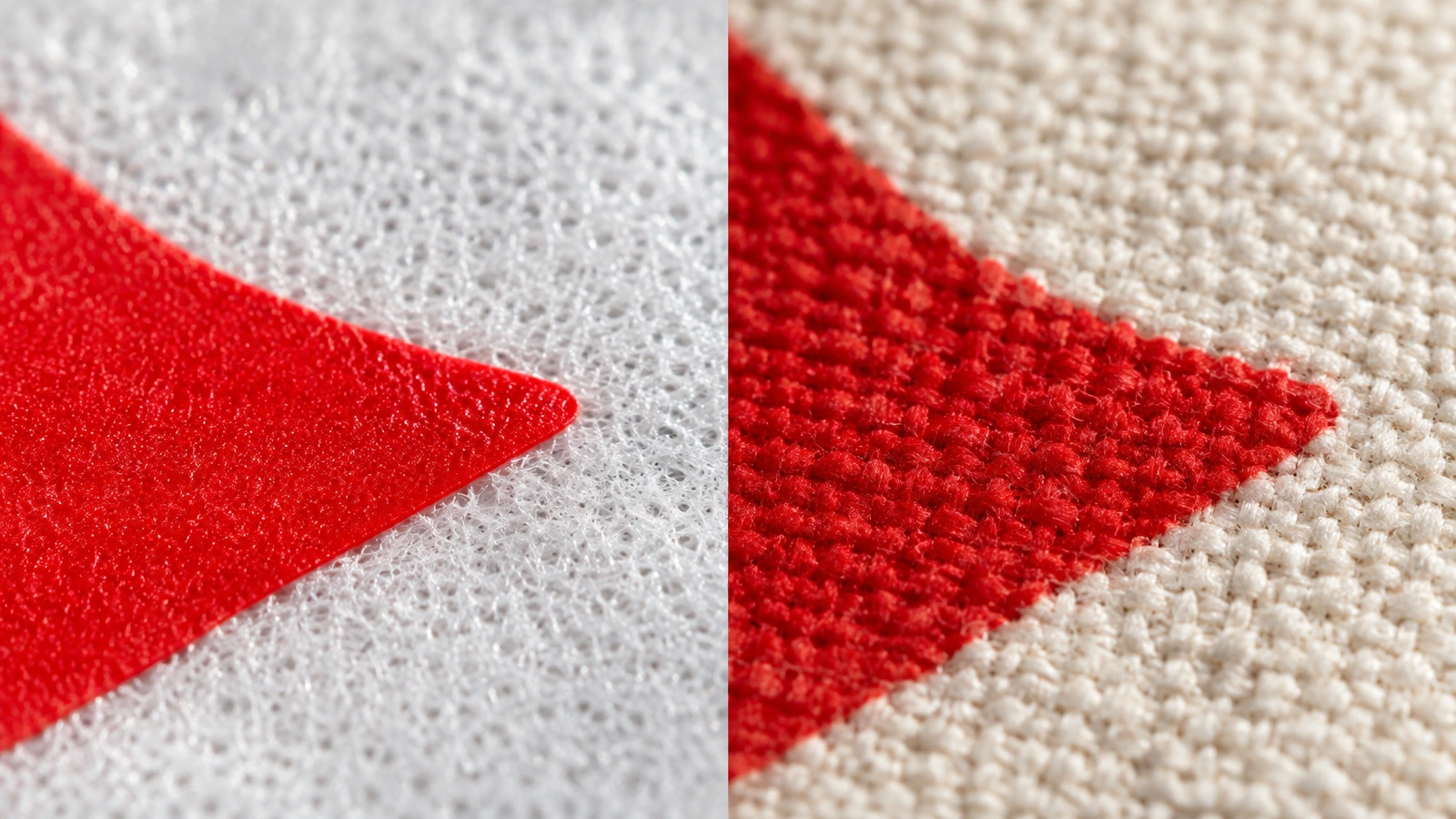
The two fabrics take ink differently, so the same logo file can look very different on each. On spunbond polypropylene, ink sits on the surface instead of soaking in. Spot colors print bright and flat, which suits bold logos. The material is heat sensitive and cannot take sublimation. Photographic gradients push the job to heat transfer or laminated full-color printing, and each added screen color adds setup cost.
On lightweight cotton, ink soaks into the weave. Screen print is the default for one or two spot colors. On natural cotton it gives a warmer, slightly softer look that many brands read as more premium. Thin 4–6 oz fabric can soften very fine lines. Heavy solid ink blocks stiffen the panel and can crack where the bag is folded. Photos and gradients go to DTF transfer, and sublimation does not work on pure cotton.
| Artwork type | On stitched non-woven | On lightweight cotton |
|---|---|---|
| 1–2 spot-color logo | Excellent: screen print, crisp and bright | Excellent: screen print, warmer tone |
| Small text or thin lines | Good if strokes are not hairline; check on a sample | Fine lines can soften on thin weave; thicken strokes |
| Large solid color blocks | Prints evenly | Can crack on fold lines; use a lighter ink deposit or a smaller block |
| Photo or gradient | Heat transfer or laminated full color | DTF |
| Light ink on dark fabric | Needs an opaque ink; approve contrast on a swatch | Needs an opaque or underbased ink; approve on fabric |
The most common complaint in buyer reviews is not a printing defect. It is a logo that disappears on a darker bag than the buyer expected. Zigpac's non-woven tote guidance is to approve ink contrast on a physical swatch, and Zigpac recommends the same physical-sample check for cotton before bulk production. A screen proof cannot show how ink sits on real fabric.
Reuse and lifespan after the show
Industry material guides consistently position non-woven polypropylene for high-volume giveaways and short-term use. Cotton is positioned for bags people carry repeatedly. Zigpac's cotton guidance draws a similar line inside cotton itself: 5–6 oz suits conference handouts, and 8–10 oz suits bags people reuse. Cotton also folds flat into a drawer or a car, which helps it stay in rotation. If you expect attendees to wash the bag, ask for pre-shrunk fabric. Unshrunk cotton can shrink up to 10% in the first wash, and buyer reviews of bulk cotton totes repeatedly mention shrinkage after machine drying. Non-woven should be spot cleaned and air dried, never ironed.
Material is only half of the keep decision. Three design choices matter as much on either bag:
- Size that fits real cargo. If a laptop sleeve or an A4 (210 × 297 mm) folder slides in flat, the bag gets reused for work and school.
- Handle length for shoulder carry. Hand-only handles push a bag into the "groceries only" category. A shoulder drop gets it worn in public.
- A design people want to be seen with. A small, tasteful mark or an event-themed illustration outlasts an oversized logo. People rarely carry an ad they did not choose.
Logistics at the booth
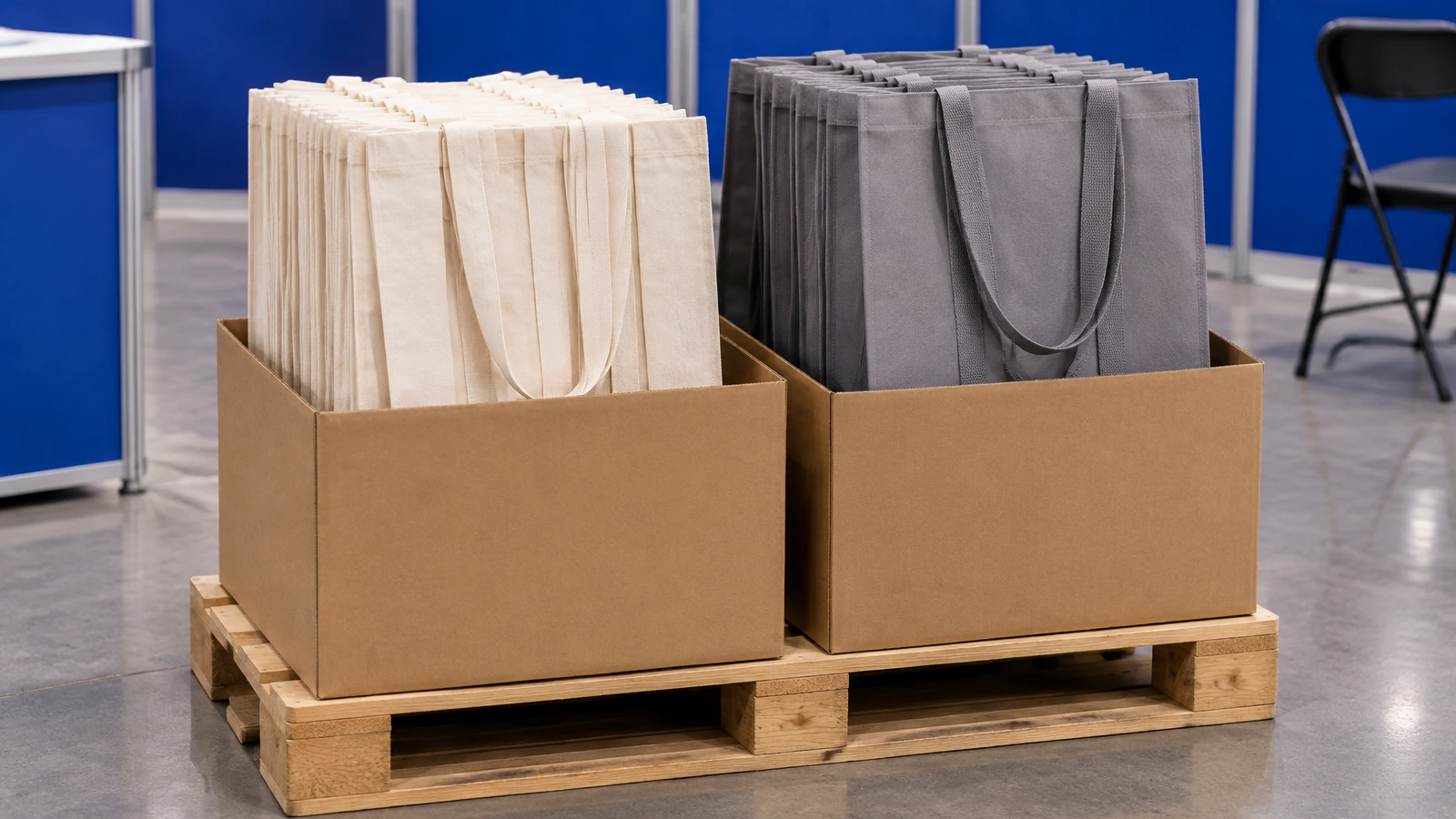
Non-woven wins on weight: a lighter fabric means lighter cartons to carry from the loading dock and lower freight per thousand bags. Cotton wins on bulk. Thin cotton folds flatter than a stitched non-woven tote with a gusset, so registration teams can stack it into kit boxes or slide it under a counter. In wet weather, keep cotton cartons off concrete floors, because damp cotton can mildew in a sealed box. Non-woven tolerates rain on an outdoor stand far better. For last-minute orders, simple artwork helps on both bags: a one-color logo on a standard size avoids extra setup and re-proofing, which is where schedules usually slip.
Environmental claims you can defend
Neither bag is environmentally better by default. What matters is how many times it is reused. The UK Environment Agency's life cycle assessment of carrier bags[4] (2011) found that a non-woven polypropylene bag must be used about 11 times, and a cotton bag about 131 times, to bring its global warming potential below that of a conventional lightweight plastic carrier used once. The Danish Environmental Protection Agency's 2018 assessment counted more impact categories than climate alone and pushed cotton's break-even far higher still. As The Guardian summarized in 2024[5], most promotional totes never come close to the reuse counts those studies require.
Four wording rules follow from this:
- Polypropylene non-woven is a plastic and is not biodegradable. Never print or post "biodegradable" for it.
- Under the FTC Green Guides, an unqualified "recyclable" claim requires collection access for a substantial majority, at least 60%, of consumers or communities where the item is sold (16 CFR 260.12[6]). Most curbside programs do not take soft polypropylene bags, so any recycling wording must be qualified.
- The FTC also warns against broad, unqualified terms like "eco-friendly" or "green" (FTC consumer guidance[7]). Do not use them for either bag.
- Say "organic cotton" only when the fabric comes with GOTS certification paperwork for your order.
The message that holds up is behavioral: "Reuse this bag. Every carry replaces a single-use bag." Then design the bag so that people do.
Decision matrix and a mixed plan
| If your priority is… | Choose |
|---|---|
| Lowest cost per bag at 1,000+ | Non-woven (US$0.48 vs US$0.75, November 2026, final price on your quote) |
| A small run of a few hundred | Cotton (price tiers from 100 pcs, final MOQ on your quote) |
| Bright, flat spot-color logo | Non-woven |
| Soft, premium feel and long-term carry | Cotton, 8–10 oz for repeated reuse |
| Rain or outdoor stand | Non-woven |
| Flattest fold for kit boxes | Lightweight cotton |
| Photo or gradient artwork | Either: laminated or heat transfer on non-woven, DTF on cotton |
Many exhibitors do not have to choose. A mixed plan puts non-woven in front of walk-up traffic and keeps cotton behind the counter for scanned leads, VIPs and speakers. Worked example for a show with about 3,500 bags: 3,000 non-woven at US$0.35 = US$1,050, plus 500 cotton at US$0.95 = US$475, for a total of US$1,525. All-cotton at the 3,000+ tier would be 3,500 × US$0.55 = US$1,925. All-non-woven would be 3,500 × US$0.35 = US$1,225. For US$300 more than all-non-woven, your best 500 contacts get the bag they are most likely to keep. Each line is priced at its own tier, prices are from November 2026, the final price is on your quote, and freight is extra.

How to order either bag for an event
At Zigpac, a quote comes back in 1–6 hours; complex projects take 6–24 hours of engineering review. Production starts within 2 hours after payment confirmation. Standard production is 10–15 days, with the final schedule on your quote, plus transit. Every order includes a free eProof, and physical samples ship for US$5–30. Bulk buyers can ask for a dedicated manager by email.
- Send the brief: logo file, quantity per material, bag size, print colors and locations, event date and delivery address. Ask for non-woven, cotton or a mixed quote side by side.
- Back-schedule from the event date: event date minus booth set-up buffer, minus transit time, minus 10–15 production days, minus proof and sample time. Work out the latest order date before you finalize the design.
- Approve the free eProof for placement, size and color callouts.
- Approve a physical sample to check ink contrast, fabric feel, handle length and fold behavior. Skip it only if the schedule truly cannot absorb it.
- Confirm acceptance points in writing: quantity, size, print position and packing per carton. Fabric and stitching details for non-woven are covered on the custom non woven tote bags page; the cotton option is Zigpac's Custom Lightweight Cotton Tote Bags.
FAQ
FAQ: Are non-woven or cotton tote bags better for a trade show giveaway?
Non-woven is usually better for high-volume walk-up giveaways, and cotton is better for bags you want qualified leads to keep. At Zigpac, the 1,000+ tier is US$0.48 for stitched non-woven and US$0.75 for lightweight cotton (November 2026, final price on your quote), so the deciding question is whether cotton's higher keep rate justifies the gap for your audience.
FAQ: How much more does cotton cost than non-woven per bag?
Cotton costs about 46–96% more per bag across the shared tiers. That is US$0.95 vs US$0.65 at 500, US$0.75 vs US$0.48 at 1,000, and US$0.55 vs US$0.35 at 3,000 (November 2026, final price on your quote). Freight and duty are extra and usually higher for the heavier cotton.
FAQ: Can I print a full-color photo on either bag?
Yes, but not by sublimation on either one. Non-woven uses heat transfer or laminated full-color printing, and cotton uses DTF. Both cost more than a one- or two-color screen print.
FAQ: Can attendees wash a lightweight cotton tote?
Yes, if the fabric is pre-shrunk. Unshrunk cotton can shrink up to 10% in the first wash, so specify pre-shrunk fabric or add line-dry care advice. Non-woven should be spot cleaned and air dried, never ironed.
FAQ: Can I call a non-woven tote eco-friendly or recyclable?
No, not without qualification. Polypropylene non-woven is a non-biodegradable plastic, an unqualified "recyclable" claim must meet the FTC's 60% access threshold, and the FTC discourages broad "eco-friendly" wording. "Designed for reuse" is the claim you can defend.
FAQ: How early should I order totes for an event?
Order no later than the event date minus transit, minus standard 10–15 days of production, minus time for the eProof and any physical sample. Request the quote as soon as headcount is roughly known; the final schedule is confirmed on your quote.
Key Takeaways
- Non-woven wins on unit cost at volume. — US$0.48 vs US$0.75 per bag at 1,000+, November 2026, final price on your quote (Source)
- Cotton wins on cost per kept bag only if its keep rate is about 1.56 times higher. — 0.75 ÷ 0.48 ≈ 1.56 (Source)
- Reuse, not material, decides environmental impact. — about 11 uses for non-woven PP vs 131 for cotton to beat a single-use plastic carrier on climate (Source)
- Unqualified "recyclable" claims need broad collection access. — at least 60% of consumers or communities (Source)
- Your bag competes in a crowded swag market. — US$27.1 billion in US promotional product sales in 2025 (Source)
- A mixed order covers both goals. — 3,000 non-woven plus 500 cotton is about US$1,525 vs US$1,925 all-cotton (Source)
Conclusion
If the goal is reach, choose stitched non-woven and spend the savings on a better design. If the goal is a bag that leads and VIPs carry for months, choose cotton and size it for real cargo. If you have both audiences, split the order. Send your logo, quantity, bag size, print colors, event date and delivery address to get a written quote for non-woven, cotton or a mixed order. Zigpac confirms final MOQ, price and schedule on the quote, with a free eProof before production and physical samples for US$5–30.
Footnotes
- PPAI, "PPAI Sales Volume Estimate: Promo Reaches New Height but Hampered by External Volatility," January 12, 2026. https://www.ppai.org/media-hub/ppai-sales-volume-estimate-promo-reaches-new-height-but-hampered-by-external-volatility/ ↩
- Fast Company, "It's time to stop spending billions on cheap conference swag," November 2, 2018. https://www.fastcompany.com/90260185/its-time-to-stop-spending-billions-on-cheap-conference-swag ↩
- US Federal Trade Commission, 16 CFR Part 303, Rules and Regulations under the Textile Fiber Products Identification Act (generic fiber name "olefin," § 303.7). https://www.ecfr.gov/current/title-16/chapter-I/subchapter-C/part-303 ↩
- UK Environment Agency, "Life cycle assessment of supermarket carrier bags: a review of the bags available in 2006," published 2011. https://www.gov.uk/government/publications/life-cycle-assessment-of-supermarket-carrierbags-a-review-of-the-bags-available-in-2006 ↩
- The Guardian, reporting on reusable tote bags, July 30, 2024. https://www.theguardian.com/environment/article/2024/jul/30/reusable-tote-bags ↩
- US Federal Trade Commission, Guides for the Use of Environmental Marketing Claims, 16 CFR § 260.12 (Recyclable claims). https://www.ecfr.gov/current/title-16/chapter-I/subchapter-B/part-260/section-260.12 ↩
- US Federal Trade Commission, Consumer Advice, "Eco-friendly and green marketing claims," May 19, 2021. https://consumer.ftc.gov/eco-friendly-green-marketing-claims ↩
- ASI, "ASI Reports Record $26.6 Billion in Annual Sales for Promo Products Industry," February 12, 2025 (cross-check of 2024 channel size). https://www.prnewswire.com/news-releases/asi-reports-record-26-6-billion-in-annual-sales-for-promo-products-industry-302375240.html






The information below is required for social login
Sign In
Create New Account