
 Blog PDF for offline reading
Quick answer: Zigpac makes custom printed zipper stand-up pouches for small food brands, with price tiers from 100 pcs, final MOQ on your quote, in PET/PE laminates with optional metallized PET, foil or EVOH barrier layers. When you compare suppliers of printed stand up pouches for small food brands, look past the per-bag price. Check four things instead: the printing route used for your quantity per design, measured OTR and WVTR data for the exact laminate, a food-contact declaration that cites the applicable 21 CFR sections, and a proof-and-sample step before bulk production. Short-run digital converters, plate- or cylinder-based converters and stock pouches with labels each fit a different stage, so match the route to your number of designs and how stable your reorders are.
You roast coffee, blend tea, pack jerky treats or sell a spice line. You need a few hundred to a few thousand printed bags per flavor, not a container load. The quotes you get, though, often carry minimums sized for national brands. They list film codes you cannot compare, and they say nothing about which documents prove the bag is suitable for your food.
Choosing the wrong pouch costs more than the invoice. A film with too little oxygen barrier lets coffee go flat within weeks. A zipper placed where the sealing jaw lands creates a false seal. Adding a valve after artwork approval sends the whole file back to the dieline. Seal faults are also the most common way flexible pouches fail. In a review of 791 seal-integrity recalls of medical products between 2019 and 2025, pouches made up 74.8% of cases and 54% were traced to incomplete or defective seals, according to a 2025 AAPS Open analysis[1]. Food pouches are a different category, but they fail in the same way.
This guide shows how to tell supplier types apart, which film and features to fix before artwork, which papers to request, and how quantity per design sets your minimum order and unit price.
Which Suppliers Make Printed Stand Up Pouches for Small Food Brands?
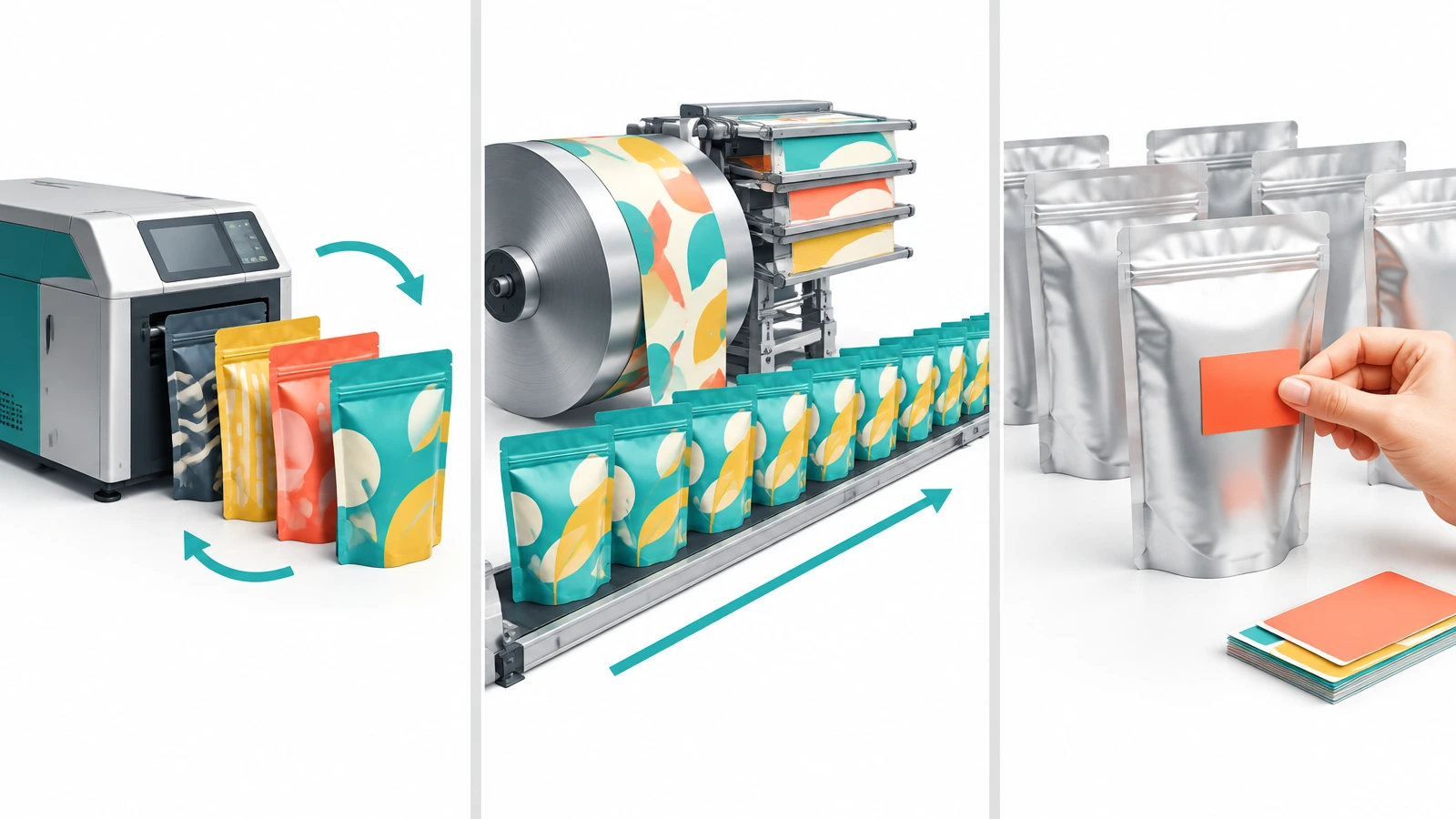
The useful split is by how the image reaches the bag, not by company name. A small food brand will usually meet three supplier routes.
| Supplier route | How the bag is printed | Fits when | Watch out for |
|---|---|---|---|
| Short-run digital converter | Printed straight from the file. There are no plates or cylinders for each design. | Several flavors or SKUs, low quantity per design, artwork that still changes | Higher unit price. Not every film or finish is offered on the digital line. Color can drift between runs. |
| Plate- or cylinder-based converter (flexo, rotogravure) | Flexo needs one plate per color. Rotogravure needs one engraved cylinder per color. Both are a one-time tooling cost. | Frozen design, steady monthly sales, repeat orders that reuse the same tooling | Any artwork change means new plates or cylinders. Minimums are higher. Production and shipping take longer. |
| Stock pouch plus labels | A blank stock pouch with a printed label applied in-house | Recipe or fill weight still changing, market stalls, test batches | Limited sizes and films. Labels can lift. The shelf look is weaker and the barrier cannot be tailored. |
Tooling is the reason minimums differ so much. A plate or cylinder is paid for once and spread across every bag in the run. That makes plate-based print cheap at volume and expensive for a 300-bag seasonal flavor. Digital presses skip that tooling. Trade press coverage of digitally printed flexible packaging[2] ties the model to smaller, faster-moving brands. It cites Bain & Co. data showing that insurgent brands held under 2% of category share but produced nearly 39% of category growth in 2024.
Many brands combine routes. They might use stock bags with labels for a pilot, a short printed run for launch, and plate-based reorders once a design stops changing. Zigpac confirms the printing route for each design on the quote rather than promising one process in advance. Ask every supplier the same question: which route will this design run on, and what changes when I reorder?
How to Choose a Supplier and Spec in Five Steps
Step 1: Pick the film on measured barrier, not on looks
Start with what damages your product. Oxygen makes nuts, coffee and fish-based treats go stale. Moisture causes powders and spices to clump. Light fades tea and some supplements. Then ask each supplier for the oxygen transmission rate (OTR) and water vapor transmission rate (WVTR) of the exact laminate they will quote, with the test conditions stated.
OTR is normally measured to ASTM D3985 (dry) or ASTM F1927 (controlled humidity)[3]. Test reports are only comparable when the method, temperature and humidity match. A label such as "high barrier" without numbers cannot be compared at all. The film table below shows what each structure is usually chosen for.
Step 2: Lock zippers and features before artwork
Every feature moves a line on the dieline, and most of them add cost. Decide on all of them before a designer opens the file.
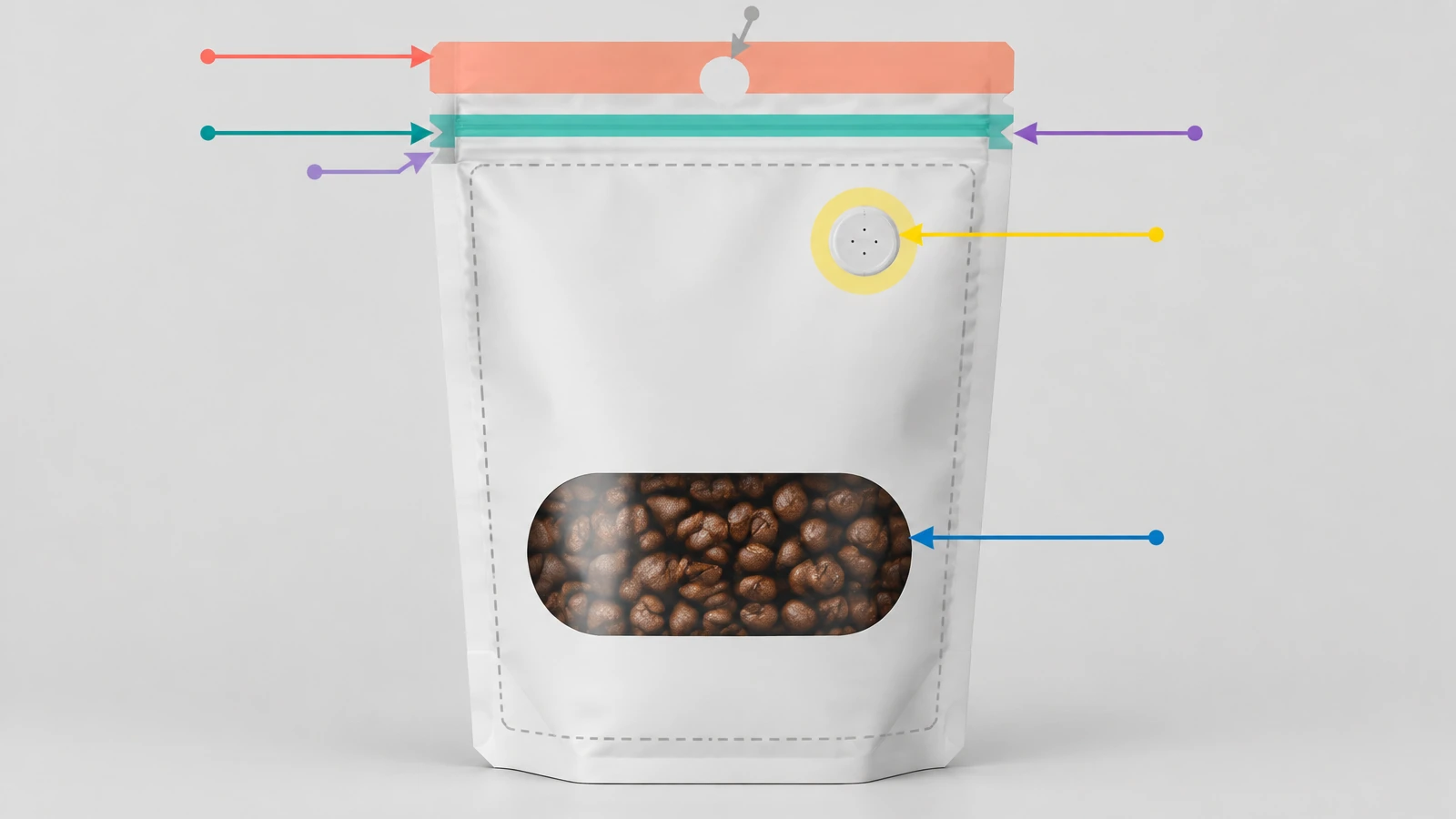
- Press-to-close zipper: commonly placed about 30–35 mm below the top edge. This leaves room above it for the top heat seal and tear notch. Never run a sealing jaw over the zipper. You get a false seal and a damaged zipper in one pass.
- Tear notches: placed above the zipper so the customer opens the bag without tearing the reclosure.
- Hang hole: keep it clear of the top seal and of key artwork.
- One-way degassing valve: for fresh-roasted whole-bean coffee that is still releasing CO2. Keep the valve flange away from barcodes and small text.
- Clear window: shows the product but leaves part of the bag without metallized or foil protection.
- Matte, gloss or soft-touch finish: changes look and feel only. It does not change barrier.
Seal strength is tested with ASTM F88/F88M-23[4], which measures the force needed to separate a seal and records how it fails. The full sequence of specifying, filling trials and release testing for one pouch is covered on our page on how to specify and order custom printed zipper stand-up pouches.
Step 3: Request the right food-contact documents
The FDA does not approve individual pouches. Under the food additive framework, a substance that can migrate into food must be authorized for its intended use, judged against a "reasonable certainty of no harm" standard, as summarized in this FDA food-contact regulatory overview[5]. Ask any supplier for:
- The full laminate structure, layer by layer, including the sealant layer, inks, adhesive and zipper material.
- A compliance declaration that cites the applicable sections of 21 CFR[6], such as the polymer sections in Part 177[7], or a Food Contact Notification. It must cover your food type and use conditions (fatty, dry, hot-fill, frozen).
- Lot traceability that links each delivery to film rolls and print jobs.
- Migration test reports, if your retailer asks for them.
An ISO 9001 or BRCGS Packaging Materials certificate describes a plant's management system. It does not certify a specific pouch. At Zigpac, anything not yet confirmed for your pouch is listed on the quote as pending sampling or testing, so you can see what still needs evidence before you print.
Step 4: Understand how quantity per design sets MOQ and price
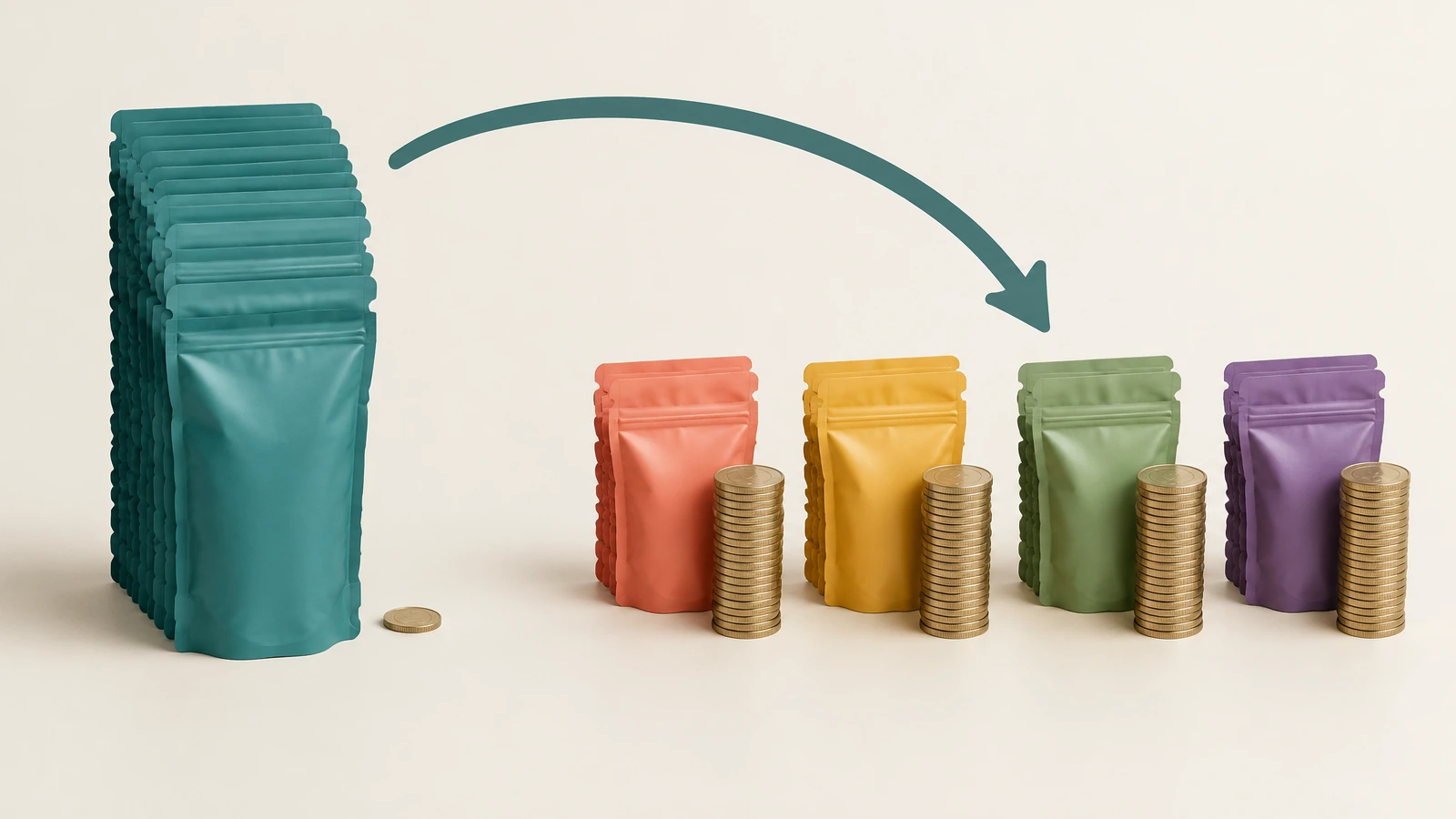
There is no single industry minimum for a digital print MOQ or a plate-based run. The minimum depends on the printing route and on how many bags share one design. Zigpac's tier table for custom printed zipper stand-up pouches (November 2026) is a useful worked example: price tiers from 100 pcs, final MOQ on your quote. Size, structure, features and print change the price, so the final price is always on your quote.
| Quantity per design | Unit price (Nov 2026) | Example: 1,000 bags in total |
|---|---|---|
| 100+ | US$0.55 | 4 designs × 250 = US$550 |
| 500+ | US$0.28 | 2 designs × 500 = US$280 |
| 1,000+ | US$0.18 | 1 design × 1,000 = US$180 |
| 5,000+ | US$0.12 | Repeat production of a stable design |
At Zigpac, MOQ, lead time and unit price are quoted per design after the spec is reviewed. Spreading the same 1,000 bags across four flavors can therefore cost about three times as much as running one design. Two common workarounds help. One is a shared printed base design with flavor stickers. The other is to print the bestseller and keep slow movers on shorter runs. For sample packs and single-serve trial sizes, Zigpac's Custom Flat Mylar Pouches (price tiers from 100 pcs, final MOQ on your quote) are a flat heat-seal format that does not stand. Standard production is 7–10 days, with the final schedule on your quote. The clock starts at proof approval, and artwork revisions and ocean freight add time.
Step 5: Run the supplier checklist and send a one-page quote brief
Ask every pouch supplier the same questions so the answers can be compared:
- Which printing route will each design run on, and does a reorder reuse the same route?
- What is the MOQ per design, and how do price tiers change with quantity?
- Can you share OTR and WVTR for this exact laminate, with the test method and conditions?
- Which 21 CFR sections or FCN does your declaration cite, and for which foods and temperatures?
- Do you supply a digital proof and physical samples before bulk, and at what cost?
- How are lots traced back to film rolls and print jobs?
Then send one page that covers: product and its sensitivity (oil, aroma, moisture, CO2), target fill weight, proposed size, film structure, features, artwork status, quantity per design, and destination.
Barrier Film for Food Stand Up Pouches: Comparison Table
| Structure | What it contributes | Typically chosen for | Trade-offs |
|---|---|---|---|
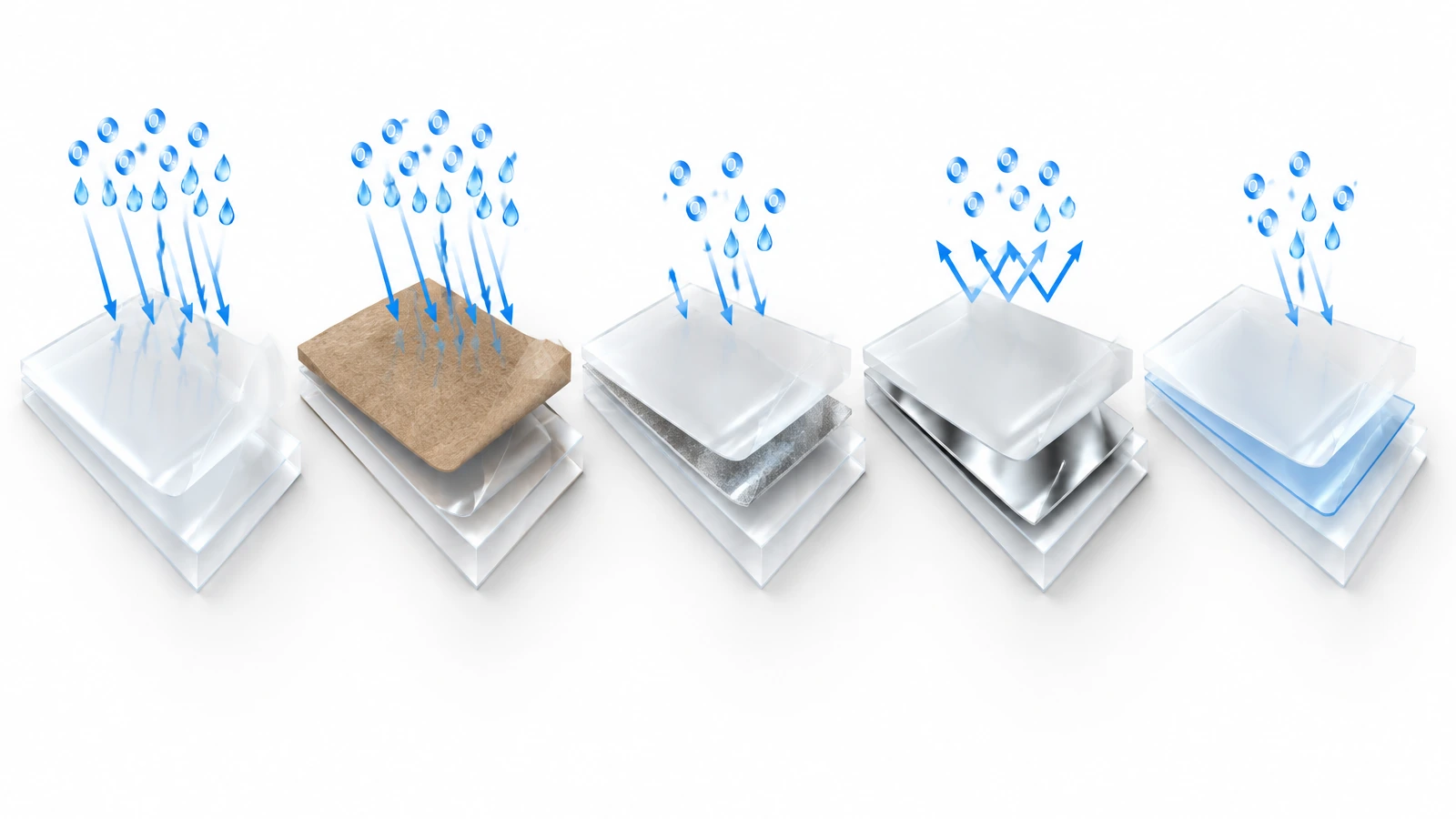
| Clear PET/PE | Print surface plus sealant. Basic barrier. | Dry snacks, candy, short shelf-life items where the product should show | Limited oxygen and light protection |
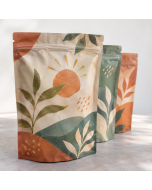
| Kraft-paper exterior laminate | Natural look and feel only. The paper adds no barrier. | Craft, tea and snack brands that want a paper look | Barrier depends entirely on the inner film layers |
| Metallized PET (VMPET) | A thin metal layer that cuts oxygen, moisture and light | Coffee, tea, granola, spices, pet treats | Opaque. The barrier can drop where the film is creased. |
| Aluminum foil (PET/AL/PE) | Highest barrier of the common options | Fresh-roasted coffee, oily or aroma-sensitive products, supplements | Opaque. Can trigger metal detectors. Heavier. |
| EVOH layer | Oxygen barrier that can stay transparent | Products that need an oxygen barrier plus a visible product or window | Oxygen barrier weakens at high humidity |
Use the table to shortlist, then decide on measured OTR and WVTR for the exact laminate. Two bags labeled "metallized" from different mills can perform very differently. At Zigpac, the base material is a PET/PE laminate with optional foil, metallized PET or EVOH layers. The final structure and finished size are confirmed on the quote, and Zigpac's product page states that a kraft exterior adds no barrier and that finishes do not change barrier.
Recycling claims need the same care. Foil, metallized and EVOH multilayer laminates generally cannot go into film recycling streams. The FTC Green Guides[8] require a "recyclable" claim to reflect collection that consumers can actually use. California's SB 54 packaging rules have also been in force since May 1, 2026[9]. Do not print recycling claims on a barrier laminate unless you have structure-specific evidence.
FAQ
FAQ: What is the minimum order for printed stand-up pouches as a small food brand?
There is no single industry minimum; it depends on the printing route and the quantity per design. Plate- and cylinder-based runs carry tooling costs that push minimums up, while digital and stock-plus-label routes go lower. Zigpac offers price tiers from 100 pcs, final MOQ on your quote, set per design.
FAQ: Is digital printing always the cheapest option for small runs?
No; it is usually cheaper only while quantity per design stays low or artwork keeps changing. Once a design is stable and reorders are predictable, the one-time cost of plates or cylinders spreads across enough bags that plate-based printing can win on total cost. Compare total order cost, not unit price alone.
FAQ: Does a kraft paper pouch keep coffee fresher?
No, the kraft paper itself adds no barrier. Freshness depends on the inner layers, such as metallized PET or foil, plus a one-way degassing valve for fresh-roasted beans. Ask for OTR and WVTR of the full laminate.
FAQ: Can I say my pouch is "FDA approved"?
No, because the FDA does not approve individual pouches. What you can hold is a supplier declaration that the materials comply with the applicable 21 CFR sections or an FCN for your food type and use conditions, backed by lot traceability.
FAQ: Can I print "recyclable" on a foil or metallized pouch?
Generally not. Multilayer foil, metallized and EVOH laminates usually cannot be recycled with film, and the FTC Green Guides require recyclable claims to match collection that consumers can actually use.
FAQ: How long does production take, and can I see the bag first?
At Zigpac, standard production is 7–10 days from proof approval, with the final schedule on your quote. Artwork revisions and ocean freight add time. Every order includes a free eProof, and physical samples ship for US$5–30.
Key Takeaways
- Quantity per design drives unit price more than anything else. — US$0.55 per piece at 100+ versus US$0.12 at 5,000+ in Zigpac's November 2026 tiers, final price on your quote (Source)
- Short-run digital print exists because small brands move fast. — Insurgent brands generated nearly 39% of 2024 category growth (Source)
- Seals and zippers fail more often than print does. — 54% of 791 seal-integrity recalls were due to incomplete or defective seals (Source)
- Barrier must be measured on the exact laminate. — 2 standard OTR methods: ASTM D3985 (dry) and ASTM F1927 (humidity-controlled) (Source)
- Recycling claims are now regulated, not just marketing copy. — California SB 54 regulations took effect May 1, 2026 (Source)
Conclusion
The right supplier for a small food brand depends on your stage. Stock pouches with labels suit a recipe that is still changing. A short printed run suits several flavors at low volume. Plate-based reorders suit a design that has stopped moving. Across all three, the decisions that prevent reprints are the same: film chosen on measured barrier, features fixed before artwork, and documents that name the regulation.
To get a quote, send your product, target fill weight, proposed size, structure and features, artwork, quantity per design and destination. Zigpac confirms size, structure, printing route, final MOQ, price and schedule on the quote, with a free eProof before production and physical samples for US$5–30.
Sources
- AAPS Open (Springer), meta-analysis of FDA seal-integrity recalls, January 2019 – January 2025, published 2025-12-15 ↩
- Packaging Dive, coverage of digitally printed flexible packaging and Bain & Co. insurgent-brand data, 2026 ↩
- AMETEK MOCON, ASTM D3985 and ASTM F1927 oxygen transmission rate test methods ↩
- ANSI Webstore, ASTM F88/F88M-23 Standard Test Method for Seal Strength of Flexible Barrier Materials ↩
- FDA food contact regulatory overview (NASA-hosted PDF), January 2024 ↩
- eCFR, Title 21 – Food and Drugs ↩
- eCFR, 21 CFR Part 177 – Indirect Food Additives: Polymers ↩
- Federal Trade Commission, Green Guides (16 CFR Part 260) ↩
- CalRecycle bulletin, SB 54 permanent regulations approved and effective, 2026-05-01 ↩






The information below is required for social login
Sign In
Create New Account