
 Blog PDF for offline reading
Quick answer: Zigpac makes both custom poly mailers and custom corrugated mailer boxes, and in the poly mailer vs mailer box decision for folded, non-fragile apparel, the printed poly mailer is usually cheaper to buy and often cheaper to ship. On Zigpac's November 2026 tier tables, a poly mailer costs US$0.18 at 1,000+ pieces and a mailer box costs US$0.52 at 1,000+ pieces, with the final price on your quote. A mailer box costs more, but it holds its shape, resists crushing and offers a fuller unboxing with optional interior print, so it suits gifts, PR kits, premium sets and already-boxed items. Many apparel brands run both formats: bags for everyday orders and boxes for gift and premium orders.
You have a folded hoodie, a packing bench and two printed formats to choose from. The poly mailer vs mailer box question looks simple until the invoices arrive. If you pick the box for every T-shirt, you pay for corrugated board, assembly time and air that the carrier may bill as dimensional weight. If you pick the bag for a structured gift set, the corners can arrive crushed and the customer's first impression is a dented product. Both mistakes are expensive, and both happen because the formats were compared on unit price alone.
This guide compares the two formats on the same basis. It covers packaging cost by quantity tier, postage exposure, damage risk, unboxing and print area, returns, storage and packing speed, and recycling routes. It ends with a decision rule and a hybrid program that many apparel brands use.
What is the difference between a poly mailer and a mailer box?
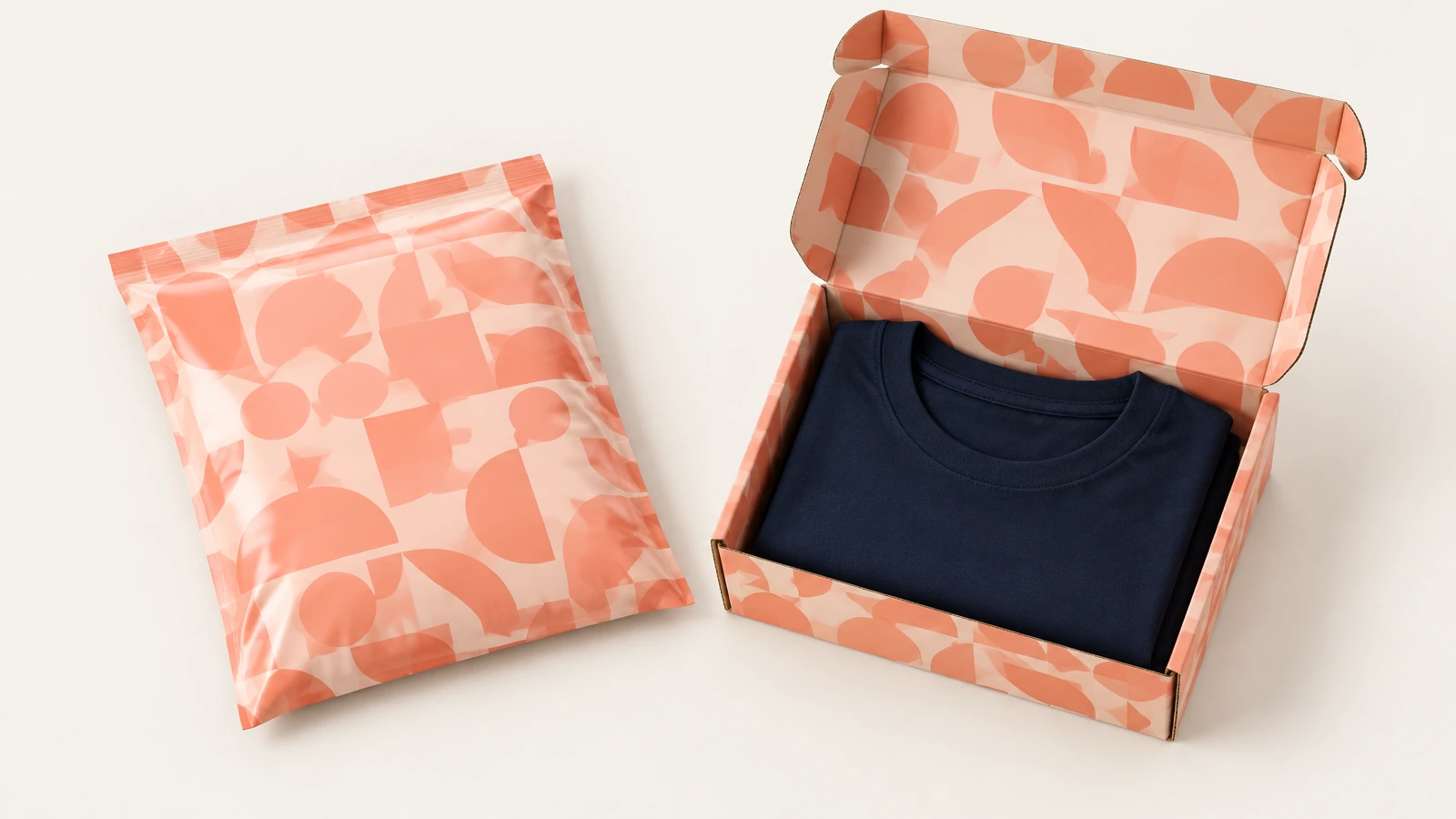
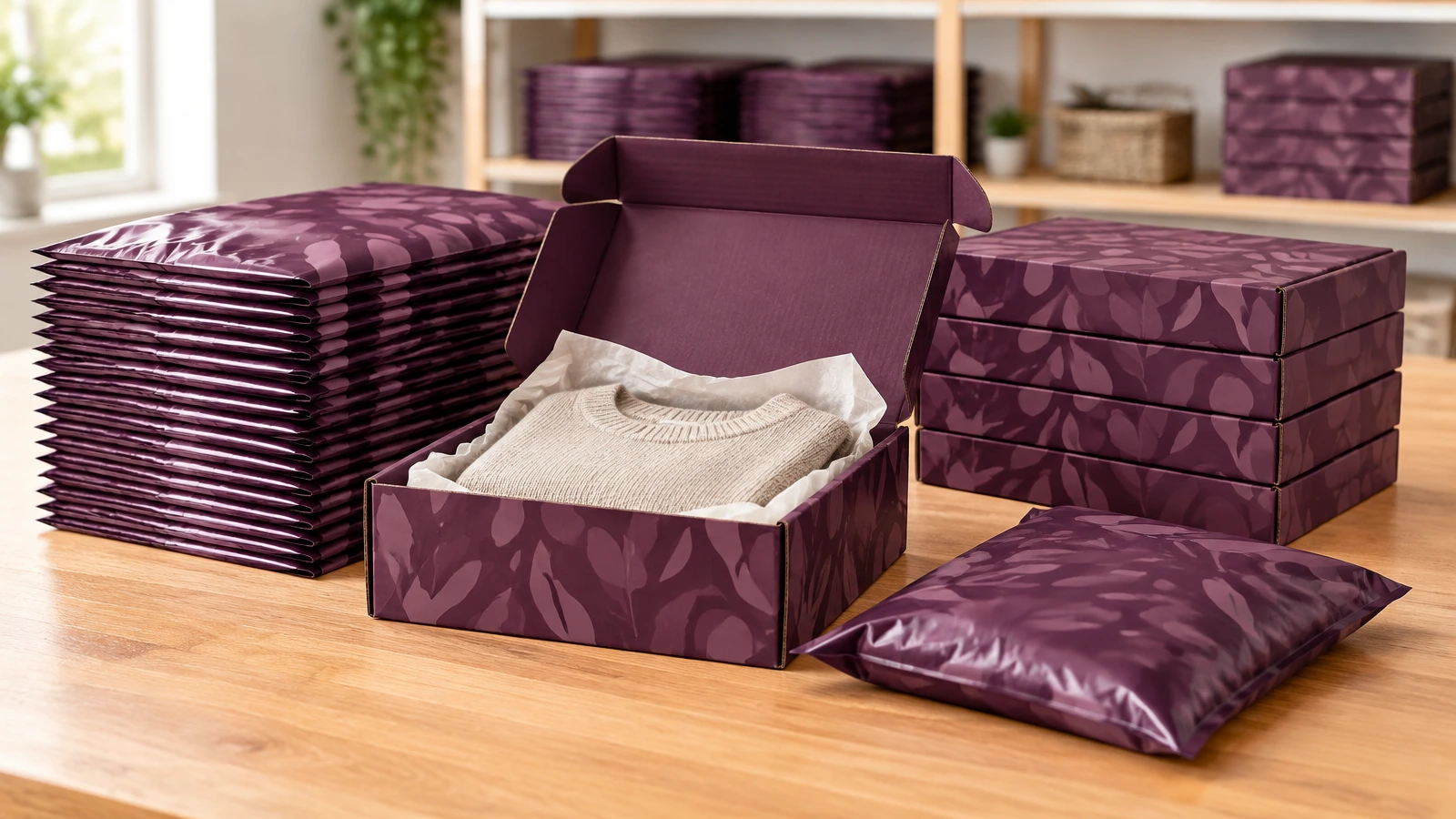
A poly mailer is a flexible polyethylene envelope with a self-adhesive closure. It conforms to the garment, ships flat and adds very little weight. Zigpac's product page describes it as suited to folded clothing, textiles and other non-fragile soft goods. A thicker film makes the envelope tougher against tears and punctures. It does not turn a flexible envelope into a protective box. Common market reference thicknesses such as 2.0, 2.5 and 3.0 mil are starting points for a discussion with the supplier, not specifications. Size and film selection are covered on our custom poly mailers page, so this article does not repeat them.
A mailer box here means a printed corrugated box with a roll-end tuck-top structure. Zigpac's Custom Corrugated Mailer Boxes are designed this way. Side walls, a hinged lid and tuck closures create a more deliberate opening sequence than a slotted shipping carton. Board choice matters. E-flute gives a thinner profile and a smoother print surface. B-flute adds cushioning and crush resistance but makes a thicker package, which can add dimensional volume. Boxes are commonly delivered flat and folded up at the packing station.
How to compare the two formats on the same basis
The fair comparison is total delivered cost plus the outcome at the customer's door. Work through these five steps with your real product, not a catalog photo.
- Define the parcel. Record the folded garment size, weight and anything rigid inside it, such as a gift box, hanger, hard tag or accessory.
- Price packaging at your real quantity tier. Compare the two formats at the volume you will actually order, not the best tier on the table.
- Measure the finished parcel. Pack one of each, then measure length, width and height as the carrier will measure them.
- Add the extras. Include tape, tissue, inserts, void fill and the labour to fold a box or seal a bag.
- Score the outcome. Decide how much shape protection, unboxing and returns handling the order needs.
Worked cost example at 1,000 pieces (November 2026)
The table uses only the listed tier prices on Zigpac's live product pages as of November 2026. Final price on your quote, because size, material, board grade, print coverage and inserts all change it.
| Quantity tier | Custom poly mailer (per piece) | Custom corrugated mailer box (per piece) |
|---|---|---|
| 50+ | Not offered at this tier | US$2.20 |
| 200+ | Not offered at this tier | US$1.15 |
| 500+ | US$0.28 | US$0.75 |
| 1,000+ | US$0.18 | US$0.52 |
| 5,000+ | US$0.11 | Ask for a quote |
| 10,000+ | US$0.08 | Ask for a quote |
At 1,000 pieces, packaging alone comes to about US$180 for poly mailers and US$520 for mailer boxes, a gap of roughly US$340 per thousand orders before tissue, inserts, tape or void fill. Boxes usually need more of those extras, so the real gap tends to widen rather than shrink. The box line does reach further down the volume curve, though. At Zigpac, mailer boxes have price tiers from 50 pcs, final MOQ on your quote, while poly mailers have price tiers from 500 pcs, final MOQ on your quote. For a 100-piece PR mailing, the box may be the only printed format that makes sense.
How dimensional weight changes the postage side
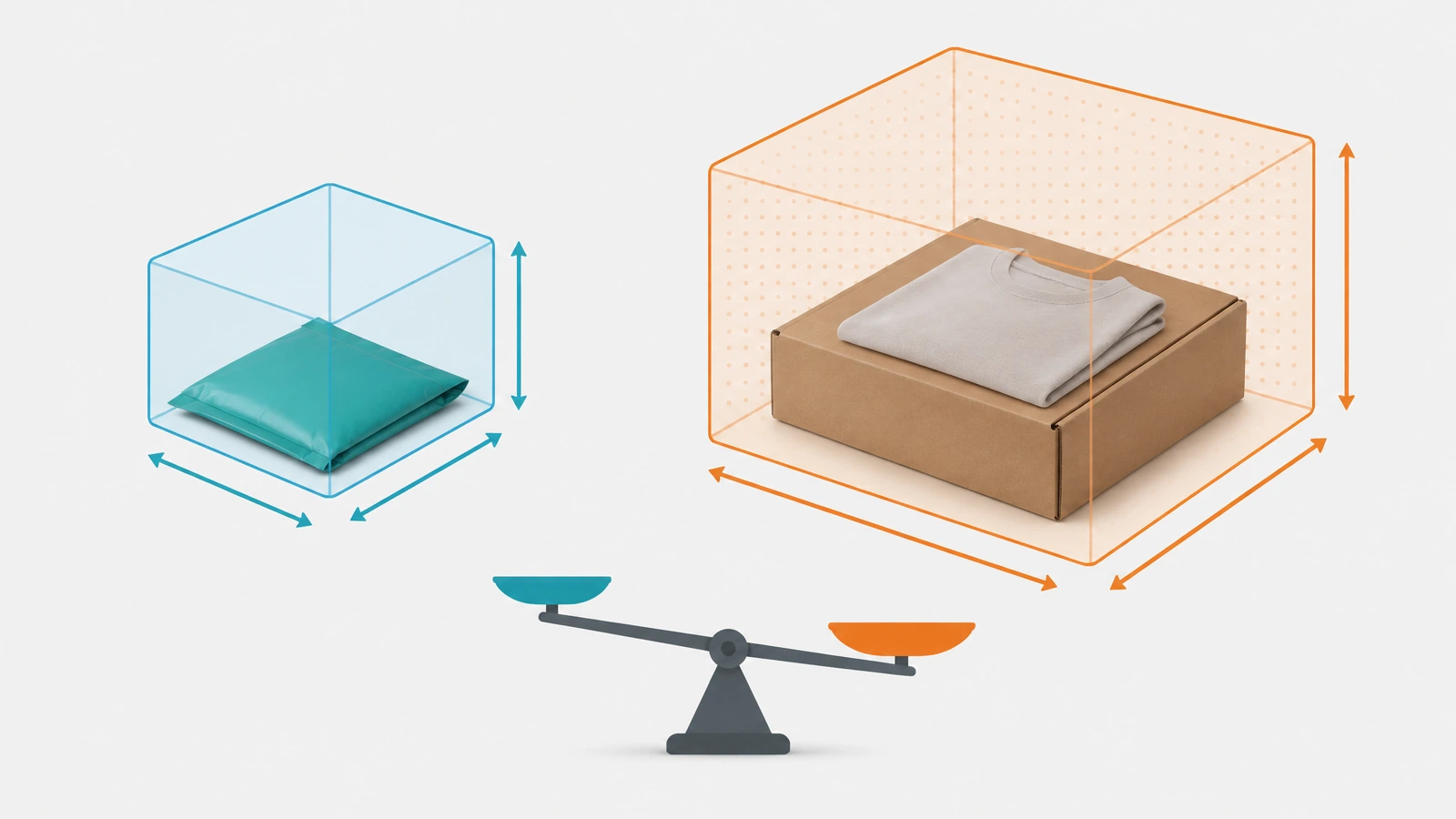
Carriers bill the greater of actual weight and dimensional weight. Dimensional weight is calculated as length × width × height ÷ a divisor that the carrier sets in its current price list. USPS publishes its rules through the USPS Domestic Mail Manual[1] and its price notices. The same manual also states that boxes are not flats, and neither are tight wrappers containing a box.
Illustrative example only: a hoodie packed in a 12 × 10 × 4 in mailer box occupies 480 cubic inches. With an illustrative divisor of 139, that is about 3.5 lb of dimensional weight, which many rules round up to 4 lb. The same hoodie in a filled bag lying at about 14 × 11 × 2 in is 308 cubic inches, or about 2.2 lb, which rounds up to 3 lb. Some services apply dimensional weight only above a size threshold. In that case actual weight decides the price, and the difference narrows. Lower packaging weight alone does not guarantee a lower postage charge for every service or destination. Measure the finished parcel and check it against your carrier's current rules before you budget any saving.
Poly mailer vs mailer box: side-by-side comparison for apparel
| Factor | Printed poly mailer | Printed corrugated mailer box |
|---|---|---|
| Packaging unit cost (Zigpac, Nov 2026) | US$0.28 at 500+, US$0.18 at 1,000+, US$0.11 at 5,000+, US$0.08 at 10,000+ | US$2.20 at 50+, US$1.15 at 200+, US$0.75 at 500+, US$0.52 at 1,000+ |
| Postage and dimensional weight | Conforms to the garment, so there is less air to bill. An overstuffed bag still gets measured. | Fixed volume. An oversized box or a thicker B-flute board increases dimensional-weight exposure. |
| Damage protection | Resists moisture and scuffs. No structural protection against crushing. | Protects shape and corners. Suits structured or boxed items. |
| Unboxing and print area | Exterior print is the main brand surface. Quick tear-open experience. | Exterior-only, interior-only or interior-and-exterior print. Lid-and-reveal sequence. |
| Returns | Returnable versions add a second adhesive strip. | Reusable if the customer opens it carefully. Usually needs re-taping. |
| Storage and packing speed | Flat stacks take little space. Fill, peel and seal. | Delivered flat but thicker. Fold, fill, add inserts or tissue, then tuck or tape. |
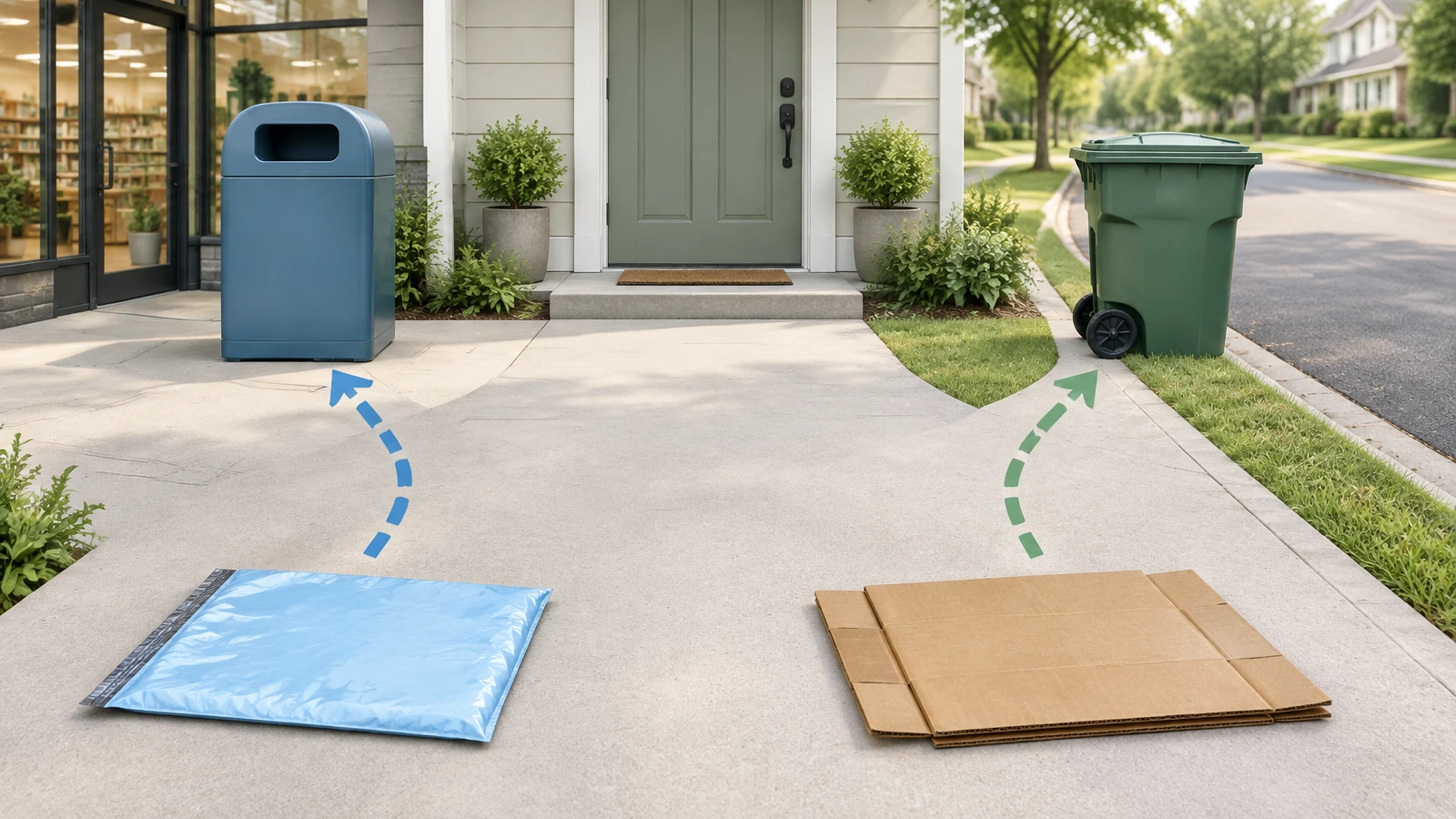
| Recycling route (US) | Film is generally not curbside. Eligible film may go to store drop-off. | Corrugated is commonly collected curbside. Check the local program. |
| MOQ and timing (Zigpac) | Price tiers from 500 pcs, final MOQ on your quote. Standard 7–10 days, final schedule on your quote. | Price tiers from 50 pcs, final MOQ on your quote. Standard 7–10 days, final schedule on your quote. |
Zigpac's two product lines share the same proofing path. Every order gets a free eProof, and physical samples ship for US$5–30, so you can pack your actual garment in both formats before committing. Zigpac recommends approving a physical sample of whichever format you choose before bulk production. What to check on that sample is covered on the poly mailer product page.
Unboxing matters, but it is not a free win for either format. In a national survey for the Paper and Packaging Board, Ipsos found that 72% of US consumers agree packaging design can influence purchases[2], and 68% said they would more likely choose paper or cardboard packaging over plastic. That survey is from 2018 and measured attitudes, not conversion, but it explains why premium and gift orders often move to board.
When each format wins for apparel
The poly mailer wins for everyday soft goods
- Folded T-shirts, hoodies, leggings, sweatshirts, socks and loungewear.
- High order counts where cents per parcel and packing seconds add up.
- Rainy routes and porch drops, where water resistance protects the garment.
- Limited storage, because flat bags take far less shelf space than flat boxes.
The mailer box wins when shape or presentation is the product
- Structured or boxed items, such as caps, shoes in their own box, or bundled accessories with hard parts.
- Gift sets and holiday bundles that should open like a present.
- Subscription and PR or influencer kits, where interior print and the lid reveal get filmed.
- Any item whose corners or folds must arrive pristine.
Zigpac's poly mailer page states the limit plainly. Glass, crush-sensitive products, sharp components or items whose corners must arrive pristine need protective inner packaging or a rigid shipping format. If you find yourself adding a box inside a bag, compare that cost with a single mailer box.
Returns: second adhesive strip vs re-taping a box
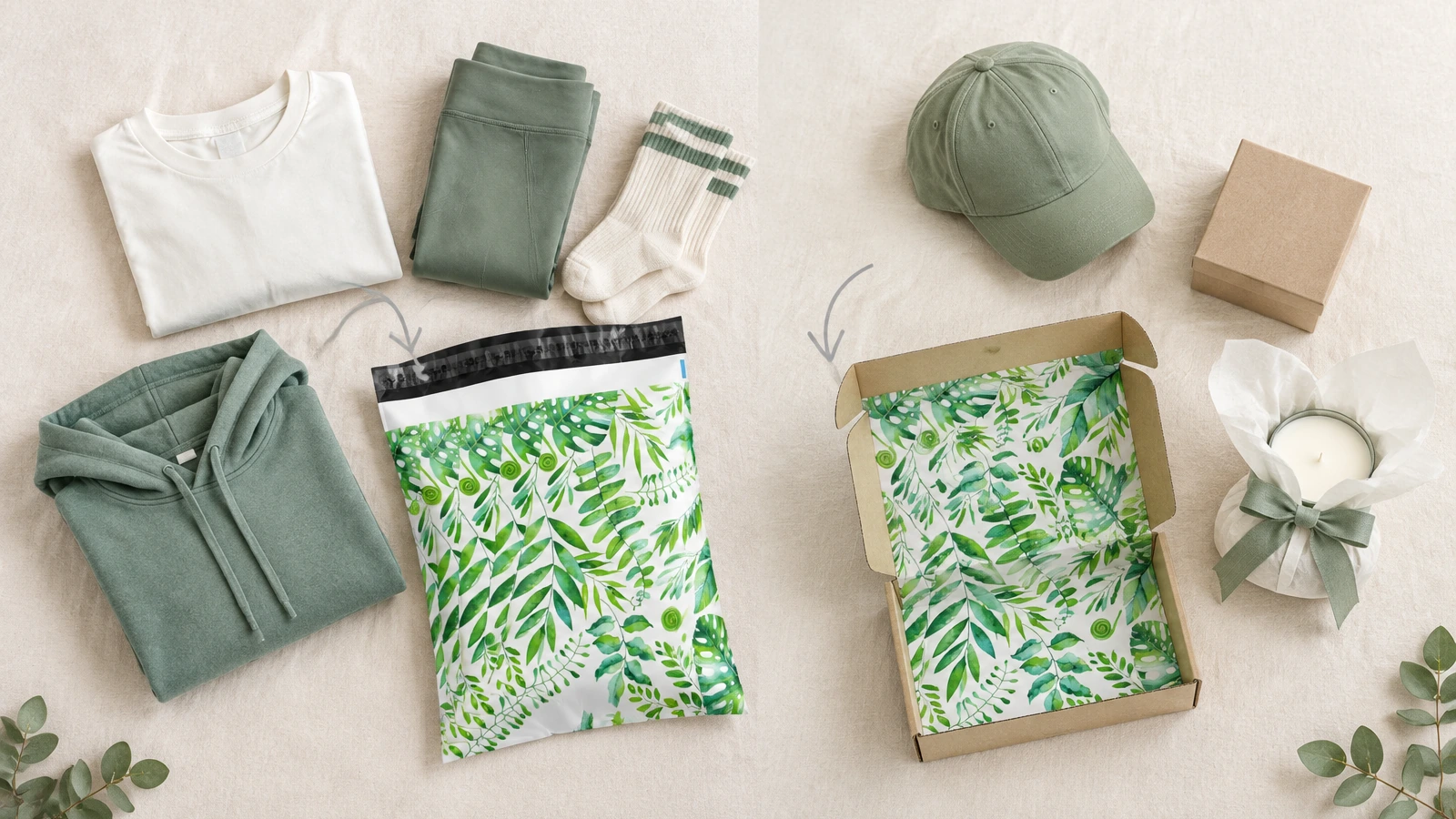
Apparel returns are mostly size exchanges, so the return trip deserves its own line in the comparison. A returnable poly mailer has a second adhesive strip. The customer opens the bag, then uses the fresh strip to reseal it for the return label. Zigpac's Custom Returnable Poly Mailers use this dual-seal structure, with listed tiers from US$0.33 at 500+ down to US$0.10 at 10,000+ (November 2026; final price on your quote).
A mailer box can travel back too, but only if the customer opened it cleanly and has tape at home. A torn tuck flap or a missing tape strip turns a reusable box into a support ticket. If returns are a large share of your volume, the second-strip bag usually removes a step. The full returns workflow is covered in our separate guide to returnable poly mailers.
Recycling routes and sustainability claims: film drop-off vs curbside corrugated
The two formats go to different US recycling streams, and that affects what you can print on them. According to How2Recycle, plastic bags, wraps and films aren't accepted in most US curbside or drop-off programs[3], while plastic mailers with a compatible label are listed as examples for store drop-off. Flattened corrugated, by contrast, is commonly collected curbside, though acceptance still depends on the local program.
Claims are where brands get into trouble. The FTC Green Guides allow an unqualified "recyclable" claim only when recycling facilities are available to a substantial majority of consumers or communities where the item is sold. The Guides define this as at least 60 percent under 16 CFR 260.12[4]. A resin number on the film is not proof. ASTM D7611 states that resin identification codes are not recycle codes[5], and recyclable claims should not sit next to them.
Label design matters too. The Association of Plastic Recyclers' design guidance says that if a flexible film needs a label, a PE-based label is preferred over paper[6], which is relevant when shipping labels stay on the bag. In California, SB 343 limits the chasing-arrows symbol and recyclable wording to materials that meet state criteria, and CalRecycle publishes the implementation status[7]. Because the rules are under active litigation and revision, check the current status before printing claims. How2Recycle's owner, GreenBlue, has already removed the chasing arrows from its Store Drop-off label[8] out of caution. Under California's SB 54 packaging regulations[9], single-use packaging sold in the state is moving toward recyclable-or-compostable requirements by 2032.
Channel pressure points the same way. Packaging Dive reported that Amazon's North American shipments containing single-use plastic delivery packaging fell from 65% in 2023 to 37% in 2024[10]. That is one platform's own fulfillment mix, not a market-wide trend, but your customers may notice it.
Zigpac does not claim its poly mailers are eco-friendly or fully recyclable. No recycled-content percentage, recycling label approval or compostability certification is confirmed for the current product. If a sustainability claim is part of your brief, raise it at quote stage and print only what documents support.
Decision checklist and the hybrid program
Run each SKU or order type through these questions in order. The first "yes" usually decides the format.
- Is anything inside rigid, crushable or already boxed? If yes, choose the mailer box or add inner protection and re-price.
- Is this a gift, PR kit, subscription box or premium set? If yes, choose the box for interior print and the reveal.
- Is it folded soft apparel shipping to an everyday customer? If yes, choose the poly mailer.
- Do you need fewer than 500 printed units? If yes, the box line's lower tiers may be the only printed option. Otherwise, use plain stock until volume grows.
- Are returns frequent? If yes, consider a returnable bag with a second strip.
- Did the measured parcel change the postage tier? If yes, re-check the box size or the bag fill before ordering.
Most growing apparel brands end up with a hybrid program. A printed poly mailer covers everyday folded orders at the lowest cost per parcel. A smaller run of printed mailer boxes handles gifts, launches, influencer kits and premium bundles, where the extra cost buys protection and a memorable opening. Keeping artwork consistent across both formats makes them read as one brand. Ordering both from one supplier also means one proofing cycle and one schedule to manage.
FAQ
FAQ: Is a poly mailer cheaper than a mailer box for shipping clothes?
Yes, for folded non-fragile clothing the poly mailer is usually cheaper on packaging and often on postage. On Zigpac's November 2026 tiers, it costs US$0.18 against US$0.52 for a mailer box at 1,000+ pieces, with the final price on your quote. Boxes also tend to need more tissue, inserts or void fill.
FAQ: Will switching from boxes to poly mailers always lower my postage?
No. Postage depends on the carrier, service, zone and the measured size and weight of the finished parcel. Where dimensional weight applies, a slimmer bag often bills lower. Where actual weight decides, the difference can be small. Measure a packed sample against your carrier's current rules.
FAQ: Can I ship shoes or a boxed product inside a poly mailer?
Only if the inner box's condition does not matter to the customer. A bag keeps the product dry and clean, but it gives no crush protection. If the shoebox or product box must arrive pristine, ship it in a rigid format such as a corrugated mailer box.
FAQ: What are Zigpac's minimum order and lead time for each format?
Zigpac lists poly mailers with price tiers from 500 pcs, final MOQ on your quote, and mailer boxes with price tiers from 50 pcs, final MOQ on your quote. Both lines have a standard lead time of 7–10 days, final schedule on your quote. Each order includes a free eProof, and physical samples ship for US$5–30.
FAQ: Which format is better for recycling?
Corrugated has the easier route in the US, because it is commonly collected curbside. Most film mailers are not accepted curbside, and eligible film may go to store drop-off instead. Neither format should carry an unqualified "recyclable" claim unless it meets the FTC's 60% availability test and any applicable state rules.
FAQ: Can one brand use both poly mailers and mailer boxes?
Yes, and many apparel brands do. Bags handle everyday folded orders. Boxes handle gifts, PR kits and premium sets. Matching artwork across both keeps the brand consistent, and quoting both together lets you compare the full program cost.
Key takeaways
- Poly mailers cost less per unit at every shared tier. — US$0.28 vs US$0.75 at 500+, and US$0.18 vs US$0.52 at 1,000+ (Zigpac tiers, November 2026; final price on your quote) (Source)
- Postage savings depend on the measured parcel, not the packaging weight. — billable weight is the greater of actual weight and L × W × H ÷ the carrier's divisor (Source)
- Packaging design affects purchase perception, and board is often preferred. — 72% say design can influence purchases, and 68% lean toward paper or cardboard over plastic (2018) (Source)
- Film and corrugated follow different recycling routes. — most US curbside programs do not accept plastic film, while eligible mailers may go to store drop-off (Source)
- Unqualified "recyclable" claims need broad access. — at least 60% of consumers or communities where the item is sold (Source)
Conclusion: pick by order type, then quote both
For folded everyday apparel, the printed poly mailer is the lower-cost, lower-volume choice. The mailer box earns its higher price when shape, protection or a staged reveal is part of what the customer is paying for. The cleanest answer for most brands is not one format but a split by order type.
Send us your folded garment size and weight, monthly order volume, artwork and destination, and we will quote the poly mailer, the mailer box or both. Zigpac confirms size, material, final MOQ, price and schedule on the quote, with a free eProof before production and physical samples for US$5–30. Start with the custom poly mailers quote and add mailer boxes for your gift and premium orders.
Footnotes
- United States Postal Service, Domestic Mail Manual 201, Physical Standards for Commercial Mail, Postal Explorer. https://pe.usps.com/text/DMM300/201.htm ↩
- Ipsos for the Paper and Packaging Board, "Most Americans Say That the Design of a Product's Packaging Often Influences Their Purchase Decisions," May 2018. https://www.ipsos.com/en-us/news-polls/Most-Americans-Say-That-the-Design-of-a-Products-Packaging-Often-Influences-Their-Purchase-Decisions ↩
- How2Recycle, "Store Drop-off (US only)," published 2023-11-22. https://how2recycle.info/about-the-how2recycle-label/store-drop-off-us-only/ ↩
- US Federal Trade Commission, Guides for the Use of Environmental Marketing Claims, 16 CFR § 260.12 Recyclable claims, eCFR. https://www.ecfr.gov/current/title-16/chapter-I/subchapter-B/part-260/section-260.12 ↩
- American National Standards Institute blog, "Resin Identification Codes (RICs) – ASTM D7611." https://blog.ansi.org/ansi/resin-identification-codes-rics-astm-d7611/ ↩
- Association of Plastic Recyclers, APR Design Guide, PE Film Design Guidance. https://archive.plasticsrecycling.org/pe-film-design-guidance ↩
- CalRecycle, "SB 343: Recycling Labels." https://calrecycle.ca.gov/wcs/recyclinglabels/ ↩
- GreenBlue, "New Store Drop-off Label Design," 2025-04-23. https://greenblue.org/2025/04/23/new-sdo-label-design/ ↩
- CalRecycle, "SB 54 Plastic Pollution Prevention and Packaging Producer Responsibility Act Regulations." https://calrecycle.ca.gov/laws/rulemaking/sb54regulations/ ↩
- Packaging Dive, coverage of Amazon's 2024 sustainability report, 2025-07-17. https://www.packagingdive.com/news/amazon-packaging-sustainability-report-2024/753294/ ↩






The information below is required for social login
Sign In
Create New Account