We use cookies to enable our websites to remember information, to help some website functionalities to work properly, to understand how you interact with and use our websites and to display you content and ads that are relevant and engaging for you.
By clicking Accept All you consent to the use of these cookie.
The store will not work correctly when cookies are disabled.
Quick answer: Most fridge magnet rubber is either molded soft PVC with a magnetic strip on the back or a flexible sheet of ferrite powder bound in rubber or plastic. Both hold paper on painted steel, weaken on some stainless and textured doors, soften under high heat, and need phthalate-free, securely bonded construction before you use them as giveaways.
Last reviewed: October 21, 2026. Scope: indoor refrigerator magnets made from soft PVC or flexible ferrite sheet.
The phrase "fridge magnet rubber" covers two very different constructions. Many businesses never ask which one they are buying until the magnets fail. Some slide down a stainless door. Some curl beside the oven. Others fade on a sunny kitchen wall. And sometimes a parent asks what plasticizer is in the PVC their toddler just chewed. Each of those failures has a material cause, and each one is easy to check before an order ships.
The stakes are commercial as well as practical. U.S. promotional products distributors sold $26.78 billion in promotional products in 2024[1]. A fridge magnet only earns its place in that spend if it stays on the door. A magnet that drops to the floor ends up in a drawer. One that raises a safety question can damage the brand printed on it. This guide covers what the material is, how it behaves on real fridge surfaces, how it ages, and which safety questions to ask before you hand it out.
What Is Fridge Magnet Rubber Actually Made Of?
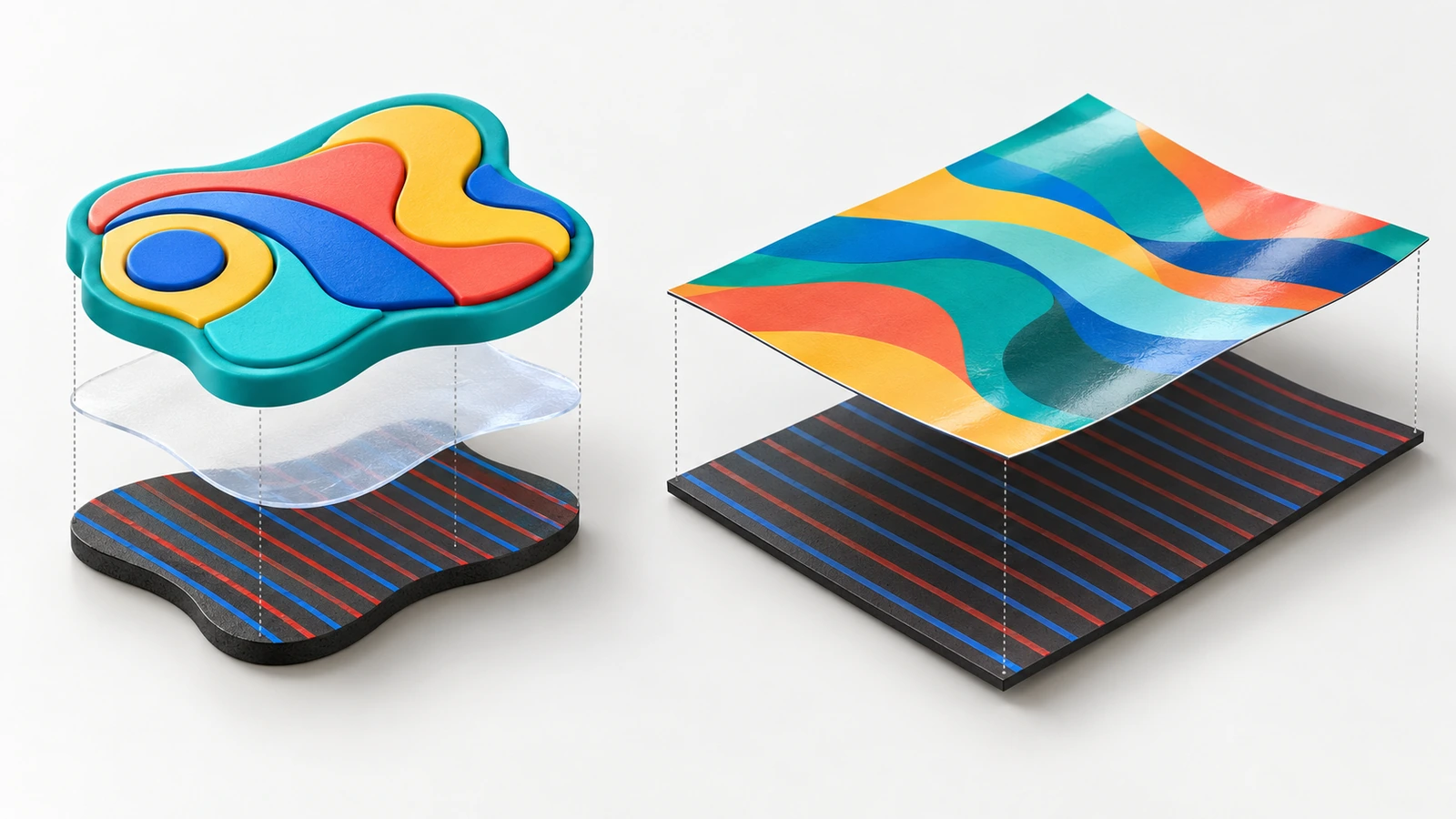
"Rubber" is a trade word here, not a chemistry label. Two constructions dominate the market. Some regional markets also call the product a rubber ref magnet.
1. Molded soft PVC with a magnetic backing
Liquid PVC is colored, poured into a mold layer by layer and heat-cured into a soft, rubbery shape. This is the 2D molded style: flat color areas separated by slightly raised outlines. A strip or patch of flexible magnet is then glued or heat-pressed to the back. The PVC body does no magnetic work. All of the holding force comes from the backing, and only from the area that backing covers. Soft PVC feels like rubber because it contains plasticizers. Those additives make an otherwise rigid plastic bendable, and they are the reason the phthalate question in the safety section matters.
2. Flexible magnetic sheet
Ferrite powder is mixed into a binder such as nitrile rubber, chlorinated polyethylene or PVC. The mix is rolled (calendered) into sheet and then die-cut. Manufacturer process guides commonly put the ferrite content at 70–90% by weight. More powder gives more pull but makes the sheet stiffer. A printed vinyl or paper face is laminated on top, so the design is a surface layer rather than part of the material.
The magnet inside is ferrite either way
Both constructions use strontium or barium ferrite, the same ceramic oxide found in hard black craft magnets. The ferrite is just ground fine and suspended in a flexible carrier. The sheet is then magnetized in narrow stripes of alternating poles on one face only. That pattern is why a flexible magnet grips hard at direct contact and loses force quickly across even a small gap. It also explains most of the holding problems below.
How Much Can a Rubber Magnet Hold, and on Which Fridge Surfaces?
Published technical sheets for flexible ferrite sheet list pull values of roughly 45–144 lb per square foot (about 220–700 kg/m²). The value depends on thickness and magnetization pattern. Thin promotional sheet around 0.4 mm (15 mil) sits at the low end. Heavier 0.7–1.0 mm (28–40 mil) stock sits higher. Magnet suppliers' own technical notes put a neodymium magnet at roughly 7–20 times the strength of a flexible magnet of the same size. A rubber magnet is built to hold a few sheets of paper, a photo or a menu, not a clipboard.
The surface matters as much as the magnet:
Painted steel doors give flat, full contact and the best results.
Stainless steel varies by alloy. Ferritic grades attract magnets. Austenitic grades respond weakly or not at all. Test the actual door with any known magnet, because the label "stainless" tells you nothing.
Textured, embossed or fingerprint-resistant finishes leave microscopic air gaps, and the short-reach pole pattern of flexible magnets loses force quickly across them.
Curved door edges and handles cut the contact area to a thin line.
Panel-ready, glass-front or aluminum doors will not hold a ferrite magnet at all.
Soft PVC magnets add a leverage problem. A thick molded shape with a small backing strip near its center creates a heavy overhang. Every door slam then tries to peel the strip off the surface. A backing that covers most of the rear face resists this far better than a narrow strip. As for the appliance itself, an expert interviewed by Tom's Guide[2] explains that ordinary fridge magnets do not raise energy use. The realistic risk is scratching or marking the exterior finish, usually from grit trapped under a magnet that gets slid rather than lifted.
Heat, Fading and Cleaning: How Rubber Magnets Age
Kept indoors, ferrite itself loses very little magnetism over the years. Rubber magnets usually fail at the binder, the adhesive or the printed surface, not at the magnet.
Heat and cold
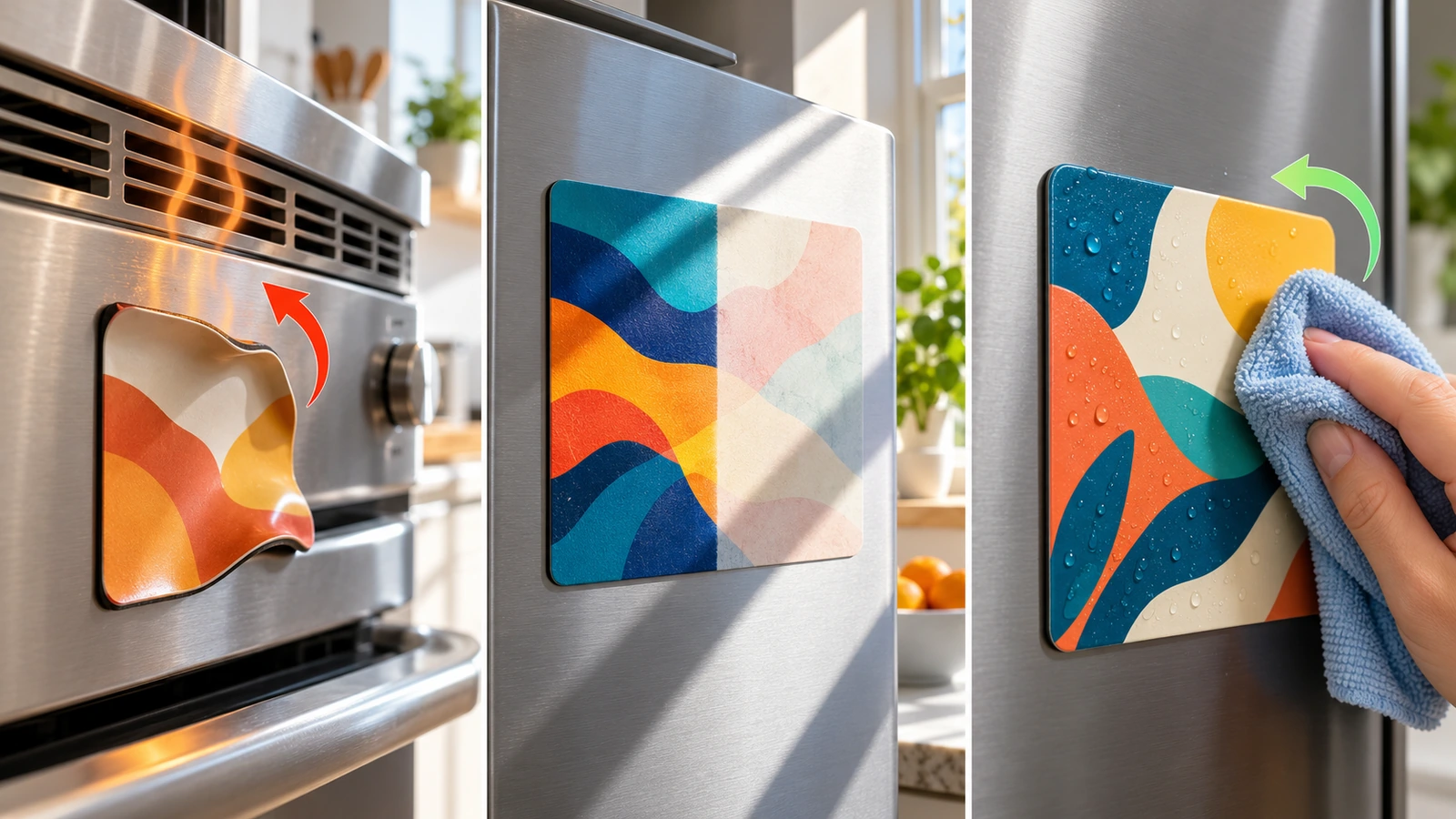
Flexible ferrite-rubber material is typically rated to function up to about 80–100 °C (176–212 °F). Above that range the binder degrades and the magnetism suffers permanent damage. Soft PVC softens and can warp well before that point. The usual kitchen hot spots are the upper door beside a range hood, the area above a toaster oven vent, and the top of the fridge near the condenser exhaust. A car dashboard in summer is worse than any of them. Cold is less of a concern: ferrite performs normally in a freezer, but chilled PVC stiffens and can crack if someone bends it.
Fading
Color behaves differently in the two constructions. In molded soft PVC, the pigment runs through the whole thickness of each color area, so wear and UV exposure fade it slowly. On flexible sheet, the image sits in a thin ink layer on the surface. Without a UV-resistant laminate, it can wash out within months on a fridge facing a window. Printed faces can also delaminate, peeling up from the magnetic sheet at the edges, when a low-cost adhesive meets kitchen humidity.
Cleaning and storage
Use a damp cloth with mild dish soap, then dry the magnet. Keep alcohol and acetone off printed faces, and never put either type in a dishwasher. Do not rub two flexible magnets against each other or store them stacked face to face. Sliding one striped pole pattern across another partly scrambles both and noticeably weakens their hold. Store them flat, separated by paper.
Material Safety Questions to Ask Before Using Them as Giveaways
Three issues decide whether a rubber magnet is a safe giveaway: what plasticizes the PVC, whether any part can come loose, and whether the product counts as a children's product.
Phthalates and other chemistry
Soft PVC needs a plasticizer, and some traditional plasticizers are phthalates. In the U.S., the CPSC toy safety requirements[3] limit eight specified phthalates to 0.1% in children's toys and child care articles. They also require third-party testing and a Children's Product Certificate for products designed primarily for children 12 and under. The toy standard ASTM F963-23[4] became the mandatory U.S. version on April 20, 2024. A cartoon-shaped magnet handed out at a school fair may fall into this category even if your company sees it as marketing. For EU distribution, a REACH amendment restricts lead in PVC articles to below 0.1% by weight, applying from November 2024, and EN 71 applies wherever the item is a toy. Ask for a test report that names the actual compound, the lab and the test date. A generic "eco-friendly PVC" statement is not evidence.
Magnets that can come loose
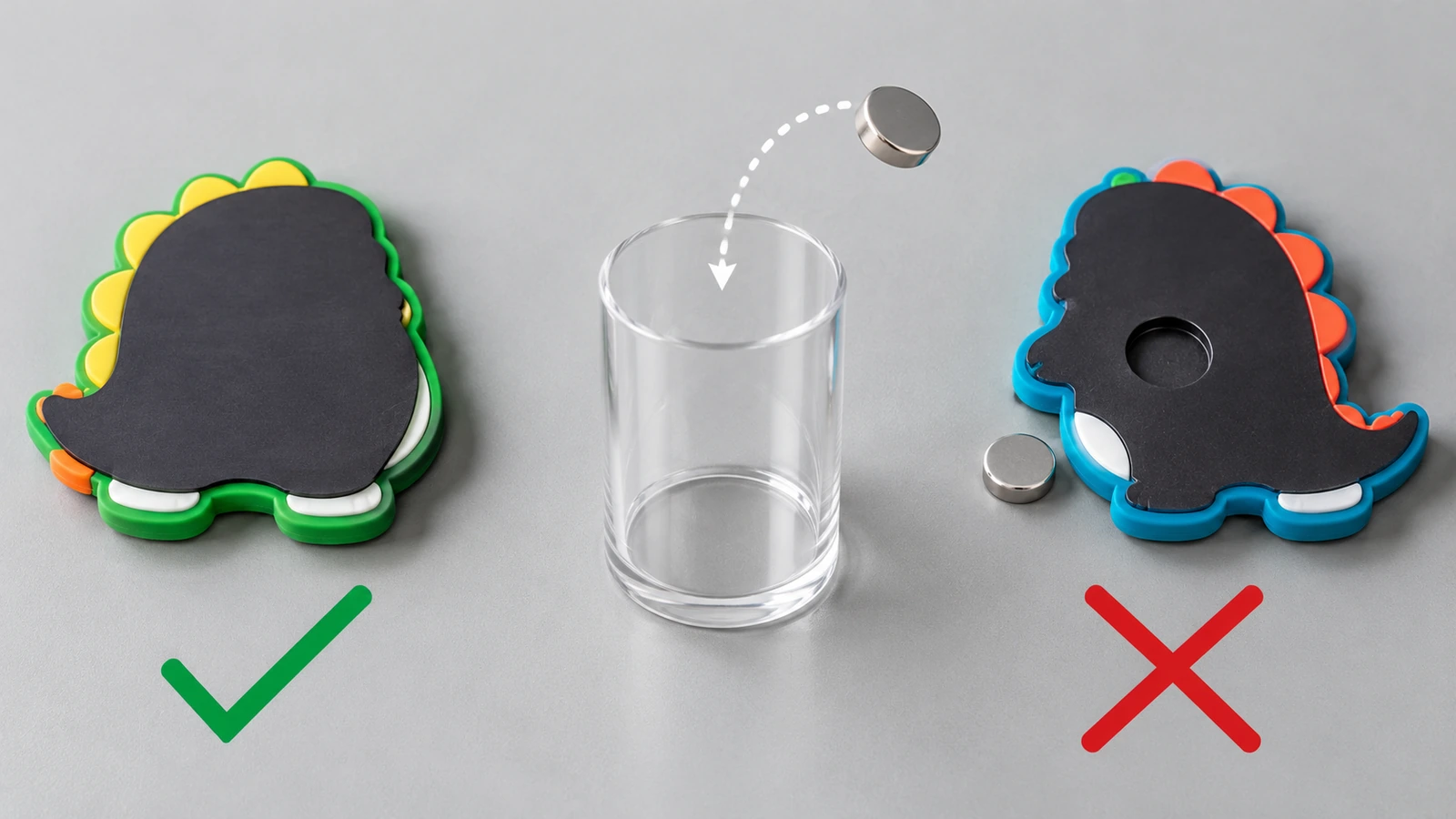
Flexible ferrite sheet is a low-flux material. The serious ingestion hazard comes from small, powerful magnets, usually neodymium discs, that are embedded in a decorative body and can work free. Under 16 CFR Part 1262[5], any loose or separable magnet in a covered product that fits inside the small-parts cylinder must have a flux index below 50 kG²mm². The CPSC's business guidance[6] applies the rule to covered products manufactured after October 21, 2022. Whether a given promotional magnet is covered depends on how it is designed and marketed, but the flux limit is the right benchmark either way. The CPSC's final rule package[7] explains the test method and the injury data behind it.
Recalls show what this looks like in practice. In September 2026, the CPSC announced a recall of 4,640 bear-shaped decorative refrigerator magnets[8] because they contained loose magnets that violated the mandatory standard. An earlier 2014 recall[9] involved novelty magnets whose small magnets detached easily from the decorative body. The CPSC's magnet safety center[10] explains why swallowed magnets that attract each other through intestinal walls cause perforations and blockages. That outcome is the reason a fully bonded flexible strip is the lower-risk design.
Questions to put to any supplier:
Which plasticizer is used, and is there a phthalate test report for this compound?
Is the magnet a flexible strip bonded across the back, or a separate disc set into the body?
What adhesive or bonding method holds the backing, and has it been pull-tested?
Is the design likely to be seen as a children's product, and if so, which standard applies?
What age warning, if any, will appear on the packaging?
How to Test a Rubber Fridge Magnet Before You Hand It Out
These checks take an afternoon and use only a few samples. They tell you how the magnet will behave in your recipients' kitchens, which a spec sheet cannot. If you are working from a supplier sample, our product page explains how sample approval links to production for molded soft PVC fridge magnets. The steps below cover performance only.
Identify the construction. Flip the sample over. A colored body with a dark strip means molded PVC on a backing. A uniform dark back across the whole piece means flexible sheet. Note how much of the back the magnetic area covers.
Run a surface test on real doors. Place the magnet on painted steel, stainless and textured doors. Stack standard 80 g/m² copy paper under it one sheet at a time and record the count at which it starts to slide.
Slam the door. Close the door firmly 20 times with one sheet of paper held. Record whether, and how far, the magnet creeps.
Heat-soak one sample. Seal it in a plastic bag and hold it in water at about 60 °C (140 °F) for 30 minutes. Let it cool, then check for warping, edge lift and backing separation.
Test for sunlight fade. Cover half of a sample with opaque tape and leave it in a sunny window for two weeks. Then peel off the tape and compare the two halves.
Test cleaning resistance. Give the face 20 wipes with a damp, soapy cloth, plus one alcohol wipe on an edge. Check for ink transfer or a dulled surface.
Peel and twist. Try to lift the backing at a corner with a fingernail, then twist the piece. On a giveaway, nothing should come away in your hand.
Record the numbers from each step. "Held 4 sheets on stainless, 0 mm creep after 20 slams" is a result you can compare across samples and suppliers. "Seems strong" is not.
Soft PVC vs Flexible Sheet vs Hard Magnets: Side-by-Side
Factor
2D molded soft PVC + flexible backing
Printed flexible magnetic sheet
Hard ferrite or neodymium decorative magnet
Where the magnetism is
Bonded strip on the back only
Entire piece
Small rigid magnet, often set into a body
Where the color is
Pigment through each molded area
Ink layer on a laminated face
Varies by body material
Typical hold
Light papers and photos; depends on backing area
Several sheets of paper; scales with thickness
Highest; neodymium is roughly 7–20× stronger by size
Heat tolerance
PVC softens first; avoid oven vents and cars
Typically about 80–100 °C before damage
Ferrite good; neodymium loses strength at high heat
Fade and wear
Slow; raised outlines can scuff
Faster without a UV laminate; edges can delaminate
Depends on coating
Cleaning
Damp cloth and mild soap
Damp cloth; no solvents on the print
Damp cloth; uncoated neodymium can corrode
Main safety question
Plasticizer chemistry; backing bond
Ink and laminate chemistry; low flux
Loose small magnets and the flux index limit
Best fit
Logo shapes, mascots, durable keepsakes
Calendars, contact cards, photo prints
Heavy-duty holding; not ideal for child audiences
Choose molded soft PVC when you want a shaped, tactile keepsake whose color must survive years of handling. Choose flexible sheet when the job is photographic detail or a large flat print. For a format-by-format buying comparison, see our custom rubber fridge magnets page.
FAQ
FAQ: Is a rubber fridge magnet actually made of rubber?
Sometimes, partly. Flexible magnetic sheet may use a synthetic rubber binder such as nitrile, but many "rubber" magnets are plasticized soft PVC that only feels rubbery. In both cases the magnetic ingredient is ferrite powder.
FAQ: Why won't my rubber magnet stick to my stainless steel fridge?
Many stainless doors are made from austenitic alloys that are barely magnetic, and others have coatings or textures that create an air gap. Flexible ferrite magnets have a very short reach, so even a small gap cuts their hold sharply. Test the door with any known magnet first.
FAQ: Do rubber fridge magnets lose their magnetism?
At room temperature, ferrite loses very little over years of use. The hold weakens mainly from heat above about 80–100 °C, from rubbing two flexible magnets face to face, or from a backing that has partly peeled away.
FAQ: Can I wash rubber fridge magnets?
Wipe them with a damp cloth and mild soap, then dry them. Do not use a dishwasher or soak them for long periods. Keep alcohol and acetone off printed faces.
FAQ: Are rubber fridge magnets safe around young children?
A flexible strip that is fully bonded to the back is low-risk. Ask about phthalate testing for the PVC. Avoid designs with small embedded magnets that could come loose, since those are the hazard targeted by the 16 CFR 1262 flux limit and by recent recalls.
FAQ: Will rubber magnets damage my fridge finish?
Rarely. Lightweight flat magnets do not affect cooling or energy use. Scratches usually come from grit trapped underneath, so lift magnets off instead of sliding them, and wipe the door occasionally.
Key Takeaways
Any separable small magnet in a covered product must stay below a strict flux limit. — under 50 kG²mm² (Source)
The U.S. magnet rule covers products made after its effective date. — October 21, 2022 (Source)
Loose magnets in decorative fridge magnets still trigger recalls. — 4,640 units recalled in September 2026 (Source)
Children's products made of soft PVC face phthalate limits. — 0.1% for eight specified phthalates (Source)
The current toy standard has been mandatory in the U.S. since 2024. — ASTM F963-23, effective April 20, 2024 (Source)
Promotional items compete for a large budget, so durability matters. — $26.78 billion in U.S. distributor sales in 2024 (Source)
Conclusion
A rubber fridge magnet is ferrite carried in a soft binder. Molded soft PVC puts that ferrite in a strip on the back of a shaped body, while flexible sheet spreads it across the whole printed piece. Its weak points are predictable: short magnetic reach on stainless and textured doors, PVC that softens near heat, surface prints that fade, and plasticizer chemistry that matters most when children are the audience. Test samples on the surfaces your recipients actually have, record the numbers, and get chemistry and bonding answers in writing. If molded soft PVC suits your design, you can request a quotation for molded soft PVC fridge magnets with those test results in hand.
Hi there! I'm Bruce, proud dad to my amazing son. I'm the founder of Zigpac, a printing and packaging company empowering small and medium-sized businesses with custom solutions. Let's create something great together!



 Blog PDF for offline reading














The information below is required for social login
Sign In
Create New Account