We use cookies to enable our websites to remember information, to help some website functionalities to work properly, to understand how you interact with and use our websites and to display you content and ads that are relevant and engaging for you.
By clicking Accept All you consent to the use of these cookie.
The store will not work correctly when cookies are disabled.
Quick answer: Custom souvenir magnets are priced in layers. You pay a one-time mold and tooling fee for each design. You then pay a per-unit price that depends on order quantity, sculpt complexity, the number of hand-painted colors, the magnet type and packaging. Sampling, compliance testing, freight and import duties sit on top of that. Compare quotes on landed cost per unit, not on the unit price alone.
If you are asking how much do custom souvenir magnets cost, a single unit price will rarely give you the honest answer. Molded polyresin magnets are priced in layers. The first is a one-time mold and tooling fee for every design. The second is a per-unit price that falls as quantity rises. The third is freight and duties, which arrive only after production is finished. A buyer who compares two quotes on the unit price alone often finds that the "cheaper" supplier costs more once molds, extra sample rounds and shipping are added.
Retail margins are where this hurts. A gift shop, tourism office or event planner gets a budget approved against one number. Then a second sample round appears. A mold refresh is billed on the reorder. Carton volumes push the freight bill higher, and a customs invoice arrives weeks after delivery. Each line is small, but together they can force a retail price change or a smaller order than the one you planned.
This guide splits a polyresin magnet quote into its parts. It shows which cost levers you control and gives you a landed-cost method you can apply to any supplier's numbers. Specification topics such as size, finish and artwork preparation are covered on our custom resin fridge magnets page. Here we stay focused on money.
What is a custom souvenir magnet quote made of?
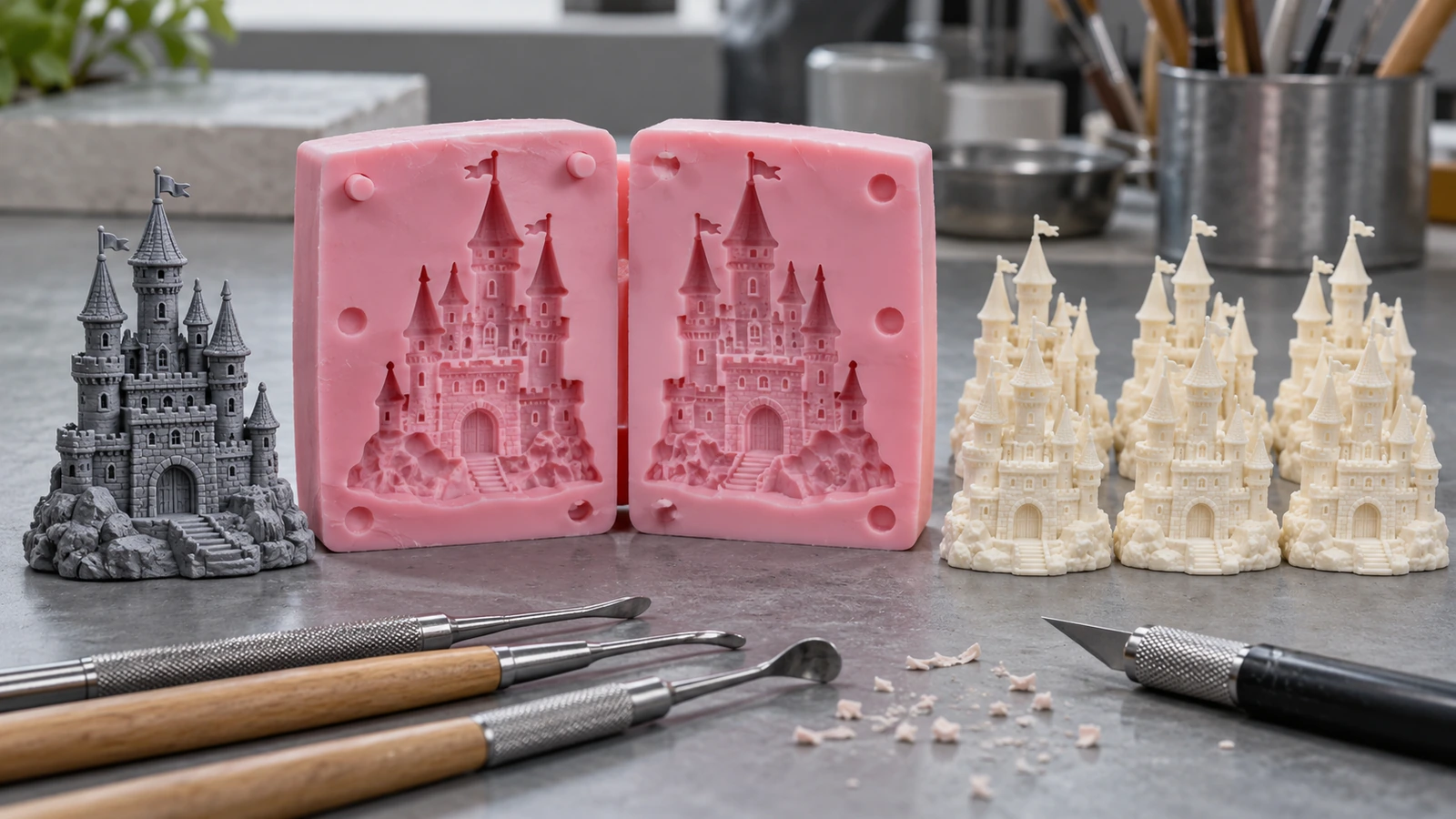
A molded polyresin souvenir magnet starts with a master sculpt of your design. That master is used to make production molds. Resin is cast in those molds, cured, trimmed and hand-painted, and then a magnet is fitted to the back. Every stage creates a cost, but the costs behave differently. Grouping them by how often you pay them is the clearest way to read a quote. If you are still deciding between molded polyresin and a flat epoxy-dome magnet, the product page compares the two formats.
One-time per design: the master sculpt, sculpt revisions and production molds.
Recurring per unit: resin, casting labor, hand painting, magnet, topcoat and individual packing.
Per order: pre-production samples, color matching, compliance testing and documentation.
Per shipment: outer cartons, freight, insurance, customs brokerage and import duties.
Only the second layer usually appears as "unit price." The other three are where quotes diverge. One supplier may bundle them, another may itemize them, and a third may leave them out until later.
How much do custom souvenir magnets cost? Estimate it in seven steps
Step 1: Separate the one-time mold and tooling fee
Polyresin magnet mold cost depends mostly on the sculpt rather than on the magnet's footprint. Deep relief, undercuts, thin protruding parts such as railings, antennae or tree branches, and fine textured surfaces all take more sculpting time. They may also need molds built in several parts. A flat-backed landmark with bold relief is cheaper to tool than a figure with freestanding limbs.
Ask four questions before you accept a tooling line:
Does the fee cover both the master sculpt and the production molds?
How many sculpt revisions are included?
Who keeps the master, and for how long?
When will worn production molds need replacing?
The last question matters because flexible molds degrade with repeated casting. A long-running bestseller may eventually trigger a mold refresh charge on a reorder, even though you never pay for the master again.
Step 2: Understand why the minimum order quantity exists
A souvenir magnet minimum order quantity is not arbitrary. It reflects the work of preparing molds, mixing and matching paint batches, and setting up a painting line for one design. Below a certain volume, that setup costs more than the units it produces.
Before planning, confirm three things:
Whether the minimum applies per design or per order.
Whether a color variant of the same sculpt counts as a separate design.
Whether several designs can share one order to reach a threshold.
A collection of eight landmarks may face eight minimums or one, depending on the supplier. That difference changes your opening budget more than any unit price does. Because minimums vary by design complexity, request them in writing with your quote rather than relying on a figure from a catalogue.
Step 3: Read quantity price breaks correctly
Printed flat magnets get dramatically cheaper at volume because machines do the work. Hand-painted polyresin behaves differently. Setup costs spread out quickly across the first quantity tiers, but every unit still needs a painter's time. As a result, custom fridge magnet price per unit tends to flatten at higher tiers instead of continuing to fall steeply.
Ask for quotes at three quantities you could realistically buy. Then calculate the marginal cost of moving up a tier:
Marginal cost per extra unit = (Order total at tier B − Order total at tier A) ÷ (Quantity B − Quantity A)
If that marginal figure is well below your retail price and you have confident sell-through, rounding up makes sense. If it sits close to the tier A unit price, the price break is mostly cosmetic. Extra stock then adds storage and obsolescence risk without real savings.
Step 4: Count the colors and the painting effort
Hand-painting complexity is often the largest recurring cost driver after quantity. Each color is a separate pass with its own brush work and drying time. Small enclosed areas, such as windows, eyes and raised lettering, slow the painter down. Gradients, washes, metallic paints and glitter add further steps. Tight color matching to brand references can add a matching round before production starts.
You can reduce painting cost without making the piece look cheap:
Merge near-identical shades.
Let raised edges in the sculpt define where one color stops and the next starts, so painters follow a ridge instead of freehanding a line.
Replace tiny painted details with relief that reads under a single base coat.
How small details can go before they stop being readable is covered in the size and detail guidance on the product page.
Step 5: Price the magnet, finish and inclusions
The magnet itself is a real line item. Ferrite (ceramic) magnets are inexpensive and widely used. Rare-earth neodymium magnets give much stronger hold for their size, but cost more per piece. See the overview of permanent magnet types[1] for how these materials differ. A heavy, deep-relief piece needs more holding force, so the sculpt and the magnet should be priced together rather than in isolation. How the magnet is fixed also changes cost: a glued disc and an embedded magnet involve different labor.
Protective topcoats are the next variable. Research on epoxy yellowing under thermal and UV aging[2] identifies ultraviolet exposure as a primary cause of discoloration. That is why UV-stabilized coatings exist, and they can change the unit price. If a quote names an epoxy coating, ask which grade. ASTM D1763[3] is the US specification covering epoxy resins for castings and coatings, and it gives you a reference point for the conversation. Finish and backing choices are compared on the product page, so here the only rule is simple: every upgrade should appear as a named line on the quote.
For European sales, chemical content falls under REACH[9], which restricts substances such as lead in paints and coatings. The Critical Raw Materials Act[10] adds labelling duties aimed mainly at larger permanent-magnet products such as motors. If a supplier adds a compliance surcharge, ask exactly which regulation it covers, which lab performs the test, and whether the report names your product.
Step 7: Add freight, duties and calculate landed cost
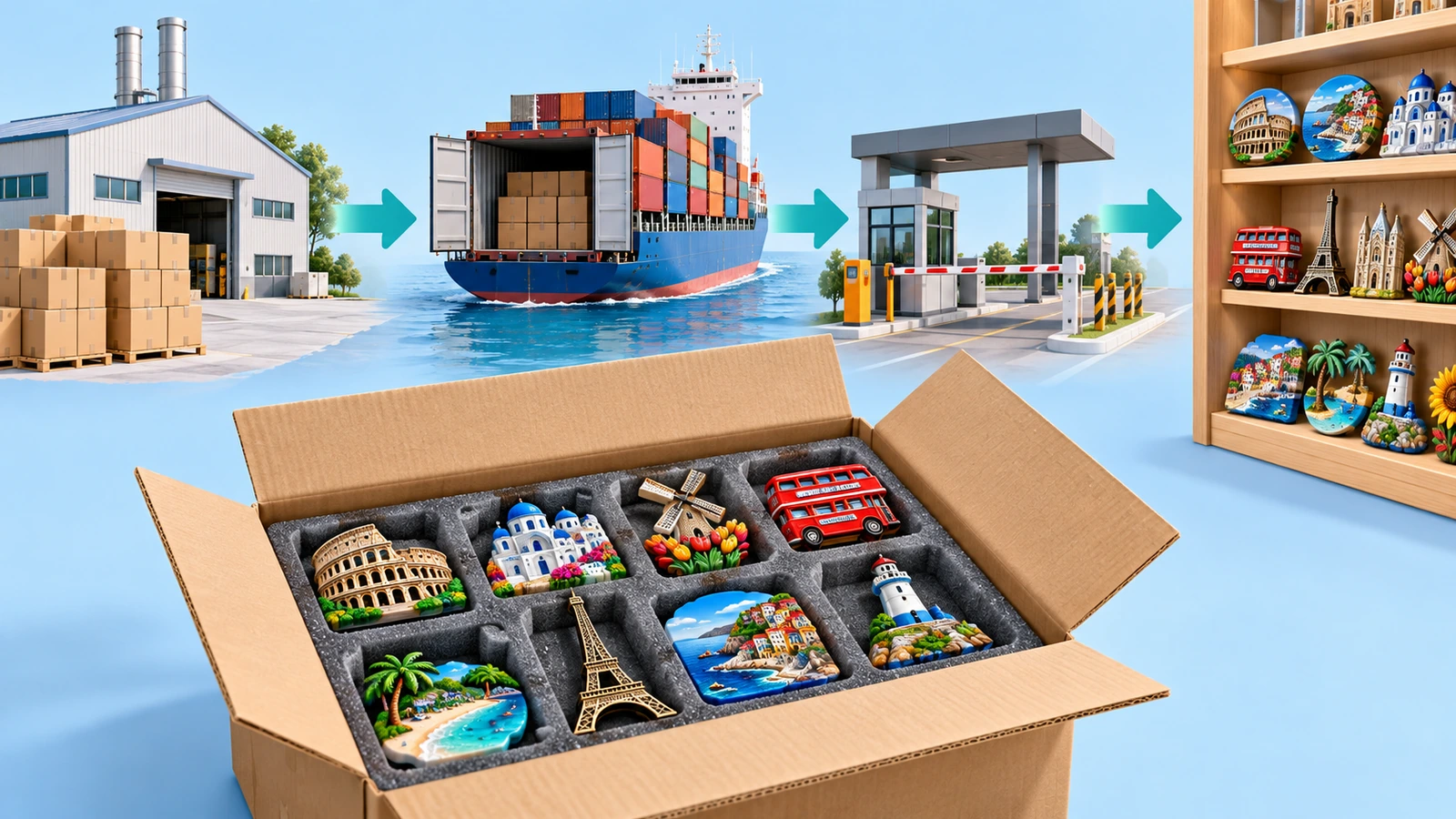
Polyresin is dense and brittle, which affects freight in two ways. Weight drives the cost of air freight. The protective packing needed to prevent chipped edges increases carton volume, which drives the cost of ocean freight and dimensional-weight pricing. Air is faster but usually costs much more per unit. Ocean freight is cheaper per unit but adds weeks, and longer transit should be built into your event or season deadline.
The trade term on the quote decides who pays which leg. Under EXW, FOB or a delivered term, the same unit price can mean very different totals at your door. Import duties depend on the tariff classification, the country of origin and any trade measures in force when goods arrive. Confirm all three with a licensed customs broker before you issue a purchase order, not after the shipment lands.
Bring every layer together with one formula. This is the number to use for bulk souvenir magnet pricing decisions:
Landed cost per unit = (Tooling fee ÷ units you expect to sell from that tooling) + unit price + (sampling + testing + order fees) ÷ order quantity + (freight + insurance + brokerage + duties) ÷ order quantity
Spreading tooling over the units you expect to sell across reorders, rather than over the first order only, gives a fairer picture of a design you plan to keep in your range.
How should you compare quotes from different suppliers?
Put every quote into the same structure before you compare totals. The table below lists the components to check line by line.
Cost component
How often you pay
What pushes it up
Question to ask the supplier
Master sculpt
Once per design
Deep relief, undercuts, revision rounds
How many revisions are included, and who keeps the master?
Production molds
Once, then on refresh
Multi-part molds, mold wear on long runs
When do molds need replacing, and what does a refresh cost?
Casting and painting
Every unit
Color count, fine details, metallics, color matching
How many paint colors is the price based on?
Magnet and topcoat
Every unit
Neodymium vs ferrite, embedded fixing, UV-stabilized coating
Which magnet type and coating are included in this price?
Samples and testing
Every order or design
Extra sample rounds, third-party lab reports
Are samples and test reports quoted separately?
Freight and duties
Every shipment
Carton volume, air vs ocean, tariff classification
Which trade term applies, and what does it include?
Quote formats also differ in ways that change how you should read them.
Quote format
Advantage
Risk for the buyer
Tooling itemized separately
Reorders are cheaper because tooling is already paid; costs are transparent
Higher cash outlay on the first order
Tooling folded into the unit price
Lower upfront payment
Reorders may keep paying for tooling unless the price is renegotiated
Delivered price to your door
One number to budget against
Freight and duty assumptions are hidden; check what happens if tariffs change
Treat the following as red flags: a quote with no stated color count, no named magnet type, no sample cost, or a vague trade term. None of these proves the supplier is unreliable. Each one, though, is a place where the final invoice can drift away from the quote.
Frequently asked questions
FAQ: Why do custom polyresin magnets carry a mold fee at all?
Each design needs its own master sculpt and production molds, and no other customer can reuse them. The fee pays for that sculpting and mold-making time. Stock designs with existing molds avoid it, which is why custom pieces almost always carry a tooling line that ready-made catalogue items do not.
FAQ: Will I pay the mold fee again when I reorder?
Usually not for the master, as long as the supplier still stores it. Production molds wear out with use, however, so a popular design may eventually need a mold refresh. Ask how long masters are stored and what triggers a refresh charge before the first order.
FAQ: Can I get below the minimum order quantity?
Sometimes. Options include ordering fewer colors, sharing one sculpt across several color schemes if the supplier counts them together, or combining designs into one order. Expect the unit price to rise as quantity falls, because setup work is spread over fewer pieces.
FAQ: Why don't unit prices fall as fast as they do for printed magnets?
Printing is machine work, so per-unit labor shrinks with volume. Hand painting needs a person's time for every piece, so after setup costs are spread out, the remaining labor stays roughly constant per unit. Price breaks flatten at higher tiers as a result.
FAQ: How can I lower the cost without the magnet looking cheap?
Reduce the color count, let raised edges in the sculpt separate colors, replace tiny painted details with bolder relief, and match the magnet strength to the piece's real weight instead of over-specifying. These changes cut labor while keeping the three-dimensional detail that makes polyresin worth choosing.
FAQ: Does compliance testing add cost to fridge magnets?
It can. Small loose or separable magnets are regulated in the US, products marketed to children face toy safety rules, and European sales bring chemical restrictions. Ask which tests your market needs and whether the supplier's quote already includes the lab reports.
FAQ: Can you tell me the price of my design right now?
An accurate price needs your artwork or reference images, the approximate size, the number of colors, the quantity range, the magnet preference and your delivery country. Share those through the product page and you will receive an itemized quote you can run through the landed-cost formula above.
Key takeaways
Loose small magnets must stay below a regulated strength threshold, so magnet choice is a compliance cost as well as a material cost. — Flux index under 50 kG² mm² for magnets that fit the small-parts cylinder (Source)
The US magnet standard is already in force, so budget for it on every new design rather than treating it as a future cost. — Applies to products manufactured after October 21, 2022 (Source)
UV exposure drives resin discoloration, which is why a UV-stabilized topcoat is a legitimate and visible line item. — Mechanisms documented in a 2022 peer-reviewed aging study (Source)
Name the coating grade on the quote so suppliers price the same material. — ASTM D1763, the US specification for epoxy resins in castings and coatings, reapproved in 2021 (Source)
European sales add chemical compliance that should be checked before production, not at customs. — Regulation (EC) No 1907/2006, REACH (Source)
Challenge magnet surcharges that cite EU raw-materials rules without explanation. — Regulation (EU) 2024/1252 targets mainly larger permanent-magnet products (Source)
Turning a quote into a budget
The price of a custom souvenir magnet is the sum of its layers: tooling you pay once, units you pay every time, order fees, and the cost of getting goods through customs to your shelf. Separate those layers, test price breaks with the marginal-cost calculation, simplify the paint scheme where it does not add value, and lock in the trade term before you sign. Two quotes that looked far apart often turn out close, and the occasional bargain turns out to be missing half its lines.
When you are ready to price a real design, send your artwork, quantity range and delivery country through our custom resin fridge magnets page. You will get an itemized quote that fits directly into the landed-cost formula in this guide.
Hi there! I'm Bruce, proud dad to my amazing son. I'm the founder of Zigpac, a printing and packaging company empowering small and medium-sized businesses with custom solutions. Let's create something great together!



 Blog PDF for offline reading














The information below is required for social login
Sign In
Create New Account