


 Blog PDF for offline reading
Quick answer: Choose 60 gsm for one-time giveaways, 70–80 gsm for trade-show and retail checkout bags, and 90–100 gsm only for heavier loads or long reuse. GSM is fabric weight per square meter, not true thickness, so confirm the choice with a filled-bag test.
Most quotes for printed polypropylene bags show a single number, such as 60, 70, 80 or 100 gsm, and leave the buyer to guess what it means. Non woven bag gsm thickness drives three outcomes at once: whether the handle survives the first heavy load, how sharp your logo looks, and how much fabric you pay for on every bag. Get it wrong in one direction and handles tear at your booth. Get it wrong in the other and you pay for fabric that customers discard after the event.
The usual mistake is to pick the lowest gsm that fits the budget, or to pick the highest one to feel "safe." Neither is a specification. A 120 gsm bag can still fail if its seams are weak, and a 60 gsm bag can be the right choice for a flyer handout that is used once. This guide maps fabric weights from 40 to 120 gsm to load, print quality, reuse and relative fabric cost, so you can match the weight to the job instead of to the price column.
What Does Non Woven Bag GSM Thickness Really Mean?
GSM stands for grams per square meter. It is a mass measurement, not a caliper measurement. The test method for nonwovens is defined in ISO 9073-1:2023[1], which specifies how to determine the mass per unit area of nonwoven fabrics. When a supplier says "80 gsm," a one-meter square of that fabric should weigh 80 grams.
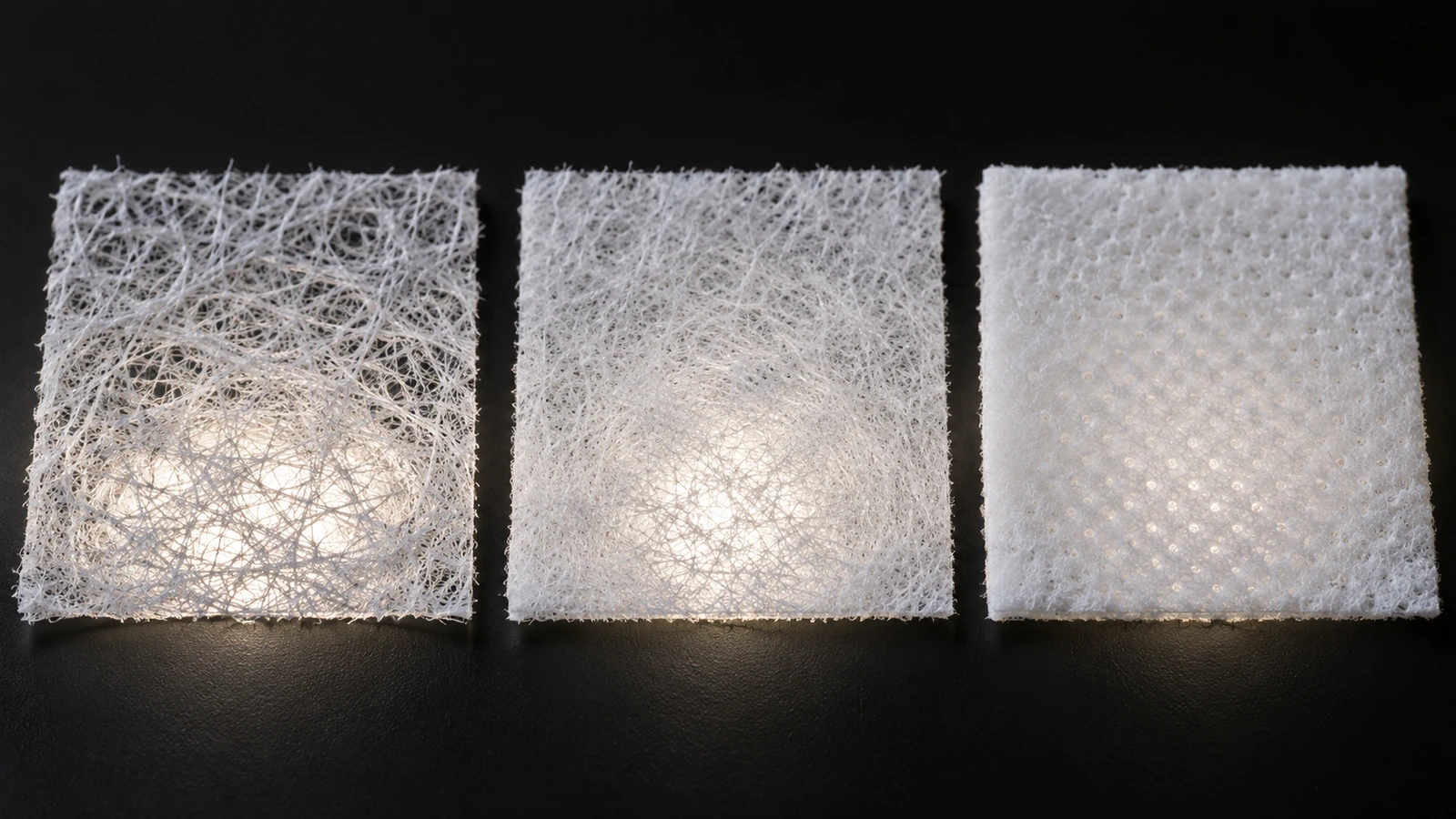
Thickness follows from weight only loosely. Polypropylene has a density of roughly 0.9 g/cm³, so 80 g of solid PP spread over one square meter would be about 0.09 mm thick. Spunbond fabric is a web of bonded fibers with air between them, so its measured caliper is higher than that figure and varies with fiber fineness, bonding pattern and calendering. This is why two rolls both labeled 90 gsm can feel noticeably different in the hand. Weight is the number you can specify and verify; "feel" is what you confirm on a physical sample.
Weight matters most where the fabric carries load alone. On a die-cut or D-cut bag, the handle is a hole punched out of the bag body, so the entire load concentrates on the fabric around that hole. Packaging engineers who analyze field returns report that more than half of real-world PP non-woven bag failures happen at the handle rather than the body, and that below roughly 50 gsm the handle hole edge is the first thing to rip. The flip side also holds: a punched handle gains less from extra fabric than a sewn handle does, so pushing a D-cut bag above about 90 gsm usually buys stiffness rather than proportionate strength.
How Do You Choose the Right GSM in Five Steps?
If you are asking "what gsm non woven bag do I need," answer these five questions in order. Each one narrows the range before you compare quotes.
Step 1: Weigh what will actually go in the bag
Load is easier to estimate than most buyers expect. Paper is the most common trade-show content, and its weight is simple arithmetic: an A4 sheet is 0.0625 m², so 100 sheets of 80 gsm office paper weigh 0.5 kg and a full 500-sheet ream weighs 2.5 kg. Glossy catalogs on heavier stock weigh more per page. For retail, put your heaviest realistic basket on a kitchen scale: two folded garments, a boxed cosmetic set, a bottle. Write down the heaviest load, not the average.
Step 2: Decide how many times the bag should be used
Reuse is where heavier fabric earns its cost. Reporting on Chinese packaging research found that non-woven bags need to be reused at least 11 times[2] before their footprint beats a single-use plastic bag. Real behavior often falls short: a study of New Jersey's bag ban found an alternative bag is reused only two to three times[3] before being discarded.
The practical reading: a giveaway that is likely used once does not justify 100 gsm, while a branded retail bag that you want customers to carry for months needs enough fabric to survive dozens of trips. Industry estimates for typical spunbond bags put 80 gsm at roughly 50–80 uses and 100 gsm at roughly 80–120 uses, though these are field estimates, not laboratory ratings. Also keep in mind that worn bags do not simply vanish: a 2025 study in Environmental Science & Technology[4] reports that nonwoven bags release micro- and nanoplastics through abrasion during use and weathering after disposal, which is one more reason not to over-buy fabric for bags that will be thrown away quickly.
Step 3: Add a margin for dynamic load
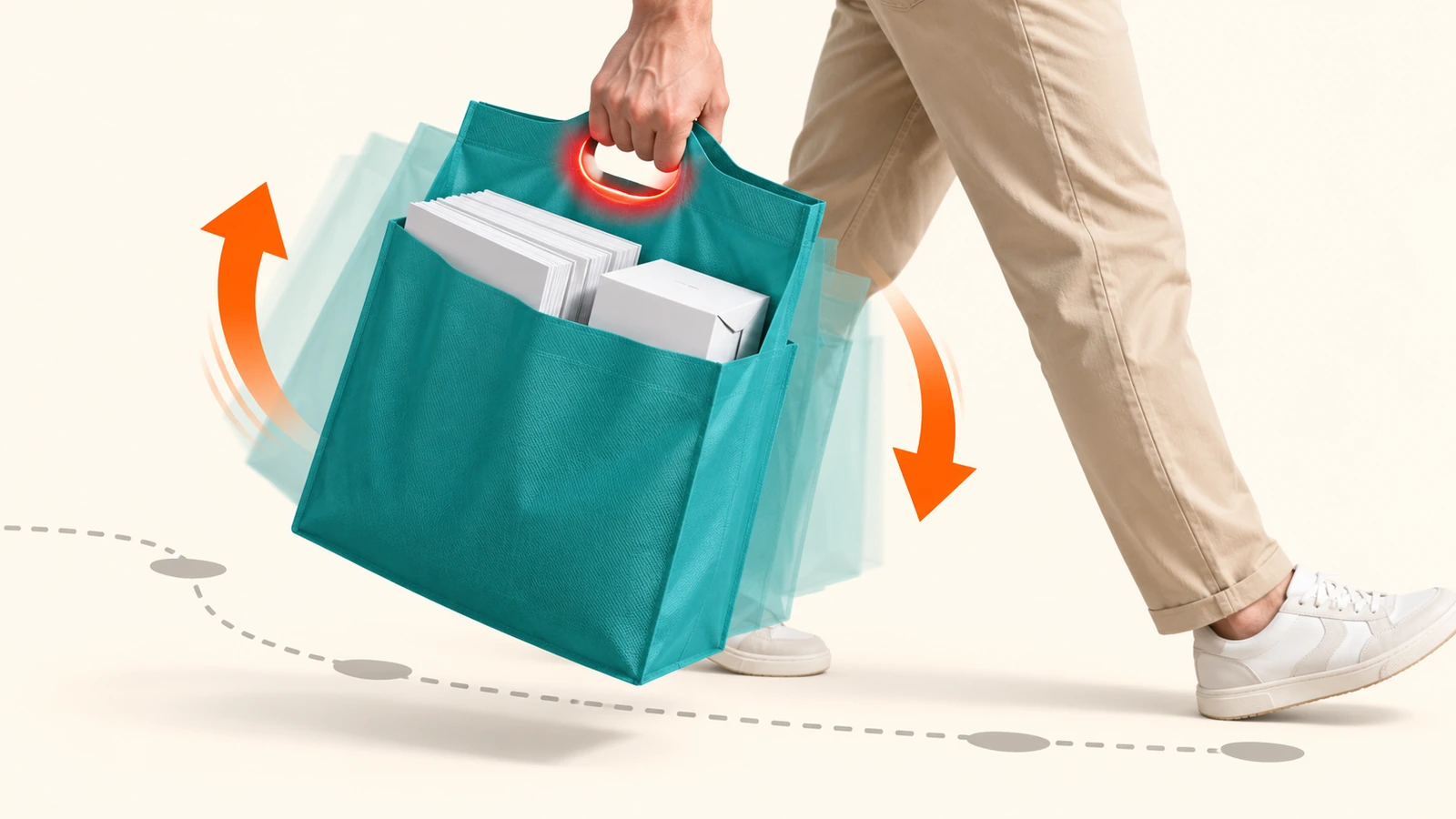
Supplier load ratings are usually static: a weight hung from the handle under controlled conditions. In use, bags are lifted fast, swung, bumped against doors and set down hard, and each of those moments spikes the force on the handle above the resting weight. A workable rule of thumb is to choose a construction whose tested static capacity is at least twice your heaviest load from Step 1. For reference, published D-cut spec sheets in the 60–100 gsm band claim roughly 2–8 kg depending on bag size, with reinforced handles claimed up to 8–12 kg. None of the sheets we reviewed named a test standard, so treat those figures as claims to verify, not as guarantees.
Step 4: Match the fabric weight to the artwork
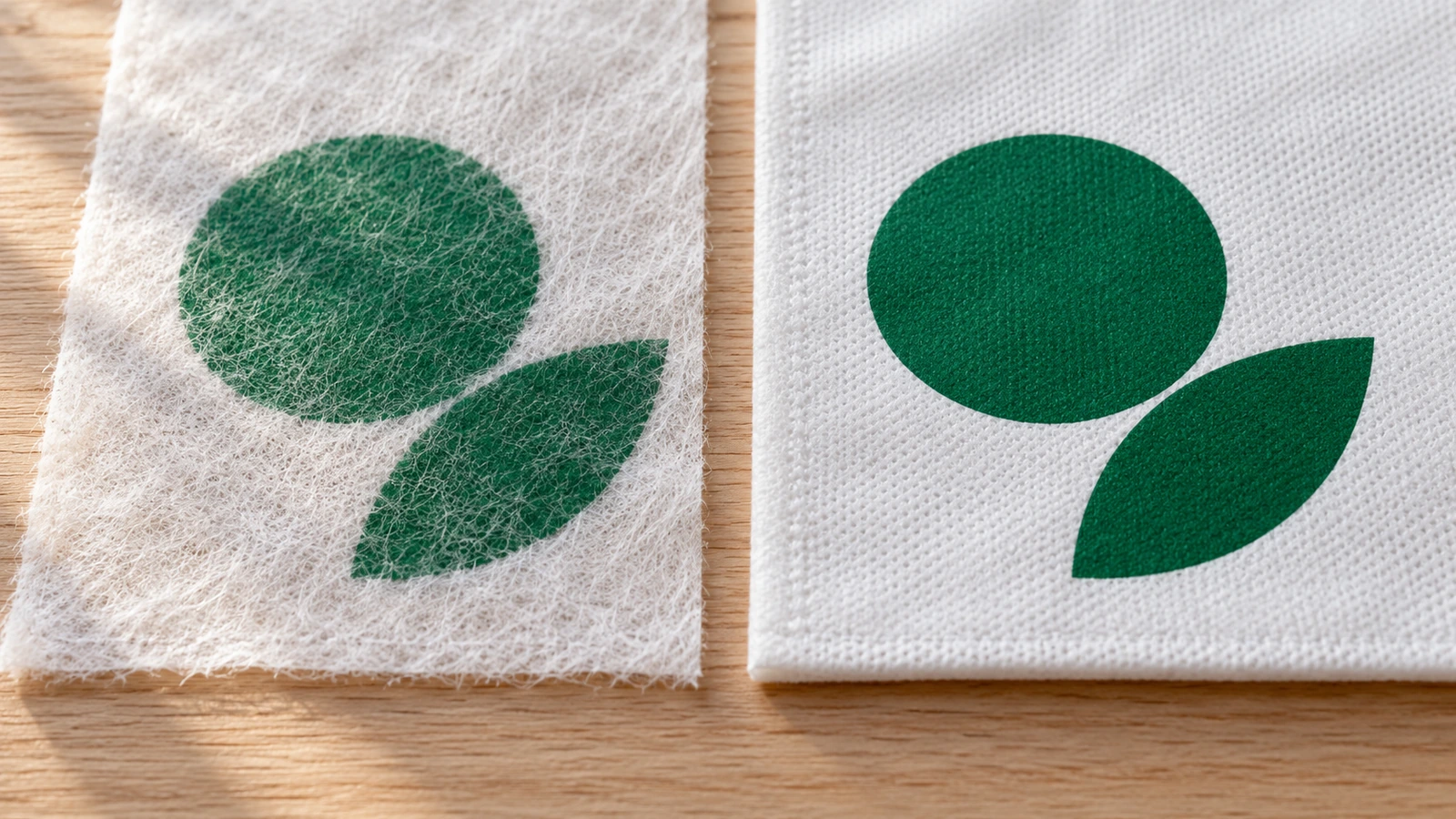
Fabric weight changes how print reads. Lighter webs are more open, so ink can strike through, fine lines lose definition and dark contents may show through a light-colored bag. White fabric around 60–80 gsm is the standard base for spot-color screen printing, and most one- to three-color logos print cleanly in that range. Photographic or gradient artwork usually moves to heat transfer or lamination, and laminated bags behave differently: they gain surface strength and splash resistance but become stiffer, can crack along repeated folds and are harder to recycle.
Heavier fabric does not fix poor ink bonding. Factory quality notes describe whole runs rejected because curing temperatures dropped and ink sat on the fiber surface instead of bonding, so the logo rubbed off onto clothing. Ask for a dry and wet rub test on the approved sample regardless of the gsm you choose.
Step 5: Verify the weight and the bag before the bulk order
You can spot-check gsm yourself. Cut a 10 × 10 cm square (0.01 m²) from a flat panel, weigh it on a scale that reads to 0.01 g and multiply by 100. A square weighing 0.80 g is 80 gsm. Check several squares from different bags, and ask the supplier to state the gsm tolerance in writing, since a lot that runs a few grams under spec affects a 60 or 70 gsm bag far more than a 100 gsm one. This quick check is not the ISO method, but it catches gross substitutions.
Then test the filled bag, not the empty one. A useful benchmark comes from California's former reusable-bag rules under SB 270, which required bags designed for at least 125 uses and, for cloth bags, carrying 22 pounds over 175 feet 125 times[5]. You do not need to replicate it exactly; loading your Step 1 weight, walking a set distance and repeating a few dozen cycles reveals handle stretch and seam peel quickly.
Note that this program is history. CalRecycle[6] confirms the SB 270 certification program ended on December 31, 2025, and since January 1, 2026, covered California stores may only distribute recycled paper bags at the point of sale, for a minimum charge of 10 cents. If your retail checkout plan includes California grocery, pharmacy or convenience locations, check how the bag will be offered before you set the gsm. Buyers exporting to India face a hard floor instead: non-woven carry bags below 60 gsm have been prohibited there since September 30, 2021.
Once you have landed on a weight, the construction choices around it matter just as much. If your answer is a 70–80 gsm flat bag with a punched handle, our custom heat-sealed D-cut non-woven bags page covers construction, handle reinforcement, the ordering steps and how the style compares with W-cut and loop-handle bags, so this guide does not repeat them.
How Do 40 to 120 GSM Compare on Load, Print, Reuse and Cost?
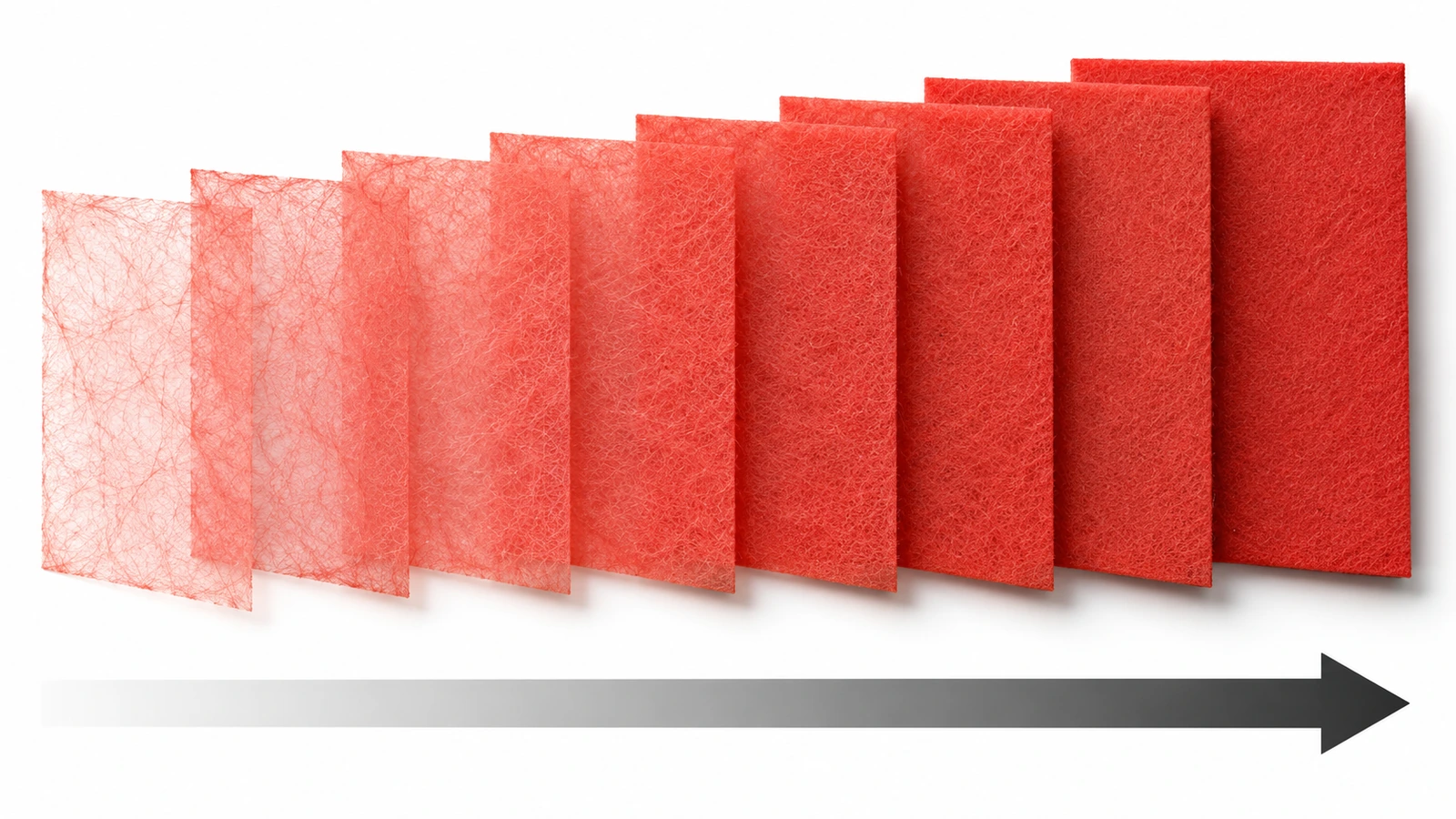
The table below summarizes the full range. "Solid-equivalent thickness" is the weight divided by polypropylene's density, a floor for the real caliper rather than a measured value. "Relative fabric" compares the fabric mass in a bag of the same size with an 80 gsm baseline; it is a fabric-only ratio and excludes printing, sealing, handle reinforcement and freight, which do not scale with weight.
| GSM | Solid-equivalent thickness | Load behavior | Print behavior | Reuse expectation | Relative fabric (vs 80 gsm) | Best fit |
|---|---|---|---|---|---|---|
| 40 | ≈0.044 mm | Too light for punched handles; hole edge tears first | Strong strike-through; simple marks only | Effectively single use | 50% | Linings, light gift pouches, no-handle sleeves |
| 50 | ≈0.056 mm | Failure boundary for D-cut handles | Show-through on light colors | A few uses | 63% | Very light inserts; avoid for carried loads |
| 60 | ≈0.067 mm | Light loads such as flyers and samples | Acceptable for one-color bold logos | Short campaigns | 75% | Mass giveaways, pharmacy sample bags |
| 70 | ≈0.078 mm | Light to moderate loads, short carry | Clean spot-color screen printing | Event weekend and beyond | 88% | Trade-show handouts, conference bags |
| 80 | ≈0.089 mm | Common retail default; more margin on the handle | Standard base for multi-color screen print | ~50–80 uses (industry estimate) | 100% | Retail checkout, boutique and salon bags |
| 90 | ≈0.100 mm | Heavier goods; diminishing gains for punched handles | Even surface for fine lines | Repeated weekly use | 113% | Heavier retail items, premium feel |
| 100 | ≈0.111 mm | Stronger body; handle design becomes the limit | Crisp print, good base for lamination | ~80–120 uses (industry estimate) | 125% | Long-life branded bags, sewn-handle styles |
| 120 | ≈0.133 mm | Strong fabric, but weak seams still fail | Premium surface; often laminated | Long life if seams match | 150% | Gift and premium retail; rarely needed for D-cut |
Two patterns stand out. First, fabric cost rises in a straight line with weight, so moving from 80 to 100 gsm adds a quarter more fabric to every bag, while the strength gain for a punched handle is smaller than that. Second, seams and handles set the real ceiling. Factory engineers have documented 120 gsm bags failing on the retail floor because heat-sealed seams opened at about 12 lb of force while the fabric itself survived. Above roughly 90 gsm, money is usually better spent on handle reinforcement or a different handle style than on more fabric.
Mapped to the three jobs most buyers have in mind, the ranges look like this: one-day giveaways and sample bags sit at 60–70 gsm; trade-show bags that carry brochures, a catalog and a few samples sit at 70–80 gsm; and retail checkout bags that should keep carrying your logo for months sit at 80 gsm, moving to 90 gsm only when contents are heavy or angular. If you are shipping to the EU, factor in that the Packaging and Packaging Waste Regulation applies from August 12, 2026, and that member states must keep lightweight plastic carrier bag consumption to 40 bags per person per year[7]; bags positioned as reusable there should genuinely be built for repeated rotations.
70 GSM vs 80 GSM Non-Woven Fabric: Which Is the Better Default?
This is the most common comparison in quotes, because the two look almost identical on a screen. The difference is 10 grams per square meter, or about 14% more fabric for the 80 gsm version of the same bag.
Choose 70 gsm when the bag has a defined, short job: a conference where attendees carry documents from hall to hotel, a seasonal promotion, a pharmacy handing out light samples. The contents are known, the carry distance is short and the bag's main role is a visible logo for a few days.
Choose 80 gsm when the bag is part of your retail experience or you cannot control what goes in it. Customers overload checkout bags, reuse them for groceries and fold them into drawers. The extra fabric gives the punched handle more margin, tolerates small gsm variation between rolls, and gives multi-color screen prints a more even surface. For most non woven fabric gsm for shopping bags decisions, 80 gsm is the point where cost, handle margin and print quality balance, which is why many factories quote it as their standard.
If you are torn, order samples of both, fill them with your Step 1 load and run the walk test from Step 5. A side-by-side test usually settles the question in an afternoon.
FAQ
FAQ: Is a higher GSM always more durable?
No. Higher gsm makes the fabric stronger, but a bag fails at its weakest point, which is usually the handle or a seam. A heavy bag with poorly fused heat seals can open under a modest load, while a well-sealed 80 gsm bag carries the same load comfortably. Specify the sealing and handle reinforcement along with the weight.
FAQ: What GSM non woven bag do I need for a trade show?
For brochures, a catalog and small samples, 70–80 gsm is the usual range. Estimate the paper weight first: 100 sheets of 80 gsm A4 paper weigh 0.5 kg. If exhibitors will add heavy catalogs or bottled samples, go to 80 gsm and consider handle reinforcement rather than jumping to 100 gsm.
FAQ: How thick is 80 GSM non-woven fabric in millimeters?
Solid polypropylene at 80 g/m² would be about 0.09 mm thick. Real spunbond fabric is thicker than that because it contains air between fibers, and the exact caliper depends on fiber fineness and bonding. Thickness is measured separately from weight, so ask for both if feel matters to your brand.
FAQ: Can I check the GSM of a sample myself?
Yes, roughly. Cut a 10 × 10 cm square, weigh it on a 0.01 g scale and multiply by 100. Repeat with squares from several bags. It is a screening check, not the ISO 9073-1 laboratory method, but it quickly exposes a lot that is well under the quoted weight.
FAQ: Does a heavier GSM make the bag more eco-friendly?
Only if the bag is actually reused more. Heavier fabric means more polypropylene per bag, so it pays off only through extra uses. Weight also does not change what you can claim: under the FTC Green Guides, an unqualified "recyclable" claim requires recycling access for at least 60 percent of consumers[8] where the bag is sold, and ordinary PP spunbond is not designed to meet ASTM D6400[9] for compostable plastics. Enforcement is active: in 2026 Philadelphia sued two brands over recyclability claims on plastic bags[10]. For wording you can print safely, see the eco-claims section on our D-cut bag product page.
FAQ: Does GSM affect print quality?
Yes. Lighter, more open fabric lets ink strike through and blurs fine lines, while 60–80 gsm white fabric is the standard base for clean spot-color screen printing. Very detailed or photographic artwork usually calls for heat transfer or lamination, which matters more than adding fabric weight.
Key Takeaways
- GSM is a measured weight, not a thickness reading, and it can be verified with a defined test method. — mass per unit area under ISO 9073-1:2023 (Source)
- Heavier fabric only pays off when the bag is reused many times. — at least 11 reuses to beat a single-use plastic bag (Source)
- Actual reuse is often far below that, so do not over-specify giveaway bags. — 2–3 reuses before discard in a New Jersey study (Source)
- Borrow a proven field protocol to test filled bags. — 22 lb carried 175 ft, 125 times under former SB 270 rules (Source)
- California checkout rules changed in 2026, which affects retail bag plans. — recycled paper bags only at point of sale, minimum $0.10 (Source)
- Fabric weight does not unlock unqualified recyclable claims. — recycling access for at least 60% of consumers required (Source)
Choosing a Fabric Weight You Can Defend
A good gsm choice starts from the load, the expected number of uses and the artwork, then gets confirmed on a filled sample. For most branded flat bags that lands at 70–80 gsm, with 60 gsm reserved for true one-day giveaways and 90–100 gsm for heavy contents or long reuse. Above that, put the budget into seams and handles rather than fabric.
If you already know your load and print requirements, send them to us with your target quantity and destination market. We will recommend a fabric weight, confirm what can be produced and quote it for your project. Start from the custom D-cut non-woven bag page to request a quote or a sample.
Sources
- ISO 9073-1:2023, Nonwovens — Test methods — Part 1: Determination of mass per unit area. International Organization for Standardization, 2023. https://www.iso.org/obp/ui/es/?_escaped_fragment_=iso:std:83590:en ↩
- "In Depth: China's Popular Plastic Bag Replacement Is Less Green Than It Seems." Caixin Global, June 27, 2024. https://www.caixinglobal.com/2024-06-27/in-depth-chinas-popular-plastic-bag-replacement-is-less-green-than-it-seems-102210555.html ↩
- "Study Shows Impact of NJ Plastic Bag Ban." Nonwovens Industry. https://www.nonwovens-industry.com/breaking-news/study-shows-impact-of-nj-plastic-bag-ban/ ↩
- Environmental Science & Technology, American Chemical Society, 2025, on micro- and nanoplastic release from nonwoven bags. https://pubs.acs.org/doi/10.1021/acs.est.5c04448 ↩
- California Department of Justice, Office of the Attorney General, consumer guidance on SB 270 bag requirements. https://oag.ca.gov/sites/all/files/agweb/pdfs/consumers/bag-ban-english.pdf ↩
- CalRecycle, "Bag Requirements at Grocery and Retail Stores." https://calrecycle.ca.gov/plastics/bagrequirements/ ↩
- EUR-Lex summary, "Packaging and packaging waste (from 2026)," Regulation (EU) 2025/40. https://eur-lex.europa.eu/EN/legal-content/summary/packaging-and-packaging-waste-from-2026.html ↩
- 16 CFR § 260.12, Recyclable claims, FTC Guides for the Use of Environmental Marketing Claims. Electronic Code of Federal Regulations. https://www.ecfr.gov/current/title-16/chapter-I/subchapter-B/part-260/section-260.12 ↩
- ASTM D6400, Standard Specification for Labeling of Plastics Designed to be Aerobically Composted in Municipal or Industrial Facilities. ASTM International. https://www.astm.org/d6400.html ↩
- "Philadelphia lawsuit targets deceptive recyclability claims by SC Johnson, Bimbo Bakeries." Packaging Dive, October 7, 2026. https://www.packagingdive.com/news/philadelphia-lawsuit-deceptive-recyclability-claims-sc-johnson-bimbo-bakeries/761077/ ↩












The information below is required for social login
Sign In
Create New Account