
 Blog PDF for offline reading
Quick answer: Zigpac makes printed scratch-off code labels (codes printed under the coating, for prize codes and PINs) and scratch-off overlay stickers (applied over content you print or write yourself). So, how do scratch off stickers work? A release varnish or thin clear film separates the hidden content from an opaque silver or gold coating, so the coating grips that barrier weakly and crumbles away under a coin while the ink beneath stays intact. Order printed code labels when every piece carries a unique code with real value, and order overlays for low-risk reveals you prepare yourself. Zigpac recommends approving a physical sample before bulk production.
You have a promotion planned: a discount on every shipping box, a prize code on a mailer, or a PIN on a gift card. The scratch-off panel looks like the simplest part of the job. It is usually the part that fails. Some panels are see-through before anyone scratches them. Others resist a coin. Others come off so hard that the digits underneath are gouged and cannot be redeemed.
Large-scale programs see the same problems. Michigan Lottery's spokesperson explained that a single game can run to 10–12 million tickets, and in some batches the latex covering is simply stickier than in others. Players also reported that tickets older than six months were harder to scratch, according to the Detroit Free Press[1]. If lottery-scale production has batch variation, a promotion run needs a clear specification and a test sample before printing.
The fix starts with knowing what is physically inside a scratch-off panel. Once you know which layer does which job, you can pick the right product type and write a quote request that prevents the common failures.
What Is a Scratch-Off Sticker?
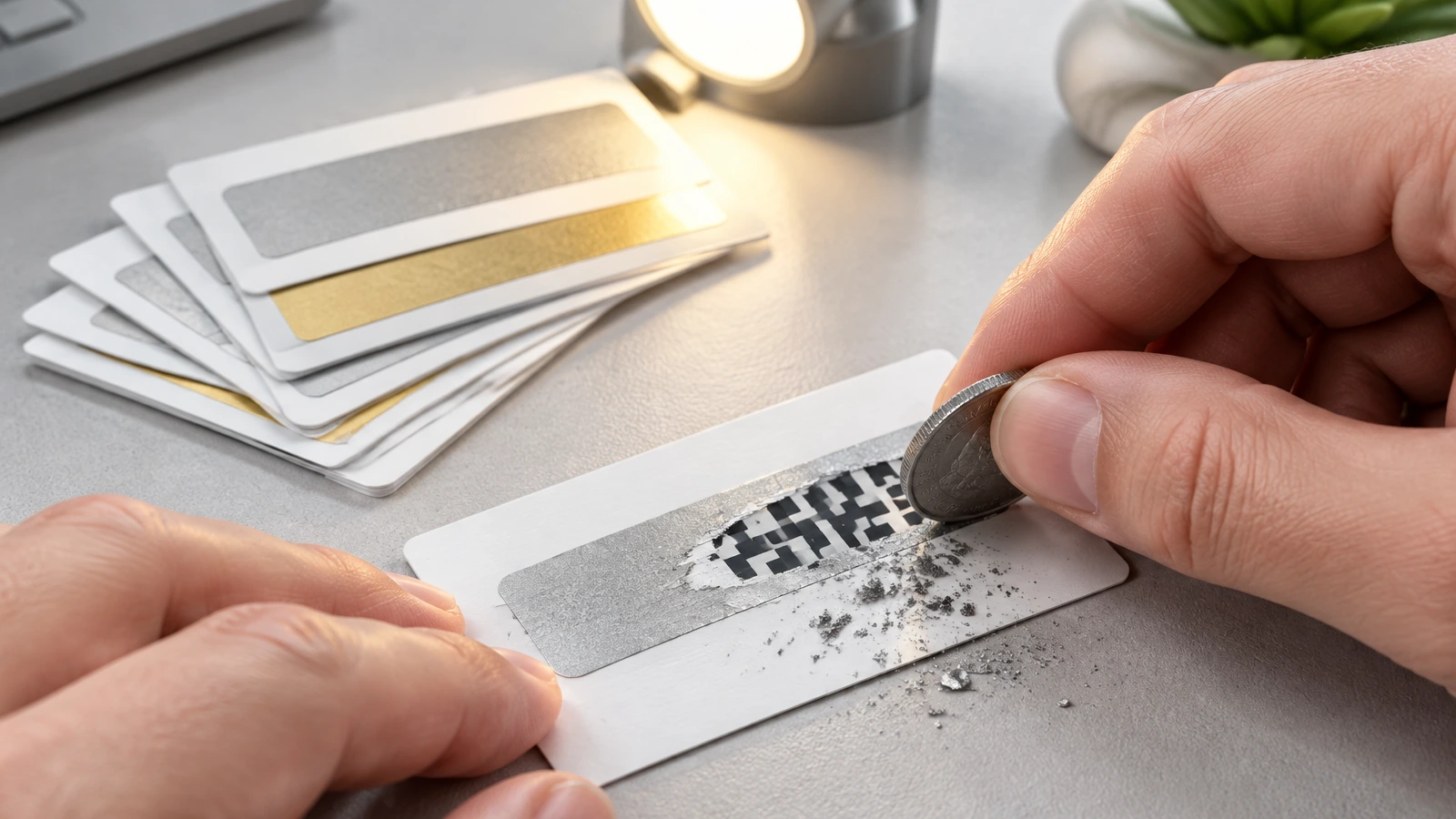
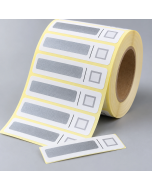
A scratch-off sticker is a pressure-sensitive label that hides information under an opaque coating, which the recipient removes with a coin or scratcher. The information stays unreadable until the coating is removed, and a removed coating shows that the piece has been used. Buyers order two formats:
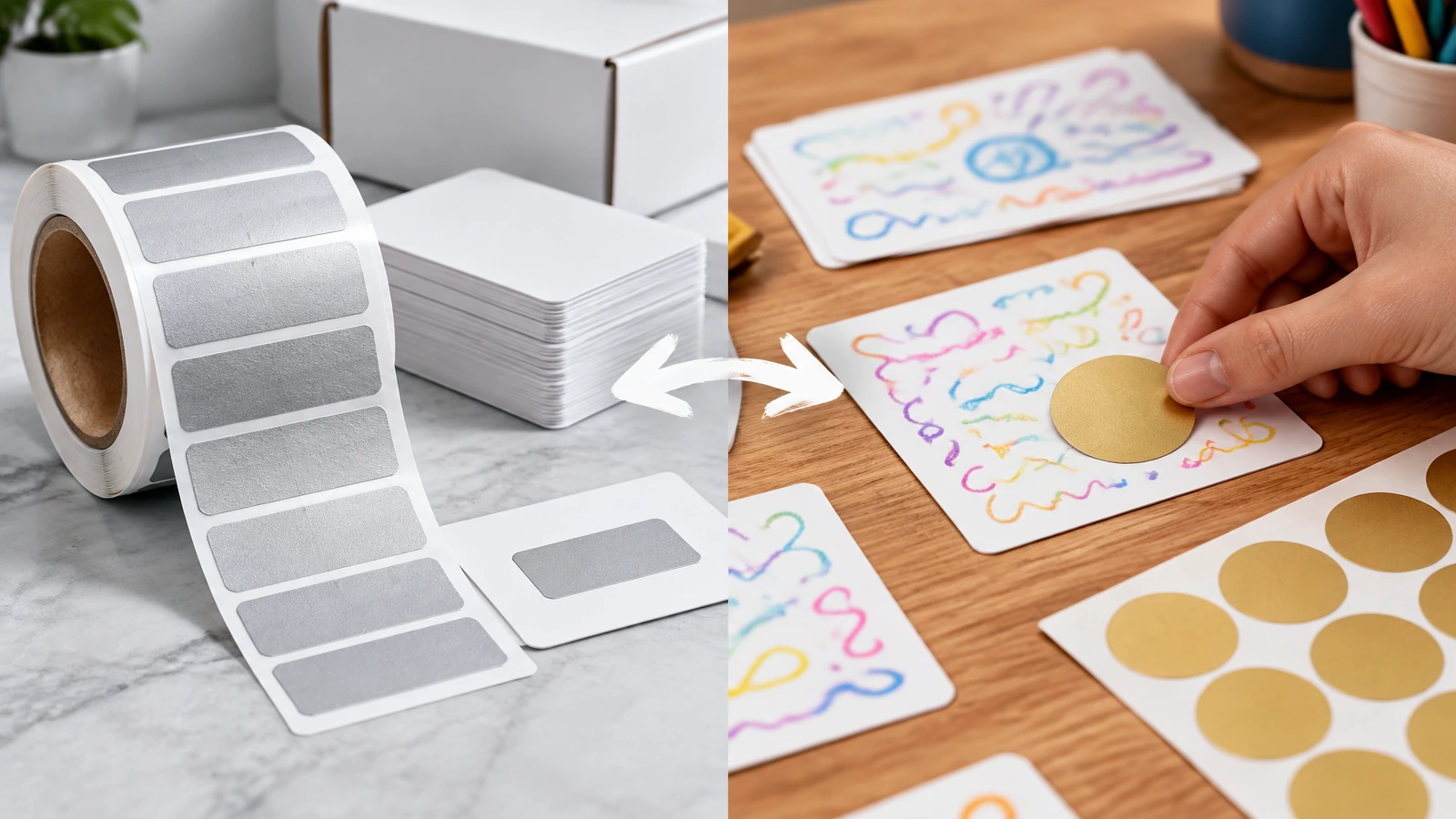
- Printed scratch-off code labels. The supplier prints the hidden content, often a unique code per label from your data file, and then applies the coating over it. You receive finished labels and apply them to cards, packs or mailers.
- Scratch-off overlay stickers. These are blank panels made of clear film, an opaque coating and adhesive. You print or write the hidden content on your own card first and place the overlay on top.
Both formats use the same physical mechanism. They differ in who controls the hidden content and in how hard the panel is to tamper with.
How Do Scratch Off Stickers Work? The Layer Stack
The core principle is the same one used on instant tickets. Patent literature describes it as a scratch-off coating applied over variable indicia "to maintain the variable indicia unreadable until the scratch-off-coating is removed", a structure used on billions of products every year (US Patent 10,183,213[2]). A printed code label typically stacks these layers, listed from the surface down:
| Layer (top to bottom) | What it does | What goes wrong without it |
|---|---|---|
| 1. Optional overprint or pattern | Decorates the panel or breaks up shapes that could hint at the code beneath | A plain panel can show shadows of the digits under raking light |
| 2. Opaque scratch-off coating (silver, gold or another color) | Blocks the view of the content and crumbles under coin pressure | No concealment, or a panel that will not scratch |
| 3. Release or protective varnish, or a thin clear film | Stops the coating from bonding to the ink and shields the digits from the coin | The coating fuses with the ink and pulls the code away with it |
| 4. Printed content (code, PIN, prize message) | Carries the hidden information in a high-contrast print | Faint print becomes illegible after scratching |
| 5. Blockout or high-contrast base (security jobs) | Absorbs light from behind and gives the code a clean background | The code can be read by holding the panel up to a light |
| 6. Face stock (paper or film) | Holds the print and the panel together | Not applicable: every label needs one |
| 7. Adhesive | Bonds the label to your card, pack or mailer | The label lifts while it is being scratched |
| 8. Release liner | Carries the labels until application, then is discarded | Not applicable: removed at application |
Security-grade stacks add more layers. One patent filing describes a sequence of substrate, a "Lower Blocking Black" for opacity and diffusion control, a high-contrast base, the variable image, and then the scratch-off coating. It also notes that the coating has to scratch off cleanly and be safe for human contact (WO2019083880A1[3]). Lottery tickets go further still, with a thick black light-absorbing layer, a white layer containing titanium white to scatter light, and a varnish over the numbers. The surface looks like one layer but is actually several (Lottery USA[4]).
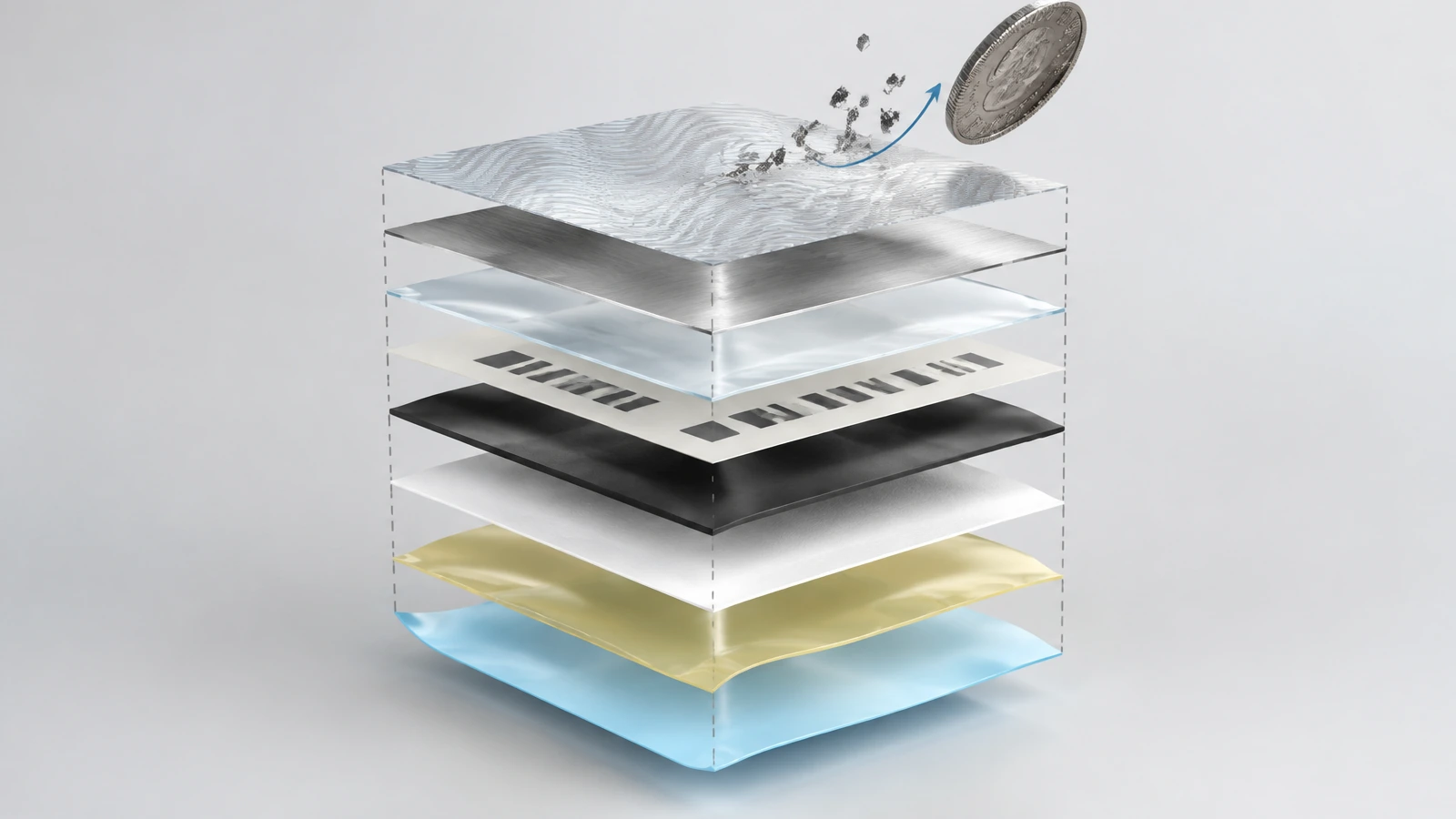
An overlay sticker is a shorter version of the same stack: opaque coating on a clear film, with adhesive and a liner underneath. Your card provides layers 4 and 6. The clear film acts as the release barrier, so the coating scratches off the film while the film stays in place and protects your writing.
Why the Coating Comes Off but the Code Stays
A clean scratch depends on three bond strengths being in the right order:
- Coating to barrier: weak. The varnish or film gives the coating a smooth, closed surface it cannot soak into, so a coin edge lifts it easily.
- Coating to itself: moderate. The coating is formulated to break into crumbs under shear. If it is too cohesive it smears and feels "stuck". If it is too weak it rubs off in transit or in a pocket.
- Barrier to ink, and ink to stock: strong. The code layer has to hold on harder than anything above it, so the coin removes only the coating.
Most failures come from one of these being out of balance. Missing or under-cured varnish lets the coating grip the ink, and digits come away with the flakes. An over-hard coating makes people press harder, which gouges the print. A weak adhesive lets the whole sticker peel instead of the coating breaking up. The order of the layers also explains the Michigan observation: coatings age and vary by batch, so a sample scratched today is the only reliable evidence of how a run will behave.
How Secure Is Each Type? Three Risk Levels
The right construction depends on what the code unlocks. Promotions fall into three levels:
- Fun reveal (classroom rewards, gender reveals, party games, "you won a free drink" with no code). The risk is spoiling the surprise. A standard opaque panel is enough.
- Promo codes (discount codes, entry codes, loyalty points). Someone could peek, copy and use a code before the intended recipient. Unique codes and a panel that cannot be read under ordinary light are needed.
- Prize, PIN and balance codes (gift card PINs, cash prizes, activation codes). Every concealed code is a target. You need light blocking, tamper evidence and code-to-record reconciliation.
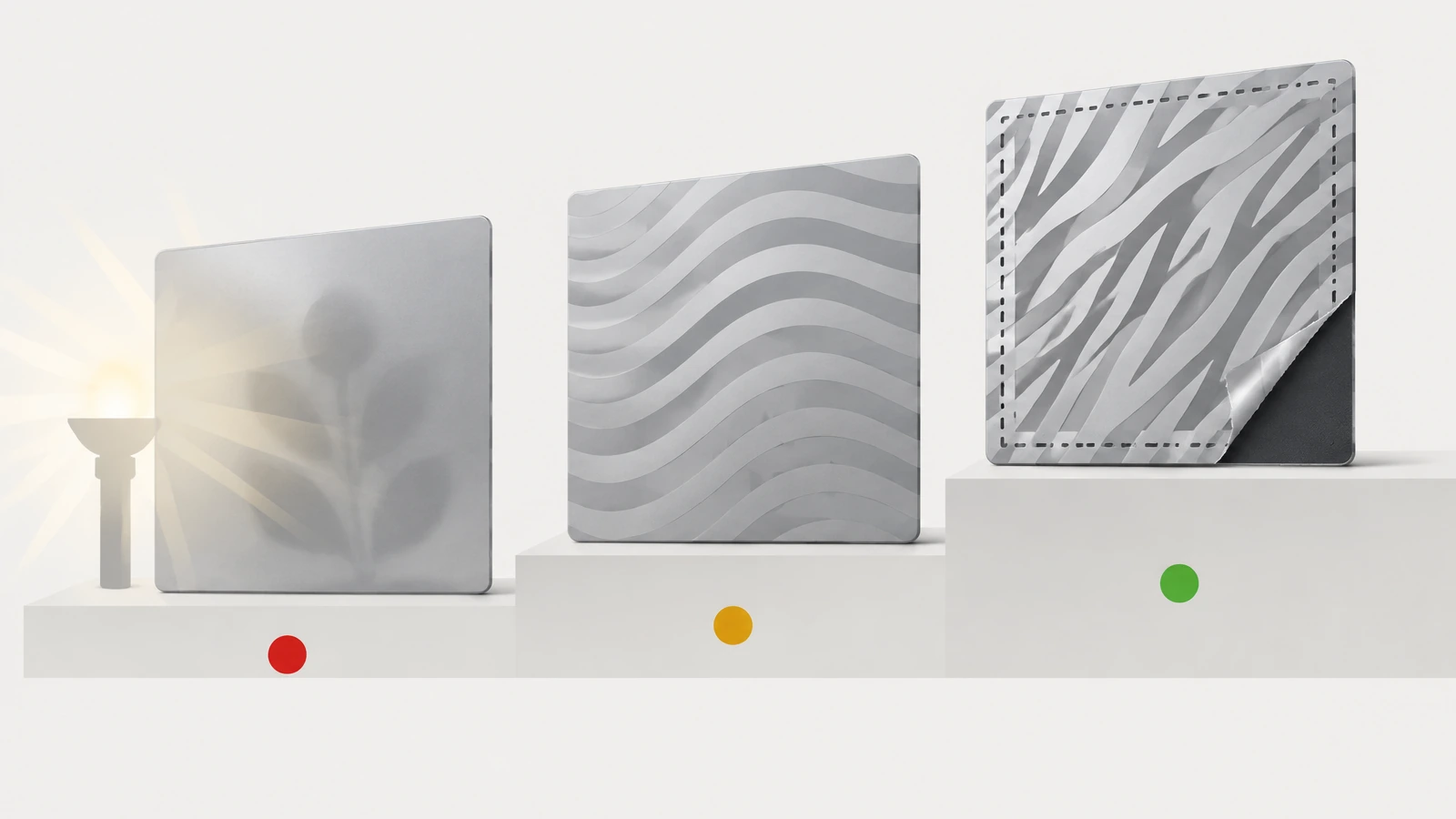
A shiny surface does not prove the panel is opaque. One patent application notes that ordinary cold foil, around 0.002–0.009 inch thick, often cannot meet instant-ticket opacity requirements against "candling", meaning reading through the panel with a light behind it (US20230149798A1[5]). For higher-risk levels, these anti-peek and tamper options are worth asking about:
- Blockout or black layer under the code, so light from behind is absorbed.
- Pattern masking printed on the coating, such as waves or zebra stripes, so faint shadows of the digits cannot be read. A related approach prints a pattern across both the coating and the surrounding area, so a panel that is lifted and replaced no longer lines up (WO2011117687A1[6]).
- Varnish seal over the code, which resists solvent "wicking" and protects the digits from the coin.
- Tamper-evident slits or destructible film, so an attempt to peel the label off and re-apply it tears the panel.
Do not take "high opacity" on trust. The industry has no single opacity definition: one patent states that scratch-off opacity levels "are not well-defined within the industry" (EP3471846A1[7]). The lottery sector's WLA-SCS:2024 framework expects suppliers to run opacity, mechanical and chemical tests (World Lottery Association[8]), and controls still fail. A California State Controller audit records that 2017 security retests found "catastrophic failures" in six games on sale (California State Controller[9]). Our separate guide on stopping scratch-off codes showing through covers the full light-test procedure. For this decision, it is enough to know that the higher the code's value, the more of these options you need.
Scratch Off Labels vs Overlay Stickers: Side-by-Side
| Factor | Printed scratch-off code labels | Scratch-off overlay stickers |
|---|---|---|
| Who creates the hidden content | The supplier prints it under the coating | You print or handwrite it on your card first |
| Variable data (unique code per piece) | Yes. Codes are printed from your data file | Only if you print unique content yourself |
| Construction | Latex scratch-off coating or pressure-sensitive label | Pressure-sensitive label with clear film and opaque coating |
| Security ceiling | Higher: the coating sits on a controlled varnish layer, with optional blockout, masking and tamper features | Lower: the panel sits on whatever surface you supply and can be lifted as one piece |
| Typical promotion use | Prize codes, PINs, gift card balances, unique discount codes, sweepstakes entries | Classroom rewards, reveal cards, party games, small batches of handwritten offers |
| Zigpac listed price tiers (per piece) | 100+ pcs US$0.45; 500+ US$0.15; 1,000+ US$0.10; 5,000+ US$0.05 | 100+ pcs US$0.40; 500+ US$0.20; 1,000+ US$0.15; 5,000+ US$0.10 |
The prices above are the tiers listed on zigpac.com in November 2026, and the final price is confirmed on your quote. At Zigpac, both product types use price tiers from 100 pcs, final MOQ on your quote, and the finished size is also confirmed on the quote. Zigpac's product page for code labels explains that MOQ, unit price and lead time are quoted per artwork after reviewing size, substrate, panel color, adhesive, variable data and security features. If you want to know why those factors move the price, our separate article on scratch-off label printing cost covers it. This guide does not repeat that breakdown.
Which Scratch Off Stickers for Promotions? A Decision Rule
Use this rule. If any piece in the run carries a code that is unique, redeemable or worth money, order printed scratch-off code labels. Otherwise, overlays are usually the simpler choice.
- Does the code unlock cash, a balance, a product or a verified entry? If yes, choose custom printed scratch-off code labels. Codes printed under a controlled varnish, with reconciliation against your code list, give you a record of what went out.
- Is every piece different? If you need hundreds of unique codes, variable-data printing by the supplier avoids hand-copying errors. Choose printed code labels.
- Is the hidden content one message, or handwritten? For example, "Free dessert" on every card, or teacher-written rewards. Zigpac's Custom Scratch-Off Overlay Stickers fit here: you control the content and apply the panel yourself.
- Do you already print unique codes in-house? Overlays will hide them, but they cannot be more tamper-resistant than a sticker on your stock. Move to printed labels once the code value justifies tamper evidence.
- Is it a prize draw? Get the promotion rules reviewed before printing. Our product page summarises which rules and standards apply, and the panel choice does not replace that review.
What to Send for an Accurate Quote
A one-time-complete request avoids rounds of back-and-forth and lets the supplier choose the right stack. Send:
- The hidden content: a code file (CSV or spreadsheet with the code count) for printed labels, or a photo of your card and writing method for overlays.
- Finished size and shape of the panel, plus how much margin it needs around the hidden content.
- Panel color: silver, gold or another color, and whether you want a pattern printed on the coating.
- Quantity, including any split across different code sets or designs.
- Application surface: coated card, kraft box, plastic card, glass and so on. This decides the adhesive.
- What the code unlocks and its value. This sets the security level and the anti-peek options.
At Zigpac, every order includes a free eProof, physical samples ship for US$5–30, standard production time is 7–10 days with the final schedule on your quote, and packaging is confirmed on the quote. Zigpac's code-label product page also states that opacity, scratch behavior and adhesion are proven on samples before any production run. When the sample arrives, scratch several pieces on your real stock with the coin or scratcher your customers will use.
FAQ
FAQ: Can someone read a scratch-off code with a flashlight?
Yes, if the panel only has a thin metallic coating and no blockout layer. Reading through a panel with a light behind it is called candling, and patent literature notes that thin foil layers often fail against it. For codes with value, ask for a blockout layer under the code, pattern masking on the coating, and a sample you can test under a bright light.
FAQ: What is the difference between Zigpac's printed scratch-off code labels and its overlay stickers?
Zigpac's printed code labels arrive with the hidden content already printed under the coating, while its Custom Scratch-Off Overlay Stickers are blank panels you place over content you print or write yourself. Code labels suit unique, valuable codes. Overlays suit low-risk reveals where you want control of the message.
FAQ: Why do some scratch-off stickers smear or damage the writing underneath?
Usually the coating is gripping the content instead of the release barrier. That happens when the varnish or film layer is missing or under-cured, or when the coating is too hard and people press too firmly. On overlays, ink that has not dried, or pens that leave raised indentations, can also show through or smudge. Let ink dry fully and write with a medium that leaves the surface flat.
FAQ: Are promotional scratch-off labels "lottery-grade"?
No. Lottery security frameworks such as WLA-SCS:2024 govern lottery operators and their ticket suppliers, not promotional stickers. Regulators add their own rules: British Columbia's TGSNE2 Version 2.0[10] (April 2026) requires prize information "concealed under a scratch-off covering" and a validation number in human-readable form, barcode form, or both. Borrow the testing ideas, but do not market a promotion panel as lottery-compliant.
FAQ: Do scratch-off stickers for children's classroom rewards need testing?
They can. If the product is designed for children, the scratchable coating counts as a surface coating, and US rules ban children's products with coatings above 0.009% lead (16 CFR Part 1303[11]). Tell your supplier the end use when you request a quote.
FAQ: How much do Zigpac scratch-off code labels cost?
The tiers listed on zigpac.com in November 2026 run from US$0.45 per piece at 100+ pcs down to US$0.05 at 5,000+ pcs, and the final price is confirmed on your quote. Zigpac offers price tiers from 100 pcs, final MOQ on your quote.
Key Takeaways
- The coating hides the code; the varnish or film protects it. — Scratch-off coatings over variable indicia are printed on billions of products every year (Source)
- A metallic surface is not proof of opacity. — Cold foil at 0.002–0.009 inch often fails instant-ticket candling requirements (Source)
- Scratch behavior varies by batch, so approve a physical sample. — One lottery game can run 10–12 million tickets with batch-to-batch latex variation (Source)
- Even tested lottery products fail retests, so match security to code value. — Six games on sale showed catastrophic failures in 2017 security retests (Source)
- Children's products have a hard coating limit. — 0.009% lead maximum for surface coatings (Source)
- Printed code labels get cheaper per piece as quantity grows. — US$0.45 at 100+ pcs down to US$0.05 at 5,000+ pcs, as listed in November 2026 (Source)
Conclusion
A scratch-off sticker works because three layers cooperate: an opaque coating that crumbles, a barrier it cannot bond to, and printed content that holds firmer than both. The type you order depends on what the hidden content is worth. Unique codes, PINs and prizes call for printed scratch-off code labels with anti-peek options matched to the risk. One-message reveals and handwritten rewards are a good fit for overlay stickers.
When you are ready, send your hidden content (printed codes or your own artwork), finished size, panel color, quantity, application surface and the value of what the code unlocks to quote printed scratch-off code labels for your promotion. Zigpac confirms the unit price and the final MOQ on the quote.
Footnotes
- Detroit Free Press, "Instant lottery tickets: why they can be hard to scratch off," 2019-12-09. freep.com ↩
- US Patent 10,183,213, Enhanced security instant tickets, granted 2019-01-22. patents.justia.com ↩
- WO2019083880A1, Scratch-off coatings compatible with digital imaging. patents.google.com ↩
- Lottery USA, "How do you protect a $25 million piece of paper?", 2026-08-30. lotteryusa.com ↩
- US20230149798A1, scratch-off documents and countermeasures against candling and fluorescence attacks. patents.google.com ↩
- WO2011117687A1, pattern printed across scratch-off coating and surrounding area as tamper evidence. patents.google.com ↩
- EP3471846A1, on opacity levels of scratch-off security features. patents.google.com ↩
- World Lottery Association, Code of Practice for the WLA-SCS:2024, publication 12.2024. publications.world-lotteries.org ↩
- California State Controller's Office, audit of California Lottery Scratchers ticket distribution (2017 security test findings). sco.ca.gov ↩
- Independent Gambling Control Office (British Columbia), TGSNE2 Technical Gaming Standard for Non-Electronic Scratch and Win Tickets, Version 2.0, 2026-04-13. igcobc.ca ↩
- US Consumer Product Safety Commission, 16 CFR Part 1303, Ban of lead-containing paint and certain consumer products bearing lead-containing paint (eCFR). ecfr.gov ↩






The information below is required for social login
Sign In
Create New Account